

It’s not coming together yet

I have finally gotten a veritable buttload of pics to post, but unfortunately, cannot do so just yet. Between work and student schedules, various tasks around the house and in the office, and sinuses that are wreaking havoc, I can’t sit down long enough to do a post justice, much less a couple or three of them.

I know what you’re saying: “Jeez, Al, work from a schedule! Set aside key times during the week devoted to maintaining your website and such commitments, and stick to it! Duryay!” Fine – easy for you to say. But my schedule bounces around from week to week, plus of course I can’t dictate when my sinuses will decide to lock my head down in a vise, and all that, so put a sock in it. The bouncing schedule, at least, will be taken care of soon enough, one way or another.

In the meantime, I will slam out some quickie posts just to show I’m not dead – unless of course I’ve written an artificial intelligence program to automate my postings, with access to the stock photo folders, and have at some time in the past died from a decongestant overdose. But you know that hasn’t happened, because no robot could write anything with this much panache – as cool and sexy as robots are. Man, robots could make our lives so much better, if only we’d let them.

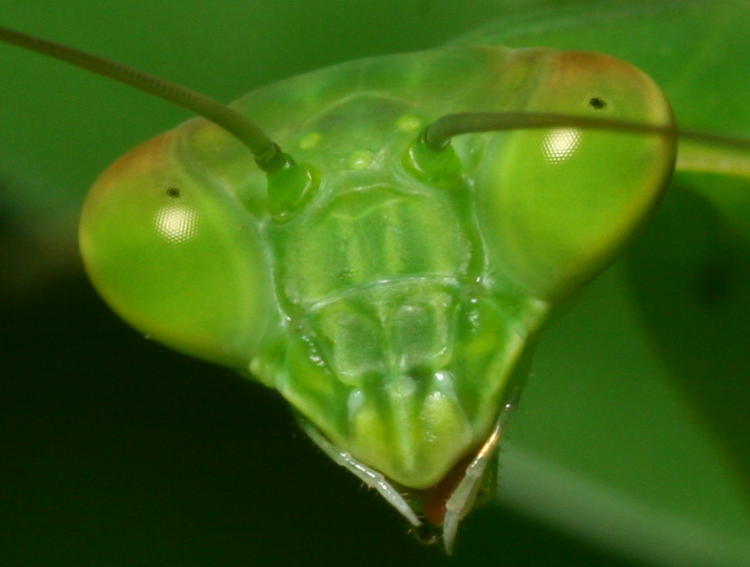
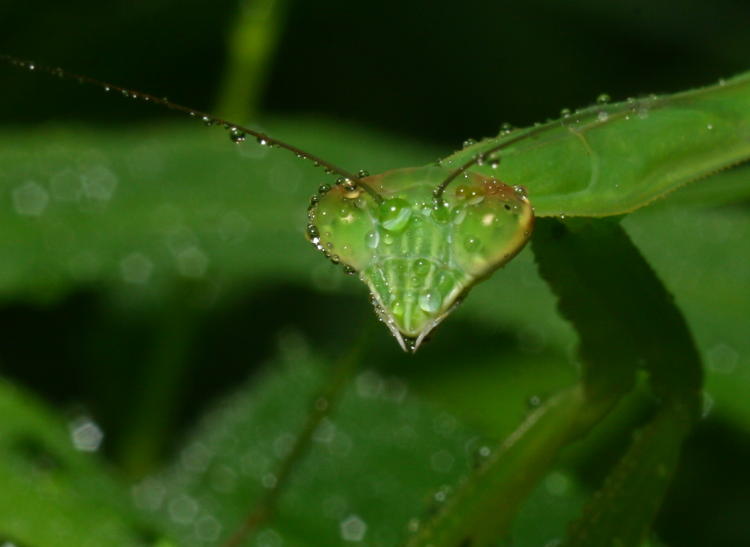
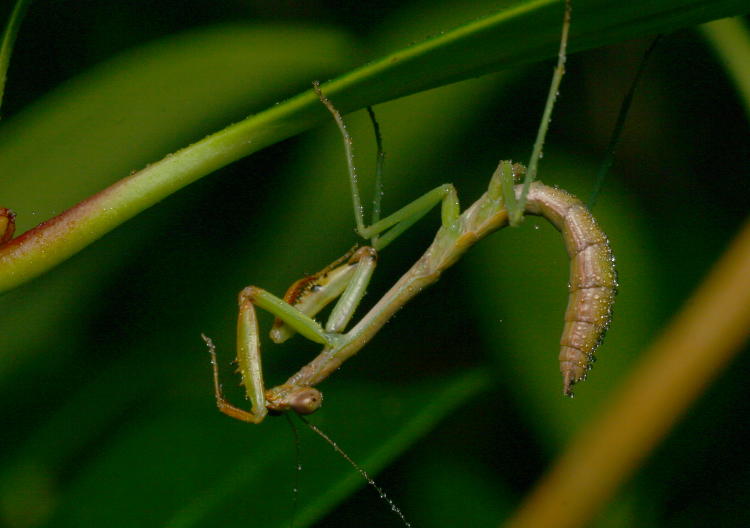
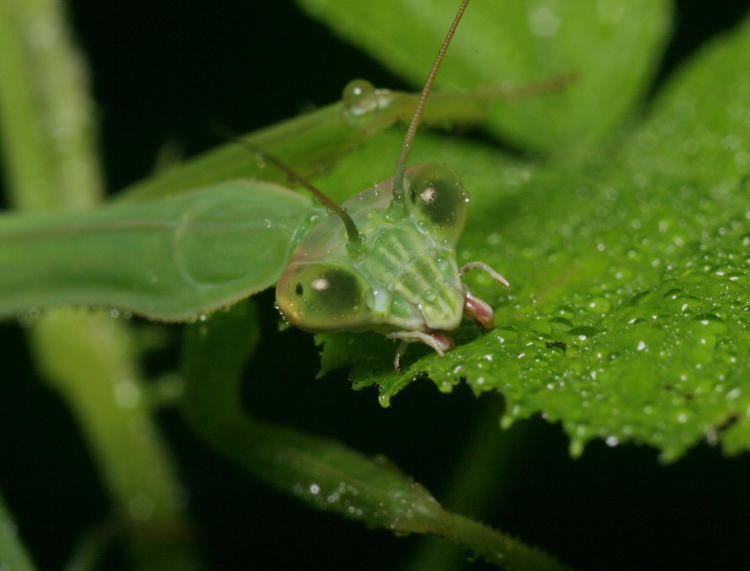
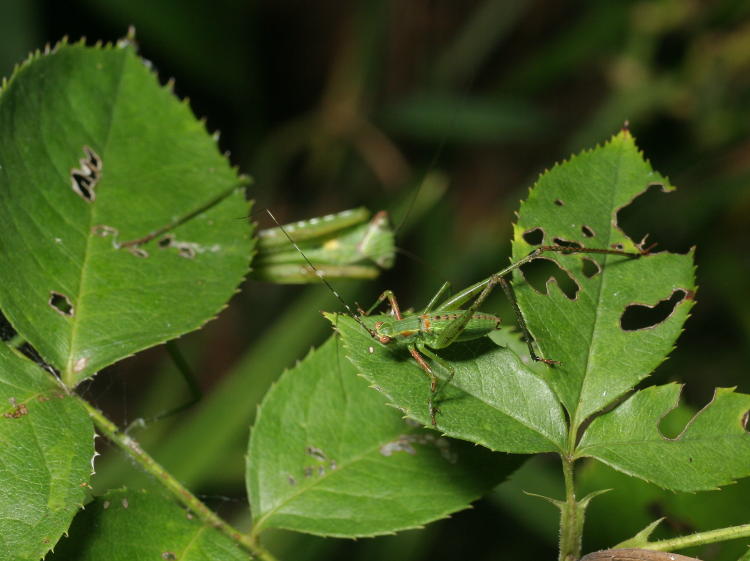
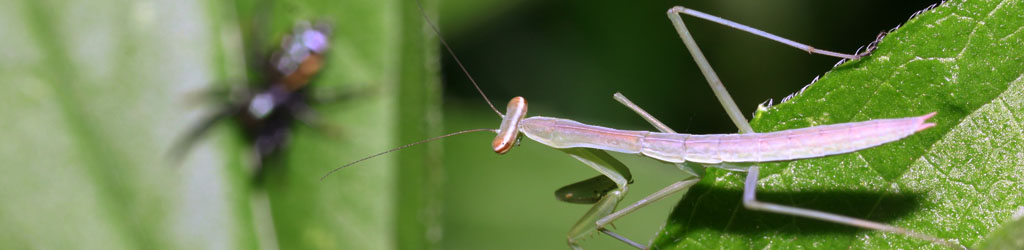
Anyway, here’s a mantis from yesterday. While none of the egg cases I got this year seemed to have hatched, nonetheless there are several mantids in the immediate area. I find it interesting that, in this ridiculously hot and dry weather, I can summon them with a misting bottle: hit key areas with a heavy coating, and if there’s a mantis around, it’ll come up to the upper leaves to get a drink. This one was quite pleased with my actions, and thus posed readily with a nice string of droplets along its antennae, and I was able to get them and the eyes in the same plane of focus.

Chinese mantis Tenodera sinensis with water drops from misting bottle
More will be along before too long, I promise. And if you can’t trust the word of a sentient computer program, what can you trust?

On the heels of June

… comes an abstract, of course.

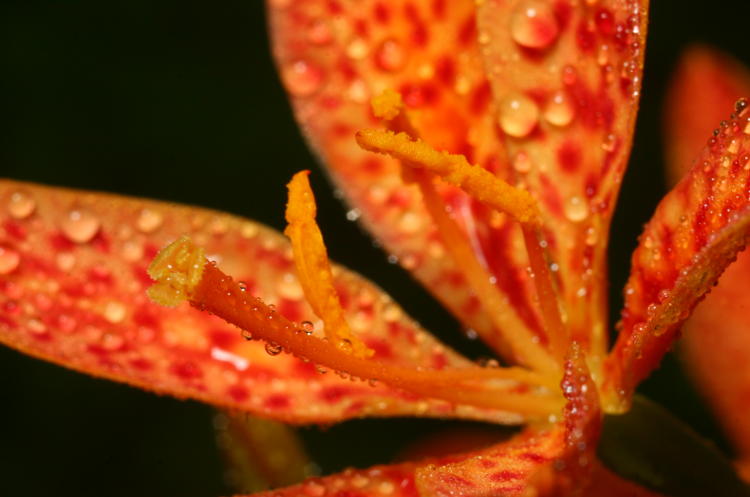
lizard's tail Saururus cernuus blossom up close
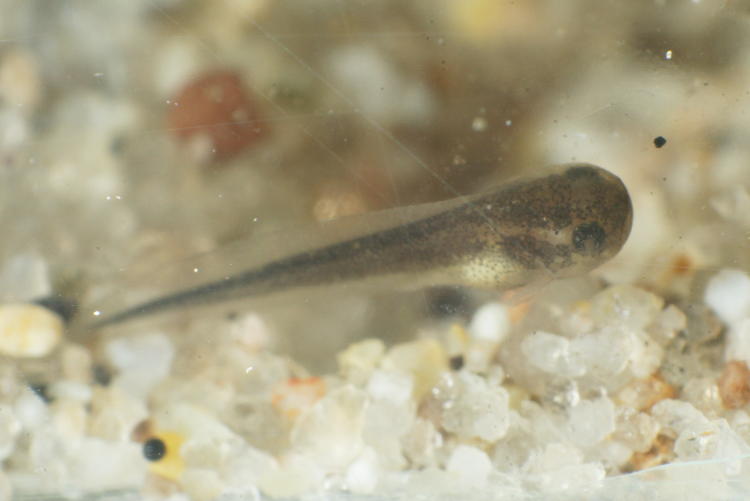
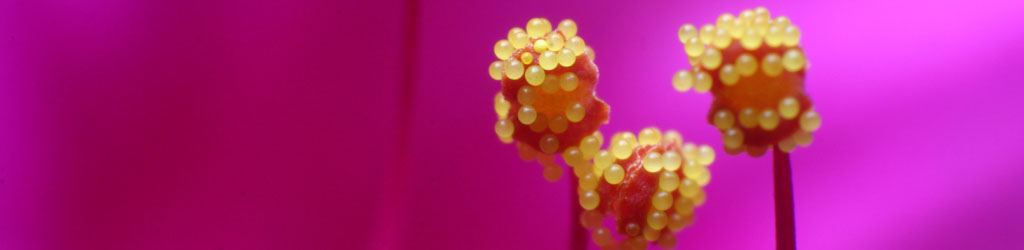
June was a pretty lean month for me, photo-wise, and my choice for abstracts was minimal. What we’re seeing here is the first flower blossoms from one of my pond plants, known as a lizard’s tail (Saururus cernuus.) The plants had gone in a couple of years ago and always did well, but this year they surpassed themselves, making a desperate attempt to get out of the pot and take over the entire pond – most of the water is shaded by their large leaves right now. This doesn’t seem like a bad thing, because the frogs are quite happy with this and I’ve had at least two separate broods of tadpoles rear themselves within – I’ll probably have a few photos of them coming along shortly.

Those webs that can be seen stretched across so many of the blossoms, if you look close, are quite small, and I couldn’t tell you what made them – I may not have even been able to see the culprit had it been right in front of me, since the entire spike of flowers was perhaps 16cm in length and not 2 wide. But that’s not really a good way to express the scale, so here’s a photo that works much better:

lizard's tail Saururus cernuus blossom with mosquito for scale
Yes, that’s a mosquito, and it’s even possible that you’re seeing my blood swelling that abdomen. We do treat the pond (and rainbarrels) with mosquito bombs to halt the growth of larva, but that doesn’t prevent the adults from finding the water sources and attempting to lay eggs anyway.

Per the ancient lore, part 16

unidentified isopod, probably Ligiidae on sand in Melbourne, Florida
As I type this first draft, I have just submitted this image to BugGuide.net for identification, since my initial searches turned up nothing; I have the stopwatch going on my desk right now to see how long it takes before someone replies.

This is, naturally, from the Arthropods folder – actually, the first of six (so far,) because I limit the contents of the folders to around 4,000 images to prevent thumbnail programs from taking forever to open them. Which says nothing of the slide pages in the filing cabinet alongside me. Yeah, I gots a few bug pics…

This trilobite-looking cuss was diddybopping across the sand in my usual haunt on the Indian River Lagoon, back in 2004, and I managed to get a couple of frames that were acceptably sharp – I don’t recall for sure, but I’m imagining that this wasn’t the easiest thing to do, since insects of this nature don’t tend to be lethargic and contemplative; I’ve had more than a few sessions where I did strange contortions while kneeling or splayed on the ground, trying desperately to keep the little bastard in the frame, much less in focus. The old jingling-the-keys trick, which works pretty well to get dogs and kids to pause for a moment and look at you curiously, doesn’t have any effect on arthropods for some reason…

It took me ten minutes to type that above (well, and upload the image and related jazz,) and I have my first reply from BugGuide – yes, they’re that fast, more often than not. That initial guess is family Ligiidae, a member of the woodlouse (pillbug) class often called rock slaters. Which reminded me of the times I’ve seen colonies of similar critters swarming over the rocks in some areas on the coast, though what I was seeing tended to be much bigger than this one. Harmless of course, but the numbers and rapid movements are enough to stir the creeps in most people.

Of the various images that are connected to that family, Ligia exotica, which may go under the colloquial name of “wharf roach,” looks the closest to me, though BugGuide doesn’t provide a range of sizes for the species. But I’m not even going to tag this tentatively as such, because there are so many variations in the arthropod kingdom that there could be multiple, even dozens, of species that look ‘close.’ But, now I have a goal of doing some much more detailed pics of the little buggers next time I see them.

Podcast: Macro video, part one I suspect

I wanted to do this one entirely as a video, but the video clips that I had to work with ended up being too short (or, I guess you could say, I was once again too long-winded) to match up audio and video. So it’s both, a podcast covering the main details and a video to illustrate what I was talking about. I’ll get better at this soon. Maybe.

So let’s start with the audio.

Walkabout podcast – Macro video, part one

It works better if you don’t skip ahead to the video below. And hey, at least this isn’t another towering wall of text, right? I’m trying to accommodate the social-media-bred attention span.


Macro photography, part eight: Tripod or no tripod?

The very simple way to make an external video monitor for DSLRs

The post where I introduce the LED light, which we’ll see again anytime now.

A look at the rig, as it stands now. I fully expect to be changing this, perhaps quite a bit, as I go. I’ll keep you updated.

macro video rig with inexpensive external monitor
macro video rig with inexpensive external monitorBy the way, it took no time at all to realize that an external microphone was pretty much a necessity. because the onboard mic is not very impressive and very sensitive to wind noise. It also helps isolate sounds from the lens. Doing audio recording with a separate recorder probably isn’t a bad idea either, just be sure to start each clip with something that’s both visible and audible to synchronize the two together – I’m not saying that you have to use a movie clapper, but you get the general idea. A starter pistol probably works just fine…

There’s two key components to this particular layout. The main support is a Stroboframe flashbracket, used sideways so the arm rises behind the camera instead of alongside it; this allows the camera to be held at either an upward or downward angle just by shifting grip a little. They make an inexpensive DSLR stabilizer much like this, and I have one, but it’s a little too small to accommodate the camera with a battery grip on the bottom. The second useful bit is that V-shaped arm attached to the camera hotshoe, which provides three separate shoe mounts for accessories like the microphone, an LED light source, and of course that monitor (modified to take a mini-ballhead, which makes it much more versatile.) Not only is this a fairly complete rig, self-contained and easy to handle, but it’s remarkably inexpensive. You can always throw a lot of money at such things, but it’s rarely necessary, and a little searching and ingenuity can save you a bundle.

So, obviously, I still have a lot of work to do in achieving steady results at macro magnifications, and I’ll probably be trying out a lot of different options. I’ll keep you abreast of what seems to be working best, and naturally, if you have any suggestions or solutions, drop a comment, or contact me directly if you prefer. As long as it isn’t something like, “Just give it up, Al.” Even if it seems warranted…

Per the ancient lore, part 15

two tiny unidentified hermit crabs embracing
It’s been a while since we’ve seen any crustaceans – let’s feature some crabs today.

Okay, sorry, I’m not in a rut, this is just one of the earlier images that still held some interest. We’re once again back in the Aquatic folder, on Day Two of the loaner camera and once again shooting in the little saltwater aquarium that I maintained while in Florida. Two of the constant residents within were the transparent grass shrimp that could be found with effort, and the tiny hermit crabs that were virtually everywhere in the Indian River Lagoon. The pair seen here measured perhaps 20mm across the wide points of their scavenged shells, so much smaller than the example seen in The Girlfriend’s hand in that previous post. And I wish I could tell you what was going on here, but I don’t really know. All I can say is that the one in the back tried, for a minute or so, to pull across or roll over the one in the front, which was resisting, but whether this was a mating thing, a territorial dispute (which did not seem to be an issue at all for the multiple crabs I had in the aquarium,) or simply the search for a new empty shell, I can’t offer an opinion. It’s easy to see that the one in the back may not have had any view at all of the occupant of the shell in the front, given the length of the eyestalks, but that’s anthropocentric thinking; they have very long antennae and presumably could tell where one another was even in pitch darkness.

By the way, this is the macro mode of the Sony F717, which was not too shabby on its own. But I quickly tried the lens-stacking trick, putting an Olympus 50mm f1.4 reversed onto the end of the fixed zoom lens that the Sony possessed, and pulled off some wicked magnification – an example can be found here (one of the aforementioned grass shrimp.) I definitely had my fun with the camera.

The dedicated researcher, I

I probably don’t need to tell you that today is Do Additional Research for a Blog Post Day, when anyone who is routinely posting should put aside some time to look deeper into one of their chosen topics. As such, I am meeting with some friends down at an amusement park for further investigation into thrill rides and their peculiar appeal to so many people. Normally, I’d be working or meeting with students or something along those lines, but if you don’t take such holidays seriously, then can you even call yourself a blogger? So I feel obligated to make this sacrifice and do the necessary observations. No, don’t call me a hero – it’s just the onus of a resolute pop psychologist.

Let’s kick back again

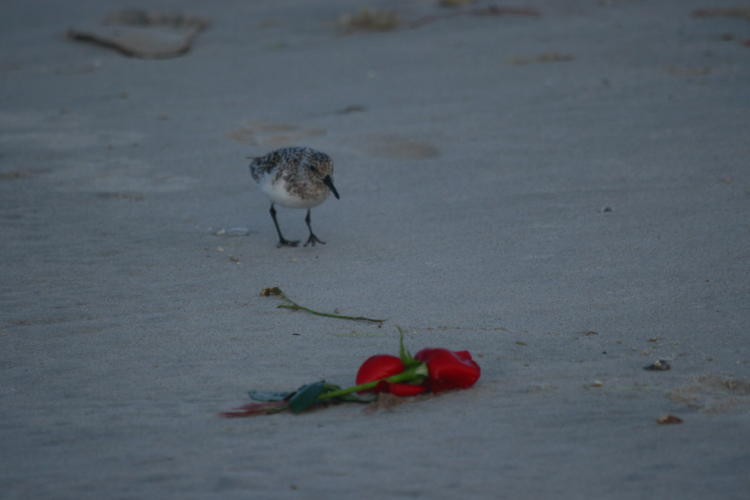
sanderling Calidris alba leaving footprints on delicately-colored sand
And so I finally get back to more of the beach trip, but part of the reason for the delay may soon become apparent, especially if you look at the page load times or sizes of some of the images. As I said, fewer pics this time around, largely because I was doing other vacationy things like abusing my muscles and joints, but there still remains plenty to put into this post.

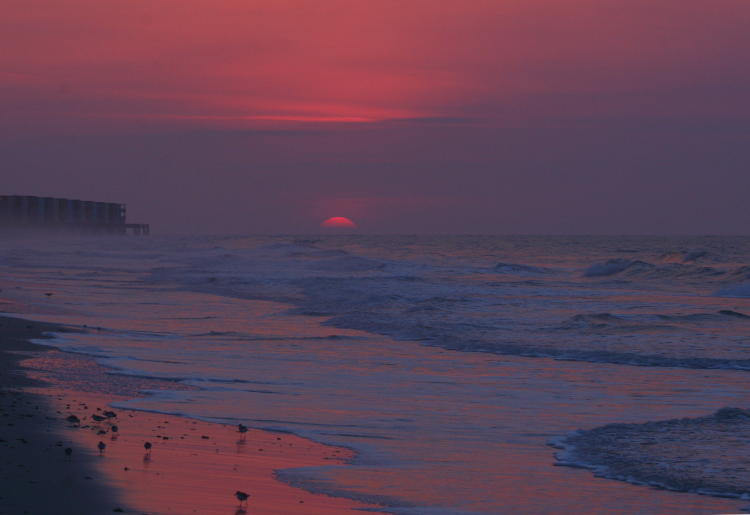
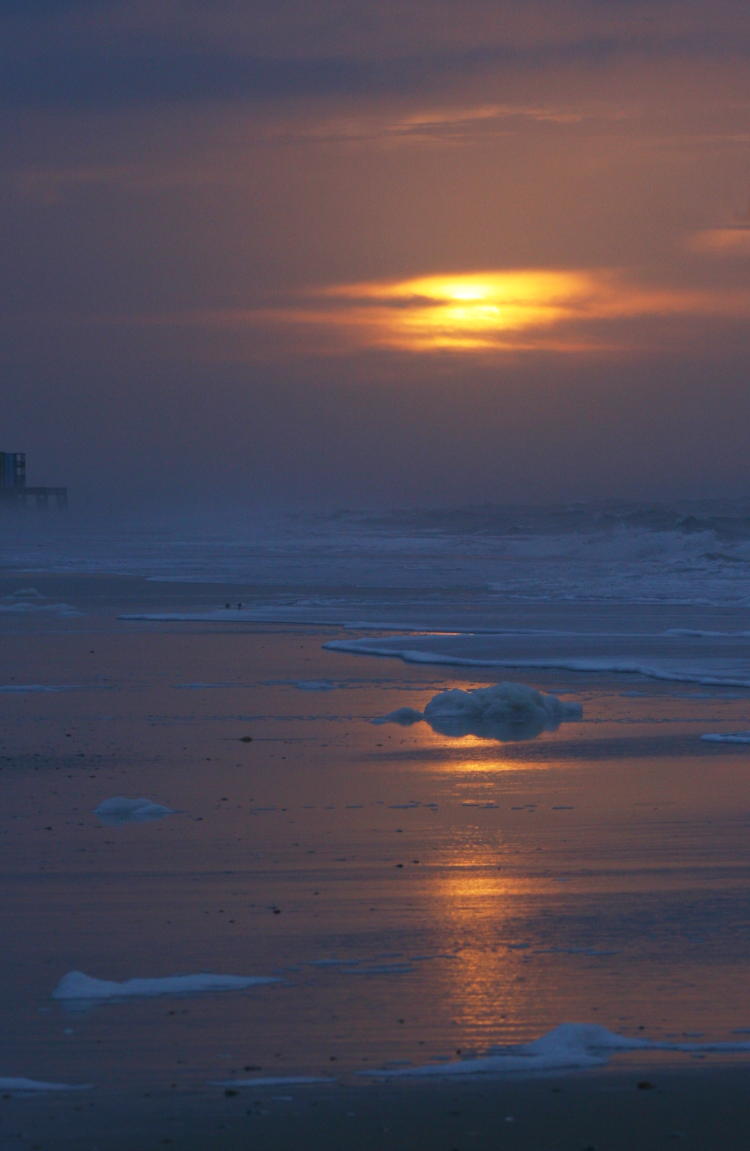
almost-obscured sunrise off North Topsail Beach
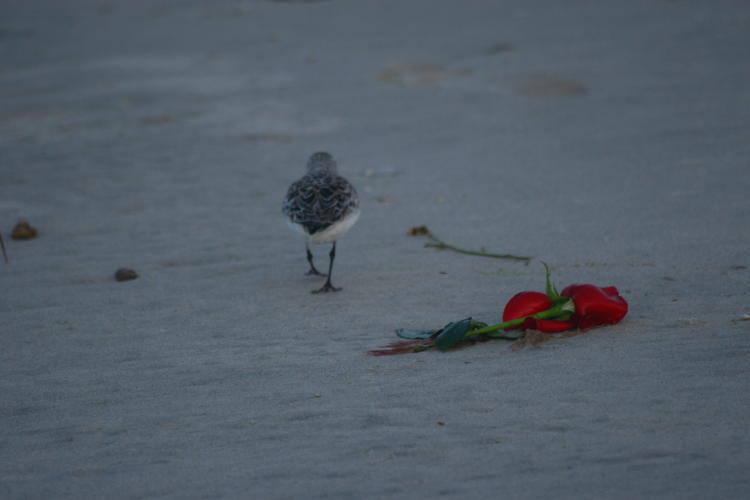
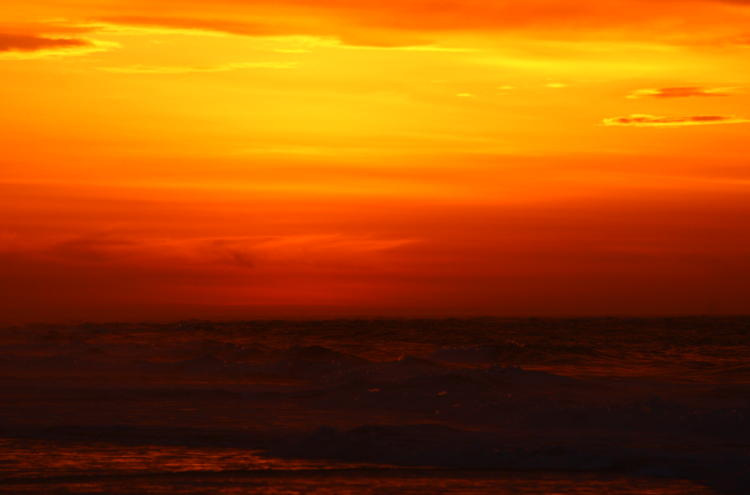
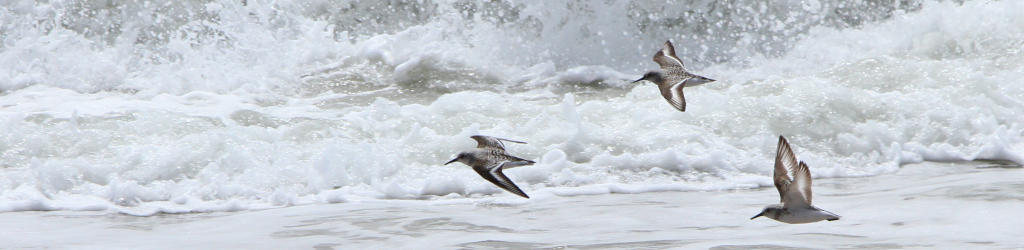
I was out most mornings for sunrise, but this time around conditions were a lot less cooperative – much more humidity and even some threatening storms, so no shot at the green flash this year (so far, anyway,) and some of the sunrises were just ehhhh. And for a couple of days, that’s almost the only thing I had the camera out for. The opening image was on one such morning, as a sanderling (Calidris alba) wandered along the waterline – I liked how the sand shows some delicate reflections from the sky. In most cases I was purposefully under-exposing a little to bring out sky colors better, but there are too many photos where the exposures seem much lower than that – not sure if this was a camera issue or what, since I didn’t notice it until I got back and unloaded, and most of my shots since then have been on full manual (macro style.) Gotta run some tests, I think.

beachfront condos on North Topsail Beach at sunrise
If you were to judge from this photo, you might think the area is over-developed, and it’s certainly more developed than large stretches of the Outer Banks further north, but in this area it’s a single row of mostly rental properties between the main dune and the quiet road up the strand, and at that time of year at least still pretty quiet – things might have changed a little since Memorial Day, the official start of summery things in the US. But even now, I imagine it’s not very crowded or noisy, and during sunrises I generally encountered maybe a half-dozen early risers on the beach, and the same number hanging out on balconies overlooking the surf. Definitely quieter than even around here, and we’re in a pretty mellow area.

unidentified minnows spring from the water in unison
Last year I watched, and even successfully photographed, some species of fish that routinely leapt from the water three times, each time, which we saw again this year but a lot less of. More often, we’d see schools of minnows that were feeding (or perhaps even drinking) near the surface, and every minute or two something would make them spring from the water as an entire school at once – with several attempts, I finally snagged a frame, more challenging than it might seem since, even with autofocus, the lens couldn’t lock onto the smooth water when they weren’t leaping, and of course the school was meandering back and forth and had to be followed carefully to even have the momentary event within the frame.

One evening, we wandered down to the dock and gazebo, and by headlamps witnessed a very large number of what we took to be small shrimp hurtling at high speeds through the water, back and forth, and attracting opportunistic blue crabs. Lowering myself from the dock and trying several times, I managed to get one into my hand, only to discover that they weren’t shrimp, but annelids, one of which can be seen here. Definitely a creepy thing to suddenly see thrashing in your palm, even if it was less than 20mm in length and completely harmless to humans (I think, anyway. They might transmit Unacceptable Delaying Disease, but then again I think I had that before the beach trip.)

But all that’s pretty trivial compared to the next topic of this post, which is… crabs!

colony of Atlantic sand fiddler crabs Uca pugilator swarming at water's edge
We went down to the south end of the island again this year, and got our timing right, arriving as the tide was transitioning from high to low (on a side note along that line, I downloaded an app to tell local tide times, which was quite handy while we were there but considerably less so now, where the closest visible tidal change is still 200 kilometers away.) Like last year, the Atlantic sand fiddler crabs (Uca pugilator) were swarming across the thin gully that allowed seawater to sweep inland during high tide, but ran dry as the tide went out, leaving behind whatever it is that this species eats. The still-damp regions of sand were absolutely covered with the little balls of sand left behind by their feeding method, and you could actually hear a chorus of little clicks from the masses of them. In one shallow pool, a blob of… something… was attracting the attention of several foragers.

Atlantic sand fiddler crabs Uca pugilator scavenging unidentified blob
Atlantic sand fiddler crab Uga pugilator latched onto sandal strap, by Wendy HallOne of our friends got the photo at left, which is as good a way as any to show scale (that’s a flip-flop,) but it perhaps gives the wrong impression of their aggressiveness, which is nonexistent. Happening upon the horde of crabs stretching across the sand, one can walk among them, where they will move aside politely but not in any apparently fearful way, and while they avoid contact, it doesn’t take much effort to capture one and hold it in cupped hands, where the most it will do is try to escape. You might imagine that the region was inundated with escape burrows, but very few were to be found – I suspect most of them were concealed in the dune grasses not too far away, but the handful of burrows to be seen were way out of proportion to the thousands of crabs coating the area.

I have to include another shot from our friend.

Atlantic sand fiddler crabs Uca pugilator in looping animation, by Wendy HallThis was an animated gif (pronounced l’chaim) produced by her silly ass Apple phone, one of the plethora of options intended for social media or whatnot – I have to point out that the original file, while the same dimensions, was huge, looping 58 frames in a completely unnecessary manner – I removed two-thirds of the frames and lengthened the delay between, and you’d be hard put to see any difference, but I guess it’s important to slam your phone memory full with more detail than needed (do you get the impression that I’m picking on Apple? Dog forbid!)

Yet what it does show is their feeding actions, if you look closer at the stationary ones anyway – you can see the smaller of their chelae (pincers) shoveling sand into their mouths, and the little sand pellets left behind. While you might be inclined to think the larger chelae were for defense, it doesn’t appear that they’re used in this manner much at all, and the females don’t even have an enlarged one; mostly, they’re for mating and territorial displays by the males, and perhaps the occasional fencing bouts. I’ve seen related species when not in feeding frenzy, standing outside of their burrows and waving the pincers in the air as if to dismiss mosquitoes, displaying their virility for all around. I’m not showing you those photos because, you know, this is a family blog.

Yuh huh – not buying that, are you? Truth is, I have no really detailed photos of this yet, since I’ve seen it from a greater distance than their diminutive size permits for good display, and they would duck into their burrows as I got closer. It’s one of the items on my list to capture someday. Perhaps if I’d gotten down there in early morning and wandered further back into the dunes, I might have been able to photograph such behavior, but as I said in the earlier podcast, that’s the kind of thing that works better when I’m traveling alone.

Atlantic sand fiddler crab Uca pugilator buried alongside cigarette butt
I have to include this pair of images, just for giggles. Walking the waterline along the inlet, which shows tidal fluctuations but no wave action, I was watching for items of interest and noticed a curious patch of slightly disturbed sand alongside a discarded cigarette butt, with a telltale spot of color. But let’s have a closer look.

Atlantic sand fiddler crab Uca pugilator buried in sand with eyes exposed
Here we can see the value of eyestalks, since they’re plainly visible above the sand – as long as you went in very close. I suspect this is a female depositing eggs, since it was buried before we got into the vicinity, and I’m not sure if the cigarette had anything to do with it – the nicotine does sometimes attract critters, but other times it repels them, and I can’t vouch for the vices or virtues of crabs (there’s a sentence fragment that shouldn’t be taken from context.) Without the little purple spot on the back, however, even I would have missed this one. And you know that’s saying something, because I miss nothing.

You dare scoff? Let me show you what I did find.

unidentifed tiny crab among feeding pellets of fiddlers
So, scroll back up to that pic of the fiddler hanging from the flip-flop. Get that size in your mind? Now come back down to the animation, and note the pellets of sand they’re surrounded by. Because that’s what this little spud is hiding among, and I’m not even going to try to identify it – I’m fairly certain it’s a juvenile, but that’s about it. A large black ant could have made off with this guy, and capturing it required scooping up the sand it was standing upon because grasping it was next to impossible. I would have had a scale shot in The Girlfriend’s palm but it refused to hold still enough to let me lock focus at such high magnification, so I got it among the sand balls instead. And I’ll be honest, because the color difference from the sand was too subtle to notice at this scale, and I spotted it because it moved instead. Which, really, is the best method that I’ve found of spotting wildlife, and good peripheral vision is a major benefit.

juvenile Atlantic blue crab Callinectes sapidus in The Girlfriend's handOne of the appeals of this portion of the island was the inlet, the only place I found where snorkeling seemed possible, and that was one of our activities while there. The water is shallow and clear, though with an appreciable current except, I suspect, as the tides were transitioning. I only did it for a short while, however, because my eyes are so bad; I need to have an old pair of glasses in the dive mask, and the pair I was using fit terribly and wouldn’t stay in position. Were I back to living in Florida, I would get some disposable contacts solely to use for snorkeling (I don’t really like them otherwise,) but here in NC there are so few opportunities to snorkel that I’d use one, maybe two pairs a year at most – not worth the expense or effort. But during the brief session we found a few items of interest, and I don’t recall who located this juvenile Atlantic blue crab (Callinectes sapidus,) but I’m pretty sure it wasn’t me. Holding it in this manner took a delicate touch, because those points on the carapace were quite sharp, but it was also the only spot to hold it to avoid those chelae – unlike the fiddlers, blue crabs are notoriously aggressive and will pinch for effect.

unidentified small hermit crab
unidentified small hermit crab scale shotThis one, however, did not. This unidentified hermit crab was remarkably cooperative for its photos, sitting still in The Girlfriend’s palm but fully exposed, and not retracted into its shell as normal (and the whole point of those shells in the first place.) The inlet is a good place to spot hermit crabs, being abundant and generally in clear shallow water; I spotted one large specimen in the sound behind the condo from the dock, but was unable to get to it – the attempt would have required either vaulting from the dock, or crossing a broad boggy area where I would likely have left my sandals (real ones, with proper straps, not silly flip-flops) buried in the muck, as I almost did last year when putting the kayak in.

There are both terrestrial and aquatic hermit crab species, by the way; the terrestrial are the kind sold so often as pets, but the only thing I’ve seen in this region, or even in Florida, are the aquatic varieties, which are capable of being out of the water for a short period of time but require the moisture. Watching for a minute or two may reveal the shell moving across the bottom in shallow water, or just picking up any shell that’s sitting suspiciously with the opening down – empty shells usually sit with the opening upward. On occasion, you get unlucky and only find the original occupants/creators of the shells, by which I mean snails, but I was finding crabs more often than not.

One more crab feature, and then we’re done. For now.

Atlantic ghost crab Ocypode quadrata with burden of sand cleaned from burrow
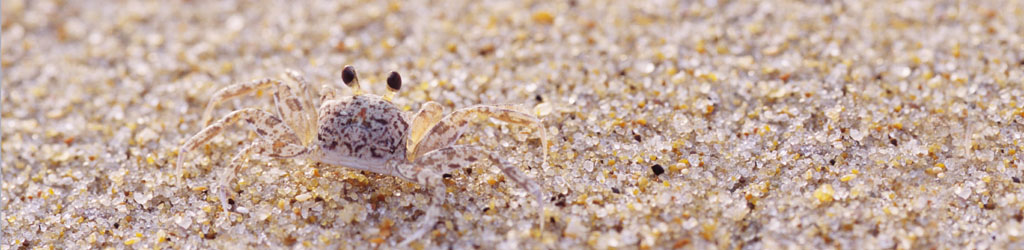
While hanging out at the beach between sessions of boogie-boarding, the others had gone off temporarily in different directions and I was just lounging by myself in the sand when I spotted a small crab cleaning out its warren. Atlantic ghost crabs (Ocypode quadrata) are numerous on the beaches all along the eastern seaboard, but secretive, more active at night or early morning, so watching this one kicking sand from its burrow in early afternoon was a little rare, but not unheard of, and I was mostly seeing it because I wasn’t moving. They might peek out quite often, camouflaged extremely well against the sand, but any kind of movement will send them back into the depths; I became aware of this one, very close to where I sat, because I noticed new deposits around the mouth of the opening. While it was within the burrow, I shifted the boogie-board over to a good location (endeavoring to keep myself clean for once,) propped upon my belly and elbows with camera in hand, and fired off a sequence of shots as it industriously rearranged its living quarters. While I was doing this, two of the others wandered up behind me – I had seen their approach reflected in the LCD panel of the camera but was intent on my subject. Thinking, however, that I was shooting some teenager in a bikini much further down the beach, Mr. Black Ops cleared his throat distinctly (like he can talk) – I’m betting he thought I never noticed.

The sequence, despite being largely handheld and thus not perfectly stable for such things, still lent itself to another animation.

animation of Atlantic ghost crab Ocypode quadrata cleaning out burrow
This is just a series of still photos run in sequence, and I wasn’t intending to do this at the time or I wouldn’t have been shifting position and depth between the shots. Also (and I may be stating the obvious,) the period between appearances was a whole lot longer than what you see here – give or take, a minute or two. The funny thing was, the video camcorder was sitting right alongside me, but I’ve never tried it out for macro work, while the video-capable DSLR was back in the condo – like I said, vacation, not necessarily a shooting trip.

But there’s one frame I’m going to highlight, just for the detail.

Atlantic ghost crab Ocypode quadrata hurling sand at the photographer
See the shadow? Yeah, the little ignatz was hurling the sand directly at me in this shot, and I, supreme photographer that I am, caught it in midair (just, you know, not in focus.) Oh, the crab knew I was there, all right…

Per the ancient lore, part 14

Crescent moon at sunset over shelter and palms
This week, we hit the last of the stock folders, the so-called Sunrise/Sunset bin – which is one of the thinnest folders that I have (‘thin’ insofar as number of images within, because there is no measurable thickness to a bunch of magnetic squiggles on a hard disk.) The reason for this is, I don’t get out often enough to places that work best with sunrise and sunset images – and in this particular case, there are less than ten images with the loaner Sony camera in that folder, in the few weeks that I had it before it went to its new owner. Eventually, the folder started to fill out a bit more, but it says a lot that last year’s trip to Topsail expanded its contents measurably.

This was pretty much a grab shot one evening as they sky darkened and a crescent moon betrayed the direction the sun had gone, taken right at the apartment complex where I’d lived. Initially, I was gonna carp about the two banes of the landscape photographer: power lines and aircraft contrails (no, they’re not ‘chemtrails’ – it’s fairly basic physics, read a goddamn book.) And that was not only because of the lines you can see across the bottom of the sky there, but another pale streak coming across mid-frame on the right side. However, as I was editing this photo for upload, I realized that the streak went across the palm trees too, so it was either an awful close passenger jet, or some other bugaboo on the image. What, I couldn’t begin to tell you, because it makes no sense – it could have been flare from a light source outside the frame to the right, but I’m pretty certain there was no such light, so how it got there remains a mystery. I simply edited it out, which took away part of my rant against the two banes; they still exist of course, but I can only show one in this pic.

This is not the first sunset image in the folder, though – that one is actually among the rotating header images up there at the top of the page, the sun shining through the fronds of a palm tree on the edge of the water. Just keep watching – you’ll see it eventually.

Since this is the last of the stock folders, we’ll start anew next week back at the beginning with Aquatic. Try to contain your excitement.

Early Friday morning color

probable Condylostylus mundus on wet leaf
Remember when I said, on last year’s trip to North Topsail, that I hardly did any insect photography at all? Of course you do – forgive me. This trip was about the same; I might have fewer than ten more insect images over what I got last year. This is one of them, taken the grey morning of our last day there after an overnight rain, and I decided it needed a feature of its own since I’m still a bit slow in getting up more posts about the trip. Every example from an image search on BugGuide.net that looked even close to this was the same species, Condylostylus mundus, so that’s what I’m going with and we’ll blame BugGuide for being so misleading if it’s incorrect.

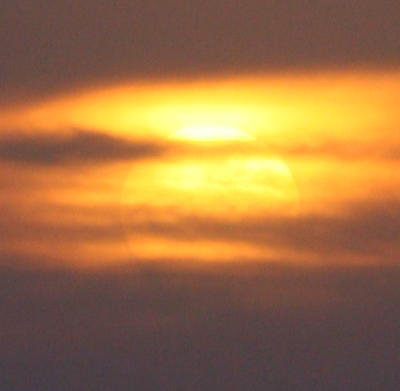
But we haven’t had a color post in a while and I felt this one just might qualify. I hadn’t bothered with the macro rig for this so it’s natural light and freehand – several other frames didn’t pass muster. Yet the larger frame, composed the way I like it, doesn’t yield the detail of the fly itself, so we’ll go with an inset for that.

probable Condylostylus mundus close inset of previous frameThere, better? This is not quite full resolution, and the fly itself was guesstimated about 5-7mm in length – and yet, hard to miss. Makes me wonder what purpose this coloration serves, since it ain’t camouflage, but by all accounts this is an incredibly fast and reactive species, so the possibility remains that it has no need of avoiding the attention of predators, and developed the colors just to mock them.

We won’t talk about how small that possibility is…

Odd memories, part 16

I’m trying to recall what kind of conversation we were having tonight that brought this subject to mind – it’s not like anyone would routinely discuss anecdotes of this nature, but then again, I’m involved, so…

This one occurred around the same time period of most of the ‘Per the ancient lore’ posts, like the one about to appear – back in the early 2000s while living in Florida. During that time I was biking a lot, partially because I had to, partially because the area was just about ideal for it – certainly much better than here in central NC where they feel that even making the roads legal, regulation width is asking too damn much of the Department of Transportation.

blue dasher Pachydiplax longipennis dragonfly on dried rosebudAnyway, one hot summer day I was cruising along in the bike lane and I spied, coming in from the right, a very large dragonfly cutting directly across my path and on a high-probability collision course. There was just a moment to react, which was to straighten up and wonder if I should duck it or swerve, when it veered 90° from its original course and began heading exactly in the direction that I was, about two meters directly in front of me. Both of these, in and of themselves, were curious; I’ve only ever seen dragonflies hunting in a darting, circling, very localized manner, and never ‘going someplace’ – and then to see it change direction, to all appearances because of my presence, and begin flying straight-line on another tangent didn’t seem kosher to me. But this was idle, back-of-the-mind speculation as I wondered just how far I was going to have this honor escort.

Not very far at all, as it turned out, as within two seconds, the dragonfly abruptly veered from course again, back the way it had come – but not entirely. It actually described a tight circle, a 270° loop back to its right, which brought it directly in line with me again. So directly, in fact, that it flew behind the edge of my glasses and lodged itself in the space between them and my eye, faster than I could even twitch away.

So ensnared, it then set about frantically beating its wings in an attempt to get free, while I endeavored not to veer into traffic or crash into a ditch. Even then, I was well aware that there was no danger, even though the insect seemed to be trying to fulfill the dire threats of my childhood and sew my eyelids together, but there is still something slightly disconcerting about a large insect trapped in the scant millimeters between your glasses and eye, thrashing exuberantly. With only a little weaving and vocal ejaculations that might have made great entertainment to a passerby that couldn’t actually make out the dragonfly, I removed my glasses and sent the miscreant on its way.

Now, this is a class of insect, mind you, that catches other insects in midair, and has some of the most involved compound eyes in the kingdom. Its change of path as we rendezvoused seemed to indicate that it had not missed my presence, and I doubt that I was being particularly subtle that day, massing a few million times what it did, in bright sunlight, and not exactly blending in with the surroundings in any manner. So I can only assume this was a deliberate and premeditated action on its part, perhaps an adolescent dare, the arthropod equivalent of Spin The Bottlefly or something. I have not ruled out texting though…

Some years later I saw something slightly related, but introducing a pattern which may indicate that insects aren’t entirely the quickest thinkers. I was sitting on the deck of my apartment, which was immediately across from a large patch of woods, early in the evening. From the woods emerged a large junebug, flying in a perfectly straight line in my direction – despite the flashbacks that this was causing, I was stalwart and remained still. The junebug flew lazily, without wavering, straight into the wall of the building just a couple of meters away from me, bounced along it repeatedly as it tried to continue its intended course, and eventually reached the edge where it could bypass this hooligan edifice and resume its journey. Mind you, this is a building ten-meters square on a side, bright white, and well-lit by the sun – also, not moving notably in any unpredictable manner, and being present for at least the past ten years. Once again, I could only wonder how anything that actually possessed the ability to fly somehow lacked the functionality to notice an obstacle of this nature, much less avoid it. I promise, of course, to keep you abreast of any further observations of this nature.

1 179 180 181 182 183 322