



My ass, that it, since I’ve been sitting on it for too long, regarding posts at least. I’ve had some pics and ideas lined up for a while now, and have simply been doing other things. So let’s get to it.
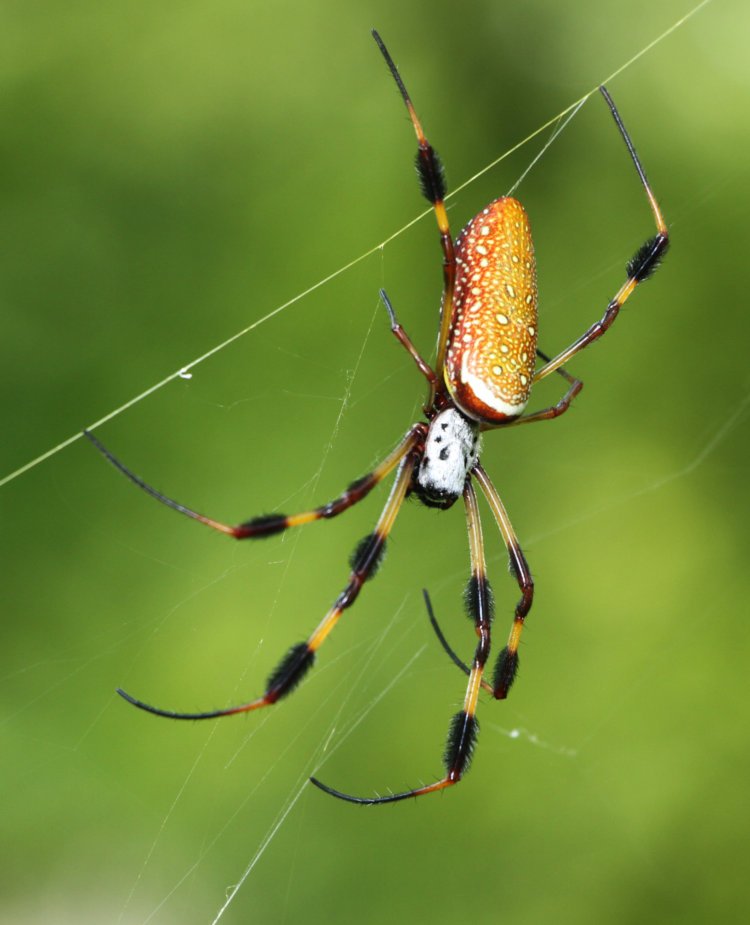
Some time back, there was a post featuring the detail captured from the molted exoskeleton of a golden silk orbweaver (Trichonephila clavipes) – actually this very specimen, unless she swapped webs with another one night. I was too late to capture any part of the process, but then many days later, I came across another that was actively molting, and trotted back inside to get the camera. I was almost too late for that one, too.
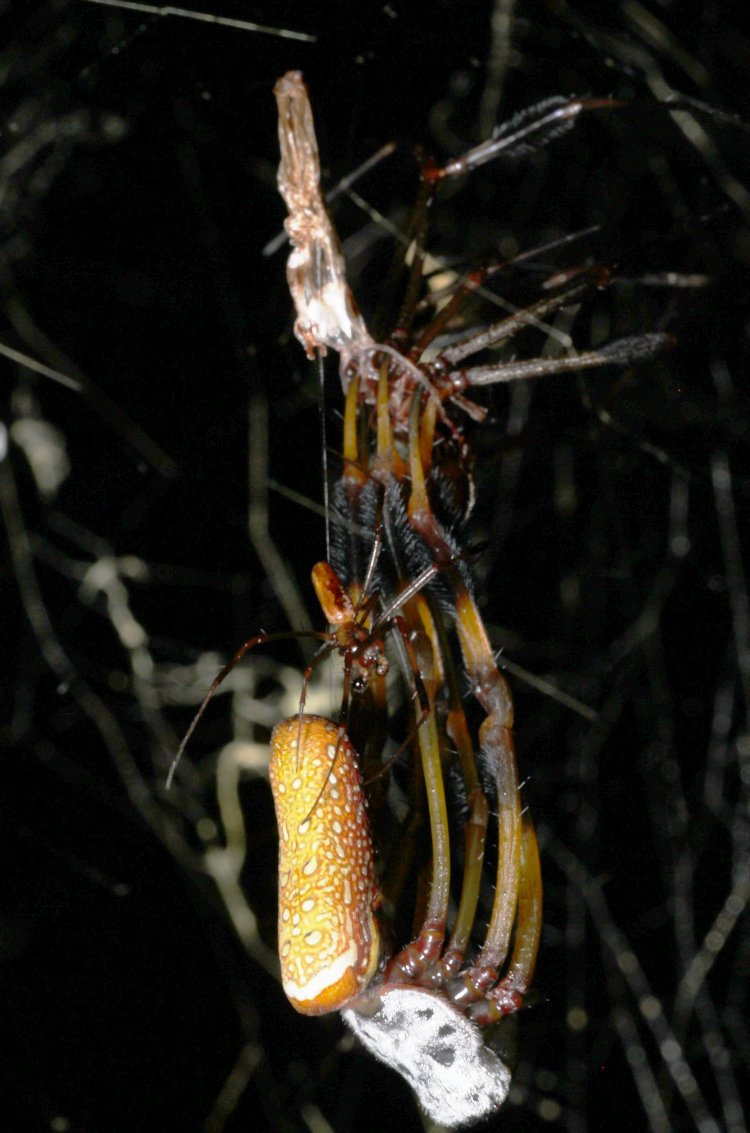
The details are a little hard to make out without close examination, and believe me, it was even more bizarre-looking in the dimmer light of the headlamp. Since the spider’s legs are so long, they’re the last things to be slid out of the old exoskeleton, so the body hangs down below and the bunched legs are all lined up above like some kind of weird seed pod. At top, the old clothes are looking like mere debris – yes, that spider just exited that exoskeleton. But it does not help that an opportunistic male is in the way between the legs and the abdomen, just muddying up the view even more. There was nothing I could do about any of this, taking place as it was above one of the Japanese maples – I couldn’t even change shooting angle, but I could wait while the female spun slowly on the end of the anchoring web that the old skin was still attached to.
And yes, the males are that small compared to the females, which is fairly typical for the arachnid kingdom. What isn’t typical is that the male for this species is not only around quite a bit once the female is even close to adulthood, but apparently they can mate multiple times. This one had heard those details and was attempting to make the most of them.
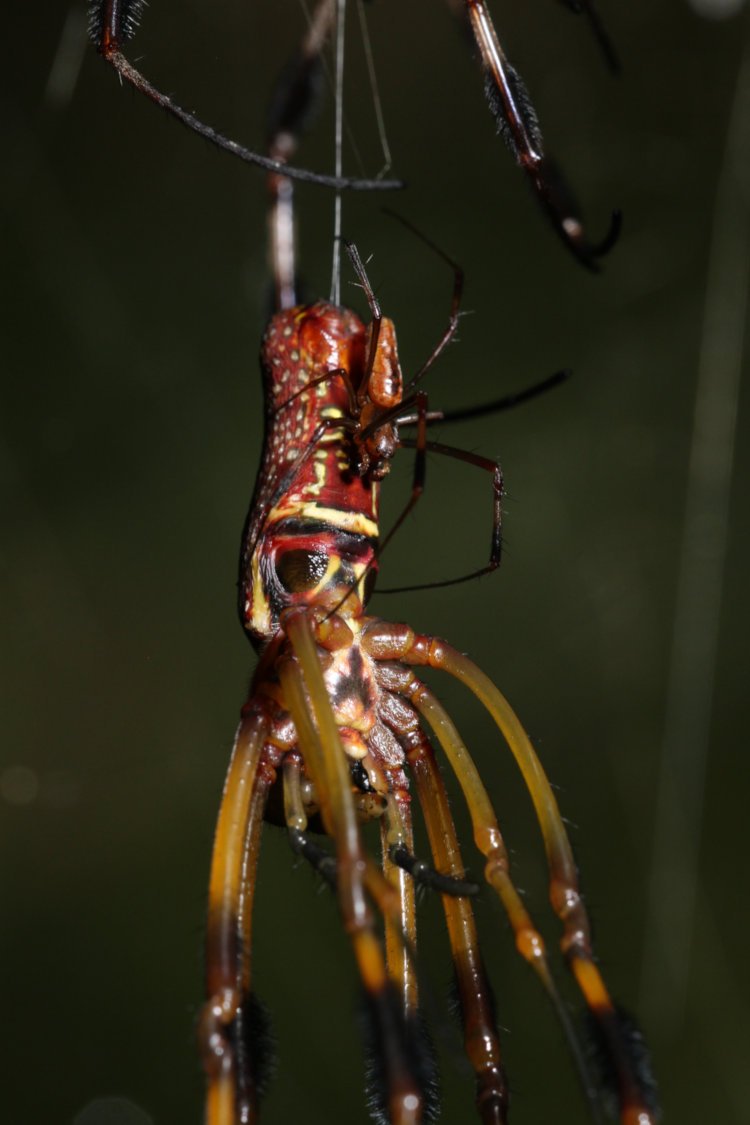
After molting, virtually all arthropods are soft and vulnerable, until their new chitin hardens and dries, so after the legs popped free (which happened almost as soon as I started taking photos,) she simply hung there biding her time, and to all appearances, the male thought this was the perfect opportunity, perhaps because she was unlikely to be defensive – spider courtship is notorious for being fraught with danger, for the males at least. So he was clambering around, though I couldn’t tell if he was having any success or not. We’ll go in closer, due to popular demand.
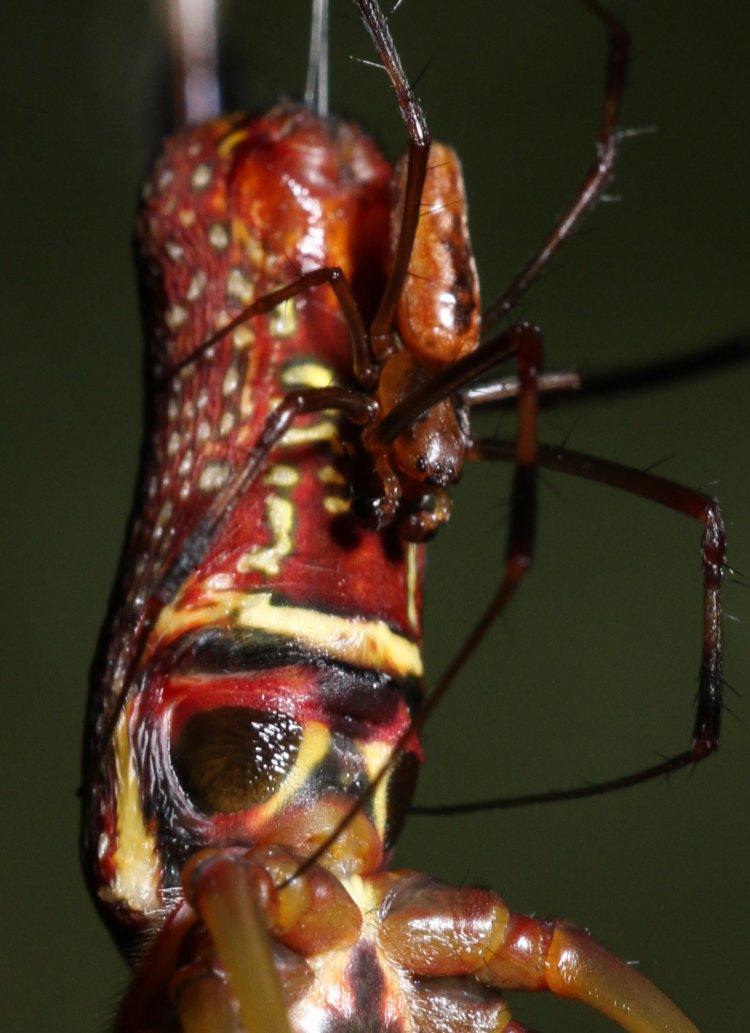
We’re looking at the female’s underside here, and the epigastric furrow, or reproductive opening for females, is a flap-like opening on the abdomen that normally sits closed, and I’m not entirely sure, but for this species I think it sits immediately below the yellow stripe here. The males, meanwhile, prime their pedipalps (the ‘mouthfingers,’ looking clublike in males) with semen in preparation for mating, and the inserts them into this opening, occasionally losing one in the process. So they’re not actively mating here, but he’s hoping at least. I’m pleased that his eyes were actually captured, given that his body length is perhaps 10mm (not counting the legs.)
But now, here’s another scale comparison, because I could. You recall when some of the newly-terrestrial green treefrogs (Dryophytes cinereus) were featured earlier, and I did the posts in this order for a reason. Because immediately after getting frames of the spiders, I went over to the morning glories where I’d already seen one of the bebbeh frogs, and obtained a few frames of this diminutive specimen at the same magnification, specifically so that they could be overlaid as a direct comparison in an animated gif (pronounced, “GY-ro.”) To wit:
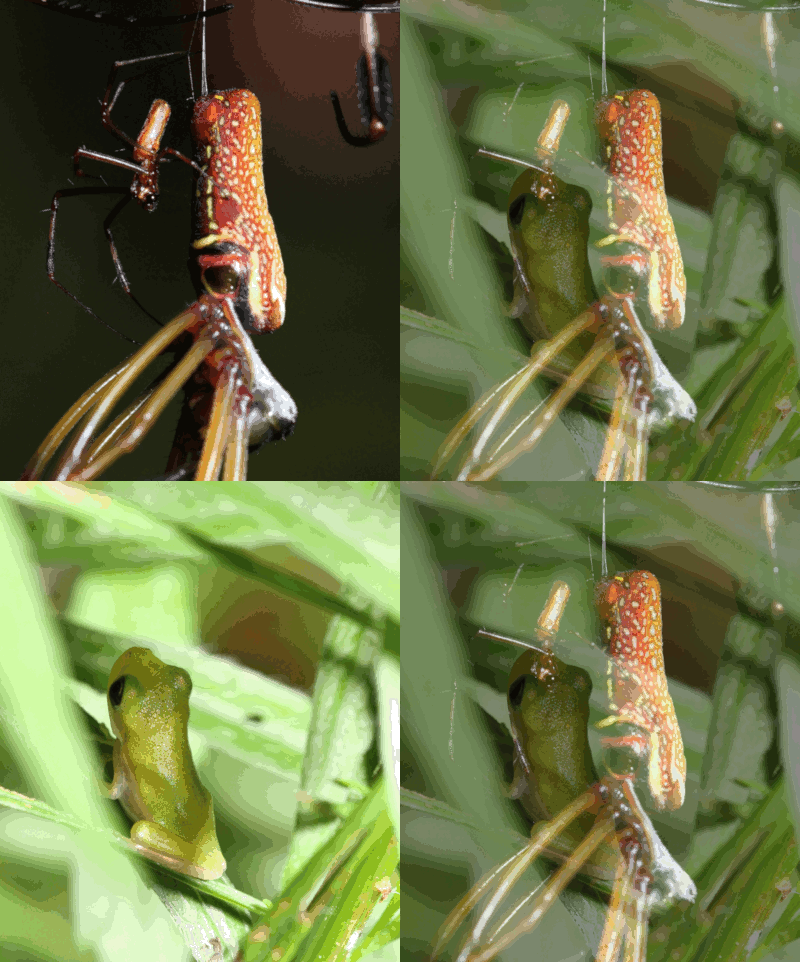 Yep, both full-frame, same distance and magnification – really drives it home, doesn’t it? The webs of the golden silk orbweavers can be over a meter across, while the anchoring strands can extend for many meters, depending on where they decide is an ideal spot; one has been anchored to a post on the kayak dock for weeks now, even though the web is well out of the way (it’s been too hot to do any kayaking, plus the pond level was too low until recently anyway, so no biggie.) Meanwhile, this very female moved her web a few days later, switching it from above the Japanese maple to alongside it, which The Girlfriend forgot while she was picking up sticks after a storm – that was an encounter she wasn’t thrilled about, though no harm came to either. It helps a little that the web of this species is very strong and is usually felt before someone can blunder through it. Still, one of the things we deal with on the property.