



Estate Find XXXI

Falling back on my ‘safety’ choice this week, since nothing exciting or unique presented itself, even when I went out looking. I might have had some lightning, had it not started raining just as I was heading out.

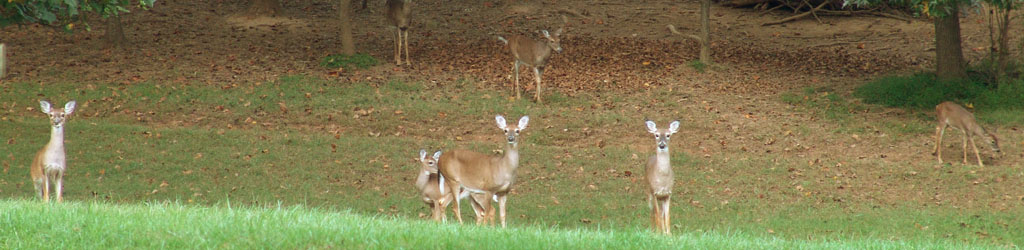
After spotting a very young fawn on the property some weeks back, we saw no young deer at all, though we suspected that at least one of the deer visiting for the corn was a parent with her fawn stashed away safely somewhere until it was old enough to be weaned. Yet we went for quite a while with no sign of any young’uns, then a singular appearance with mom, and then nothing. Until about a week ago.

adult female white-tailed deer Odocoileus virginianus with adolescent fawn
These are, naturally, white-tailed deer (Odocoileus virginianus,) and there were actually two fawns, but of course one of them wandered out of my ability to frame them together as soon as the camera was in hand. As alert as they appear here though, they weren’t very concerned with my presence up on the deck, and soon continued foraging; I even missed one of them attempting to nurse with mom discouraging it.

After a few minutes, I did something incautious and the fawns spooked, bounding away for only a short distance, probably discouraged from this paranoid behavior by mom who was still foraging industriously. They regrouped in another portion of the lawn (a term I use loosely since we let the backyard go unchecked.)

adult female white-tailed deer Odocoileus virginianus and her two adolescent fawns looking into camera
Actually, to get them all looking up simultaneously, I had to make several whistles and clicks until they got too curious, otherwise I always had at least one with its nose buried in the tall grasses. And again, this didn’t last long.

adult female white-tailed deer Odocoileus virginianus with her two unconcerned adolescent fawns
I’m not 100% sure of the actions of the one fawn here; while too many people would claim it was going for a kiss, I suspect it was trying to sample what mom was eating, which she did not oblige. The fawns’ behavior was split between a certain air of independence, sometimes wandering quite far from mom, and the typical neediness of a juvenile. Someone that knows deer better than I could potentially use this to pin down their age.

Speaking with a neighbor recently (okay, texting,) we found that she had a couple of orphaned fawns visiting her backyard regularly, believing that the mother had been hit by a car and died off the back of her property. We might have seen one of them a little earlier, since a lone fawn had come by to forage among the ducks’ corn.

slightly older adolescent white-tailed deer Odocoileus virginianus fawn looking into camera
This one was clearly larger and thus older than the pair still with their mother, the spots fading away. We knew enough about their habits to know that they don’t go independent that quickly, tending to stick together at least until breeding season in the winter, so we’d wondered about mom. There’s no easy way to tell them apart, save for a young adult doe visiting over the winter that had different enough coloration to distinguish her from others. Despite their overly-generic appearance, we’ll still try to monitor them as best we can.

By the way, this was written a few hours ahead of posting, so the photos were uploaded in July and thus beat the previous record by (at least) four images. I know you’re as excited as I am…

Last chance for July

It’s that time of the month again – you have until midnight to get what you need from July, because after that it’s gone. We tried to warn you…

And that means it’s end-of-the-month abstract time, though I think I’m abusing the definition of that word again. But here it is anyway, free of charge, so file your complaints appropriately.

raindrop near sunrise reflecting light with starburst
After one of the heavy overnight downpours (which we still did not receive enough of,) the morning was sunny but drippy, and the sun reflecting from this raindrop caught my attention, which I then exploited with a small aperture to get the starburst. With the gap between the leaves, it has a kind of magical, E.T. vibe to it. Or at least it does to me – you derive what you will from it.

That’s the more abstract one. The less abstract one, that I like a lot better, is this:

sunbeams coming through humid hazy air over end of pond
Certainly more scenic than abstract, but the sunbeams in the morning haze/fog were doing their thing, and I maneuvered to get the sun peeking through. I like the impression that it gives, which is a bit inaccurate from what the backyard really looks like, and that’s fun when you can accomplish it.

I noticed before starting this post that, with only four more photos uploaded this month, we would tie with the highest number ever uploaded in July, which is pretty good considering how slow it was at times. So here are the other two necessary, from the World Snake Day trip that netted no snakes.

inlet off of Pamlico River in Goose Creek State Park
Again, more scenic than abstract, even with a little creative cropping, but I like it when vistas become so simplistic – it’s actually hard to accomplish most times.

We go much more abstract for the last, though:

lichen and moss on tree trunk solely in Blue channel monochrome
For a while in the main gallery I had an image that looked like an ancient map, actually lichen patterns in tree bark, but the image quality wasn’t really up to snuff and I removed it. Ever since that time I’ve wanted to redo it, but never found the same subject in as great a state as that first. This wasn’t quite it either, though converting it to component channels and selecting only the Blue channel helps the abstract nature at least. It’s also an image whose Brightness Curve is remarkably even and runs the entire range, full black to full white with a peak quite well centered in the middle. Still, it could be better, and I’m remaining on the lookout for the opportunity.

I’ll be a little busy today for a while, so I’m not sure if I’ll get the chance to add to this and break the upload record or not – we’ll see I guess. I mean, i have plenty of other images I could simply dump here, but you know I don’t like just throwing things up.

Down on The Bayou

That’s capitalized that way because it refers to a specific area; we have three ponds, interconnected, and the southernmost one (which we only own half of) resembles nothing more than a bayou, so that’s how we refer to it. Up until this morning, I’d only seen it from the marshy banks at the northern tip, which allowed a limited perspective, but today I took the kayak down into it for a better view.

Now, a note about this: While the three ponds are interconnected, it’s loosely. The upper pond connects to the main one behind the house by a narrow channel that we built a small bridge across, that if it weren’t for the bridge I might be able to navigate with a kayak, but only just. One of these days I’ll simply put the kayak in from the bank. The main pond behind the house is relatively easy to launch the kayak into and I’ve done it a couple of times, but it’s shallow and entirely visible from the banks so there’s not a lot of reason to. This connects to The Bayou by a very narrow channel that I watch the ducks navigate, but I was never sure that it wasn’t more of a marshy border area than a channel. Today I determined that it was indeed very shallow, enough to prevent paddling through it but the kayak could be ‘poled’ through by pushing against the bottom (which is thick enough mud that wading it would be quite difficult.) Yet I made it through, and took a few pictures while down there.

view across the lower pond 'The Bayou' from a kayak
There’s not a lot to say about these, so I’ll just be clarifying which way we’re facing, in this case south deeper into The Bayou. The main tree in this pic was probably the one seen in that linked post above. Most of these are bald cypress trees (Taxodium distichum) and quite large, the canopy of which prevents a lot of sunlight entering at any time of the day.

view across the lower pond 'The Bayou' from a kayak
Deeper into The Bayou but still facing the same way. I didn’t poke the paddle down to see how deep it was, but judging from the lack of yellow cow lilies, it was deeper than the main pond behind the house. Though this might only have been from the minimal sunlight.

view across the lower pond 'The Bayou' facing north, from a kayak
This is turned around now and facing towards the main pond; the channel that serves as the link isn’t really visible at this low angle, but sits way back there under that shadow to the left.

view of bald cypress Taxoodium distichum trees in lower pond 'The Bayou' from a kayak
If it wasn’t such a bear to get the kayak in there, I’d do this more often – quite a peaceful and evocative place. I like the single cypress paired with the absolute cluster of them here, and don’t ask me how this occurred.

towering bald cypress Taxodium distichum tree at edge of lower pond 'The Bayou' from a kayak
No easy way to show scale, or even to measure it myself, but this is a monster tree – or maybe not, and it only seems that way because it’s visible bottom to top, unlike most of the others. This is pretty close to the connecting channel now, but that’s out of view off to the right.

blossoms of white water lily Nymphaea odorata found on lower pond 'The Bayou'
Going a little fartsy here, but these white water lilies (Nymphaea odorata) were conspicuous in their solitude – this is the only example of them that we’ve seen on any of the ponds. The Girlfriend wants me to transplant these to the main pond, and I can’t blame her, since these are much nicer looking that the yellow cow lilies, but they may not be able to compete well. Still, we might just buy a handful of them and try to get them established.

Notably, I saw no ducks, no wildlife of any kind, while down there, which was curious. That was a large part of the reason why I ventured down there, but that’ll be a topic for a later post, or perhaps a few of them. For now, we get scenic pics.

Blatant disregard

We have relatives over this week, so there hasn’t been a lot of time to find anything new, but while sorting, I did remind myself of this image, obtained the same time as this Estate Find, and set aside to be forgotten.

green treefrog Dryophytes cinereus in awkward pose on bamboo
I mean, how could you resist this pose? The determination, the struggle against adversity?

This is here, by the way, in lieu of recognizing the holiday that fell today, which is Create Meaningless Content Day, a holiday that I find insipid and certainly something that I strive never to do, so we’re skipping the holiday this month.

A wee bit closer

After confirming that we had Mississippi kites (Ictinia mississippiensis) living in the immediate area, and strongly suspecting that they’d raised a brood within a few hundred meters, we’ve been seeing them off and on, mostly wheeling overhead – the few times I’ve seen them perched, they didn’t remain long enough for me to get any photos of them. Until this afternoon, anyway.

Mississippi kite Ictinia mississippiensis perched on dead tree
A pair were hanging out and talking to one another, and one perched a couple of times on a dead tree within easy sight. The first time around, the bird flew off as I was trying to clear the condensation from the long lens, since it hadn’t been ‘primed’ by leaving it in a warmer location just so it wouldn’t do that – it’s been stifling hot and humid here, like most of the east coast, and lenses left indoors where the air conditioner could maintain a living temperature will of course fog up immediately upon hitting the outside air. But I left the camera nearby as I tackled a few tasks, and a short while later a kite regained the dead tree and I was able to fire off a few frames. The exposure compensation is set to +1 full stop, accounting for the brighter sky, and this is a pretty accurate rendition of what could be seen. Now, the bird could have been facing more into the light, but this is what we have for now.

It was also talking up a storm, and I wish I’d been prepared for video to record it, but you wouldn’t want to see what handheld long lens work looks like (or maybe you do.) So I have just one frame where it wasn’t facing directly away from the camera as it chattered.

Mississippi kite  Ictinia mississippiensis calling from perch on dead tree
At some point in the future, I hope to feature at least the recording of their calls, but I’ve never heard them calling at all when flying, only when perched, and that’s relatively rare – we’ll see what happens. It’s cool to see them remaining in the area at least.

Estate Find XXX

No, that doesn’t mean that it’s dirty.

I mentioned that I had two Magic Bucket of Variety finds this week, and this is the second, from a few days back. First I’ve seen in 21 years, since I was in Florida.

giant water bug Lethocerus americanus in bottom of trash can outside Walkabout Studios
It took only a moment for me to recognize it, mostly because of those forelegs. We go in closer:

close dorsal view of giant water bug Lethocerus americanus in trash can outside Walkabout Studios
That is a giant water bug, and yes, that’s the common name, more brainiacally known as Lethocerus americanus – it’s sitting among the waste from resin printing. They’re a predatory semi-aquatic bug that spends a lot of time in the water and swims fairly well, and feeds on whatever they want, largely aquatic insects and minnows. They bear more than a passing resemblance to big cockroaches, in size and coloration, but that’s as far as the similarities go. As I said, those forelegs are a giveaway.

giant water bug Lethocerus americanus alongside paper millimeter scale
This is typical adult size, though they can get bigger – I measured this one at precisely 49mm, not counting their ability to fudge the body length, as we’ll see in more detail.

underside of giant water bug Lethocerus americanus in author's grasp
They’re curiously flat. with a raised ventral ridge under the abdomen, and can spend a decent amount of time above water; their efforts at running across the ground are definitely stilted and awkward, but they can fly quite well and are occasionally attracted to lights. Which might have been how this one was obtained; the outside door to Walkabout Studios has window panels at top, and some hours before my find I heard something large buzzing against the glass, so it might have dropped into the Magic Bucket and been unable to climb or fly out.

facial view of giant water bug Lethocerus americanus
Colloquially, they’re occasionally called ‘Toe Biters,’ which is about as accurate as ‘hoop snake’ – they don’t bother people, though if handled improperly they could possibly deliver a sharp bite with that proboscis, which is used much like spiders do, to inject digestive fluid into their prey to liquefy the internal organs and suck them out.

close up of grasping claws on legs of giant water bug Lethocerus americanus
We get a peek at the grasping claws at the end of the legs, which I had to disentangle from the paper towels in the Bucket. Obviously, they can grip their prey quite well with these.

Once while wading in Florida at night, I felt something start climbing my leg from the water’s surface, and I reached down and swatted it away, hearing the burr of wings as it hit the surface while attempting to fly off – it was likely one of these.

unidentified parasitic eggs attached to exoskeleton of giant water bug Lethocerus americanus
One of the other photos showed a glimpse of these, which I’m taking to be eggs of some parasitic insect attached to the exoskeleton of the water bug.

At this point I started to set up the macro aquarium for pics and video, which meant transferring the eggs within to another terrarium. The glass front that I added to the macro aquarium is necessary for sharper pics of underwater critters, since the usual plastic/polycarbonate is far from distortion-free and is always scratched.

full body dorsal view of giant water bug Lethocerus americanus in water showing breathing siphon
This is a typical hunting pose for the species, grasping a twig or water plant and hanging down with forelegs at the ready, while a breathing siphon at the tip of their abdomen gets extended above the surface, allowing them to remain indefinitely like this (since they don’t have gills.) They’re also quite buoyant, and have to swim downwards to remain submerged if they’re not actively holding onto something.

closeup of eyes of giant water bug Lethocerus americanus showing smooth nature of ommatidia
We get a closer look at the eyes here, and how they differ from most other arthropods. Usually, the top surfaces of the ommatidia, the individual eyes in the compound collection, have curved surfaces like corneas over each, but here they’re smoothed out, likely to cut water resistance when swimming. Or maybe the giant water bugs just think it looks cooler.

side view of giant water bug Lethocerus americanus under water showing unidentified parasitic eggs attached to exoskeleton
Another view of those parasitic eggs, taking on a different light quality when under water.

So after the initial photo sessions, I wanted to see if I could get video of it feeding, and went out the next morning and snagged a bunch of minnows from the pond (as well as a ridiculous amount of debris, since no point of the water’s surface is actually clear.) Most of what I captured was tiny, less than 10mm in length, but I did snag one at least 30mm, a good meal for the water bug. And so I introduced these into the macro aquarium after setting up the video rig.

giant water bug Lethocerus americanus in ready to feed pose under water
The water bug adopted a great ready pose after a few nudges, close enough to the glass to reduce distortion and allow good lighting, and then I waited for one of the minnows to swim within range. Every time it got close, I started the video and watched for the action.

giant water bug Lethocerus americanus completely ignoring small minnow swimming easily within its grasp
Which solely consisted of the minnows swimming blithely past the resolutely immobile water bug, who apparently didn’t feel like feeding – the bright video lights may have had something to do with this. Even as the larger minnow practically cuddled up alongside the water bug, unaware of the potential danger, the water bug irritably shifted position and even swam off disturbed. After half an hour of this, I moved the macro aquarium into a larger terrarium (because, like I said, water bugs can fly) and left them in the dark. When I checked back a few hours later, the minnows were untouched and the water bug had left the water and was doing short flights in the terrarium, so I let them all go. Can’t say I didn’t try, though.

For the children

The Girlfriend and I were out in the backyard early this evening and we spotted a red wasp with deep blue wings skimming close to the ground right near out feet, and quickly discovered why, as a fishing spider suddenly broke its camouflage by scampering off madly. It was clear that the wasp was one of the spider hunting varieties, and had just missed nailing the fishing spider. I bent down and identified the spider, then shooed it off from the immediate location so the returning wasp would have a hard(er) time locating it again.

This was all for naught, because within a few minutes we saw the wasp again, practically right under the lawn chair that I was sitting in, and it had located the spider. The wasp flew off from our proximity, but it was too late for the spider. I ran and got the camera but didn’t have time to mess with the macro flash rig, so all photos are with the popup flash on the camera.

dark fishing spider Dolomedes tenebrosus paralyzed by wasp sting
This is a dark fishing spider (Dolomedes tenebrosus,) about mid-sized in the range that they can be found as adults, so, 40-50mm in leg spread. I examined it and prodded it gently, finding that it wasn’t completely paralyzed, but could only manage feeble movements of the legs.

Here’s the deal: several different species of wasp, specifically the Family of Pompilidae or spider wasps, paralyze spiders with their sting and carry the still-living spider back to their nests, where eggs are laid within the spider’s body cavity, then the spider sealed up in a nursery cocoon. The eggs hatch out, and the wasp larvae feed on the spider in their initial stages before they dig their way out of the spider and then the nursery. The tube nests of mud that are often found under overhangs and within sheds are from one such wasp species, and I’ve long wanted to capture the act of one bringing a spider back to enclose it within the nursery. I was pretty certain the wasp would return for its prey, so I waited.

rusty spider wasp Tachypompilus ferrugineus ferrugineus dragging off paralyzed dark fishing spider Dolomedes tenebrosus
Sure enough, it was back within minutes, and quickly seized the spider and began dragging it backwards across the lawn. I thought it would simply gather the spider off and fly away with it, but surmised that the burrow was nearby and this was a waste of time. This was wrong, as it turned out.

rusty spider wasp Tachypompilus ferrugineus ferrugineus examining paralyzed dark fishing spider Dolomedes tenebrosus
After much playing around on BugGuide.net, I find it likely that this is a rusty spider wasp (Tachypompilus ferrugineus ferrugineus,) based on several esoteric details that I first had to look up to understand, then flip through several images to get a good enough view of. When you get:

T. f. ferrugineus is an eastern subspecies with black typically on the sternum, propodeum, and hind coxae

… and you don’t know what a propodeum or coxa is, then you go looking to find out just so you can then locate those within your photos and see if they match. Long story short: the dark base of the four hind legs, though it looks pretty bright here in the direct flash, are those key features – they’re not red like the rest of the body, so probably T. f. ferrugineus.

rusty spider wasp Tachypompilus ferrugineus ferrugineus dragging off paralyzed dark fishing spider Dolomedes tenebrosus backwards
From time to time the wasp would fly off, probably because I was getting too close, though it never tried directly bothering me. It would return in a minute, examine the spider closely for a good spot to seize it, then resume its journey.

rusty spider wasp Tachypompilus ferrugineus ferrugineus returning to paralyzed dark fishing spider Dolomedes tenebrosus after being spooked away
The trek actually got quite impressive, since the wasp dragged the spider backwards through the leafy debris along the edge of the deck for several meters while I kept it in sight. I even shot a little video, but the constant movement under the non-autofocusing video function of the Canon 7D meant that I was trying to maintain focus as distances changed perpetually, and it wasn’t worth the effort to put up.

rusty spider wasp Tachypompilus ferrugineus ferrugineus dragging paralyzed dark fishing spider Dolomedes tenebrosus across porch steps
The wasp brought the spider all the way to the deck steps, vertically up the sides (still backwards,) and across the top, then over to the molding on the enclosed porch.

rusty spider wasp Tachypompilus ferrugineus ferrugineus dragging paralyzed dark fishing spider Dolomedes tenebrosus vertically up house molding
And then, began scaling the molding vertically along the corner. You can see in this image that one of the spider’s fangs are extended, so this doesn’t seem to be the most prudent place for the wasp to grab the spider, but no issues occurred as I watched.

rusty spider wasp Tachypompilus ferrugineus ferrugineus dragging paralyzed dark fishing spider Dolomedes tenebrosus vertically up porch screen
And I couldn’t watch a whole lot longer, since the wasp took the spider straight up the screen to the roofline, then struggled with the sharp overhang there and began shifting sideways to find better purchase. This was now getting out of easy reach of the lens and flash, save for getting a stepladder, and I still had no idea where the wasp was heading with its quarry, so I let it go at this point. Still, it had gone at least ten meters, horizontally and vertically – it was putting in the effort at least. Quite impressive to watch.

You’d blame me if you missed something

Once again, we enter into another annual meteor shower season, actually the two for late July: the Southern Delta Aquariids and the Alpha Capricornids. Both of them peak more towards the end of the month but they’re going on now and will be through much of August. My lack of luck with meteor showers is now legendary on the blog (meaning I won’t shut up about it,) but I still make the effort pretty frequently because, really, all it takes is sitting outside at night with the camera locked open, so what’s the effort in that? At least it doesn’t require bundling up against the cold.

We’re in a much better location for dark skies now, so it’s even easier than before when I had to go down to the lake, and even then the light pollution was significant. Here, I can sit on the back deck and at least see straight up, even though the trees and house prevent any other angles, and I can travel a short distance in many directions for views not straight up. Does this mean that I’ll finally get that spectacular fireball? No, of course not.

Last night I stretched out on the hammock on the deck alongside the tripod and fired off a few frames, until the haze moving in started to obscure too much, but I should be back out later on to try further. You can be sure that if I actually do get something cool, it’ll appear here. Unless I die of a heart attack from the shock…

time exposure of night sky with no sign of meteors whatsoever

The Magic Bucket strikes again

The trash can that sits next to the outside door to Walkabout Studios, used primarily for the stinky trash that resin printing produces, has claimed another capture. For reasons unknown, wildlife keeps getting into the can only to be discovered later, and now it’s a semi-regular feature.

This was the find a couple of days ago:

southern toad Anaxyrus terrestris trapped in bottom of trash can 'Magic Bucket of Variety'
Okay, this one isn’t too surprising – certainly less so than a turtle or a crayfish – but it’s still curious how many things get in there. I might have this figured out, though. The sides of the semi-buried stairwell are brick walls surmounted by latticework that begins just above ground level, and the lattice might be just wide enough to admit the passage of the turtle, certainly enough for the other things that have gotten in there. So what might be happening is, the critters are wandering around and get into the space by my rear windows, following the wall along until they get to the latticework that forms a right-angle to the wall and windows, and then crawl through. This makes plenty of sense with this southern toad (Anaxyrus terrestris,) specimens of which are found each night hunting insects by the windows, along with the green treefrogs and Copes grey treefrogs. Those, however, could easily climb out of the Magic Bucket should they find themselves within.

This one, not so much.

formerly trapped southern toad Anaxyrus terrestris held in author's palm
That’s a pretty fat toad, perhaps testament to the number of insects that it’s been catching at my windows, and not a wonder that it couldn’t leap out. Which is being unkind – it would take a near-vertical leap and I’m not sure they can do this. But this pic also shows the large pair of ‘warts’ that distinguish this from the American toad, sitting above and behind the eardrums and more reddish than the rest of the coloration. Too many earlier images on the blogareenie here have been misidentified as American toads when they were actually southern; I blame this on both my ID source claiming that southerns couldn’t be found in my (previous) area, and my own failure to check identifying characteristics because of this.

But that’s not all for the Magic Bucket of Variety, since it produced another capture early this morning – that one will appear later on, likely Friday.

Night of 1,000 lizards

Well, okay, not quite that many – more like half a dozen.

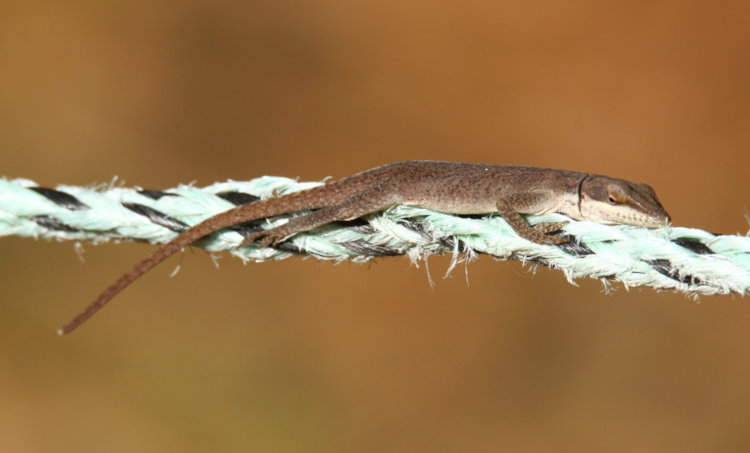
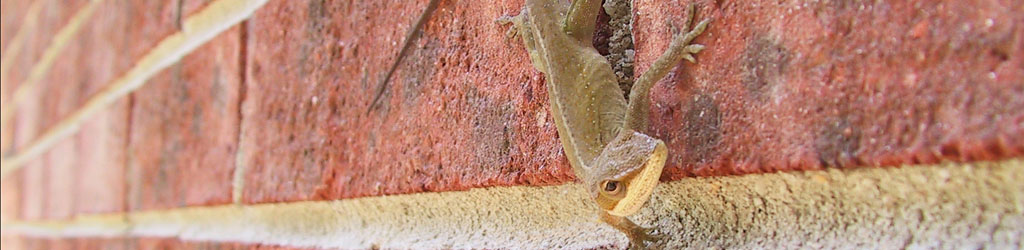
For the past couple of nights I’ve noticed that the three small transplanted Japanese maples out back each have their own bebby Carolina anole (Anolis carolinensis) living thereon, mostly visible when they’re sleeping draped across the leaves. One we’ve already seen, suspected of being from the egg that I missed hatching, but with two of the other trees now sporting their own, this case gets weakened a bit. The property already possessed a moderately-sized Japanese maple when we moved in, twisted and gnarly and generally Bonsai-looking except that it’s half-again as tall as I am, so like, a giant Bonsai – I think that means, “tree.”

back yard with Japanese maple coated in ice
Okay, this isn’t from last night, but an archive shot from this past winter, so don’t get excited. Anyway, I searched the tree over in vain to complete the set of anoles, as it were, because of course they all had to have their own, right? But for reasons unknown, the anoles don’t seem to like the giant Bonsai even though it looks like a wonderful habitat to them.

Last night, however, we got the complete set. so let’s run them down:

newborn Carolina anole Anolis carolinensis snoozing on Japanese maple leaf
This is the one I suspected came from the egg that I was inadequately monitoring, on the tree closest to the door to Walkabout Studios, the one with more reddish-green leaves.

newborn Carolina anole Anolis carolinensis snoozing on Japanese maple leaf
Number Two and probably the largest, which isn’t saying much, deeper within the foliage of the maple with bright green fuller leaves.

newborn Carolina anole Anolis carolinensis snoozing on Japanese maple leaf
Number Three, on the one with the fringey or lacey leaves. The Girlfriend probably knows what varieties these all are, but I haven’t bothered memorizing them and don’t feel like trying to find out now, so this is how I typically identify the different varieties of Japanese maple, at least until I give them better names, like ‘Björn’ and ‘Agnetha’…

newborn Carolina anole Anolis carolinensis snoozing on Japanese maple leaf
And now, we have the first find on the giant Bonsai, which is large enough to house a few dozen, half of which could remain safely out of sight over my head (and might well have up until last night.)

newborn Carolina anole Anolis carolinensis snoozing on Japanese maple leaf
And the second one on the giant Bonsai – it’s actually fairly easy to find these guys, because they all turn the palest green at night even when they’re usually much more color-matched to the tree during daylight. I don’t know if this is simply because they relax and lose control over their pigmentation, or because it helps them collect dew, or what. I could argue that it keeps them cooler, but it’s much hotter during the day and they’re virtually never this pale then.

Anyway, I had the misting bottle out and was gently wafting some their way because I felt they might need the additional moisture, avoiding direct ‘blasts’ since it startles them and they often start seeking shelter, which is weird because a) even a downpour isn’t likely to do anything to them, and b) I’ve seen them out soaked after having apparently slept through one. But this guy popped awake quickly and adopted an action pose, unsure if there was a real threat. If you look close, you can see the barest hint of the mist adhering to the body.

newborn Carolina anole Anolis carolinensis awake and alert on Japanese maple leaf
Keep in mind that they can easily see the headlamp bobbing around and occasionally crack an eye to watch it, and I’m sure the camera gets into the light often enough that they should be able to see it looming close – it never sparks any kind of reaction. But mist? Land-o-goshen, better take shelter! What, do they think it’s a predator breathing on them or something?

Before we leave this tree, we’ll go with a couple of other finds thereon.

tiny juvenile green treefrog Dryophytes cinereus perched on Japanese maple leaf, with author's fingers for scale
A very small green treefrog (Dryophytes cinereus) of course, with my fingers for scale. You can see the ridges worn into my index finger from having the camera and macro rig dangling from my left hand as I examined the tree – one of the ridged tightening knobs sits right under that finger.

By the way, on two separate nights while out checking on what’s happening in the yard, I was walking through the dew-laden grass and felt an odd sensation on my left calf, looking down both times to find a tiny treefrog like this clinging to my leg. Both times, same spot, and both times as I watched, the frog(s) clambered up my leg in their curious monkey-like manner and onto my shorts – this is something that I have to get video of someday, since the motion is decidedly unfroglike. Both times, by the way, I was in the middle of the lawn and nowhere near any of their typical perches; treefrogs don’t spend much time at all on the ground, greatly preferring (like the anoles) to be on raised vegetation of some kind. It was weird, and both times of course I didn’t have the camera in hand. I’ll learn, someday.

juvenile likely carolina mantis Stagmomantis carolina perched on Japanese maple leaf
I was a little surprised to find this guy, and curiously enough, in the same exact spot on the Japanese maple for two successive night, even though we’d had a serious downpour soon after my first sighting. The Chinese mantids that I caught just after hatching dispersed and were never seen again, and this one likely isn’t one of them, since the sharply-upcurved abdomen makes this probably a Carolina mantis (Stagmomantis carolina) instead. I didn’t measure it, but maybe about 35mm in body length? Still far from adulthood, anyway, large enough to be safe from both the anoles and the minuscule frog while also not posing a threat to them itself – a full-grown adult Chinese mantis could, potentially. I’ve never witnessed it myself but I’ve seen photos of an adult mantis with an anole as prey.

And now we get to the last of the anoles, only this one was around front instead, snoozing on the leaf of a star jasmine (Trachelospermum jasminoides) vine wrapped around the lamppost.

newborn Carolina anole Anolis carolinensis snoozing on star jasmine Trachelospermum jasminoides leaf
I misted this one too, and caused it to stir and nose back and forth; it gave me the impression that it was licking up the moisture from the leaf, though I didn’t see a tongue. Granted, the overall body length is that of my finger, so I could easily have missed it, and my closeup photos didn’t reveal anything.

close crop of newborn Carolina anole Anolis carolinensis snoozing on star jasmine Trachelospermum jasminoides leaf, showing evidence of author's misting
Maybe one of these nights I’ll take out the tripod and the video light and do video of them while I mist them, see what happens. With this one it would have been difficult, because the ground isn’t open enough under the lamppost to set up the tripod easily, but maybe one of the others.

Finally, an unrelated shot, just because I snagged it in the same session.

tiny spider web delineated by mist
This spider was perhaps twice the size of a grain of sand, the entire web spreading 50-60mm on one of the butterfly bushes. Even in bright daylight, the light would had to have been exactly right to show even some of the strands of the web, so the misting bottle helped out a lot. I have to be fartsy from time to time…

1 20 21 22 23 24 334