Once again, I observe that the posts are thin, which is a shame because I am/was well on the way to a record in number of posts, having already passed the total for both 2014 and 2012 (not combined, mind you.) A lot of that had to do with Monday color, which I’ll leave it up to you whether that should be considered cheating or not. But at best, they added five photos per month to the number uploaded, and I’m way the hell out in front on that score this year – yes, even discounting Jim’s pics from Juneau.
Mostly, it’s been a combination of being busy with projects, finding fewer photo subjects as the season winds down, and simply lacking inspiration for other topics. It is what it is, though, and I refuse to let it obligate me.
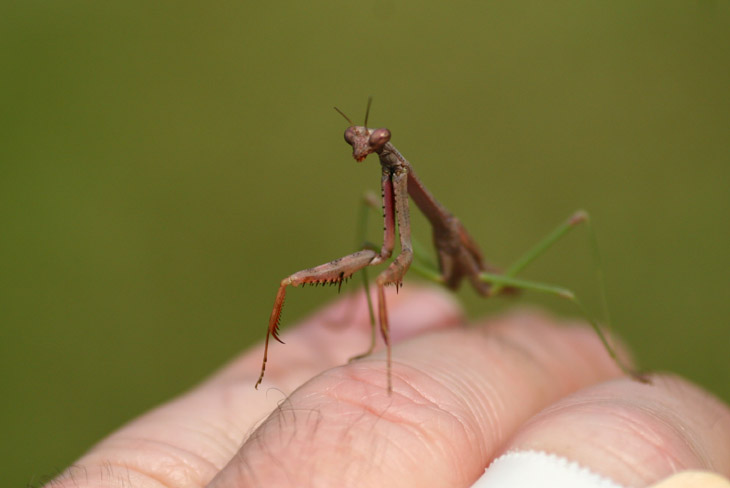
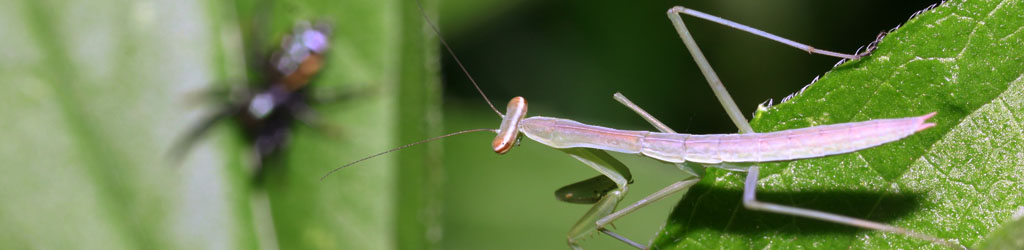
About six weeks ago, when the saga of the local mantids was petering out as they reached adulthood and began to disperse, I was walking around the nearby pond when I spotted, out of the edge of my vision, a bit of leaf litter on my shoulder. As I was reaching up to brush it off, the pattern suddenly registered just before my hand made contact, even as badly unfocused as my eyesight was, peripherally and from behind the edge of my glasses; too late, however, because the small mantis masquerading as leaf litter saw my hand coming and vaulted away. This is always an amusing sight, because before the final instar they have no wings, so they throw out all of their limbs in an attempt to snag vegetation and arrest their descent, and it gives them an air of utter abandon, the pose of a dog leaping off of a dock. This was a Carolina mantis (Stagmomantis carolina,) much rarer around here than the Chinese mantis, even though I write this from North Carolina and not, shocking as it may seem, from China. The photo above is for scale, having swept it up for a quick pic – the tape in the edge of the frame was because I injured my hand and had two fingers partially immobilized to help the healing that was going slower than preferred. Below, a more natural image of the same mantis.
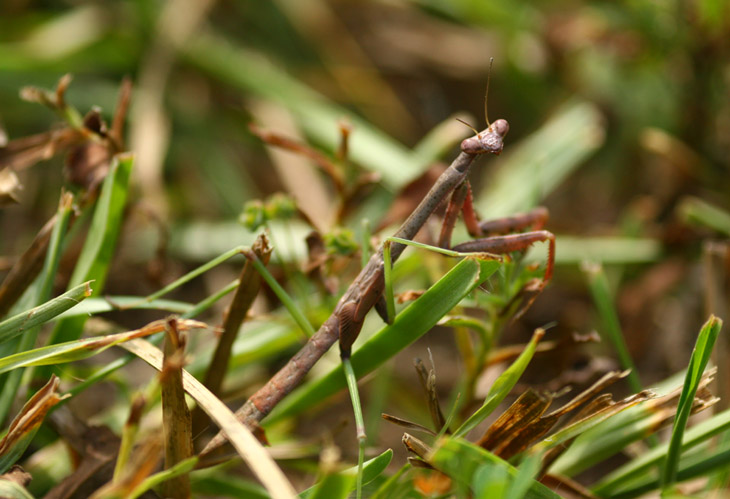
What had me pondering was the simple fact that I hadn’t brushed against any plants or wandered close to any trees, and as can be seen, the mantis was too young to be flying, so how it got there, and how long it had been riding along, was a mystery.
Not quite a month later, about two hundred meters away from that incident, I spotted another Carolina mantis, this one fully adult and, if that girth is any indication, soon to produce an egg sac.
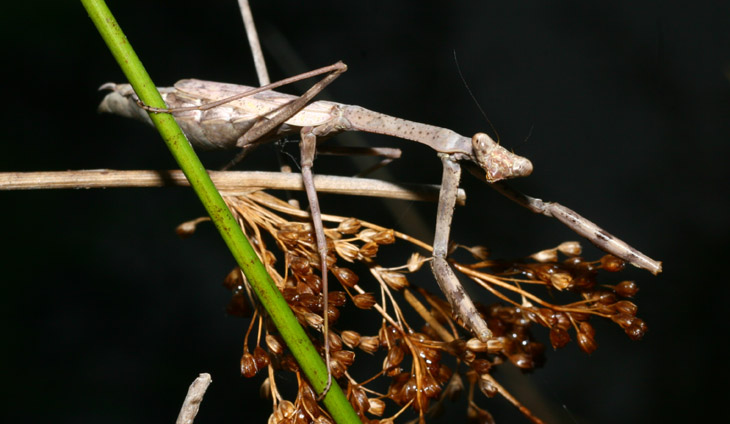
I had a vague suspicion that it was the same mantis, but comparing the antennae I now consider this very unlikely – I don’t think they would grow back that completely, though I could be wrong. While I found this one on two separate occasions upon that same cluster of reeds, she abandoned them before laying her eggs and I have not found the sac.
I bring up that leaf litter story, gripping as it was, solely because it happened again, 12 days back now, and in almost exactly the same way except on the opposite side of the pond. And so, another scale pic for comparison.
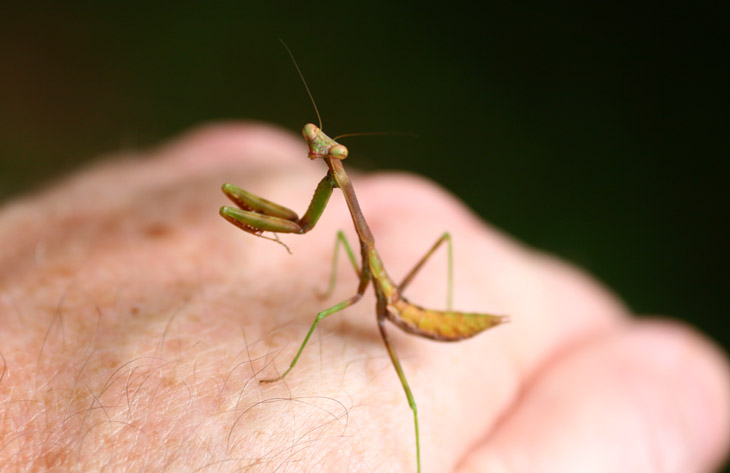
 [That’s two of my knuckles flanking the head, with my thumb peeking in at right.] This time, however, I knew exactly how it had gotten there, since I had just brushed past a low-hanging branch with that shoulder, so after the scale image, I returned it to its perch.
Right now, due to the variation in color, I am only tentatively identifying this as another Carolina mantis, though one with much less grey and more green in the mix. The Chinese mantids seem to have two primary phases, green and brown, and can switch between these (I suspect when molting) as they change host plants, so I’m going to crassly assume Carolina mantids are capable of the same. Now, I had originally assumed this one had recently consumed a massive meal, since that abdomen is quite swollen but the mantis still a juvenile, so we shouldn’t be talking pregnant here. However, I don’t think the hearty meal assumption is correct, since I have found that the mantis not only likes that tree, it likes that precise position on the outlying branch, because I keep finding it there.
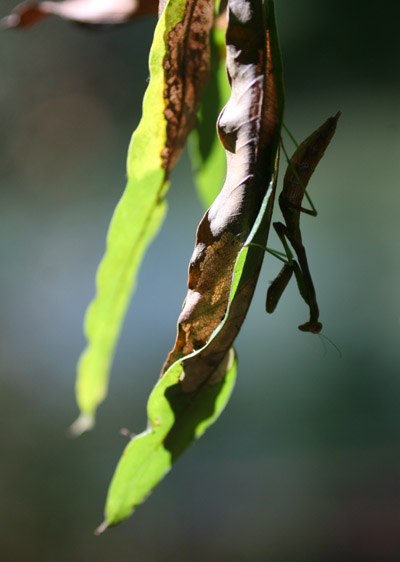 This one’s from yesterday, and as you can see, that abdomen is still pretty impressive. I can’t offer a decent explanation as yet – the tree is hardly one to attract a lot of potential mantis-meals. I am not discounting the possibility that, had I not acted sooner on that first encounter, the mantis may have been fatter still, feeding from those like me who frequently walk around the pond. But the path I took is one seldom used, because the spiders tend to throw their webs across between the trees and, for some reason, most people don’t like walking face-first through a large orb web – I’ve pointed it out many times before on this blog, but people are weird. However, this might help explain the girth anyway. The orb-weaver spiders don’t often encounter mantids because of their own protective habits, sitting in the middle of the web where mantids cannot reach, but they do at least have to begin the web, which requires stringing the support strands, and the outlying branch that the mantis owns is potentially a good anchor for such. So maybe the mantis had been fortunate enough to stumble upon a self-stocking smorgasbord, as it were.
A little ways past this point I had discovered, a few weeks back now, a large black-and-yellow argiope spider (Argiope aurantia) in her web in a pine tree, also abdomenally enhanced. Judging from the current capture in her web and the two dessicated carcasses of a dragonfly and a cicada in the branches beneath, she was eating for dozens, and within a few days an egg case had appeared nearby. Within a few more days she was gone – I have yet to determine if this was the natural cycle or not, since some spiders die soon after producing eggs, while others remain around and protect the young for a bit. I wasn’t checking back often enough, though, because yesterday I found the egg sac opened, with chaff strewn nearby, and no sign of spiderlings anywhere.
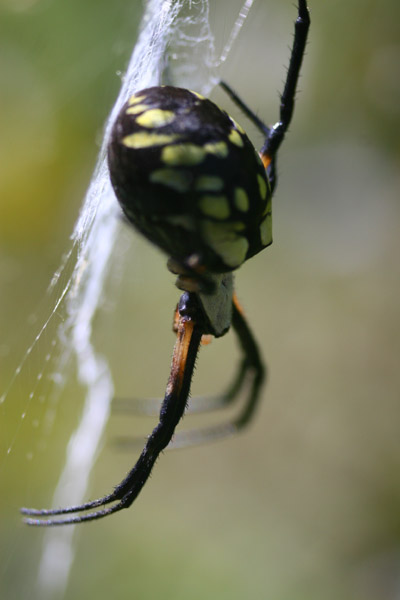 While I was faintly chagrined at having missed the hatching, I wasn’t absolutely sure a hatching had occurred. The egg sac might have been found and raided by a predator, a hypothesis buttressed by the fact that there was no evidence of a large number of web strands left behind by dozens of departing spiderlings. Not far away, though, another argiope was perched, and her girth was also evidence of an impending sac – this was taken four days ago. The thorn bushes she had selected as her web anchors prevented me from getting a better viewing angle, but as you can see, her belly’s to the sun anyway.
These, by the way, are among the largest spiders in the area, with a body length that can reach 30mm and thus a leg spread up to 50 or 60mm. The fishing spiders are the only ones that get noticeably larger. Argiopes are the largest that people routinely encounter, though, due to their habits of throwing a large web across between two strong, low plants, always decorated with a prominent white zig-zag of webbing right in the middle where the proprietor sits, and often enough in gardens near something that attracts pollinators, thus the common name of ‘garden spider.’ I see them more often on the shores of lakes and ponds and think a name reflecting that would be more appropriate, but not as many people explore those areas I guess. There is also one right alongside the house at present, next to one of the rain barrels, but as yet she is showing no signs of a baby bump.
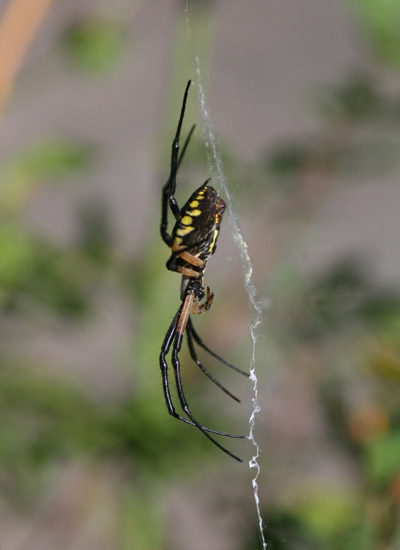 Yesterday, the same spider as above was noticeably deflated, as predicted, but I was unable to locate the egg sac. The foliage nearby was dense, and argiopes don’t put their eggs in the immediate vicinity of their webs, opting to go outside of the orb’s range a short ways (usually less than a meter) to place the sac. It was almost certainly there, but ten minutes of searching didn’t reveal it to me. I’m going to keep checking, because I really want photos of newborns, and if I capture them in the process of emerging, all the better. It will also be interesting to see if, now that the eggs are laid, this one disappears soon as well. Check back – if I’m successful, you know they’re going to appear here.
Potentially Related Posts:










 The frame above, by the way, is tightly cropped, and slightly less than full resolution. This one, the same image, shows exactly how big the moon appears in the frame at 453mm focal length, just so you know what kind of magnification it takes for moon photos. For exposure details, 1/100 second at f11, ISO 100 – the typical exposure for full moon shots, provided that it’s not faintly dimmed by haze (basically, at f11, shutter speed should be 1/ISO, what’s often called, “Moony 11”.) A stop or so brighter would have been better, given the glow easily visible around it when observed.
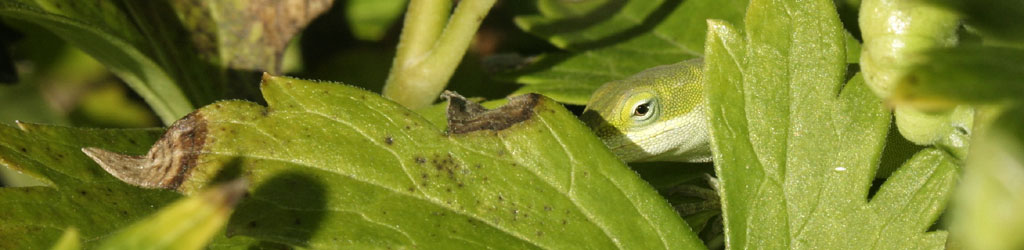
 The mantis from the previous post stayed trapped by the rain for several days, finally leaving its position early this afternoon – naturally while I wasn’t watching. While I was wandering around the backyard, hoping to find where she’d gotten off to, I spotted something else, which I won’t identify and simply let you look at the image to the left to try and find on your own. It gives a pretty good idea of what I saw at first, and the kind of things I pay attention to because they often enough lead to new critters to photograph.
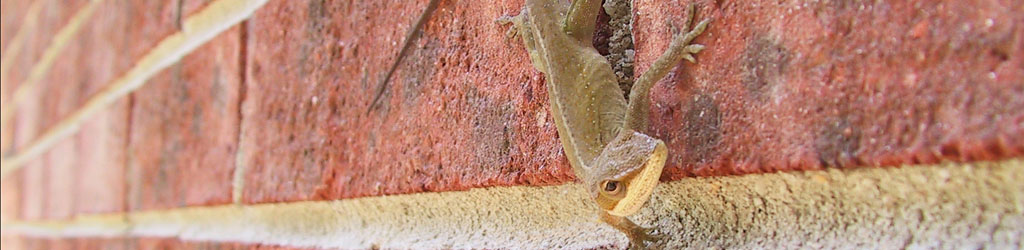
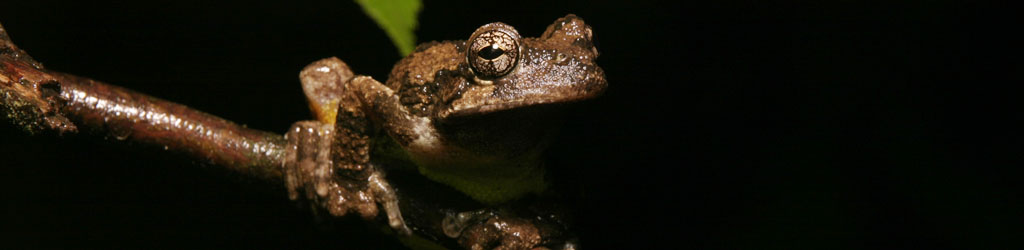
 I am going to identify this as a Cope’s grey treefrog (Hyla chrysoscelis,) with reservations – they cannot be distinguished from the common grey treefrog visually, but so far, the Cope’s is the only species that I’ve confirmed we have around here, solely by
  Remember, look at your thumb – the distance between the tip and the crease of the joint is how long this little bugger is (unless your hands are way different in size from mine.) But this gives a good view of those little blobby pads at the tips of the toes, which help treefrogs cling to such surfaces, and the brilliant yellow lining of the hind legs which often remain hidden from sight. Don’t ask me the purpose of that coloration, because I could only speculate, and poorly at that.

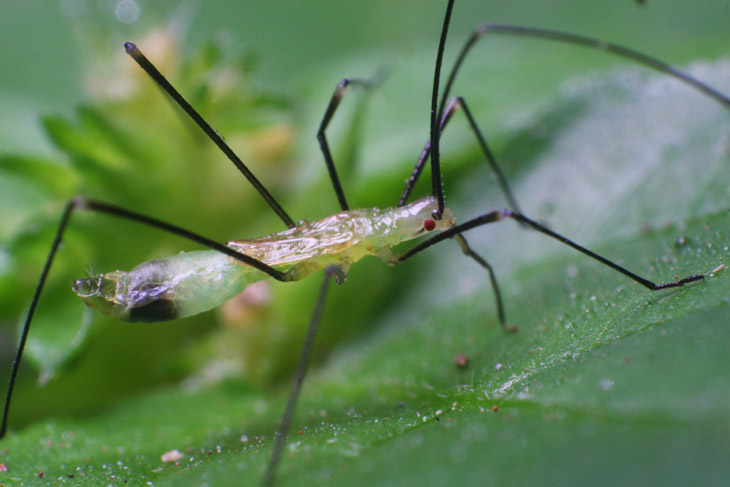
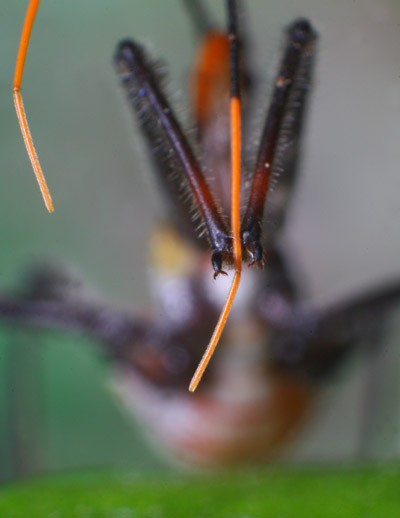
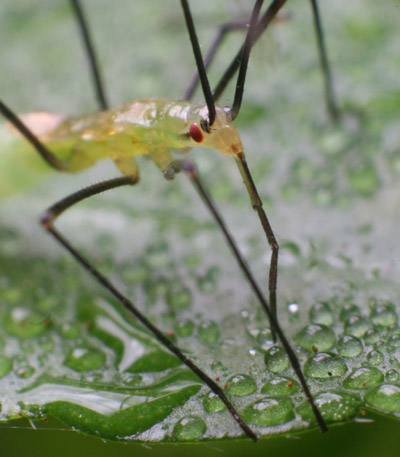 First off we have the most recent images from just a few days ago, an unidentified Hemipteran nymph, quite a small one. I am inclined to call it an assassin bug, but so far I have found no species that matches this coloration (the black legs in particular.) Oddly enough, it was spotted on the kitchen counter, with no good guesses as to how it arrived there, though it might have hitchhiked in on a tomato or basil leaf. It measured just 6mm in body length, and appreciated the water provided by the misting bottle, so it may have been indoors for a while.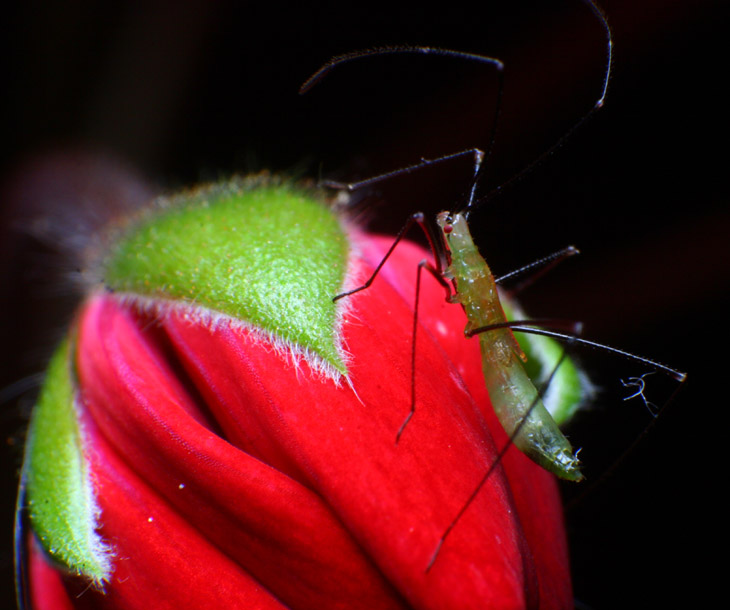
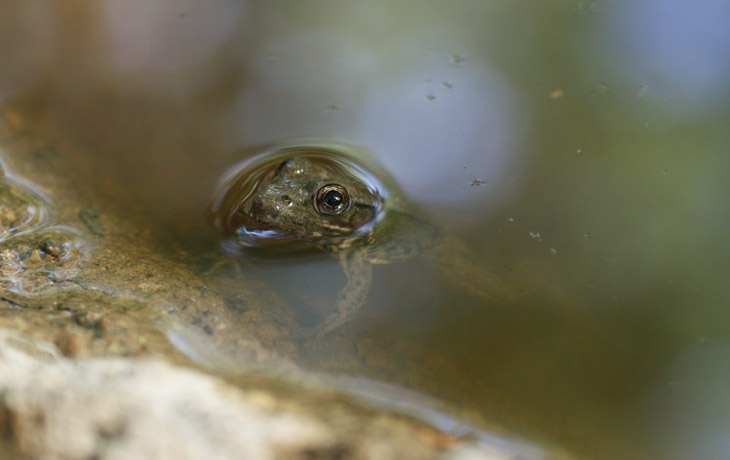

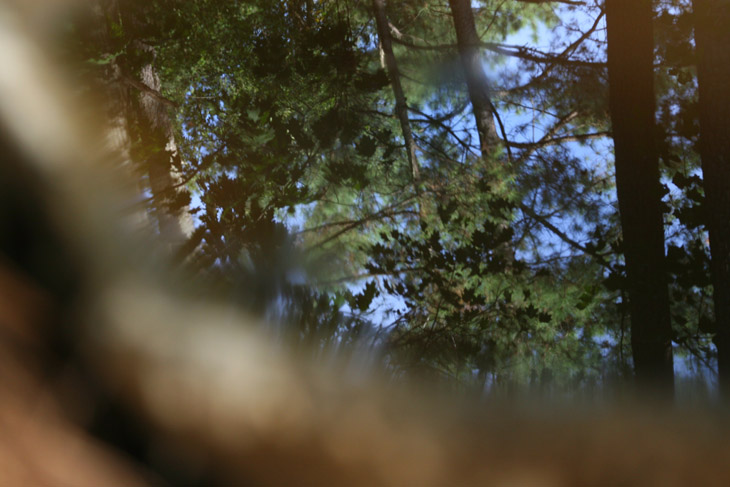
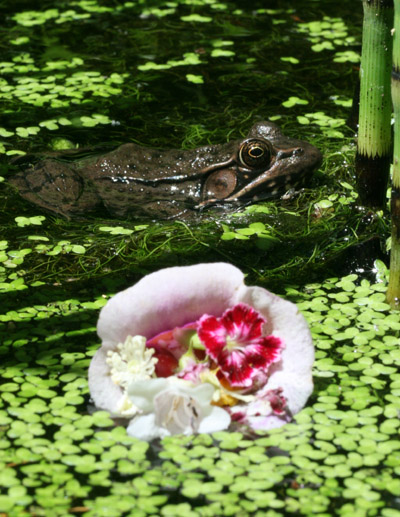 We’ll stick with the frogs for a moment longer before changing the subject, as I show off a photo that I haven’t actually had a good use for yet. This was taken at the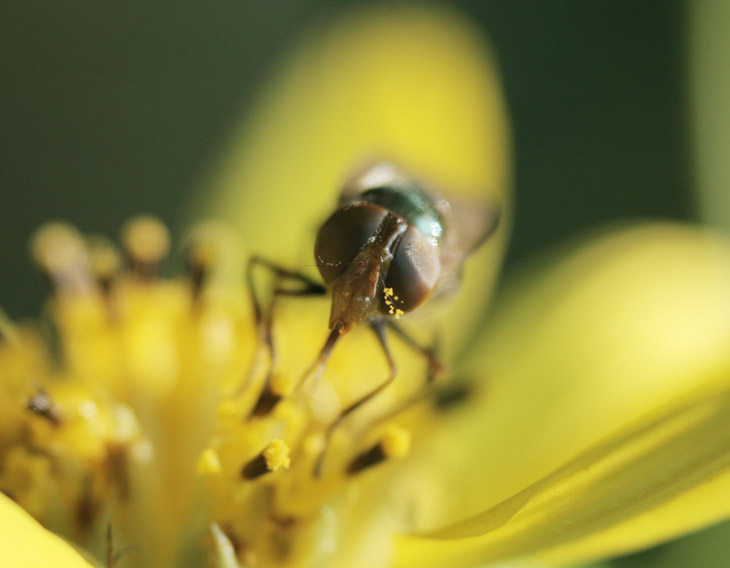
 Somehow, I missed putting this one up with the others when I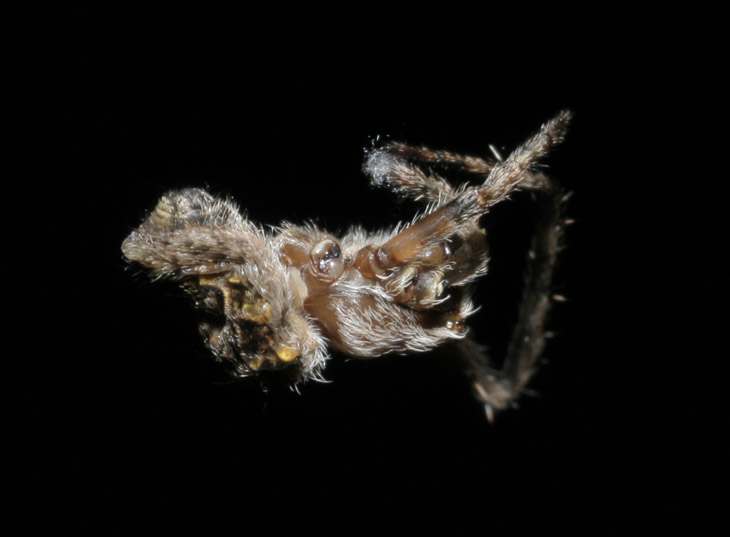
 I had originally identified this flower as a winter aconite, Eranthis hyemalis, but now I’m pretty sure that’s wrong – the leaves aren’t like that, and no image I can find shows this green translucent ‘berry’ springing from the middle. So if you know what this is, feel free to enlighten me. All I can say right now is that these are tiny flowers perhaps a centimeter across, that appear very early in the spring – last year they got
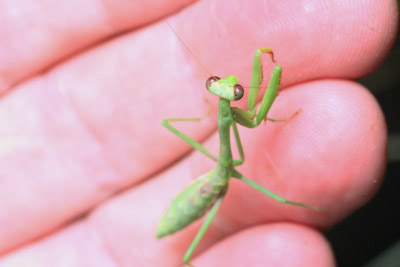 While coaxing it around for a better view, it scrambled onto my hand without a qualm, and I juggled the camera around one-handed for a quick scale shot. Then, as I tried to convince it to get back onto the maple tree, it resisted playfully and trotted up my arm all the way to the short sleeve cuff, before I could brush it back onto the tree. It would seem I now have a reputation for making mantids famous. Either that or my beard looked like a tasty bug – your call.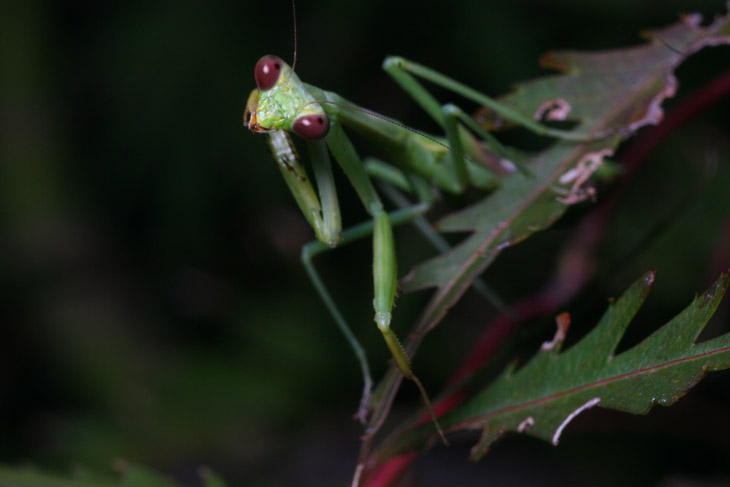


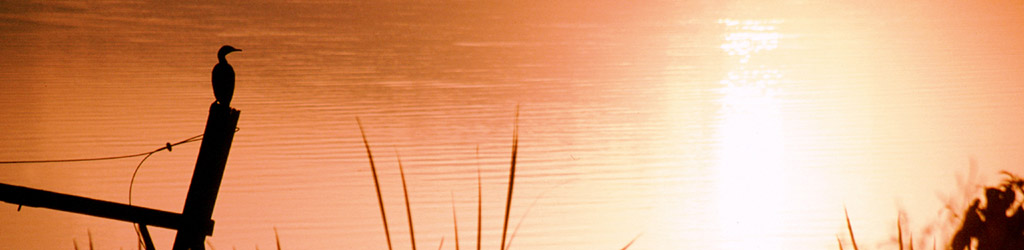
 From a nature photography standpoint, as well as portraiture, one of the better bits of planning is using the best natural light. Sunrise and sunset, often referred to as the ‘golden hours,’ offer softer, low-contrast lighting that has a pleasant warm hue, not to mention often producing nice displays in the sky, so being in position when this occurs can be very useful. If you don’t have a developed sense of where the sun will be, a compass and any online guide or app can tell you exactly where it will contact the horizon, allowing you to use this tiny window to frame the sun (or moon, as it may be) against some foreground interest. The colors change rapidly at these times, and the best displays may last only a minute or so.
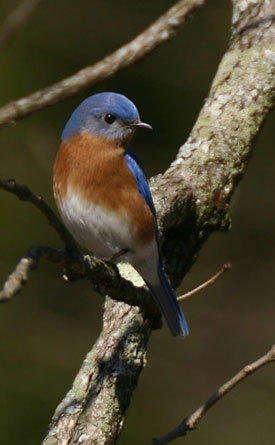 Anticipating the action is also an important facet. This might mean setting up a complete rig to be able to capture birds feeding their young without being close enough to spook them, with light levels adjusted ahead of time so everything’s ready when the action starts. Or it might simply be knowing what pose or position is going to work best, and being able to trip the shutter exactly when it occurs, no matter how fleetingly. Most animals look better with a bright point reflection in their eyes, called a ‘catchlight,’ but don’t often pose where this can occur because it also means that light is making it hard for them to see; thus it might happen for a second or less. Yes, this takes practice and fast reflexes – you’re seeing the successes here, but I have enough misses as well. A little forethought made me position myself so that the bluebird’s head fell in the gap between the background branches, rather than intersecting them in a distracting way, and then it was simply a matter of waiting until the bird turned to look in exactly the right direction.