








Well, okay, not quite that many – more like half a dozen.
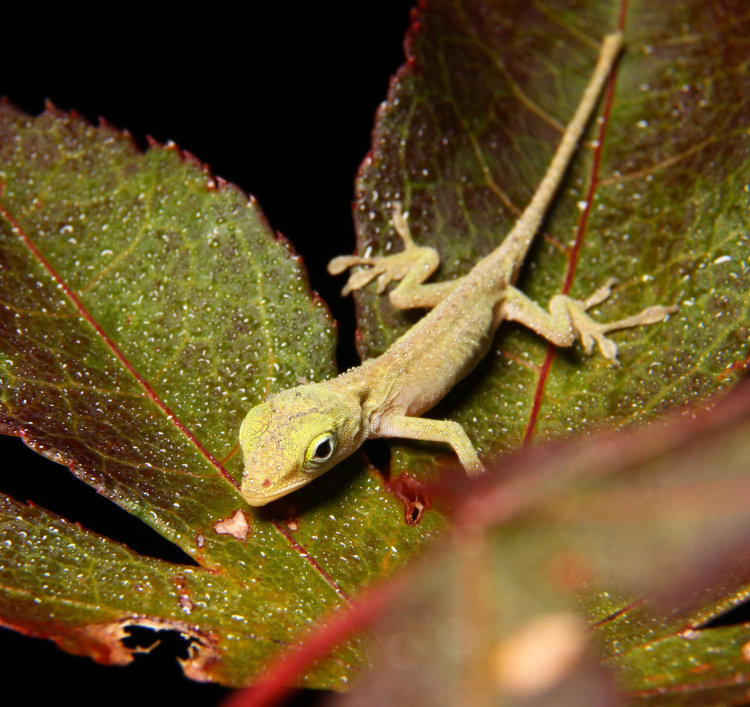
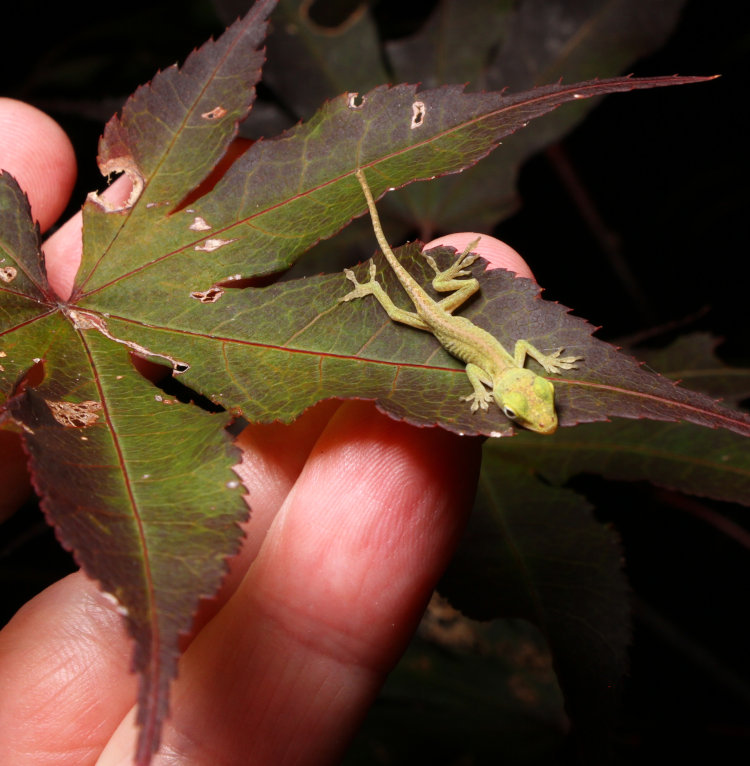
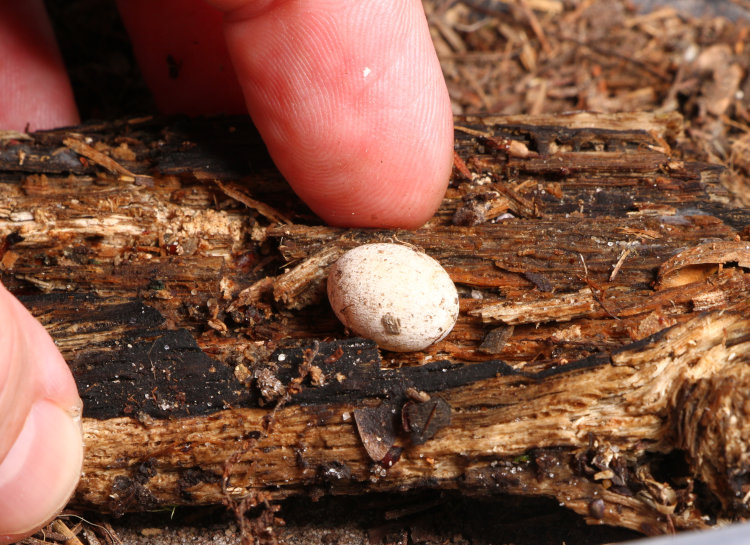
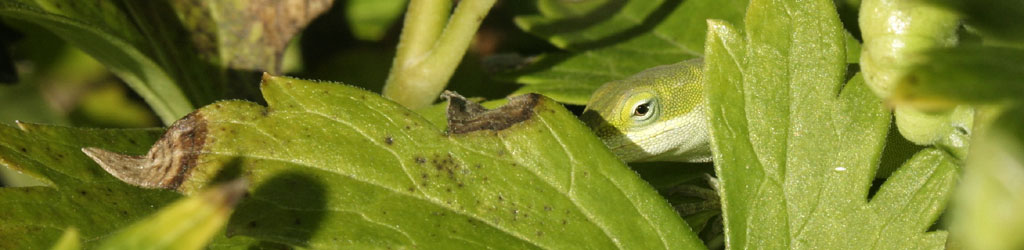
For the past couple of nights I’ve noticed that the three small transplanted Japanese maples out back each have their own bebby Carolina anole (Anolis carolinensis) living thereon, mostly visible when they’re sleeping draped across the leaves. One we’ve already seen, suspected of being from the egg that I missed hatching, but with two of the other trees now sporting their own, this case gets weakened a bit. The property already possessed a moderately-sized Japanese maple when we moved in, twisted and gnarly and generally Bonsai-looking except that it’s half-again as tall as I am, so like, a giant Bonsai – I think that means, “tree.”

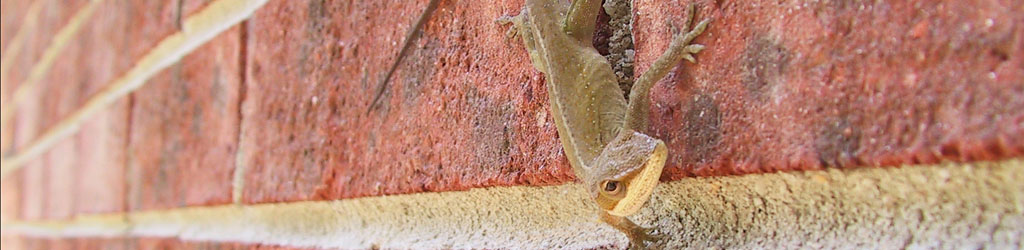
Okay, this isn’t from last night, but an archive shot from this past winter, so don’t get excited. Anyway, I searched the tree over in vain to complete the set of anoles, as it were, because of course they all had to have their own, right? But for reasons unknown, the anoles don’t seem to like the giant Bonsai even though it looks like a wonderful habitat to them.
Last night, however, we got the complete set. so let’s run them down:
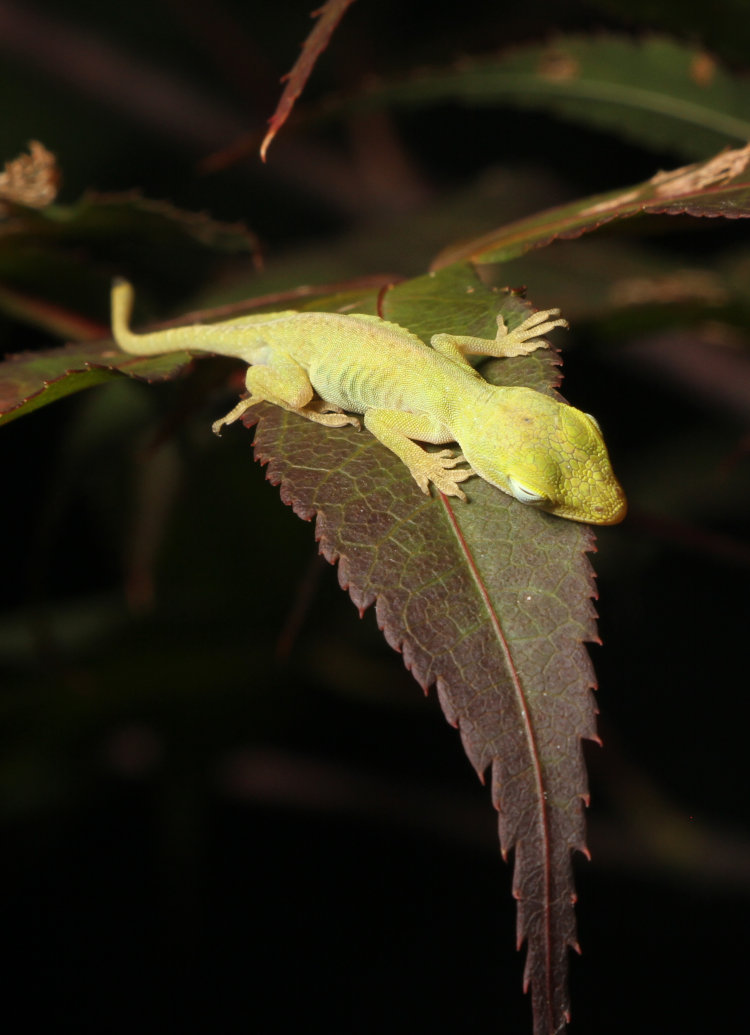
This is the one I suspected came from the egg that I was inadequately monitoring, on the tree closest to the door to Walkabout Studios, the one with more reddish-green leaves.
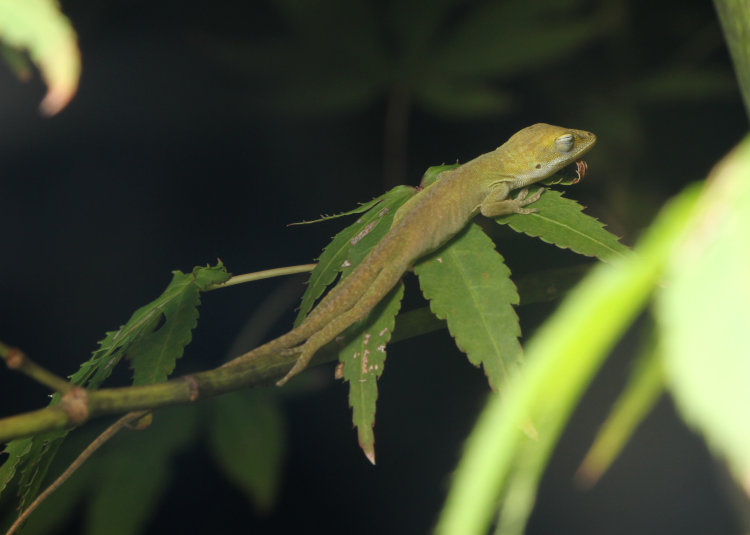
Number Two and probably the largest, which isn’t saying much, deeper within the foliage of the maple with bright green fuller leaves.
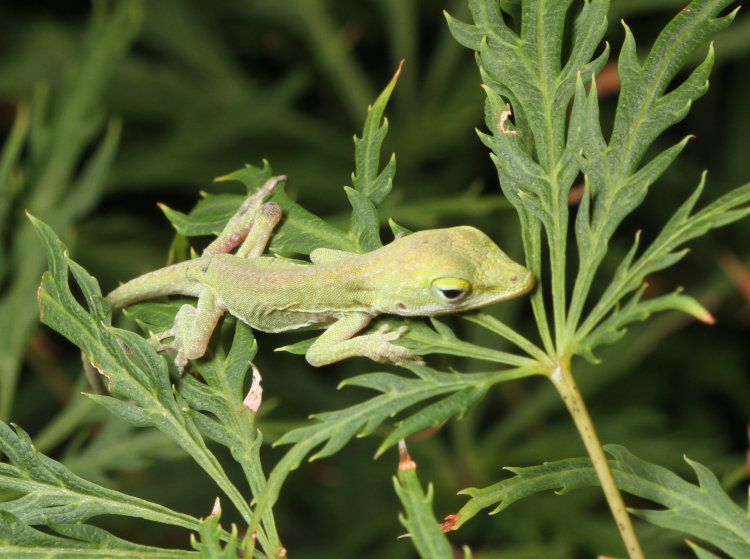
Number Three, on the one with the fringey or lacey leaves. The Girlfriend probably knows what varieties these all are, but I haven’t bothered memorizing them and don’t feel like trying to find out now, so this is how I typically identify the different varieties of Japanese maple, at least until I give them better names, like ‘Björn’ and ‘Agnetha’…
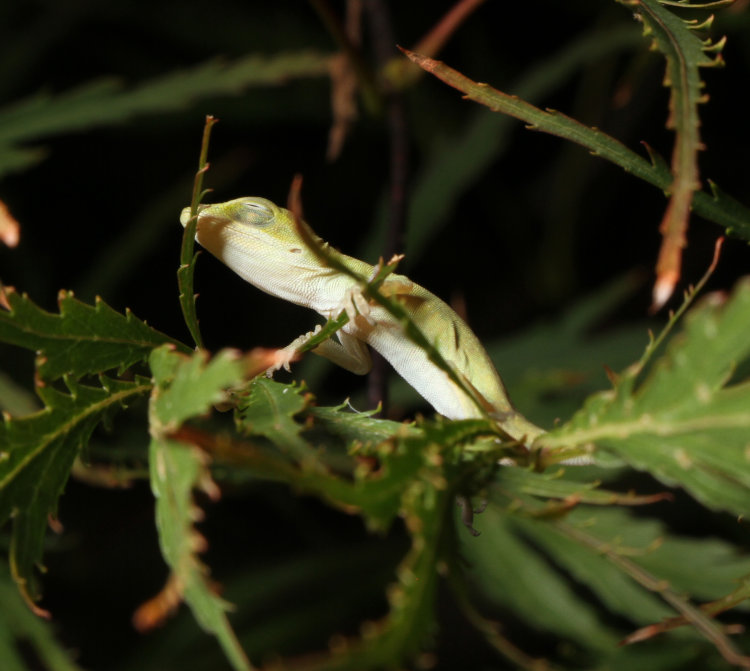
And now, we have the first find on the giant Bonsai, which is large enough to house a few dozen, half of which could remain safely out of sight over my head (and might well have up until last night.)
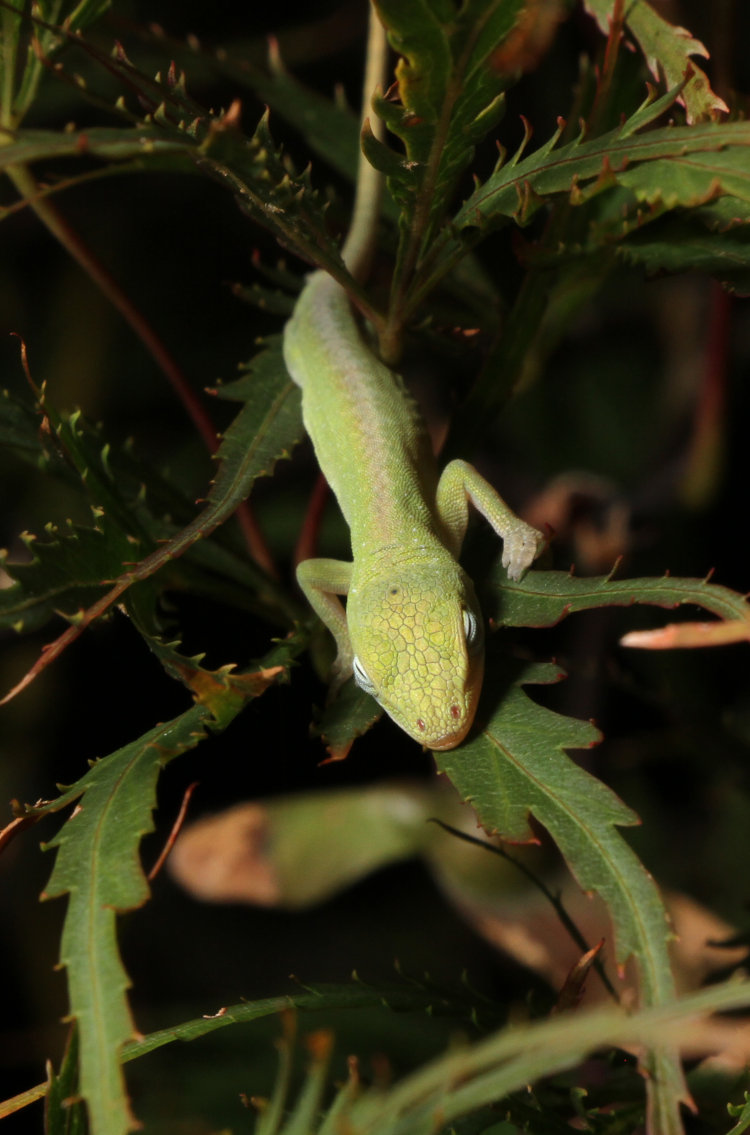
And the second one on the giant Bonsai – it’s actually fairly easy to find these guys, because they all turn the palest green at night even when they’re usually much more color-matched to the tree during daylight. I don’t know if this is simply because they relax and lose control over their pigmentation, or because it helps them collect dew, or what. I could argue that it keeps them cooler, but it’s much hotter during the day and they’re virtually never this pale then.
Anyway, I had the misting bottle out and was gently wafting some their way because I felt they might need the additional moisture, avoiding direct ‘blasts’ since it startles them and they often start seeking shelter, which is weird because a) even a downpour isn’t likely to do anything to them, and b) I’ve seen them out soaked after having apparently slept through one. But this guy popped awake quickly and adopted an action pose, unsure if there was a real threat. If you look close, you can see the barest hint of the mist adhering to the body.
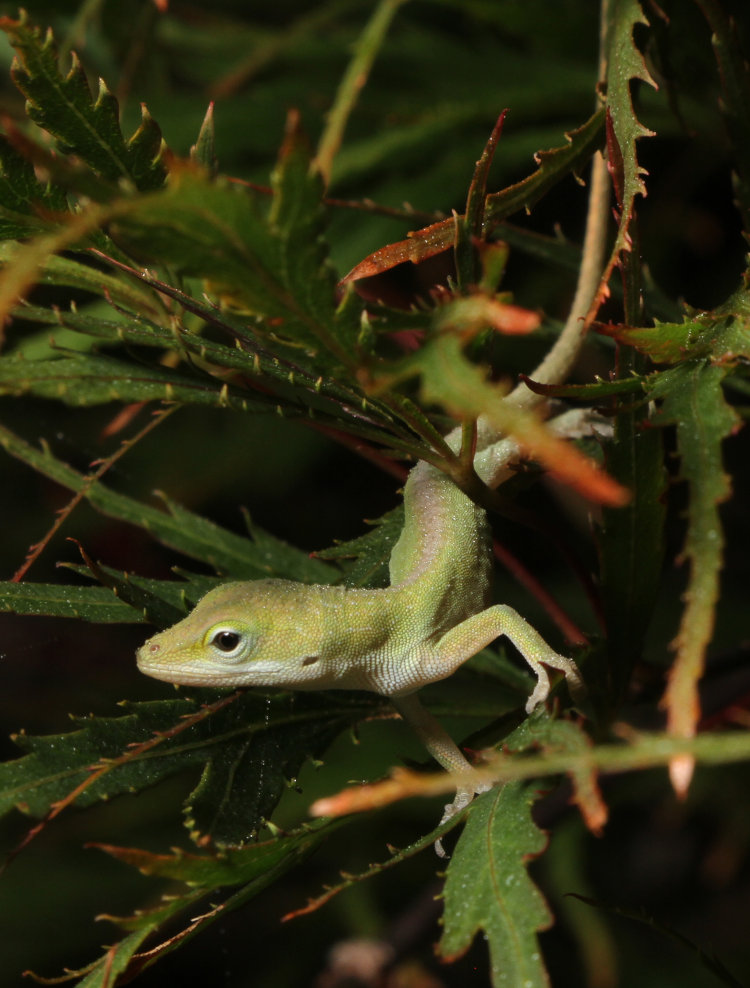
Keep in mind that they can easily see the headlamp bobbing around and occasionally crack an eye to watch it, and I’m sure the camera gets into the light often enough that they should be able to see it looming close – it never sparks any kind of reaction. But mist? Land-o-goshen, better take shelter! What, do they think it’s a predator breathing on them or something?
Before we leave this tree, we’ll go with a couple of other finds thereon.
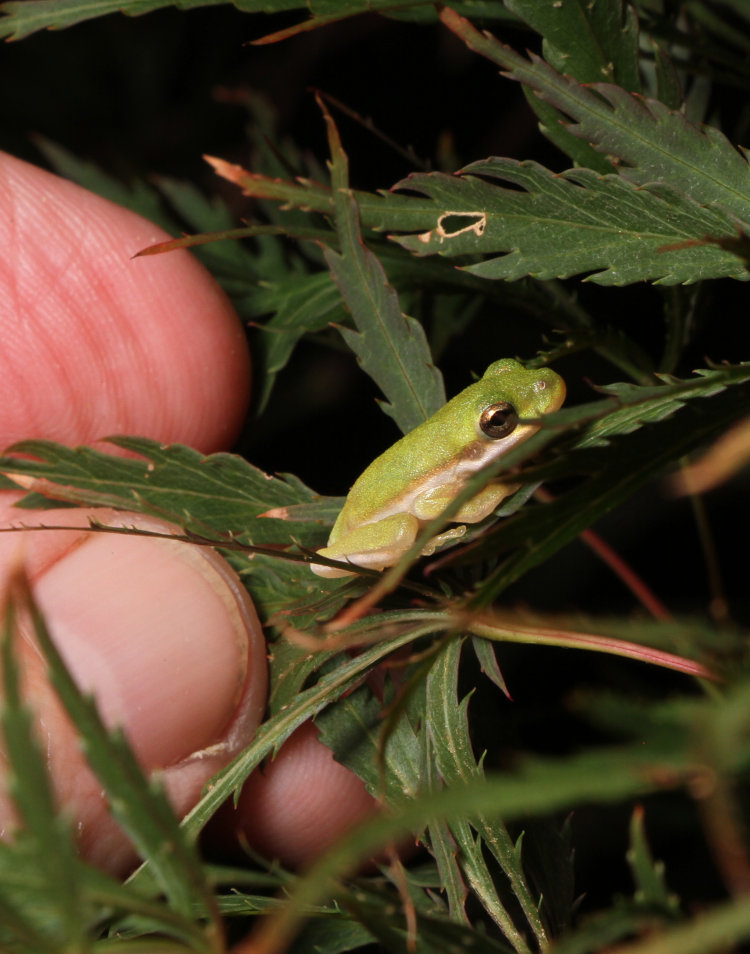
A very small green treefrog (Dryophytes cinereus) of course, with my fingers for scale. You can see the ridges worn into my index finger from having the camera and macro rig dangling from my left hand as I examined the tree – one of the ridged tightening knobs sits right under that finger.
By the way, on two separate nights while out checking on what’s happening in the yard, I was walking through the dew-laden grass and felt an odd sensation on my left calf, looking down both times to find a tiny treefrog like this clinging to my leg. Both times, same spot, and both times as I watched, the frog(s) clambered up my leg in their curious monkey-like manner and onto my shorts – this is something that I have to get video of someday, since the motion is decidedly unfroglike. Both times, by the way, I was in the middle of the lawn and nowhere near any of their typical perches; treefrogs don’t spend much time at all on the ground, greatly preferring (like the anoles) to be on raised vegetation of some kind. It was weird, and both times of course I didn’t have the camera in hand. I’ll learn, someday.
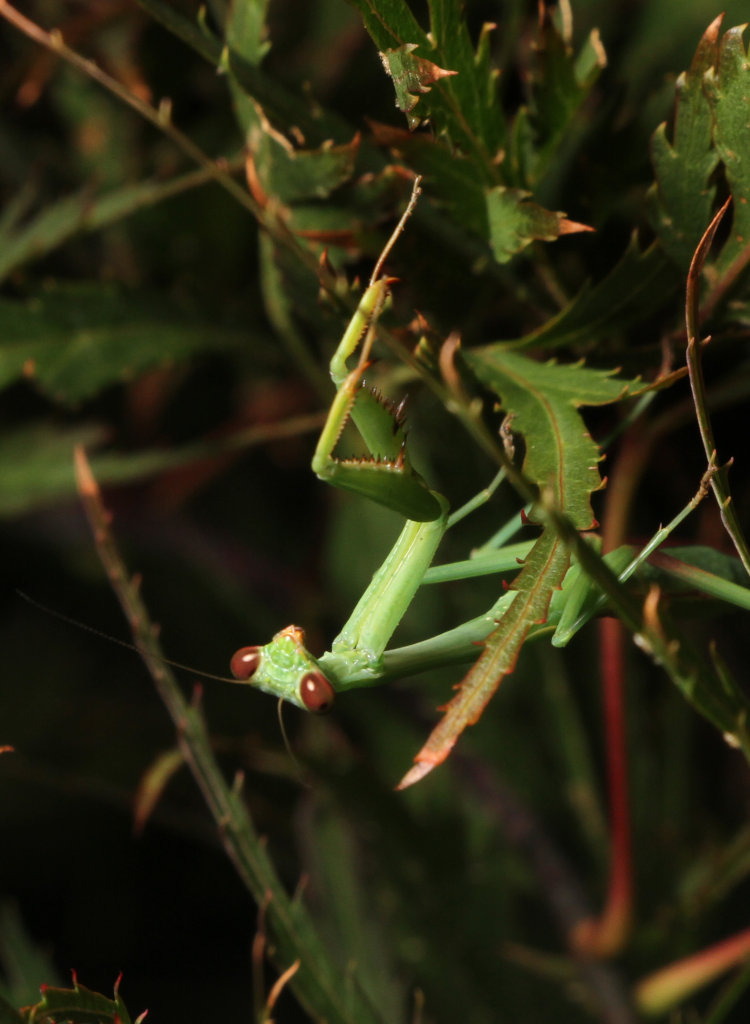
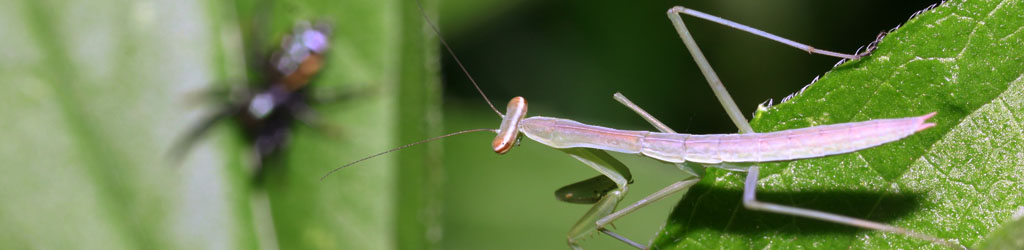
I was a little surprised to find this guy, and curiously enough, in the same exact spot on the Japanese maple for two successive night, even though we’d had a serious downpour soon after my first sighting. The Chinese mantids that I caught just after hatching dispersed and were never seen again, and this one likely isn’t one of them, since the sharply-upcurved abdomen makes this probably a Carolina mantis (Stagmomantis carolina) instead. I didn’t measure it, but maybe about 35mm in body length? Still far from adulthood, anyway, large enough to be safe from both the anoles and the minuscule frog while also not posing a threat to them itself – a full-grown adult Chinese mantis could, potentially. I’ve never witnessed it myself but I’ve seen photos of an adult mantis with an anole as prey.
And now we get to the last of the anoles, only this one was around front instead, snoozing on the leaf of a star jasmine (Trachelospermum jasminoides) vine wrapped around the lamppost.
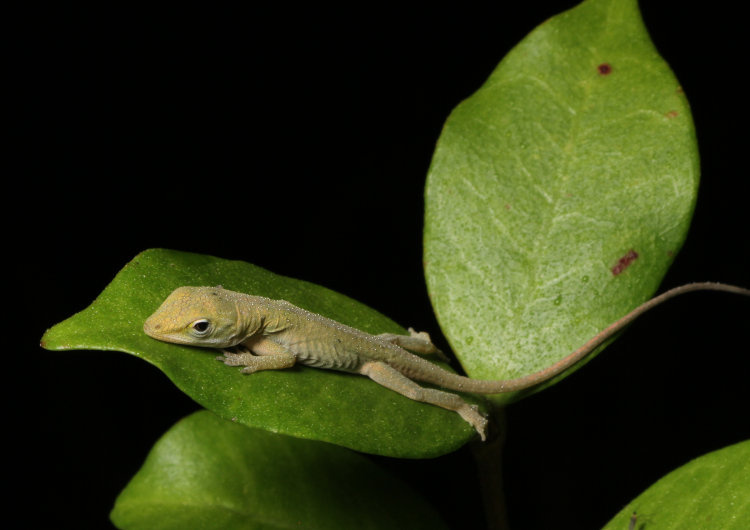
I misted this one too, and caused it to stir and nose back and forth; it gave me the impression that it was licking up the moisture from the leaf, though I didn’t see a tongue. Granted, the overall body length is that of my finger, so I could easily have missed it, and my closeup photos didn’t reveal anything.
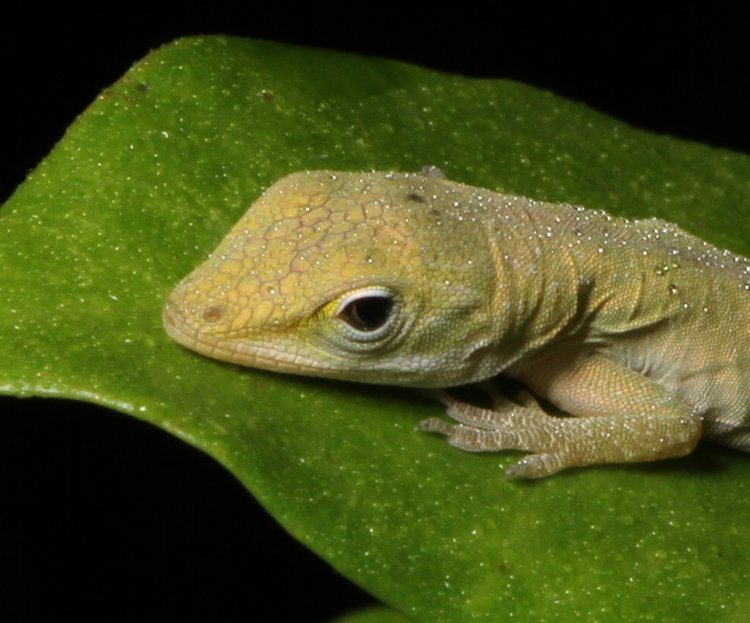
Maybe one of these nights I’ll take out the tripod and the video light and do video of them while I mist them, see what happens. With this one it would have been difficult, because the ground isn’t open enough under the lamppost to set up the tripod easily, but maybe one of the others.
Finally, an unrelated shot, just because I snagged it in the same session.
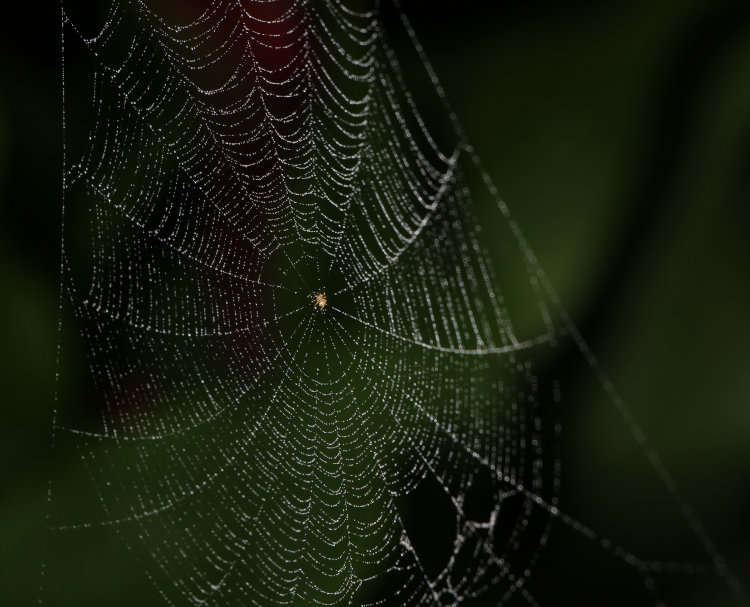
This spider was perhaps twice the size of a grain of sand, the entire web spreading 50-60mm on one of the butterfly bushes. Even in bright daylight, the light would had to have been exactly right to show even some of the strands of the web, so the misting bottle helped out a lot. I have to be fartsy from time to time…