Living in the past XX

green sweat bee Halictidae on partridge pea Chamaecrista fasciculata blossom
To me, this one just all came together nicely. The complementary colors of course, but the V-shape of the line of blossoms and the fernlike leaves working the corners, the short range of sharpness, and the position and lighting on the sweat bee just worked. A certain amount of this was serendipity, since I had only a moment to frame things while the bee was present, and was mostly concerned with leaving space out to the right since that’s the way the bee was facing, but I did notice the green leaves and twitched enough to include them completely. Of course, you want a large print for your living room…

*Grumble mutter blaspheme snarl*

I’ve mentioned before (probably too many times) that I switched over to Linux Mint several years ago and have been largely happy with it. Far more stable and problem-free than any version of Windows that I’ve used, completely free of forced upgrades and intrusive or proprietary horseshit. There was a learning curve, certainly, especially with getting the MIDI keyboard working on it, but once the initial problems were all sorted through, it worked fine.

Up until recently. A few months back, something went wonky, and while trying to get it corrected, I lost my ‘root’ privileges (that’s the main administrator account that’s allowed to do everything.) I had to reinstall to get those back, but it’s never been the same since, and some really funky shit has been going on recently.

I just had to add this, because as I finished typing that sentence, a popup appeared to tell me about the security updates that are available. Granted, that’s as intrusive as it gets, but the ironic part is, it appears that one of those updates is what fucked up the system big time, and I have yet to determine which one. The ability to roll back the system to a previous backup was screwed by the loss of root privileges and the subsequent reinstall, so no option to find the culprit that way. But yeah, thanks for the reminder.

The biggest issue was disk management. I maintain several hard drives on this desktop, mostly for backups of the digital image and video files, and have a memory card reader for three separate cameras and the 3D printer. The drives all of a sudden refused to ‘mount’ automatically (meaning they were not found until I went into a drive management program and reassigned the properties to them) and the memory cards simply will not be found when plugged in – same issue, even though I’ve set the parameters multiple times to automatically open them as they are found – they always have to be manually mounted. even then, permissions are often changed, so I cannot make alterations at times unless logged in as root – sometimes not even then (especially true with the card for the Canon 7D, which can only be erased in-camera now.) Whatever the fuck this change was, it’s inexcusable, and no solution that I’ve found yet on any forum has worked.

And just hours ago, I discovered that something in the audio system was seriously fucked as well, since if I attempted to record audio on Audacity while video was running in KdenLive (which is how I do voiceovers for video editing, just like dozens of times in the past,) it now introduces a wicked background crackle the moment that KdenLive starts playing – despite the fact that all audio from KdenLive is muted. How’s that happening? The microphone is a high-end USB model that doesn’t even go through the sound card, so there should be no crossover – but some software doodad is allowing interference.

I’m frustrated enough over all this horseshit that I’m about to switch to a different distro than Linux Mint, but it’s going to wait until after the holidays, because I have too many projects going on to reformat the entire system over it – I have audio, video, and photo editing programs, several different music programs, and several different 3D design and prep programs, to say nothing of the daily-use stuff. Much of it will have to be reinstalled and/or reformatted with my preferences, not something I’m looking forward to. I am certainly going to use a separate SSD to install the new distro onto, to avoid erasing all of the old stuff, but that also means transferring files could be a little tedious. We’ll see one of these days, I guess.

Anyway, rant over (for now.) But goddamn, has this wasted a shitload of time that could have been better spent elsewhere, and for no determinable reason. It’s like using Windows all over again.

Get ready for bugs

Hoo boy. The period that I’ve reached while going through the folders for the ‘Living in the past’ posts was dominated by arthropod photos, and while I actually produced new content yesterday, it was by visiting the butterfly house of the Museum of Life and Science, not to mention that I’ve got some video clips from this past summer that I’m trying to put together (more on that in a later post) that feature… more insects. Somebody send me an axolotl or a quokka or something…

Anyway, off we go!

red lacewing Cethosia biblis and Harmonia tiger-wing Tithorea harmonia sharing flower cluster, Museum of Life and Science, Durham NC
I thought I could knock off this post quickly before the clock struck midnight, but soon realized that I couldn’t if I maintained my blogly standards of providing proper identification. This is partially my fault (maybe, anyway,) since the photos that I have of their provided butterfly guides are thirteen years old, which are quite likely out of date knowing how often the proper species names change, but I neglected to take new photos of the guides yesterday to see if they were updated. Even though I would have been double-checking online anyway. So, I’m doing confirming research as I go, or as much as I can reasonably provide with singular perspectives on arthropods that have a tendency to have wide color variations anyway. What this means is, trust these names at your own risk. I have no firm confidence that what we see here are a red lacewing (left, Cethosia biblis,) and a Harmonia tiger-wing (right, Tithorea harmonia,) and you’re absolutely on your own with all the the flower species. Lookit the colors and forget all else, okay?

possibly blue clipper Parthenos sylvia lilacinus in Museum of Life and Science, Durham NC
Like this one. Nothing looked like it in the guide, but the pattern was closest to a clipper, and further research indicates that this may be a blue clipper (Parthenos sylvia lilacinus.) Cool colors, but this was the only time that I saw one.

two species of postman Heliconius sharing a flower spike, Museum of Life and Science, Durham NC
And then there are these. By far, the most numerous residents in the butterfly house are the various postman (genus Heliconius,) of which there are countless species, and I have far too many photos of them anyway. But as a pair settled in on a flower spike, the shallow depth was easy to work with. We’ll go in tighter for detail.

tighter crop of two species of postman Heliconius sharing a flower spike, Museum of Life and Science, Durham NC
Gotta get deep in those blossoms for the good stuff, right? Or maybe they’re wanted by the police. Or maybe we’re seeing a clumsy tryst – do those flowers meet in the middle? Let’s move on.

closeup of feeding paper kite Idea leuconoe in Museum of Life and Science, Durham NC
This one was easy enough, to a degree, and also quite numerous in the butterfly house, but impossible to mistake too. It’s a paper kite (Idea leuconoe,) perhaps the largest species in there, or at least among the top three, and very active yesterday (as opposed to the other two large species that were never seen flying.) There are 23 subspecies, so this is as specific as we’re getting, but at least they were more interesting than the postmans, even though I still have too many images of them from past visits.

I took a few moments to go fartsy, as well.

unidentified butterfly in profile on huge leaves, Museum of Life and Science, Durham NC
Actually, looking the the scalloped pattern on the trailing edges of the wings, this might be another lacewing, though it clearly isn’t the same one we saw earlier. I already closed the tab that had the various lacewing species on it, too. Screw it.

likely some species of clipper Parthenos sylvia on palmetto-like plant, Museum of Life and Science, Durham NC
That pattern says ‘clipper’ again, but not the same species as before, so we’ll just go with Parthenos sylvia. We’re being fartsy, remember? Bathe in the aesthetics and don’t worry about it.

And we’ll do that ‘strong close’ thing again, with the return of the (a) red lacewing.

red lacewing Cethosia biblis in closeup portrait feeding from purple flower, Museum of Life and Science, Durham NC
I have a confession to make, and please be understanding: this was rotated 90° clockwise, because the original position of butterfly and flower were actually sideways, but it looks much better this way and fits the blog format better. I know, I know, it’s shameless manipulation for egotistical reasons, but I’m permitted one a month because the content here is free. Maybe two. Certainly no more than six or eight within a four week period. But c’mon, look at that detail! Surely that’s worth a little digital fakery.

By the way, every once in a while I look through recent images to see how many would hold up as monochrome, and haven’t found many recently, but some of these might apply. And since we have a certain number of posts to reach this month…

[Huh. It’s 12:15 right now. I probably could have slipped in under the wire, if I hadn’t stopped to make hot chocolate…]

Living in the past XIX

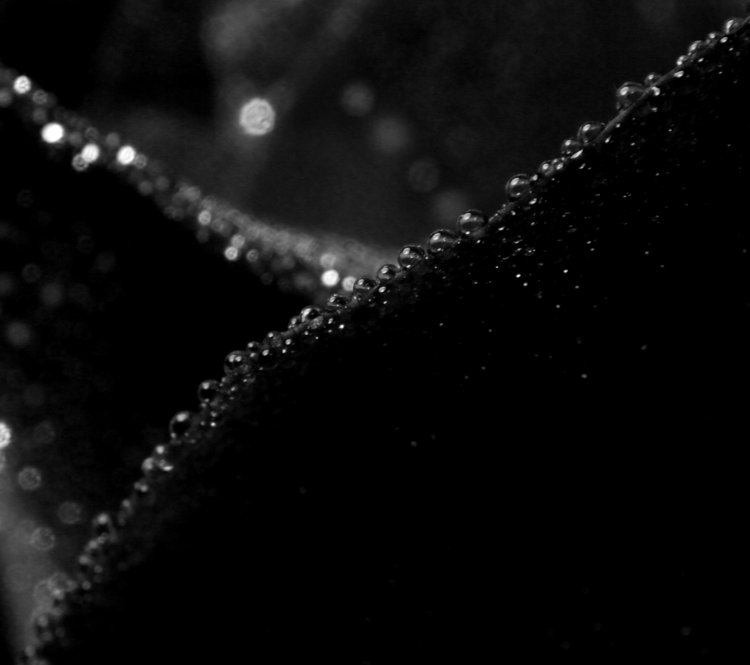
rainbow diffraction through frost
I like this one for how vague it is, but dislike it for not getting the detail that I wanted while still having too much. Do I sound neurotic, or just spastic?

But okay, the explanation. First off, this is winter 2015, and shows something that I heard about and always wanted to try, but we rarely get the necessary conditions at this latitude. You’re seeing a soap bubble in the process of freezing over and becoming solid, because it was about -8°c outside, plus the soap solution had been pre-chilled. It takes temperatures this cold because the soap bubbles will typically pop on their own if you have to wait longer for them to freeze, so it has to be pretty quick, and seriously, you can often watch the ice spread across the surface; I did not have video capability at that time, otherwise I would have been attempting that.

But the other aspect is getting it distinctly visible, which takes a dark background and light at just the right angle, which I largely accomplished here. The flash unit was off-camera to the side on a light stand, connected to the camera by a coiled cord, and that’s the dotted line you see under the rainbow edge of the developing frost, since it caught the light from the flash. It can take a lot of playing around to set everything up right, not including the soap bubbles that pop too quickly or start freezing on the back side. I just had to go back through the images to check: it was about 90 minutes of shooting for the first session, where I worked out a lot of the kinks, but only 15 minutes for the subsequent when I caught this – I think everything was still set up then, though the temperature had dropped further and I was having a little better luck then.

A bit of trivia. While I thought the rainbow effect was caused by refraction, it’s not – it’s actually light wave interference from the light reflecting off of both the outer and the inner surfaces of the soap membrane, separated by that fraction of a millimeter that causes the waves to go out of sync, doubling up some colors and canceling out others. You can even see the colors swirl due to the thickness of the bubble shifting as gravity pulls the soap around. I mean, not when it’s frozen, but normally.

I’ve tried this freezing bubble trick twice since, I think, and never got anything decent, and as I said, we rarely hit those temperatures here, so I get the chance once every couple of years, if I’m available and motivated at, you know, two o’clock in the morning…

Dittyday 10: Faded Flowers

This is another taste of how much the internet has changed things. We go back to 1986 and a movie called Band of the Hand, which I saw in theaters and happened to like (reviews are quite mixed but, you know, listen to reviews only when you can’t form your own opinion.) I’m not here to go into the film, but a particular song therein, which had a very brooding sound, enhanced by vocals that were throaty and almost-spoken; hearing the lyrics, “weave a circle ’round him three times,” sparked my curiosity, since I recognized it as a reference to Coleridge’s poem Kubla Khan.

But this was the eighties, and we didn’t even have a VCR at the time. The movie played ever-so-briefly on cable, then about vanished, and I would catch it on rare occasions, eventually remembering to watch the end credits and determining that the song was “Faded Flowers” by the band Shriekback. But what could be done with this information was sparse. While in music stores, when I remembered, I’d check out the 45 RPM bins for any sign of the song or the band itself, and occasionally the albums, with no luck at all. And that was pretty much our only options then. I don’t think it was ever released as a single, and I can’t recall ever seeing any of the band’s albums.

Many years later, I had a VCR, but the film could not be found for sale anyplace that I looked, though I’d rented it twice, I think. But I stumbled across a cassette of the movie soundtrack in a bargain bin, sometime in the early nineties, and snatched it up. This was the only song on the soundtrack that I had the faintest interest in; the theme track was by Bob Dylan, perhaps the last of his appearances on the charts, and while I intensely dislike Bob Dylan, this was a particularly annoying song. But I kept the cassette cued up to “Faded Flowers” and copied the track over onto a couple of my mixtapes that usually stayed in the car.

Time moved on, and I moved a few times myself in there. Most of my cassettes, including the soundtrack, disappeared, and technology switched over to CDs anyway, though I never attempted to have a CD player in the car (the early versions, for sure, were terrible, because they hadn’t perfected the anti-skip technology yet and so it was impossible to listen to an entire song in the car without it stuttering or just plain giving up.) Very likely that the soundtrack was never released on CD anyway, but even so, finding it still required searching bins in music stores; purchasing things online was still a decade or so away. The song eventually slipped from my consciousness.

Finally, about ten years or so ago, I thought about it again and started searching, only this time, YouTube was an active thing and people were using it to showcase their favorite songs (not yet entire bands, because there were server limits then.) And I found it again, and downloaded it – illegally of course, because finding it for sale, even online, wasn’t yet happening. So now it’s in MP3 format and easy enough to transfer to a smutphone, MP3 player, or the jump drive in the car. which means I can present it to you quite easily.

Faded Flowers – Shriekback

What took even longer was finding out what that word at the start of the second stanza was: “Only the anacrusis…” – even online dictionaries for a long time didn’t have something that esoteric in their volumes, and I’ll let you look it up on your own if necessary. As you might imagine, the song plays within the movie as the ingénue discovers she’s made a few bad decisions in her life; the lead’s gravelly tone offset by a falsetto female’s voice in unison within the chorus is a nice aural bittersweet effect, while the sparse music does little more than establish the mood.
Anyway, there’s an obscure one for you, though yes indeed, still from the eighties – why break my pattern now?

[On a similar note, I had much the same rotten luck trying to find the soundtrack to Highlander in any form, even though I knew Queen did all of the music for the film. It was when picking through their albums, on CD at the time but still in a music store, that I saw the album title, “A Kind of Magic,” and recognized the reference. It’s never been identified as the soundtrack and bears no mention of the film at all, and includes one song from another movie: “One Vision,” which played in the film Iron Eagle and made an appearance on the pop charts for a while that year. But anyway, if you’re looking for the Highlander soundtrack, and you should be, that’s the album you’re after – it’s quite a strong one.]
I wish I could explain it

This is an examination of not just an occurrence in my past, but the powerful mood that it invoked, and still invokes whenever I think about it. I’m not sure that I can possibly explain it in such a way that anyone else can come close to the same feeling, though.

It was, I think, 1999, and I was on an extended photography trip to Florida, touring where I pleased with no real itinerary. Several days in, I was staying down in Key Largo, where the evening before I had snagged a dynamic sunset sky out over Florida sound (the section of water between the Keys and mainland Florida, shallow and tussocky.) But that following morning, I had taken advantage of the canoes that were made available by the cottages where I was staying, and was tooling along in the sound under a brilliant clear blue sky among a light breeze and comfortably warm temperatures, about as close to piloting a dugout canoe among Indonesian islands that I was about to get. And hearing the drone of unrecognized engines, I looked out over the sound to see what was likely a tour plane cruising along at low altitude, not a thousand feet above the water.

Curiously, it was a Douglas DC-3, a WWII-era transport plane (though known in the military as the C-47,) one of the workhorses of the war and roughly the following two decades, but virtually unused in the US by that point – a pair of rotary piston engines and a decidedly mid-century design, with flat windscreens and a large rounded tailfin. Seeing one in flight was a little surprising, more so since it was not apparently a restored, commemorative piece but in actual use commercially, and I watched it pass with the sudden desire of being within it, hearing the distinctive drone of the engines and watching the blue waters of the sound roll by only a short distance below – preferably while hanging in the open door restrained only by a cargo net.

There remains in my mind the conditions of the war in the Pacific, where small airbases dotted various islands among the Marianas and Guam, hastily constructed hangars and airstrips among the largely undeveloped tropical islands, this curious mix of the devil-may-care tropics and combat readiness. It was also a golden era of flight, before we had jet airliners that operated at high altitudes with virtually no ‘feel’ to flying; instead, this was low and slow, follow the terrain and feel the shifting air and sways of the aircraft in an unpressurized cabin, listening to the distinctive throaty song of the engines. The rotary piston engine is almost gone now, replaced by turboprops and turbojets for anything larger than a four-seater, and this is probably no bad thing – the maintenance on such was probably quite involved. But I dare anyone to listen to one, or even to walk around any aircraft from that time period, and tell me it’s not evocative.

Though I still can’t place why I find it so compelling – that era was before my time, and there is no experience I can point to that would make me identify so readily with it, but I’m drawn to it nonetheless.

Living in the past XVIII or XIIX

…or just 18, or 12 perhaps (geek alert.)

translucent head of variable oakleaf caterpillar moth Lochmaeus manteo
Still working on 2014 right now, and we have this startling capture when photographing a variable oakleaf caterpillar (Lochmaeus manteo.) The light angle and the translucent exoskeleton/skin of the caterpillar combined to bring up this peek at internal anatomy, which looks like brain lobes, though I’m skeptical that they would be that big or detailed in an arthropod. Then again, the head is pretty sizable for some reason. But I’ve said it before: I just photographs ’em – someone else can explains ’em.

[Which still won’t stop me from applying my own bastardization of ‘reasoning.’ Because the adult moth that will spring from this will have a much smaller head, especially when you eliminate the compound eyes, and you might think it’d be the other way around – bigger brains as adults, especially ones that fly and fornicate. Yet for many arthropod species, that’s all they do as adults, which is the reproductive stage – many don’t even eat during their final instar. And we all know that reproduction doesn’t require a lot of brains, and may even shut them down at crucial times, which is not going to make a good children’s morality fable no matter how you slice it. Meanwhile, caterpillars… walk and eat. So do they need larger brains and/or olfactory apparatus for proper food selection, detecting the very specific foods that they often have (note the name)? Or perhaps this is their philosophical stage, where they ponder all those worldly curiosities and determine the meaning of life, before they lose it all during metamorphosis because the universe has a nasty sense of humor? What does that potentially say about this post?]

Tripod holes 49

trees in fog on Falls Lake not inverted
N 35°56’12.12″ W 78°35’55.49″ Google Earth location

I can pin down this location much better than when it was taken, partially because there’s no date stamp on the slide frame and it sits in the ‘Abstract’ section devoid of further context that might lend a clue – I’m going to say 1999, and let you attempt to prove otherwise. I was on – well, off of by this point – some hiking trails that bordered this particular branch of Falls Lake, early one foggy morn. This little ‘bay’ of the lake had a narrow isthmus across the mouth, certainly manmade, for reasons unknown, but it had a couple of – cedar? – trees growing upon it and I chose them for the fog shot. If I remember right, it was either on the north shore of this bay, or the one immediately north of it, that I found an old stone fireplace almost hidden within the woods, the remainder of the cabin/lodge/satanic altar since vanished. The isthmus wasn’t likely to be a dam, since it was far too low, on a shallow water site anyway, the feeder stream into the bay far too low in volume, and a much easier place would have been near the tip of the bay where the sides of the valley were quite steep. A bridge? Perhaps, but it would have saved only a few hundred meters at best, and linked to nothing apparent; the sides of the lakeshore were fairly steep all through here and the hiking trails meandered around and up and down and, really, the area was for footpaths or horses – little else could handle it.

Immediately north of this on the next bay is a small pond at the tip of the bay, and that was likely created by a manmade dam, because it’s too straight and not at all a natural-looking bit of geology. But I have no idea what this was.

Living in the past XVII

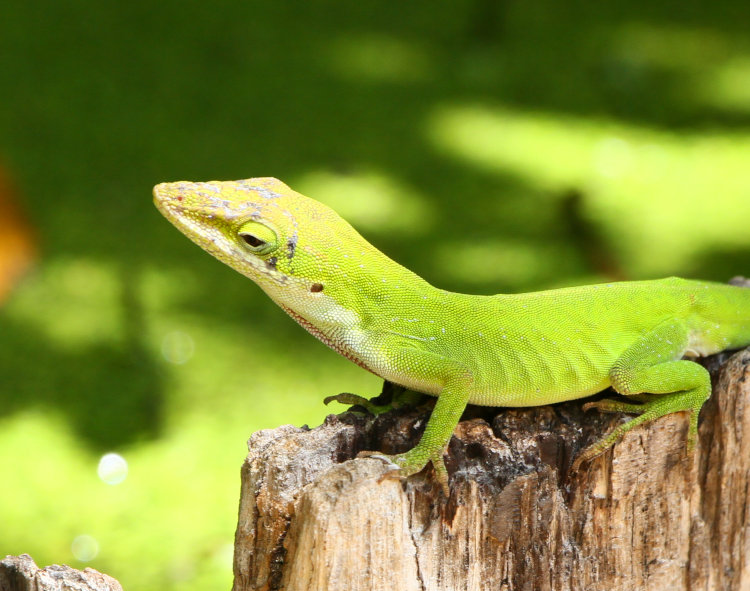
Contemplative Carolina anole Anolis carolinensis
Hopefully, it’s clear why this is one of my favorite images. The curious pose with its chin on its ‘hand,’ the downward, thoughtful eyes, and the soft and pastel, dreamlike background all work together extremely well – and all a happy accident; hell, I was only shooting with a wide-open aperture because of the light, and working without a flash. Plus I love the mosaic skin of the anoles, which fell into the narrow zone of sharpness. That the image is not exactly an accurate representation of what was going on is just fine – who needs the truth?

More human than human

Our legal system, at least in the US but I imagine in many other countries as well, has gradually become so broken that it barely serves its original purpose anymore, and while by all rights it should be improving, it is instead collapsing into a wildly manipulative affair that falls a long way from, “justice.” There are multiple factors behind this, but I’ll stick to the larger ones because I’m not going to do a treatise, and there’s a point that I’m about to examine.

Let’s start with:

Over-reliance on human testimony. By far, our courts rely on witness statements, which is perhaps the weakest factor that they could. Humans are notoriously prone to subjectivity, emotional bias, suggestibility, false confidence, and even “gut feelings,” something that a recent experience with jury duty reinforced, suggesting that we the jury ask ourselves whether we thought the witness’ statements felt correct. This is patently ridiculous, since courts are there to present evidence, not solicit feelings, and objectivity is intended to abolish whether we like some aspect or not – this is likely never completely possible, but at the very least the attempts should be actively encouraged, rather than subverted in this manner.

More specifically, however, humans make terrible witnesses, and this has been established and clinically proven time and time again. What someone says that they saw or heard should be taken with a grain of salt, especially if there is nothing solid to corroborate their statements. We tend to forget how often people lie, to say nothing of how often they’re simply dead wrong, and/or wildly mistaken in what they’ve seen or heard. Attorneys actually know this, because they’ll coach their clients, again and again, on exactly what to say, trying to establish confidence through repetition. The further people are from an event, the more likely their recollection of it is damaged or altered, and this has been well-established too, and preyed on just as much by attorneys.

Humans are notoriously biased. You can instruct jurors on penalty of expulsion or mistrial not to let prejudice enter into their decisions, and it won’t stop the lifelong, ingrained biases that they possess. The idea is that this balances out with multiple jurors, but in reality? Not so much, especially in some cultures, or portions of a city, and especially not if the attorneys are tasked with helping select jurors. And this says nothing whatsoever about judges, public defenders, and so on. It’s even hard to determine to what extent this takes place, though long-term examination of data and decisions often reveals some nasty little trends.

Expert testimony is too often anything but. It’s fairly well known that police officers are usually considered impeccable witnesses – certainly their testimony will be considered much more reliable than any other participant unless strong countermanding evidence is presented, as if becoming an officer instills perfect objectivity while also eliminating bias – just saying that highlights how ludicrous this is, though most people never even raise the question. But at the same time, outside testimony, for instance by metallurgists or handwriting experts, is often selected carefully by the attorneys because such testimony hews closest to their desired outcome. No one is a certified “expert” that cannot be wrong, and such testimony thus comes down to how convincing they make their statements and how well, or poorly, the opposing attorney has sought their own expert witness. Moreover, precision in many of the sciences simply doesn’t exist, and despite the impression that DNA testing and such offers incontrovertible evidence, almost no one steps in and points out how often such things can and do go wrong.

Nearly everyone involved is more motivated by their own career, advancement, and ego. Judges, attorneys, police officers, expert witnesses – the idea of serving proper “justice” is not usually paramount to most of them. Instead, it’s their record, and their politics, how many ‘wins’ they garner, how high-profile the case is, what kind of settlement it’s likely to produce, and so on. Everyone is well aware of the “hanging judge,” or the public defender that doesn’t put much effort into drug cases, and so on; attorneys routinely juggle the court dates of their clients to aim for the desired bias.

It’s ridiculously, irrevocably, undeniably money-driven. With few exceptions, the client with the most money will win their case, and attorneys will even refuse cases based on who they’re up against rather than the merits of the case itself. While it may not be as distinct as implied here, a legal team receiving more money will devote more time to reviewing case histories for applicable precedents, seek out better testimony, and most especially, bend over backwards to ensure a larger settlement and thus a greater payoff from their percentage (which is often ruinous, and not in the slightest commensurate with effort involved or an ‘hourly rate.’)

It’s also disturbingly true that representing oneself is almost guaranteed to fail; the legal system is so byzantine and convoluted that trying to negotiate it without years of law school is impossible. Clients that cannot afford a decent attorney will therefore never get representation, in the vast majority of cases, meaning that many, many crimes simply never go to trial, something that large corporations prey upon ruthlessly.

There’s a lot more, but suffice to say, it’s fucked up.

Now here’s the curious, potential solution that’s been nagging at the back of my brain for a little while now: this is what artificial intelligence can actually provide for us.

Not in its current state, no – what we have now is not even remotely artificial intelligence, it’s just algorithms to find patterns. And it’s possible that we may never develop a system that mimics natural intelligence to any serious degree. But bear with me for a moment.

The biggest issue with artificial intelligence pursuits right now, that many don’t even realize is an issue, is that the biological imperative defines what we are and what’s important to us. Actually getting humans to think rationally requires effort – otherwise, we default to indulgences and reactions and feelings. It’s what worked best for us among the choices that arose, all during our evolutionary development, but it’s so intertwined with our thought processes that it defines us and guides us, and depending on what purpose we might want to develop AI for, it could be exceedingly difficult to ‘program in.’ It’s also what introduces a tremendous amount of the difficulty in producing a functional, objective, and fair trial of justice. Hell, we can even argue about what justice is and what our morals should encompass.

Very little of that would actually have to be present for a justice AI, and the lack thereof is what would produce the fairest and most focused system in the first place. No ulterior motives, no biases, no underlying self-aggrandizement, no past experiences that color perception, and especially, no corruption. As the saying goes, just the facts, ma’am.

It would take a lot of work, without question – but quite possibly a lot less than self-driving cars. Attorneys would still be necessary (that’s a hard sentence to type) to prepare the cases for presentation, at least for a while, though a system that can search a broad database for precedents and interpretations is well within our abilities now. it even has the advantage of being able to determine, through the same kind of data searching, what forms of ‘expert’ testimony are anything but, and where the flaws lie.

Right now the idea is only half-baked in my own head, and needs more consideration; witness statements, for instance, which should probably take place in the forms of immediate recordings and specific questions to eliminate the subjective and exaggerating aspects – though this should be the case regardless. Cross-examination? Is this possible for an AI to accomplish functionally?

But overall, it suggests that it could potentially produce the environment that we’ve striven for all along, the elimination of human pettiness and imperfect concepts of justice, as well as the aforementioned biases and unrelated motivations. I’m at least finding the idea rather intriguing…

1 60 61 62 63 64 334