No, I’m not dying; we’re referring here, yet again, to the ol’ philosophical arguments about free will. Even worse, this may not be the last despite the implications of the title, but c’mon, I haven’t done one in a while so you can’t complain. This one was inspired by re-reading a post from five years ago, and realizing that I was toying around with some ideas therein but never pursued them. Now that they’ve gotten all complacent, it’s time to start the chase again.
I’m more than happy to point you towards some previous posts to fully define my take on the topic, and they will certainly do a more thorough job, but I also recognize that not too many people want to go through all that, so at the risk of being too brief and missing something, I’ll still try to boil down the basic premise. We’ll start with: There’s no free will – not in any manner that it’s typically invoked. Physics has distinct cause/reaction functions, to wit: input energy in, and this is what you will produce. And we count on this, as I’ve said before. Imagine driving a car and having some action of ours produce an unexpected or random reaction. That would suck, to put it mildly. These physics hold true from the realms of the very small to the unfathomably big, molecules up to stars, and yes, our brains are mere matter, and not even exotic matter, so they’re playing by the same rules. So what it inevitably boils down to is, pretty much everything is deterministic: a will lead to b and thus to c and so on. There is no property of our minds, or any other matter or energy scenarios, where the input/application of energy (for instance, pushing against a door or thinking about what to have for lunch) might produce a variety of reactions. Not only that, but any reaction has a distinct cause, which also applies to the matter within our minds – c could only have been caused by b, which could only have been caused by a. Seems a little more questionable – sure, the door is open, but anyone could have done it – though physically, only one person did do it, and with enough information at hand, we could easily determine who. There is no point where something could be up for grabs, variable at a physical level – and again, this applies to our meat brains as well. So what this means is, we’re not choosing actions in any sense of the word, because physics has already dictated what the outcome will be – even if we don’t have enough information to know what it is.
And yes, there is an apparent random factor down at the subatomic level, superpositions and indeterminate states and all that; on an extremely tiny scale, things seem to be unpredictable. And I’m hedging here because there are indications that they are not perfectly unpredictable, and may simply be driven by physical laws that we have yet to discover. Either way, these manifestations are infinitesimally small and don’t impact physics on a level that we can utilize, but even trying to fit this randomness into some free will scenario doesn’t work very well – randomness is not will or direction, being in fact the opposite of such. And it’s rather farfetched to think that our brains could use or even dictate such subatomic functions when nothing else that we have observed, anywhere, can make use of them. What are we, magic?
The interesting (and ridiculously contentious) part of this is, we really don’t like the idea of being automatons, where our actions and reactions can only be one way because laws of physics are a thing. But just like computer programs, input n and we will always receive output p. “That’s ridiculous!” anyone may scoff, “Just to show you, I’m going to do this!” But the very act of reading these words produced that reaction; it was not willed, it was simply following the programming of physics. Anyone may argue that we haven’t, and cannot, prove such a thing, but this isn’t quite true – it’s actually the only thing we have any evidence of in the first pace, and that evidence is omnipresent. Yes, there seems to be a nihilistic, ‘What does it matter what I do?’ aspect to this all – which is a manifestation of something, and that’s what we’re going to look into now.
First off, before anyone started recognizing that free will was a corrupt concept, everything was fine – we were in control, and shaping destiny and all that. We resent the idea of being mere players, following the rules precisely; it takes away our humanity. It is undeniable that we find decision making is important, and control is a driving force. We are not lower animals just reacting to conditions; we are not plants opening for sunlight, or rocks rolling downhill. We have these complicated brains for a reason.
Which is true enough – they weigh an awful lot of factors at any time. Some are not as important as others, and some are amazingly petty, really. And our emotions, which are goads towards survival behavior, can push us in rather questionable directions at times (more often than we ever care to admit.) We like to think of ourselves as much more discerning than the parent bird that stuffs food into whatever mouth is gaping in front of it, but we have a lot more automatic reactions than we like to believe. When someone shouts, “Hey, asshole!” we’re rarely inclined to think, Well, he’s entitled to his opinion, though it doesn’t seem very accurate. No, much more often we’re more along the lines of, “Who the fuck are you shouting at, dickhead?” Emotions are powerful things.
And, so it appears, is the idea of being in control, so much so that we can argue interminably about free will and the lack thereof. So, think about this: does it actually matter if we’re automatons or not? I mean, good or bad, like it or not, that’s what happens, right? But no, we need to feel in control of ourselves. And just like any other emotion, it seems very likely that this evolved for a reason. The question is, how and why would this work better than mere acceptance, or even being completely oblivious to the concept that things could be any different?
First off, we examine the difference in functionality and result, which is what evolution would be working with. Automatic reactions, like when we touch something hot or when birds flee sudden movement, are immediate, but more importantly undiscerning – there’s little room for variation, and it may take a conscious effort to override them (large question in there about what exactly a ‘conscious effort’ is, but we’re liable to answer that further down anyway so we’ll ignore it for now.) Then we have the ‘mid level’ responses, where something attracts our attention and provokes action, but we evaluate the situation before actually taking it – think of the startled response to finding someone right behind us, and how it might differ between being in a crowded office and being on a dark street at night. The automatic response is simply, “Hey, figure out what that is, because it might be dangerous!” But we have a variety of actions that we can take, once we determine what is warranted; it’s a complicated world so one type of reaction isn’t sufficient.
Then we come to what we’re actually doing when we’re exercising that free will, in-control, destiny thing. We’re not just weighing options, but imaging the consequences, creating little scenarios in our mind to try and determine the most likely outcome of any given action. The immediate reaction from frustration might be to quit our job, but then the after-effects of this come to mind and we realize that this might be much worse than hanging on a little longer while we find something better. Or for something as simple as where to go to eat, we may think, “Hey, Italian seems good” – an immediate gratification kind of response – but then remember that the Italian restaurant takes a long time to serve us, or costs more than we want to spend right now, and so on. So free will becomes much more of an impulse to carefully consider an action and its long-term result – which is undeniably a better function for any species, and exactly why we consider our human minds to be so much better than the rest of the animal kingdom. When it started getting colder back in our early hominid history, instincts may have told us to head towards warmer climates, but deliberation told us to have food for traveling in case it wasn’t readily available, and to stick together, and to aim towards places with building materials. The answer was already in our minds, because physics says so, but the desire for control, the impetus towards consideration, pushed away the kneejerk response functions to produce a more nuanced set of actions – often based on our past experiences and the ability to extrapolate. It might still be a computer program, but it’s quite a sophisticated one. And we have it because natural selection favored it over the simpler versions that had come about.
So where does this leave us on the whole ‘free will’ argument? Well, it redefines the actual functions and steers us away from the philosophical concept and all of its attendant assumptions, to begin with. But it also thwarts, to a large extent anyway, the idea that no free will means we’re puppets, because the actual functions in our brains really are to override kneejerk, immediate responses to produce something that covers a lot more bases, which is what we consider our decision-making process. So in that respect, yes, we have ‘free will’ (though my opinion is to eradicate the concept and the phrase entirely, because it’s stupid and misleading.) And yet, none of this means that physics doesn’t work exactly the same within our brains as everywhere else, so determinism still remains, and in the long run, we were still going to reach only this decision given all of the myriad factors involved. The point is, the function is to involve those factors (or as many as our other emotions allow at least) to produce the better action – and that’s all we wanted anyway. Still software, but much better software than imagined or implied.
* * * *
I’m going to add something here, right before I post this. As I’ve said before, here and elsewhere, emotions are goads towards survival behavior, essentially a reaction to input, and much closer to ‘instinct’ and ‘kneejerk’ than what we consider our reasoning, thinking minds (even though they’re all part of the same matrix.) And we recognize this to a certain extent, especially when we say that someone is “getting too emotional” – we know that emotional responses are more reaction than reason, more immediate and less considered. While not necessarily producing just one result (e.g. jerking our hand away from something hot, our ‘reflexes,’) nonetheless they’re pretty simplistic. And while it’s easy to think, in this deterministic universe, that provocation a will always spark off emotional response b, this isn’t necessarily true. First off, there are so many factors in any given social interaction – who it’s with, how mellow or irritated we are at the time, whether we’re hot or hungry, and so on – that the same provocations might produce a different reaction at different times; technically they’re not actually the same provocations anyway because of all those factors, no matter how much we might want to simplify things. But there’s also the past experience part, which is really what our minds are mostly made of in the first place. Somebody saying simply, “You’re getting too emotional,” is input, a factor that creates its own reaction and a new set of program lines. Perhaps it embarrassed us. Either way, we may now have a new set of criteria when a similar situation arises, and now there’s a subroutine that reins in the emotional response and provokes more of the ‘consequential’ one, what we consider thinking or even will.
But again, physics and determinism tells us that this was inevitable – we could only develop these new traits at this point in time. However, sitting within the machine, as it were, we couldn’t know that this would happen, and none of it exists ‘against our will’ anyway – because it happened within our own minds, it is our will.
Does this actually change anything in our lives? Not in the slightest – except if we get involved in ridiculous philosophical arguments about indeterminate circumstances and actually changing the universe by thinking about it. And those should go away anyway.
* * * * *
Okay, another addendum, just a small observation about the ‘programming’ that makes up our minds. There is admittedly a lot of variety that comes about from our past personal experiences, making each of us unique – and a lot of similarity because human minds have largely the same structures; the same tendencies towards social interactions, the same emphasis on family, and so on. As I was writing this, I was anticipating the typical reactions to any given statement herein and attempting to address the follow-up questions. So ask yourself: How often was this correct? Because if it’s more than once or twice, this is evidence in itself that we have a lot of thinking structure that’s predictable ;-)
Potentially Related Posts:





























































 The Aconitum blossoms above go by a variety of names, and one of them is ‘monkshood’ – when we choose that one, this now seems to have a faintly accusatory feel to it, as if we’ve just caught the eyes of the monks from across the monastery while doing something unmonkish (which is just about everything, I think.) Or maybe that’s just me.


 Eventually, it settled in on a bloom that was a bit closer to me, and ignored my approach, so I was able to get in much closer and get the detail that I was after. Once again, I think the muted light helped; it’s easy to believe that bright light is better for colors, but the truth is, bright light increases contrast and makes the shadows seem deeper while it can wash out the colors at times, so hazy to overcast light is actually better for such colorful compositions. And of course, bright sunlight would have burned away all of the dew by this time, eradicating an element that I was making good use of this trip.


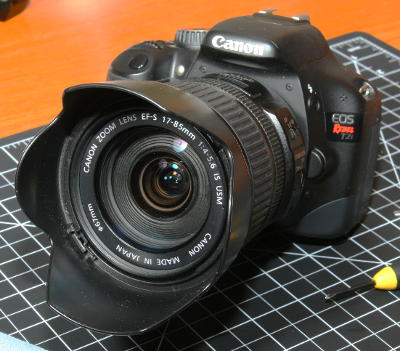 A little background. This particular lens is actually a notorious one from Canon, since this failure issue is well-known and frequent, which may be why I picked it up so cheaply with the Rebel T2i when I got that. It worked fine for me for a year or so, then I began having the dreaded “Error 99” messages when attempting to use it, which basically means the camera body is not getting the expected responses from the electronics within the lens. Sigma was fairly known for this same kind of failure, at least in the 2000s, and they were mostly caused by the same thing: damage to a ribbon cable within the assembly.
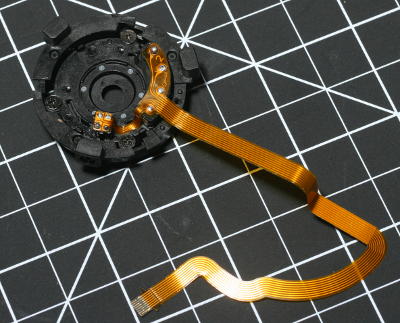 The part itself is quite inexpensive from many sources; it’s just getting to it and replacing it effectively that’s the royal bitch. And I will offer this choice bit of advice to anyone wanting to tackle this themselves: for the Canon 17-85, buy it already attached to the aperture assembly itself. It’s a bit more expensive but well, well worth the extra cost, because said assembly is not intended to be desoldered and resoldered and likely will not stand up to the abuse. I found this out the hard way (which means this was the second attempt.)

 And one other thing that I was wondering about, which was answered when I used it with my subject