Some tor’les

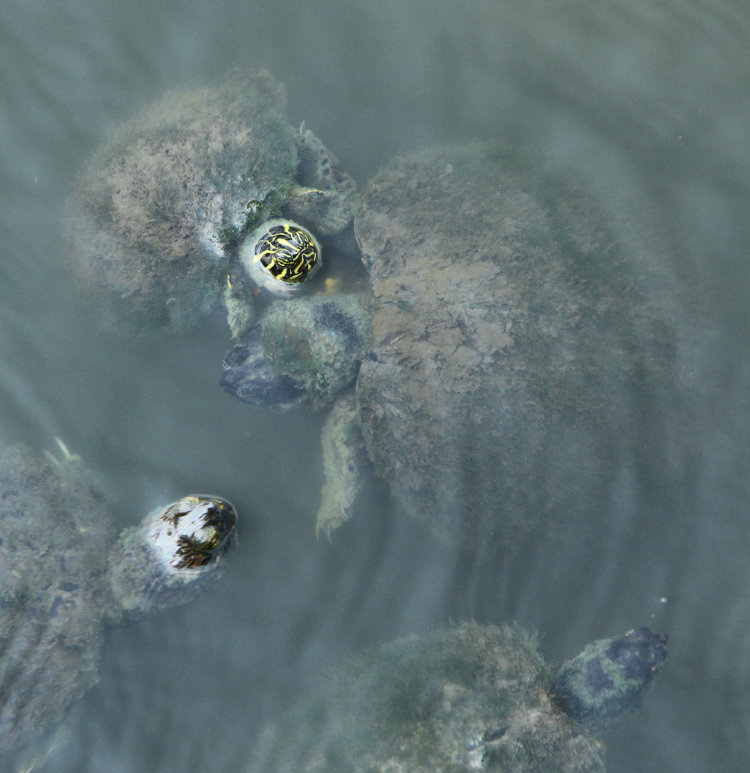
These were taken, I started to say, ‘a couple weeks back now’ but it’s actually over a month ago, so I’m definitely sliding a bit. It was when friends were visiting so we went down to the waterfront, and we were watching the turtles underneath the boardwalk. While there are posted signs that prohibit feeding any wildlife along the boardwalk, it was clear that plenty of people weren’t heeding these, since the turtles had clustered when we paused, obviously expecting a handout (or hoping we’d fall in – one or the other.)

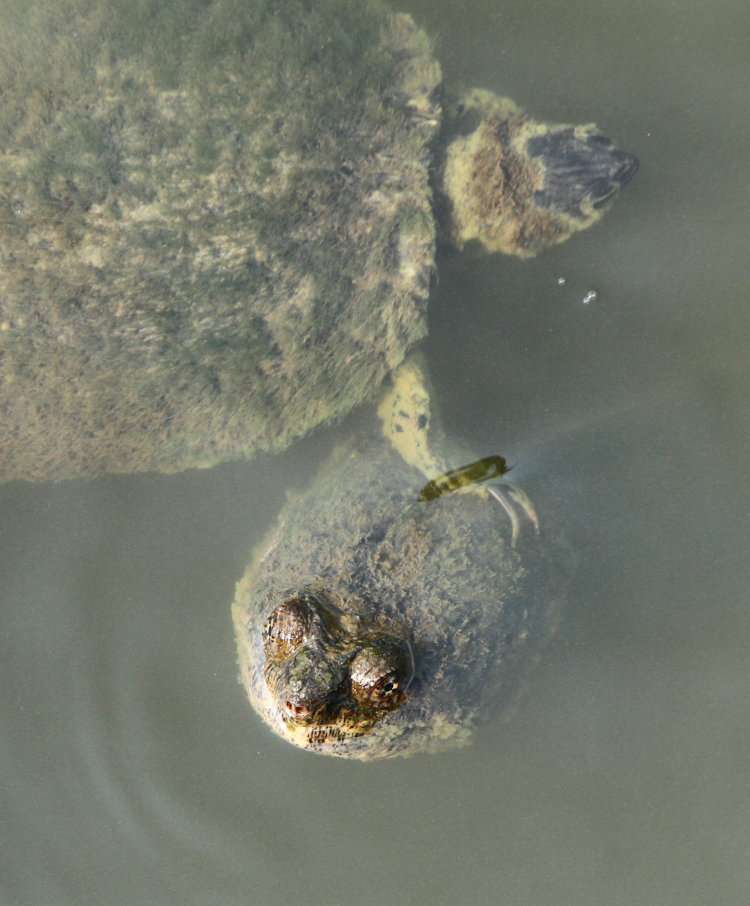
cluster of yellow-bellied sliders Trachemys scripta scripta underneath boardwalk on waterfront
While the angle and the algae-covered carapaces prevent absolute certainty, I’m fairly confident that everything seen here is a yellow-bellied slider (Trachemys scripta scripta,) varying from moderately-sized to quite large. Don’t ask me why that one in particular stands out so well with the vivid facial striping – to the best of my knowledge it’s a typical variant, though it was behaving slightly differently too, as we’ll come back to.

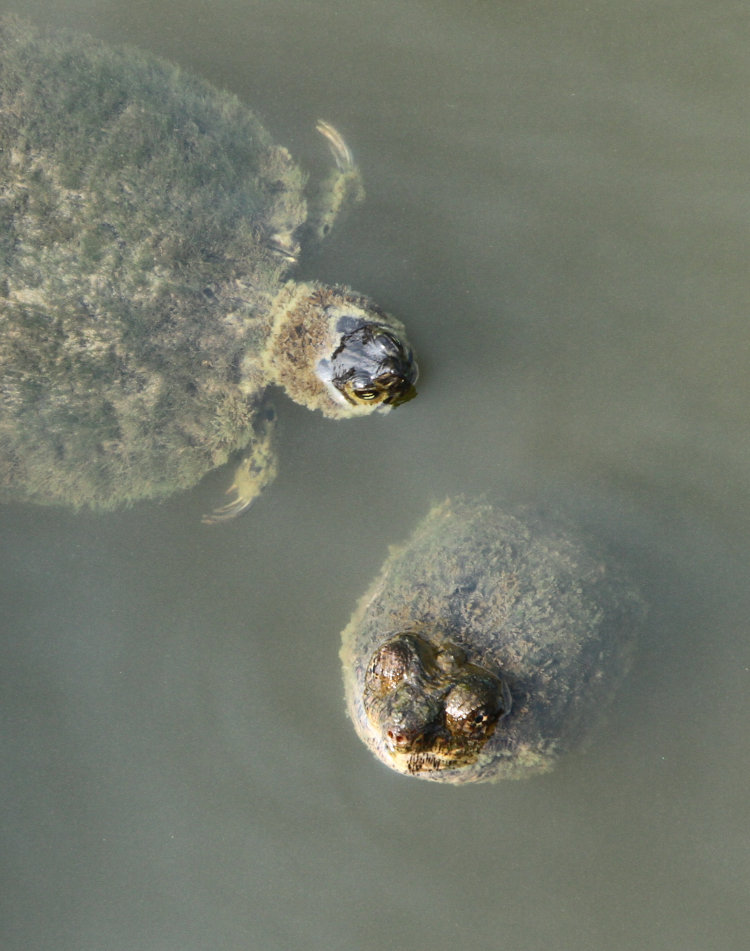
The startling thing was realizing that the wood piling that we were seeing at one spot, wasn’t – it was actually the head of a massive common snapping turtle (Chelydra serpentina.) It dove before I got into position for a clear shot, so I waited around and it returned – or so I believed.

yellow-bellied slider Trachemys scripta scripta drifting alongside head of massive common snapping turtle Chelydra serpentina underneath boardwalk on waterfront
Compared against the rather large slider next to it, this one was certainly quite impressive, and while I had no way to introduce scale, I can tell you that the snapper’s head is larger around than my wrist, and overall probably weighed more than six kilograms. It was only later that we found that the one spotted initially was actually larger, when it reappeared – again when I couldn’t get a clear shot.

The slider alongside was not impressed by this at all, though:

yellow-bellied slider Trachemys scripta scripta pushing off of head of massive common snapping turtle Chelydra serpentina underneath boardwalk on waterfront
As far as the slider was concerned, the snapper was just landscape, as it pushed off against the snapper’s head in passing. And the snapper took no apparent notice. This isn’t particularly surprising, because while snapping turtles have a wicked reputation, that’s from people harassing them; they don’t prey on other turtles save for very small specimens, sticking to mostly fish with the occasional duckling thrown in. And sliders are strictly vegetarian.

The little bright-headed slider was a bit of a pest, though:

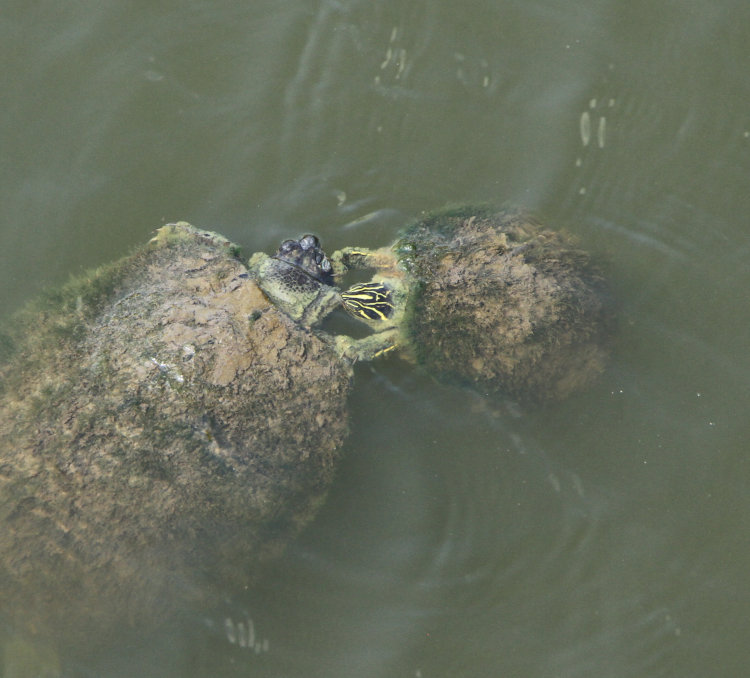
medium-sized brightly-colored yellow-bellied slider Trachemys scripta scripta biting the neck of a larger specimen, under the boardwalk on the waterfont
We observed this several times, but the one with the bright stripes was inclined to bite the other sliders (we didn’t see it attempt this with a snapper) on the excess neck skin, to what purpose we can only imagine. You can see the skin stretching out here. The larger slider put up with this for only a moment, though:

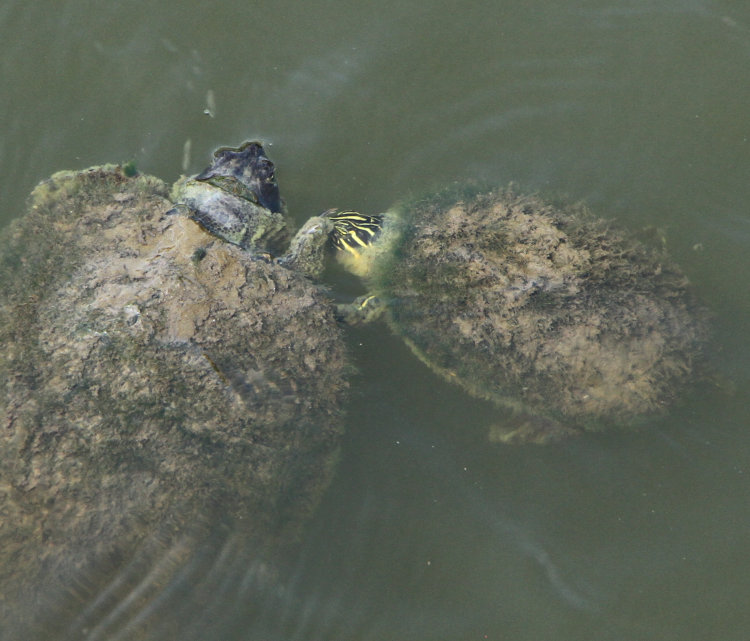
medium-sized brightly-colored yellow-bellied slider Trachemys scripta scripta getting palmed by a larger specimen, under the boardwalk on the waterfont
The larger one negligently raised a foreleg and planted its ‘palm’ right smack on the nose of the intrusive little guy, shoving it off with almost casual disregard.

By the way, don’t ask me what causes the prolific algae growth on their carapaces like this; I don’t know if it’s the water quality, or the temperature, or the lack of noticeable current, or something that the turtles do to encourage it. I get the impression that they don’t bask as often as, for instance, the sliders in our backyard ponds, because the algae should dry out and bake off then, to my thinking anyway. But this is also a brackish estuary and the higher salt content might be a factor too. I just takes picchers.

One more, not a tor’le, but shot on the same outing.

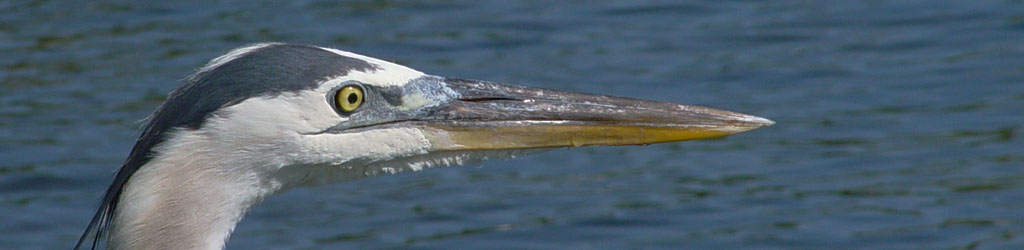
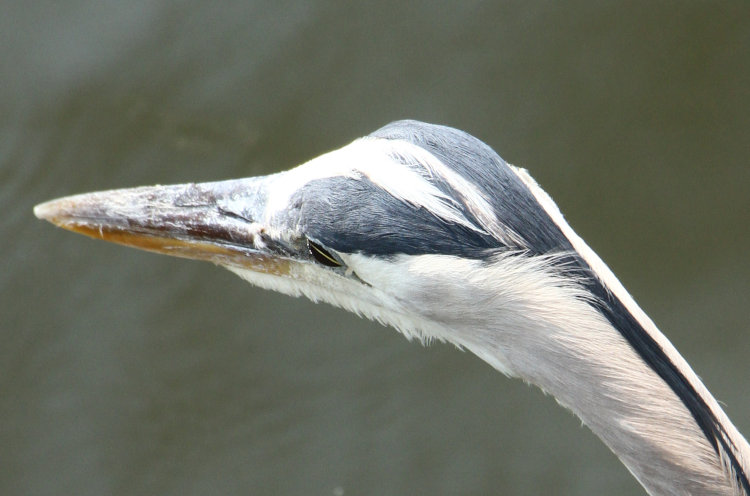
top-down viw of head of great blue heron Ardea herodias herodias from boardwalk on waterfront
Quite often on the waterfront, a great blue heron (Ardea herodias herodias) is in evidence, supremely used to the proximity of people – I can only assume it’s the same one but have no way of proving it. This time it landed quite close to the boardwalk and remained there as we approached, to the point that I was shooting almost straight down from above just a few meters away. The feather detail isn’t bad, but the eye is the real focus (heh!) because how often do you see it edge-on like this? Okay then.

That cleared out six more – the blog image folder is getting closer to normal now.

Just once, part 27

red-backed salamander Plethodon cinereus exposed from under rotting log
While we found several examples of this species on the day this was taken, to my knowledge, I’ve never seen it before or since. Yet this red-backed salamander (Plethodon cinereus) was found in the best location nearby to find salamanders and newts of any kind, which is West Point on the Eno River in Durham, NC. Their range across NC is curious, to be sure, especially when it doesn’t seem to follow the rivers that salamanders tend to congregate near. Why is it patchy and separated like that? My guess would be family issues – you know how it is sometimes.

While this image is rather straightforward from the top, something that I try to avoid as much as possible, what I like about it is how the natural speckling of the salamander is duplicated from the underlying leaves, a purely serendipitous effect from the sun angle, but I’ll take it. There’s a potential that pine pollen season had something to do with this too, since this was shot in April, but it looks far more uniform than pollen usually does, plus the fact that until moments before this image, everything you see was under a rotting log. Pollen can certainly get around, but not quite that well.

Plus, these guys are certainly less sticky and oogy to handle than white-spotted slimy salamanders, for eponymous reasons, though they were both found in the same location, just in different years.

Just because, part 52

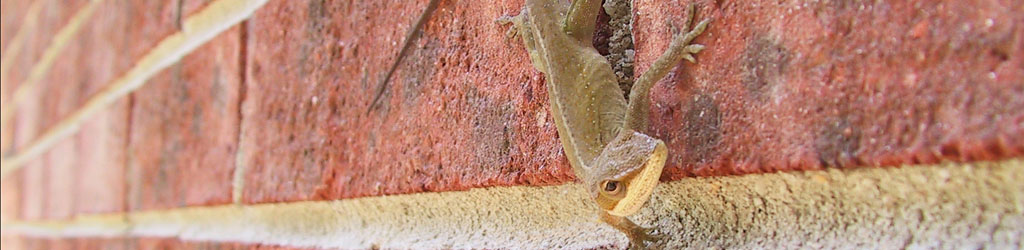
Carolina anole Anolis carolinensis peering down from upper branch of Yoshino cherry tree
Just a quick one from today, finding a Carolina anole (Anolis carolinensis) stretched out on an upper branch of the Yoshino cherry tree, the same one that I’ve been trying to protect from the Japanese beetles – it would be nice if this guy was eating those, but I’m not sure anything does. After finding the lizard there, a bit higher than I stand myself, I misted the leaves nearby because it’s been hot as shit here recently and I thought it might like a drink; my reward was this expressive pose, though at the same time the reptile’s skin darkened to a medium greenish-brown from the pale green that it was when discovered. What this means, I do not know, but I suspect we might be married now…

Only kind of useful

Two discoveries last night led me to shoot some comparison images, which allows you to see the size variations between these species, but not the actual size of them. It’s not easy to get something to show size in the frame with most of my subjects, even when I carry little paper measuring scales with me (how many people can say they have one of those in their wallets regularly? How many people don’t find this a bragging point? Weird.) Most of my subjects would either be disturbed by my attempts to slip something like that alongside them, or would move on immediately after I got it propped into place. Plus it destroys the aesthetic.

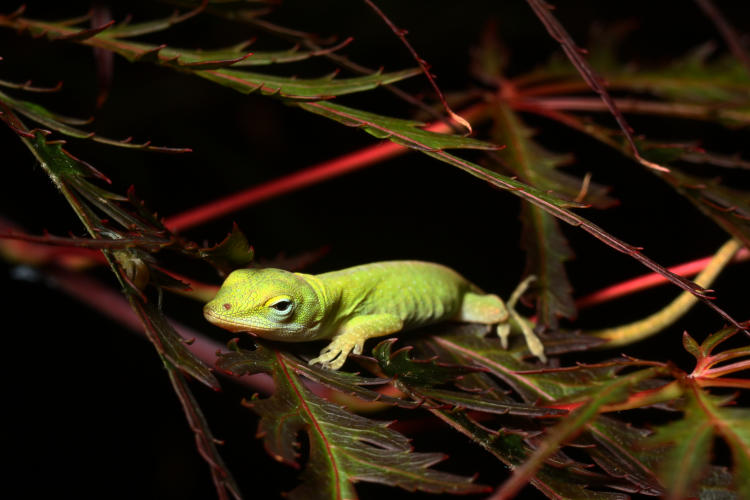
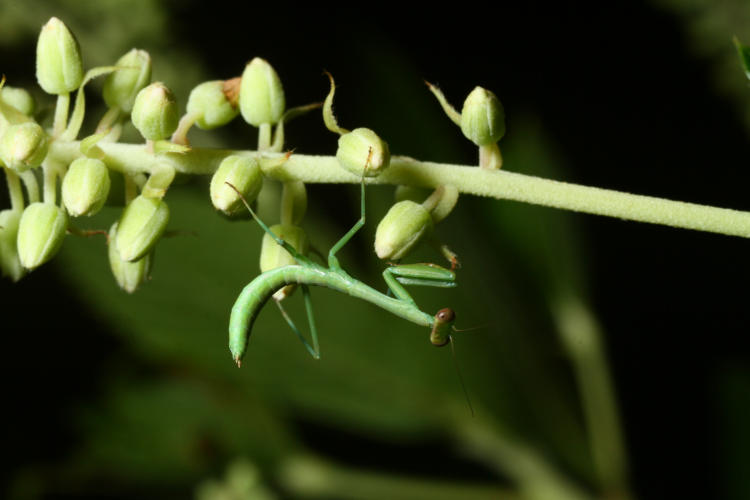
Regardless, here are the images, notable in that they were all shot at the same magnification and are shown here full frame, so each of these is exactly this size in comparison to the others.

very young Carolina anole Anolis carolinensis snoozing on Japanese maple
This is likely the same baby Carolina anole (Anolis carolinesis) found a few days back, given that it’s less than two meters away from that spot. Though I’d be thrilled to know there’s more than one this age (how many people – oh, never mind…)

juvenile Chinese mantis Tenodera sinensis on blackberry lily Iris domestica
This is a juvenile Chinese mantis (Tenodera sinensis,) roughly half adult size, flushed out as I misted the area. I missed a great video opportunity, because for all the times that I’ve seen mantids excited about getting misted, this one was the most exuberant, climbing the leaves excitedly and waving its forelegs in the air like it was conjuring – it would be easy to mistake this for an aggressive display, except that I know how they feel about water when it’s this damn hot out.

juvenile Carolina mantis Stagmomantis carolina on clethra buds
And this is a juvenile Carolina mantis (Stagmomantis carolina) on the buds of the clethra bush. Carolina mantises are roughly half the size of Chinese mantises and hatch much later in the season, so this one is quite young, probably a few weeks old. I’d seen it on the clethra bush earlier but the misting didn’t flush it out like the Chinese mantis; nonetheless, I found it with a short search while shooting the comparison images.

To keep these together, they were all shot at the maximum magnification of the Mamiya 80mm macro, though without the extension tube, so at a working distance of 16cm or so from the end of the lens hood. The last mantis is probably about 10mm in length, and the head of the anole is smaller than your little fingernail. Thankfully, they’re well separated because, at these sizes, there could be a food chain thing going on (though not in this order.) I was also pleased to find three Chinese mantids in the area with a short search, after how scarce they’ve been this season. Time to start stalking them for video.

Past midnight

Last night, the rains finally came through, mostly sideways, and it’s safe to say we’re saturated now. The treefrogs were signaling their approval even before it started, while remaining mostly out of sight (yes, even to me,) but they prompted me to go out after it stopped, just barely into this morning now, and look around a bit. I got no photos of the frogs, but found a couple of other subjects to tackle.

small ginkgo Ginkgo biloba leaf dotted with raindrops
Above, our ginkgo tree (Ginkgo biloba,) newly transplanted in the yard, was demonstrating the faint hydrophobic properties of its leaves. Ginkgos are often called living fossils, which is nonsense, but they are the only members of the Order Ginkgoales, which appears (through actual fossils) to date back to the middle Jurassic period – the structure of the leaves is pretty distinct, as you can see here: no branching, just the veins all originating from the stem itself. At some point I’ll be posting a little more about them, but right now we’re pleased to have one in the yard.

Out front, other things could be found.

unidentified wet leafhopper Cicadellidae defecating in public
This leafhopper was out within easy reach, but small, and my attempts to snag a sharp portrait with the reversed 28-105 didn’t quite nail it. This still illustrates the red color the eyes turn at night (much like the mantids, but theirs turn black,) and the raindrops, but that milky one isn’t rain, it’s leafhopper excrement. I know, right smack in our yard with no one around to scoop it. Class.

The real subject, the one that made me get the macro rig in the first place, was out on the big Japanese maple.

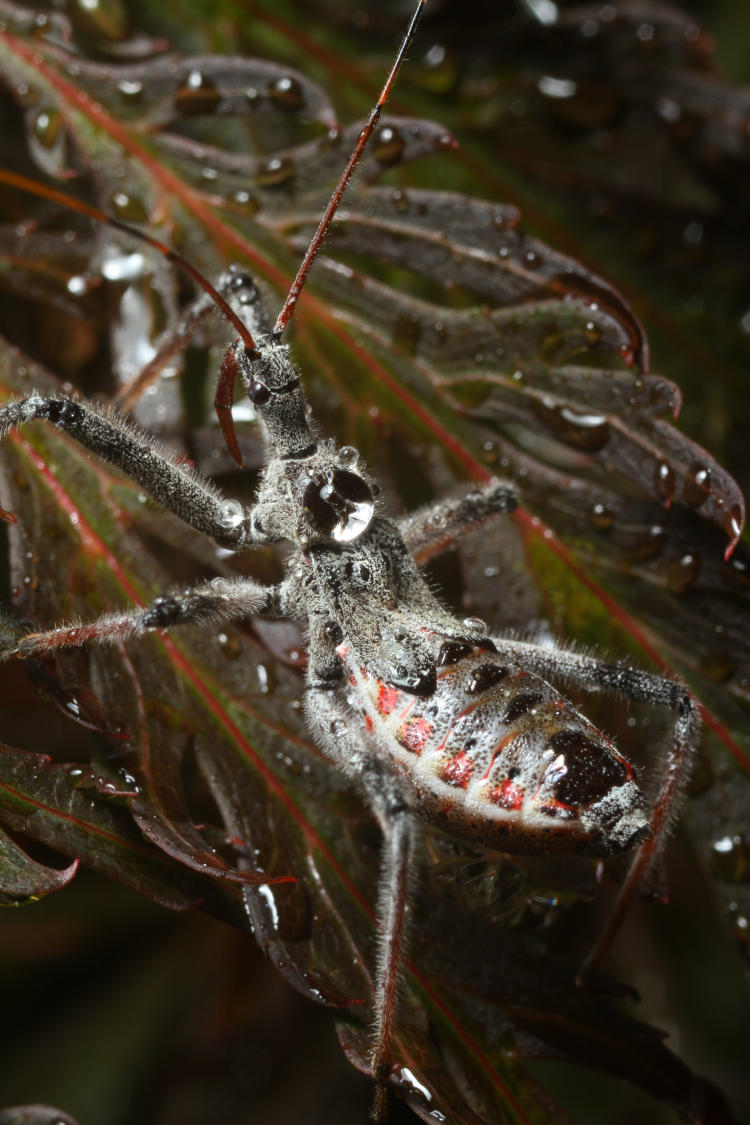
juvenile wheel bug Arilus cristatus sporting raindrops
I’d initially seen this juvenile wheel bug (Arilus cristatus) on the underside of the leaves, so white that I mistook it for the molted skin of a katydid, but when it had moved up top I could see the myriad raindrops adhering to it and knew I had to get some pics, especially since wheel bugs are almost fearless and thus easy to work with. This meant I could go in close.

juvenile wheel bug Arilus cristatus with big raindrops on back
All those hairs help suspend the water drops away from the body, and likely help repel parasites. The huge proboscis down there distinguishes this as a serious predator, which I’ve photographed before. But let’s go in for the real closeup.

extreme closeup of juvenile wheel bug Arilus cristatus showing magnifying water drop and eye facets
The luck that I didn’t have with the leafhopper came through here, in that we can see the eye facets as well as the magnifying properties of the raindrops – this is a little below full resolution. For the record, this specimen was less than 20mm in length, far smaller than an adult. And note the reflection of the round face of the macro softbox in all shiny surfaces in these images, visible once I point it out but otherwise subtle enough to escape attention most of the time, the reason I made sure the illuminating aperture was round; the rectangular highlight of a typical strobe becomes noticeable because it’s unnatural-looking. I’m still trying to balance an ‘even’ light source with the reduction in power that it will entail, because diffusing it more for a uniformly white circle will reduce what makes it to the subject, and I don’t need that. As always, modifications and refinements go on.

Gotta be quicker than that

I hadn’t quite finished sorting the stock photos before I left on my trip, and of course doubled that number with the trip photos themselves, so I’ve been endeavoring to catch up (just a handful more to go now.) But while doing this, as usual, I came across a few photos to feature and comment upon. This one is trivial, but I want to put it here because more sunrise photos are on the way.

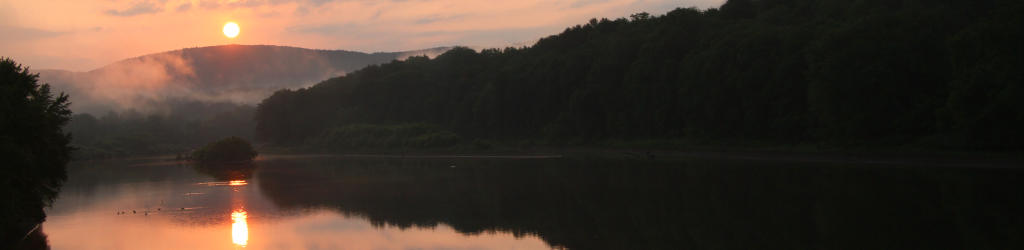
sunrise over Jordan lake showing ripples from fish jump
Nice enough sunrise shot out over Jordan Lake, on an outing a few days before I left, but I’ll draw your attention to lower center. See those ripples? That’s from a fish that jumped from the water as I was framing the photo – a nice addition, if I could capture it, but it takes millisecond timing because fish don’t often give any forewarning, nor any pattern in appearance in this manner. Their actual time out of the water might be, hmmm, 1/4 second or so? See it, recognize it, send the message down the arm to the hand, electronic delay time in processing the shutter press, mirror-slap and aperture closing… yeah, we’re on the fine edge of bare possibility, and that’s the best that can be said. More likely that I’ll trip the shutter coincidental with a fish jump – but hey, I have accomplished it intentionally, only with a much bigger fish that jumped higher, probably four times as long out of the water, so…

Please stand by

I have more than a couple of images to feature here, soonish, waiting on a little more time to write things up. They will be along eventually, but they may be delayed until after I’ve completed a large project, which is moving the site to a new host.

Which also means that things might go a little screwy, on the blog or on the main site itself, but anything should be rectified in a day or two. Provided that I actually get this all together, and right now it’s being a bit problematic – too much so, and I’ll dump the new provider and find a better one, which will delay the changeover a little longer. Regardless, if any part of the site is borked, just wait it out. As hard as that may be.

animated gif of bloggingIn the interim, I have to post a meme found online, which exemplifies my thoughts about blogging better than I could ever express in writing. Much as I hate using sports references, this one works well.

Thanks, everyone! I couldn’t do it without you!

It’s not coming together yet

I have finally gotten a veritable buttload of pics to post, but unfortunately, cannot do so just yet. Between work and student schedules, various tasks around the house and in the office, and sinuses that are wreaking havoc, I can’t sit down long enough to do a post justice, much less a couple or three of them.

I know what you’re saying: “Jeez, Al, work from a schedule! Set aside key times during the week devoted to maintaining your website and such commitments, and stick to it! Duryay!” Fine – easy for you to say. But my schedule bounces around from week to week, plus of course I can’t dictate when my sinuses will decide to lock my head down in a vise, and all that, so put a sock in it. The bouncing schedule, at least, will be taken care of soon enough, one way or another.

In the meantime, I will slam out some quickie posts just to show I’m not dead – unless of course I’ve written an artificial intelligence program to automate my postings, with access to the stock photo folders, and have at some time in the past died from a decongestant overdose. But you know that hasn’t happened, because no robot could write anything with this much panache – as cool and sexy as robots are. Man, robots could make our lives so much better, if only we’d let them.

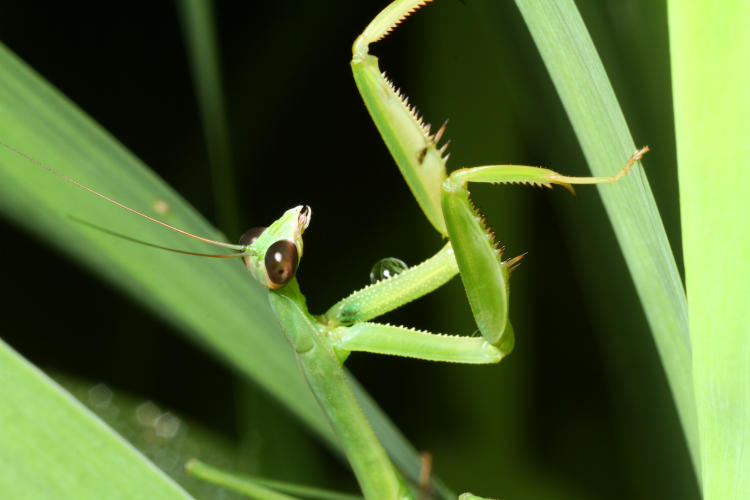
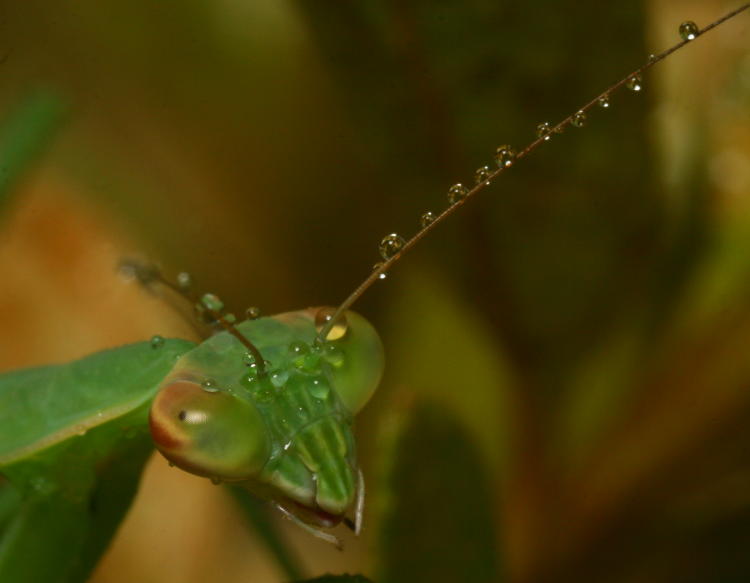
Anyway, here’s a mantis from yesterday. While none of the egg cases I got this year seemed to have hatched, nonetheless there are several mantids in the immediate area. I find it interesting that, in this ridiculously hot and dry weather, I can summon them with a misting bottle: hit key areas with a heavy coating, and if there’s a mantis around, it’ll come up to the upper leaves to get a drink. This one was quite pleased with my actions, and thus posed readily with a nice string of droplets along its antennae, and I was able to get them and the eyes in the same plane of focus.

Chinese mantis Tenodera sinensis with water drops from misting bottle
More will be along before too long, I promise. And if you can’t trust the word of a sentient computer program, what can you trust?

Podcast: Twps & Boros & USB

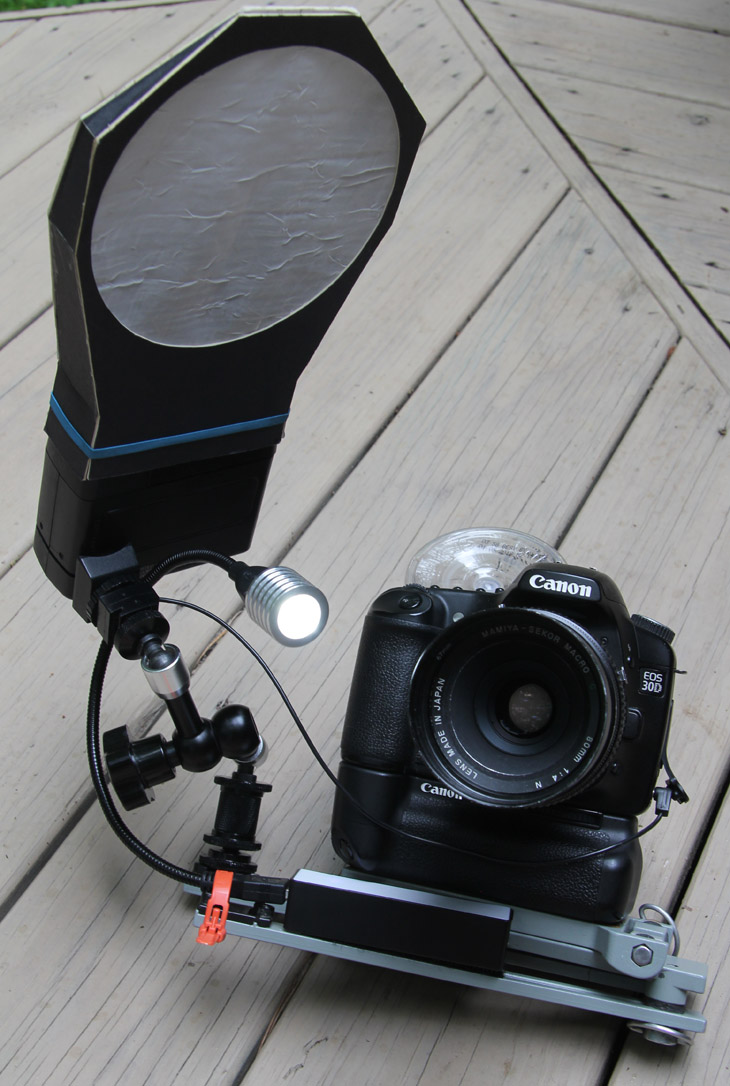
macro photography rig showing focusing light and softboxed flash unit
And so, at long last, another podcast… but, you know, don’t rejoice yet:

Walkabout podcast – Twps & Boros & USB

Let’s start with the good stuff: Carmen’s Deli in Bellmawr, NJ, where you can get authentic Philly-style hoagies. And other things, too, but who cares? Hoagies, man. Hoagies.

A Jersey jughandle – follow the blue arrows.

Google Maps illustration of an actual jughandle
If you’re traveling north on E. Black Horse Pike, you have to bear right to go left onto W. Nicholson. Notice, however, that southbound traffic has a (more or less) normal left-turn lane.

Here’s another:

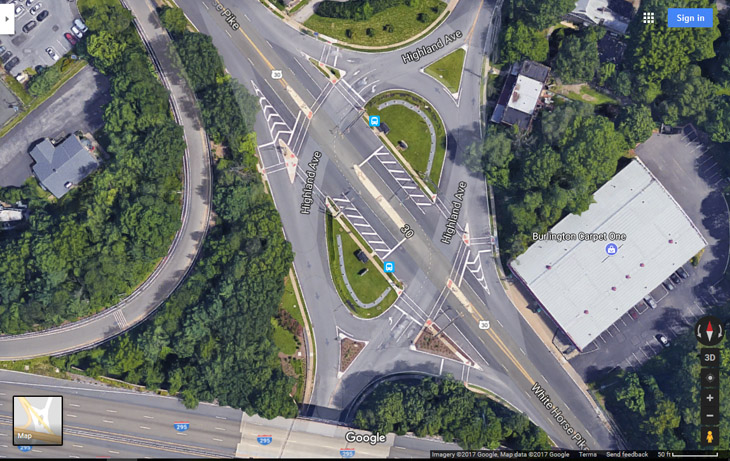
Google Maps aerial view of another Jersey  jughandle
You see, I understand the idea of a traffic circle, which more-or-less regulates without the need for traffic lights (as long as people understand the very simple rule of “yield to those within the circle but not if you’re in it and not if no one is coming” I’m looking at you North Carolinians,) but there are lights at each of these junctions. So how does this improve matters over a simple four-way with turn lanes? Ya got me.

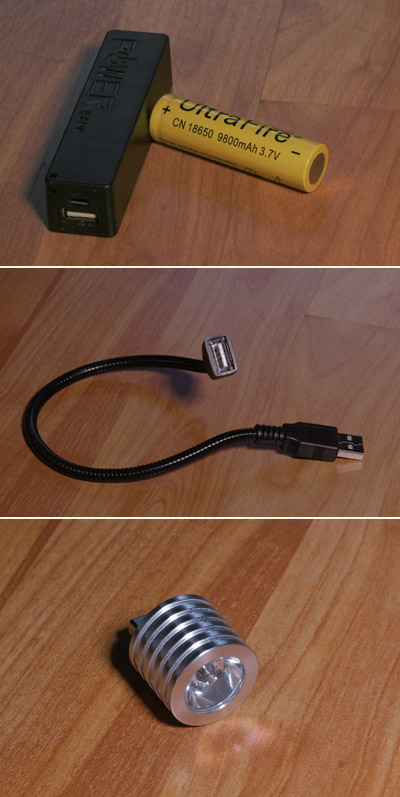
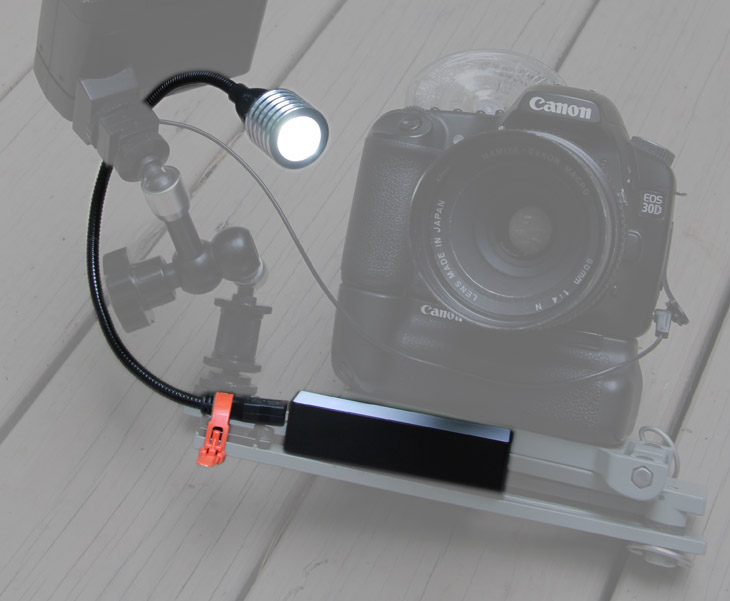
three main components of LED macro focusing lampOkay, on to more topical stuff. These are the three components of the macro focusing light that I constructed, for only a few dollars all told.

At top, the USB power pack, usually intended for recharging smutphones in a pinch, and the 18650 battery that it takes – all I purchased was an empty case, since I already had the battery. It might be best to buy the battery separately so you can get the best deal on the highest milliamp-hour (mah) battery you can find.

In the middle, the USB gooseneck extension, very stiff and easily aimed as needed.

At bottom, the light unit itself, not to the scale of the others but roughly twice as big in this pic – compare the wood grain to the image above it, which is the same stretch of floor. If it helps, the unit is 26mm across, about the diameter of a quarter. And yes, it is bright, and fairly tightly-focused, so ideal for my purposes.

The previous version, a homemade rig, can (kinda) be seen here; it worked, but tended to slip position even with hook-and-loop attachments or rubber bands. Some of this was due to the short gooseneck and the necessity to be close to the lens.

You can see everything in place with the entire macro rig in the opening photo, but highlighted below to point out the components clearly.

macro focusing light highlighted
The orange zip-tie is removable, and serves to stabilize that end of the gooseneck arm because it doesn’t fit as snugly as needed into the battery pack. But with it, the light remains pointing precisely where needed.

So, how’s it work? Well, the next two images were taken in a pitch-dark room with only the macro light to focus by (manually of course, with the reversed 28-105mm.)

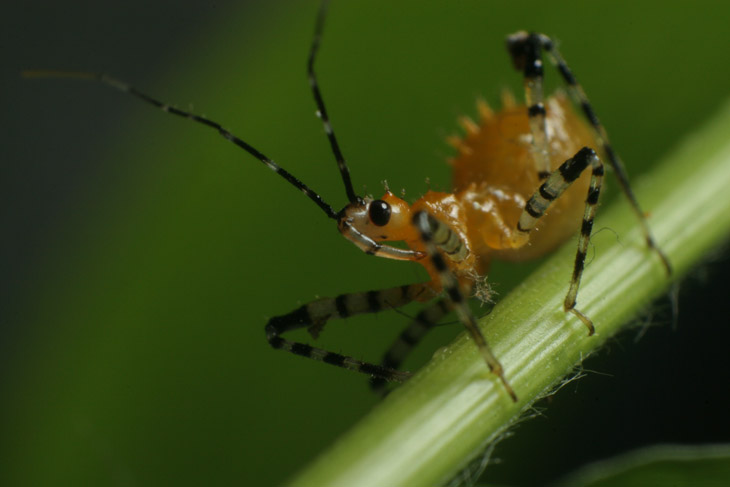
juvenile assassin bug possibly Pselliopus
This assassin bug was less than 6mm in body length, making that proboscis 1mm or less, and you can see how short the depth is even at f16 by how quickly the legs have gone out of focus. The stem that it’s perched on is perhaps slightly thicker than a pencil lead.

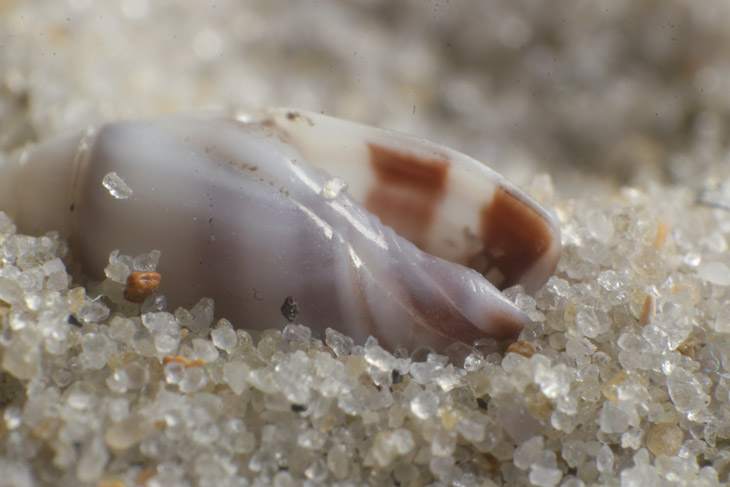
tiny shell and sand grains
And this is a tiny shell found during the beach trip – those are grains of sand, fine ones mind you, in the foreground and adhering to the shell. The illumination for both of these images came from the flash unit, but the ability to see them and have the camera at the right focusing distance came courtesy of the new macro light. Yeah, it seems to work just fine.

I still wear a headlamp when out at night just to find my way around and do the initial spotting of subjects, but the macro light comes into play when I’m focusing; as I said, it can be positioned close to the flash unit itself to throw light from the same direction, to give a better indication of how the light will model and where shadows will be thrown. Later on, I might affix another LED directly within the softbox itself, aimed where the center of the flash burst will fall – that way, I know precisely how the lighting will be, and will know when the flash might be blocked by leaves or aimed a little off (which happens more than occasionally.) There are always refinements that can be made.

Oh, what the hell. Here’s another example of Jersey boulevard blight. And yes, I drove through each of these – this one was even under construction. I added arrows to help illustrate directions of travel.

ridiculously engineered road junction in south Jersey
Once again, all of this in ground level, and every place where the lanes cross has a traffic signal – at least twice as many as would be needed for a routine intersection. When the power goes out, this would require a squad of police officers to direct traffic through.

Okay, okay, I’ll get back to nature photography or trashing religion shortly.

Peace or piece?

This is an observation that’s been lurking in the back of my mind for some time now, and I finally decided to set it down in detail. It is sure to make quite a few religious people get defensive, but the point is, that’s probably inevitable.

Let’s start with the simple aspect, and I’m going to fall back onto my old favorite, gravity (as well as subtle but terrible puns, it seems.) Do we ever see anyone arguing for the existence, function, or logic of gravity? Can there be found, anywhere, even the faintest vestige of doubt that it exists? It seems ludicrous to even ask those questions, doesn’t it?

Why, then, do so many religious folk get uptight, like, all of the fucking time? How does the absolute assurance not only of a creator, but one that has distinctly outlined exactly what happens to true believers and nonbelievers, result in the widespread anxiety that forms so much of the public face of religion? How does the idea that same-sex couples can receive legal recognition of their partnership foster so much ire? How does teaching evolution in school count as denying someone’s religion? Why should the eradication of “under god” in the pledge of allegiance (a completely irrelevant ritual to 99.9979% of schoolkids) provoke so much backlash? Truth is truth, right? How can omnipotence be threatened in the slightest?

A ridiculous number of online articles that even mention evolution will receive disparaging comments asserting that evolution is anything from a mere theory to an outright lie, and the vast majority of these comments are, not to put too fine a point on it, distinctly petulant and bratty in tone. Provoked? Not hardly – it’s next to impossible to find any article about evolution that even mentions religion, much less makes any claim that it’s disproved by natural selection. But is it an inferred attack anyway? The case could be made, but then again, it could be made for virtually any science article, as well as any article that mentions a religion other than the one the testy commenter follows. Yet even an inferred attack doesn’t justify the type of responses seen so often.

If you’re a public figure that even mentions homosexuality, secularism, atheism, or merely reducing religious privilege, you can expect a storm of messages promising your eternal torture and assuring you of your gross immorality, with the addition of a few threats of direct violence – because, you know, religion has that ‘force for peace’ thing going on. Point out that some law or practice is unconstitutional and you’ll also invite the diatribes produced from spittle-flecked keyboards. And I shouldn’t have to point this out, but this is not from some marginalized and openly-targeted minority faith, but mostly from those ‘good christians’ that not only make up a majority in this country, but enjoy the frequent rump-osculation from every political party as well, not to mention quite a few perks from the bare idea that religion should be respected. In fact, that’s a favorite word among the religious, a hell of a lot of whom somehow believe such a thing only goes one way. And while there certainly are exceptions, people who would never stoop to such juvenile tactics, don’t be looking for them to correct their brethren, or even suggest civil discourse.
I am a great fan of objectivity, though in some cases the attempt to demonstrate it is pointless, and only worthwhile because this entire post will be summarily dismissed otherwise. So, are these comments being made by children? Well, of course they are, duh! Oh, you mean actual adolescents, below legal age or whatever? The evidence doesn’t really support it; the posts often take place in forums where other obviously youthful comments don’t appear, and where topics of teen interest are few. It’s often not hard to distinguish a comment from a youth, and this is not consistently demonstrated. Moreover, adolescents jumping into adult discussions with derisive commentary just isn’t a common practice – though there are mitigating circumstances that we’ll look at shortly. And finally, if the majority of those holding such attitudes were under voting age, then the politicians wouldn’t be pandering to them at all, would they? Not to mention that we all have personal experience with fully-grown people who demonstrate these outlooks, and I can say that with utter confidence.
Is it fear? Well, of course – but very likely something more than that too. Just the possibility of being wrong doesn’t make people get that uptight, that outright nasty – it takes a lot more, the fear of losing something valuable. That something valuable is privilege, the status that is gained from the very idea of religion. It is important for them to be recognized as superior, because of their very choice of religion – otherwise what would be the point? It’s kind of like when big sister is left in charge, and the younger siblings ignore her orders, safe in the knowledge that she cannot wield the authority (and/or the punishments) that the parents can. Impotent rage takes over.

This would mean that faith, in such cases, doesn’t come from logic or moral guidance or even the reassurance that there is a plan of a benevolent overseer, but from insecurity, the desperation for a special status. If this seems doubtful, consider how often religious symbols are openly displayed in the home, on someone’s person, on the car… who needs to know about this? The omniscient god?

Interestingly, the similarities between this and discussions regarding aliens and conspiracies and such are manifest, in fact almost identical: the same blustering schoolyard attitude, the same condescending and insulting approaches, the same name-calling – and even the same old hackneyed sound bites, over and over and over again. That last bit says a lot all on its own, because it’s not like these sound bites haven’t been answered and repudiated, nor is it likely in any way that doing so yet again will have any affect. The appearance of such arguments is a distinct indicator that the user openly ignores any and all contradictions or corrections – they are not in search of what’s right, only what validates them. And when this validation seems weak – when it seems like it’s being ignored or simply doesn’t have any application at all, when their status is worthless – they strike out with open animosity. It does not provide peace of mind in the slightest – but perhaps a piece of their mind to bestow upon others, at least.

This is not to oversimplify anyone’s motivations, which may be complex, but it bears consideration as a distinct factor in light of the responses; sports and politics are capable of fostering the same. The relation to these is probably not coincidental either, since the convincing, demonstrable superiority of either sports teams or political parties is just as ethereal; it’s not a sign of confidence, no matter how one looks at it.

But since so much of religious belief, and indeed so much of many human behaviors, is prompted by what others are doing, we should take a look at this too; it’s giving more credit than is warranted to assume that all such actions come through careful consideration. There remains the distinct possibility – actually the very high probability – that such attitudes are promoted directly by churches, and the threatened, defensive demeanor is what the flock is encouraged to have, by either the passive beliefs of those around them or the active teachings of their church. This fits in remarkably well with the constant repetition of those aforementioned sound bites, which must be coming from somewhere; such consistency is not generally found among other topics.

Which is a very curious line of thought. Does this mean (or to be more accurate, how often does this mean) that churchgoers are actively steered towards insecurity and looming threat rather than, as we are repeatedly assured, the peace of mind that religiosity promotes? Instead of providing answers and confidence, how many churches play mind games with their followers by making them paranoid? The ‘wolf at the door’ tactic has been used for centuries, often enough by political parties trying to create a common, manipulative cause, and this pretty much defines the idea of satan and evil in the first place.

Don’t get me wrong – people don’t need help being insecure, or seeking some pointless, effortless manner of feeling superior because of it. But that just means churches have a common trait that they can exploit, just like they have for centuries when targeting the disadvantaged or sending missionaries around. And we can’t deny the appeal of becoming ‘better’ just by performing some inane ritual, rather than expending some effort towards honest improvement. But isn’t it funny how this superiority somehow fails to instill confidence?
So how does that happen? Is it a program of careful manipulation, the creation of a specific set of circumstances where the chosen folk are under constant threat from the pagan scientists and Teh Gays? Or is it the dissonance of hearing the assurances from the churches of how things ‘must be’ but failing to see any actual evidence of such? Or is it simply an unaddressable insecurity, to be found no matter what? Or any combination of those, or anything else besides? That will be left as an exercise – I know what I’ve seen plenty of evidence of myself, including the specific assignments for teens, without any useful background, to go to science and secular websites to post their diatribes for church credit. But this is by no means an exhaustive and controlled study.

Funny, though, it simply doesn’t work. While condescension is occasionally a wake-up call to someone being arrogant or assumptive, most times it’s simple annoying, almost the exact opposite of convincing. The abject ignorance of most of the arguments is plainly evident to anyone even remotely aware of the fields usually addressed, and the rabidly defensive responses visibly well out of proportion to the ‘threat’ of same-sex marriage or allowing women to drive cars – it’s remarkably easy to look like a loon. And it says an awful lot that these tactics are still being promoted.