The end of the beginning

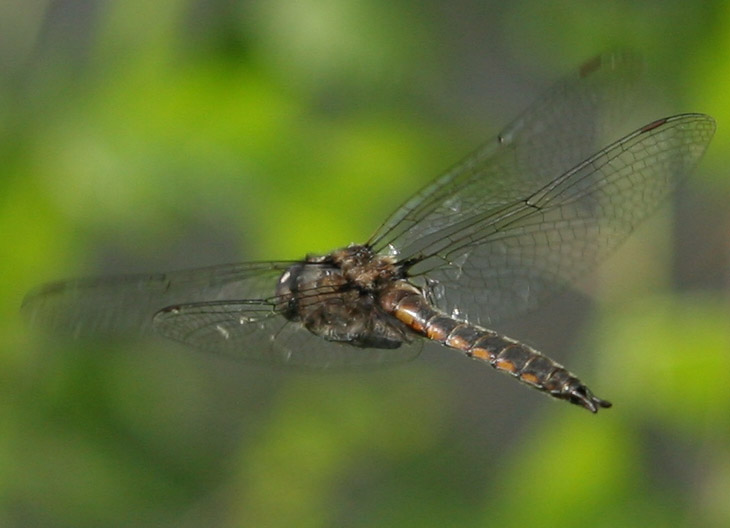
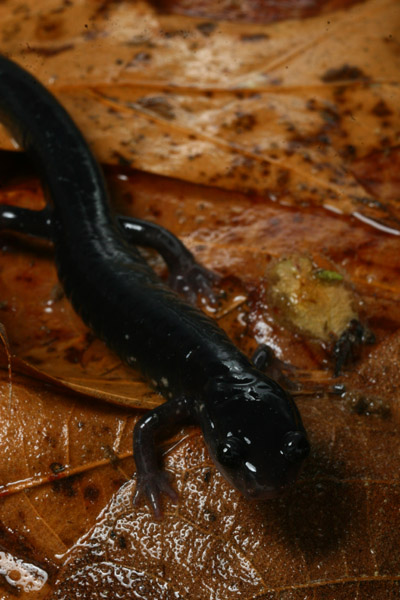
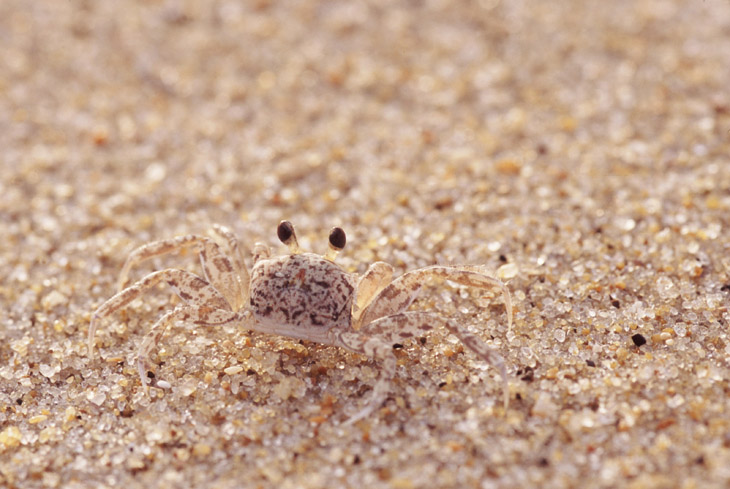
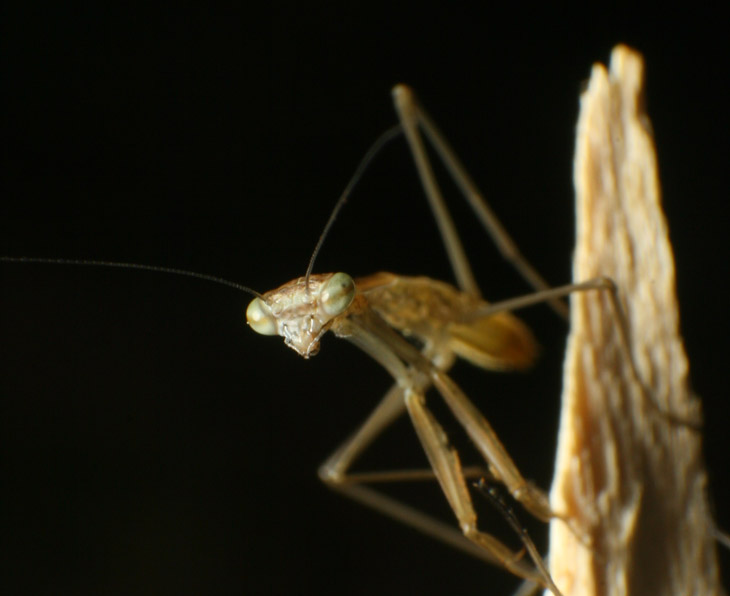
Otherwise known as January’s month-end abstract:

tight crop of hindwing of Low's swallowtail Papilio lowi
I said this might be back, and you scoffed – don’t deny it, I heard you distinctly all the way over here. So let’s gaze deep into the hindwings of the Low’s swallowtail (Papilio lowi) and the curious pattern thereon. Don’t ask me what exactly it accomplishes, but I want you to see something. From a short distance, the wings appear to have gradient tones, shading that almost gives them a three-dimensional shape, but on close examination we can see that the scales come in only two colors, black and pale blue. The shades are produced only by distribution, a lower density of the blue scales giving more of an impression of shadows. This is almost a good mimicry of hollow tubes or stems, but there’s a flaw: the centerline of each should be the brightest blue to carry the impression, the reflection of more direct sunlight, rather than having a darker line which hints at a hollow or crease. Again, I can’t think what this is supposed to communicate, if anything – it might simply be to attract the attention of predators more towards the non-vulnerable hindwings, or it might be a sexual display, or simply something to confound bloggers…

Monday color 17,241

Duke Chapel at sunset
I’m doing that count from memory, so I’m not exactly sure that’s the right number, but it’s somewhere up there, anyway.

As I was going to meet with a student at Duke University at 5:30 last Tuesday, Duke chapel suddenly became visible between the buildings, illuminated by the setting sun, and the stark coloration naturally grabbed my attention. Extending well above the trees and surrounding buildings, the bell tower captured the light of the sun as it was dropping to the horizon while just about everything else was in shadow. White balance was set for full sunlight, which basically means no correction, though I admit I tweaked this a little bit – I bent the curve a tad towards blue for the sky alone, which would have reduced yellow by the same margin – the effect to the tower itself was not even visible.

Many years ago I was working for a place that printed the school newspapers, and I would go to another building nearby at 1 am to pick up the pasteups, driving up chapel Drive directly towards one face of the tower. The chapel is always lit by floodlights from all four sides throughout the night, but on one particular night, during an extremely dense fog, the floodlight on my side was out while the remaining three were still alight. The effect was fantastic, the dark silhouette of the elaborate tower standing out against the brilliant white of the floodlit fog that twisted and billowed gently like steam. See those faint patches of sky peeking through the bell openings at midpoint? Yeah, the light was coming through those too. The appearance of a horned demon with glowing eyes, looming from the smoke of the pits, was undeniable – and alas, I wasn’t carrying a camera, nor could I easily go back to get it. Probably a once-in-a-lifetime opportunity so it remains a regret of mine, but I’ve gotten a couple of other nice pics since then, so I guess I’m okay…

Sunday slide 5

ring-billed gull Larus delawarensis looking pompous
Last summer, I talked about a trip I took to the Outer Banks, and how I hadn’t been there in a while. It appears it was even longer than I thought, because this slide is from the last time I was there, I believe, and dates from 2007! That’s just not right. I’m going to ensure that I don’t wait anywhere near that long between trips, ever again…

Anyway, this ring-billed gull (Larus delawarensis) was posed on the first high point of the beach looking around with a pompous air, and I got low and fired off a few frames against the water and sky; when it finally turned towards me, I was lucky enough to have a curler break in the background. You might think, at the coast, this is a trivial thing to capture, but the truth is, waves don’t always break in a dynamic way, and they do so in sporadic locations along the beach, so having one in the frame for the couple of seconds that the gull turned towards me was more chance than guaranteed. The image accompanying this post was taken during the same shooting session, and I waited a few minutes for the waves to produce a nice inverted mimicry of the cloudbank above. Not to mention that the beach wasn’t as deserted as it appears at all, and the tight vertical composition there cropped out the nearby bathers. I often end up doing this on beaches… but not, as I said, as often as I should.

Of matters big and small

I have a text file that sits in my blogging folder, of ideas that came to me at one point that I felt I should sit down and put some effort into, and the first portion of this post was one of those topics. Recently, another forum produced some further thoughts, and I finally decided to sit down and throw out some perspective.

Language, as useful as it can be, can also be inordinately troublesome as well, and it may play a part in this first aspect, which I’ll introduce with a commonly-heard saying: “It’s my child and I will raise her how I please!” Now, I think we all know that such phrases are the defensive battle-cry of the shitass parent, but is there a subtle aspect that influences our thought processes in there? When we say, “It’s my child,” we’re indicating that we are a parent, the one who contributed genes to this particular human, but how often is there a sense of possessiveness as well, exactly the same as if we said, “It’s my car and I’ll put on headlight eyelashes if I please!” Children are not possessions; slavery is illegal, and even when it wasn’t, it still wasn’t safe to say we could own a living and free-willed being. The best that could be said was that the violence, abuse, and deprivation used for coercion wasn’t going to be punished in any legal manner.

But this idea of possession, even in extremely subtle forms, is a ridiculous and damaging attitude to have. Children are, of course, developing adults, and are only our responsibility – a responsibility to guide them towards sound decisions and behavior, to bring them through their formative and vulnerable years to the best of our ability. This does not make them customizeable, for instance indoctrinated into our preferred mindset regarding politics or religion et al, or guinea pigs, beholden to our astounding ideas about what constitutes proper medical treatment (it’s truly amazing how we know that physicians require years of college and constant refreshers to practice medicine, but think reading a fringe magazine article is enough to pass judgment on their entire education, if not the entirety of internal medicine itself.) All too often, it seems the goal is to produce a little clone of us, when it really should be to foster someone even better than us. I mean, who can argue against this? But to do it, our self-absorbed ego must take a backseat to the simple idea that there are aspects of ourselves that can actually be improved. We need to stay away from the (even internal) assertion that we know what’s best, and ask ourselves if we can actually support this view. A bit of self-doubt is an extremely useful thing, because it makes us seek solid answers. In contrast, believing that we’re right, to the point where we avoid even considering the possibility of being wrong, is far beyond pointlessness, very often producing damaging results. Humility is a good thing.

While I haven’t tackled the topic too often here, if ever, when it comes to the topic of abortion I’m distinctly pro-choice, mostly for a very simple reason. Quite frankly, if someone doubts their ability, financial situation, emotional makeup, dedication, or anything else required to raise a child, then by all means they shouldn’t be raising a child, and requiring someone to do so is hardly a tactic that’s going to instill these necessary traits, is it? And while I wish I could say that any of the various arguments against abortion were compelling or made valid points, that’s unfortunately not the case; the best rely on unsupportable premises, while some of them become downright insipid.

It goes without saying that the various religious arguments hold no water for me, and to be blunt, the kind of people who feel that the garden of eden and planet-wide flood stories are anything less than totally absurd are not the kind of people I’d be inclined to take advice from. While the phrase, “life begins at conception” is a popular one, it has no basis in science – even an unfertilized egg and lonely sperm are alive – but more to the point, why should we find that the key factor in all of this is “life”? I’ve seen too many abusive and unloving households, and I’m sure you don’t need my stories to make the point, because you’ve seen your own – but you know, those abused children, even if they’re chained in a corner of the cellar, are “alive,” so chalk one up for religion, right? I wish I could say that religious folk actually had higher standards than that bare minimum, but take a look around you and see where all of the effort is going, and what the key points of the arguments are. Hell, just count how often you hear, “quality of life” – you won’t need more than two blank lines on your notepad.

Yet to me, that’s a key factor: a household, a family, should be dedicated and devoted to raising a child. Again, we are talking about a human being here, regardless of whether or not it is magically imbued with either ‘life’ or ‘soul,’ and children can easily be influenced in their development by households with poor attention or affection, inadequate economics, inferior healthcare, instability, and on and on and on; the negative effects ranging from social deprivation to outright misery can last for years and even impact the entire adulthood of this precious life. You know, we often put our pets to sleep with an overdose of anesthetic when we find them suffering too badly, but to hear far too many churches tell it, humans deserve much less. You’re alive – be happy, you little ingrate.

I also love the argument that, “you should have thought of that before you had sex,” and all of the various abstinence-only approaches, actually and measurably demonstrated to work far worse than quality sex education and stigma-free birth control (don’t confuse religious folk with numbers and especially facts – you know how offensive that word is.) I’ve mentioned before the irony of the religious thinking they’re somehow better informed than everyone else, but think about this one for a moment: their argument usually is, you made a mistake (goaded by the strongest emotions that mankind possesses, and who might we blame for that?) so, as penance for your idiocy, you now have to be responsible for a child until they’re of legal age. Making the tough choice to keep a child or not, despite the reasoning that might be applied in this decision, is not allowable; instead, you just better get ready, by magic I suppose.

Now, not only is this a pretty brainless approach to humanity overall, it makes the child the instrument of punishment for bad decisions. Again, I thought we were talking about human beings here, but I guess not enough to be worried about their actual welfare. Much, much better to have someone grow up in any manner of untold bad situations than disappear as a zygote with no nervous system at all, exactly the same as the estimated 50% of fertilized eggs that never implant in the walls of the uterus, perfectly naturally.

I’d ask how anyone could actually think this is a viable approach, but I know better: thinking is not involved in the slightest. It’s all kneejerk reactions to senseless platitudes and sound bites, shamelessly manipulated by religious organizations (which have more than enough money to actually fund a better quality of life among their communities) that resort to arbitrary claims and misleading images and outright fraud to make their case. Lying is a sin of course, unless it’s really handy.

It’s a blog, which is a fancy electronic version of a soapbox, so yeah, I get to rant every once in a while. You can start complaining when I print up a few thousand pamphlets and start a day camp to influence young minds with utter bullshit before they’re smart enough to know better.

But here’s the second part, the one sparked by the forum a few days back. The topic had come around to infidelity, specifically a case when a guy felt his kid didn’t resemble him at all and was wondering if he should try to obtain a blood test. Now, there are countless different bits of advice that would be forwarded in such a situation, and of course the dynamics of any particular marriage are not something that are going to be comprehended from a forum comment. But there are two primary questions that occur to me right off the bat, and they are, “Is that your only evidence?” and, “How much does this really matter?”

I’m not one to be cavalier about marital infidelity, and I think honesty and communication are pretty important, yet there are a lot of situations that can occur. One instance of extra-marital sex is a pretty minimal thing to break up a marriage over, considering the huge number of mistakes that can befall us all even without the assistance of alcohol. Let’s face it: our partners/spouses probably had sexual partners long before we came along, so it’s not like there’s this exclusivity thing that we should expect, unrealistic scriptural references notwithstanding, so does it come down to something occurring during a particular period of time that we should expect to be the sole sexual partner? That almost sounds like a technicality, when it’s put that way. And if it’s ongoing, there are probably a lot of things to address in such a domestic situation.

Our egos have a huge role in such situations, and it’s almost entirely undeserved. From an evolutionary standpoint, we have a vested interest in propagating our own genes – that’s really the kind of behavior that’s going to win the selection lottery, when it comes right down to it. Male lions, when they take over a new pride from another male, often kill all of that male’s offspring, just to ensure that their own genes are the ones that will survive; it’s not a reasoned course of action, but evolved behavior, and Homo sapiens hasn’t escaped the same kind of traits, despite our tendency to believe that everything we do is reasoned and intentional.

Yet, genetics is only a tiny part of what we are as people, with all of the rest being how we’re raised and the values and reactions and decision-making we come to possess, products of our environments more than genes, and an awful lot of that is what parenting is actually intended to accomplish. Let’s face it, we have adoptions, and fostering, and surrogate parenthood, and all sorts of jazz like that going on; parents are the ones who raise a child, regardless of what genes have to say. How is it that we could happily raise an adopted child but somehow resent or abandon one from an undisclosed parent? Isn’t that just semantics, a difference that exists only in our own heads? If we were perfectly fine with the situation before we received some crucial bit of info, then what exactly changed?

We come back to the influence of words, the ones always resorted to in such situations, such as, “lying,” and, “cheating,” and “cuckold” (always a good one,) and many more besides, the ones that fill us with righteous indignation – or so we believe. Are we simply conditioned by our culture to have certain reactions? Some people have open marriages, engaging with multiple sexual partners, soooo… the difference is knowledge, or permission? Some people have really crappy marriages, despite no infidelity or outside shenanigans at all. There are lots of different situations, but it’s up to us to define how acceptable they are or not. And this should probably be based on something more functional than our egos, than feeling put-upon or misled or anything else.

… most especially when a child is involved; then, it’s beyond the personal affront or expectations, beyond the idea of a partner being ‘with’ us or not, but a family, a different circumstance altogether. A lot of what that child becomes will be owed to who is doing the parenting, and how. And when we think about our heritage, it’s not really as a collection of genes that we’re passing along, but what our children accomplish and how they behave. Genetic benefits take a ridiculously long time to provide marginal improvements, while directed and willed benefits – for instance, our human advances in healthcare and energy efficiency and communication and so on – take affect thousands of times faster, and are responsible for damn near everything that we’re proud of as a species. It’s why a teacher can be proud of their class even though none of the students provide any kind of genetic heritage to the teacher.

Among the various stories that popped up on the forum was one where a guy found out that the child wasn’t “his,” instead a product of his wife’s affair, and ended up divorcing her. He lamented that it tore him apart, and that he was really fond of the child. And while I was silent on the forum, internally I was asking, “And what did you accomplish with that?” So, he’s miserable, the wife is a single parent, the child has now had one parent abandon her, annnnddd… is there an up side to this story? Is he especially pleased that he fixed the situation? Does the child understand and approve, or will she eventually? Did the ex-wife take it to heart and strive to become an exemplary single parent? I sincerely hope that there was some way in which this situation worked out as an improvement for at least somebody, and was not just a kneejerk reaction spurred by wounded ego. But you and I both know what people are like, and how often exactly that kind of scenario played out somewhere.

Any kind of major decision stands to benefit from careful consideration, but this applies to family life exponentially more. We need to be able to ask ourselves, what are we trying to achieve? What are the consequences of any given action, and who is affected by it? Are we correcting something, improving our future selves in some way, or simply reacting? We cannot change past events, but we can decide how to move forward from them.

Most especially, we sometimes need to remind ourselves that it’s not about us. While we may not be happy about something, that need affect no one else, and it’s just a state of mind anyway; there will always be plenty of things that we’re unhappy with, and the only function of this emotion is to improve matters, not try to enact revenge or make someone else unhappy – that’s just petty. When there’s a child involved, well, are they even going to comprehend what’s going on before they reach late adolescence themselves? If not, then should we do anything that impacts them negatively, or even stands the chance? Can we ensure ourselves that our actions are going to be more beneficial than, for instance, just letting it go, or dealing with it in a manner with distinctly minimal impact?

We consider people who put themselves at risk for the sake of others to be heroes. And while swallowing our pride isn’t exactly risky, it’s also easier to do, and stands a much better chance of fostering something to really be proud of a little further down the road.

Some days, not even then

exotic plants in Museum of Life & Science, Durham NCSo, yeah, it’s winter, the slow season, and there isn’t a lot to photograph, which means it’s time for our yearly visit to the Museum of Life & Science, specifically the butterfly house, though on occasion we get some other types of images as well. Unfortunately, the day we scheduled this for was overcast and rainy, and since the butterfly house is a giant greenhouse, this meant light conditions inside weren’t very good either, not just slowing shutter speeds down and creating more gloomy shadow areas, but causing the lepidoptera to be sluggish and uninspiring as well. We had to be fairly selective with what we tackled, and the number of useful frames produced by this excursion was definitely lower than previous years.

By the way, while I said it was rainy out, this image was taken indoors, and the glass panels of the roof are in fine shape; the moisture is courtesy of the misting stations set up at strategic points around the enclosure, helping produce the rainforest conditions that make the butterflies happy. But the same conditions make photography slightly challenging, most especially from the standpoint of when you can actually be ready to shoot. The Impatient Mr Bugg forgot my admonitions not to remove his lens cap before his camera had completely reached the temperature of the air in there, and fogged up his lens as the humidity lovingly adhered to the cooler glass; this meant he had to wait even longer for this to clear than if he’d simply kept the cap in place for the required amount of time. This is one situation where taking a quick peek is a no-no, like opening the darkroom door to see if anyone has film out.

Low's swallowtail Papilio lowi in tight head-and-shoulders shot
I had foregone the flash rig (mostly due to being short on time as I went out the door) and was shooting in ambient light, and so was doing some esoteric experiments with creativity and being fartsy. I said they were experiments – I didn’t say they were successful. But I still like the way the antennae of this Low’s swallowtail (Papilio lowi) echoed the leaf structures of the background. Those pale iridescent patches on the hindwings will probably turn up in better detail a little later.

possibly Heliconius posed on wavy leaves
This one is likely a longwing species, genus Heliconius, but don’t quote me on that – the identifying images I have all show the dorsal surface of the wings and not the ventral seen here. “Longwing” is a relative term, since from proboscis to wingtip this specimen doesn’t exceed 4cm, giving an idea how short the depth of field is; another impression can be gathered from the antennae, one of which is flat to the focal plane and sharp almost the entire length, while the other points almost directly towards the camera and nearly defocuses to invisibility. While it’s not the best image for identification or anatomy, I like it as a portrait, and it gives a good impression of dense foliage.

just a snail on a big leaf
Is this some kind of exotic snail from southeast Asia, or perhaps even a snail-mimicking rodent? Doubtful, since such rodents don’t exist, and it looks exactly like the snails we have around here in abundance. But while it was cruising the large leaf with both eyestalks and feelers in sight, I had to go for the minimal diversity that it presented. Seriously, even the flower blossoms were sparse on this trip.

Meanwhile, apparently we weren’t the only ones doing the observing. I turned around at one point and found this one watching me through a gap in the leaves.

unidentified butterfly glimpsed through a gap in the leaves
After my previous experience with butterflies, I have very limited trust of them, and we started addressing each other with code names after that, and took a circuitous route home. Can’t be too careful…

Sunday slide 4

First, the pic:

very young American alligator Alligator mississippiensis sprawled behind mother
And now the backstory. This one’s kind of a favor to the Impertinent Mr Bugg, though Bob knows he doesn’t deserve it, not just for being rude, but also because he still hasn’t done two of his assignments even as he’s messing with his posting dates again.

In March 2000 I was once again touring Florida, cruising down Tamiami Trail (Rt 41) through the Everglades, and had stopped at Shark Valley Visitors Center, which featured a long asphalt loop trail deep into the Everglades. I wasn’t planning on spending a lot of time, but I wanted to see what could be found. And perhaps half a kilometer from the parking area, right alongside the trail, basked a mother American alligator (Alligator mississippiensis) and several of her young.

And I mean right alongside the trail – I could easily have walked up and yanked on her tail if I so desired. The US is so litigious and liability-phobic that you might imagine the entire trail would be closed in such circumstances, but Florida is a special place, and this kind of thing happens all the time in the Everglades; visitors are warned not to approach too closely, but that’s about it. Alligators can be dangerous, and this one was well in excess of two meters long, but for the most part they’re lazy, and only pose a problem if they feel threatened – this one was probably so used to people that, even with her young so close, she really didn’t care. I set up the tripod at a circumspect distance, using the 170-500mm lens, and kept an eye on her behavior as I shot the babies, which were about 30cm or so in length – you can kind of get an idea of their size by the reeds seen here, but there wasn’t anything else I could do to provide scale, since I did not have a banana on me (leave it alone.) And yes, that’s mama’s tail in the foreground.

And here’s mama:

Mother American alligator Alligator mississippiensis basking alongside trail, Shark Valley Visitors Center
Funny, for years I couldn’t locate this place again on the map, for a couple of reasons. The first is, no one had tagged it with its name, and while I seemed to recall ‘Shark Valley’ (and don’t ask me how it got that moniker since a shark couldn’t come anywhere near the place,) I wasn’t absolutely sure about that. And the second is, Tamiami Trail is a long and feature-challenged road, not quite as boring as Alligator Alley (I-75, further north,) and there are almost no landmarks to be found at all along a hundred-kilometer stretch. Skimming along the map didn’t turn up the spot, until this morning – click here if you have Google Earth installed, though the placemark is only approximate; the spot was somewhere along that stretch of trail.

I will return at some point, because Florida – I mean, c’mon! But I have yet to find the spot on the same road where I took an airboat tour…

Nothing too serious

While we had another fog this morning, one that lasted for quite a while, I couldn’t be arsed to go out to someplace photogenic to chase pics, so I just went over to the pond to see what could be found. None of the landscape shots that I contemplated were really doing it for me, so I just shot a handful of macro frames, really just noodling around. Two of them, however, produced some nice effects – the same nice effect, in fact.

mist drops on vine showing lens effect
In the twisted crook of a small vine, some spider webs caught the mist in a cluster of tiny spheres, and cropping down the original frame fairly tightly showed off the multiple Sauron eyes, actually two tree branches in the immediate background brought up by the lens effect of the water. It’s always better to have something really cool to see in such circumstances, and extremely difficult to do. The drops act as fisheye lenses, which makes everything seem smaller, so to see anything with real detail, it has to be extremely close, and at the right angle behind. And it helps if the drops are nice and round.

So then we get to the second one.

mist drop on pine needle showing lens effect
That’s a cluster of pine needles, many of them with drops perched at their tips – I just chose a particular one to pin focus on. Did I mention that, in order to see the background sharply through such lenses, focus has to be very specific? Forget autofocus, and we’re not even talking about a fine touch on the manual focus ring; what we’re looking at here is trying to hold still at a precise number of millimeters from the drop, and timing the shutter release within the infinitesimal swaying of my whole body. I’d take credit for excellent control, but I’d be damned to hell (or maybe Manhattan) for lying, since this is one of eight frames and the only one that’s sharp enough. But another was close.

It’s easy to believe you’re seeing more branches in that drop, but you’re not – they’re all pine needles, with a faint peek at the treeline against the water in the distant background. I think, in fact, that the yellow stripe in there is a reflection of the needle that supports the drop. Someday, I’ll locate a scenic little cabin after a snowstorm, and catch a nearby tree just as the snow is starting to melt off, and do a natural snowglobe pic. Sure, that shouldn’t be hard to arrange…

But in lieu of more scenic images from these fog conditions, I’ll return to the last fog, and an image you’ve already seen (probably.) For giggles, I cut it down to just the red channel, which was the least distinct for this image, and a tighter crop to highlight the ghostly nature of the tree.

tree in fog, red channel monochrome
That’s a really narrow dynamic range, and I like how the top of the tree almost vanishes into white. This is unaltered, by the way, just the way that the red channel looked, and you can see below, in the top row, exactly what the histogram looked like: not exactly an abundance of shadow tones.

histograms and curves showing various effects
The lack of any peaks at all towards the left side of the histogram tells us that there are not even decent middle tones, much less any deep shadow, like that wasn’t obvious from the image itself. But in the middle row, I shifted the bottom end to make the tones within the image fill the entire range from black to white – while it looks like I just clipped out the shadows (left side of the histogram,) technically what happened was telling the program to move the darkest tone, still quite high, all the way down to black, which has the result seen in the accompanying thumbnail.

All tones shifted evenly with this, however, making the top of the tree more distinct than I liked, so in the bottom row, I tweaked the brighter tones back up to where they were, and gave a very slight nudge down in the darkest tones to increase contrast in the foreground grasses – again, the accompanying thumbnail shows the end result. But if that’s not sufficient, here’s the larger version:

tree in fog with curves tweak
So, which one do you like better? I have my own favorite, but I’m curious to know how others see it, so I’m not going to influence your decision.

By the way, the near-monochrome image that I passed on posting for last Sunday’s Slide? It was another fog shot, so I’m glad I skipped it, otherwise I would’ve felt bad featuring even more thin white pics.

Sunday slide 3

rotted stump with clinging vines
For this week’s slide, I had originally chosen a rather stark, almost monochromatic frame, then remembered that a couple of years ago I started the Monday Color posts at exactly this time to counteract the grey winter conditions, and so that slide will appear much later on. You know, when we’re overloaded with color and need to offset that, rest our eyes…

I would probably shoot this a couple of different ways now, but sixteen years ago I tended to be a little more straightforward. Even then I knew better than to center all of my subjects, but now I might go lower and do more depth, something like that. Who knows, maybe I had considered it but the background just wasn’t working that way? It’s easy to imagine that the deep green setting seen here couldn’t be maintained with a wider or lower perspective. I can remember where this was taken (alongside the Neuse River north of Raleigh) but not every detail of the landscape…

What captured my attention was the artfully-draped vine, setting itself off against the colors of the stump. It’s a lot like, if you decided to paint such a subject, you’d arrange the vine in exactly this manner, so capturing it when it occurred naturally was a necessity.

This is Fuji Provia, by the way, and a pretty close rendition of the colors – Provia could really kick the greens and blues for the nature photographer. Velvia was even more saturated, but sometimes overly so, and at ISO 50 it was a bit limiting at times, so Provia was my standard workhorse film.

Papa’s got a brand new tag

Once again, like last year and the year before, we take a brief look at my abuse of standard blogging protocol (I mean, aside from and on top of my perpetual abuse of blogging protocol.) I’m talking about tags here, people. In normal situations… are you going to make me explain this again? All right, so be it… In normal situations, post tags are short descriptors of relevant topics within the post, useful in allowing people to find posts that all feature worthless philosophy, for instance. And I do use them that way. But I also use them as commentary or end notes at times, and it means I wind up with a lot of tags that appear only once in the entire history of the blog (like that’s saying a lot.) And some of them really don’t prepare someone for the content itself, or indeed, even make sense. Here are some examples that I turned up when I downloaded the whole list at the end of the year, in chronological order because why the hell not?

I get that song in my head every damn time – And I have to share

creepy is what creepy does – A fictional conversation about a real event. A friend of mine said he was going to rewrite this for greater accuracy, but I haven’t seen it yet…

Inattentives Anonymous – “It’s been 76 days since I missed something right under my nose.” The hell it has – I’ve barely even been on the wagon

aspiring to be a Hack Laureate – I actually like this one, but you might have taste

Barack who? – A window into my mind, for which I apologize in advance

aren’t dimples adorable? – If you know me, and you should, you know ‘adorable’ isn’t

eggs with aposematic coloration – I’m quite proud of that one; don’t make me explain it

first you get the nectar – Say hello to my little friend

that’s exactly what an imposter would say – This is in the top five of shortest posts so, a really shitty imposter

everybody runs out of toilet paper sometime – Trying to watch where you step won’t do any good

Thou Shalt Have No Other Level Roads Before Me – There’s nothing I can add

not at all – I’ll let you figure out why

I’m quite proud of the sneeze however – Who wouldn’t be?

can’t even – Her name’s not really Sophie. You’ll get it eventually
[On a side note, finding this one was tricky, because it’s hardly a unique phrase, and I had pages of the original search results]

First they came for the nectar… – You can’t unsee it

And then all I’ll need are teeny little cheek swabs – Easier than telling twins apart

Mrs. Robinson you’re trying to consume me – Of course I had to

you slipped a disc photographing a what? – That question really is in my future

chill the fuck out – Seriously

did you change your hair? – Also, “going in the other direction defeats causality.” But I like the pics either way

apparently I don’t know it either – And “intrepid exotic excursions” and “okay not so clean off”

eyeing the bamboo – Always a warning sign

By the way, I’m up to 3,566 tags (more now) for only 1,130 posts, and 2,668 of those have been used just once – a lot of them species names, but still…

Look! I took pictures!

bare branches against frozen pond
No, I have not started the new year with a turnaround from the thinner posting schedule that I maintained last year, and it presently doesn’t seem likely. But I’ll take whatever opportunity I get to post new content, and (for better or worse) I’ll still be podcasting now and then.

thin ice patterns on pondMoving on to real content rather than excuses, we did not escape the winter weather that hit the east coast, actually getting a pretty decent snow – not as much as threatened or feared, but in the immediate area it was a couple of inches (pardon me for not using metric, but it just sounds better this way.) Alas, I still had commitments, and had to drive in it for each of the worst days, just not very far. But that meant that I didn’t have much opportunity to shoot photos of it – the first day I spent a lot of time clearing off the cars and the driveway, plus it was overcast and not quite finished snowing, and I didn’t bother even trying to go out. So I did a quick look around on the second day when the sun was out, and by then, the neighborhood had been out with their dogs everywhere and the pristine white blanket was all torn up, greatly limiting my options. Above, I took advantage of the sky reflecting from the textured and incomplete ice cover on the pond and started doing the fartsy thing; seen to the right, the just-barely-frozen surface in another section of the same pond yielded some unusual patterns.

Snow cover can be very informative about just what kind of wildlife is visiting the area, at least if you’re halfway decent at reading tracks. I can identify most of the common visitors, but I still get stumped occasionally. I know, I know, it’s a deplorable state of affairs, hardly what you should expect from someone of my extensive educational background; you’re welcome to contact Nonexistent Polytechnic and ask them to revoke my Super Doctorate…

alternating bird tracks in snowInitially, I thought I knew what made these, but now I’m not exactly sure. The mark from the prominent “thumb” toe (hallux) indicated, to me, a woodpecker of some sort, supported by the size of the tracks, about 35-40mm overall; the woodpeckers have larger-than-average halluces for bracing against trees as they drill for food. But two things made me pause a little. The first is the left-right alternating steps, which doesn’t seem correct to me, but I admit I’ve only seen them scaling trees and not foraging on the ground. Most of the birds in this area hop, keeping both feet together, and the only one I can recall seeing walk left-and-right are crows, but these tracks were too small for them. The second detail is the drag marks between. Again, I thought this was from the hallux, but as I looked at the photos I realized it was from the third phalange, the middle toe, skimming the snow. So at present, I’m not going to positively identify the creator of these tracks.

[You know where I said above about all the snow being torn up? This is a very small section that I chose for clarity, and you can even see the faintest hint at the top of the frame where I cropped out the human and dog tracks – it really was hard to find a decent expanse of untouched snow…]

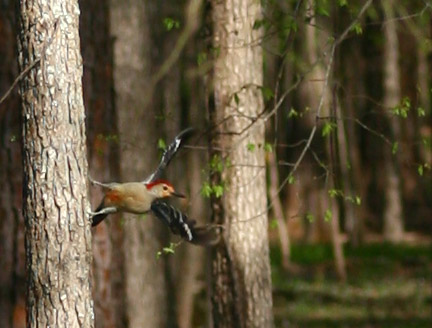
red-bellied woodpecker Melanerpes carolinus making a reluctant appearanceSoon after spotting the tracks, I also caught a red-bellied woodpecker (Melanerpes carolinus) zooming from down low up to a safer tree branch, seeming to confirm my identification. And it still might, but there remains a couple of points to note, such as not being the only bird visible in the area by far, and the snow having gone through an overnight refreeze by the time I was out shooting, turning the surface into a hard crust that was far too tough for a medium-sized bird to leave distinctive tracks; this trail was from the previous day. However, in an area of our yard where The Girlfriend had tossed out some beef and bacon grease, I found an extensive cluster of the same tracks, and woodpeckers are very fond of grease, so make of that what you will.

Or you can correct my ornithological shortcomings, right out here in public, because we’re past the christmas season and there’s no need to be on good behavior any more. Like, you know, everybody was being so cheerful and selfless before the holidays rolled around…

Mr Bugg, who’s lagging far behind in both post and photo count, decided to be snarky when he finally put an update in a few days back, which just meant that I didn’t bother telling him when I was heading out this morning. Well, that, and the fact that the fog conditions that I was after, courtesy of the warm front that’s rapidly melting the snow, would clear very fast and I had no time to waste at all if I wanted to get something decent.

tree in heavy sunrise fog at Mason Farm
There aren’t a lot of options in the immediate area for fog settings, and I was running later than I should have for optimum conditions, so I simply hit Mason Farm Biological Reserve a few kilometers away. The sun was already rising above the thick fog banks and the snow cover was patchy, so I picked the layouts that I could to make the most of it. I should have been out the previous evening when the fog rolled in under a full moon that occasionally peeked out, but by the time I got free I was tired and not really motivated to go out looking for abandoned barns or old cemeteries, the kind of subjects that work well in those conditions; I still haven’t pinned down a couple of go-tos for fog like I should’ve. Ah well, I’m still pleased with what I did get.

sun bursting from behind trees in heavy fog conditions
Longneedle pines are not the best trees to use for blocking direct sunlight, but whatcha gonna do? By this point the light was getting far too bright to have coming directly into the lens, and the opposite direction wasn’t producing any nice landscapes.

Spiders (oh, shit, yes, we’re back to spiders) are surprisingly weather-hardy, and there were still a few patches and strands of spiderwebs to be found here and there. Coupled with the heavy humidity and backlighting, just like a previous visit, they provided a little something to work with.

spiderwebs against near-frozen drainage channel
At the best of times, the low winter sun can get in the shots, but sunrise doesn’t help at all – I couldn’t avoid the green ghost lens flare. Well, I could, and did – another shot has my hand visible at the top of the frame, blocking the light, and the autofocus wandered off the webs and onto the background, rendering the photo unusable, so we’ll cope with the ghost (won’t we?) It’s just a shot to show the webs against the winter conditions anyway, and that patch of ice is probably gone now. But of course I went in closer on a nice dew display – it’s not a photo outing for me unless I get the macro lens out.

fine dew on winter spiderwebs
There were some very fine droplets flanking that big one, up until I inadvertently bumped the plant, but this served to isolate the drop in space, so happy accidents, eh? In this light, the web could appear and disappear with very slight changes in position, and I purposefully chose this one to levitate the prominent drop. You can’t quite see that it’s showing a view of the landscape behind it, and this could have made a neat shot had I gone in closer, but I doubt I could have held still enough to get it sharp, and the tripod wasn’t an option for this particular subject, so here we are. If I hadn’t told you that it might have been better, you would have been perfectly happy with it – I should learn to keep my mouth shut. Or my fingers still. Whatever.

1 210 211 212 213 214 325