


 We just broke a run of over two weeks of temperatures exceeding 100 degrees F during the day here, so of course, now I’ll bring you a tip about shooting in hot weather.
Don’t do it. Seriously, just stay indoors.
Okay, if you’re dedicated or stupid, I suppose I can give something more useful. I’ve run into this problem quite a few times now, from shooting in Florida, butterfly houses and rainforest exhibits, and now for a couple of weeks in abnormal conditions for North Carolina. Your camera, of course, should be kept cool – film doesn’t handle heat well, and starts to decay towards color-shifting, but much worse, your lenses can be really messed up with heat. Many have a lubricant inside to keep the zoom and/or focus rings operating smoothly, and this can get a lot thinner as it gets hot. This can make it run onto the lens surfaces themselves, but much worse, onto the aperture blades. These are very light thin pieces of metal that have to snap open and closed very quickly, and getting gummed up with any kind of moisture, even when it’s supposed to be a lubricant, can cause your aperture to become erratic or stuck fast. That’s called a minimum $100 lens repair.
But keeping the camera cool, such as remaining in air-conditioning, leads to a problem when you take it out in hot, humid conditions – it acts like a nice cold glass of lemonade, especially the glass. The lens glass, and sometimes even the camera body, will attract condensation and fog up. Your best bet is to leave the camera in the bag out of contact with the humid air until it warms up closer to ambient temperature, but if you have a properly padded and closed bag, this acts like insulation, so warming up can take a while. Whatever you do, however, don’t uncap your lens, and most especially don’t switch lenses, which lets moist air into the insides of the lens and can cause fogging on interior elements. I did this once and it takes forever to clear. Bright sunlight can help bring the camera and lens up in temperature faster, and a faint breeze helps too.
Don’t try to rush things, but instead try to plan your shooting around such conditions. This doesn’t always work – several times these past two weeks I found a photo subject and fetched the camera, only to have to wait until it could be used. Don’t count on microfiber lens cleaning cloths to dry off the surfaces, either – they’re usually not very absorbent and only distribute humidity around in droplets. A small towel in your camerabag can help dry off the body, if you need it (and you should have one in case of wet weather and splashing water,) but don’t use it on your lens, because they’re bad about retaining grit and using that to scratch the glass. Patience can save you a few hundred dollars in replacing a favorite lens.
The other issue I encounter frequently is viewfinder fogging. This is made much worse because I wear glasses, so the extra glass surface cuts air circulation right around the eyepiece, and contributes to heat buildup. So does a hat brim, and while I recommend a good shady hat for outdoor shooting, they can contribute to fogging in rough conditions. I have yet to try those pith helmets with a fan built into the brim (I don’t mind looking a little goofy, but there’s a limit,) though this strikes me as probably an effective solution. Battery-powered little fans can be found in most department stores, but this leads to the problem of how to hold it and the camera, and adjust the lens at the same time. A simple sweatband, believe it or not, has proven most effective, if only because it absorbs some of the humidity from your own sweat that would be present near your eye.
Finally, a little tip to keep your camera looking good. With hot weather comes insect repellent, which is fine and often necessary. Just be aware that anything containing DEET will eat into the plastic of your camera body, lenses, binoculars, and so on. Even wiping your repellent-treated forehead and grabbing the camera can mark it. Keep that towel handy.
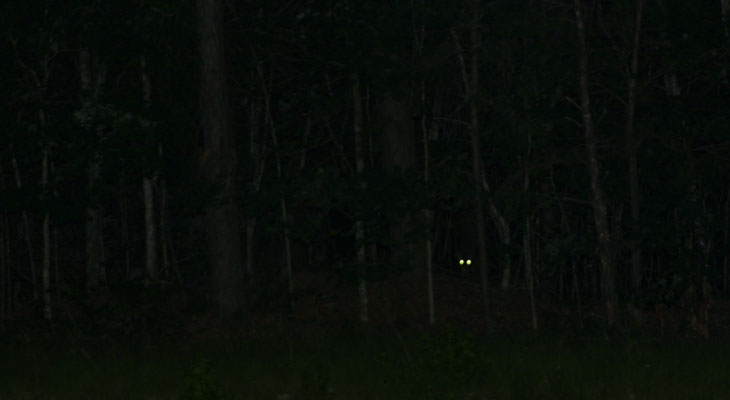
 The big point is, there’s a lot going on at night, and encounters to be had that you’re not likely to have during the day. The quiet and darkness only add to the effect. There is a whole other world of activity, and if you have any interest in nature, you need to be wandering in the dark. It doesn’t make photography any easier, true enough, but there are still opportunities. In the past week, I’ve had encounters with umpteen deer, opossum territorial disputes, a family of raccoons, owls conversing, and the coyote calling the jet. And who knows how many insects and spiders? And last night, my photo subject was curious enough to stay put as I crept closer to let the camera flash have better effect. To this whitetail, I was no doubt the creepy one.
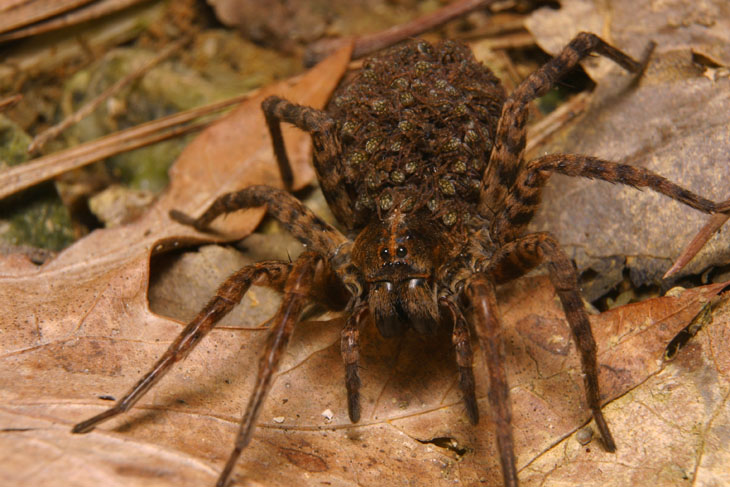
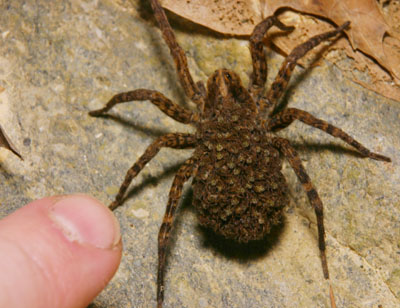 While I can certainly get some really closeup shots, making this spider seem more impressive than she really was, I can provide proof of scale – yes, that’s my own forefinger in the pic. Now, there’s a photographers’ trick called “forced perspective,” where a high depth-of-field can be used to make two radically different subjects appear similar in size. I’ve used this to make people appear to stand taller than lighthouses, for example. But here’s the thing: if I had used it here, my finger would have to be a lot closer to the camera than the spider, and thus appear much larger than reality. The spider herself would have been even larger in comparison to my finger. Faced with that thought, the idea that this is an accurate pic is a little better now, isn’t it? And yes, I got that close – most spiders are actually a bit shy, and I had to keep her close with nudges from a stick to get these pics. It gave me the chance to try out a softbox flash diffuser, which worked pretty well actually.
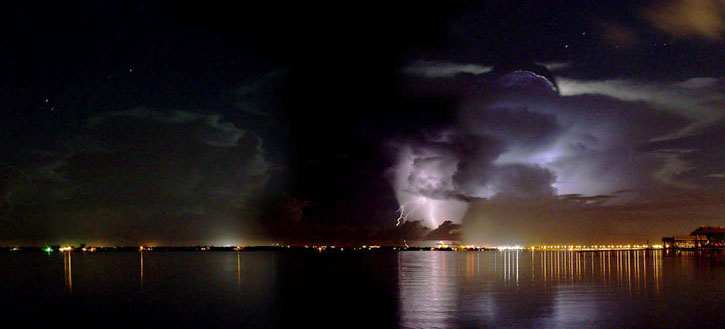
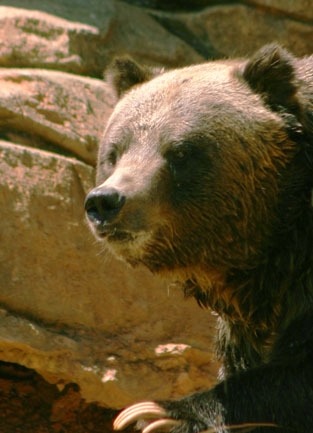 Let’s look at it from the market point of view. I am an editor, and I have a new article in my hands about a disease hitting brown bears. I have three days to get to press, and it needs an illustrating image. Moreover, the layout of the magazine requires an image that works well as a vertical composition, a certain size, and facing to the left – graphic layouts really do require such things, and many more besides. Note that the article is not about brown bears in a certain area, habits, populations, or anything specific – I just need a bear. The photographer I’m going to call is the one who has the best selection of brown bear shots so I can find one that fits my intended layout quickly. One-stop shopping. I have no reason to care if it’s actually a wild shot or not.
 Plants, unless they’re very exotic-looking, don’t really hold my interest, but I’ll examine them carefully to find the insects that they host. Parsley plants in the garden were getting ravaged by Black Swallowtail caterpillars (Papilio polyxenes asterias), who seem to favor that plant above all others. They’re very brilliant in color, getting brighter as they get larger, and will make their
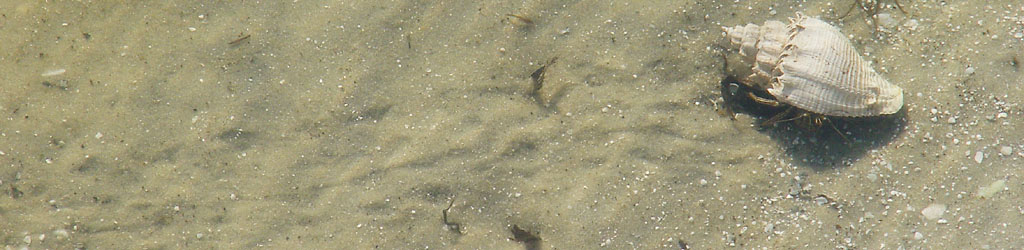
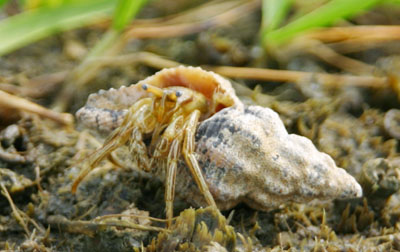 The last day of our trip, we elected to take the ferry over to Southport, and while waiting we wandered around the public access area just beyond the ferry port. We’d been there the day before and chased a few obligatory pics of wading birds near the boat launch, but this time we went to the northwest side of the point onto a small beach area. Here, still early in the morning, the Thin-stripe Hermit Crabs (Clibanarius vittatus) were foraging at the edges of the peat where it gave way to sand. I think a lot of people miss this, because the crabs will retract into their protective borrowed shells as danger approaches, and the motionless shells in the beach grasses don’t attract attention. Again, a little patience pays off, and soon enough they’ll emerge slowly from the shell and return to foraging. Typically when they retract the shell opening is facing the ground, but I cheated a bit by rocking the shells backwards a half-turn, to get sequence photos of their emergence.
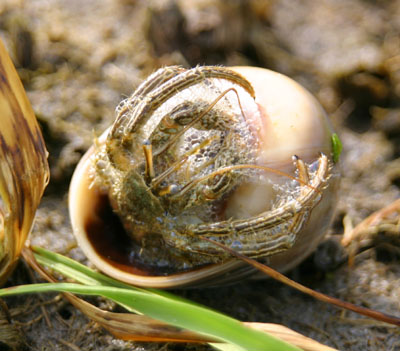 The one shown here had produced a nice little cluster of bubbles that filled the shell opening, which might have worked against it. Many species of crabs do this for a number of reasons, and I suspect this one was either keeping its gills moist, or performing an aggressive display. What it meant was that, as it slowly peeked back out to see if the coast was clear (Ha! Take that, Dave Barry!) it had to get its eyes past the froth.
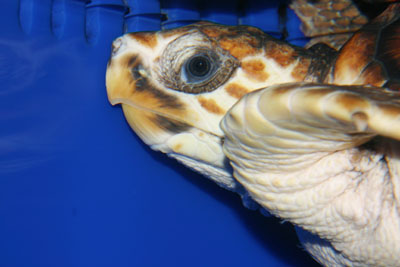 This past weekend The Girlfriend and I took a three-day trip out to the beach, in this case the Wilmington, North Carolina area. Wilmington is the shortest beach drive from the center of the state where we live, features the best aquarium, and is only a short distance from Topsail Beach. Topsail is of interest because it’s the home of the
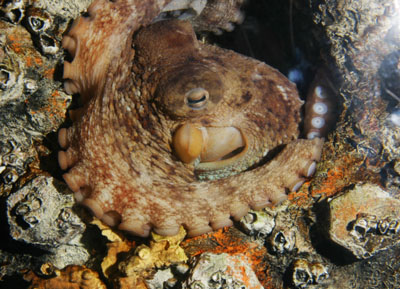 We spent a lot more time at the
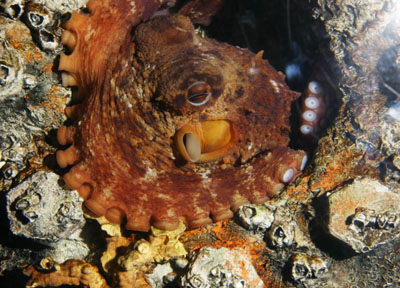 Octopi, of course, have the ability to camouflage themselves with reactive pigments under their skin, and will also use this color-change ability to express some basic emotions. Here, I suspect it’s irritation at the flash – this was taken one second after the photo above. One tentacle stretched out and probed about the tank for a different hidey-hole to inhabit, one that would be safe from annoying photographers, but it found none and the octopus stayed put. I’m pleased with the quality of these images, because the tank was a cylindrical affair that’s great for putting in the middle of the floor and allowing access to groups of people, but plays hell with distortion, and this often gets worsened with camera lenses. I wish they’d switch to something like octagonal tanks for something like this.