A trend?

I got out and did a little shooting today, by heading down to Jordan lake while the skies were clear and the temperatures reasonable (meaning about 15°c, but a stiff breeze down on the water.) I wasn’t expecting anything, though I was hoping, and as it was, things fell someplace in the middle. The skies were empty and quiet, but before too long I spotted a lone bald eagle (Haliaeetus leucocephalus) manning, uh, birding its sentry post atop a dead tree.

solitary bald eagle Haliaeetus leucocephalus sitting high in dead tree at Jordan Lake
This was quite some distance off, and the way the lakeshore curved around at this location, I knew I wouldn’t be able to get much closer even if the eagle allowed it, which was unlikely, so I simply waited to see if it set off to do some hunting, which might bring it closer. In the meantime, I followed a cormorant for a few moments – also none too close, and not doing anything of interest, just passing by. But when I turned back to the eagle, it was gone.

That was mildly frustrating, because the cormorant was a waste of time as it was, and I scanned the skies in all directions, trying to determine where the eagle had gotten to so quickly, knowing that if it decided to cut away from the lake I’d lose it within the trees in moments. But after a minute or so, three eagles reappeared over the trees and began circling among one another, still quite distant.

pair of adult bald eagles Haliaeetus leucocephalus circling together
Only two of them came close enough together to get in the same frame, but those two seemed to remain in close proximity to one another fairly often – sometimes separating by perhaps a hundred meters, but then closing in again. I was wondering if I’d see mating behavior, because it’s about the time of year for it here, but my understanding was that this took place in midair at higher altitudes; my knowledge of eagle behavior is by no means comprehensive, so take that with a grain of salt.

After a short while, the pair (the third having vanished by now) circled around and came in low and deliberately, and I realized they were both coming in to land simultaneously in the tree with the osprey nest that has been featured here so many times before.

pair of adult bald eagles Haliaeetus leucocephalus coming in to land in tree with osprey nest
It’s not the easiest to see here, but the entire sequence of frames that I took as they came in to land showed both with their mouths wide open, seemingly calling though I heard no sounds from my distance – maybe it was carried away by the wind, but I knew that I hadn’t heard a peep while the entire circling was going on, which is rare in my experience.

While eagles will take over osprey nests, they’ll inevitably build over top of them because eagles prefer nests at least three times the size. One of the eagles settled onto the nest, while the other picked a branch nearby, so it certainly seemed like they were considering this as their new place to raise a family. I would be exceptionally pleased if this were the case, because there are several vantages available, but I also know that this section of the lake is quite busy and I doubt that they’d be happy there. The only other eagle nesting area that I’m aware of is hundreds of meters from any approach by people, and commensurately too far to make photography worthwhile.

Jordan Lake lies in the approach corridors for the nearby airport, so I was provided a nice little framing opportunity at one point.

pair of adult bald eagles Haliaeetus leucocephalus with airliner passing behind
This is cropped of course, so I’ll also provide the full frame, to give an idea of what I was seeing – all these have been taken at 600mm.

same image, full frame
And yes, that’s the same dead tree that the solitary eagle was sitting in when I first arrived, though I was a little further around the curve of the lakeshore at this point and so the relative positions have changed – I’m guesstimating that the dead tree is about 20 meters closer than the nest tree, but that’s only ballpark.

Little else was going on, and it seemed unlikely that the eagles would head out to do any hunting, so I started winding my way back. Just as I was getting to the point where I’d lose sight of them in the surrounding trees, I noticed that they were now sitting together on the same branch, possibly discussing decorating ideas.

pair of adult bald eagles Haliaeetus leucocephalus just hanging out near osprey nest
My path back to the car actually took me a lot closer to the nest tree, though it remained out of sight due to the foliage, and as I approached I head a couple of singular chirps from that direction, the first sounds that I’d heard from them, but if this was typical of how they’d been communicating, I’m not surprised that I didn’t hear anything from the much greater distance; these were softer and singular vocalizations, not at all territorial or warning.

I knew I could get pretty close in underneath the nest, but also that the eagles would see me long before I had a clear view of them, not to mention that I didn’t want to spook them if they were considering taking over that nest, so I avoided going any closer and simply headed back home.

I had unloaded the memory card and was just starting to go through the images I’d obtained when I got a text from my friend at the neighborhood pond, who had spotted the visiting eagle cruising around out there again, so I immediately loaded back up and trotted over there. The eagle was nowhere to be seen by that time, having chosen not to find any perches, so I simply did a circuit and took a few frames of opportunity, like these turtles.

trio of turtles, likely yellow-bellied sliders Trachemys scripta scripta, basking on snags in neighborhood pond
Not quite enough detail visible to be sure, but I’m fairly certain these are yellow-bellied sliders (Trachemys scripta scripta,) both from the habits and because that’s what the pond is full of. They were taking advantage of the sunlight, and I honestly don’t know what it means if a turtle sees its shadow today – probably just that it’s sunny out. Or perhaps that we will have six more weeks of weather.

There was also about six double-crested cormorants (Nannopterum auritum) hanging about, but most slid off a little more distant as I approached – the turtles were far less wary of my approach and stayed put the entire time, which is reversed from how it normally is. But I still did a quick portrait.

pair of double-crested cormorants Nannopterum auritum perched on pilings in neighborhood pond
Just good enough to make out the green eyes of the closest. Both of these last images, by the way, were warmed slightly in post, taken as a cloud passed and thus the light had gone into deeper shade, too blue. I know they don’t look warm, but they’re improved over what they originally looked like without getting heavy-handed.

Anyway, off to an early start with the eagles – we’ll see how this trend pans out for the year.

Just once, part 5

American kestrel Falco sparverius perched on cassette storage shelf in apartment
The age of this photo is not just displayed by the condition of the negative (which has even been cleaned up a bit from the original,) but by the perch of the bird here, my roommate’s rack for holding cassette tapes – those are not my music choices. Are there even some cassingles in there? Anyway, I peg this around 1994 or so, and I believe it represents the latest image of an American kestrel (Falco sparverius) that I have in my stock. That’s annoying all by itself, because I think they’re fabulous little raptors, easily my favorite, and for some reason I haven’t seen one in the wild in ages. Like literally decades. They used to be fairly common in the area, but their numbers seem to have dwindled significantly, and while I won’t say that my experience is definitive – I may simply not be visiting the areas they frequent – not seeing any in such a long time does not bode well. I got excited last year down at Jordan Lake because I spotted a bird in the distance that immediately sparked recognition in my mind, despite its great distance from me, since its body shape and flight pattern was so familiar, but that turned out to be a merlin instead – closely related and actually my first confirmed sighting of that species, but not a kestrel.

The odd setting of this photo is courtesy of the kestrel, kind of. I was working then in a humane society, primarily admin but also animal rescue and rehabilitation, and in that last I largely specialized in raptors. This guy had arrived in poor condition but no broken bones and was being nursed back to health. Several days in when it should have been eating solid food on its own and wasn’t, I took the bird back to my place in a carrier to spend more dedicated time in coaxing it to eat something. This was where I discovered that reducing stress on the patient helped them respond better – seems obvious when I say it that way, but you have to consider the details. When attempting to introduce solid food to a wild patient, typically we bundled them up in a towel so they couldn’t try to fly off nor do any damage with talons/claws/beak/teeth/etc, and then would attempt to slide the solid food into their beaks/mouths. Just like infants, this was often met with resistance, and when attempting this for a short while with my patient here, I failed to notice that the towel was coming loose – but the kestrel didn’t. With a sudden shrug it burst free from the wrapping – and then seized the food and began eating quite readily on its own. And as long as it was unrestrained, it wasn’t bothered by my proximity and would take the mouse parts I offered. On the second day of this, it decided to try out its wings again and took a short flight over to the cassette rack, and I was happy to allow this both from not wanting to re-injure it through attempts at restraint, and because we had to evaluate its flying ability anyway – no sign of reduced capacity was displayed by this short flight at least. After a few days in a flight cage where it demonstrated plenty of mobility, my patient here was released, whereupon it flew up to the top of a nearby telephone pole and vented forth a solid minute or so of calling exuberantly, before then setting off determinedly in a specific direction and vanishing from sight. What the serenade was about, I have no idea, though I’m quite sure it wasn’t aimed at me in any way, because that simply isn’t how birds think nor what birdsong is for. But I was pleased to see it fly off so competently – with a little regret of course. Had I known I would see so few again after this point, I would have taken more photos.

A little later on, I was doing the same bundled-up feeding thing with a barred owl (which can be extremely nasty when inclined) and noticed how it watched me as I leaned over. On a whim, I shifted it higher than I was, feeding it (still bundled) while propped up on a desk while I sat on the floor beneath it, and it fed much more readily. Height and an open avenue of escape is security to birds, while looming over them is not, and I began suggesting this practice to others when it was possible – it did seem to help.

But yeah, man, I gotta find some more kestrels someplace…

Der Januar ist für mich tot

Take everything you can from January, because after today, it’s kaput. We have reached the end of the warranty period and so tomorrow it stops working. And that heralds the end of the month abstract.

aged flowers of oak-leaf hydrangea Hydrangea quercifolia backlit by sun
Again, not a lot that I’ve photographed this month, so this is from just yesterday to fulfill this very obligation. The flowers of the oak-leaf hydrangea (Hydrangea quercifolia) hang around forever, and so spend more time looking like this than like this. The-kid-that-asks-too-many-questions in me wonders what purpose this serves, other than being scaffolding for tiny spiders, though it might simply be an artifact of too much fiber in the diet or something. But they served my purpose for the day at least, so there’s that.

Totally free

Yep, once again, today is Free Thinkers Day, when you can go into your favorite home furnishings store and get a little statue of a naked constipated man at no charge! While supplies last, of course.

Okay, the Walkabout Fact-checkers (stop giggling) are informing me that this is not at all the case, or even the meaning of the holiday, and that it’s actually Freethinkers Day, so now I have to do a 500-word essay as punishment. Why you have to be punished too, they haven’t said, but so be it.

This is admittedly not a widely-recognized holiday, which is quite unfortunate, because it really should be. This date was chosen because it’s the birthday of Thomas Paine, who was responsible for vocally promoting numerous doctrines and ideas that were uncommon in his time, among them the immorality of practicing slavery; The Freethought Society is recognizing those efforts in their events for the day. But he was also a major factor in the war of independence for what was to become the United States, and numerous other efforts to improve society then and afterward.

[An interesting aside here: Most sources give the purpose of the holiday as thinking for oneself and not falling for ‘groupthink,’ being open to new ideas and perspectives, but one also adds, “When we close our minds and think that our opinions are the only truth in this world, we stop ourselves from learning new things and being better versions of ourselves.” Paine’s own history, however, wasn’t exactly a demonstration of this – he was adamant and stubborn about his own views, not apparently open to debate nor always diplomatic about it, and while responsible for promoting some concepts that would later come to be approved, at the time he was often considered contrary and problematic. Hindsight is wonderful, but it can be argued that there’s a fine line between being adamant and being antagonistic, and it raises the question of how to know the difference between standing up for beneficial ideas or stubbornly clinging to flawed ones.]

Paine himself is often credited as having been an atheist, which has led to a lot of pushback against his ideas – too few can consider ideas themselves without slotting the originators into distinct ‘good’ or ‘bad’ categories; again, something that critical thinking can assist with. Paine was not an atheist at all, however, but he did consider any religions that he encountered to be woefully corrupt, and those that can’t fathom the difference are the ones that need to observe the day the most. And of course, that aspect has no bearing on anything else that he espoused, beneficial or not.

For us overall, however, it’s best to remain aware that what’s popular in the public sphere isn’t any indication of value or even rationality; we have routine conflicts between ‘fitting in’ socially, a useful survival trait from our past at least, and ideas or actions that are demonstrably better even though unembraced, which can lead to social awkwardness of varying degrees. And in today’s climate of targeting anyone not conforming to the cause of the day, it’s especially difficult, a challenge that far too many have chosen to avoid rather than risk ‘cancellation.’ But here’s the deal: if anyone knows some perspective, idea, or action that is demonstrably better, what value is it to avoid mention of it through fear of how people might react? Isn’t that mere selfishness?

And one final aspect that occurred to me recently, going back to cancel culture and the efforts to demonize so many people from our past. We should never expect, at any point in time, to have a perfect society, much less find a perfect person – but isn’t the recognition of the flaws from the past (as seen from our perspective now) evidence of how much we have been improving, rather than how much we should be ashamed?

Okay, that’s over 600 words – I’ve fulfilled my obligation to The Man. And while today is the holiday, in practice it should be every day.

* * * *

Some related links:

Tomorrow, let’s… keep on – Last year’s post on the holiday.

Something to add

The most important thing you’ll ever read

The exception proves to rule

To the rescue! Or, not…

Needs a little work

With the weather being surprisingly warm and clear and a not-full moon shining down, I elected to traipse over to the neighborhood pond and try my luck spotting the beaver(s). This time I did not have The Girlfriend to wield a light for me so I could focus, since she’d gone to bed hours before, so I strapped a powerful flashlight to the lenshood of the Tamron 150-600 and did a quick test out back – wonder of wonders, it was aimed precisely where it needed to be and I could see enough to manually focus. This was quite lucky; like most flashlights, it widened towards the lens, which should have aimed it cockeyed and too high as it pressed against the lens barrel, but I had the lenshood on reversed (not worried about the sun’s glare at midnight) and the resultant backwards taper matched the flashlight perfectly. And so armed, I went down to the pond.

The moonlight helped a little, but not a lot. Basically, the brighter sky would reflect off of the water’s surface and allow me to dimly see if anything was cutting across it – when the sky was reflected in the water. Since the pond is surrounded by trees, this was limited to mostly near me and not at all towards the opposite shore. But, as I’d found out two years ago, you can also eyeball the reflections of residents’ yard lamps in the water, which only show a little point of light but this would change as the ripples of something passing cut across the reflection. Very soon I picked this up and turned on the lens light, only to find that it was Canada geese.

But then as I neared the far end, walking as quietly as possible, I started hearing something over the idle muttering of the ducks, and it certainly sounded like beaver gnawing. It was on the opposite side from me and thus at least 80 meters off, well out of range of the Vivitar 285, so I continued quietly around the far end. As I closed in, I found that my guesstimated location, based on hearing alone, was pretty close, just a few meters shy, as the beaver continued to issue occasional gnawing noises. The problem now was, I would be entering the pool of light from a streetlamp alongside the pond and would become far more visible to the beaver than it was to me, but there was nothing to be done about that.

As suspected, as I got close to the location where the sounds had been issuing from, I could see the ripples of the beaver heading away, alerted by my presence but not so startled that it felt it had to submerge. Switched on the light, found my focus, and stating firing off a few frames.

North American beaver Castor canadensis in water at night by flash lighting
I really didn’t have any doubts at this point about it being a North American beaver (Castor canadensis,) but this shows that the rig was working reasonably well, though focusing manually while the beaver was swimming was awkward – Tamron put the focus ring near the base of the lens where you can’t really support it steadily. I’ve been happily using my own long lens grip and it makes a significant difference, but not while trying to focus, and I’ve been trying to hash out a design for a focus lever or mechanism that will sit well forward alongside the grip. For the time being, I may try a monopod.

By the way, the green glow alongside the beaver’s body is actually the reflection of a streetlamp on the opposite side of the pond, one of the old mercury vapor lights that appears blue to our eyes, but goes green in the camera.

And I found that my technique needs a little work.

North American beaver Castor canadensis in water at night by flash lighting, not quite focused
It looked focused in the viewfinder, but mostly what I was seeing by the flashlight was the reflection of the eye, not very big at all (this is cropped,) so obviously this is lacking, but there’s not a lot I can do about it except be as careful as possible. The same issue showed up a little later on, which we’ll get to in a moment.

Having snagged a few frames and with the beaver passing behind me, I switched off the lens light and started moving on, more into the streetlamp alongside me, and within a few moments I heard the sharp crack! as the beaver gave its alarm water slap and dove. I’ll have to keep checking, too, because as I rounded the far end, before approaching this one, I heard a curious tiny splash of the water over near where the old lodge was. I didn’t see anything by flashlight when I checked, but it’s possible there’s more than one beaver there again.

Up near the near end and crossing the berm that forms the dam, I was able to switch on the headlamp to see my footing without worrying about spooking my target now, and this quickly pointed out something a short ways out onto the water.

medium-sized six-spotted fishing spider Dolomedes triton floating on water at night
Seeing the eyes reflecting the headlamp beam back to me, I focused (almost) on the moderately-sized six-spotted fishing spider (Dolomedes triton) out on the water. Considerably closer than the beaver was, I had to make some adjustments to the flash power because the first frame blew it out entirely.

And then, another few meters along, another subject, but this one I was able to see much better and so focus was nailed.

American bullfrog Lithobates catesbeianus sitting on edge of pond at night
The pine cone in front of it gives some indication of size – this American bullfrog (Lithobates catesbeianus) was larger than my fist and never budged a millimeter. The temperature was hovering around 15°c, pretty pleasant for January and a welcome change after the sub-zero overnight temps four or five days ago.

Because I saw this guy, I decided to check out the backyard pond when I got back to see if any of the resident green frogs was peeking out as well. But on going out the back door, I heard familiar noises again and allowed myself to be sidetracked for a moment.

white-tailed deer Odocoileus virginianus buck caught by flash at night
Again, all I was seeing was the eye and a hint of outline, but I should have framed better than that with that rack up there. The three of them (white-tailed deer, Odocoileus virginianus) were on the move and trying to screen their passage with the trees, so… [whiny whiny excuses go on]

very young white-tailed deer Odocoileus virginianus buck caught by flash at night
They seem to be visiting routinely each night, so I guess I’d better consider that blind, and the temperature was a lot more conducive to sitting out there now, but no one ventured any capital either. I mean, c’mon.

No sign of any frogs in the backyard pond, which surprises me a little because they never seem to waste any time popping out the moment it’s slightly warmer overnight, but I found one more subject before I wrapped it up for the night, once again in the crack of the door that leads into the water heater closet and crawlspace.

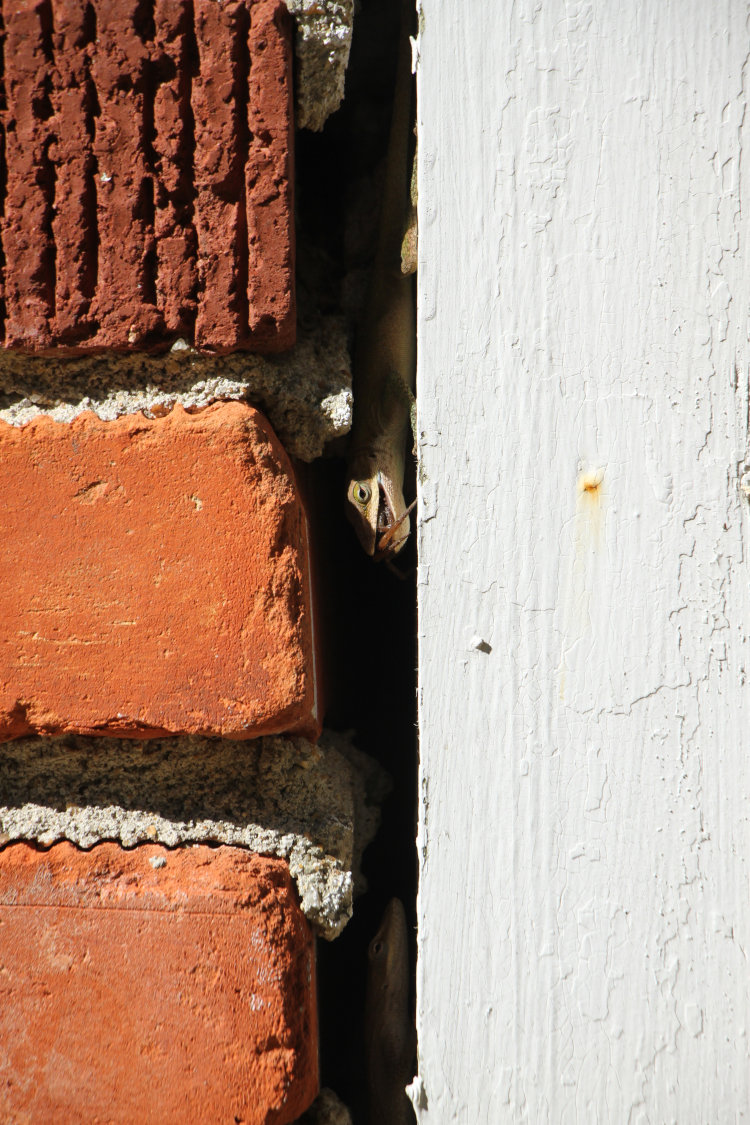
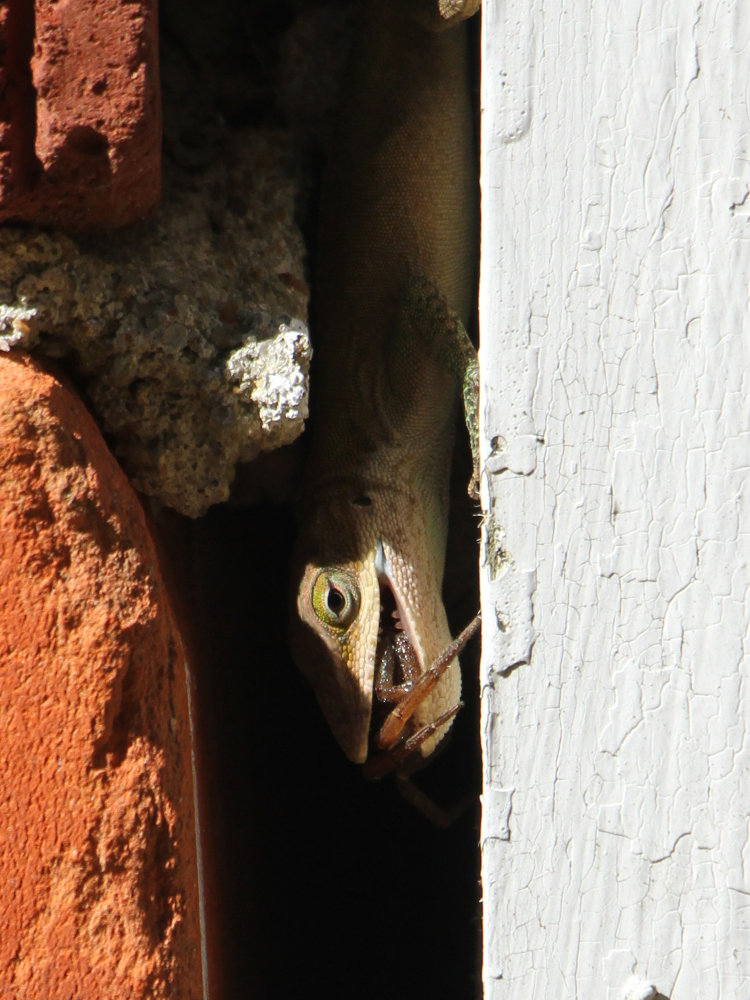
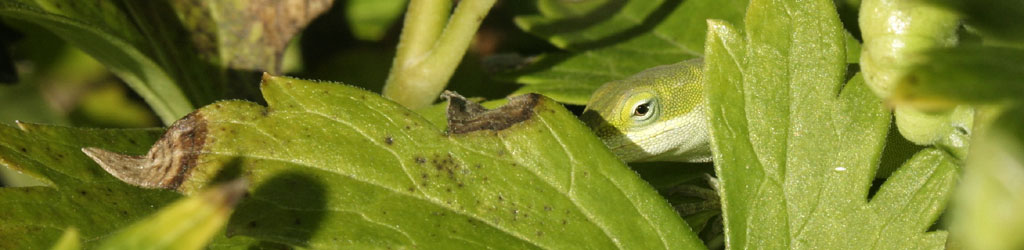
Carolina anole Anolis carolinensis sleeping in crack in door
I’d spotted it in there during the day, too, so no surprise here, but this Carolina anole (Anolis carolinensis) hasn’t seemed inclined to settle in for the winter, and I guess it’s finding decent shelter for the temperature drops. From time to time I have to go through this door, and I make it a point to check carefully before whipping it open – almost always the lizard is someplace else at those times, though I don’t know exactly where. But this one, at least, is making do.

Just visiting

Late this morning I got alerted by a friend who lives on the neighborhood pond that there was a new visitor hanging out, and I wasted no time in getting over there. Thankfully, the visitor decided to stay put long enough.

adult bald eagle Haliaeetus leucocephalus perched in tree at neighborhood pond
This, of course, is a bald eagle (Haliaeetus leucocephalus,) and the first that I’ve seen there, though my friend has seen them in previous years. It’s safe to say that it won’t hang around, since the pond is less than 300 meters long by 100 wide, so a bit small for an eagle to feel comfortable with, not to mention frequented by people with dogs. It was likely just checking out the fish activity while exploring the area.

adult bald eagle Haliaeetus leucocephalus perched in tree at neighborhood pond
I was lucky in that it was winter and thus the foliage was gone from most of the trees, but I could never manage a perfectly clear angle without small intervening branches. My shooting distance for these two images was probably about 80 meters, so this is significantly cropped, but sharp enough at least.

The eagle moved to another tree in a bit better concealment, and as I was circling around to get a clear vantage, it decided to move on. I feel pretty comfortable that I wasn’t the cause of this since I wasn’t anywhere near as close as two joggers that passed, multiple times, so I think the eagle was just ready to head out.

adult bald eagle Haliaeetus leucocephalus flying off
I watched to see if it was going to choose another tree nearby, but no, it disappeared over the treeline in the middle distance, so I continued around the pond because I hadn’t been there in a while.

A great blue heron (Ardea herodias herodias) appeared from someplace and cruised down to the pond’s edge, then chose another spot; as it was coming in to land, it made an abrupt turn and dove into the shallows, a lot like a seagull, and stood up with a capture – perhaps lucky that it did not do this in front of the eagle, a species notorious for stealing fish from others.

great blue heron Ardea herodias herodias wading with recent capture
The heron immediately headed towards shore as I advanced around the pond trying for a better view, but after passing some intervening bushes, I could no longer see the heron. Eventually, with the long lens I spied it hiding behind some trees right on the shore, but this meant that I had some distance to cover before I’d get a clear view again. And once I had, I found that the heron had finished its meal already.

great blue heron Ardea herodias herodias in profile after finishing off a snack
This isn’t surprising, because herons swallow their meals whole like most birds; what I chiefly missed was it dislodging the fish from its stab-through capture to realign it head-first so it could be swallowed, almost certainly why the heron climbed onto shore in the first place: the dislodged fish wouldn’t be able to escape into the water. So I settled for the profile.

Also evident on the pond were a few double-crested cormorants (Nannopterum auritum,) initially perched on the old pilings but eventually setting out for their own meals.

female and male double-crested cormorants Nannopterum auritum cruising in neighborhood pond
The brown neck denotes a female, but I’m not absolutely sure, given the light conditions, that the one on the right is a male – they’re typically overall black, or at least dark-grey, so this might just be a color variation in another female. I’ve seen multiple females hanging out together quite often, and never distinct evidence of a mated pair doing so, so I commit to nothing. But I also think I missed one of them surfacing with a fish, again because of bushes blocking a clear shot (you see the pics from when I finally get a nice view – I don’t bother illustrating the conditions.) I admit that I should have been checking out the pond more, but also admit that it’s been damn cold for the past week or so and I likely would have seen nothing anyway – today got a lot warmer and will continue to do so for another couple of days.

Plus, I have another reason to check things out, but in this case, it’ll be overnight:

evidence on cypress roots of recent beaver activity
That’s distinct evidence that, after having disappeared last year, at least one beaver is back in the area, and I spotted several different instances in multiple locations – more than a night’s worth of activity, is what I’m saying. Probably won’t see anything by daylight until early spring at the earliest, so I’ll have to resort to flash stalking again, see what turns up. You’ll find it here if I’m successful.

Just once, part 4

skunk, possibly striped skunk Mephitis mephitis, foraging in yard
I find it hard to believe this myself, but not only have I featured a skunk only once here on the blog, I think I have just one other set of images in my entire stock, from many years ago, of a juvenile that had been live-trapped.

For reasons unknown and completely perplexing, skunks are incredibly scarce in this area of North Carolina, and bear in mind that I used to work with both animal rescue and wildlife rehabilitation, as well as advising about wildlife encounters. Throughout all of that, to say nothing about being a photographer and wanting to get more images of them, the actual contacts that I’ve had were just barely enough to maintain that they existed and little more. There was one section of the whole region where I suspected they might be, if not prevalent, at least present in small numbers, and that was from smelling their evidence there perhaps three times in over a decade.

This image of a (likely) striped skunk (Mephitis mephitis) was therefore taken in Ohio, in the suburban front yard of friends of mine, and my exposure to one had been so many years previous that I was peering at this black animal for too long, trying to determine what it was – granted, it was night and the skunk hadn’t yet revealed the white spot on its head, but still. I was nonetheless delighted, knowing that skunks are actually pretty mellow and require a fair provocation before they’ll let loose with their defensive spray.

Twice while up in New York a few years ago I found skunks, both during the day, yet neither time able to snag a photo. One had emerged from deep weeds right alongside the car while I was stopped in a wildlife refuge, but I was unable to focus in time before it realized I was there and disappeared back into the weeds, never to be seen again – it would have been a great portrait, too. Three decades back when I lived there and used to go out for walks on the road at night, I encountered them a few times with never any defensive response; one realized that I was following it down the road and turned to face me quite deliberately, alert but not yet threatened, and continued on its way once I’d held still for a few moments. You gotta admire that kind of panache…

Be quiet out there

Going out onto the back porch the other night, I heard a significant racket coming from either just outside the back fence, or just inside it. While I always have a pocket flashlight on me, the view in that immediate direction is blocked by the greenhouse and the shed, so I had to creep down there, to be greeted by no fewer than eight white-tailed deer (Odocoileus virginianus) all bucks with notable racks of antlers, one rack appearing to be a half-meter tall alone. Getting any photos of this in the darkness would have required not just getting the camera, but loading the Vivitar 285 flash with batteries and getting the headlamp just for focusing, and I didn’t think they’d hang around for that. I probably should have chanced it, because as I went across the backyard to the other side of the house, I was met with another, nowhere near as impressive in the antler department, but watching me curiously from about five meters away, while I could see two more at the edge of the front yard. Life is full of regrets.

Just tonight, however, I heard much the same noises, and this time before even venturing out I grabbed the camera, flash, and headlamp. They were farther off the back of the property this time and there appeared to be only three of them, but I managed a few frames before they wandered off away from me and my weird noises and lights. Only one was good enough to illustrate, at least:

white-tailed deer buck Odocoileus virginianus off back of property at night
Certainly could have been better, but here’s the deal: all focusing has to be done manually using the beam of the headlamp, and things are darker in the viewfinder, so the only thing that can be used is the reflection of the eyes – when they’re looking at the camera. That’s one little dot of light, provided I can keep the headlamp aimed at them while framing, which the large flash unit wants to block, so the headlamp has to be shifted off to the side, cockeyed on my head, where it wants to aim elsewhere. If I did more of this, I’d rig up something to hold the light on the flash unit, but since this occurs about once a year or so, I’m not inclined to put in the crafting effort.

By the way, the racket that I’d heard both times, reminiscent of someone clattering a load of branches, comes from the bucks marking territory by scraping their antlers along the trunks of trees, and I suspect the sound serves as well as the markings or the scent. Though why in the first instance there were so many bucks all together without a doe in sight, I cannot say – I do at least think there was one doe among the three tonight.

But yeah, if I was inclined to brave the cold for a chance at a few frames, I’ve got a good area to set up a blind within – but I’m not really inclined. I left NY because of that cold shit. Yeah, I know, dedicated nature photographer and all that, but make an offer if you like – I’ll certainly consider getting paid for it…

The debt we all owe

One of the things that we get to do here is recognize the unsung heroes of our world, the ones who by all rights should have a holiday of their own but have somehow been missed. And today, on the 75th anniversary of the first time he was laughed at in public, we review the contribution of Bumfester Chugtrollop, the inventor of the photographer’s vest.

First, we need a little history of the vest in the first place, which can not be credited to Chugtrollop; in fact, the originator is lost to time, probably because his wife threw out the initial sketches when she was ‘cleaning up.’ But we are certain that it was a man at least, because in the years before the first recorded evidence of a vest, there was a distinct fashion trend towards white shirts with ruffles and other silly-ass things that were certainly not the idea of any male. The function of the vest, or ‘waistcoat,’ was to have a dark-colored covering over the chest and stomach of the male wearer, because we all know how men eat, and getting stains out of white shirts was the bane of their existence.

[Fun fact: Any stains are actually quite easy to remove, with the proper chemicals, but the insistence on favoring cloth too delicate for these as the base material for white shirts is what causes all the problems in the first place. “Ooh, look at how great you look in silk!” Right. But even easy stuff to clean up gives women the opportunity to scold, and dry cleaners soon discovered the concept of extra fees for stain removal, meaning they could charge up front based solely on appearance, regardless of how little extra effort was involved in cleaning.]

Thus, the vest was born, masquerading as a fashion accessory while functionally easing the lives of men, hiding the drips from the mutton and serving as napkins when needed. You have not failed to notice that many vests use colorful and delicate material only for the backs, we assume? Had to be a man. The creator of the white vest was obviously some poncy bastard that was trying to show off and probably ate mostly dry salads.

Soon, it was discovered that by sewing a small square of extra fabric onto the vest, men had someplace to put their pocket watches, which before then had merely been held in one hand or dangled from an ear. These extra squares were quickly called “pockets” after the watches – many, many people assume that it was the other way around, but the Pocket Watch was a particular model created by Smedley Pocket with an extra compartment to hide nude engravings within; this also gave rise to the term, “pocket pool.” Soon afterward, pockets migrated to the trousers (surprise,) jackets, and billiard tables, which until that time had merely had ramps in the corners to launch the balls from.

[Fun fact: Both podiatrists and floor refinishers protested this change to billiards, but the pockets proved too popular, so they joined forces to invent the treacherous raised threshold and maintain their respective incomes.]

It was probably about a century later that Chugtrollop came up with his ‘brilliant’ idea; he was a working cinematographer and constantly fumbling around with lens caps, light meters, cable releases, gaffers’ tape, and model prods (which impressed cattlemen enough that they adapted a version for their own use, though at a lower voltage.) The Production Assistant had yet to come along, so Chugtrollop added numerous pockets to an old vest that he hadn’t used since the divorce, and began wearing this during his duties. This had the added benefit of making people assume the distended belly of the vest was burdened with tools of the trade and not simply a distended belly; every little bit helps. Other photographers took note that Chugtrollop could actually shake hands with prospective clients (or slap a Best Boy behind the ear) without needing a bench to pile stuff on, and the trend was soon on its way.

Chugtrollop’s real genius, however, was in marketing the accessory as a photographer’s vest, as if this meant it was specially designed or constructed or something, and thus was able to charge a premium price for a square meter of old canvas that didn’t even need to be measured for fit, a trend that continues to this day. He was inadvertently aided by the fact that anyone seeing him wearing it, having never seen one before, assumed that it was a specific tool of photographers and thus had to obtain one for themselves the moment they purchased a Kodak Brownie; the high price simply convinced them that they were correct.

[Fun fact: Chugtrollop had nothing to do with the trend of wearing a beret, or even of using a long cigarette holder – those both can be credited to others. Beret is in truth a French term that means, “incompetent hatmaker,” and they were originally rejects only sold to the impoverished, i.e., mimes. How they came to be used by filmmakers is another story and not germane to the holiday we’re celebrating.]

Today, vests with an inordinate amount of pockets automatically spell out, “photographer” to anyone that sees them, even though somehow you don’t hear people saying, “Wow, that’s a great photo – you must have a really good vest!” Yeah, we’re puzzled too. And they can be handy at times, though far more often, photographers waste time trying to determine which pocket holds the damn thing they’re trying to find at the moment. Admittedly, it would also be a hassle emptying out all the pockets before putting it in the wash, if indeed they were ever put in the wash. Their most important function, however, is announcing to one and all that here is a professional photographer, justifying the arrogant attitude that invariably goes along with wearing one. Without this, they would just be another asshole.

Just once, part 3

antlike jumping spider likely Peckhamia americana on studio flower buds
There are probably going to be a lot of arthropod images showing up in this topic, because there is a much wider variety of species than anything else, and I was going to say “in this area” but I think that holds true around the world. I’ll mix it up as much as I can but, you know, nature of the beast…

And this one I’ve definitely only photographed once, because I think they’re damn cool and would certainly remember finding one again, but this is not an ant – instead, it is an antlike jumping spider, likely species Peckhamia americana, but even BugGuide.net has so little information on them that it’s not clear that anyone is sure. Some jumping spiders have developed the appearance of ants, and I’m not exactly sure if this is as a defensive measure or offensive; in other words, if it is to avoid predators or to assist them in their own predatory efforts.

antlike jumping spider likely Peckhamia americana on studio flower buds
While the eyes are a dead giveaway, it’s pretty hard to get this close a look at them in any normal circumstances, so the key feature that you’re looking for is two body segments instead of three: all spiders have a fused head and thorax (cephalothorax,) while ants have very distinct separations between them. Behavior-wise they’re a bit different too, which if I recall correctly is how I identified this one. Ants tend to move at a distinct quick pace and pause infrequently before resuming the same pace, while jumping spiders move slower and with a lot more investigating. Jumping spiders obtain more information from their eyes, while ants primarily use their antennae, and this is noticeable if you watch.

portrait shot of antlike jumping spider likely Peckhamia americana on studio flower buds
The magnification that was needed for these was quite high, as you’ll see in a moment, and I cheated quite a bit by capturing this specimen and photographing it on a detached flower stem held in a clamp, so I could turn the ‘stage’ as needed and try to keep up with the spider. The clamp was itself nestled in a small bowl of water to prevent the spider from simply making its escape. Nonetheless, even with such control I had an awful lot of images that didn’t pass muster, and more than a few that I only kept because they illustrated certain details. Like the one below.

antlike jumping spider likely Peckhamia americana on studio flower buds on photographer's knuckle
This is full frame and it’s not terribly sharp, but this was before I had my handy-dandy little paper scales to insert into images, and so this is perched on my knuckle instead. If you were imagining something the size of one of those large black ants, you were way off – I’m fairly certain my friend here is less than half the length of those species and doesn’t top 5mm overall.

These came from 2012, when I was deeply into arthropod photography, largely because they were easy to pursue in the yard and what I was seeing the bulk of, and the images in my Arthropods folders still outclass the counts of any others, though Birds are catching up. Mammals still remains shamefully low – we’ll have to see if these can be boosted a bit…

1 46 47 48 49 50 325