

Less than a week

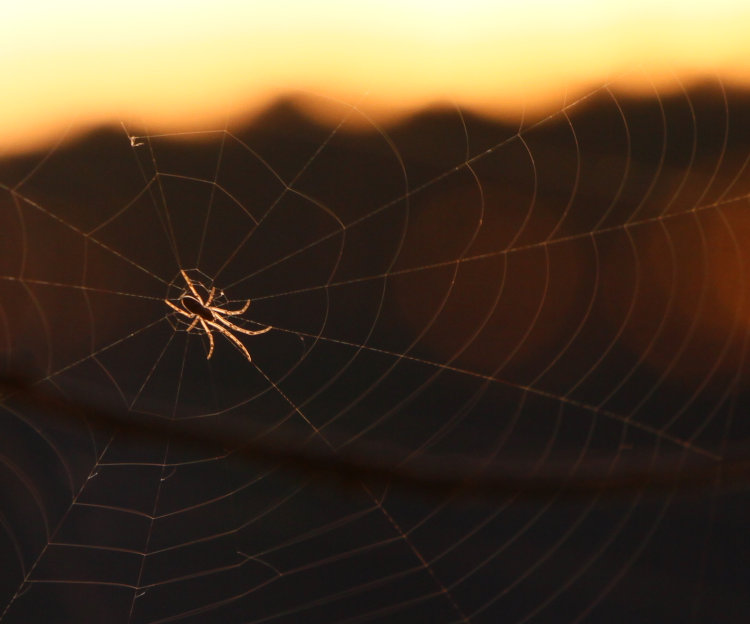
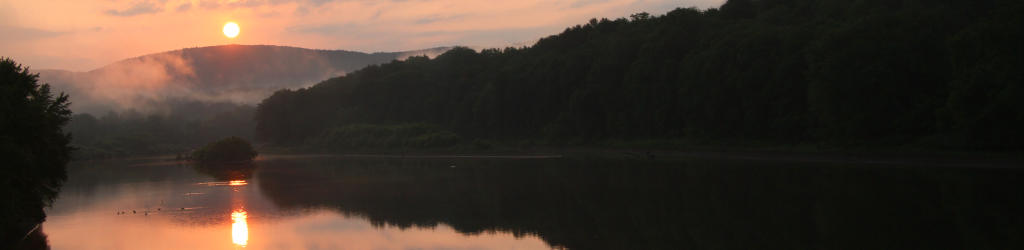
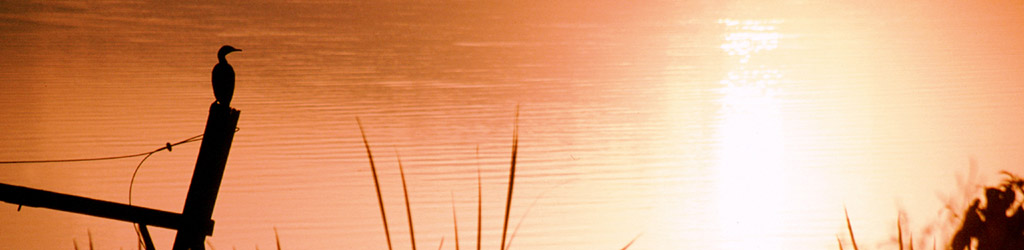
predawn colors over Jordan Lake with Venus in upper corner
All of these photos were taken a week ago, except not quite – it was Saturday morning, but around sunrise, and this is posting well before sunrise. Just to take that accusatory tone away from you.

I won’t say it was a great outing, given that the sunrise didn’t perform worth a doodle and the bird activity was kind of sparse, but we (meaning the Incalculable Mr Bugg and I) still managed a few photos. Above is about as good as the sunrise colors got – not a cloud in the sky, too little humidity to cause much refraction, so the sun rose quite yellow. But before that, in the dawn twilight, we could see things happening.

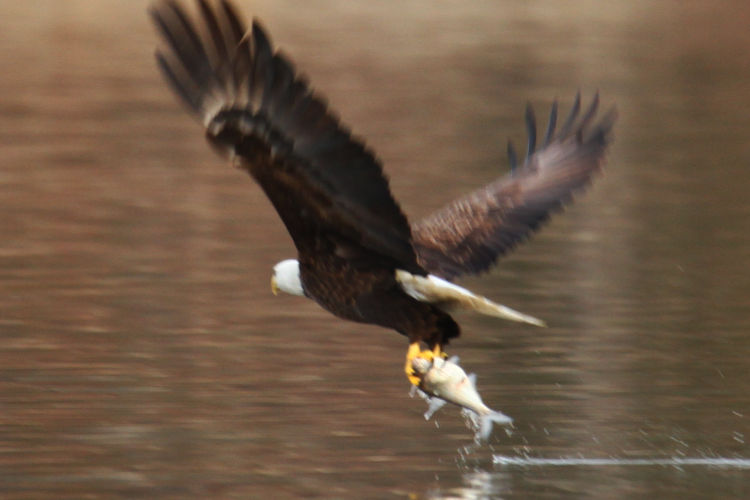
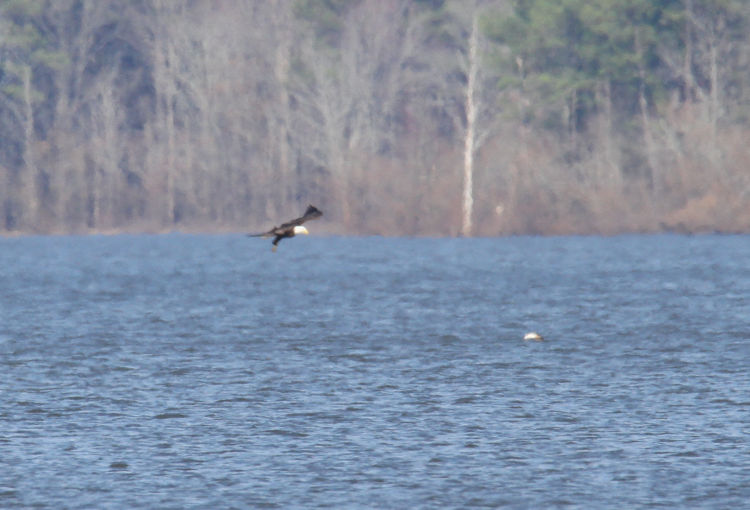
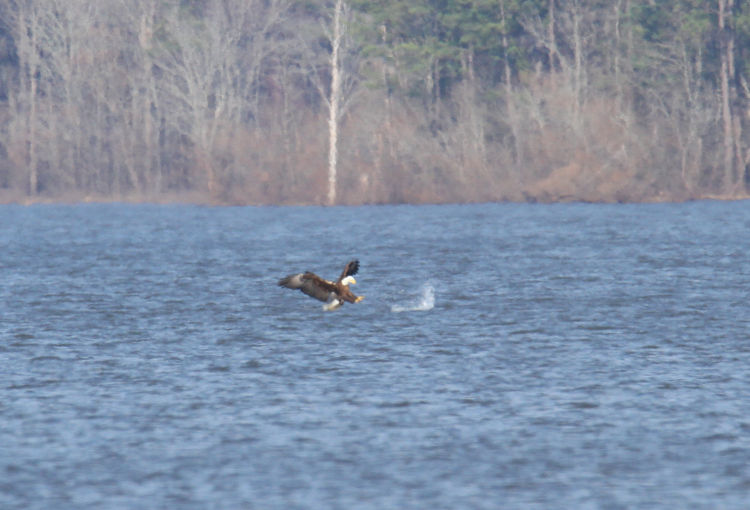
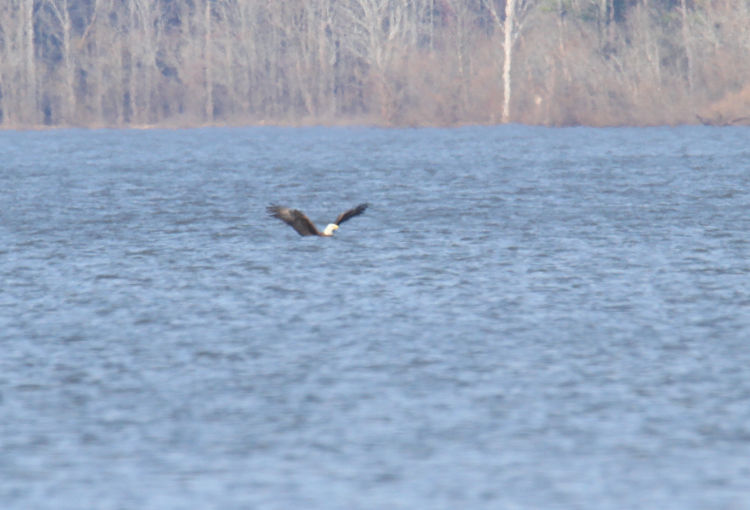
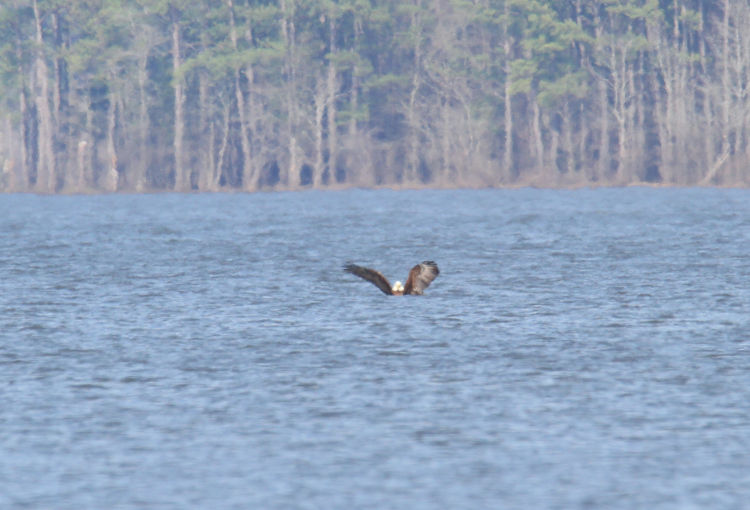
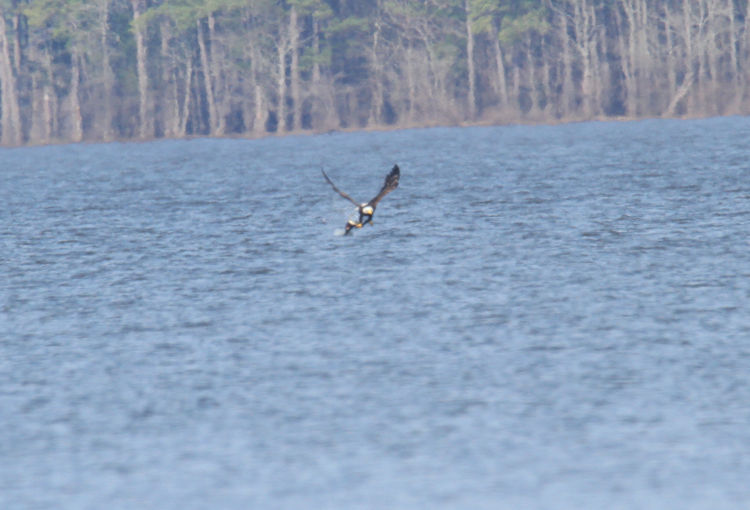
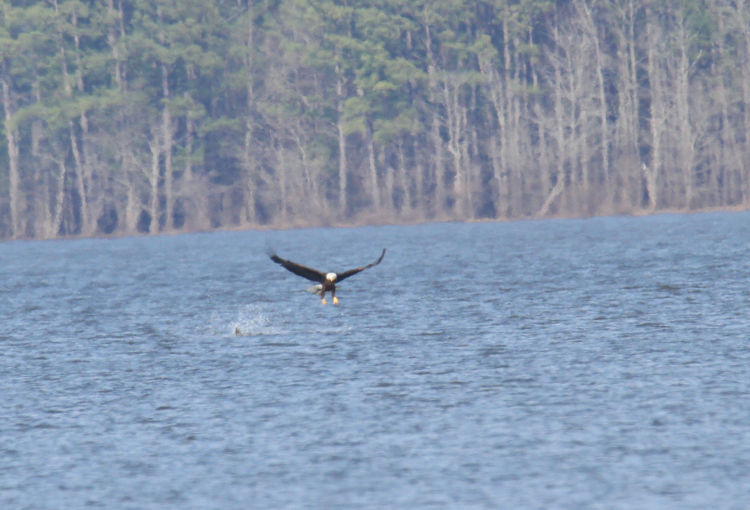
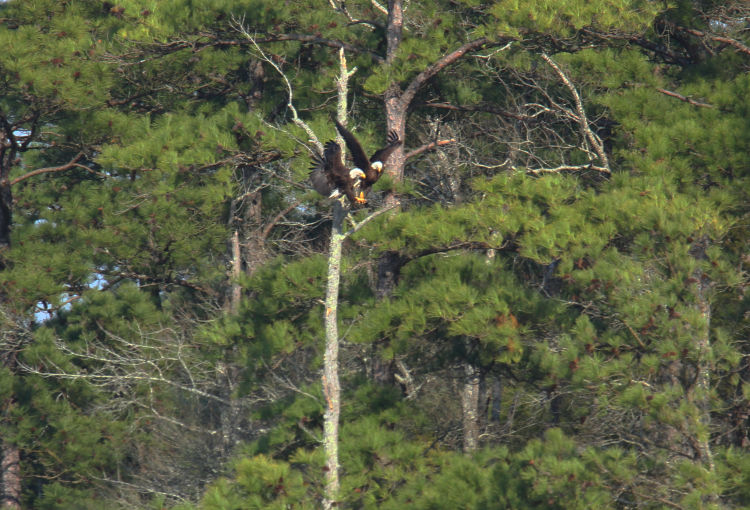
bald eagle Haliaeetus leucocephalus struggling to gain altitude with a recently-captured large fish
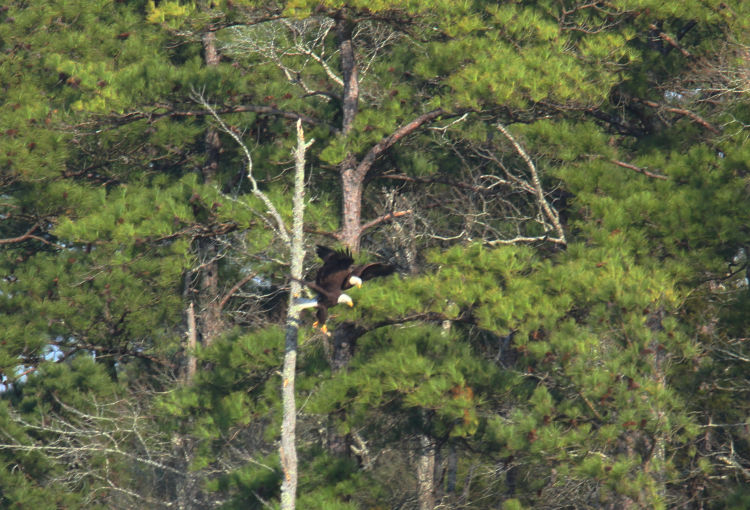
The light was too dim for me to even bother thinking about distant birds, and I still had the 18-135mm attached as a bald eagle (Haliaeetus leucocephalus) swooped down to the surface and snagged a fish – at that distance I couldn’t even be sure that it was an eagle until it made the capture, reaching below the surface with its talons as it cruised overhead, rather than crashing violently into the water as the ospreys do. It must have been a monster fish, because the eagle had serious difficulty gaining altitude with the burden and remained only a meter off the surface for quite some distance. Would have been nice to have seen that in the light.

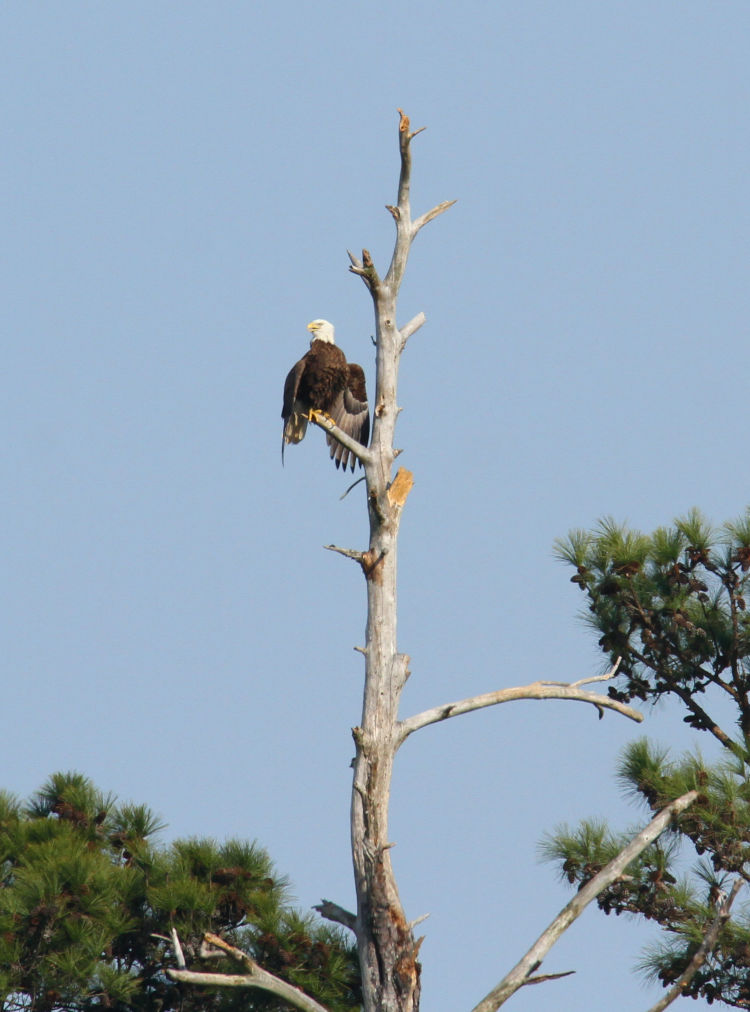
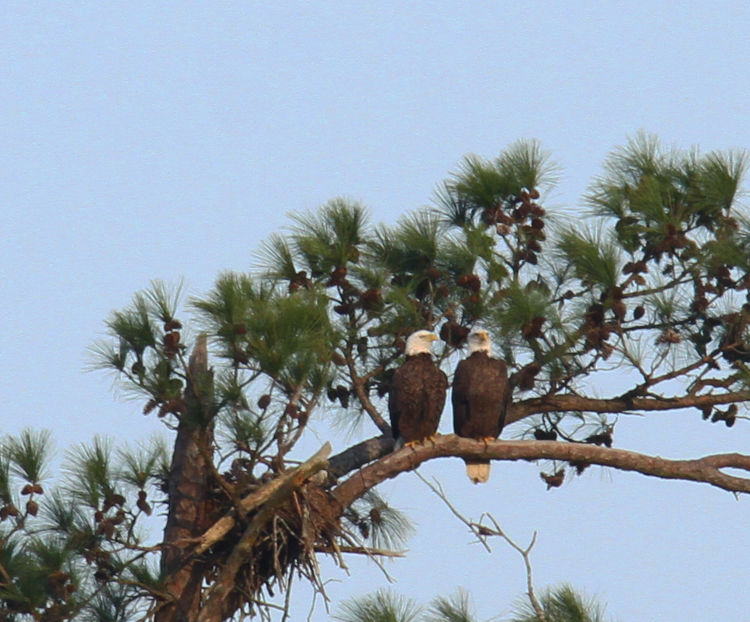
In fact, four eagles cruised past before the light was decent, and then vanished once the visibility was good for photos. So I just have some barely-adequate images of two more of them.

combined two frames of bald eagles Haliaeetus leucocephalus, with edits to bring out some detail from near-silhouettes
The two left images are the originals, while the two right are the edited versions to show what detail could be discerned at those exposures. The top one certainly seems to be a third-year juvenile, displaying the stripe along the face and a nearly-white tail (I’m assuming, anyway – at least it’s much lighter than the body.) The lower one, on the other hand, could potentially be a first or second year juvie – there are hints of mottling, but it’s hard to prove this isn’t just underexposure variations. The silhouettes of each certainly say, “eagle,” though.

And of course, herons were in evidence.

great blue heron Ardea herodias herodias standing quietly at water's edge before dawn
Several great blue herons (Ardea herodias herodias) were hanging about and jockeying for ideal positions along the shore, but not even hunting as far as we could see. I fired off a few frames for fart’s sake but otherwise paid them little attention.

We scoured the trees as they became visible in the rising light, trying to see other eagles or osprey or anything else of interest before we got too close and spooked them, but all we saw were vultures – lots of vultures.

turkey vulture Cathartes aura watching photographer carefully during grooming
Most of them, and the only ones that I got worthwhile shots of, were turkey vultures (Cathartes aura) – I have enough images of the species perched, and flying overhead, that I don’t waste too much time with them anymore. I did a few frames as the full sunlight colored them much more yellow than they actually are, but this lessens the contrast with their bare red heads at least.

turkey vulture Cathartes aura on top of stump trying to look impressive
Around the lake, they seem reasonably acclimated to humans and didn’t get concerned until we got within about 12 meters or so, deciding that was close enough – but after we’d passed, they returned to the same perches, and I couldn’t tell you what the draw was. There didn’t seem to be any corpses around to attract them, and the lakeshore has an abundance of places to settle that no person can come close to.

The lake level was way down, perhaps the lowest that I’ve seen it, and this revealed much of the bed of the old railroad spur that crossed that arm of the lake; at the distant end, the buoys that marked the shallow rock hazard to boaters were no longer floating but resting on those rocks themselves, rising out of the water now. And right near those, a curious formation attracted our attention.

female double-crested cormorant Nannopterum auritum sleeping on exposed rock
A female double-crested cormorant (Nannopterum auritum) was fast asleep out on the end of the exposed spur bed, ignoring the fishing boats that sat no more than 15 meters off. Seeing as how the footing was more-or-less dry leading up to her, we began stalking up as quietly as possible.

female double-crested cormorant Nannopterum auritum still snoozing on rock as photographers approached
I thought we were kind of screwed when the nearby boater decided to fire up the outboard, startling the cormorant awake. But she was made of sterner stuff, and merely eyed the boat as it circled around towards deeper water, then tucked her head back down again and lapsed back into slumber.

We drew up as close as we could reasonably get, given the large, algae-covered rocks that threatened to twist ankles, and fired off several frames. Then, asking if Mr Bugg was ready, I gave off a few sharp whistles that brought her awake again, because a Headless Cormorant, while seasonal, wasn’t very photogenic.

female double-crested cormorant Nannopterum auritum awakened from snooze by photographers
She awakened as intended, finding us maybe about ten meters off, and surveyed us judiciously. I figured she’d take to the air, but she was singularly unimpressed by our proximity and demeanor and, within ten seconds, tucked back down to resume her nap. Given that it was Saturday morning, I reckon she was hungover. You can’t see the eyes too well here, but they’re normally deep blue-green in color, and I imagine that becomes rather startling when they’re bloodshot…

Annnddd not much else, really. A passing belted kingfisher (Megaceryle alcyon) presented a few somewhat distant photo ops.

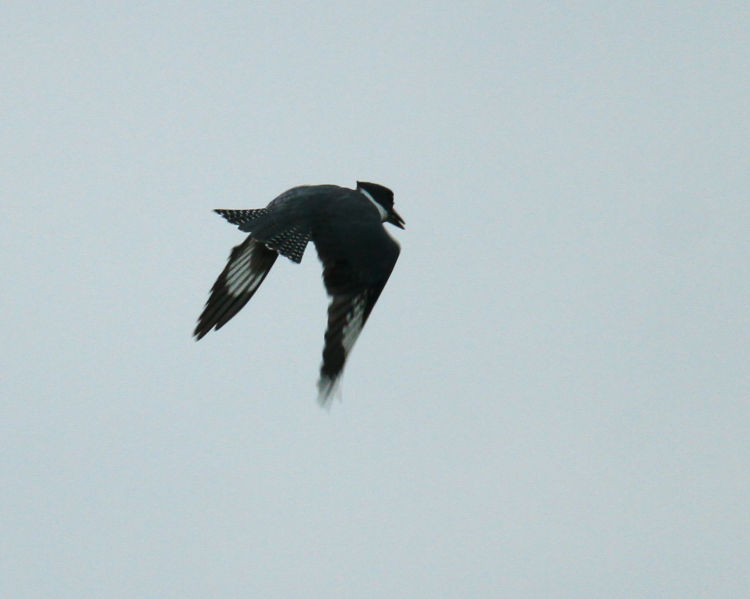
male belted kingfisher Megaceryle alcyon overhead showing gaps in wings from molting
I’m still after some nice, close portraits, which continually eludes me, but at least I could show how this one was in mid-molt, with two gaps in each wing from the missing primary flight feathers. The lack of another, orange band across the breast pegs this as a male, which is curious, since it’s usually the males that have more colors than the females. And I just found out, while confirming that the scientific name hasn’t changed since the last time I featured one, that they actually nest in burrows at the water’s edge – not what I expected at all, and now I have that to add to my list for the spring. I really need to find an area that they frequent and stake it out for a while.

The autumn colors were well before peak while we were there, but in some places they could look a little impressive, as long as you cut out the surrounding areas where they didn’t.

small patch of autumn colors on edge of Jordan Lake
Not bad, right? You’re looking at nearly all of the colors in this area, with only singular trees here and there showing off otherwise. I might still get out to do a dedicated colors outing, if I can find a good spot, but I’m juggling availability right now. We’ll see I guess.

That’s a first

I’ve heard of this happening, seen a few photos online, but this is the first time I’ve seen it for myself.

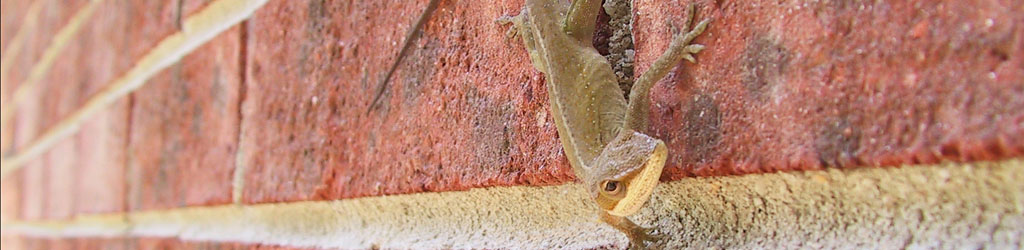
adult Carolina anole Anolis carolinensis with regrown forked tail
Now I finally have one that I can tell apart from the others…

Some reptiles can regrow limbs, most especially the tails, if they lose them to predators; the skinks can drop them at will, where the severed tail, often brightly-colored, will writhe madly and hopefully distract the predator while the skink makes its escape. On occasion, the tail will grow back forked, which is likely what happened to this Carolina anole (Anolis carolinensis.)

This was immediately alongside the front door here at Walkabout Estates, and curious in two ways. One, I’ve been trying to keep tabs on the various ones around the yard and have been unaware of any that have lost their tail recently, much less been in the process of growing it back, so this slipped right past me somehow; not impossible of course, but the posts here haven’t been reflecting anywhere near the number of times I see anoles in the yard – I’ve been sparing you. Second, the temperature dropped down into the low single digits last night (that’s Celsius,) and I would have expected these guys to have holed up for the winter – certainly not climbing up the shady side of the house. Not too long after this, however, my fork-tailed subject continued, somewhat sluggishly, up the downspout and onto the roof where the sun was beating fiercely, and so should have gotten plenty warm enough.

I was doing a little research on how this regrowth occurs and came across a comment in one article that said it may take more than 60 days, which I was skeptical of – I thought it was half that, give or take. And then suddenly I thought, Hey! What if this is Stubby? I went back to my stock images of the aftermath of that fight (it’s video – check it out,) from several days later, and started comparing images. Note, above, that there is a lot of fight scarring around the snout, and especially a distinct spot behind the left eye. Now we look at some images from April of the bob-tailed victor of those fights.

Carolina anole Anolis carolinensis back in April showing scars from recent fight
This was from eight days after that altercation, and we can see the damage behind the left eye. And another image showing the missing tail:

adult Carolina anole Anolis carolinensis back in April showing missing tail and fight scars
So is this is the same guy, with his new tail? I can’t possibly tell for sure, but the regrowth area, the size, and at least a little of the scarring seems to match up. This is on the other side of the house from where the fight occurred, but that’s not difficult or a great distance – I was up on the roof the other day and one was dodging around on the chimney while I was there.

Either way, I’m glad to have seen and photographed this in person, and I’ll be keeping my eyes open, though it’s liable to be next spring before I see him again. But I’ll close with another from a few days previous, a big one on a downspout on the back of the house that let me lean in close, in much better light.

large adult Carolina anole Anolis carolinensis in profile

If you’re not doing this, why not?

So we did our thing for Halloween last night (or Hallowe’en if you want to be pedantic in an enormously stupid way, because who makes a contraction like that anyway?) and I have to tell you, we won’t ever stop doing this. I’m referring to All Hallow’s Read (or is it A’allo’ead?) where we give out books at Halloween. Not instead of candy, though from the reaction of the kids we could have easily, because The Girlfriend led off with the books and just about every kid was prepared to ignore me with the candy dish. The past few years were lean with the trick-or-treaters because of weather and COVID, and so we were trying to deplete our stockpile of books and gave out more than one on many occasions, but this year we had more kids than we’ve ever seen before and they all left happy, as did the parents – one dad in particular made it a point to come back and tell us how cool it was and that we were his daughter’s favorite house. This was great to hear, certainly, but we’d be happy with them getting books even without that. One girl seemed quite reluctant to pick one out, rejecting every offering, and we started to believe that we had a ‘vidscreen kid’ on our hands. Then The Girlfriend found the right choice and the girl’s face lit up – it just takes a little effort with some.

Each of them got a 3D printed bookmark too, as did any of the parents that thought they were cool. And several complimented the skeletons out front, so overall, a very nice night. Seriously, if you have the kids coming to your door, I cannot recommend enough getting into this habit; the parents may have to start traveling with a rolling cart for the book haul, and this is no bad thing.

The moon wasn’t out during all of this, unfortunately, but at least the rain held off, and while it was pretty chilly, that doesn’t slow the kids down (says the guy who used to trick-or-treat in NJ and NY, often with a winter jacket over or under his costume.) So I’ll leave you with the lovely pumpkin moon from sunrise on the 28th instead, rippled thoroughly with the atmospheric distortion from being so close to the horizon. You may also note a dark semi-distinct band extending halfway through from the top, which is in several frames in the same location, indicating that I had a hair adhering to the inside of the lens I believe – it was gone from the other shots of the day, after swapping lenses back and forth. But with that kind of distortion, I wasn’t going to get anything sharper than this.

full moon at sunrise through a lot of atmospheric distortion, and a hair
Now get them books for next year – I’ll expect photo proof.

No, no, October no home

Despite seeing the car in the driveway and lights on upstairs, we’re told that October has left the premises, and so we have no choice but to dig out the end-of-month abstract images to placate us. And what might these be, you say? [That was your cue, go ahead – time is money, sweetheart.] Why, they look a little something like this:

leaves of unidentified tree turning golden in early autumn
I should probably know what this tree is, seeing as how it’s right off the back of Walkabout Estates – crepe myrtle? I dunno, something, we’re not here for the botany, but for the abstractedness, of which is has a bare modicum, just like the number of images that I shot this month. Yet I will admit, more are coming, though they’re not more abstract than this, sorry. I was thinking about it this month, but no inspiration was coming nor tableaux presenting themselves.

Still, we have another.

osprey Pandion haliaetus nest in twisted pine silhouetted against sunrise colors along Jordan Lake
Between the sunrise light and thinner needles from the drought, the osprey nest was quite visible in the tree after having been almost invisible all summer – not occupied at this time, of course, but I liked the mimicry of the ‘typical’ African scene that always seems to pop up, at least in the states, though that’s generally an acacia tree on a plain and not a misshapen loblolly pine (Pinus taeda) on a lakeshore. This was as good as the sunrise colors got, too – well, maybe not, we’ll see in a short while.

Tripod Holes 44

unidentified hermit crabs in beach grasses at Fort Fisher, NC
N 33°57’37.10″ W 77°56’31.87″ Google Earth location

The best time to see something like this is early morning, and it should be clear that the barnacle-encrusted shell in the middle is housing a hermit crab – they all are, actually, and they typically forage at night to early morning in the beach grasses immediately adjacent to the waterline. I’ve only ever been there in summer though, so I can’t say for sure whether you can see them in other seasons, but I don’t think they hibernate – colder weather might just make them remain in deeper water or something. I don’t have a resource to identify hermit crabs, but looking at those legs, I’d be inclined to say these are thinstripe hermit crabs (Clibanarius vittatus,) which seem to be very common on the Atlantic seaboard. They’re aquatic, but as long as they keep some water within their shells to moisten their gills, they can forage on land for a while. This was right at the mouth of the Cape Fear River where it drained into the Atlantic Ocean, so brackish water – I’ve found shrimp several kilometers further upriver.

A little trick: if you see any shell of this approximate shape (typically whelks or conchs,) on land or under the water’s surface, and the opening is facing down, it’s probably occupied – the weight is opposite the opening so empty shells will usually be turned upwards by wave action. Even if the crab gets overturned, it knows that facing down is ideal and won’t waste any time righting itself when it feels that it’s safe to do so. Depending on the size of the occupant, when withdrawn the legs may be way up inside, almost entirely out of sight, so never assume such shells are empty if you’re collecting them.

They will usually withdraw when they sense danger, but within a minute or two, if things remain quiet, they’ll emerge only partially, observing the surroundings for a short while, before they fully extend their legs and get back to business. I waited out a couple of the larger ones to see what they did, and watched as one trundled right over to the ‘cliff’ (not half a meter tall, but impressive to these guys) where the turf had broken away from wave action, and without hesitation plunged over. The shell clattered and rolled across where the soil gave way to the beach sand, then sat motionless for a couple of minutes before the occupant re-emerged and continued on its journey; it had withdrawn in a split second as the shell toppled over the edge and apparently such knocks don’t have any serious affect.

The number of crabs on the beach that morning (thirteen years ago) was staggering – the grasses were literally crawling with them, and I endeavored to do a wider shot to show this, but the grasses were a little too thick and the crabs too small (ranging from 1-4 cm,) so all that really showed were paler blobs that could have been rocks or chewing gum or anything. Video would have worked better, but I didn’t have the ability at the time, and not the time on subsequent returns. Maybe next year.

Not unexpected

Yesterday, the Immortal-So-Far Mr Bugg and I went back down to the lake to see what was going on, which was, “Not a lot.” We got a handful of photos, and spotted four different bald eagles though in pre-sunrise conditions, so far too dark to be worthwhile in the slightest. However, there was one particular discovery that bears highlighting here. Maybe. I don’t know – are you even reading?

The lake level was way down, probably the farthest that I’ve seen it, and as we approached the tree that housed the productive woodpecker nest last year, I was sharp-eyed enough to notice that it looked a little different.

broken dead tree that used to house a woodpecker nest
That may not be enough, by itself, to illustrate what I mean, though the shattered drunk in the foreground might give a clue. But here it is from last year while the nest was active:

tree with woodpecker nest
Taken from the opposite side, of course, but the difference should be obvious. The nest opening was between the two distinct branches extending to the right out over the water, and it appears to be just below those that the break occurred. It was inevitable, and while it did not seem to be occupied at any time this year, I’m still glad that this happened in the fall when it wasn’t likely to be in use.

I did, of course, start examining the shattered fallen portion of the trunk to see if I could find the nest hollow. After a bit of back-and-forth, looking for those side branches which had broken off, I picked a section and rolled it over, and there it was:

hollow of red-headed woodpecker nest Melanerpes erythrocephalus in section of fallen dead tree trunk, even showing downy feathers
The debris in the ‘floor’ of the hollow was fairly indicative, but the couple of grey downy feathers still adhering to the wood confirmed things well enough to me. The bark had been long gone for years, but the impact broke away most of the underlying ‘outer’ wood as well. Still, from top center extending out to top right is the root of an old, smaller branch, which is visible as a stump in most of last year’s photos, such as this one:

adult and fledgling red-headed woodpeckers Melanerpes erythrocephalus checking out surroundings
From this, you can tell that the nest opening was about even with that stump, making it roughly 25cm deep.

I couldn’t let it go at that, because today is Expend Way Too Much Effort On a Pointless Project Day, which I do have to admit that I celebrate far more frequently than just on October 29th – at least once a month, but probably more than that, and someday I’ll try to calculate how often this is, in the spirit of true dedication. In recognition, I took a few of yesterday’s photos of the ‘outer’ wood that had broken away from the base of that branch stump, and compared it to several of the photos that I obtained last year to try and confirm that I had exactly the right hollow. That this makes no difference to anyone is exactly the point, which I suppose makes this not entirely a pointless project and so I’m kinda shitting on the holiday – don’t tell anyone, I’ll get branded a traitor or something. I never could confirm this (matching the wood, I mean,) but there are some markings that give a lot of weight to being correct; the wood around the nest opening had broken away someplace else, and I hadn’t looked for it because I had forgotten the holiday was today. But there were still plenty of fresher, paler scratches on the section I had examined to show that something had been clawing at it fairly recently, courtesy of all the parental activity at the opening, which is one method to identify an active nest. This is vaguely visible under the fledgling in the image above.

More photos – just a handful – will be along shortly.

What? Pictures? Get out!

Yeah yeah, I know, terribly unprofessional of me to neglect the blog, but I’ll tell you what: you can keep my honorarium this month. Deal?

That aside, I did indeed take a few photos yesterday, which means only an hour or two ago. It’s a clear night.

waxing gibbous moon
I’d seen the moon last night, uh, two nights ago, and knew it was too soon for… you know… so kept it in mind for tonight, uh, last night, whatever. But the key moment fell sometime during the day it appears, because Tycho is fully illuminated here – it is the distinctly round crater at lower left, well beyond the terminator. Though as I examined the photos, I thought I’d check and see what other craters might be seeing sunrise on their central peaks, if any. And now we focus on Bullialdus, the one that sits by itself in the dark mare southwest of center (not the one centered along the terminator, with light catching its floor – that’s Archimedes.) Let’s take a closer look.

waxing gibbous moon centered on Bullialdus crater, showing possible hint of light on central peak
This is at full resolution, at roughly 1000mm focal length (the Tamron 150-600mm with the not-quite-2x teleconverter,) with Bullialdus centered. And yes, it seems there might be a hint of a light spot centered in the crater, but it’s not conclusive.

So I waited a half hour, and went out again.

waxing gibbous moon centered on Bullialdus crater again
I made the mistake of not noting my previous exposure when I went back out, and had been changing the settings drastically for reasons that will soon become apparent. So this shot is slightly less exposed than the previous, though it does seem to confirm that the first hint of sunrise is catching the peak in the center (which is not as distinct as Tycho’s, but hey.) For comparison, Bullialdus is about 61 km across and has a central peak system that rises a little over a kilometer, while Tycho is 85 km across with its peaks rising 1.6 km. Bullialdus is older and more degraded, but it’s not clear if astronomers have any real idea how old it is – younger than the mare it sits within, obviously, but that doesn’t narrow it down much.

But because of this exposure boo-boo, I went out again to do a bit better.

waxing gibbous moon centered on Bullialdus, brighter this time, definitely showing sunrise on central peak
Yep, it’s clear – it’s sunrise on Bullialdus’ peak, and appears to be just happening as I took these shots. Now granted, had you been standing there you would have seen the sun break the lunar horizon some time before, hours perhaps – it’s going to be a while after first light before enough is reflected from the peak to be seen from Earth, but this is what I got with what I got, equipment-wise. Which is not quite true: I have a semi-decent telescope that would do a much better job, but I have yet to get off my ass and get it in spec. It almost happened tonight, because there were multiple things to be seen, but laziness prevailed.

1000mm shot of SaturnI had checked Stellarium before I went out, to be sure I wasn’t missing something cool like the ISS passing in front of the moon, and so I knew that the semi-bright star just above the moon was actually Saturn, and thus shot a few frames of that. This is also full resolution, so you can compare it in size to Bullialdus – I could just barely make out the oval nature of the planet in the viewfinder. But I admit that I used the moon to focus sharply, chimping at the image previews under high magnification to try and get the sharpest pic possible. Saturn is a whole lot dimmer than the moon, so while the Bullialdus frame immediately above is 1/125 second at f8, ISO 800, the image of Saturn at right is at 1/13 second, f8, ISO 3200 – over five times brighter. And Saturn’s moons still aren’t visible.

[Doing this, I was suddenly made aware that, when I reinstalled GIMP, the “Save EXIF data” setting was reset to ‘Off,’ and so the images edited for the blog no longer have them included – I had to go back to the originals for those. All those little things that have to be fixed when you rebuild a system…]

But Jupiter was up too.

Jupiter seen through thin haze of clouds, with some moons visible
Everything looked just fine by naked eye, more that bright enough, but the resulting image looked like shit. After a few test frames and a little playing around, I determined that this was not the fault of a dirty lens or anything, but a very thin haze of clouds in the vicinity, especially as they shifted between frames. They were completely invisible by naked eye, but then again, I was doing this from Walkabout Estates with a ridiculously bright LED streetlight coming from about 90° off, so we’re not talking dark skies here. The clouds didn’t go away as I’d hoped, and I (initially) wrote Jupiter off for the evening, even when the four Jovian moons were visible (though showing motion blur from the 2/3 second shutter speed used for this frame.)

Then I went back out to do those further Bullialdus photos, and refocused on Jupiter – this time the clouds had passed.

overexposed Jupiter distinctly showing all four Jovian moons
This is again full resolution, just barely fitting within my blog width guideline, and while Jupiter is blown out, the Jovian moons are distinct; bottom left to top right, they’re Callisto, Europa, Ganymede, and Io on the opposite side of Jupiter – it’s nice to see them leaving the straight-line perspective that I used to capture, because we were seeing Jupiter largely along its equatorial line, but now the orbits have progressed and a tilt in the lineup is visible, much like Saturn’s rings.

Jupiter at 1000mm showing some stripe detailI did do a ‘proper’ exposure for Jupiter itself, as well, and captured a moderate amount of detail, at least for a telephoto lens and not a telescope. I have a goal to capture the Great Red Spot, but it won’t happen with this rig, especially as the spot is shrinking and fading now. It wasn’t visible at this time anyway, but Jupiter rotates pretty damn fast and typically it will become visible at some point throughout an evening (I believe it starts coming into view around 3:15 AM, about 90 minutes from now as I type this.)

By the way, since they’re at the same resolution, you can compare the apparent sizes of Jupiter here and Saturn above, and know that Saturn is almost twice the distance from Jupiter than Jupiter is from the sun. The rocky bodies (Mercury, Venus, Earth, Mars) are all clustered close to the Sun in the solar system, with the gas giants (Jupiter, Saturn, Uranus, Neptune) spreading way the hell out beyond that – the scales are mind-boggling.

[Meanwhile, a brief explanation of why I’m stalling on the telescope thing: In and of itself, it’s a lot fussier to set up than the long lens and tripod, but should I desire to use the tracking motor, that has to be aligned with true north and is fussier still. Plus the scope needs to be allowed to reach something close to ambient air temperature, which means at least a half-hour when the temperature is as drastically different from indoors as it is tonight – it’s about 10° C right now, and dropping fast. Then, I can set about collimating/focusing it to actually get a clear view, and with the temperature changing, re-collimation would probably be necessary every 20 minutes or so. Essentially, I have to be psyched to spend a few hours on a dedicated session, and I just haven’t gotten motivated to that point yet – and if I’m going to do it, I’m going to do it in a much darker sky area than this, so that means traveling to a good spot too.]

Anyway, while I was out and actually pressing the shutter release, I thought I’d check on another subject that I’d been seeing.

Carolina anole Anolis carolinensis tucked into crack of crawlspace door at night
I’ve seen only one Carolina anole (Anolis carolinensis) in the past few weeks during the days, but when I think to check at night, I usually find this guy tucked into the crack of the door into the crawlspace of the house – immediately inside is the water heater, while a bit deeper is the house heater, so there’s some residual heat leaking out that it’s taking advantage of. How much longer this will go on I can’t say, though this may be the last I see of the species this year, unless one sneaks into the greenhouse. It’s funny – I saw this behavior plenty of times last fall, then not again until abut two weeks ago. As the conditions warrant, I guess.

I wanted to do this shot too while I was out.

gardenia blossoming even while leaves are turning
Two of the three gardenia plants in the Back Forty thought that the recent rains, coming as they did after a long hot drought, heralded a second spring and blossomed out – not exuberantly, but we have a handful of flowers even as autumn is beginning to settle in, which the background leaves indicate. And just now, I noticed the spider down at the bottom of the frame.

But then I went around the same bush for a different perspective on another flower and made a more surprising discovery.

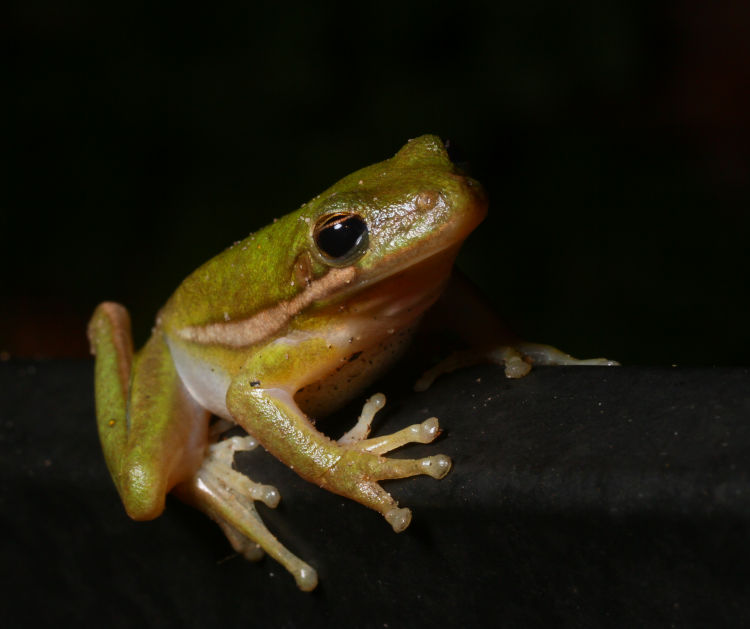
gardenia blossom in late fall with green treefrog Dryophytes cinereus perched alongside in 10 degree weather
From my initial angle, the white stripe on the side was the only thing I could see, wondering what it was, until it resolved itself into a green treefrog (Dryophytes cinereus.) I tried a few frames, but overhanging leaves always prevented good light from reaching the frog. I’ve been seeing these a little more frequently than the anoles, true, and they seem slightly more cold-hardy, but it’s about time for them to tuck into someplace safe for the season. The winter slump is arriving, but hopefully I’ll get a few more pics of interest before it gets a firm toehold. We’ll see.

Tripod Holes 43

unidentified greedy fish at coral reef near Key Largo, Florida
N 25° 6’31.47″ W 80°18’23.91″ Google Earth location

There’s a lot to unpack with this one, so here goes.

First, this may, or may not, be the correct location; I had no idea where we were at the time, but clues indicate that this is the spot. It was on a touristy snorkeling trip off Key Largo, Florida, and I recall the dive operator saying that only one small section of the coral reef was open to tour boats. Between the already-existing placemarks and the selection of boats visible in the aerial photos, I feel comfortable with this being the place, and the distance and position are close to what my memory tells me, anyway – it’s not like there were landmarks to be found. The particular photo came when I was in a school of fish and wanted to silhouette them against the late afternoon sun, and so dove towards the bottom, rolled over, and found that I wasn’t underneath them as planned, because they’d followed me down, probably expecting a handout. It might seem ominous, all of them looking directly at me in this way, if they weren’t as vapid-looking as fish always are.

This was in, I dunno, 1995? and I was touring Florida by myself, my first real photo excursion as I was considering getting serious about the pursuit. This was taken with one of those disposable ‘Fun Saver’ (or whatever) cameras though, and it shows.

patch of coral reef off of Key Largo, Florida
This is even better than the original, because it’s been color-corrected reasonably well – the original was quite blue-green. There’s no real subject here because I could barely see much of anything, as this post relates, so I was winging it when I saw motion or a nice blob of different colors.

But I can be more precise about photos taken soon afterward.

brown pelican Pelecanus occidentalis reluctantly moving aside in a Key Largo harbor
N 25° 5’23.42″ W 80°25’50.93″ Google Earth location

This frame was likely just a bit further north in the channel than what I’ve plotted, but I did this for a reason, so be patient. The brown pelican (Pelecanus occidentalis) got out of the way of the returning tour boat with exaggerated calm, allowing me to snag a nice portrait, especially for the Olympus OM-10, Vivitar 75-260 zoom, and Kodak Gold 400 print film that I was using at the time – the gentle surreal ripples in the background help a lot, I think. But immediately before this frame, I shot another pelican hanging out right at the mouth of the channel back to the tour boat dock. Nothing great here…

brown pelican Pelecanus occidentalis hanging out at mouth of channel into Key Largo Marina
… but it pins down the location pretty handily. I’d gone back and forth looking at various marinas and docks along the southeast side of Key Largo in Google Earth, trying to determine where we’d departed from, until I spotted the house at the mouth of the channel now plotted – you can see these walls, steps, and little private ramp right there in the aerial photos. Do I want to know how much that little piece of property on the end goes for? I do not.

But okay, fine, while we’re here…

sunset off docks near Sunset Cove Motel, Key Largo, Florida
N 25° 5’36.57″ W 80°26’39.43″ Google Earth location

I figure there’s no point in featuring Key Largo again in the lineup – not when I have so many other fascinating places to get to. This one was years later – 1999 I think – when I had a much better camera and was now shooting slide film. I had just checked in to the little rental cottages where I’d spend the night and, on coming out of the office, saw the sunset doing groovy things. I scampered to my car, snagged the camera bag and tripod, and hoofed it down to the little beach they had before the colors faded – this can happen pretty damn quickly. I had someone tell me that this image was Photoshopped, being too colorful, and I had to bring him the original slide to let him see for himself, though granted, I was using Fuji Provia 100 which is fairly saturated. I rarely alter my images more than a simple tweak for web display, because the entire goal is to do it right when out there, not correct it afterward. Not to mention that editors want to see the original as faithfully as possible.

I had not remembered what the entrance to the Key Largo Marina looked like, four years previously, and did not realize that I was staying so close to where I’d departed on the dive trip (in fact, I did not realize this until just now.) The next morning, after a nice little paddling excursion in one of the motel’s canoes, I drove further along the Keys Highway and paid a visit to the Florida Keys Wild Bird Center. I pack a lot into my trips.

Odd memories, part 28

It’s been slow in regards to nature photography and I’ve been embroiled in other projects, to the detriment of the blog. So I’m digging out an old draft that I almost-completed years ago to fill in a little, until I get some ‘proper’ content going. I should something more topical shortly.

I couldn’t even tell you what brought this one to mind the other day [heh!], so this is a complete non-sequitur, and I apologize for derailing the blog in this manner.

I was 25 when I finally moved out of central New York, and by that time had had my fill of winter weather. The thing is, up there snowstorms are frequent enough that not only do most places of work expect you to be on-time regardless of how treacherous the roads are, but even if you could afford to avoid them entirely, it could mean remaining sequestered in your house for quite some time. Credit to the road crews: at the first accumulation, plows were out and clearing roads, so typically only a blizzard would move fast enough to produce roads that were not drivable, and this wouldn’t last longer than overnight in most cases. You learned how to handle snow, you kept real snow tires (none of this all-weather radial horseshit, which are total shit for snow driving,) and you judged how bad the roads and parking lots were at any given time.

I don’t even have a rough date for this; I can just say I was in my early twenties and was still driving my parents’ Ford Granada, which was not known for its traction. I was making a quick run over to the nearby mall one night, looking for magazines I think. At one end of the mall was a totally unused parking lot which most people just used to cut across to shorten their trip around to the back entrances closest to certain stores, like the Waldenbooks I was after.

It had snowed recently, “a few inches,” but the roads were clear and the mall parking lot had been plowed, so most of what any driver faced was wet asphalt – nothing to worry about. But as I rounded the back side of the mall, I found they hadn’t touched the cut-through parking lot, still pristine under a smooth blanket of white snow. A little slippery perhaps, but a) I already had experience in accumulations of that nature, b) maintaining a straight line usually presented few problems, and c) it was an empty parking lot, with nothing to hit even if I did start to skid or spin or anything – horsing around in snow-covered lots is a winter pastime in most northern states, and even serves as valuable practice in getting out of (or into) skids, learning about the breaking point of traction, and so on. So I just aimed the car across the white blanket and continued on.

No problems for several seconds, until I was reaching the far side (and a plowed, clear section alongside the building itself) when I realized the blanket wasn’t perfectly level. It sloped upwards gently at the end, and I knew what this meant. Plows don’t of course eradicate the snow, they simply push it off to the side, and in most cases this is no longer a fluffy, soft pile, but packed and chunky icebergs with a tremendous amount of resilience to them, often remaining for weeks after the rest of the snow had melted away. Over a period of a few storms, the snow had piled up at the top edge of this parking lot, and when the last storm had passed, it had disguised this ridge, a little under a meter high, under a deceptive slope of new snow, not visible in the night under the parking lot lights until you were close. Directly in my path was a barrier of what I knew to be dense and deep icebergs.

There was nothing for it; my speed was too high, I had already passed V1. I gunned the engine a little in the hopes of simply breaking through, counting on it being not too dense. This was not something I’d practiced.

And with a fierce crunch, the car ground to a halt, mired in the packed snow with the front wheels a solid 15cm off of the asphalt. Remember what I said about the Granada’s traction? It was a rear wheel drive at least and they were still on solid ground, but all they did was spin without the car budging a centimeter. I knew most of the tricks, rocking and slow starts and all that, but none of that was going to shift the front end suspended on a ramp of pack ice. Resignedly, I went into the mall to a payphone and called my dad.

[Yes, this was the eighties. Yes, there was a Hickory Farms stall in that mall. No, I did not own even one item of neon-colored clothing, you little asshole.]

It wasn’t that my dad could do much, given that he was driving a Fiat, I think. He arrived with the snow shovel and the kitty litter (for traction, not because we were stranded so far from facilities,) but these were inadequate for the predicament I’d achieved. We played around a bit, including his own attempts at rocking and so on, but not a damn bit of progress was made. I was quite aware of the potential for catcalls and derision from passing drivers, not long out of high school and in a redneck part of the state where that’s one of the prime activities among youth, but this was the quiet end of the mall and I may well have been being paranoid anyway. Someone else spotted our dilemma and stopped to help, or at least observe, since they were no better equipped than we, and to give you an idea of how bad the Granada was, at one point during our fruitless attempts while my dad was behind the wheel and I was outside to push/shift/direct/stand by helplessly, I heard an odd whirring sound and looked back to see the rear wheels, sitting on wet asphalt, spinning merrily while the car idled in gear, having too little traction to even engage the automatic clutch. Yeah, that would have been a clue as to the folly of picking an unplowed path, but this was one of the factors that told me how bad the car was.

Eventually someone in a large pickup truck happened by. If you have a pickup in NY, you always have tow chains or a strap, you usually have four-wheel-drive, and you carry extra weight in the bed for traction; about 30% or better have mounts for snowplows on the front. These kind gentlemen hooked up to the rear of the car and yanked it effortlessly off of the snow embankment, taking all of three minutes to do it, and I thanked them profusely and gave them some money, a pittance really, for their troubles. I made sure the car could move on its own in the level part of the lot and helped my dad load up the stuff that he’d brought.

“What are you over here to get, anyway?” he asked.

“Nothing, anymore,” I said.

I think he believed I was either scared of driving or too wrung out to consider shopping. “The mall’s still open, you can go get what you’re after,” he pointed out.

“I just gave those guys all my money,” I replied, and got back in the car and headed home.

Tripod Holes 42

small green treefrog Dryophytes cinereus in pond in front of statue, Brookgreen Gardens
N 33°31’11.84″ W 79° 5’54.55″ Google Earth location

I could put you practically within my footprints for this one, because I remember pretty precisely where I was standing, at the edge of the spillover from this decorative sculpture pool within Brookgreen Gardens between Murrell’s Inlet and Pawley’s Island, South Carolina. This was a sculpture garden, filled with various works of art, and I was indeed doing some photos of them, including the one seen out-of-focus in the background – but if my preferred subjects happen to show up, I’ma do them too. Green treefrogs (Dryophytes cinereus) aren’t terribly aquatic – the name ‘treefrog’ provides a hint – but they can swim well enough and will use water sources as needed. So when I found one peeking out, I had to ensure that it was part of the composition. Brookgreen Gardens is a pretty nice place to check out, worth even a side trip – in fact, worth a few days there, which your entry fee will cover. I won’t guarantee that this guy will still be handy – the one in front, anyway; the one in back is likely still there wrestling his alligator. No that’s not a euphemism. You can even see right where I was in the post immediately following that visit, courtesy of The Girlfriend – I told you I could place you in my footprints. Though it took a little playing around to pin it down from the aerial photos, but, the default photos right now in both the online and installable versions of Google Earth show a blob right on the northern curve of the wall alongside the darker spillover that is precisely where I was standing – I’d speculate that the aerial photo actually captured me there, except The Girlfriend would also be in the frame and there’s no sign of that.

Pretty much right across the street sits Huntington Beach State Park, which we’ve seen in an earlier Tripod Holes, so again, worth the visit. Just, not so much for the beach vistas…

1 63 64 65 66 67 334