





More mouths to feed

Luckily, I’m not the one to do it.

newly hatched Chinese mantids Tenodera sinensis swarming near egg sac ootheca
I was busy with other tasks this morning and neglected to do my morning check of the mantis egg sacs, but judging from how many were swarming around when I finally did notice this one, they’d probably gotten started in the very early morning hours. Only a couple were still displaying a slight forehead bump that’s the last vestige of the bullet-head they have for hatching, while most were scampering around freely with little display of stiffness or clumsiness that indicates recent emergence. Ah well.

cluster of newborn Chinese mantids Tenodera sinensis on branch where ootheca was attached
No masks, no distancing – must be Fox News viewers. Here you can see the string that I used to attach the collected ootheca/sac to a larger, stronger branch for placement around the yard, while the background leaves are the day lilies that aren’t yet in bloom. Actually, most things aren’t – it’s been a slow spring, but we’re getting there.

They were just as spooky as the last batch, starting to disperse as I leaned in for closer photos, but I managed to snag a couple of decent frames anyway – and a lot of indecent ones. Well, no, not in the way that sounds – let’s just say crappy frames; English is weird. Here are a couple up at the tip of the branch having that tense movie moment before the big showdown in the third act.

pair of newborn Chinese mantids Tenodera sinensis meeting face to face
I lie; they weren’t in any movie, even my own. And they weren’t tense or even facing off, but just happened to get in each other’s way as they explored their environs. There was a lot of that going on, really, but luck allowed me to be in close enough with decent focus to catch one.

I went in even closer, but was working without the focus assist light, because I’m lazy/stupid, so using the reversed 28-105 for high magnification meant a little guessing in the dark because of the aperture fixed at f16. This was as sharp as I got – I know I can get sharper, but it also requires subjects that don’t leap away as the lens looms close.

newborn Chinese mantis Tenodera sinensis in very close portrait
The facets of the eyes are almost discernible here, though they might also not be too distinct yet because the eyes have only been ‘inflated’ to proper shape within the past couple of hours. And sorry, but I had to go for the long vertical framing on this one, to show the little ‘thorns’ on the forelegs too.

But this very shot prompted me to go out again and pursue another, specifically for you readers (and, well, anyone that might want to pay me for such things – don’t let your ego get too carried away.) It’s one thing to have detail, but another to know just how small those details are, so I went out with the paper millimeter scale in hand to try and illustrate this. All I had to do was place it somewhere near the gathered mantids and wait for one to amble across it.

Well, no. First off, most of the lily leaves they were now occupying were vertical, so the scale wouldn’t stay put (and would drop down into the dense middle of the emerging leaves when it slipped.) Second, the mantids didn’t like my hand, or even the tweezers, coming into their territory like that, and mostly dropped away into the denser undergrowth as I did so. Placing it at an acceptable distance and then trying to coax one closer, given that they now opted to freeze in place with my own activity visible, resulted in mostly the mantids heading in some other direction, but on the rare occasions when I got one close to the scale, they quickly dodged off of it, seemingly aware that it was foreign and wanting nothing to do with it (again, Fox New viewers.) On two occasions, I actually coaxed one onto the open tweezers, but then trying to introduce them onto the scale failed. Eventually, I managed a faint success; not what I was after, but perhaps just sufficient enough.

newborn Chinese mantid Tenodera sinensis near millimeter scale
As shown, they’re roughly 10mm in overall length when hatched, so the entire width of the head falls around 2mm, so you can scroll back up and judge for yourself how small the details that I did capture were.

This one was almost cooperative.

newborn Chinese mantis Tendora sinensis running behind millimeter scale
Seeing it perched on the edge of a large planter nearby, I placed the scale well ahead of it and then attempted to shoo the mantis in that direction, figuring that it would stick to the upper edge without too much difficulty. Ehhhhh, kinda. It tried going in other directions, and climbed a nearby leaf before I coaxed it back down to the rim again, and finally headed in the direction of the scale. Getting the camera in hand, I leaned into focus, and the mantis dodged down the side of the planter and soon disappeared. I spent far more time in trying to get a scale shot than with all the other photos combined, with far less success.

While this was going on, I glanced down into a planter behind me and noticed a much-larger fly sitting complacently on the side, and fired off a few frames of that one. This was much easier.

unidentified insect possibly syrphid fly showing eye facets and body 'hair.'
I don’t know what this is and am not doing the legwork on it right now; I’m leaning towards it being a syrphid fly of some kind. Not quite twice the body length of the mantids and a hell of a lot more cooperative, it shows the detail that can arise if your subject holds still. And proof that I don’t suck too bad.

Profiles of Nature 18

it's just a goat, I'm not trying to determine the breed, but his name is Osmar, okay?
Welcome back – it’s good to see you again! [I told you they hadn’t gotten any brighter – pay up, dawg!] Our model this week is Osmar (one syllable,) a recent arrival in the states from New Mexico – which is still in the states, but it’s disturbing how many people don’t know that (mostly Republicans, we’re betting.) Osmar, as might be obvious, specializes in dual roles, multiple personalities, and of course, modeling for that boy-band, ‘what-the-fuck-is-a-comb?’ look. He doesn’t actually have a midsection at all – there’s just a void, due to a mishap on the dynamic range when he was in the military, but he’s turned that to his advantage because it’s easier to Photoshop in whatever waistline is desired. Osmar has trust issues, though, due to few people maintaining eye-contact with him for more than a second or so but, seriously, can you blame them? Damn. He was pushed into modeling on the failed aspirations of his father, who had attempted to become clay but couldn’t pass the regionals. He’s really tired of being asked to go mountain-climbing, nothing to do with stereotyping, he just despises the type of people and has been known to mutter, “‘Because it’s there!‘ Vapid dingwalladers.” Osmar hopes to make his first million by the time he’s thirty, but he didn’t specify the “what” for either number, which would have pissed off our 9th-grade science teacher no end, but so did everything else so who cares? His favorite symbol to mispronounce and misuse is §.

Next week. Thing. Be there and be square.

In comparison

muted sunset colors over water iris plants and pond
Just a sunset shot from last night. The passing storm had left some clouds in the sky, which haven’t been there at sunset for literally weeks; even when we had them in the late afternoon, they’d magically cleared by sunset. Without clouds of some kind, you get no colors and nothing to show the light strata as the sun disappears. It wasn’t a remarkable display by any stretch (saturation has been boosted in-camera here, and a slight tweak to contrast,) but compared to what we’d been seeing over the past month or so, it was notable. Could have posted it yesterday, but we already had enough posts for yesterday.

More things happening

In the next couple of days (May 5th and 6th, to be precise,) the Eta Aquarids meteor shower should be peaking – this is one of two meteor showers caused by debris from Comet Halley (the other being the Orionids in October.) However, Aquarius is the radiant and that doesn’t rise above the horizon for the northern hemisphere until roughly 3 AM, and soon afterward the moon follows in the same general region of sky – it will be only a crescent, but too close to the typical origin point. You may get lucky since, again, meteors might appear all over the sky, just on average more from Aquarius, but it’s not the best of conditions. My recommendation would be to start after midnight and aim towards the southeast, if your location allows clear skies in that direction.

eastern kingbird Tyrannus tyrannus wondering what you're doing
Saturday May 8th is World Migratory Bird Day, so stay indoors because it’s their day – there’s gonna be a bird parade and probably a lot of cookouts, pulled mealworm sandwiches and all that. I keep finding that we have plans for that day, or at least portions of it, but I imagine that I’ll get some chance to observe the holiday. Really, I observe it a few dozen times a year at least, so I suspect I can cope even if I get no opportunity on the day.

I have this feeling there’s another holiday coming up, but can’t for the life of me remember what it is. I’ll figure it out eventually – stay tuned. And keep your calendar open.

red-throated loon Gavia stellata in water

Running a little late

The rains mentioned in the previous post did indeed come, but many hours after they were predicted – about twelve after finding the mantids. We’d gotten a bare sprinkling in the morning, which wasn’t anywhere near enough, so I’d gone out to water all the plants. Later in the day, naturally, we got a thorough soaking, which is how it goes, isn’t it?

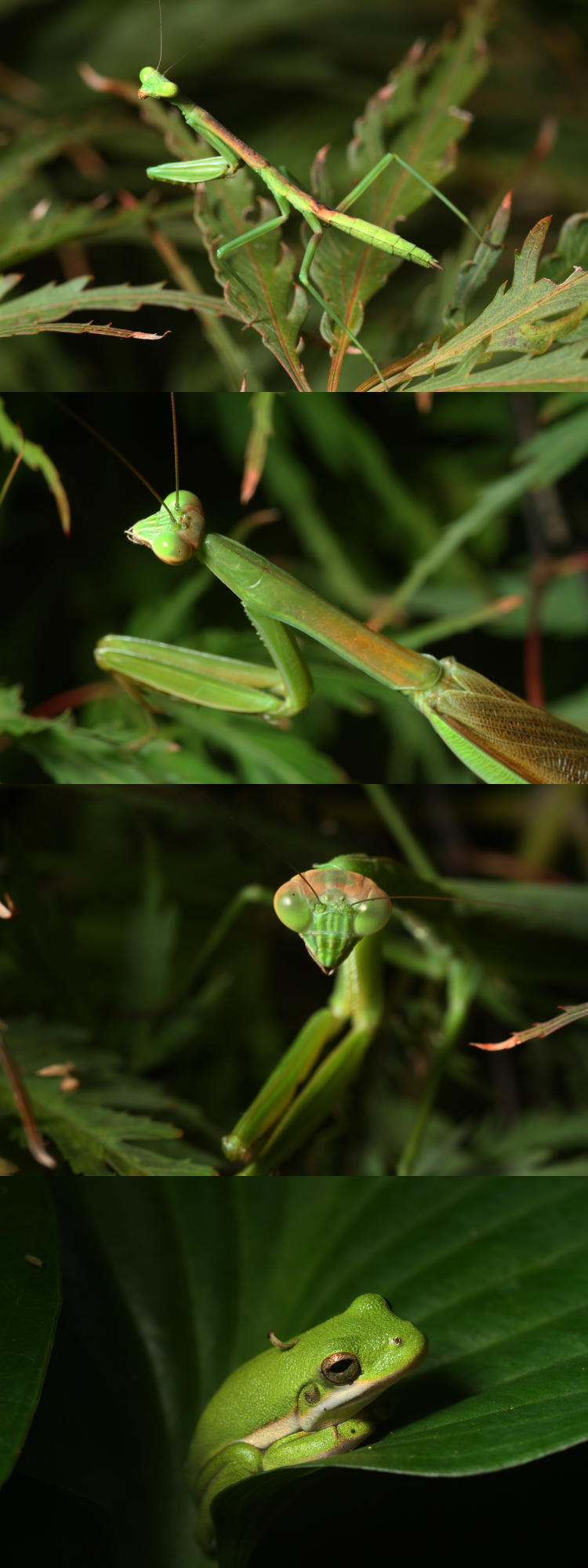
On the back porch, a green treefrog (Hyla cinerea) sat at the storm door like a Dickens waif; frogs are good at looking forlorn.

green treefrog Hyla cinerea at storm door as if begging to come inside
Why it’s sitting like this, I can’t say, because they like the rain, and several frogs are out there right now voicing their approval – I think we just happened to catch this one as it hung out for the day. Or maybe its Frisbee got inside somehow…

They’re trying to avoid me

It’s almost 4 AM right now, and don’t ask me about my sleep schedule. But yesterday evening (as in, about seven hours ago,) I checked on the mantis egg sacs in the yard because I know they’re due – actually overdue, going by previous years. Nothing was happening then, so as I stepped out this morning at 3-ish I only glanced down at the nearest one in passing, since it sits by the Japanese maple right by the front door – and saw the telltale beard.

egg sac ootheca of Chinese mantis Tenodera sinensis during hatching
Yep, they thought they’d slip this hatching by me – and almost succeeded, too, especially since we’re due for a thunderstorm in about four more hours. Wasn’t going to try setting up the video light, so it’s only still photos this time; I got video last year of the hatching, and now I’m aiming for hunting behavior, at least. See how many you can spot just in this tighter shot; the thin legs are the giveaway. But it was apparent they’d been at it for a while, judging from the huge number roaming the twigs.

newborn Chinese mantids Tenodera sinensis swamring over branches near egg sac ootheca
The twigs here are not from the maple, but the dried branch that I affixed the egg sac to, and they were mostly sticking to it, though some had ventured farther ‘afield’ and as I leaned in closer for detail shots, more of them felt threatened and dropped away like rain. This hurts them not at all, since their mass is so slight that even a big drop results in infinitesimal impact, and they just scamper away upon landing.

I really do have to emphasize their numbers.

clusters of newborn Chinese mantids Tenodera sinensis on twigs
Curiosity has me wanting to do a rough count to see how many had emerged, but I knew this would be nigh impossible. Not only had they already started to disperse among the maple and underlying vinca/periwinkle, but they were criss-crossing one another and dodging back and forth, so it would be hard to tell who was already counted. It will be an exercise for the day that I see the first hints of emergence, and want to sit there for several hours. Don’t expect that to happen anytime soon.

And while I didn’t see any in the act of emerging, I probably could have just waited, since at least one was still limbering up before detaching itself from the ‘dragline’ that anchors them to the ootheca.

newly emerged Chinese mantis Tenodera sinensis still attached to ootheca egg sac
You can see the still-bulging ‘forehead,’ just below the dark eyes, a bullet-shape that disappears soon after emergence, so this one was almost certainly less than 15 minutes old. And of course, the discarded exoskeletons (or something,) the chaff from all of the previous – you can go ahead and count those if you like.

They were definitely reluctant to let me loom in too close, no matter how slow I went, but then I got lucky with one that roamed into range as I was already in position.

newborn Chinese mantis Tenodera sinensis approaching camera
Only a few days back, I had completed mowing and edging the area, less than a meter from the egg sac, so I’m glad I won’t have to do it again for a while – we’ll avoid the slaughter as much as possible. They are, of course, a little less than 10mm in length, and so a bit hard to discern unless you’re right on top of them (or they’re clustered in huge masses right after hatching.) Thankfully, they tend to stay up on plants and not run around in the lawn very much – though they do spread out a bit, so it still happens.

I was hoping to get one to pose on the vinca blossoms for some nice colorful shots, but despite the availability of at least four flowers in the immediate vicinity, they weren’t getting particularly close. Then I lucked out slightly as a wandering individual started sizing up a new bud for a jump.

newborn Chinese mantis Tenodera sinensis judging distance to vinca minor periwinkle bloom for a jump
It eventually decided against it, so this is the best I got in the short session, but I’ll likely have plenty of opportunity. Close by, there will soon be daylilys, peonies, and the butterfly bushes to pose against, so we’ll see what happens.

On this date 58

Yes, this topic has not died yet, but there’s a special reason for it to occur this time, and we’ll get to that. Right now, let’s see what was happening on this date in history. Pretty recent history, and nothing at all historical. Pretty self-centered, to be blunt. But it’s a blog, which as I’ve said before, is an exercise is thinly-veiled narcissism. If it’s veiled at all.

So back to Florida we go.

Florida stone crab Menippe mercenaria chillin in shallows
In 2004, I was out in the Indian River Lagoon (surprise surprise) making the valiant attempt to get clear photos of aquatic species through a rippling surface, never the best of moves – the water might look quite clear and reasonably calm, but our vision tends to average out the distortion of each little wavelet while the camera will capture the funhouse effect. Nonetheless, I snagged a decent-enough frame of a Florida stone crab (Menippe mercenaria,) a species that I saw quite infrequently. Despite their buff and steroidal appearance, and the fact that their pincers looked easily capable of lopping off a finger joint, stone crabs are incredibly meek and seek shelter at the slightest provocation, at least in my experience – I could just be that intimidating myself. Atlantic blue crabs are something else entirely; they’ll take a shot at you if you’re just in the general neighborhood.

A year later, an entirely different neighborhood.

Moore Cove Falls, NC between two trees
I’d moved back to NC in the interim and realized that I’d never done a dedicated mountain trip in the previous years that I’d lived here, and corrected this oversight that spring. I’d underestimated the advancement of the spring growth, however; while things had been well in bloom for two weeks in the eastern Piedmont where I lived, that flower peak was still about two weeks off in the Blue Ridge mountains, and some of the trees still hadn’t budded out. But I was mostly chasing waterfalls, and had to look this one up again (in Kevin Adams’ excellent guide, North Carolina Waterfalls – Where to Find Them, How to Photograph Them, which I’d had for years at that point.) It’s Moore Cove Falls, not huge or impressive, but it has its possibilities (as I’ve hopefully illustrated.)

I’ve taken a whole lot of photos on May 2nd throughout the years: according to the spreadsheet that I created for this topic 18 months ago, 240 in the stock folders, and those were the ones good enough to retain. I had about nine potential images for this post, but I’m going to jump ahead eight years to 2013 for the next, because I picked those that I liked best.

very young Chinese mantis Tenodera sinensis with dewdrops on antennae
Someplace nearby, the undiscovered ootheca of a Chinese mantis (Tenodera sinensis) had hatched out, and there were plenty of newborn mantids scampering about on the azaleas right outside the door. I should need no justification of this particular focus.

Two years later, we’ll feature two, because I couldn’t decide between them.

unidentified Hymenoptera, possibly beewolf Philanthus, on fleabane Erigeron variety
Identification-wise, this photo is quite unspecific, because it’s actually hard to differentiate the two different species, especially when I didn’t take measurements and am going off memory. But this is likely a wasp variety known as a beewolf (genus Philanthus,) because the adults will feed bees to their nymphs, even though they eat nectar themselves. It’s on an aster variety, likely one of the fleabanes (genus Erigeron.) But the focus, on an insect not exceeding 12mm, is bang on, isn’t it? I couldn’t pass this one up for the feature, even though a sequential frame has appeared here before.

That was in the NC Botanical Garden in the morning. That afternoon, I was wandering around the neighborhood pond and came across a treacherous pile of dog crap.

northern water snake Nerodia sipedon sipedon sunning itself before impending molt
… Or at least, that’s what it looked like initially, and it’s possible that others had strolled past it without realizing its true nature. This is a northern water snake (Nerodia sipedon sipedon,) basking on the banks, helping itself dry out for its impending molt – that’s what those opaque eyes mean. It also means that this individual, of a species known for being quick to bite, cannot see well and will be especially prone to defensive measures. However, I took advantage of its obscured vision to lean in close for detail, counting (successfully) on my wraithlike abilities to remain silent and undetected [see above re: narcissism.] And in fact, silence isn’t even necessary, because snakes don’t have any ears, so I just had to keep the vibrations to a minimum.

And finally, the image that provoked all this.

male red-winged blackbird Agelaius phoeniceus photographed through a passing car
One year ago, we were in the Savannah National Wildlife Refuge, the one excursion that we took all year long, and we were parked on the side of the trail and trying for a decent frame of a male red-winged blackbird (Agelaius phoeniceus.) Obviously this isn’t it. It is, instead, evidence of my exquisite timing, as I tripped the shutter right when another visitor drove between us – you’re seeing the bird through two car windows. I had come across the frame again a few weeks back and set it aside for eventual use, then realized that the anniversary was coming soon; that, and finding just how many frames I’ve taken on this date, was the impetus of this post. And where I said above that there were 240 images for this date? That spreadsheet was made before this trip, so there’s a hell of a lot more in the folders now.

I was going to include one from today specifically taken for this post, but it’s 3 AM as I get ready to finalize it and there’s little to shoot. I considered the moon, just as a gimme, but the altitude it’s reached at this point means that it’s obscured by trees; I checked, going out in shorts, T-shirt, and barefoot despite the fact that it’s 9°C out there right now (spring seems to be only here during the day.) That’s dedication to a topic – only, not so much that I actually have a photo to put here.

Some birds before retiring

I have a gout of bird photos taken recently, so I’ll throw them up quickly to round out the month. I’ll still be one shy of a post for every day in April, but so be it. Worse, I don’t have a podcast for the month either, but may make up for this shortly.

Also, remember when I mentioned doing the sorting? I’d cleaned out the download folder at that point, yet it now has over a thousand photos awaiting sorting again as I sit here, and some more of those will be edited for blog use – I’ve found that if I don’t do it before I sort them into their categorical folders, I rarely go back and find blog topics from there, so it’s better to do it pre-sort.

The Girlfriend and I had been cruising around the neighborhood pond a few days back, and on our initial circuit, I lined up with the pair of double-crested cormorants (Phalacrocorax auritus) that tend to hang out on the pilings, and snagged a near-mirror-image frame for giggles.

pair of double-crested cormorants Phalacrocorax auritus posing almost identically
These piling sit at the end of a little peninsula on the pond, so there are two primary angles that I can achieve, and as I came around to the second, I was able to include a great blue heron (Ardea herodias) in the frame – with the unplanned addition of a Canada goose (Branta canadensis) to boot.

great blue heron Ardea herodias in foreground, with double-crested cormorant Phalacrocorax auritus in mid-frame and Canada goose Branta canadensis in background
Granted, depth of field at that focal length wasn’t really working in my favor, but I can assure you, that blob in the distant background is indeed a goose, and (despite the similarity in appearances) not a UFO or Bigfoot.

Yet we’d made it most of the way around the perimeter without seeing any of the green herons (Butorides virescens,) and I was puzzling over it a little, given how active they’d been only a couple days previously. And then I glanced down at the water’s edge near my feet to find one right there, not four meters away, which is a lot closer than they usually allow.

green heron Butorides virescens peering out from weeds at water's edge
I was extremely cautious as I drew The Girlfriend’s attention to it and maneuvered for a good angle, but really, it was likely wasted effort; the heron didn’t seem to give the barest fragment of a rat’s ass that I was there. So I was able to do a full-length portrait…

green heron Butorides virescens in profile
… and a tighter closeup…

green heron Butorides virescens in tight closeup
(The above image is full-frame, by the way) … and even a head-on perspective with some careful circling around…

green heron Butorides virescens seen hunting from head on
Really, way too lucky with these. I remarked earlier that I knew there was at least a pair, with one being more tolerant of close approaches than the other, so I have to assume this is that one. I’m still watching for nesting behavior, even though I suspect I’d never get a clear view of the nest. And this makes me recall that I have some good illustrations of this, but not edited for posting yet. They’ll be along.

We had stopped to chat with a friend of ours, a resident around the pond, but as the two ladies got deeper into conversation, my wandering eyes were picking out more subjects. Very close by in plain sight, what I believe is a juvenile red-shouldered hawk (Buteo lineatus) sat and watched us impassively.

juvenile red-shouldered hawk Buteo lineatus in good view
I’m not sure I could pin down a positive ID from this view, but our friend said she’d had a nest in her backyard and that was only a couple dozen meters off, so I’m fairly confident of tagging this as a red-shoulder. Before I could break in and draw their attention to it, it flew off, having completed its onus of sitting still for a portrait.

We were right alongside a nest box for eastern bluebirds (Sialia sialis) where we normally didn’t pause, so I was able to catch the male after his turn stuffing the young-uns.

male eastern bluebird Sialia sialis pausing to eye the photographer warily
We didn’t have a decent vantage into the nest box, so no pics of the young, but I’ll keep an eye out and potentially catch one of them bailing the box as they fledge. It’s a very narrow timeframe, and they’ll soon be up in the branches above, so more than a little luck will be involved if it happens.

Our friend had also told us about a pileated woodpecker (Dryocopus pileatus) that had been visiting, though she hadn’t seen it in several days. Then she got engrossed in conversation with other residents (it was a very pleasant afternoon and, really, what else is there to do these days?) and missed the bird flying overhead and landing in a nearby tree. I could only get a couple of clear shots at it, but I’m pleased, since pileateds tend to be rare around here and it’s been a couple of years since I saw one.

male pileated woodpecker Dryocopus pileatus peeking out from denser foliage
It’s a shame, because they’re very cool birds, and quite big as far as woodpeckers go, only a little smaller than crows in body size. Plus they have great calls – I’ll endeavor to get some recordings at some point.

Less endearing was the sight as we returned home, hearing a commotion in the neighbor’s yard and seeing some frantic activity at a nest box of theirs.

male red-bellied woodpecker Melanerpes carolinus raiding nest box of black-capped chickadee Poecile atricapillus
That’s a male red-bellied woodpecker (Melanerpes carolinus) raiding the nest box presently used by a black-capped chickadee (Poecile atricapillus) family. I’d never actually seen this behavior myself, but there was no question it was after the young.

male red-bellied woodpecker Melanerpes carolinus raiding nest box of black-capped chickadee Poecile atricapillus
I hadn’t actually had the camera in hand when we first saw this, so I’d had to rush in and grab it, giving some indication how long this was going on. I also attempted a couple of video clips, but even braced on a fencepost, the video is so wobbly that I can’t inflict that on you. This answered the question that I’d had as to whether a monopod would be sufficient for long-lens video clips. No. No it would not.

male red-bellied woodpecker Melanerpes carolinus raiding nest box and being harassed by black-capped chickadee Poecile atricapillus
At our first sight, one or both of the parents was well in attendance, attempting to dissuade the woodpecker, but upon returning with the camera I only got this one frame (and a bare blur in the video); they’d started to keep their distance. The woodpecker (slightly larger than a robin) managed to pull something from the nest and kept it hidden from our vantage on the far side of the nest box, but I had several views of it picking and discarding fluff, so I’m fairly certain it got a nestling chickadee. After that, it made another few attempts, then flew off, and I get the impression that another nestling, at least, was too deep to be reached, because the parent chickadees are still attending the nest.

Only a couple of minutes after seeing the raider fly off, we saw it again on trees in our yard, busy foraging among the bark as they are typically found. The vantage, with intervening branches, was worse at times, thus the green blur.

male red-bellied woodpecker Melanerpes carolinus working on oak tree with leaves in way
On occasion, it peeked out into the bright sunlight and allowed some better lighting, and I liked the glow from the eyes here.

male red-bellied woodpecker Melanerpes carolinus on oak trunk
But as I examined the photos afterward, I realized this was a different individual, not having the wet-looking stripe along the top of the head (potentially even blood from chickadee attacks) that’s visible in the earlier frames.

male red-bellied woodpecker Melanerpes carolinus from rear
This raises it own questions, because the two trees were only a handful of meters apart, so this means two males in the same territory, and neither one looked like a juvenile. One taking advantage of the other being occupied? I can’t say. This one stayed busy for several minutes as I got achy muscles from holding the long lens practically over my head, eventually laying down on the back deck and shooting from a supine position, which helped a bit.

male red-bellied woodpecker Melanerpes carolinus peering under bark of oak tree
The woodpecker foraged busily under the bark of the oak tree in that slightly-manic way of theirs, almost like stop-motion animation. Makes me wonder how much caffeine they consume…

male red-bellied woodpecker Melanerpes carolinus twisting head upside down to get under bark of oak tree
In some cases, way under, trying to find those juicy little wood-borers that make up the majority of woodpecker diets. I couldn’t pass up that view, could I?

And finally, today we did another brief trip out to Jordan Lake, which was brilliantly sunny but with a stiff wind, very seaside-like. And true to form, the eagles were easy to find, which I’m still getting used to. There was only one instance of actual fishing, way off in the distance, so no good pics of that, but a juvenile eventually passed quite close by overhead. This is the full-frame perspective:

juvenile bald eagle Haliaeetus leucocephalus passing directly overhead
And now we have to go in for a detail crop:

juvenile bald eagle Haliaeetus leucocephalus cropped close for detail
But, I have an ugly confession to make: these are not the same frame. They’re sequential, a second or less apart, but I liked the catchlight in the eye for this view, while the wisps of clouds in the previous shot made the full-frame view look better. Try not to let it ruin your sleep tonight.

And I’ll close with this one, because I’m me.

juvenile bald eagle Haliaeetus leucocephalus defecating in mid-air
I caught the glitter of this in the sunlight as it occurred, and was glad the wind was in another direction; you may have to look hard to see the details below and behind the eagle. I saw it with its talons dropped, normally a sign of a stoop for prey, but apparently it’s also a sign that nature calls, as the juvie dropped a deuce from altitude. Let that be a warning to you: if the talons drop and the bird isn’t coming down to the water, close your mouth.

I have only a couple minutes left in the day and month, so away it goes!

April must skedaddle

Nobody skedaddles anymore, do they? It’s becoming a lost art. Maybe I’ll start a school…

But it’s the end of the month, and you know what that means. No, not fresh underwear day – it’s the end of the month abstract, begun through a trivial coincidence and continued through sheer lack of originality and good sense. Today we have…

pine pollen floating in Jordan Lake at sunset
… to be honest, I have no idea what this is. No, okay, I lie, not being honest at all, because I’m perfectly certain this is – but wait, do you want to guess? I don’t want to take that from you. Go ahead, I’ll wait.
.
.
.
If you guessed, “the surface of Enceladus illuminated by gamma ray bursts,” there’s a prize waiting for you, solely for being obtuse, because how the hell am I gonna get a pic of the surface on Enceladus during a gamma ray burst? The radiation would discharge the batteries. No, this is actually pine pollen on the surface of Jordan Lake, taken way back when; I noticed, as the sun got lower, that the pollen wasn’t in the water but instead riding on top of it enough to show a texture with the right light angle, and immediately knew I had my month-end photo.

Or one of them, anyway.

varied vegetative debris on surface of New Hope Creek in Duke Forest
Some of my abstracts are pretty weak, stretching the meaning of the word even to my standards, but both of these I’m pretty happy with. While in Duke Forest trying to find decent subjects, an eddy in New Hope Creek had collected the shedding flowers and such from some species of tree nearby, in a vaguely Starry Night way; I’m especially pleased with the air bubbles captured underneath. Or it might be methane – I never bothered to check. I know, I know; I’m a lazy little shit.

But of course this means May is right on its heels, and that’s fine with me; I think May might be my favorite month. There’s even a chance it will be photographically productive. Shocking, I know…

I let my guard down…

… and of course someone snuck in.

recently hatched egg sac ootheca of Chinese mantis Tenodera sinensis showing 'chaff'
In this case, it was the first of the mantis egg cases (oothecas) hatching. There are several in the yard, including four now that had been naturally placed there – three Chinese mantids and a Carolina. I was doing routine checks, but the last one discovered, deep under an untended thicket of mostly vines, I now realize that I don’t recall checking two days ago, and so yesterday I find it with the telltale ‘beard’ of molted exoskeletons that the new hatchlings soon discard.No sign of any hatchlings though, so I figure it had occurred the day previously, or even overnight. I am ashamed to have missed this, bringing dishonor to my family and profession, and I poked myself in the belly with a butter knife to atone for this. But in my defense, the position was so bad on this one that I was certain I’d be doing very few extreme closeups of the hatching, and no video – just too much stuff in the way. Here’s a small example:

egg sac ootheca of Chinese mantis Tenodera sinensis lurking deep within foliage
And bear in mind, this is with crouching low and aiming into deep shadow – I only discovered it when picking up damnable pinecones before mowing. I took no photos on the day of discovery, so going out there this morning, I made it a point to search carefully for the newborns, and only managed to spot two, but they do represent the first mantids of this year, so everyone take note.

newborn Chinese mantis Tenodera sinensis, first for 2021, near ootheca
Since oothecas typically produce dozens to hundreds of mantids (each bit of chaff in the beard represents one emergence,) they made themselves scarce pretty thoroughly, but the foliage is thick enough that this is no surprise. It does slow me down from the project of clearing out some of that unwanted undergrowth, though. And it’s going to make me do more frequent checks of the other egg sacs – I’m wasting too much time on the computer right now…

1 129 130 131 132 133 335