



Catsup

This is the second post to clear out some accumulated photos, that I had intended to get to yesterday, but we already know I suck. Regardless of my differential air pressure, these were all taken two days ago and all within the confines of sprawling (for a given definition of ‘sprawling’) Walkabout Estates (for a given definition of ‘Estates,’ though this isn’t news to you, is it?)

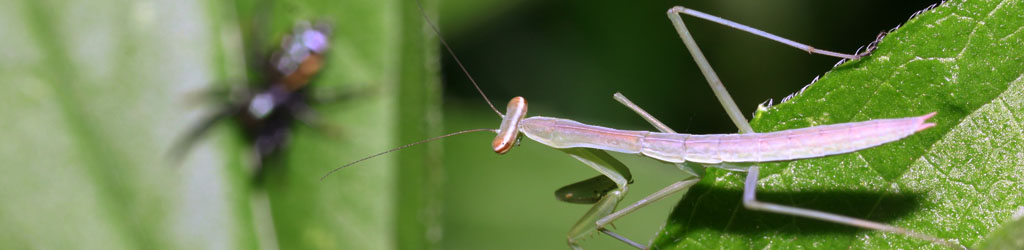
I noticed a little juvenile mantis out front on one of the big planter pots, and it was facing the molted exoskeleton of a cicada (that’s been there for weeks,) swaying back and forth as if looking for a fight – I did not have the camera handy and quickly corrected this, but the mantis had by that point uttered its face-saving bravado statements and turned away.

unidentified juvenile mantis disregarding exoskeleton of Brood XIX cicada
Shame, because I would have liked to have seen how that went down – the empty exoskeleton might have actually outweighed the mantis, though possibly slower. The mantis is going unidentified right now, now to protect its privacy (nature photographers don’t even know what that word means,) but because there remains a possibility this is in a European mantis from egg cases that my brother sent down, and not the typical Chinese mantids that usually inhabit the area. One of these days, I’ll capture one and see if I can spot the differentiating markings.

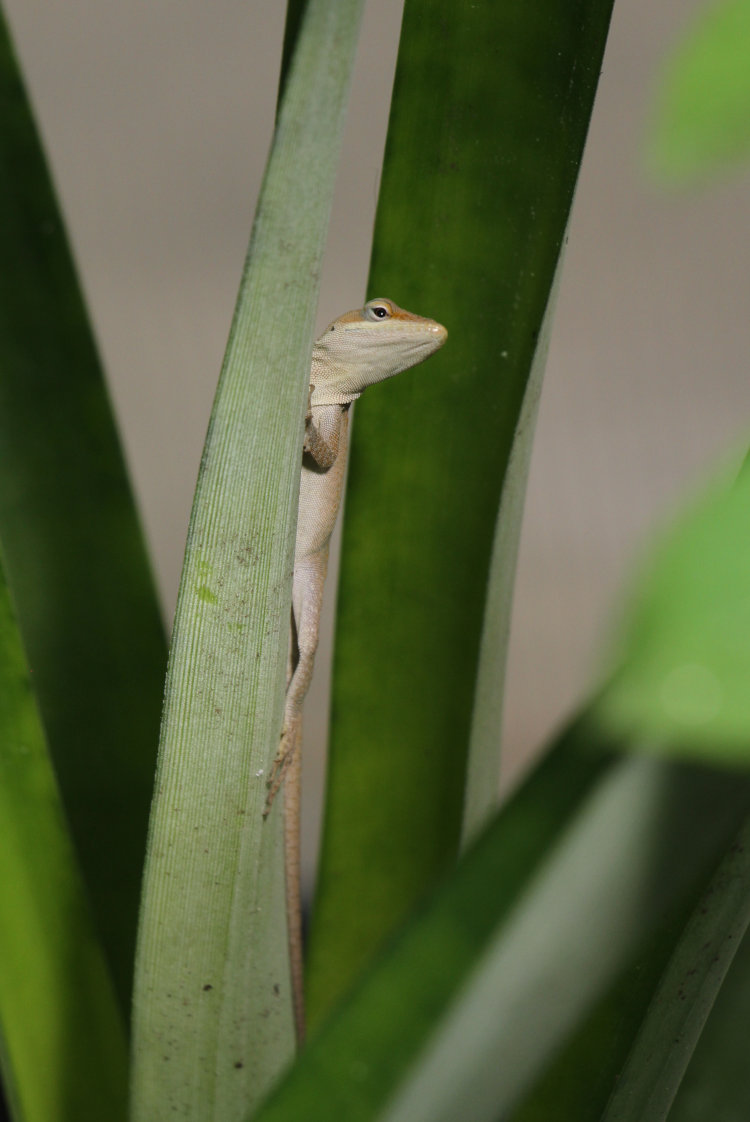
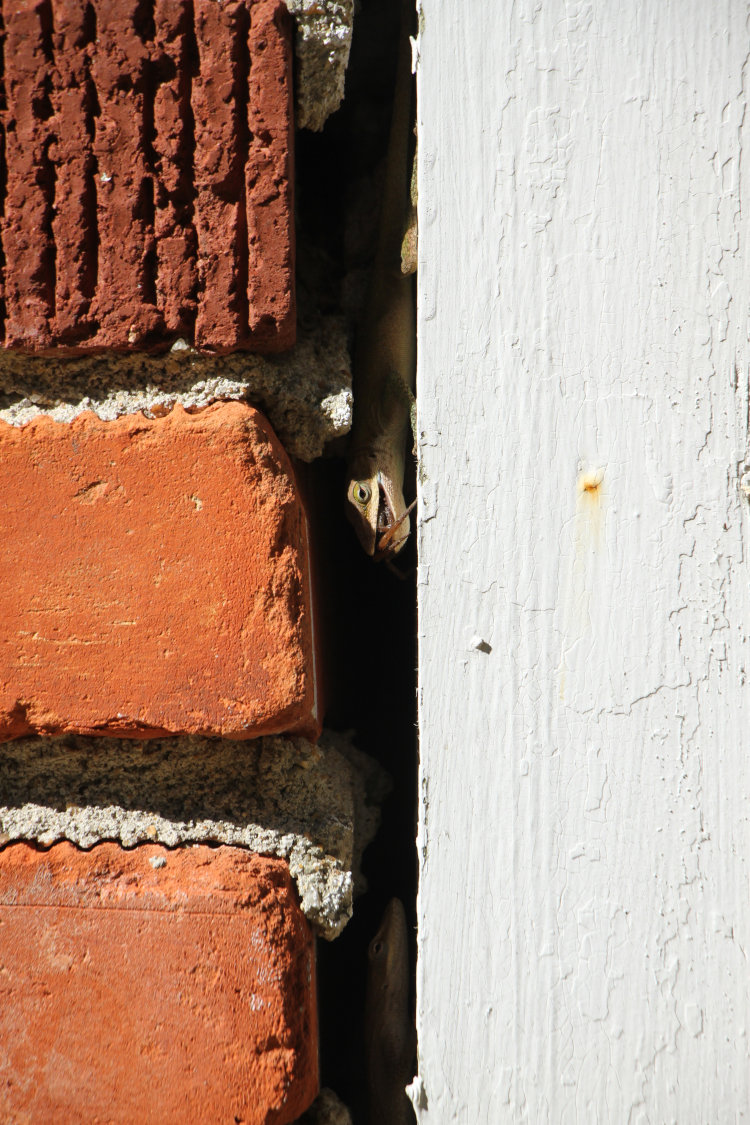
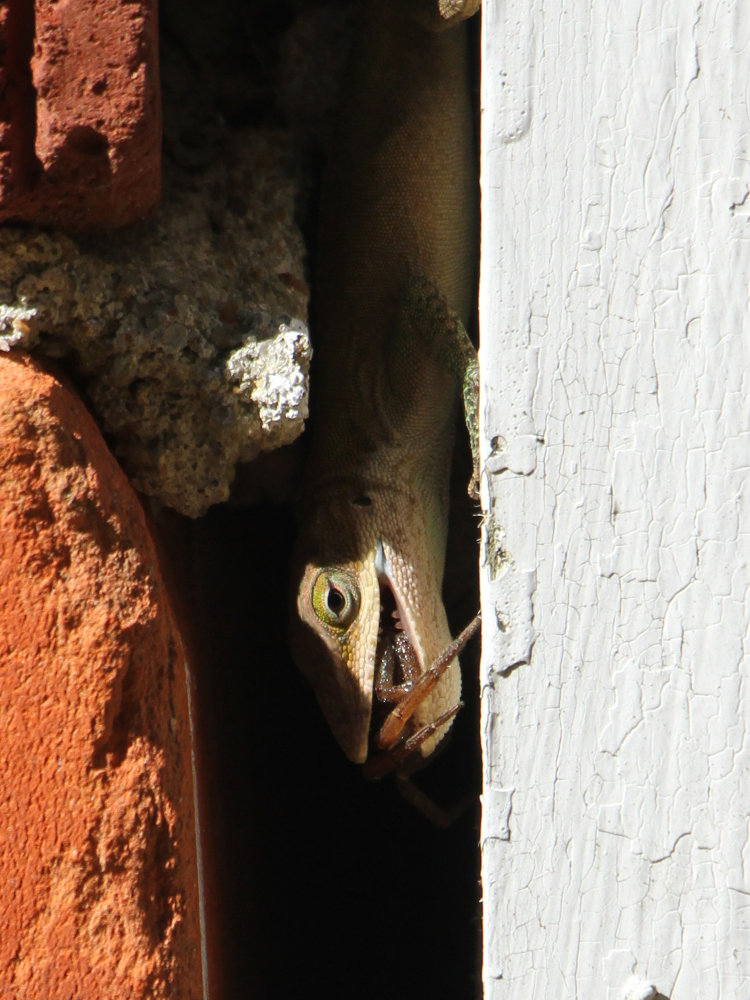
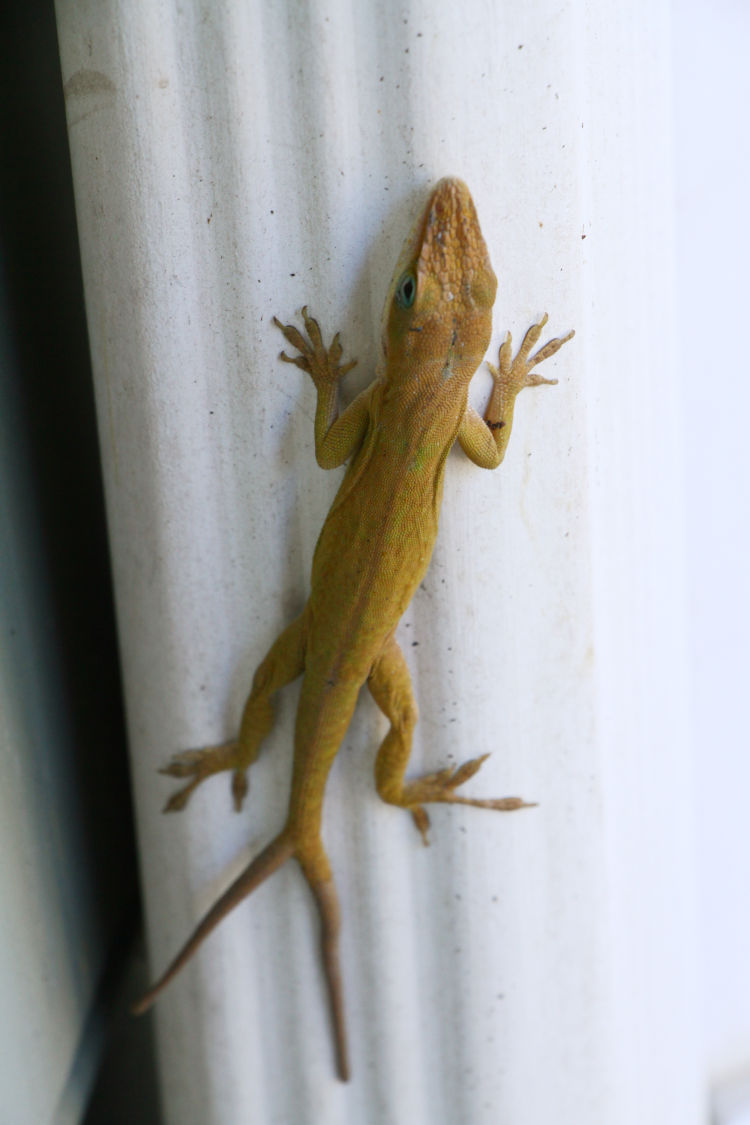
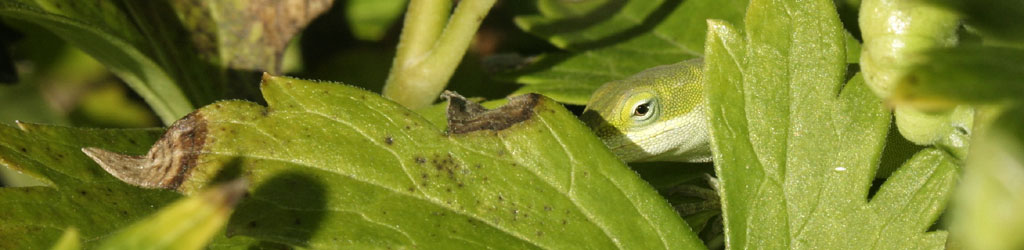
I left the immediate area and returned not too much later, to find a Carolina anole (Anolis carolinensis) suspiciously in the same location that the mantis had been – with no mantis to be see.

Carolina anole Anolis carolinensis watching photographer from where mantis had recently been seen
I watched for a few moments, changing angles slightly, looking for the gulping motion that anoles do for some time after they’ve snagged a meal, as if it’s stuck in their throat, but the anole simply watched me warily, possibly thinking I was going to try and sell it gutter-cleaning services. But then, using my eyes just a tad more responsibly, I spotted the mantis again, further around the curve of the planter and wisely holding very still.

juvenile mantis holding completely still in presence of anole
I never know how much evolved behavior I’m actually seeing. Anoles certainly respond much more to motion than to appearance, recognizing the quick movements favored by a majority of their prey, but have the mantids co-evolved not to display these motions? I’ve certainly seen them moving quite rapidly at times, but of course not while hunting, and their typical stance by far is being motionless, though that’s also in areas where they blend in very well and I don’t think this qualifies. Regardless, it escaped the attentions of the anole while I was watching.

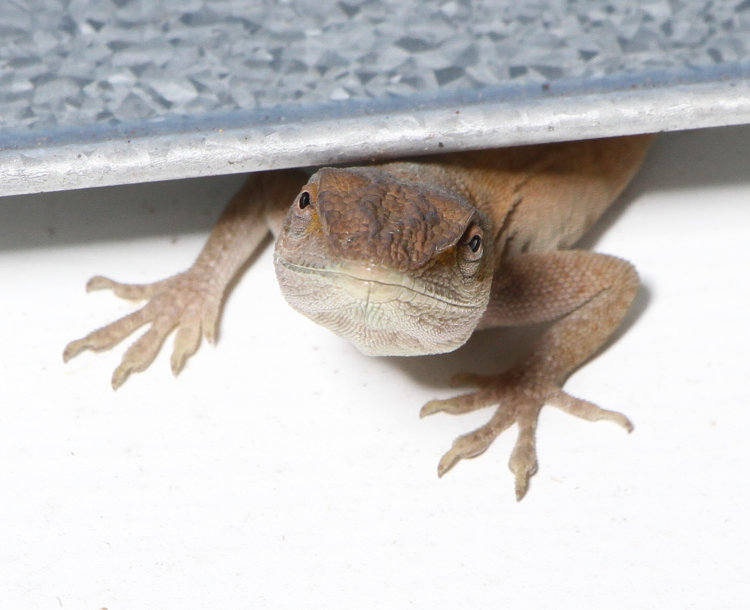
Quite close by sits a presently-empty plant stand in the front garden, and I realized that it had an occupant.

still young Carolina anole Anolis carolinensis perched on plant stand with tail growing back
I’d been seeing this anole for the past week or so, always on or in the immediate vicinity of a large stick that I’d planted to hold the aforementioned mantis egg sacs in a good hatching area – this guy claimed it as its territory, and even gave me a territorial display twice when I was too close for its liking. It’s the same Carolina anole species – they can change hue drastically – but as you can see, this one has an odd-looking tail; this is because the tail got detached sometime in the past and has been growing back now, and don’t ask me if it will eventually blend in with the rest or not, since I’ve never watched it happen. I can say that, just in the week or so of seeing it regularly (which of course I can tell specifically because of that tail,) the tail has roughly doubled in length, perhaps growing as much as a centimeter in that time. I’ll endeavor to keep tabs on it.

Heading around back, my next find couldn’t have been more obvious without flashing lights.

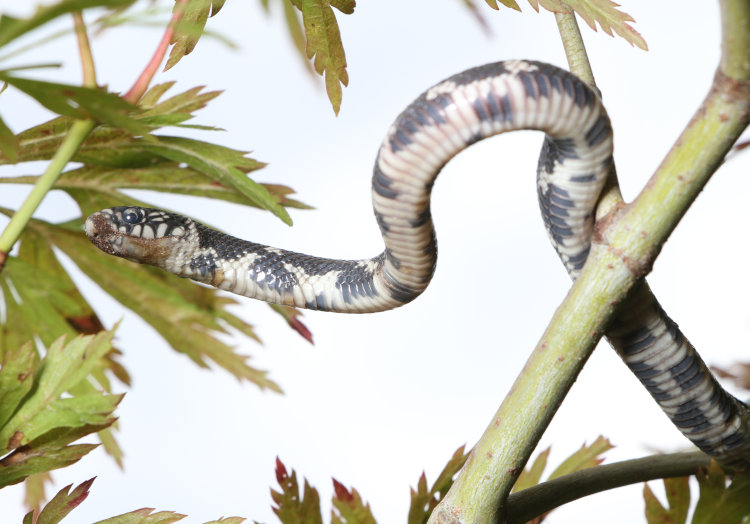
eastern rat snake Pantherophis alleghaniensis stretched out in backyard
This is an eastern rat snake (Pantherophis alleghaniensis,) formerly known as a black rat snake until biologists realized they could change the clearly descriptive name into something more vague that incorporated the vastly-overused ‘eastern’ – seriously, I don’t know what it is with them but I’m recommending therapy. Anyway, I only see these occasionally, and this one was the largest that I’ve spotted in years, thicker than a garden hose and nearly as long as I am tall (182 cm.) I was quite pleased, since maybe it’ll help with the mole problem, but it’s a good thing that The Girlfriend wasn’t around at the time because this is the size that freaks people out. They’re not only harmless, though, they’re usually pretty docile, which we’ll see in a minute.

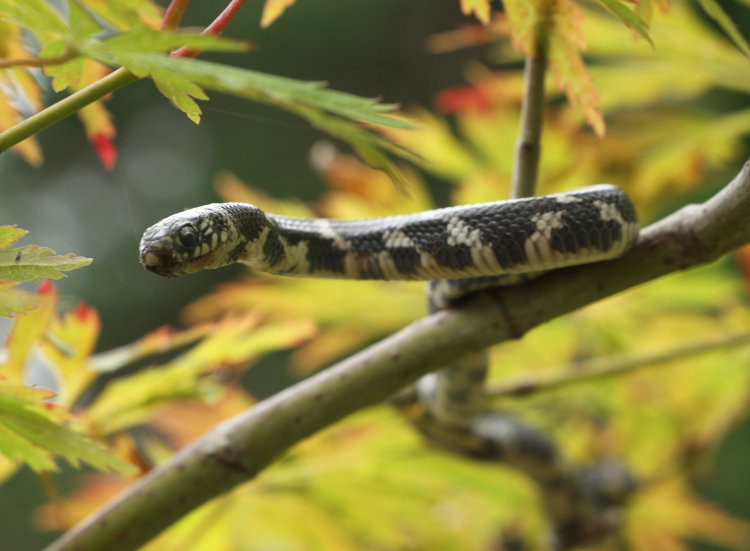
eastern rat snake Pantherophis alleghaniensis closeup of head
This is a snake big enough to consume chicken eggs whole, though they do have to do that jaw-dislocation thing, and thankfully it didn’t show up until the titmouse nest had been vacated. I wanted to do a couple of useful scale shots, however, so I reached down as it was realizing that I was definitely aware of its presence and beginning to slide away, and simply picked it up by the midsection. Not only did it not turn to bite, it didn’t attempt to defecate on me either, or even coil around an arm; its reaction was more along the lines of mild distress and slightly more effort in moving on. It was not, however, as cooperative as it could have been for the selfie.

author/photographer holding eastern rat snake Pantherophis alleghaniensis for mirror selfie
Yes, I realize I completely failed to take a proper mirror selfie by not wearing only a towel or a muscle shirt, and for that you should be grateful enough to actually donate something. I had to take too many images because of both the snake wandering off in different directions, and the inexcusable lag for actually taking a photo – seriously, why do people think smutphone cameras are so great? But it gives a little more scale anyway, even when so much of the snake is coiled out of sight, but you can at least see the head.

This one might also give an idea.

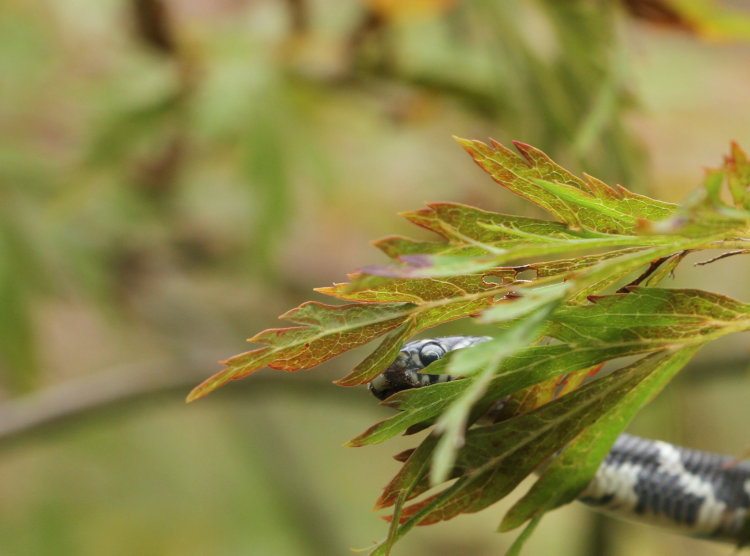
eastern rat snake Pantherophis alleghaniensis near access door on Stately Walkabout Manor
That’s a standard-width door into the water heater and crawlspace access, 80cm wide. And I have to note that all of the outdoor photos here were taken after I’d already picked up the snake and done the indefensible mirror shot – this is how agitated it did not get, and simply slid on its way with a little more purpose. How can anyone be scared of these? It’s like being scared of a sloth…

By the way, tomorrow is National Get Outdoors Day, so have at it. It’ll be up to you, as I may be very limited in this myself because I was running a fever last night and haven’t been able to do much. Some reptile-related virus, is what my doctor told me, and I should be fine once I shed…

Ketchup

Okay, I have a bunch of photos I’ve been neglecting, so let’s get some of them out of the way first – there will be another post following this with the rest. Provided I don’t get even more in the interim…

adult osprey Pandion haliaetus in nest examining something out of sight
I did make a trip down to one of the osprey nests, right around sunset because that would throw the best light on things, but only one osprey (Pandion haliaetus) made a brief visit, appearing to examine things in the nest before flying off and again and not returning until the light had dropped so low that I gave it up for the evening. It should be well past the time that the young would have hatched, but not quite time for them to be showing themselves above the nest rim, yet the adult also didn’t do any feeding. Not sure what to think at this point.

This was the nest that I have to observe from a busy bridge, and while there, I watched a pair of North American beavers (Castor canadensis) foraging in the drainage stream below.

North American beaver Castor canadensis bringing water reeds back to den near dusk
This was well down below where the sun could reach and it was subsequently pretty low light down there, so what I have isn’t very good quality. But at least I snagged this one bringing a bunch of reeds back to the den, indicating pretty strongly that there are young-uns around. I lost sight of both of them as they passed under the bridge, but the behavior of the ripples gave a hint that they’d stopped soon afterward, and I suspect the den is in the bank under the bridge. I’ll have to keep an eye out, since it gets dark so much later now that they should be active before sunset.

I’d stopped by NC Botanical Garden at some point, finding it an enormously slow day, and so I include just one curiosity, a hitchhiker that was walking along my shoulder.

Acanthocephala terminalis nymph on photographer's hand
This is the scale shot, that gives a hint of the colors, but we can do better.

Acanthocephala terminalis nymph on unidentified flowers
The little bugger took some convincing to get off my hand and someplace that I could use both hands to operate the camera. I was thinking that I’d need to submit the images to BugGuide.net, because I knew this was a nymph and thus not likely to maintain this coloration into adulthood, but searching under “blue assassin” turned up a match, that of Acanthocephala terminalis. Not actually an assassin bug, instead being a leaf-footed bug, but they’re not far removed from one another, and yes, the adults look almost nothing like this – certainly the deep metallic blue hue is gone. We can see that a little better in the inset:

Acanthocephala terminalis nymph in detail
We need more really bright and deep blue bugs. Maybe I’ll start selectively breeding some…

[I have to note that, as I was copying “Acanthocephala terminalis” for its multiple uses in the photo descriptions, spellcheck asked me if I meant, “phallocentric.” You’re reaching like a snickering ninth-grader, spellcheck.]

Back home on Walkabout Estates, I was looking for anoles on the oak-leaf hydrangea (Hydrangea quercifolia) and instead took a few moments to snag the European honeybees (Apis mellifera) that were visiting.

European honeybee Apis mellifera visiting blooms of oak-leaf hydrangea Hydrangea quercifolia
The Girlfriend was thinking that the flowers were more pink than they’d been last year, but I have photos from around this time that shows them to be largely the same. However, we need a closer look at that honeybee.

closeup detail of airborne European honeybee Apis mellifera visiting blooms of oak-leaf hydrangea Hydrangea quercifolia
That’s… really pretty sharp for a handheld shot of an airborne bee with a manual focus lens, but I admit that a lot of luck was involved, since other frames did not look even remotely in focus – it’s why I often fire off a sequence of frames of such subjects. Digital images are easy to discard and don’t cost anything, unlike slides. But the slides would have had richer color…

Okay, that got rid of seven of them – another eight are coming.

Just once, part 23

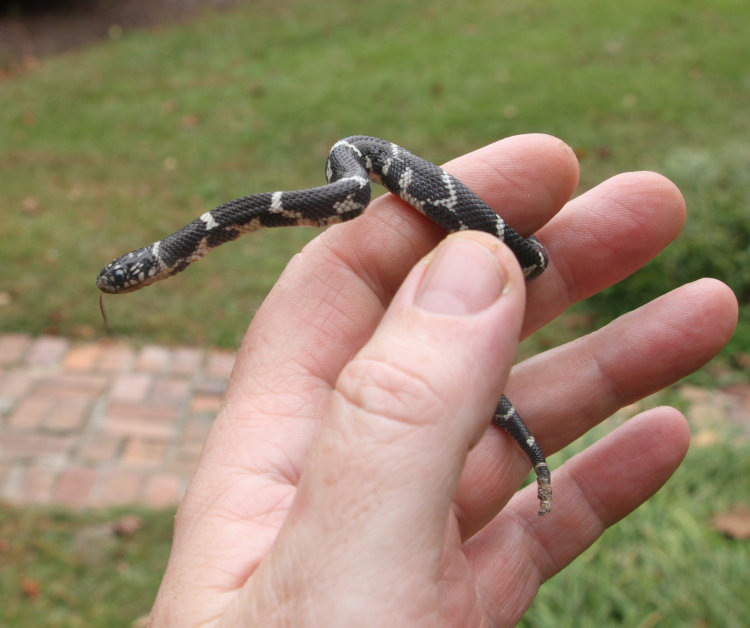
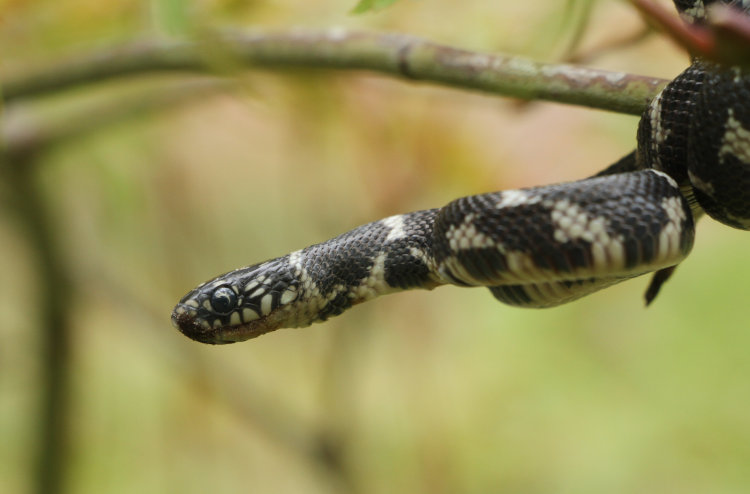
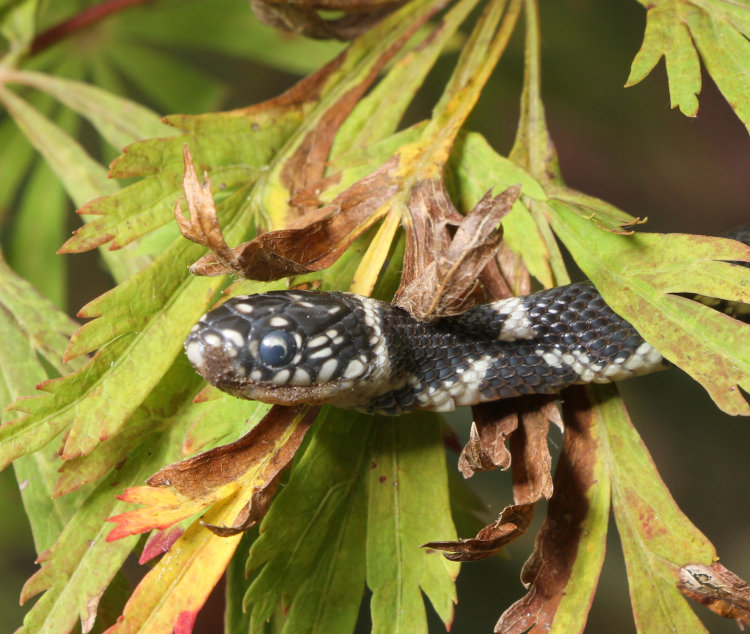
possibly mole kingsnake Lampropeltis rhombomaculata basking on fencepost
This one comes from just a few days over nine years ago, and while it’s possible that I have seen the same species once or twice since, I never got any usable photos of it, much less featured it here in a post. It was also misidentified then, but I’m not sure I’m correctly identifying it now.

Here’s the deal. Back then, I hadn’t found the useful source of identifying reptiles and amphibians for this area, which is this one, that I use all the time now. So my searches on rough description pulled up a likely match, that of a prairie kingsnake (Lampropeltis calligaster) – except that they’re not found in this area (kinda duh! really, when you think of the common name,) and presumably said source did not provide the active range. Since then, I have found one that does inhabit this area – and another. The descriptions and images, from any source that I’ve pulled up just now, do nothing to help differentiate them. So I am very tentatively identifying this as a juvenile mole kingsnake (Lampropeltis rhombomaculata,) with the recognition that it might instead be a juvenile eastern milksnake (Lampropeltis triangulum triangulum); the single row of markings along the lower sides favors the former, though.

Another source (not my preferred one above) also indicated that it might be a scarlet kingsnake (Lampropeltis elapsoides) and showed photos to match – except that these popped up under the scientific name for the eastern milksnake and clearly did not have the typical markings of the scarlet kingsnake, which is the species that closely resembles the coral snake, differentiated only by the order of the colored bands. I suspect they were trying to cover the ‘regional’ name for the snake, which can be all over the damn place, but it still remains incredibly stupid to have a regional name that’s identical to another species especially when their ranges overlap. This is not a scarlet kingsnake, by any stretch of the imagination.

It is also not a coral snake or copperhead, that some guides claim they’ve been mistaken for, which boggles the mind – both species are wildly different from either of the two possibilities here, so much so that “mistaking” them can come only from someone who hasn’t a fucking clue what they look like. Not surprising at all, really, and such “mistakes” almost always come from people who automatically consider all snakes dangerous and “bad,” but it’s still egregiously misleading to imply that this is a factor of close resemblance rather than just evidence of idiots who freak out over garter snakes…

Notably, the mole kingsnake, eastern milksnake, prairie kingsnake, and even the scarlet kingsnake are all from the Genus Lampropeltis, so little wonder than that three of them are almost identical in markings. They’re kinda like the Kennedys…

Summore

Just the last handful of photos from Tennessee and New York, no real theme to be found.

We didn’t do a lot of sightseeing or exploring on this trip, partially because we had to spend a lot of it traveling, partially because it was freaking hot in Tennesee. On Wednesday I believe, we moseyed over to David (Davey) Crockett’s Birthplace State Park, just to poke around a bit, but we had other places to go that day so we didn’t spend a lot of time there, and quite frankly I’m not terribly fascinated with seeing authentic replicas of log cabins and fences (my knowledge of Davey Crockett comes almost entirely from The Wide World of Disney on Sunday evenings, but I can’t recall him accomplishing anything groundbreaking.) Anyway, all I found to photograph there was a cooperative damselfly.

unidentified damselfly in David Crockett Birthplace State Park, TN
I just tried to pin down what species this was, with no luck – those orange eyes don’t seem to be appearing anywhere, but this may be because this isn’t normal coloration, occurring soon after a molt or something. We need a closer look at this frame:

closeup of unidentified damselfly in David Crockett Birthplace State Park, TN
Not too shabby, especially since I wasn’t using the macro lens, but only the 18-135mm. and this one held still well enough that my brother could slide his hand in underneath and get it to climb aboard:

unidentified damselfly in David Crockett Birthplace State Park, TN on photographer's brother's hand
That adequately expresses scale, I believe.

On the property where we were staying, there were several examples of minor wildlife to be found, including amphibians that had recently departed the tadpole stage in some drainage creeks near the barn – the same ones where bear tracks appeared from time to time. My brother managed to snag one and I took it out into bright sunlight for some detail shots.

unidentified tiny frog found in mountains of Tennessee
This one also defeated my attempts at identification, largely because it’s only recently entered the terrestrial stage and so isn’t adult size or coloration yet. It was no more than 10mm in length, so I’m leaning towards one of the chorus frogs, but none of the identification guides that I checked seemed to match these markings. This has been an ongoing issue because virtually all such guides show only adult specimens, often just one color variation as well, so anything that doesn’t fall into this category raises questions.

I’m a lot surer about this next one, though.

immature eastern fence lizard Sceloporus undulatus seen through acrylic aquarium
Before there was even the suggestion that I’d be out there myself, I’d told my brother it seemed likely this species would be around, so it seemed fitting that he found one while I was there, and in fact I assisted in its capture. This is an eastern fence lizard (Sceloporus undulatus,) but a young one, less than half size. The image is this soft because i was shooting through the acrylic sides of a small aquarium, the best thing that we had to photograph it within while preventing an escape – there was no chance I was going to snag any photos of this without restraint. They can get quite large and with much more distinct markings, up to perhaps 16-20cm in length, though this one was roughly 10 itself – crickets were a big meal for it. But yes, certainly the gnarliest-looking reptiles we have in the area.

And then, on to New York. At the Gatsby mansion, the ospreys were quite active, though initially the skies were pretty crummy since we were there between rains. While I had the camera in hand, I was up near the mansion helping with some maintenance issue when a commotion overhead drew my eyes up, and I just barely snagged the bald eagle (Haliaeetus leucocephalus) cruising low overhead, being harassed by ospreys.

adult bald eagle Haliaeetus leucocephalus fleeing from harassing ospreys in central New York
I hadn’t brought along the long lens, which would have been an additional bag not to mention that I wasn’t going to even think about putting it into checked baggage, so this was with the old Canon 100-300 L lens at 300mm – the eagle was close overhead, is what I’m saying. Shame about the lighting.

But we ended up leaving and returning in the evening, closing on sunset, and the light was better then. I kept hearing an osprey (Pandion haliaetus) in a nearby tree, but my attempt at stalking it didn’t quite pan out – it saw me and took flight before I’d spotted its perching area, though I did get several frames as it was departing.

osprey Pandion haliaetus taking flight with partially-eaten meal in its grasp
The setting sunlight was more dramatic this time, but you can also see the meal that I’d interrupted. We’d driven past several roadside nests and it was clear that the young had hatched, so this was a meal just for the parent, or perhaps an unwed specimen, because I’m quite sure the osprey did not depart a nest (I was actually standing under an unfinished one, far too close to be allowed near an occupied one.)

A quick peek at this year’s brood of eastern cottontail (Sylvilagus floridanus):

very young specimen of eastern cottontail rabbit Sylvilagus floridanus pausing in driveway
Look at those little ears! This guy paused in the driveway and I crept up on it as close as it would allow, which wasn’t half as close as I would have liked, but I was already in plain sight so there was a distinct limit. I also spotted a tiny fawn, little more than terrier size, but it scrambled through a fence before I could bring the camera to bear. I’d just been thinking how odd it was that I hadn’t seen a deer yet on the property…

And finally, sunset. This region of New York produces ten times the number of fascinating sunsets than what I can see around here, so I was taking advantage, and while this one wasn’t stunning, I still appreciate having something on the one day that I was available to shoot it.

osprey Pandion haliaetus against sunset colors over Cayuga Lake, New York
And when you have a cooperative osprey, even if it is a little distant, you take advantage of it. But the better one came from going wider.

sunset on Cayuga Lake, New York
I closed down the aperture to produce the starburst effect from the bright sun, but the crepuscular rays were produced by the clouds and they complemented each other nicely. Moreover, the temperature was about perfect, the lake quiet and almost devoid of boaters – curiously, since it was Memorial Day weekend, but off and on rain storms had driven most of them back to harbor. The water was still too cold for decent swimming, though, but I got a little wading in anyway. Not too bad for one full day in NY at least.

I’m tired of ‘May’ puns…

… but it’s the end of the month anyway, so let’s see what that entails from the nonsense tradition of month-end abstract images that got started by accident, shall we?

sunset on facade of old hunting lodge in New York
Why, it’s the sunset on part of the Gatsby mansion that I’d stayed in on previous visits to central New York – not this time around (I was on my brother’s couch instead, not a comparable substitute,) but we had to go out there to check on some things anyway. For this frame, the glare from the sun’s reflection off of the glass helped set the exposure lower, giving a moodier look to the building, and I cropped tighter for better effect. I could have done without that stray wire in there, but whatcha gonna do?

And I have another abstract, though it’s a shameless repeat of others that I’ve done in the past, but I liked the colors and contrast and you probably haven’t seen the others anyway or have forgotten if you did, so here it is:

sunset colors on rippling waters of Cayuga Lake
Maybe I’m in a rut, but I like these kinds of images, in this case the hastening sunset over Cayuga Lake reflecting from the rippling water, essentially the ‘glitter trail’ that leads towards the sun itself (but falls short by, oh, about 93 million miles.) These two images were taken only nineteen minutes apart, the same day that we’d had multiple downpours, so not bad conditions for that.

May’s been a little bit slower month for photos than normal, but we’ll see what can be done about that shortly. I still have to check in on the osprey nests, for instance. Something will be along soon enough.

Had the potential

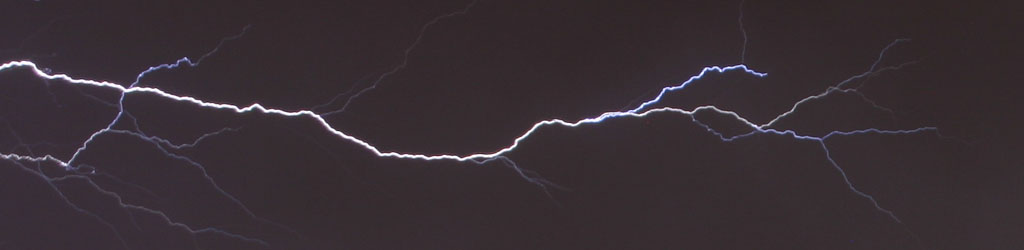
While spending a few days in Tennessee last week, a wicked thunderstorm rolled through (as it did for much of the east coast,) and I made the attempt to get some lightning photos. I was borrowing my brother’s tripod since I’d left mine behind – I know this sounds like poor planning, but the trip was to drive him back up to NY since he’d injured his shoulder and couldn’t drive that far, so I’d traveled there by bus and would be returning by plane, thus my luggage load was necessities only. Yes, the camera is a necessity – what are you, stupid?

Anyway, it was well after sunset when the storm broke, though you wouldn’t know it from some of the photos.

clouds brightly illuminated by internal lightning
We were deep in the Great Smokey Mountains – or is that the Blue Ridge Mountains? – near the NC border, but it wasn’t as dark as you might imagine, since everyone there had decided they needed streetlights in their yards. All of this light, however, came from lightning within the clouds, quite a light show. There was a distinct mountain peak quite close by, and I was holding out hope that a bolt would strike it because I’d have a front row seat – we were safely under the porch overhang, at least until the rain began driving sideways.

storm clouds illuminated by lightning over Tennessee
The peak in question is the tallest one off to the left there, not looking like much here because of both the wide-angle perspective and the fact that it’s blending in with the others nearby, but I was later to determine that it was just under 2 kilometers distant and fairly steep. The sharper one to the right of it, under the telephone pole, is only 250 meters further off. But wires everywhere – not a nature photographer’s ideal locale for sure.

rain starting from violent thunderstorm in Tennessee mountains
Only a slightly different angle here, as the rains started (note that the peaks were invisible to me when aiming the camera, shrouded in total darkness because the sky behind wasn’t even lighter – the lightning was the only thing that defined details, and my eye wasn’t up to the viewfinder at those moments.) But you can see the haze from the rain starting to shroud the mountain, and again, this is only in millisecond bursts from the lightning. It got worse, though.

rain from violent thunderstorm in Tennessee now completely obscuring nearby peak
Annnndddd now it’s gone completely, hidden entirely by the rain. I have to note that, despite a lot of strikes in the area, the thunder didn’t indicate that any of them were particularly close, though certainly not far off either. You can see the porch overhang in this shot illuminated only by the interior light coming through the storm door, and that same light was now revealing the waves of rain passing between us and that neighbor – it was really coming down, is what I’m saying. Those same waves were starting to get on the camera, and so we wrapped it up about this time and headed inside, but it was clear that the brunt of electrical activity was now past, and subsequent examination of the frames revealed not one visible lightning bolt. Figures.

The next morning was sunny, and showed how the mountains got their name.

mist rising from overnight rains among peaks in mountains in Tennessee
Again, this is that nearest peak (again, a bit wide-angle,) with the mists rising as the rainwater was evaporating, thus the ‘Great Smokey Mountains’ – and just a hint of the ‘Blue Ridge’ as well, the haze from all the humidity turning them more blue with distance. But let’s take a closer look at that nearby peak to the right.

rising mist from overnight rains almost obscuring nearby peak in Great Smokey Mountains, Tennessee
Remember, there’s only a quarter-kilometer separating these two peaks, so all that humidity is concentrated in that narrow valley – my guess is the sun just started hitting that portion. This is not a spot for decent sunrises or sunsets, both being obscured by nearby mountains, though it would be even worse for Northern Lights, since the property was on the side of a mountain rising to the north. It also bordered a large forest, to the point were black bear tracks were routinely found right behind the barn. I had the opportunity to stake out the area for potential images (my only black bear shots are at a great distance,) but passed on it for two reasons: 1, I hadn’t brought any flash at all with me, and it would take a powerful one to snag a bear at night, and 2, there was no safe location to be staking out from – any spot that had a view of the locations they visited was far too exposed, and no pic is worth risks like that. There is now a trail camera set up there, though, so maybe there will be something to show later on. We’ll see.

I’ll throw down one last shot for giggles, closing on sunset the day before the storm.

near sunset clouds in Tennessee mountains
This is looking east-southeast, a bit to the left of the nearby mountain peak, and the differing colors of the clouds indicates their relative height, the white ones being taller and still getting the sunlight uncolored by the sunset angles. It also gives another hint of how many mountains surrounded us, especially since the nearby trees are already in shadow. Nothing great, but as I said, I was only snagging shots of opportunity and not actively seeking out areas for high art – just wasn’t that kind of trip.

I have a handful more from the trip coming along, but first we must deal with the end of the month.

Just once, part 22

female common yellowthroat Geothlypis trichas maybe, Montezuma National Wildlife Refuge, NY
This week we have a female common yellowthroat (Geothlypis trichas) – I believe, anyway. It was the closest match that I could find, but since there were no males in evidence, I won’t say that I’m 100% certain (the males being more distinctly colored.) I snagged this almost offhandedly while touring through Montezuma National Wildlife Refuge in central New York three years ago – which is where I was not quite a week ago, though the day this was taken had considerably better conditions than the most recent visit, which was overcast and rainy. So, I had the chance to remove this from the ‘Just Once’ list only days ago, but saw nothing of the sort in the brief visit. Now, they’re also supposed to be found around here in central North Carolina, though I have yet to positively identify one, but they’re marsh birds and so more likely to be found nearer the coast.

[As a stupid bit of trivia, I had only days before switched the incoming text alert sound on my smutphone over to the call of a marsh wren, obtained from the same video clips found here, and this was firing off while we were driving through the refuge – the sounds of home, as it were, though they elicited no response from anywhere therein. But it did serve to confuse my brother a couple of times…]

Flanking turtles

Last week, I announced that the 23rd was World Turtle Day, but also that I’d be unlikely to do anything about it that day – this was because I knew I’d be traveling, and in fact, all of last week’s posts were written ahead of time and scheduled for certain days, none of them reflecting where I really was. Family matters (nothing serious) required that I shoot out to Tennessee, then up to New York, and the 23rd was slated to be a driving day, which it was.

However, I managed to snag two turtles on days flanking World Turtle Day, so I observed the holiday better than expected, though not in any remarkable way.

male eastern box turtle Terrapene carolina carolina being shy after being disturbed
In Tennessee on Tuesday, I came across this eastern box turtle (Terrapene carolina carolina) at the edge of a small cleared area where I was staying. Reluctant to do anything after being disturbed and likely wanting to escape the rapidly-warming sunlight, it never poked its head out or posed fetchingly, but I did determine from the eyes and the plastron that it was a male, and comparing the photos taken by my host of another turtle from a few days earlier indicated that this was not the same specimen, suggesting that the property was home to several – not surprising, really, but this was the only one that I found.

And then on Saturday, once up in central New York, we found another just after crossing the road.

smallish common snapping turtle Chelydra serpentina just finishing a road crossing
This is a common snapping turtle (Chelydra serpentina,) extremely common in New York – it’s a smaller specimen, roughly 15-18 cm in carapace length. This was immediately following a downpour and we saw no reason to disturb it, so this was taken from the car window and then the turtle was allowed to go on its way. Had it actually been World Turtle Day, we might have given it a cake or taken it out to dinner or something, but being too late for the holiday, it would have to wait for next year.

There will be more coming along, even though I didn’t do a lot of photography on this trip and conditions conspired against it too often anyway, but I got a few frames of interest. They’ll be along as time permits.

Today, by the way, is also a holiday of sorts, in that it’s the tenth anniversary of our moving to this house – that’s almost scary, really. But we’re available for dinner if you’re so inclined…

[I realized as I linked that post from 10 years ago that there were mantids on the same Japanese maple out front, and so I went out just now specifically to take a commemorative shot. Same tree, but certainly not the same mantis, since they only live through a season. There’s a semi-reasonable chance that this is a descendant, though, since I suspect that mantids return to the same location where they had hatched to produce their own egg clusters. There is a degree of resemblance, you must admit…]

immature mantis, likely Chinese mantis Tenodera sinensis, perched on Japanese maple

Saved for today

Yesterday was one holiday, and today is another (don’t ask me who schedules these things without any breathing room): National Where The Hell Did This Come From? Day, and I’ve got a nice example for you, discovered in the back yard here at Walkabout Estates.

probable sunfish Centrarchidae found in middle of back yard far from water source
First off, ignore the brown wormy thing, which is just a millipede that was passing through as I snapped the image. My brother tells me this is a sunfish, but there are several species and the state of this one isn’t making it easy to pin down, so Family Centrarchidae anyway. The thing is, we’re not terribly close to any water source, and I even know a four-hour time frame of its appearance in late afternoon since I had been through that area earlier and it wasn’t present.

Best guess, of course, is that it was snagged from the neighborhood pond by an osprey and accidentally dropped, either as the bird was passing or as it landed in a tree to knock off its meal, though this seems odd in itself; ospreys have wicked talons and can easily hang onto something as small as this, and even the damage to the carcass seems less than I would have thought they’d inflict in capturing a fish from the water and hauling it off through the air. Not to mention that there does not seem to be any osprey living nearby or frequenting the pond, even though they make the occasional appearance. Mid-afternoon isn’t any time for raccoons, opossums, or neighborhood cats to be slinking around, especially inside the fence. I’m not the kind that watches all of those TV forensics shows so I didn’t try evaluating the angle of the wounds or the impact impression underneath, and it’s too late now; this was a couple of weeks ago. So I’ll go with clumsy osprey and leave it at that I suppose, always wondering what sinister story might really lie underneath. It wouldn’t be the first time…

Just once, part 21

Bobcat Lynx rufus drinking
While I would be totally chuffed to have obtained such a pic of a bobcat (Lynx rufus) in the wild, alas, this is not the case, and this was taken in the NC Zoological Park, part of the reason that it’s only appeared once before. The other part is that, while I’ve seen bobcats twice before to my memory, both times were fleeting and far too brief to bring a camera to bear. As I look at this however, I chide my older self for not framing this better, but I’m fairly certain I slammed the frame out in the bare moment that the bobcat made eye contact.

Bobcats are common throughout North America, and in fact there are now two recognized subspecies: Lynx rufus rufus in the east, and Lynx rufus fasciatus in the west – given that I took this in a zoo in North Carolina, I’d tend to believe this is the former, but who knows how they obtained their specimen? Yet while common, bobcats are also quite shy and tend to be nocturnal, so the chances to spot one are rare, and you largely have to be either very lucky or specifically trying for the subject; up until this writing I’ve never spent enough time in an area they were known to frequent. Both of those that I’ve spotted have been bounding across the road ahead of me, come to think of it: once on Pilot Mountain in NC, actually on the drive into the park (late morning,) and once in Merritt Island in Florida (late afternoon) – that one was huge, and crossed the two-lane road in three bounds. There was a chance that I saw one near Jordan Lake right around here, but it was a fleeting glimpse (true to form, seen in the headlights of the car,) and I’ve found no evidence of them there before or since, so I may have been mistaken.

So let’s put it this way: if I ever discover that they’re frequenting an area that I can spend a little time in, I’ll definitely make the attempt to snag some truly “wild” images – much more effort than I’d put into chasing any songbird, for instance. Or if, you know, there’s some chance of commensurate income from such photos, I’ll even make a dedicated trip – we can deal.

1 48 49 50 51 52 334