Fermi and physics

I’m up to these kinds of things again, by which I mean, thinking exercises that won’t ultimately mean a damn thing – but then again, that’s the story of my life, so why stop now?

Most people that have even the faintest interest in the idea of life on other planets are familiar with the Fermi Paradox, an idle question from physicist Enrico Fermi one day that says, in essence, “The universe is an old place, and there should have been plenty of opportunities for life to arise on other planets. There should also have been enough time for said life to have expanded quite far across the universe, perhaps even to effectively permeate it. So why haven’t we seen the faintest sign of them?”

First off, we’ll ignore the claims that we have been seeing signs, in the form of little spaceships that come to Earth solely for the purpose of zooming around within easy sight – there are lots of things wrong with this idea, chief among them that applying any critical thought at all to the reports causes them to fall apart very quickly; I’ve tackled this before and will tackle it again, probably before too long. And Fermi’s Paradox has been examined many, many different ways over the years and some of the potential flaws highlighted then – I’ll let you do a search if you like.

Right now, I’m going to examine one aspect in particular, one that gets glossed over pretty often by people that, to my thinking, should know better – likely they just haven’t thought about it carefully. So let’s look at the idea of a race of intelligent beings expanding across the stars.

To establish some basic traits, we’ll consider our own efforts, feeble in comparison to what we believe an extraterrestrial, more-advanced race could accomplish. After making the moon landings, the public idea was that we would soon be expanding to Mars at least, and getting bases established on both, and so on. But the physicists involved in actually planning these things knew there was a major problem: Earth’s gravity. It takes a lot of effort (read: thrust) to overcome this gravity and get a vessel into space, just to the Earth orbit level, and then a lot more to get such a vessel out much further away. The Saturn V booster was a thirty-story tall spacecraft to get just three people to the vicinity of the moon, in tiny crafts, and back again, the vast majority of this being expended in the first portion of the trip. Add more fuel, and you add more weight to be lifted as well, and need more fuel for that weight, and so on; very quickly, you hit a limit as to how efficient the fuel is and that you simply cannot boost enough of it out of Earth’s gravity to go very far. At least, not at once, and this leads to the idea of a space station or moonbase. The moon, having 1/6 of the Earth’s gravity, could serve as a refueling stop where a lot more fuel could be loaded to push a lot farther out, and a space station would be even better in that regard, having virtually no gravity to speak of.

Kind of. The station has to be somewhere stable, and right now that’s always been in Earth orbit. Despite what we see in photos and videos, the occupants of stations like the ISS aren’t really in zero gravity, and truth be told, there is no such thing – remember that the moon is held in orbit by Earth’s gravity, while both are held in orbit by the sun’s. The space stations are simply moving sideways fast enough to overcome the downward pull towards Earth – someone once put it as, “falling towards the planet but missing” from this lateral motion, which is what actually makes an orbit. So any spacecraft refueling at such a station is still overcoming Earth gravity to some extent, though the orbital speed, if aligned properly, can be used to counteract this and help them on their way. Aligning properly is a bit of a key here, in that an orbit that will help boost a craft towards the moon is different from one that will help boost towards Mars – and both of them keep moving. The mathematics involved in calculating orbits and interceptions is far beyond me.

The same can hold true for a moon base. The moon is orbiting on its own, in a pretty specific direction, and only occasionally will this direction help throw a vessel towards Mars, for instance. But more of the problem is having the fuel there to begin with.

Back to that diminishing returns thing: only so much fuel can be lifted to either a space station or a moon base at a time, so it would take a lot of trips to build up a ‘tankful’ to go farther out. The mass of the fuel also has to be considered if it’s to a space station, where it will affect the orbit and will require the station to have to go faster to avoid sinking out of orbit towards the Earth. More fuel there.

[Small related anecdote: When the Falklands War broke out in the 1980s, England had no major military bases anywhere near the islands, and no structure in place for long-range maneuvers. When they wanted to bomb an airfield in Argentina, a pair of bombers needed a support structure of eleven air-to-air refueling aircraft, most of which were simply refueling the refueling aircraft, a pyramid of support to make one bombing run, a there-and-back mission. We’re talking about the same kind of problems here.]

Plus the fact that the spacecraft have to have the tank space for such fuel, and may have to land this additional mass onto the moon itself, or pick up a new booster thereon, and so on. Then we’re talking about having enough fuel for a return trip, and soft-landing this on Mars or keeping it in orbit around the planet (much like the command modules did around the moon for the Apollo program.) On top of that, having people along means a significant support structure for them, which is a hell of a lot more mass/weight. So, theoretically, we know what it would take to get to Mars, but logistically, we can’t accomplish this, and at the very least it would be a very involved and expensive program with a large support structure.

In comparison, the New Horizons probe went way out to Pluto, so how about that, eh? But it used the gravity boost from orbiting multiple planets to do so, took nine years to accomplish the trip, and blew past Pluto at high speed because it carried too little fuel to slow down and enter into orbit. Plus no life support.

So, despite the claims of Elon Musk (who’s been proven to talk out of his ass more than his mouth,) a manned mission to Mars isn’t going to happen anytime soon, and only once the elaborate support structure has been put into place first. Right now, the plans for a sample-return mission to and from Mars are hitting significant snags, and that’s targeted for grabbing and returning a soil sample roughly the size of a test tube.

Now let’s scale all of this up. The nearest star to us is about a million times farther than Mars is, and that’s actually on the lower end of average distance between stars in this arm of the galaxy (4.2 light years versus an average of 8 or so.) So, a million times more support, like a million times the number of space stations? Not quite; while a lot of the trip is going to be coasting so fuel isn’t needed for such portions, if we don’t want to blow past Alpha Centauri at a blinding speed, then we’d need to slow down as we approached. And travel time is a factor, because taking a few hundred years to accomplish this has a lot of problems of its own.

But more to the point, each station built along the way is going to take a ridiculously long time to build, and stock, and maintain – that pyramid thing again. All of which have to be there-and-back missions, or fully automated somehow. The cost would be absolutely stupendous. And bear in mind, this is good for one direction only. Want to check out another star? If it’s not right in line with the first, start a whole other supply pyramid.

Now the fun bits. Most proponents of interstellar travel, by other species than our own, believe in the deus ex machina of “advanced technology,” something that will permit faster than light travel or super-efficient energy sources or something along those lines, always vague and without the faintest support from physics. Let’s be blunt: we, as a species, have been hashing out the laws of physics for quite a few decades now, with some elaborate and esoteric experiments with super-colliders and a lot of observations of extremely powerful stars. There has been no evidence that such things could ever take place, yet at the same time there’s a lot of evidence that they never could. And it’s not about discovering a new law of physics, because we already know the existing ones and they’re not going to suddenly vanish when a new version comes out – at best, they can be refined for circumstances that have yet to be discovered. But to think there’s a “magic switch” that will allow something like faster-than-light travel while simultaneously allowing us to maintain a coherent and cohesive body in the shape of our preference, not to mention being compact and manageable enough to actually fit within any reasonable (or unreasonable) spacecraft, is nothing but comic-book thinking. The same can be said for an energy source that somehow exceeds the E=mc2 formula for total binding atomic energy. Don’t count on it happening, any more than exposure to gamma rays will do anything but kill you.

Thus, expansion by conventional physics, which would take a loooonnnng time. Centuries at least to cover just a few nearby stars, much less the majority of the galaxy. If you can find someone to do it, which would actually be harder than the physical, logistics part of it. Unless your planet has some pretty specific circumstances, confining oneself to any kind of space-traveling vessel is going to impose severe limitations, physically and mentally, and while it’s hard to vouch for what some other species might be like, chances are they evolved to favor certain conditions on their planet that will be nonexistent in space – to use us as an example, gravity, blue skies, open spaces, fresh water, a varied diet, and so on. Confinement and limited stimulus are a recipe for severe mental breakdown.

So, to expand throughout even a significant portion of this spiral arm of the galaxy would require centuries of effort and vast quantities of resources. The idea that asteroids and planets providing access to more raw material to help fuel this expansion is bandied around often, but think about it: raw materials. As in, requiring lots of refining to turn into useful product. An asteroid may be iron-rich, but to turn it into frames for the new space station? Mining, smelting, forming, and so on, several production plants worth of equipment and labor – that all has to be gotten to the asteroid (at the very least the mining equipment,) then transported from there with fuel that comes from some other station.

And all this ignores that, in the deep space between star systems, none of this will be able to be found anyway. Asteroids and planets are attracted to gravity sources – they don’t congregate out in the middle of nowhere. Exotic fuels? Not in any quantity, even in a nebula – we can see through most of those even with nearby stars lighting up all that gas, indicating that it’s not terribly dense. And solar energy is going to be pretty lean between stars too.

On top of that, it would require a species that not only had all the resources, but the desire to spend so much of them on… what? The possibility that nearby stars would provide much better conditions or materials or living areas? The desperation that they’re going to die out if they don’t? (And that’s a possibility that isn’t likely to be beneficial to any race they contact.) What species is going to expend so much effort for such expansion, and can any species actually live that long? Spend enough time in space, and they’ll evolve away from any traits that sent them there in the first place.

Finally, we’d also have to consider that such a species would either aim directly towards a star system showing promising traits (of which ours is unlikely to count,) or towards the center of the galaxy where the stars are most dense and travel thus more efficient.

But the long and short of it is, that diminishing returns thing about fuel, up there at the beginning, is quite possibly a factor against expansion throughout any portion of a galaxy: it may be simply impossible to cross a certain distance, no matter how much time or effort is able to be put into it. The fuel and materials will run out before they carry far enough, the drive and mental state of the beings attempting it may simply not hold up, the nastier conditions among certain stars could be too much to protect against. Everything has a limit.

Just once, part 26

Florida gar Lepisosteus platyrhincus lying in grass alongside drainage channel
Today’s prehistoric installment comes to us from just over 20 years ago, this image being taken on June 4th, 2004 – I could potentially line these up closer to the anniversaries (not perfectly, since the 4th was a Tuesday this year,) but I’m working from a spreadsheet that lists the first post they appeared in and has no image date info, and it’s not worth the effort. Plus I try to space out the birds and insects and so on.

This is a Florida gar (Lepisosteus platyrhincus,) and the only time that I’ve ever gotten photos of one, though I might have glimpsed said species here and there. This one was sitting on the bank of a drainage channel (closer to being a canal, really) behind where I lived, potentially caught by a fisherman and then discarded, though why they didn’t simply throw it back into the water escapes me. It was still alive and might potentially have leapt from the water itself, though it was a good two meters laterally and one vertically from the surface, so a damn good leap if so. Either way, I tossed it back into the water to terrify another day.

But this reminds me that it’s still been far too long since we’ve been to Florida, and no indications that this will be remedied soon. Sigh.

Could this be Al?

It’s been almost a week without anything but my routine weekly post, and for that, I apologize – it’s been a bit busy here, and while I obtained some frames here and there, I never got around to doing anything with them. Today, however, is Prove That You’re Not Dead Day, so it seemed as good a time as any to get them up here. Or for someone to produce a post that sounds like it was written by me to throw the investigators off. You can place your votes below.

[Heh, “votes,” plural – like anyone reads this schtuff…]

We’ll start with an update, since the lead-in was featured in an earlier post.

adult female magnolia green jumping spider Lyssomanes viridis poised for defense of her nursery
It’s interesting that they call these magnolia green jumping spiders (Lyssomanes viridis,) because I’ve never seen a magnolia even remotely this color – those tend to be pretty deep green, but even the undersides of those leaves, while much paler, isn’t this shade of day-glo green. I’m not sure what plant I could effectively compare it to, really, but it likely grows in Chernobyl…

Anyway, she was standing guard outside of the bebby nursery peeking in behind her here, where the eggs have hatched now, and I tried to get some decent photos of the young-uns, hampered by the sheltering webbing.

newborn magnolia green jumping spiders Lyssomanes viridis still within web nursery on underside of trumpet flower Brugmansia leaf
This is on the underside of a trumpet flower (Brugmansia) leaf, and you’d have to look close to spot either the nursery or the mother thereon. I had to wait until nightfall for the breeze to stop blowing the leaf all over hell and back as I was trying to focus, and then the flash illuminated the dense webbing enclosing the babies and obscured a lot of the detail, so I boosted contrast on this frame to make things slightly clearer.These newborns do not top 2mm in body length, but I admit to not taking the calipers out there for a precise measurement.

Nearby, the headlamp caught an unidentified larva ‘inchworm’ dangling from a web strand – I couldn’t say it was motionless, but it wasn’t moving of its own volition.

unidentified larva inchworm dangling from web and showing parasitic eggs
There was no breeze at this time, but that didn’t mean that I wasn’t inadvertently creating my own when I leaned in close, nor that I could stop the inchworm from spinning on its single strand. They produce the webs from their mouths, instead of from spinnerets at the end of their abdomen like spiders, so they hang head-up instead of head-down. But you likely already spotted that odd little detail, so let’s go in for a closer look at it.

green parasitic eggs on body of unidentified larva inchworm
You know, not only have I found that merely getting the macro rig out will usually stir up a breeze where it had been dead calm before, but when attempting to photograph something that can turn, it will inevitably fail to rotate into view no matter which side I attempt to photograph it from. This took far longer than expected, but at least I got one frame where you could clearly see the eggs from some parasite attached to the larva’s body. This is a doomed inchworm, is what I’m saying.

There are still a handful of mantids to be found, if one looks closely.

juvenile Chinese mantis Tenodera sinensis inverted under Japanese maple leaf
While I had several oothecas (egg sacs) from central NY that I suspected might be European mantises, what I’ve found so far appear to be the Chinese mantises (Tenodera sinensis) that are common around here, so I’m labeling this as such, and if the kidnappers are challenging you to correctly identify a bug and you get it wrong because of me, let me know and I’ll send a free print to your family, because that’s the kind of guy that I am.

Anyway, this one was on the popular Japanese maple, and I wish I’d seen the background leaf right behind the head, but I was focusing by headlamp and didn’t realize it was there. It’s been hot as hell here with no rain for a month, so I occasionally get out the misting wand and give these guys a drink, which they appreciate.

The butterfly bushes (Buddleja davidii) have also been struggling with the heat – actually, every plant in the yard is – and I’ve been steadily draining the rain barrels to keep them watered. On examining one of them the other night, I noticed what appeared to be a white petal on the otherwise pale blue flowers. This merited a closer look.

juvenile jagged ambush bug Phymata on flower of butterfly bush Buddleja davidii
See it up there? It’s a mere 2.5mm in overall length, so not exactly leaping out at anyone, but of course I went in closer.

juvenile jagged ambush bug Phymata on flower of butterfly bush Buddleja davidii
Enough to make out the body shape, certainly – this is a jagged ambush bug (genus Phymata,) and a juvenile or nymph stage. As adults, they’ll get perhaps five times longer than this, and typically turn yellowish with brown markings. I switched over to the reversed 28-105 for the serious closeups, but the bug was getting wary and, even at night, I was fogging up the viewfinder, which is definitely a hindrance when the lens is locked at f16. I have a lot of frames to discard, is what I’m saying.

juvenile jagged ambush bug Phymata on flower of butterfly bush Buddleja davidii
But there’s your menacing head-on shot, and if you were a gnat or moth, this would be a bad thing to see, since ambush bugs are pretty fierce for their size.

Now onto the frogs.

juvenile Copes grey treefrog Dryophytes chrysoscelis perched on leaf of lizard's tail Saururus cernuus plant
Spotted this one night by the headlamp as well, roughly half of adult size, so pale that I wasn’t sure what the species was – at least at first.

juvenile Copes grey treefrog Dryophytes chrysoscelis perched on leaf of lizard's tail Saururus cernuus
Still practically no markings visible, but if you look closely, there’s a paler spot edged with darker grey right underneath the eye, which is enough to confirm this is a Copes grey treefrog (Dryophytes chrysoscelis.) I haven’t been seeing these much at all anymore, which is funny because when we moved here ten years ago, they were the only frogs I’d find. While I don’t think the green treefrogs are somehow chasing them off, it might be that the eggs or tadpoles are favored differently somehow, some pH thing or whatever, and so the populations are changing. I know there are plenty of each at the neighborhood pond, so this might just be a temporary, local phenomenon.

On the front storm door, one night, one of the green treefrogs (Dryophytes cinereus) was trying to do some cutesy, Instagram bullshit.

green treefrog Dryophytes cinereus perched on glass door unable to make a heart properly
It might have carried better if the frog hadn’t been so filthy, but don’t look at me – I didn’t set this up. Meanwhile, a word of advice: if you see someone doing it on any form of social media, this is precisely why you should never do it yourself. Be original, not a mindless fad-monger. I know, I’m being mean to the frogs again.

And of course, I have to close with this one:

green treefrog Dryophytes cinereus looking complacent on sweet potato leaf
This guy was perched on one of the decorative sweet potato vines we establish in the front planters every year, and from a portrait angle, it looks like it’s smiling benevolently. Chances are of course that it’s watching me carefully to see if I’m going to do something aggressive, though the treefrogs really aren’t spooky in any way – when uncovering the grill (a favorite daytime hideyhole) to cook something, I usually have to grab them to carry them to a safe location because they’re not easy to convince otherwise. I keep looking at both the frog’s and the lavender’s angles here and thinking I should level this frame, but it is level – they’re crooked.

Anyway, vote now to say if this was computer-generated, or my actual writing, or too much dreck to give a shit either way. We’ll back to tally up any votes that might accidentally have occurred!

Just once, part 25

summer tanager Piranga rubra peeking from foliage
I knew this one was going to appear in this category and purposefully held onto it for this week. This is a summer tanager (Piranga rubra,) and it was photographed two years ago, coincidentally on the first day of summer (which doesn’t fall on a Wednesday this year, so this is as close as we get.) It was during an outing with Mr Bugg and, despite the brilliant red color, we could have missed it easily but I realized I was hearing a call that I’d never heard before. I’m not very well versed in songbird calls, there being far too many that I know I’ve heard before yet can’t put to a species, but at least I recognized that this one was new to my experience, and carefully tracked its location until we could get a clear view. This habit has produced more than a few photos over the years, and I strongly encourage any nature photographer to develop it as much as possible.

Then again, most birders would be far better than I in pinning down the species by sound, familiar with the various calls, so I could use the work myself. But hey – you’re seeing the pic, so it worked for me, right? Okay then.

We won’t talk about the number of species that I might have missed through inexperience, because it’s my blog. It’s all about the ego.

Now, today

It’s been hot as hell recently – again – and I haven’t been going out much to chase photos, so I decided this morning before it got too hot to get in a quick session down at Jordan Lake. Spoiler: there wasn’t a lot happening, even though i expected to see ospreys and perhaps eagles finding food for their young. As it was, I have just three images (well, three-and-a-half) to show for it – I got more, but this was what came out the best.

We’ll start slow, with the cicada-killer, now on time for the annual cicadas at least.

likely eastern cicada-killer wasp Sphecius speciosus alighting on stick alongside lake
This is most likely an eastern cicada-killer wasp (Sphecius speciosus,) though a few years ago I would have called it a hornet – they’re quite big, not quite the size of your little finger, and yes, they sting and paralyze cicadas to carry them home to their burrows to feed their young. I have yet to get images of one with a cicada, but I’m trying. Overall, though, not bad for using the 150-600mm lens while I was watching for birds instead.

osprey Pandion haliaetus flying overhead with partially-consumed fish
While I didn’t witness this osprey (Pandion haliaetus) capturing its prey, at least it passed close by, allowing enough detail to reveal that it probably got interrupted by some fishingfolk while it was consuming its meal – that looks partially-eaten to me. So no, this one was not for the kids it seems.

I could make out a small amount of activity on the osprey nest visible in the distance, but the sky in that direction was resolutely grey with heavy haze turning to cloud cover, reducing the direct sunlight on the nest itself while backgrounding it in white, so no photos turned out worth anything, and no one showed up with food for the young while I was watching, nor were they visibly hunting.

However, the real capture for the day was this:
immature belted kingfisher Megaceryle alcyon perched cooperatively nearby
Several times in the moderate distance, I heard a belted kingfisher (Megaceryle alcyon) cruising around, because they’re noisy birds when they’re disturbed and the same kids that likely spooked out the osprey were sending this guy around. I was staying put, however, knowing how shy kingfishers are and that I was unlikely to successfully stalk one. Luck was finally with me today, since this one circled around and landed in a tree about ten meters off, allowing me to fire off a bundle of frames. I’ve been trying for a decent portrait of a kingfisher for years, and this certainly qualifies. Moreover, the brownish throat band indicates that this is a juvenile, potentially this year’s brood, which might have helped a little in that the juvies of many species are often not as cautious as the adults. Don’t care – I’ll take it.

It’s cropped of course, but not by much – we’ll take a look at the full frame.

immature belted kingfisher Megaceryle alcyon perched cooperatively nearby, full frame
By the way, as birds go kingfishers are not large birds, a bit bigger than an American robin or red-bellied woodpecker, notably smaller than a crow – you couldn’t have “two in the hand,” in other words. This one remained there for about 10 seconds I think before disappearing again for good, but I had my shots. The Girlfriend remarked on how smooth the wing feathers looked, especially contrasted with the crest, but I liked the stippling of the neck band. Hell, I like all of it, because it took a damn long time to get this. Made the outing worthwhile for sure.

First, the night before

I don’t have a lot of photos to show right now, but I’m still going to split them off into two posts, partially because they represent two separate time periods and subject matters, and partially because I haven’t been posting much and driving up the numbers justifies, um, something…

So, last night.

small herd of white-tailed deer Odocoileus virginianus, all bucks, just outside back yard
In doing my semi-regular nightly patrol, I was well aware of eyes reflecting the headlamp from just over the fence, but realized there were a lot of them – this is actually only half of the herd, since some of them started wandering off nervously as I played with the camera settings and removing the flash diffuser to have enough light. These are, naturally, white-tailed deer (Odocoileus virginianus,) and this isn’t the first time that I’ve seen a herd of them sleeping just outside the back fence of Walkabout Estates. It is also not the first time that I’ve realized they were all bucks, all roughly the same age, which to my knowledge (and those of several people I’ve spoken to about it) isn’t typical; bucks tend to break off on their own to find their own does. But it’s Pride Month, isn’t it? So maybe that has something to do with it…

This is at 35mm focal length, by the way, so looking notably wider (and thus further off) than I actually was, roughly ten meters.

single male white-tailed deer Odocoileus virginianus showing barely discernible ear tag with '78' on it
Now, autofocus is certainly out of the question in the dark, even with the headlamp, so I was forced as always to manually focus on just the bright reflections from their eyes, which tends to be more miss than hit for truly sharp images. Though that’s not what I’m showing here and I was focusing on a different part of the frame for this one, but you can just make out the ear tag on this buck, and it reads, “78.” I include this because, in April, I got a similar frame in the same location.

male white-tailed deer Odocoileus virginianus in April clearly showing ear tag with '78'
Better now? The deer are relatively complacent in the area, even though I was quite close, but a) I’m pretty much silent when I’m out there, just the sounds of my footsteps and I’m endeavoring to keep those as minor as possible, and b) the bright headlamp partially blinds them and keeps them from fully realizing that it’s a human only a handful of meters away. Still, I know my arms and the camera get into the beam from time to time, so there are clues for them to figure it out. All that aside, take note how much the antlers have grown in just two months.

white-tailed deer Odocoileus virginianus chewing some grass as two other start to wander off
The sharpest one (of the deer, anyway) from the evening, and yes, he’s snacking on something as he looks at me. Not one of them bolted off, or even seemed to be walking fast – they just felt that something was happening too close and discretion might dictate they maintain a little more distance. I soon switched to pursuing other subjects and they settled back down in a new position beyond the fence, just a few meters from where they’d been – this is a semi-regular thing with them, but most times I’m set up for macro work when I’m out at night, with the wrong lens and the macro softbox attached to the flash, which I’d removed for these.

You know, this kind of shooting:
annual cicada Cicadoidea molting into adult final instar
The Brood XIX cicadas had emerged some weeks back, filled the air with their peculiar song, and are now only able to be found as stray body parts here and there, but now it’s time for the annual cicadas to emerge, and this is the first I’ve seen. Often enough, they come out when rain has softened the ground, but that wasn’t happening here – it’s been quite a while without rain, perhaps long enough that they can just shove aside the dust that used to be soil. I expect to start hearing the ‘standard’ cicada song within a few days, and since I had no luck finding one of the Brood XIX laying eggs, maybe I’ll get lucky with this wave. We’ll see.

Disqualified

As of last night, I had to remove one of the potential ‘Just Once’ candidates from the lineup, because… well, you figure it out.

Rhomphaea fictilium closer, showing reshaped abdomen
This was one of the original images from its one appearance; it’s a Rhomphaea fictilium, no common name to my knowledge, and it’s a spider with a couple of curious traits, which I wrote about in the original post. But then last night, I found this guy ‘floating’ in the yard:

dorsal view of male Rhomphaea fictilium spider suspended from long webline
So, credit to the spider for being suspended right at eye-level, to make it much easier for me, but that credit goes away when I tell you that the web was only a couple of strands that weren’t well-anchored, stretching over two meters. Even on a still night, the negligent breeze was enough to move this guy several centimeters in every direction, which is pretty damn annoying when working at macro magnifications and depth – this is about the only decent frame, though I have a side view that clinches the ID with the position of the spinnerets only a third of the way along the abdomen, instead of right at the end.

I was taking a break from tasks last night when I spotted it and fired off a few frames, then came back in to search the species again to confirm that I’d only featured it once; for some reason, I couldn’t remember “Rhomphaea fictilium” from its one use eight years ago, but we already know I’m old. Later on, I realized that I could be putting some greater effort into it, including trying to photograph or video their predatory behavior, and I went back out to collect the specimen to keep in a terrarium. Naturally, it was nowhere to be found, even with the help of a misting bottle (which at least highlights all weblines that are in the area – the one that the spider was using in my pic was gone as well.) I found plenty of other spiders, all mostly boring, and a juvenile mantis. but no R. fictilium. I’ll try again from time to time, but I’m not holding out much hope.

The magnolia green jumper eggs have not hatched yet though – I just checked on those tonight. I’ll try to be sure to feature pics of the bebbies when they’re around, and really should try for more video.

Just once, part 24

Saddleback caterpillar moth Sibine stimulea larva
My one and only encounter with this species was just under 11 years ago, and while I wouldn’t mind seeing it again, I’d prefer not to find it the way that I did. This is the larva of a saddleback caterpillar moth (Sibine stimulea,) and those contrasting colors are there for a reason – somewhat self-defeating given that the species likes being on the undersides of leaves in deeper foliage. All those spikes do indeed sting with contact, which is what the memorable color scheme is intended to convey – nothing debilitating, just mildly irritating, a little like a bee sting but not as strong.

I actually had a saga with the species, that began when I discovered one sporting some new ‘appendages.’

saddleback caterpillar moth Sibine stimulea larva showing cocoons of parasitic braconid wasp
There is a class of parasitic wasp, the Braconids, that lay their eggs within the larva of other species, or occasionally in the eggs of such, which then hatch out and feed on the living host larva until they spin their cocoons on the outer surface, eventually emerging from those as flying adults. This does the caterpillar no good at all, but it does not kill them as quickly as you might think, either.

Now we need a little scale here. The caterpillar itself is only 18mm in body length, and the cocoons are 2.5mm – from which an adult wasp will emerge. Yes, they’re tiny wasps, ones that you would barely notice anywhere. But having such a specimen close at hand, I decided I’d attempt to catch the new adults popping free. This was a long-drawn out story that you can find here – suffice to say, it was not one that would encourage anyone to take this up for a living.

Nowadays, I’d endeavor to photograph the eyes and mouth of the species, and I’m not even sure which end is which in these photos. Nor am I sure that, if I tried again to catch the emergence of the parasitic wasps, that I’d do better this time – I can think of nothing to improve my chances, no skills that I’d picked up in the interim. Save for staying out of the sun while waiting.

It works, sometimes

On Monday, I was watering the plants and found something that compelled me to get the camera, because she was surprisingly vivid – I was going to say, “unnaturally,” but that’s plainly wrong, I think. Anyway…

obviously pregnant female magnolia green jumping spider Lyssomanes viridis on trumpet flower Brugmansia leaf
I thought first from the blonde thatch that this was a green lynx spider, but soon corrected myself – it’s our old friend the magnolia green jumping spider (Lyssomanes viridis,) sporting a rather distinctive and nuclear-hued babies bump. I’ve never spotted one in this state, and it was making me hungry for jellybeans.

pregnant female magnolia green jumping spider Lyssomanes viridis showing pale eyes
Unfortunately, my good macro lens is being repaired right now, so I had to resort to the 18-135 for these shots – adequate, but not ideal. It was breezy, she was as fidgety as jumping spiders always are, and I had nothing to brace against, so when she started showing that ‘wandering eyes’ trait, I didn’t get any decent frames of it – instead I’ll refer you here for some cool video of it. Meanwhile, she wasn’t enamored of the attention and kept slipping to the underside of the leaf, whereupon I’d flush her back to the top side again for a few moments and get another frame. Eventually, I let her be – it’s not good for expecting mothers to get too stressed, you know.

A day later, I was poking around at night and thought to check and see if she did what was expected, and began shining my pocket flashlight up from the underside of the leaves. Indeed, she hadn’t even left the one I’d found her on.

brood nest of magnolia green jumping spider Lyssomanes viridis silhouetted by light shone from underneath leaf at night
There she is with her new brood nest of eggs, which is typical of the species – they actually spend most of their time on the undersides of leaves, which is fine, because that’s where their prey (like mosquitos) tend to settle in. But no, I couldn’t let it go at that, so down on the ground on my back I went to shoot upwards at the underside of the leaf. I was using the reversed 28-105 this time, but the trumpet flower proved to be too high for this and I really cannot do a partial-crunch while tilting my head backwards and trying to focus at the same time. I know, I call myself a nature photographer…

Regardless, I simply tipped the pot over a bit so I was shooting at a more amenable angle, a maneuver that probably would have sent her scurrying off had it not been for her protective instincts over the eggs.

egg cluster of magnolia green jumping spider Lyssomanes viridis in brood nest, watched over by mother
She looks a little more trim now, doesn’t she? I had the opportunity to watch this take place, do some video even, but she might never have done it in my presence, and it might have taken ages, and I had other things to do as well as still getting over this weird illness. This is what you get, so there.

The headlamp that I was using has a blue LED mode that actually intrudes into the UV spectrum a little, which has helped me find some fluorescing subjects, but my suspicions were incorrect: despite the dayglo appearance, neither the eggs nor the mother fluoresce in ultra-violet. Ah well, I tried.

And while I was out there, I went a short distance away to the backyard pond, because there was a subject there I’d been meaning to tackle and now that I had the macro rig out, it was time.

small six-spotted fishing spider Dolomedes triton resting on surface of water in backyard pond
This is a six-spotted fishing spider (Dolomedes triton,) a smaller one at about 4cm in leg spread. Which nevertheless was many times larger than the magnolia green above, which probably topped out at 12-14mm in body length, the eggs a mere millimeter across – I’ll try to get some specific measurements, but I know she’ll be running interference. Anyway, I have a couple of subjects to keep my eye on, on top of the routine collection of course. We’ll see what happens.

On composition, part 33: Impressions

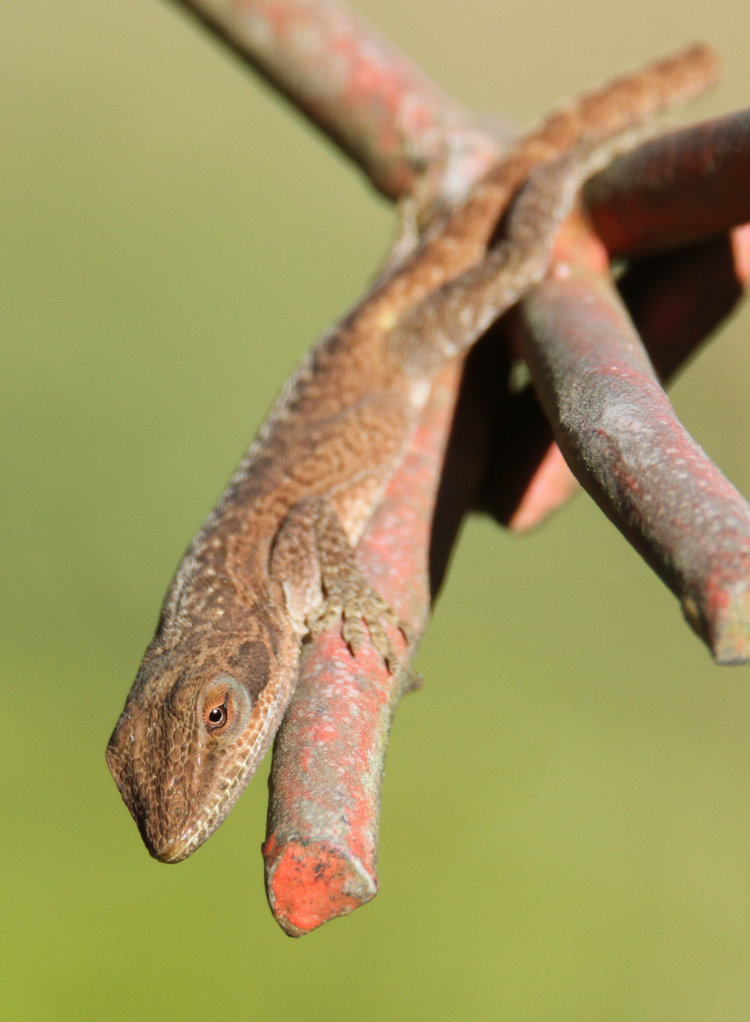
Contemplative Carolina anole Anolis carolinensis
Recent tasks brought this one to mind, an aspect of composition that can have significant effect but often remains entirely subconscious, so let’s talk about the subtle and tricky topic of impressions.

First off, I’ll say that from my own perspective, I more often stumble upon an image that provokes a certain impression, more so than I’ll actively aim for it, much less create it; there are certainly circumstances where I recognize the potential and intend to incorporate it, but it’s more often that I’m reviewing images afterward and am struck by how it makes me feel, or what it seems to say, or most especially, what the subject’s expression makes us believe they’re thinking. When it comes to wildlife, this is usually entirely wrong, but that doesn’t mean that these impressions still can’t serve a purpose, even just for amusement.

Wrightsville Beach wetlands channel
The first portion of this that we’ll tackle is the disconnect. While we know where we are and what’s happening when we’re taking the photo, the conditions and surroundings and so on, the viewer only sees what we’ve included in the frame, which can be representative of the true conditions or not, as we see fit. It’s often not too hard to present a placid and pristine natural setting by studiously avoiding having any aspect that says otherwise within the frame, never revealing that right behind us runs a major interstate highway, for instance. What goes to the edge of the frame goes on forever, is what I’m fond of saying – not quite accurate, perhaps, but the idea is that the viewer believes what they see represents what was there.

And this can be important to just about any kind of photography – we don’t just see the subject, whatever it may be, but the setting as well, and this should carry the impression that we want to convey. A hawk sitting on the edge of a building is no longer either nature or wildlife photography – I say that not from arrogantly defining the terms, but only from how others will view the image. But it works fine to illustrate urban wildlife encroachment, or adaptation, or simply surprise – what’s that doing here? But overall, even if we’re only illustrating the markings of a reptile, the image works better if the setting expresses an accurate habitat.

Then there’s expression, and while it is often challenging enough to get a human model to effectively communicate, “pleasantly surprised,” this is exponentially harder to produce from any animal subject; it’s usually a serendipitous discovery rather than an intentional effort when capturing the image, especially when such a large number of animal subjects do not use such expressions in any way. Yet there are still some things that we can do to help this along, changing our shooting angle or watching for the head tilt or shift of eyes. A simple little thing like the head shifting forward slightly can convey intensity of attention. And of course looking upward is positive, optimistic, unthreatened (unless there’s some aspect of ‘cower’ involved,) while looking down might be predatory, or disdainful, or simply depressed. It can help a lot to recognize how we might interpret these things as we see them. Take it from me, however: getting down to eye-level with your subject greatly improves your chances of generating a specific impression.

lone juvenile green treefrog Hyla cinerea looking unconvincingly earnest
The initial task that brought this topic to mind illustrates many of the factors involved. A friend needed paired images that said, ‘True,’ and, ‘False,’ but should ideally be matching, abstract yet interesting, and easy to discern quickly and from a moderate distance – there were additional details in that they couldn’t be mistaken for any other images that we were already using, in colors or shapes, but the initial criteria were tricky enough. I mean, what image comes to mind when you think of, ‘True?’ And of course, I have no such categories in my stock folders and could only pick through thousands of images trying to find ones that could be interpreted in those ways, mostly in the Scenic/Abstract folders.

[Was I successful? Well, we’ve settled on a handful of images that can work, but I don’t think either one of us is satisfied yet, no images that make us say, “Yeah, that works!” I’m still not just keeping my eye out while reviewing images, but thinking of potential new concepts as well.]

single long-stemmed rose washed up on beach
It’s often easier than that, though. Light color expresses temperature pretty well, since we know (subconsciously, mostly) that overcast days limit the red and yellow spectrum of sunlight, so light that is mostly blue spells out, ‘cold.’ Which also means that orange light is considered, ‘warm,’ something that too many TV and film directors use rather hamhandedly. Contrast and shadows provide their own impressions, sometimes of direct sunlight or, ‘being in the spotlight,’ sometimes specifically not. Blurring means motion or speed, also communicated at times with windblown hair or fur. Sunrise conditions almost always say, ‘quiet,’ among anything else. And if you’re planning on expressive images of abandoned buildings, you’d better bring along a little doll to discard into a corner someplace.

Okay, try to avoid the clichés when you can, but admittedly, clichés can still express what you need them to, and if the idea is to provide an immediate and unmistakable impression, sometimes a cliché is handy. Monochrome images dance exuberantly back and forth across the border between ‘trite’ and ‘expressive’ – simply converting to B&W often isn’t enough by itself, but selecting the right image for it can definitely work.

Being able to recognize something that provides a distinct impression is very handy for accent pieces and background illustrations – for art prints on a wall of course, but also to hint at an underlying mood. Yet, for commissioned works or advertising purposes, you often have to create those impressions. Just street photography can be tricky in eliminating all of the factors that might provide a negative impression (if that is not your explicit goal): trash, worn paint, cars that need work, people who are obviously not happy, and so on. When shooting weddings, I knew I had a roughly thirty-second window of capturing the couple’s first dance, when the guests were all looking on with smiles. Past that time, attentions wandered, people turned away or started quietly conversing among themselves, even sneaking a little food, and having that in the shot simply doesn’t work. And believe me, your eyes will go straight to that one person. For any photography, spotting the subtle little distractions and keeping them from your frame is important, but doubly so if you’re trying to foster a distinct mood or idea. You have to see everything, as well as nailing your timing. Candid groups of people can be especially hard, and photographers may often take lots of frames hoping to capture one where nobody is forming a distraction to the overall idea.

two edits of seagull against sunset clouds
We can’t forget what you can do in post, either. If you need to foster more of an impression than the original provides, or simply see the potential, a little editing in the program of your choice can make a huge difference. The parts above about color temperature and contrast will likely provide most of what you need, but some selective lightening or darkening can alter things nicely, something that cinematographers know all too well. And here is where you can occasionally remove those distractions that you missed when taking the photo. I’m never a fan of altering images beyond cropping or slight color corrections, preferring to get the intended image right the first time, and so I don’t push people in this direction, but at times it serves a purpose. Always remember that changing images that contain people is inherently asking for trouble, and alterations are widely frowned upon for journalistic uses, where it becomes “editorializing’ rather than ‘witnessing.’ Tread carefully, but preferably, not at all.

So there are some ideas to get you started, but by no means a complete list or the best examples (I never claimed to be perfect.) It’s often trickier than it might seem, but when it works, you know it. Give it a shot, and be creative.

[And if you have any decent ideas for ‘True’ and ‘False,’ let me know.]

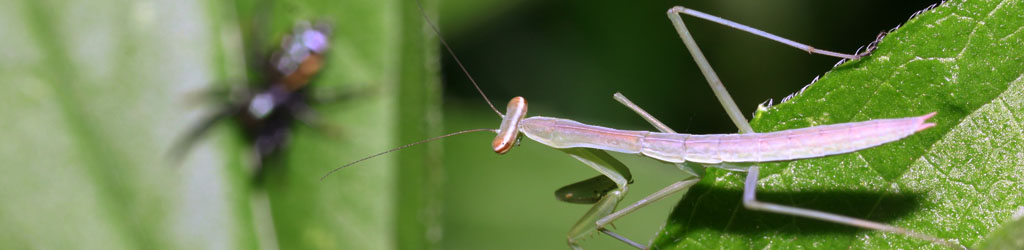
Chinese mantis Tenodera sinensis looking appalled
Chinese mantis Tenodera sinensis looking sorrowful

1 47 48 49 50 51 334