You can’t escape

Normally, I avoid the ‘popular’ news items (or, for that matter, nearly all news items) because frankly, there are enough sources for such out there and I certainly don’t need to offer my two pfennigs, much less jump on any bandwagon, and I have established my own typical subject matter herein anyway – stay in your lane, kind of thing. At this point in time, however, the ‘greater public’ is bringing its focus more into my realm, and so, while it might appear that I’m becoming one of the crowd, it’s more accurate to say that the crowd is starting to cluster around me.

Or not. But what we’re talking about is the upcoming total solar eclipse across a great swath of North America, and Randall Munroe of xkcd has featured not one, but two eclipse-themed comics recently:


Both are quite accurate, though right now I’m identifying more with the second, since I’ve been doing, and seeing, the exact same thing: cloud cover for where I will be is predicted to be less-than-ideal and getting worse. The accuracy of weather reports recently has dropped – things getting too unpredictable what with, you know, nothing at all happening, according to Republican fuckwits – and so I can hold out hope that the skies will be clear enough at the crucial time without being too blindly optimistic, but I’m also prepared for the likelihood that I’ll see nothing.

Small update on the tracking motor, because I know you’ve been hanging on every word (If you even exist, which is unlikely): I said I had two options for getting it working, and option one failed to pan out. Option two was using a different motor, requiring a driver chip that I’d ordered. This arrived the day before I was scheduled to leave early in the morning, and I spent far too much time getting it all together and wired and programmed. But it doesn’t work. The whole shebang is still coming along, on the chance that I figure it out and get it working before Monday, but it’s not looking good right now – call it a weak, ‘maybe.’ We’ll see.

A little content

I’ve been a bit busy of late, and haven’t been taking the time for posts – this will continue a little while longer, too. So I’m going to throw something down pretty quickly, the frozen pizza of the online world, because we need something here.

First of all, while this image isn’t the slightest bit impressive or even interesting, it’s evidence:

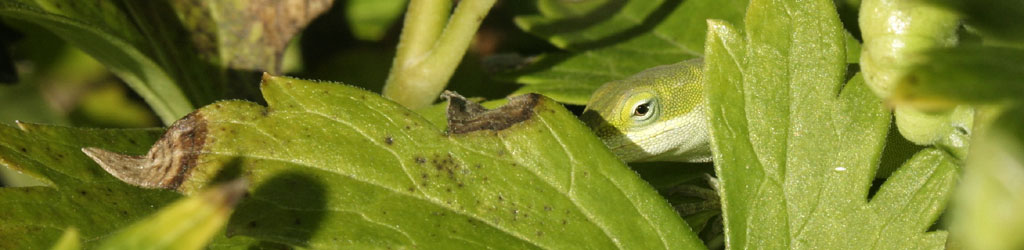
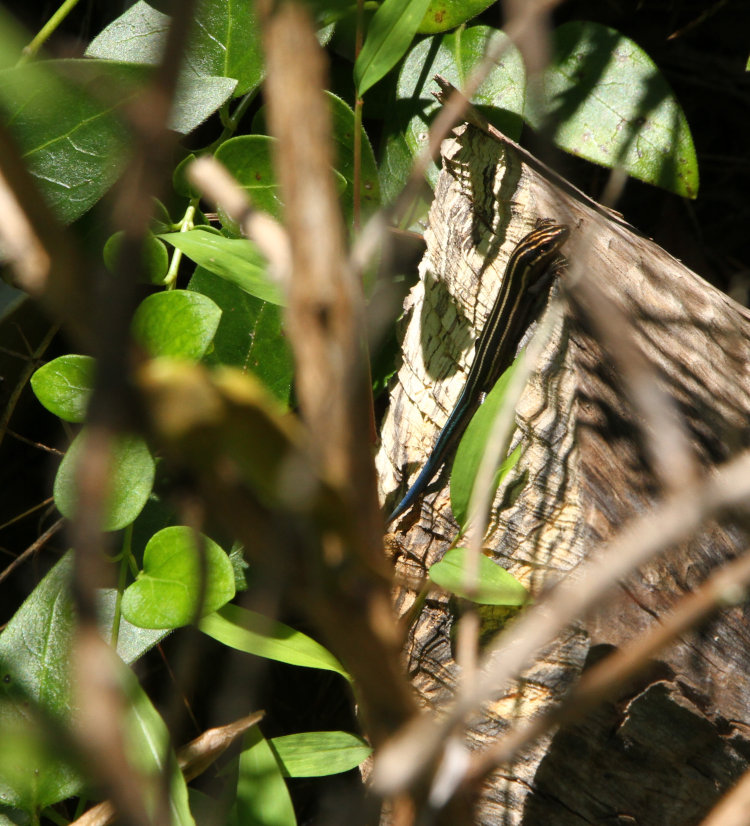
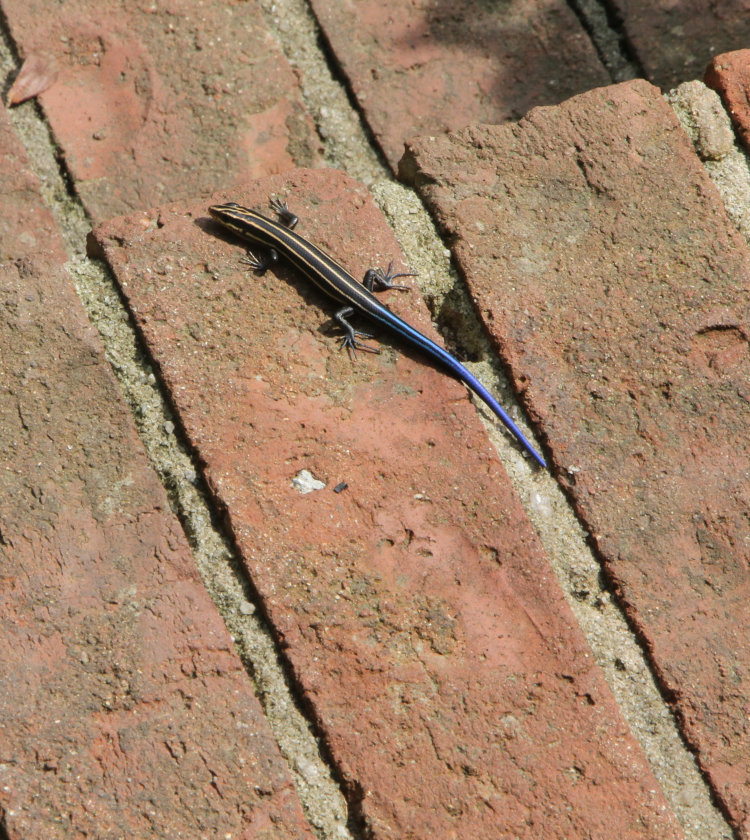
mostly hidden American five-lined skink Plestiodon fasciatus, venturing out as the weather warms
It’s even hard to tell which way the head is – to the lower right I believe – but this is an American five-lined skink (Plestiodon fasciatus,) the first for the season on Walkabout Estates at least, and it dates from March 31st. Earlier that same day I’d seen something scamper up a wall and under cover, and I thought I’d seen evidence of stripes, which is something that the anoles don’t have. A few hours later on, I heard a rustle in the leaves too close to my feet as I crossed the yard, and waited for less than thirty seconds before this one revealed itself. I knew their habits and continued waiting, camera raised, but this guy perhaps knew my habits a little too well, and had barely raised is head from the leaves before it hurtled off across the yard, without pausing, and disappeared into cover near the wall again – the camera never had a chance to even autofocus. So this is all we have for now.

We do slightly better for an anole.

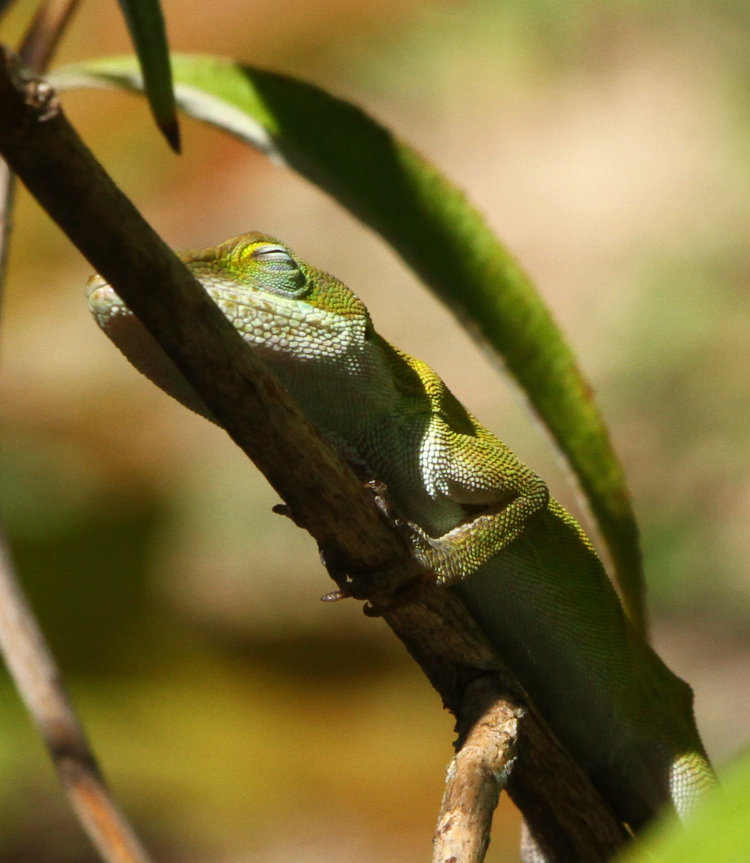
Carolina anole Anolis carolinensis basking on crook hanger
This was a day later, and in The Jungle out front, well removed from the skink’s territory; this represents the first appearance of a Carolina anole (Anolis carolinensis) from the front area, near the oak-leaf hydrangea that serves as a favored habitat. This one is roughly half adult size, and was inclined to bask while I was there so I avoided disturbing it. A little later on as I brought The Girlfriend over to see it, the anole had moved from this plant hanger (or in our case, the Japanese beetle trap hanger) to a bush beyond it and favored us with a territorial display of its dewlap, naturally while the camera was no longer in hand.

Later that same day…

hatching eggs of probable lady beetles coccinellidae
The eggs seen earlier on one of the rose bushes were hatching in the evening, and I attached the reversed 28-105 for detail pics, since the entire egg cluster didn’t exceed 6mm in spread. It’s not quite as sharp as it should be, but not only was I working freehand with a sharp focus range measured in millimeters (if not fractions thereof,) I was attempting to focus by headlamp since I have to redo a lighting system for the macro flash rig. Excuses excuses, I know, but buy any print and you can complain more. These are most likely some form of lady beetle (Coccinellidae,) and will help rid the bush of aphids, though my own efforts seem to have done a pretty damn good job.

But while we’re here…

first blossom from white rose bush
This is not from the bush with the lady beetles, but another obtained at the same time and just two meters along the deck – it was blooming the other day, so I shot it in passing. Should’ve bracketed exposure to produce a version without blowouts of the highlights, but oh well.

And finally,

juvenile green treefrog Dryophytes cinereus posing patiently
While I still had the 28-105 affixed from the egg shots, I poked around the yard and revealed this young green treefrog (Dryophytes cinereus,) who cooperatively stayed put as I maneuvered around in the ivy to get this perspective. This is half adult size, so roughly 30mm in length. If you look closely at that reflection in its eye, which is the macro softbox attachment that I designed, you can see the hotspots that it produces: a semi-rectangular one at bottom near the flash head itself, and then a crescent from the reflective bowl on the far side. I’d like to correct this and produce a nearly uniform circle, but I also don’t want to cut down the light by using a more diffuse surface, so I may be playing with the design again – perhaps a more oblique angle from the flash head so what transmits is mostly the reflection from the bowl. Then again, did you notice it before I pointed it out? Maybe I worry about it too much…
There are a few more pics in the queue, and they’ll be along shortly. Try to contain your excitement.

Just once, part 14

vole, likely meadow vole Microtus pennsylvanicus, realizing the photographer is getting closer
This week, we have a meadow vole, or at least I believe it is (Microtus pennsylvanicus, if I’m correct,) coming to the realization that the guy with the big black thing in his hands was actually closer every time it looked up. Meadow voles aren’t particularly scarce, but they have preferred habitats and are easy targets for numerous predators, so this represents perhaps only the fourth time I’d seen one in the wild and the first time photographing one, though I’d handled a couple while doing wildlife rehab. The funny thing is, so few people have even heard of them; many more, perhaps, have seen them, but mistook them for rats or rabbits solely from that unfamiliarity. They’re benign and unassuming little herbivores, and probably do less damage to gardens than rabbits.

This was at the rental condo when we were staying out at North Topsail Beach, NC, one spring, and a pair could often be seen near dusk right out in the back common area. Already out there to photograph ospreys or eagles, I took the opportunity to practice my stalking, creeping closer as the vole looked away and pausing as it looked up, which worked far too well. Even when the vole decided that I had approached nearer than seemed prudent, it merely hopped over closer to a thicket where escape was easier, and resumed eating.

In size, it was probably a little larger than your closed fist, so yes, about rat size and smaller than adult rabbits, but on a par with juveniles. Pretty cute, and I need to add more images of them to my stock.

No foolin’

I said I’d be back to ‘fess up, and I keep my word – eventually, anyway. I mean, there’s still time to make good on some of those things in my past…

In this case, however, we’re talking about the month-end abstract. But first, another image from the same session, to see if this helps things along any.

hairball clog from a sink in Chernobyl
Is it more evident now? I can’t know if it helps, or how much – I was there, of course, and responsible for the very abstract nature of the images. Had I taken them straight, it might have been a little more evident.

Last chance to figure out either or both, before we move down to the reveal.

.

.

.

.

We had a lot of scrap lumber to get rid of, which would have necessitated a trip to the landfill, but we also had a fire pit, and I’m a guy, so the obvious solution was to simply burn it off. I’d spent a few hours in the afternoon continually feeding wood into the little bowl of a pit that we have, then let it die down for the night. Much later, I went out to check and see how well the remaining charcoal was burning off, knowing that it might remain hot coals completely overnight. Stirring around the ashes produced quite a bit of heat and a nice bright glow, and the appeal was obvious. I got the camera and tripod, and with a few frames determined the best length of exposure. Then I started experimenting.

The month-end shot yesterday was a 20-second exposure while slowly zooming the 18-135 lens in, thus the streaks. You’ll notice the ‘dotted’ nature of most of the streaks, which came from the lens itself; still photo lenses aren’t made like video lenses, with a buttery smooth zoom function, and so they tend to be slightly ‘sticky’ or ‘grabby’ as they’re turned, and that’s what you’re seeing: tiny little jerks and twitches as I attempted to move the zoom ring as smoothly as possible. I actually went back in and tried it with an older lens, a manual focus Vivitar 28-200 that has a push-pull zoom, but it doesn’t maintain constant focus (this close, anyway) while doing so, and the effect of getting softer as it got larger wasn’t better than what I posted yesterday.
And now the pic above. It shouldn’t be too hard to figure out, given what I just said, but instead of tracking the zoom, I let it be and simply leaned over and blew heartily into the embers themselves; all those squiggles are sparks flying free. I did make it a point to blow in a couple different directions, to even things up. I also did a few frames where I stirred around the embers during a long exposure, but believe it or not, the effect was barely noticeable – the embers moved too quickly during stirring to produce much blur, the majority of the exposure coming when they were still.

But maybe it gives you some ideas for your own experiments, so have at it!

Not March

And so we find ourselves at the end of a slowish and lackluster month, which needs to be saved by the end-of-month abstract – a tall order, for sure. Will it be able to rescue us from this dismal month? Let’s see:

dull orange, um, starburst?, in the darkness
Well, that’s certainly… dynamic, I guess. Intriguing. I dunno, what would you call it?

In fact, I’m not going to tell you what this is, even though I knew it would make the month-end the moment I unloaded the card. Well, not the moment, because I had to rename the files and open the thumbnail program, but when I saw it in detail at least. One of many experiments, this one seemed to be the best.

Oh, I’ll be back shortly to tell you what, exactly, this is, but I’ll give you time to figure it out on your own first. I’ll provide a clue, though: it’s not very big, and not very small. I had time to work, but in a few hours the opportunity was gone.

Have fun!

Much the same, but bright at least

pink azalea bush in full bloom
So, it’s more of the same images that I get every spring, because they’re all on Walkabout Estates, but it’s what I could get today and it’s cheery, so deal. It’s not pics of food or me dancing in a halter top, you know? Okay then.

One of the azalea bushes out front is in full bloom, while the other, which is right alongside, the same species, and planted at the same time, has only two open blossoms and the rest still buds. Go figure. It’s like that neighbor that’s always the first to get the Halloween decorations up.

Meanwhile, out back, we have even less.

white azalea buds still a little ways from blooming
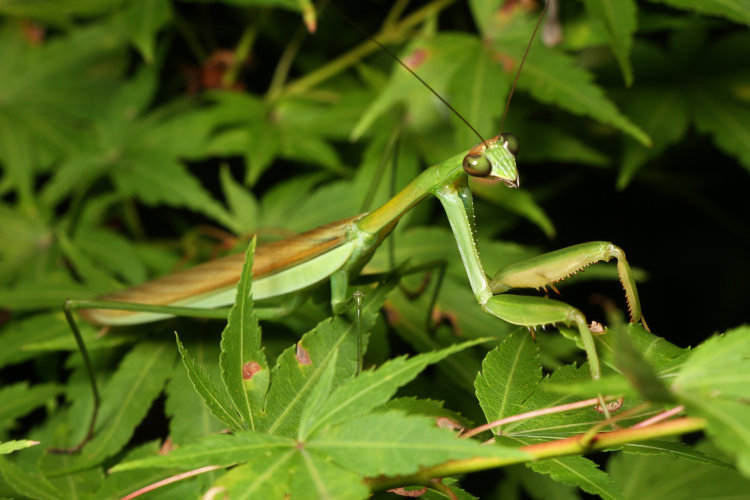
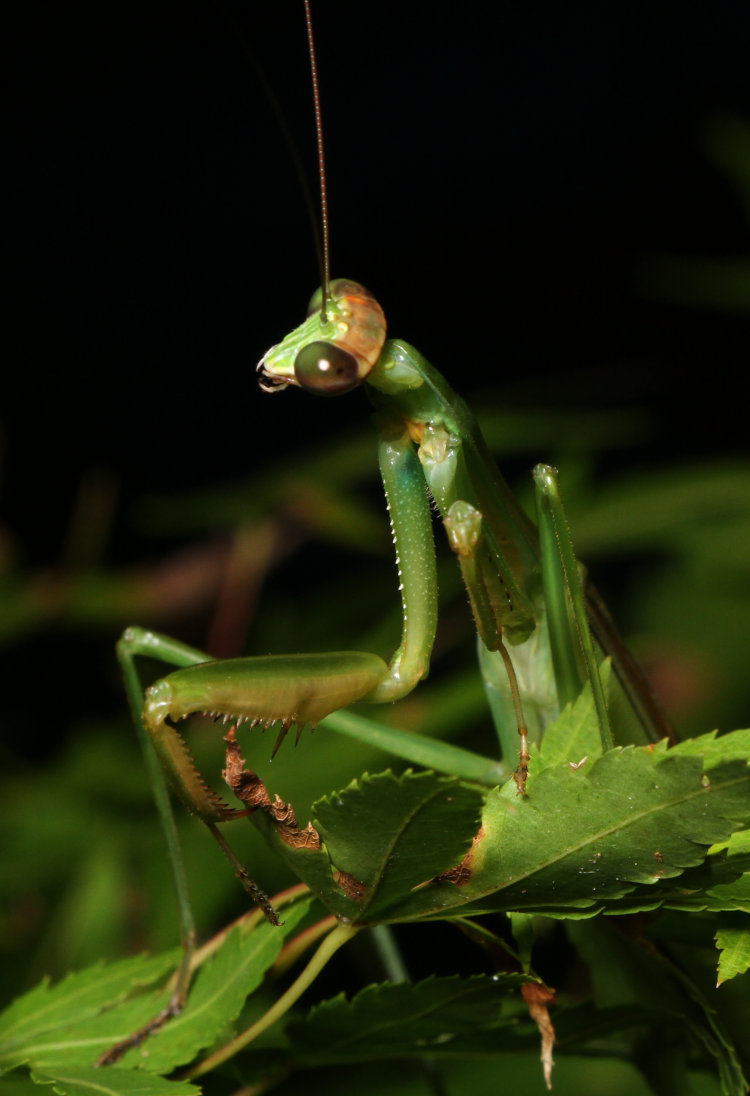
This is from the white azalea bush, which is huge and healthy, just not ready to bloom yet. It always does very well, but it runs later than the others, usually about the time that the mantids hatch (which I hope doesn’t take place while I’m away, but if given the choice between mantids and the eclipse, well…)

The tall ginkgo (Ginkgo biloba,) planted in the yard, is slowly starting to stretch out.

first leaves from outdoor ginkgo Ginkgo biloba tree
You can see the indications that pine pollen season is well underway, and a little yellow thing that might be an arthropod, and might not – I didn’t see it when I was getting the shot, but I also wasn’t using the macro lens. The tree seems happy with its location, so we’re pleased with it, but it stands in marked contrast to the potted, dwarf ginkgos that spent the winter in the greenhouse.

exuberant dwarf ginkgo Ginkgo biloba tree seen through side of greenhouse
It wasn’t actually banging on the glass, which isn’t glass anyway, but that was the impression that I got. It and its sibling will probably move out in about two weeks – we still have some cold overnight weather to contend with. The ginkgos probably don’t have to be in the greenhosue, but we lost a few potted plants one year to a long cold spell that penetrated through the pot and soil, so the potted plants go into one of the greenhouses over the winter.

Now two for The Girlfriend.

Japanese silverberry Elaeagnus umbellata almost at peak bloom
In the past two days the blooms of this one started kicking it, and they’re one of her favorites because they have a very pleasant smell, despite the flowers being very small and unassuming. This goes by a wide variety of names, including Japanese silverberry, autumn olive, and spreading oleaster, but Elaeagnus umbellata is the biological name anyway. I felt sure that I’d identified it here before, but there’s no sign of any of the names in the tags, so I suppose I’d only featured the unidentified flowers or berries in previous posts. The only problem we have with the plant is that it’s a small tree, but leggy and a bit droopy, and sitting right by the gate as it does, it’s often in the way. I actually put up a simple arch to hold it up, but it stretches out over the edges and drops off.

Of course, what spring would be complete without the cherry tree?

Yoshino cherry Prunus × yedoensis showing older flowers and new cherries in development
The Yoshino cherry (Prunus × yedoensis) is doing quite well itself, shown here with some remaining late flowers (minus their white petals,) as well as a selection of developing cherries. The cherries never get larger than 8-10mm and are mostly pit, but the birds still appreciate them, so there’s a narrow window when I can capture images of those, a few weeks hence. This tree, along with the almond tree, tulips, and one of the rose bushes, has been receiving regular coatings of the deer repellent ever since it started to bud out, since the deer were far too fond of the new shoots and kept it cropped from its natural ‘weeping’ nature, but we’ve found that, by treating it early, the deer quickly discover that it tastes like shit and will only sample it a couple times a year to confirm that it still tastes like shit. Provided I maintain the repellent, of course.

[If you have the interest, it can be found here, Recipe #2 – a little involved to make, but works extremely well, and will even keep in a bottle over the winter. It’s concentrated, so mix about 1:10 with water and apply with a spray bottle.]

Naturally, we have a guest appearance by the blackhaw viburnum (Viburnum prunifolia.)

blossoms of blackhaw viburnum Viburnum prunifolia against clear  blue sky
There were plenty of ways to approach the blossom clusters, many of which I’ve done before, but I liked the contrast with the blue sky best this time, along with the abstract modern-fart shapes of the leaf shadows. Had you noticed them? Now you have.

It was warm enough today, so we have some critters too.

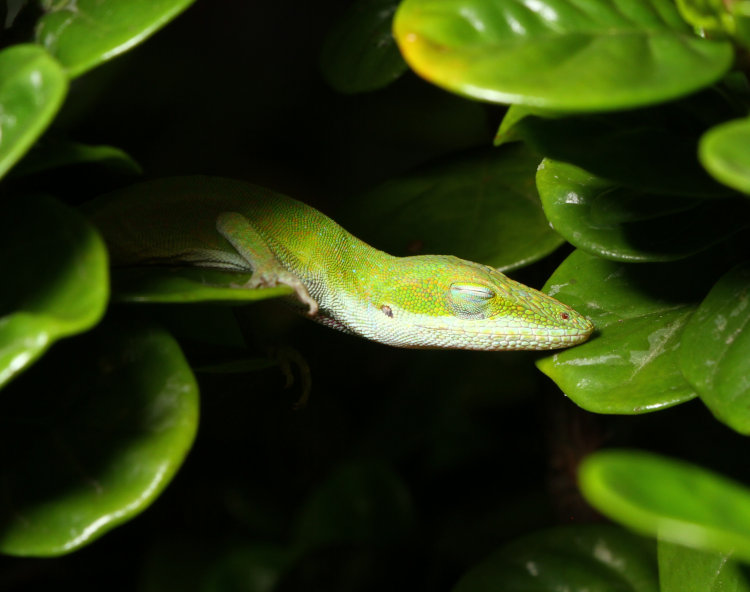
Carolina anole Anolis carolinensis perched on overflow hose
A pair, at least, of Carolina anoles (Anolis carolinensis) have been appearing the moment it gets warm, largely because I believe they spent the winter in the crack in the wall around the dryer vent pipe, so they never really hibernated. Here, however, one is venturing across the hose that drains the overflow from one of the rain barrels – it could have blended in a little better than this, but I suspect the brown color is to absorb more UV radiation. Let’s have a closer look, shall we?

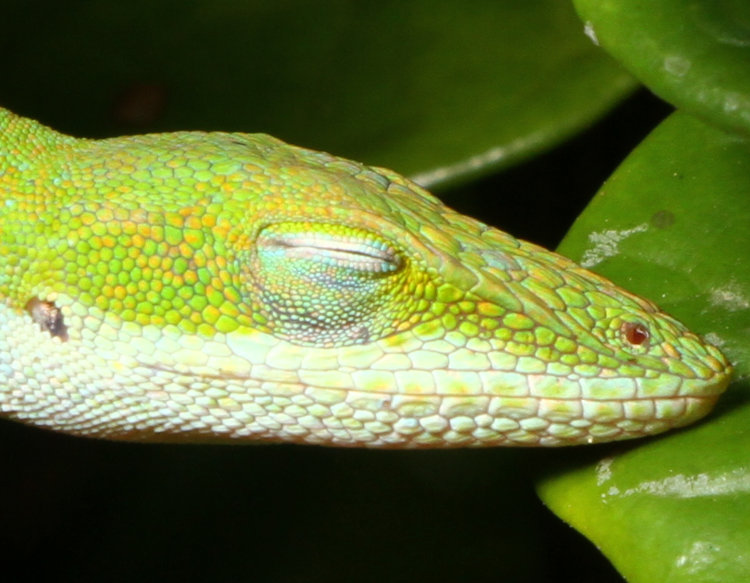
closer crop of Carolina anole Anolis carolinensis

I never get tired of that mosaic-nature of their skin, even if the eye-shadow is a bit too 70s.

But in the downspout that the hose empties into, was another find.

half-sized green treefrog Dryophytes cinereus hiding in downspout stub
From having seen it there before, I suspected that this green treefrog (Dryophytes cinereus) was hiding down the spout, and wanted to get them both in the frame if I could, but my maneuvering around wasn’t kosher to the anole and it moved too far away to frame properly, so we have this one all by itself. I find it hard to believe that this exposed downspout remains warm enough during the overnight chills, even when it leads briefly underground to a longer drainpipe that empties a few meters further down the yard, but any number of treefrogs continue to use it, so what do I know? Meanwhile, we also need a closer look at this one.

closeup detail of green treefrog Dryophytes cinereus showing pine pollen
That’s enough to see that, even sheltered as it is, it cannot escape the pine pollen. Nothing escapes the pine pollen! Little chartreuse bastards (the pollen, I mean.)

One last, then I’ll let you go.

eggs, likely from ladybeetle, on underside of rose leaf with accompanying aphid
We received several rose bushes late last year, discards from a nursery, that got a head start in the adjunct greenhouse and have now been moved onto the deck. Despite being lined up together, only one of them proved susceptible to an aphid infestation – I blasted them off a couple times with a high-pressure water stream, and we’ve had a couple of overnight near-frosts since then, so their numbers have been decimated. The eggs seen here, however, look a lot like lady beetle eggs, which makes sense because aphids are their main food source, and if you look closely, you’ll see one aphid hanging out as if in defiance of this, below and slightly right of the eggs. Go ahead, stay right there, nothing will come of it, I swear…

So, that catches us up a little, for about an hour of shooting, and I feel more normal now. Well, normal for me

I’ve had better luck

While there hasn’t been a lot to post about, and not a lot to photograph, I’ve been keeping busy with various projects – not necessarily to fruition, but busy anyway.

Long story short: the barn-door tracker mentioned a few times previously has been occupying far too much of my time, and right at the moment, it’s not clear that I’ll have it working in time for the eclipse. It’s not worth going into all the gory details here, but two ordered parts were delayed inexcusably long in shipping (one of which probably shipped from China despite claiming that it originated only three hours from here,) and figuring out the programming took too long in itself, only to find that the motor (that one maker assured was powerful enough) was not powerful enough. I’m not licked yet; I have a couple other options available, but we’re down to crunch time before I have to pack it all up and head north to be in the path of the eclipse – I’m driving up, and have plans to capture something the day before if I can, plus I’m avoiding driving on the weekend, since I don’t know what kind of traffic to expect.

Anyway, once I get it working (before or after the eclipse,) I’ll provide more depth, and some pics. Speaking of which, I have a few from earlier that I’ll throw down here, just to maintain a little content.

green frog Lithobates clamitans sitting on edge of drainage ditch
Several nights back (I mean, the 18th,) when the weather was quite warm, I heard the chorus frogs sounding off down at the neighborhood pond, but wasn’t quite available to head down there with the camera. Several hours later, I was, but by that time the frogs were silent – it’s primarily an early evening activity. What we have here is not a chorus frog, but a green frog instead (Lithobates clamitans) – much larger, with a different call, though it was silent while I was out there. I think their breeding season is a little later on in the season. Still, it was one of the few things that I actually found to photograph, and dazzled by the headlamp, it held still long enough.

Meanwhile, this was the other subject from that night:

six-spotted fishing spider Dolomedes triton floating on pollen-dappled water
There was no doubt, as I approached, what this was; I got the sharp reflection from the eyes long before I could discern its shape, and it moved quickly out over the water’s surface – not too many subjects fit those criteria. This is a six-spotted fishing spider (Dolomedes triton,) skimming over the surface in search of early arthropods, which as likely as not right now are other spiders. This is a medium-sized example, leg spread about 35-40mm, while you can see on the water the first evidence of the pine pollen inundation that happens every spring – again, this was two weeks ago, and it’s much worse now.

One of these days, I’ll revisit my attempts to show just how well spider eyes can reflect light, thus how easy they are to find at night with a headlamp. It really is bright and distinct, and while dewdrops can mimic the reflection, they tend to shift color a little as you move, while spider eyes remain a distinct blue-white.

Now, this pic’s even older than those above.

spotted sandpiper Actitis macularius perched on branches on edge of Jordan Lake
This dates back from the 7th, when I went down to Jordan Lake but didn’t see a lot. I spotted this guy and carefully stalked it for better detail shots, knowing it was from the sandpiper family but not which species. Which is fairly inexcusable (my word of the day,) since this is a spotted sandpiper (Actitis macularius,) probably the most common sandpiper species in the US and able to be seen just about everywhere. Yet this is the first time that I’ve gotten identifying shots of one – I could have saved it for the weekly topic, though I have enough options for that. It’s likely that I’ve seen them numerous times on the lake, since sandpipers have distinctive habits and flight patterns, but never close enough for a decent shot, and even this one took a careful approach; here, it’s very aware of me and considering that, despite a slow approach, I was probably up to no good. Which isn’t fair, because I’ve never eaten a sandpiper in my life, but that’s bird brains for you.

You’ll notice a lack of spots on this spotted sandpiper, but this is fairly common; birds usually develop different plumage at different ages, as well as seasonal changes and for breeding displays. This is a non-breeding adult, likely about to molt into breeding colors. They also have a distinctive bobbing walk, and I would have shot video if I’d had the tripod (and the chance to set it up, which the bird wouldn’t have waited for.) If you really want to see it, I’m sure someone has video examples online.

But really, that’s been about it for the photos, though a few things are in bloom now and the days have returned to being clearer and warmer, so perhaps I can produce a little more before the end of the month, maybe even later on today. If that happens, I’ll return and tell you where to find the pics.

Just once, part 13

cluster of Atamasco lilies Zephyranthes atamasco
While I have numerous images of plant species that have appeared only once in the blog, I feel that most of them are not strong enough to build a single post around – I have plenty of plant images that I find strong enough, but they’re all of species that have appeared multiple times. So not only has this species only appeared once, it might be the single representative of plant species for this year’s topic. We’ll see.

But these are Atamasco lilies or rain lilies or easter lilies – all depending on what the other people around you call them, I guess, unless the other people around you are botanists, then they’re Zephyranthes atamasco. But because they’re sometimes known as easter lilies, I purposefully stalled this post to appear today, which is about as much as I’ll observe the holiday. They’re supposed to be quite common in this area, but this is the only time that I’ve ever, to my recollection, seen them growing wild anyplace, and they served as a splash of color and interest on an otherwise dreary outing. Still, I’d like to find them when either the light is better, or they’re growing among something more interesting as a setting or background.

Visibly different, part 54

Okay, not all that visibly different, really, but it’s not my fault.

We begin with the full moon at 10:12 PM EDT last night.

full moon before start of penumbral eclipse 03-25-24
“Last night” being a little over five hours ago, but basically, before the start of the penumbral lunar eclipse – use 02:12 UTC 03/25/24 if you like. Yes, there was a lunar eclipse this morning (actually, it’s still going on as I type this,) but only a penumbral one, meaning the moon only passed (is passing) through the diffuse outer shadow and not through the distinct and total inner (umbral) shadow. This eclipse makes sense, in that the total solar eclipse is only half a moon cycle away, as the phases completely reverse into New and the moon traverses to the other side of the Earth, in relation to the sun anyway. You’d almost expect a total lunar eclipse, given how it’s going to near-perfectly align in just two weeks, but tilted orbits and all that jazz. So all we got/get is some cockeyed darkening:

full moon during peak of penumbral lunar eclipse of 03-25-24
This is during the peak of the eclipse, five hours further on (07:18 UTC, or 3:18 AM EDT.) Visibly darker, but not notably – about half a stop, I’d estimate, though at least the deeper shadow at the bottom is easy to discern. And it’s tilted almost 90°, but that’s because it’s five hours later on and I didn’t bother trying to rotate the camera to match (or rotate the image in post-editing.) Technically, it’s still oriented (mostly) the same way, but I was riding the planet along as that tilted. And I say “mostly” because the moon wobbles, suffering from libration (nasty thing, that,) and so it probably wouldn’t be a perfect match even if rotated to match the poles.

Excitement City, I know, but it’s all I’ve been up to recently, at least photographically. Now, preparations for photographs are taking place, as the barn-door tracker mentioned previously is taking shape, and would be much further along if the goddamned parts that I’d ordered has arrived at a reasonable time. Will they get here today? We’ll see, I suppose. This isn’t leaving me a lot of time to experiment and refine the design if there are issues (which I consider at least 30% likely,) but so it goes.

Worse is the possibility of crappy weather during the eclipse, since the northern states aren’t known for having frequent clear skies even in early spring – I’m resigned to the very real possibility of traveling up there and not being able to see a thing. It won’t be a wasted trip, since I’ll be with friends and we’ll find plenty to do, but the preparations that I’m making for this event may all be for naught. Though, whatcha gonna do?

Just once, part 12

possible pelagic gooseneck barnacles Lepas anatifera with extended cirri
Some subjects, like mammals, are pretty easy to identify, from a combination of few varieties to be found in any given area, distinct markings or anatomy, and plenty of online resources. Arthropods often become a bit harder, since there are a lot of varieties and many distinguishing characteristics are tiny and hard to spot. And then there are things like crustaceans, where online resources are so thin that I couldn’t tell you if a lot of species look like this, or if this is the only one. So when I say that I think this is a pelagic gooseneck barnacle (Lepas anatifera,) well, pay attention to the italicized “think.”

And yes, crustacean is correct – they’re not mollusks, and in fact are quite mobile when they’re younger (a stage I have yet to photograph, though it’s definitely on my list.) But now things get a bit sticky. When first posted about in 2019, I said these were in the Order Pedunculata, but as I was checking details just now, I found I was incorrect – they’re from the Order Scalpellomorpha. Yet at the time I wasn’t actually incorrect – the texonomy changed two years later, and Pedunculata is no more. Makes me feel a little better, because I try to be as accurate as reasonable for my posts, and I was worried that I’d screwed up back then. I mean, I may still have screwed up and these are not pelagic gooseneck barnacles, which I’m now compounding, but anyway…

possible pelagic gooseneck barnacles Lepas anatifera showing extended cirri
When I collected these specimens with the exorbitant effort of picking up an old bottle on the beach, I placed the bottle in a macro aquarium (what I could of it anyway,) and waited in vain for those little fan-fingers (cirri) to start sweeping through the water in feeding behavior. I later found out that they don’t do this, but simply let the current or the motion of their anchoring object bring food to them, the lazy sods. Are you sure you can handle drawing it in to your mouth, or do you need help with that too?

possible pelagic gooseneck barnacles Lepas anatifera potentially discharging eggs or young
One of my specimens was found to be discharging some ‘stuff,’ and not putting a lot of effort into that either – it was closer to falling out than anything. While I initially thought this to be indigestible sand, close examination showed it all to be uniform, smooth, and oblong, like eggs – except barnacles don’t produce eggs. You know where I said above that I had yet to photograph the young, the larval stage? I’m not actually sure I haven’t, now, but what isn’t visible, even at high magnification, are the slightest details that demonstrate that these are crustaceans, which is what I’m really after. That quest will continue, even though I’m not exactly sure what I’m looking for or will know it when I find it.

For the record, barnacles swim around on their own until adulthood, whereupon they attach their heads to a fixed point, floating or well-anchored like a rock, and then their chitin extends to make an encapsulating shell that makes them appear more like mollusks; the cirri that you see here are actually their feet. And yet, they reproduce after they’re anchored – they’re hermaphroditic and possess both male and female organs, but do not self-fertilize, so they rely on being exceptionally well-endowed to mate with all other barnacles attached to the same general area. Something else that I did not actually capture, but I’m not on a quest to photograph this as much as the mobile young.

Still…

1 52 53 54 55 56 334