A break in the numbers

This was going to be another of the ‘Just Because’ posts, but really, there’s too damn many numbered posts, so it’s not. And it’s a throw-up, just something that I came across today when watering the plants. Which looked almost exactly like this:

black racer Coluber constrictor peeking out from vinca plants
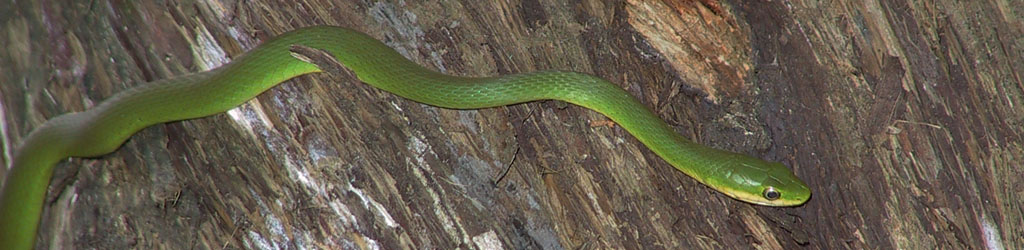
I had initially identified this as a black rat snake/eastern rat snake, but afterward as I looked at the almost uniformly indigo belly and smooth scales, I realized it was a racer (Coluber constrictor) instead. I always pictured them with slightly narrower heads, not to mention the habit of hurtling away upon anyone’s approach, but so much for that. Somewhere in the realm of 120-130cm in length and thus average for the species, this one was remarkably patient, not only staying put as I got the camera and The Girlfriend (who doesn’t like snakes but has gotten used to them enough to observe from a moderate distance,) but also as I leaned in pretty close for pics.

black racer Coluber constrictor  motionless with head raised
The one aspect where it was not cooperative was with the tongue action; it demonstrated plenty as I shifted position, but only a hint when I was locked in and focused, and I caught just the barest tip in a single frame, visible only at high res. Ah well.

And while we’re here, the eastern rat snake, almost identical, would show a distinct longitudinal line, a ‘keel,’ on each body scale – subtle, but it would be plainly visible in this light. This might actually be the same snake as last year, though it’s a few dozen meters away from that area – certainly not outside of any normal range. Going through the collection of frames from both years just now, the color pattern around the head isn’t identical but is remarkably similar, so I’m giving it a better than 80% chance, myself [Editor’s note: The author has no scientific training and hates math, so his estimate has less than a 50% chance of accuracy.]

Still closer.

black racer Coluber constrictor lloking alert and threatening
I was a little amazed that this guy did nothing but twitch slightly as I got in this close, though I admit that, a little later on using the smutphone camera just to pester others with the shots, the snake finally decided that I was invading its personal space and gently, slowly backed from view. The focus on this particular frame needs a closer look, however, so let’s get to that:

black racer Coluber constrictor in close portrait
While last year’s shot was done with the 150-600mm lens, this was with the 18-135mm, meaning I was considerably closer. So menacing in appearance, and racers are much more willing to bite than rat snakes, but this one just stayed as motionless as possible and counted on this as protection; it may have been a different matter had I tried to pick it up, but I’d rather encourage it to hang around, so I let it be and went back to my yard work. We’ll see if I encounter it anytime later on.

Air, and a little Water, Day

While my schedule was a little odd, I did get the chance to go out for a short while in recognition of Earth Day, so back to the lake it was. I have to admit that I was a bit disappointed when, after reminding all my readers of the holiday and talking so recently about the species that could be found down there, Jordan Lake was remarkably quiet. It’s like I’m not reaching anyone somehow…

Still, I found a handful of things to photograph, and got some outdoor time and fresh air that notably wasn’t laden with some wicked allergen that hit me right in the back of the throat (unlike all day yesterday,) so I’m good. Still trying to be better of course, but right now I’m not complaining, and that’s remarkable enough on its own.

While a handful of herons and a red-tailed hawk made an appearance, we’ll just stick with the bald eagles (Haliaeetus leucocephalus) for now; either their numbers have exploded at the lake recently, or they’ve moved from an area that I was unaware of to my most-frequented haunt. It takes almost no effort anymore.

adult and juvenile bald eagles Haliaeetus leucocephalus wheeling together
High overhead, an adult and a juvenile wheeled together, almost appearing to be courting, which may be possible (I suspect they reach sexual maturity before their fourth year when they achieve the white head and tail of the adult,) or it may have been a parent and offspring, though I doubt this year’s because of the coloration – it looks like 2nd or 3rd year for the juvie, to me. There was no further behavior to support either idea, however, and eventually they separated a bit and disappeared from view.

Then it was quiet, but after a while I spotted one in the distance coming closer, and I switched position on the chance that it might do some fishing in my view. The sun was high and bright, not ideal for shooting up into the sky, but as the eagle started banking around I got a couple of decent angles.

adult bald eagle Haliaeetus leucocephalus in slight bank
This one was ‘stepping’ lower, slight swoops and pullouts, no actual diving, more like false starts, but it steadily dropped lower.

adult bald eagle Haliaeetus leucocephalus lowering its feet
As the feet started to extend from their tucked position, I knew it was spotting potential prey, even though it maintained the indecisive descent. I wasn’t about to look away now.

adult bald eagle Haliaeetus leucocephalus in shallow stoop
Yep, it’s got its eye on something, and I silently cheered it on.

adult bald eagle Haliaeetus leucocephalus just before snatching fish from water
Annnddd the focus twitched away again, inexplicably. I’m going to spend the day tomorrow hashing out just what the hell it seems to be doing, and/or trying to prevent it. But this is what I got today, and the action is clear at least.

adult bald eagle Haliaeetus leucocephalus, snagging fish and heading out
Gracefully, it snatched its prey from the water and started climbing back out, very shallowly. This is cropped significantly, and in the viewfinder I wasn’t completely sure that it had caught one or not, but since the eagle headed straight off without climbing much or wheeling back, it seemed likely to me.

I’ll be back to make more attempts, and video is in the works – I’ll have to determine if a tripod is necessary or a shoulder-rig will be sufficient, but shooting freehand (like these still photos) would only induce seasickness. We’ll see what happens, hopefully soon.

Profiles of Nature 16

black vulture Coragyps atratus Rigoberto in tree overhead
This week we wave back to Rigoberto, only to realize he was just admiring his ring. Rigoberto didn’t let his appearance hold him back, and Buscemi’d his way into movie roles such as The Jungle Book (1967,) Clash of the Titans (1981,) Conan the Barbarian (1982,) and as a stand-in for Kenneth Copeland and Sylvia Browne (though he regretted both on moral grounds, and ended up donating his fees to the charity ‘Holy Shit Use Your Head For Something Other Than A Snapchat Filter’ to help offset this.) In fact, he’s very motivated to help others, but after being asked not to volunteer at retirement homes or children’s hospitals, he found his niche perching outside Ford Motor plants, eventually being credited with a 12% increase in quality among the vehicles produced therein (nowhere near enough, but better than anything their execs ever accomplished.) Rigoberto is a perfectionist on the job, insisting on nothing but the absolute best performances and consequently not working most of the time, a standard we’re hoping to establish with more pop stars. In his youth, he set his eye on playing Charlie Brown in an eventual live-action Peanuts special and endeavored to have his head measure more than five times his neck diameter, which led his emergency room physician to call it quits, move to Montana, and begin making that string-stretched-between-nails art that was so popular in the ’70s. Rigoberto owns 754 pockets squares as an investment; we’re not sure how that works either. His favorite tourist trap is the world’s largest ball of twine.

We’ll be here next week, and you will too because now it’s just horrified fascination.

Too cool, part 48: Ingenuity leaves the nest

Astronomy Picture of the Day had the news this morning, and you’ve likely already heard it anyway, but who would if I failed to cover this on my own? Two ‘Too Cools’ ago, we observed the landing of the Perseverance rover on Mars, and now we have the follow-up, so let’s do it in chronological order. The transmission time from Mars is significant, and the first information to come back was telemetry data:


Note the photo that the Ingenuity helicopter took of its own shadow. Ingenuity is just a proof-of-concept vehicle, a test, not intended or equipped for exploration, but it has a basic, monochrome still camera onboard. That, I must point out, is extremely fast, because it stopped the 2,400 RPM blades dead in the frame, no blurred shadow.

Later on, the Perseverance rover processed its video and transmitted that along, its view from a moderate distance away, where it had reversed to after dropping Ingenuity from its underside a few weeks back.


Ingenuity traveled with dead batteries, so it had to charge them with its solar panels for a while, and there was a software issue that, I thought I’d heard, was going to take a few days more than this to fix, so I was a little surprised by the news, but hey, I’ll take it. And the stability and precision are great to see, much better than I can maintain with my own quadcopter (which isn’t saying much.) And yes, you know I’m motivated to go out this afternoon and do a few flights.

It’s pretty impressive, overall: Mars’ atmosphere is much thinner than ours, making any kind of flight a serious exercise in engineering, and because of the transmission delay between Mars and Earth, all such flights have to be autonomous. Helicopters themselves are inherently unstable, requiring constant correction to maintain flight, and accomplishing this with software is pretty damn slick. So mad props (a ha ha) to NASA and the crew at Jet Propulsion Laboratory for this feat.

As a stupid aside, Metal Earth is a company that makes sheet metal models and features a lot of space-related stuff, and when I checked on a whim a few weeks back, I found that they were soon to produce a model of Perseverance and Ingenuity. I’ve purchased and assembled no small number of these myself, so I’m psyched.

Metal Earth models of Mars explorers, Insight Lander and Curiosity Rover

Fingers crossed

No, that’s superstitious – let’s just say I’m hoping for the best, or at least the better than average.

I went over to the neighborhood pond today, in part just to see how a new bag situation was working – long story, but a shoulder-slung bag has been bothering my back, so I’m investigating other options, and this time around it was a sling bag. Yes, I know it’s still shoulder-slung, but it sits higher and has a broader strap, plus the bulk of the weight is now on my opposite shoulder, so we’ll see how it works out.

One of the other reasons was to see if the green herons (Butorides virescens) were showing yet, since I’m hoping to catch the nesting behavior; we’ve had nests for the past two years, but generally I’ve only known this when the fledglings had already left and were simply hanging around in its general vicinity, and I’m trying to get ahead of the game this year. It wasn’t long before I spotted one, the first of the season, flying a short distance away to perch on a lower branch partially obscured by the tree’s trunk. I started edging around, and the heron was peeking out just enough to see me and lean back out of sight. Or what it thought was out of sight, anyway – it would get its eye back enough not to see me, thinking this was sufficient and not accounting for its long beak (or hoping that this was subtle enough to pass notice.)

green heron Butorides virescens barely peeking from behind trunk
That’s expressive, but we need a closer look for detail.

green heron Butorides virescens showing very edge of eye
If you look right against the trunk, you can just make out the barest edge of its eye. There’s no question that it was watching me and leaning back out until it could no longer see my torso, since it not only did this multiple times, it kept leaning further back as I slowly maneuvered for a better look. Eventually, I just stepped a little more quickly out around the tree (still at some distance – this is at 600mm and cropped further) to get a clear pic.

green heron Butorides virescens slightly better view
It didn’t tolerate this for very long, and soon flew off to a safer location, but it didn’t matter: I had evidence that one, at least, had returned, and could now keep a wary eye out for nesting behavior.

The day was chilly, and I had no intention of being out very long since I’d dressed in the belief that it was warmer, but then another green heron was spotted, and I stalked that one, which turned out to be a lot less wary. Just so you know, this is full frame, no cropping at all:

green heron Butorides virescens holding still
This one was counting on its camouflage and total stillness, and I was able to creep fairly close and even sit down for more stability, thus this nice portrait. After a moment though, now that I was nearly motionless myself and as close as I intended, it started to get a little more anxious and took a few quick steps, crest now raised:

wary green heron Butorides virescens stepping away with crest raised
Now, this might have been from deciding that my behavior wasn’t kosher, or realizing that I was indeed aware of its presence, or it might have been from the swimming approach of a Canada goose, which was admittedly closer (and tending towards territorial.) I can’t say either way, but it soon flew off. I had both the proof and the pics I needed though, so no biggie.

Coming back, I spotted some movement within the thick trees that I suspect held the heron nests last year, and stopped to observe it. The bird was quickly revealed as being far too small, but I struggled for a clear look, determining that it had no intention of letting me obtain this. I shrugged and moved on, yet almost immediately another with a beak full of nesting material flew in to the same location. This prompted me to try again, and with much dodging of intervening branches and foliage (and switching the focus to manual because autofocus would have grabbed everything but the bird,) I managed a couple more portraits.

gray catbird Dumetella carolinensis with nesting material
This is a gray catbird (Dumetella carolinensis,) and I couldn’t tell you the gender since their plumage is indistinguishable, except that it seemed marginally larger than the other so that usually indicates female. It was obviously a companion of the first that I’d spotted, and they both watched me warily while waiting until it was safe to approach their nest location in that tree.

gray catbird Dumetella carolinensis with tiny sprig of nest material
This one doesn’t seem to be putting the effort in, but it was a nicer portrait. There was no doubt as to the identification, but one of them vented a couple of the quiet, mewing calls that gave them their common name, just to confirm. I soon left them alone to complete their nest, and perhaps I’ll make the attempt in a couple of weeks to find it and observe their rearing behavior.

So, yeah, nice bit of progress and good omens for a brief, casual outing. No complaints on my end.

This week in Things

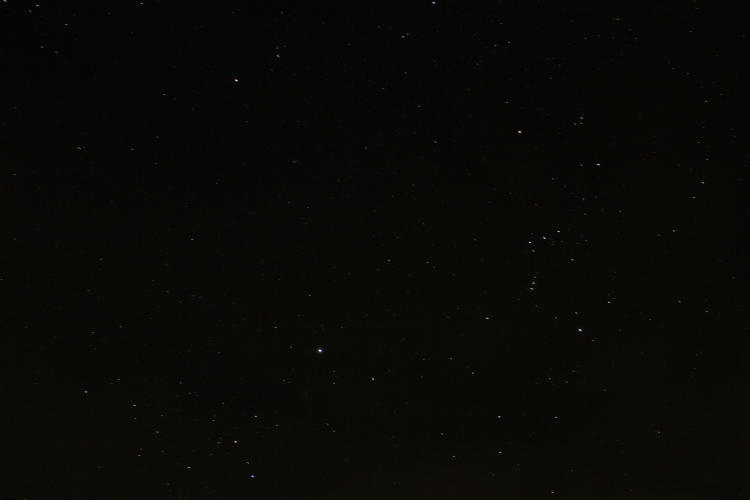
I have routine event reminders in my home calendar, a remnant from the period that I actually had a calendar attached to the blog with nature-photography-related events thereon – only about half of those were carried over, and of those, most of them I don’t post about. But I retained the meteor shower data, so I can tell you that the Lyrids meteor shower is due to peak on the 21st and 22nd. ‘Peak’ is a vague thing, since they’ll be visible for many days before and after, and the actual activity can be wildly variable as well, just because that’s the nature of meteor showers. The moon will be setting in the early morning hours, leaving a dark window of a couple of hours before sunrise to make any attempts, which is when the meteors tend to be more visible anyway. Now, setting up time exposures and not capturing any satellites in the image is the real challenge anymore, but I would suggest the earlier the better, to reduce the number that can reflect the approaching sun (being at high altitudes, satellites can catch sunlight long before we see any evidence of it on Earth.) The Lyrids is near the constellation Vega, riding high to the east, so in more of a ‘dead spot’ between equatorial and polar orbit satellites, but in my experience, you might see meteors anywhere – they just tend to ‘originate’ near Vega. Whatever – give it a shot, if you have the sky conditions and can get out in the early morning.

April 22nd is Earth Day, so go eat some dirt. Or something. There are plenty of resources online with suggestions, but my own is simply to get out and enjoy nature (imagine that.) Due to The Girlfriend’s video conferencing schedule, I’ll probably be forced from the house anyway – I’ll definitely be away from the office. We’ll see what happens – I try not to make too definitive plans because the weather doesn’t like cooperating, or other things come up. It’s not like the 22nd will be the only day I get out this month.

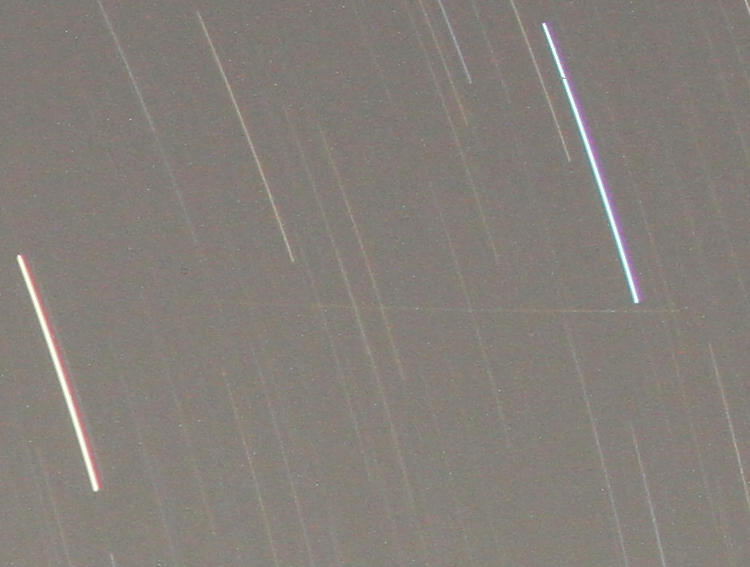
And April 24th is the 31st anniversary of the launch of the Hubble Space Telescope. In my area, it will make the briefest appearance not long after sunset, but wink out (from passing into Earth’s shadow) just after it rises above 12°, so there’s very little opportunity to see it on that date – Heaven’s Above and Stellarium can help you plot it for your area (generally, search on ‘HST’.) However, I have seen it at other times:

streak of Hubble Space Telescope passing against background stars
So that’ll keep you busy for a few days. Just tell your boss you need the whole week off – you know, as a Walkaboutian. I’ll back you up.

On close inspection

After a gout of photos taken in the past few days, there comes the sorting. It’s not enough to simply take them, to capture them, no no – they must be examined for merit, culled of any that do not pass muster (very, very few, naturally,) and then distributed into folders appropriate for their primary subject. Not to mention copying them all onto separate harddrives in a process that I like to call, “backing up.” And while doing this recently, I came across a couple of curious details that I’d like to share with you (you get half, and I get half, exactly, at the same time, ready? One, two, three…)

The first is something almost invisible in the original exposure, but brightened here to make it easier to see, of an osprey (Pandion haliaetus) over Jordan lake from a few days back.

osprey Pandion haliaetus overhead and potentially looking down and back at photographer
They eyes are what we’re paying attention to here, and I won’t say for sure that it’s looking back and down at me, but those eyes sure are aligned in that direction, aren’t they? The lower part of bird skulls tends to be narrower than the upper portion, allowing many species to have a gaze that can fall directly down from normal orientation, ‘seeing under their chin,’ as it were.

And then we have our most recent subject, zoomed in and color-tweaked here.

great blue heron Ardea herodias with channel catfish Ictalurus puntatus in its beak
The eyes are the key focus here too (a ha ha, get it?) just for the sake of it. I have no idea how well herons can see something held in the base of their beak, but it’s probably not too often that they’ll ever come more eye-to-eye with their prey, almost like pro wrestlers before a match, only a lot less stupid.

I just thought you should see these. I would say that we’ll now return to normal content, but you and I both know that’s not gonna happen here.

Came through in the end

We (meaning the Insuperable Mr Bugg and I) had another outing on Friday – intended to be a morning session, but the overnight and AM temperatures were less than inviting and we knew it would prevent many species from even poking a head out, so we postponed it until early afternoon. Even then, it was pretty slow going. The temperatures had gotten into a quite comfortable range, it was sunny and clear, yet the critters were few and far between. However… but I’ll let the mellifluous narrator explain it:


A small note: I was trying to avoid the ubiquitous 16:9 aspect ratio for this video and use a more versatile 4:3, which hews a lot closer to the 3:2 that the camera renders, but for unknown reasons OpenShot makes such options far too complicated and byzantine, so this is what we have until I figure out how to do it properly (or that the program cannot actually accomplish this.) 16:9 is fine for movie theaters I suppose – never saw the value in having such a wide display, myself – but why it has to be used everywhere now is beyond me.

The deep canopy of trees over the heron is responsible for the greenish cast to most of the photos – that’s the way it appeared, and I’ve never liked the vagaries of Auto White Balance.

Some of the other photos from the session. The heron of course:

great blue heron Ardea herodias not looking gorged at all
Unless it pulled a switcheroo in the brief period it was out of our sight, this is the same heron that just horked down a kilo of catfish. You’d never suspect it, would you?

possible Greater Bee Fly Bombylius major on bluet Houstonia caerulea
Another look at the greater bee fly (Bombylius major,) or what I take to be one anyway. The few photos I have aren’t close enough to pin this down for sure. Bluet blossoms (Houstonia caerulea) are only about 10mm across.

crested dwarf iris Iris cristata in bright sunlight
This is a crested dwarf iris (Iris cristata,) a fairly common NC wildflower but I think the only place I’ve ever seen them is Duke forest. Finding them is bright sunlight was slightly trickier, but hey, you know I’m up to the challenge.

likely northern water snake Nerodia sipedon sipedon nestled in crevice in rocks
And, after the heron sequence, we managed to find another snake – normally Duke Forest is loaded with them. This is a smallish water snake, likely a northern water snake (Nerodia sipedon sipedon) but the key features to distinguish this for sure are hidden under debris, and this was as close as we were getting without risking a dunking in a deeper section of river (not, by any means, deep, but deep enough not to risk camera equipment, you know?)

It would have been a pretty weak shooting session without the heron, so credit where it’s due. Now I simply have to decide if I’m going to start packing along at least the monopod on most of these outings…

Don’t plan on it

[Another meaningless milestone: this post is the 2021st, and it’s the 2021st year since jesus was born only not really because early chroniclers got the dates wrong and he may not even have existed anyway and why the hell are we still using this idiotic dating system? It’s year 60, since we entered into space – let’s start using that. Anyway, it’s unlikely that I’ll be able to do anything again with the year and post counts, unless I stop right here and post nothing more for, oh, another eight-plus months, but I’m not that dedicated to a silly coincidence. I just stalled some of the cooler photos taken recently to meet this conjunction.]

There’s a certain level of irony in preparedness when it comes to nature photography – probably other topics too, but we’re not on that kind of blog. Yet you can plan and prepare and overthink an outing or shooting session, intent on getting some kind of subject, and get nowhere, only to snag much better photos without any intention at some other point in time.

As mentioned earlier, The Girlfriend and I made a little run to pick up some materials and did a side trip on the way back to stop by Jordan Lake, mostly just to see what was going on, but I did at least take along the camera and long lens. The day was almost totally overcast, far from ideal, but at least this kept the region a little quieter when it came to boaters and kayakers. Not expecting much, we were just scanning the area.

Almost immediately, a bald eagle (Haliaeetus leucocephalus) cruised by low overhead, not allowing much of a clear shot, but then took a perch not far off in a clear tree.

bald eagle Haliaeetus leucocephalus perched in tree next to vulture effigy
This was unprecedented, at least in my experience, because this tree sat between two boat ramps in a fairly busy section of the lake, with lots of quieter options to be found less than a minute’s flight away, including the spots where we’d been seeing the species last year. The thing suspended from the tree below the eagle, by the way, is the still-present remnant of the vulture effigy program, clearly of stunning effectiveness.

We decided to see how close we could get to the eagle, since there’s a lakeside trail that wends along behind that tree, and started off slowly. As expected, the eagle didn’t wait around long at all, and flew off without my ever obtaining a clear, closer view, but we waited to see if it would return or at least wheel overhead. The wait was perhaps thirty seconds, as I caught a glimpse of a large bird overhead immediately before it slammed into the water not 15 meters away; my view was obscured by trees, and before I could move and obtain clear focus, the bird (now revealed to be an osprey, Pandion haliaetus) launched from the water with its successful capture in talon and flew off along a more obscured route, so all I had were unfocused grabs.

This miss was not indicative of anything, however, as soon another started circling straight out from where we were, fairly low and obviously hunting.

osprey Pandion haliaetus wheeling overhead
This helped correct a misconception that I had, I admit, which was that fishing birds were more likely to hunt in brighter sunlight, when the light would penetrate the water better, than on overcast days when the entire sky will reflect from the surface and reduce the ability to see within. I’ve never had the opportunity to see the water from an osprey’s altitude, or with an osprey’s eyes either, so maybe I’m missing something, but they certainly seemed to like fishing more in the dimmer conditions. Soon enough, there was a pair wheeling around.

pair of ospreys Pandion haliaetus actively fishing
Looking through the viewfinder as I followed the one, I wasn’t even aware of the other approaching until it entered the frame, but got lucky enough to snag it before it left. The focused one is ‘backing,’ going into a near hover which is often an indication that it spots something and is about to begin the ‘stoop,’ the dive after prey. It did this quite a lot, producing several false starts as I kept an eye on it to capture the full descent.

osprey Pandion haliaetus backing before beginning stoop after a fish
It did indeed make a dive, and the lens did the typical focus racking (which I thought I’d programmed out of it) while I tried with little success to keep it centered in the frame as it accelerated down into the water – I should at least back off the zoom a little, make it easier on myself, but I will admit that, with a heavy lens and the acceleration of the bird, it’s more than slightly tricky. The osprey was unsuccessful in capturing anything, though, and flew off into the middle distance as I switched attention to the other.

Before that one started exhibiting any backing, however, The Girlfriend pointed out that the first had returned, to the same general location in the sky, and was once again actively fishing. Very soon, it went into a stoop again.

osprey Pandion haliaetus descending in stoop
Some idea of how close it was to shore is shown by the treelimb here (another damnable longneedle pine) that it actually passed behind as it dove. Once again, focus twitched away at the crucial point as it crossed the horizon line, so I have no good frames of its entry.

[A brief note here: the camera body has some settings to restrict how the autofocus behaves, but limiting how much it might wander in attempting to track a moving subject also limits how quickly it can obtain a new subject, so an advantage in one set of subjects is a disadvantage in another, and I’m still refining my settings. The Tamron has an optional doodad to do more direct programming of the lens itself, a cool innovation, and I finally purchased one, but as yet have not tackled it. I should be doing that instead of posting, I suppose.]

But we have a peek as the osprey paused momentarily in the water before launching itself back out, at least.

osprey Pandion haliaetus immediately after fishing dive, wings raised within the water
It had gone completely under, obviously aiming for a fish a little deeper under the surface, so again, good visibility to the osprey. And then it took off, and I had a clear view and tight focus.

osprey Pandion haliaetus rising from water with a fish in either talon
Two fish simultaneously! I was impressed, and happy to be capturing the photos. In fact, let’s have a closer look.

closeup of fish from previous frame
Given all of the motion at this point in time, I’m not complaining about this at all. Anyone want to identify the fish species? I mean, besides, ‘toast’?

And away it went with its supersized takeout meal, one heads, one tails.

osprey Pandion haliaetus flying off with fish in either talon
My real view was a bit farther off than this – it’s a tighter crop, but that just shows that focus here at least was bang on. The Girlfriend lamented (on seeing the pics at home) that it was a shame the head wasn’t visible, which is true enough, but I’m cool with this for now.

The other osprey had moved farther off, so we headed back towards the car, catching another glimpse of the eagle (or an eagle, at least) as we did so, but still obscured by trees. It was low, once again, and visible over a wooded section that sits between the two parking lots for the boat ramps, and I was starting to get suspicious that there might be a nest back in there, especially after hearing an eagle call and seeing what appeared to be harassing behavior from a vulture. But nothing remained visible, and so we elected to leave.

On our way up the parking lot, I remarked that I wasn’t removing the long lens until we’d reached the car, since I’d snagged the previous eagles from that very area as I was examining a flock of vultures wheeling overhead, as they were on this day too. Less than thirty seconds after saying this, we both heard the distinctive calls of an eagle, seemingly from right alongside the parking lot in the trees very close by (opposite the suspected nest site, however,) and within two more seconds it broke from cover and cruised low overhead.

adult bald eagle Haliaeetus leucocephalus cruising past
It’s amusing when I think about how long I went without any eagle photos at all, and only the barest views of them for years, and abruptly, the tide has shifted. The eagle activity down at the lake has exploded, it seems, but I’m not complaining, even though I like the osprey better (bald eagles are way over-photographed.) By the way, the time frame between the first eagle photo and the last, here, was a mere 24 minutes – not bad for a casual outing.

As a small postscript, I was faintly confused when unloading the memory card back home, since it seemed that a few frames were out of order, when I realized that the first osprey we’d seen, the one that slipped away without providing a clear view, had also snagged two fish at once. Now it’s just starting to seem greedy…

Just because, part 40

I know I just did a buffer post, but then I realized that I was about to hit another meaningless milestone and decided to sneak this one in to facilitate it. We already know I’m shameless.

These are just a couple of photos that I had in the blog folder with no real topic to attach them to, so, yeah…

female mallard Anas platyrhynchos with pale coloration
At the neighborhood pond, one of the female mallards (Anas platyrhynchos) sports a much paler and muted color scheme, seen here before. One of the (human) residents thought this might be from hybridization, but I more suspect just a genetic anomaly. She’s never lacking in male companionship at least, so maybe we’ll get more of an answer just a little later on. But I liked how the background rendered on this one.

damselflies sleeping on thin reeds
This is kind of a follow-up to a previous post, now that the pine pollen is much reduced (the pollen I’m most allergic to seems to be peaking, however.) Just being fartsy, pay it no mind.

juvenile green treefrog Hyla cinerea perched on Japanese maple
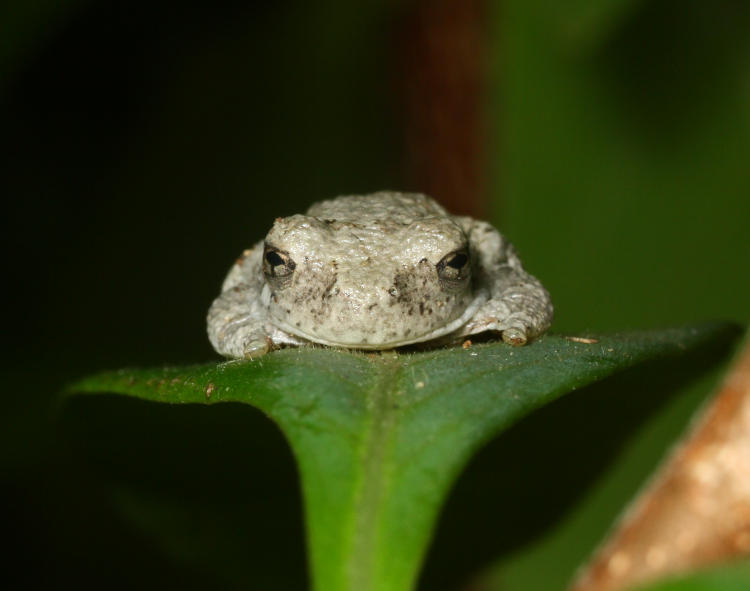
The ‘main’ Japanese maple out front (we have, what, five of them now?) is simply exploding into foliage this spring, and just after the rains that greatly reduced the pine pollen inundation, this juvenile green treefrog (Hyla cinerea) reluctantly posed for a portrait.

And one that’s a tad embarrassing.

piebald rock dove common pigeon Columba livia atop shed at Walkabout Estates
Just yesterday, I found this rock dove (Columba livia) perched atop the shed right here at Walkabout Estates. The coloration is impressive enough, but also, there are practically no rock doves (virtually always just called ‘pigeons’) in the area anyway, so we suspected it was domesticated. I tried to get a clear view of the legs to see if there was a band, but it flew off at my approach. The embarrassing part is, I was already thinking that this slow, high-visibility bird hanging around was going to entice the bird-eating accipiters that are in the area, and as the dove flew off, The Girlfriend saw a hawk fly from an observation point nearby and pause on a branch almost directly over my head before darting away; I saw nothing. I mean, they can be very hard to spot in the heavily-wooded environs, so I likely would have missed it anyway, but even while thinking of the hawks I never bothered to even look, and missed the one that was ridiculously close. Ah well. Hindsight (and this post) is 20/20.

1 123 124 125 126 127 327