Big honkin’ bird post

It’s been a few days since I got these, delayed partially by being busy (I keep saying that, and we’re close to finding out why) and partially because I knew it would take a while to write up the post. And I’m going to do things out of order because it’s better that way, maybe.

Once again, Jordan lake, but before the trip down to catch the ISS transiting the moon, which it never did. Well, I’m sure it did, if you were in the right spot, and we weren’t. And once again with Buggato too. One small section of woods was incredibly busy with bird life, noticeable only if you listened carefully and paid close attention, since most of it was from the smaller species.
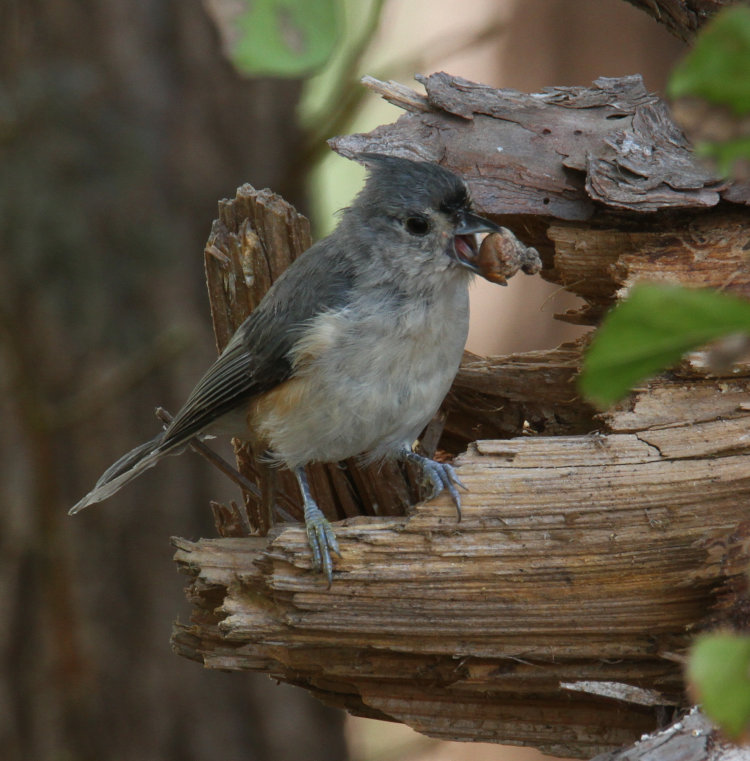
tufted titmouse Baeolophus bicolor with acorn almost too large to handle
I wasn’t sure whether this tufted titmouse (Baeolophus bicolor) found this acorn in the end of a broken trunk, or brought it there, but it juggled the nut for no small amount of time in the apparent effort to lodge it securely enough to crack, which we never witnessed. If you’ve ever heard titmouses, they’re quite talkative, but not loudly, and a few of them were chattering away as this was going on.

Close by, a pair of downy woodpeckers (Dryobates pubescens) made an appearance, virtually silent except for very quite drilling.
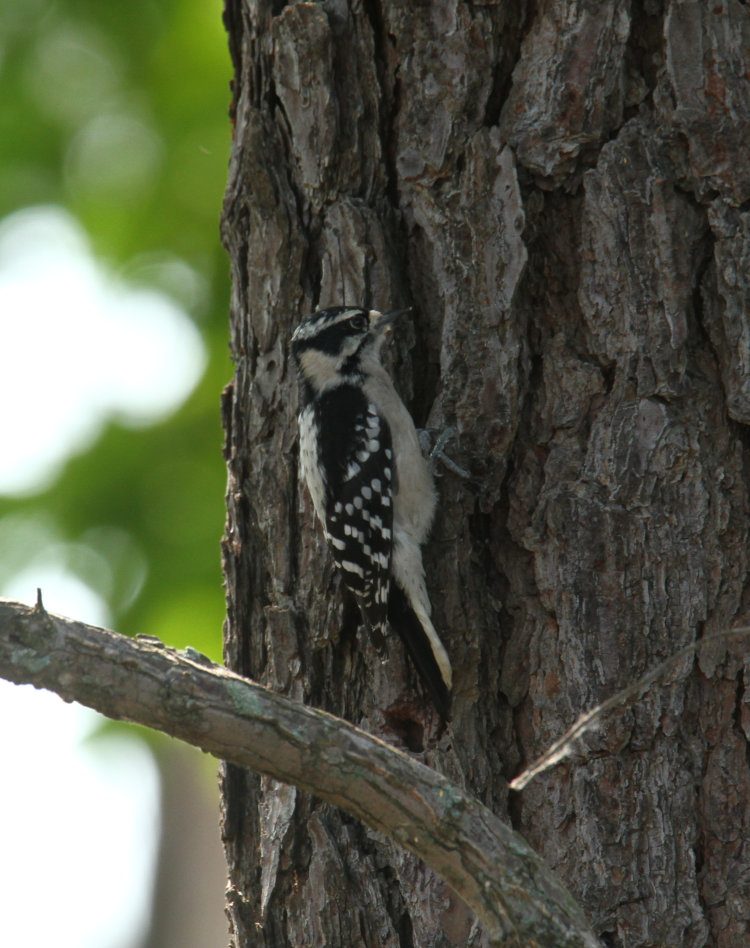
female downy woodpecker Dryobates pubescens on pine trunk
Differentiated from the hairy woodpecker by their smaller size and shorter bill, it’s extremely easy to mistake one for the other, but I’ve only ever found the downy around here anyway. This female worked her way up a trunk subtly, spotted only when she flew over to it in the first place because those markings helped her blend in against the rough pine bark. After a minute or so, however, she was chased off by a male, for reasons unknown.
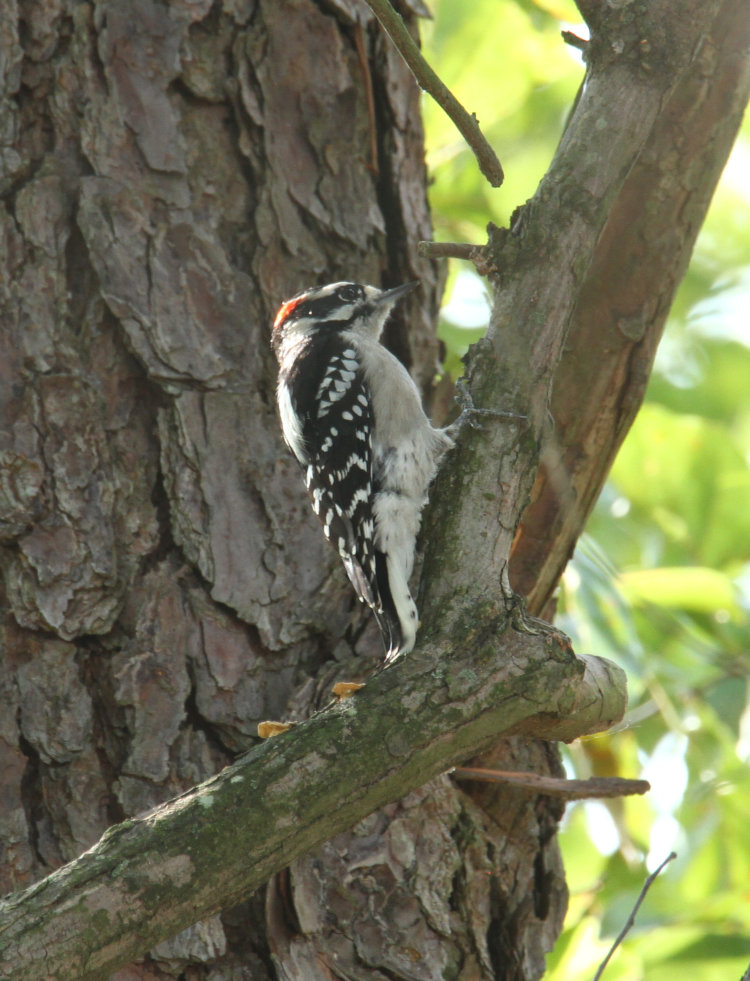
male downy woodpecker Dryobates pubescens on same tree
Key part here of course is the red MPB fringe, and with the sun largely behind the tree, this was the best lighting that we got (which woodpeckers also seem to exploit more often than not.) We worked our way around to the sunlit side of the copse of trees, and then of course few birds chose to show themselves. The American crows (Corvus brachyrhynchos) aren’t shy, however.
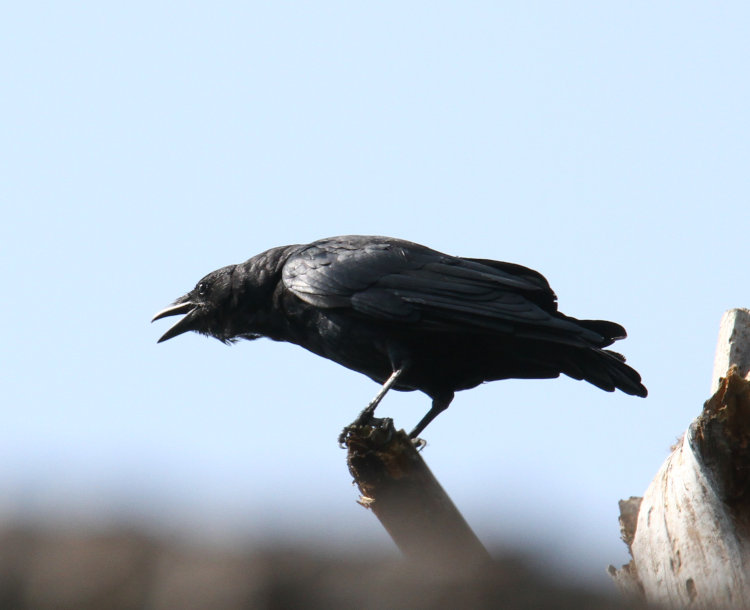
American crow Corvus brachyrhynchos sounding off from atop broken trunk
Perched in perhaps the most obvious spot in the whole woods, this one was calling enthusiastically, but not alarm calls – it simply seemed to be territorial, and this was bolstered by it taking over this spot from a red-headed woodpecker. The light angle worked for its jet-black plumage though.

Nearby, a green heron (Butorides virescens) was being shy and waiting for us to leave.
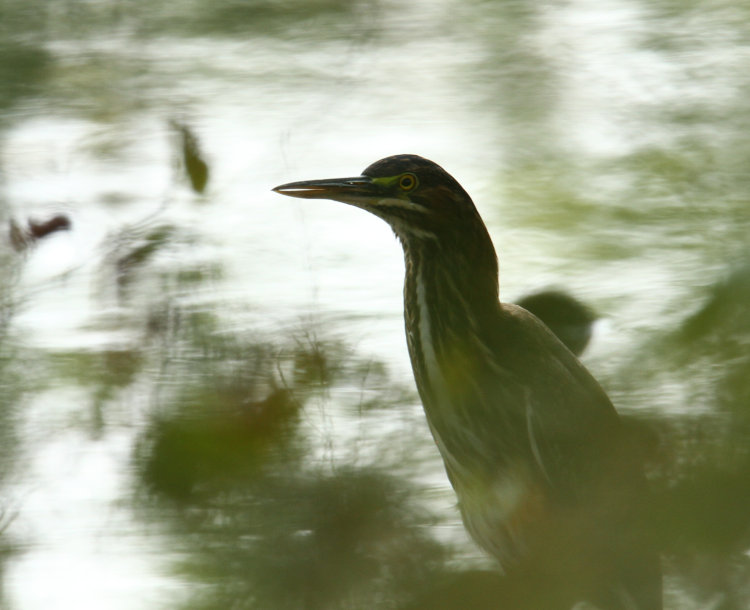
green heron Butorides virescens hiding in shadows on edge of water
Small and unobtrusive (for herons, anyway,) the greens can be hard to spot and even harder to get clear photos of; this one was giving us a run for the money, unwilling to leave its prime hunting spot but not happy with our presence. It did a lot of slinking around on the water’s edge.
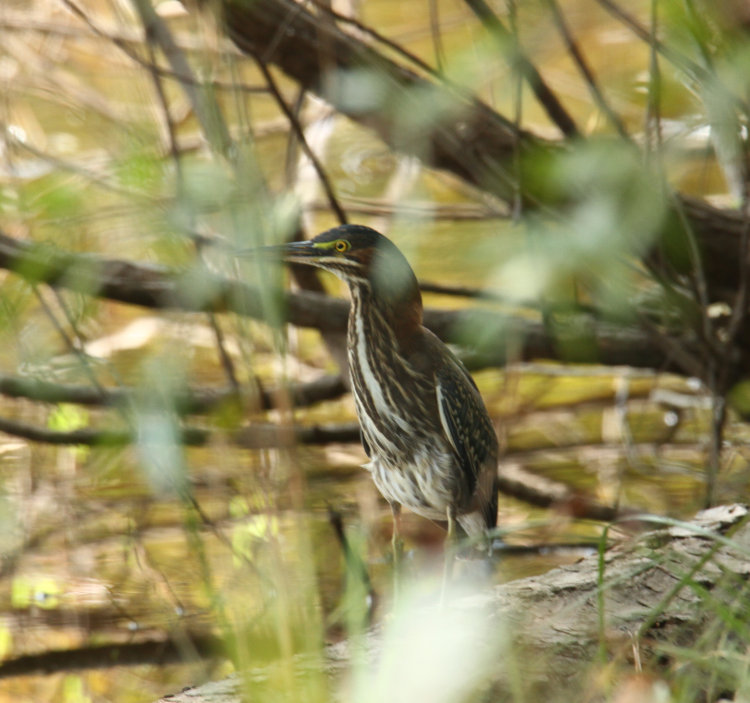
green heron Butorides virescens seen through foliage
These were all shot with the longer lens and a lot of careful sidestepping to try and get a clear shot through the undergrowth, but eventually it moved just a little ways further on where we could maneuver for a cleared shot.
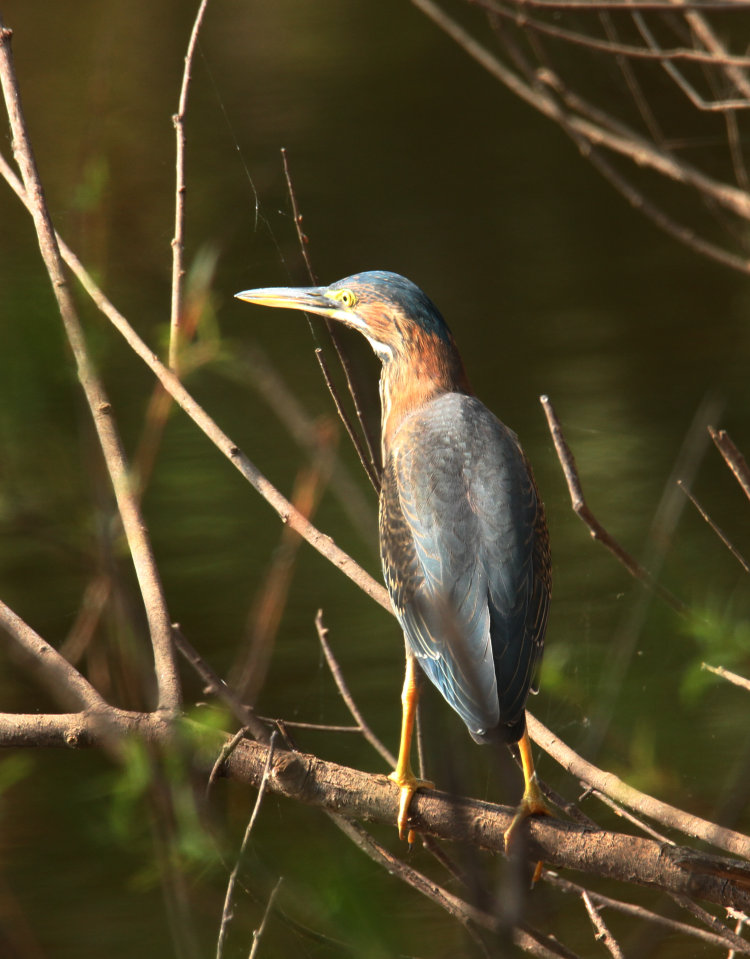
grene heron Butorides virescens finally catching some sunlight
A little bit of a pose in the sunlight, and that was it. The great blue herons (Ardea herodias herodias) were a bit more cooperative.
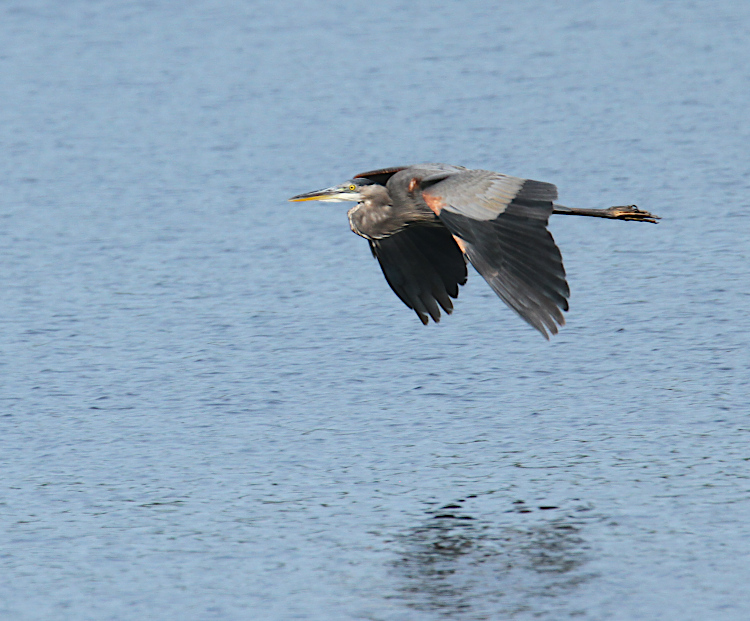
great blue heron Ardea herodias herodias cruising low over the water in decent light
This was one of a pair that were fishing along the lakeshore but refused to let us get too close, though at least it flew past in good later afternoon light. At another location, the subject there was more cooperative but there was no way to get better lighting on it:
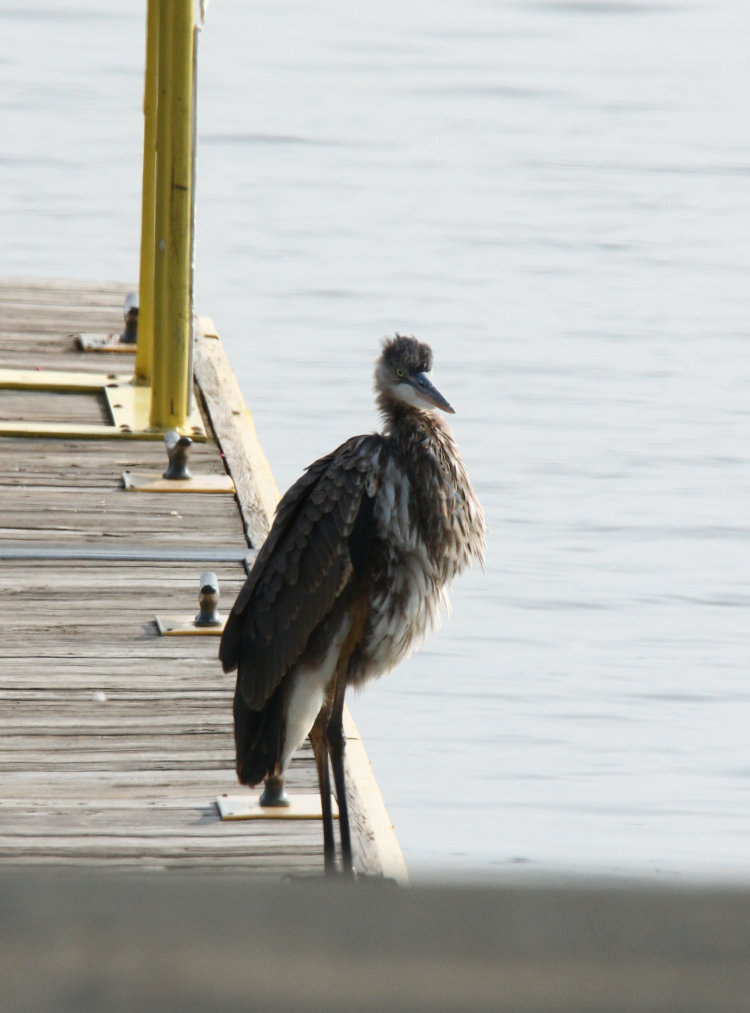
juvenile great blue heron Ardea herodias herodias preening on dock
The barred/speckled markings on the throat and chest, as well as the overall more brownish hue, pegs this as a juvenile, this year’s brood. It was quite complacent in its spot on the docks, and even let a boat approach to within eight meters or so before it decided that was too close.
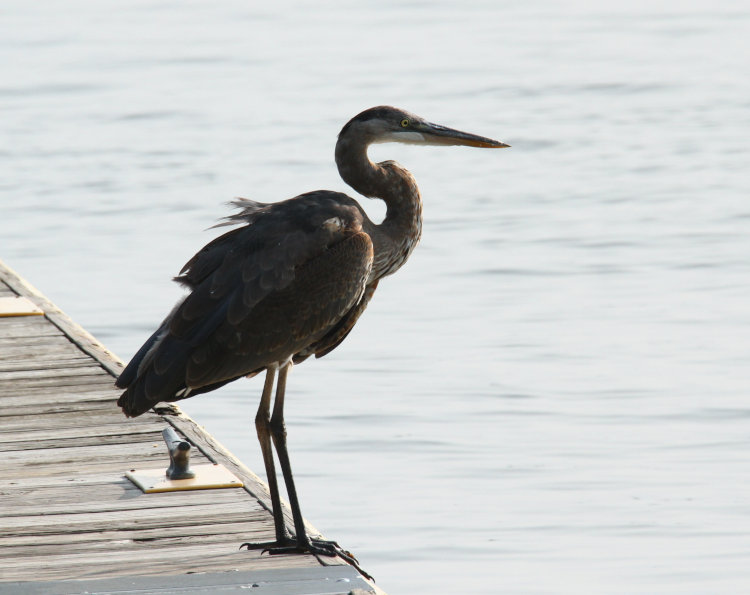
juvenile great blue heron Ardea herodias herodias not quite finished with its grooming task
Typical adolescent: done grooming but missed a spot. This was closing in on sunset but without any kind of decent sunset colors. Am I surprised?

Actually, I was slightly surprised by this one, ninety degrees away anti-sunward at the same time:
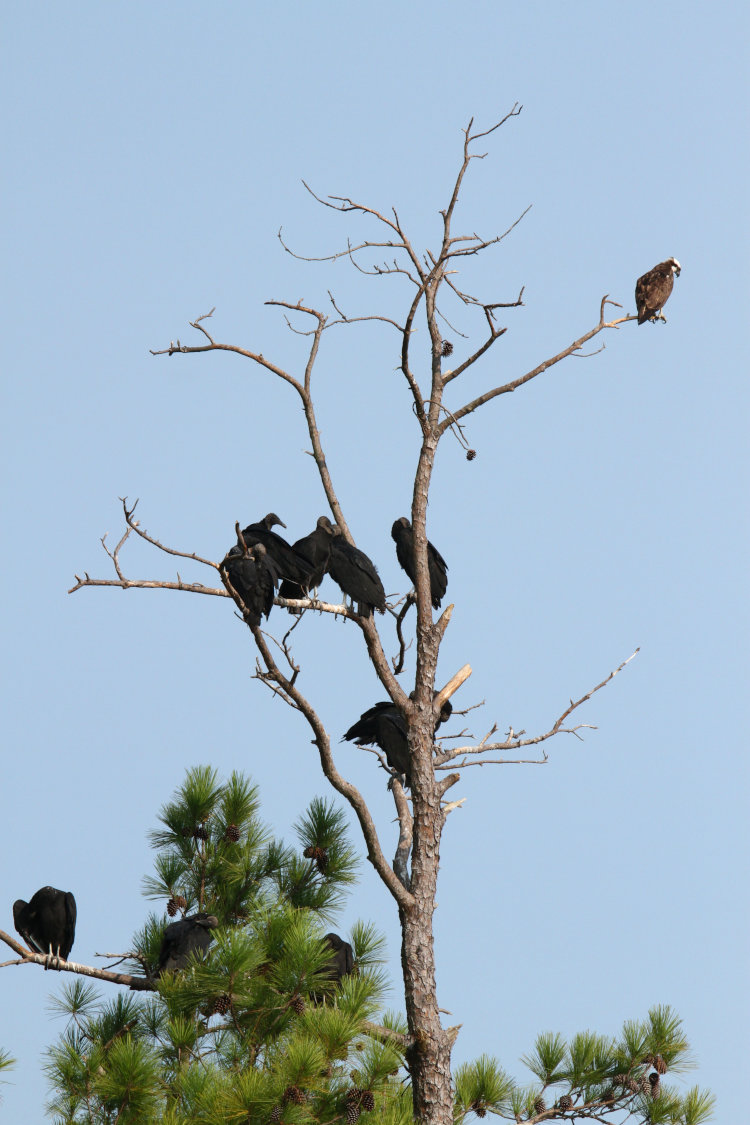
lone osprey Pandion haliaetus sitting in tree among flock of black vultures Coragyps atratus
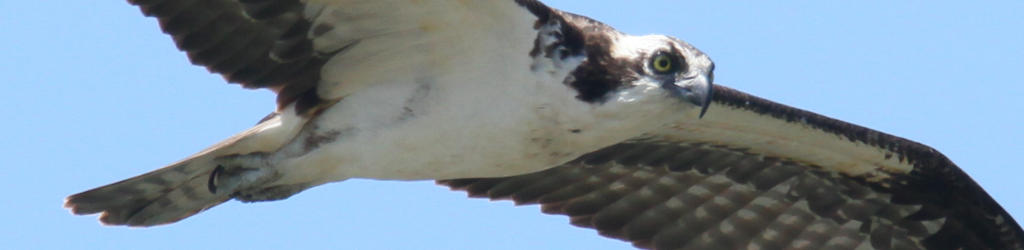
That’s a single osprey (Pandion haliaetus) up there to the right, hanging out with an entire flock of black vultures (Coragyps atratus.) There’s no animosity nor prey competition between these two species, but osprey tend to be solitary birds and this is the first I’ve seen one perching among other species, or even a flock of its own. I mean, sure it’s way out there away from everyone like the kid with the eight-crayon box, but at least it’s in the same tree. And you have to admit the body positions all give the same cliquish impression.

Further on, I heard a belted kingfisher (Megaceryle alcyon) chattering as it came closer, and I tracked it carefully when it came into view. The species is notoriously shy and my attempts to creep closer to its perching spot didn’t net any decent frames, foliage always getting in the way, and the bird flew off while I was attempting to subtly slip past this; so much for my stalking. But it took a perch twice as far away on top of an old snag, and I could get a few frames there:
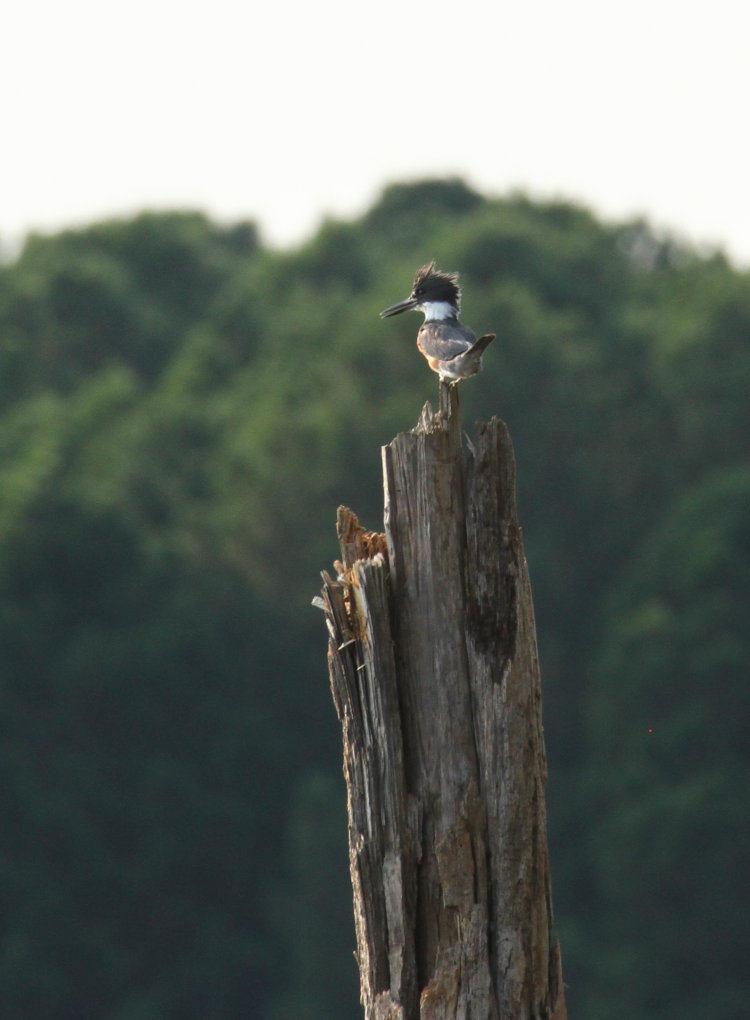
female belted kingfisher Megaceryle alcyon perched on old snag
You can’t make out the brown neck band that denotes this as a female, but it’s there in the other semi-obscured attempts, so take my word for it. The raised crest feathers are very typical of the species, always seeming upset about something – now I have to snag a photo of one with the crest down. But at least I could manage an angle without the bright sky directly behind the bird bleaching out the edges (or forcing the exposure much lower.) Tiny victories.

How about another vulture? (he asks, plowing ahead without waiting for an answer…)
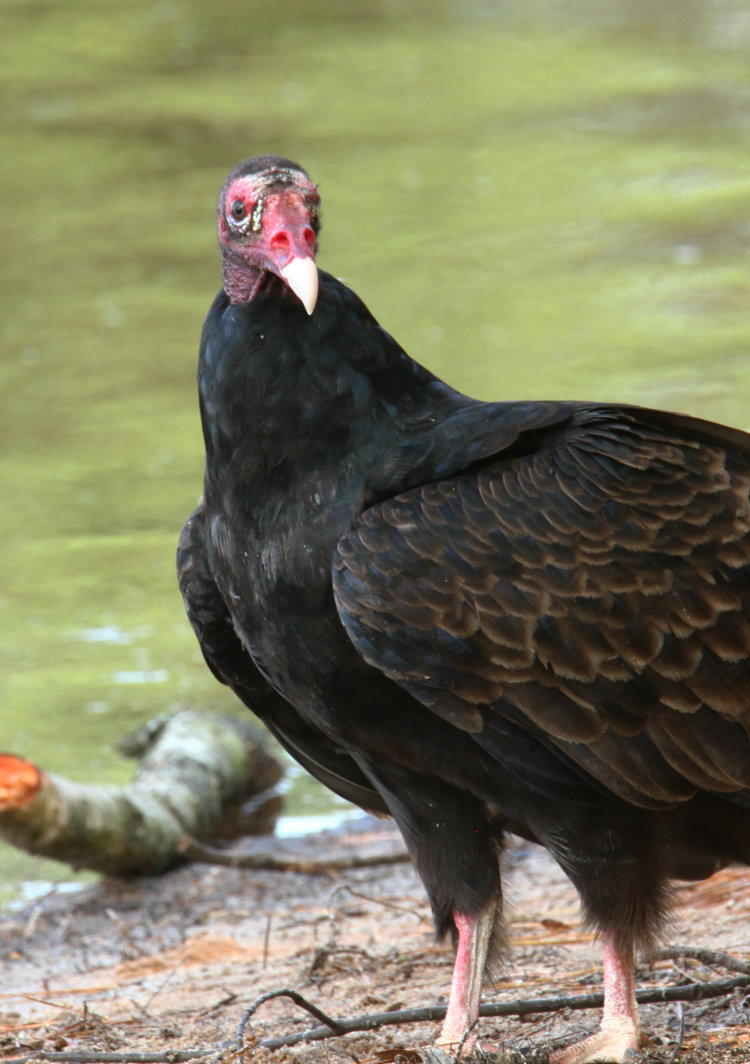
turkey vulture Cathartes aura standing on beach staring into camera
This one came cruising in for a landing as we stood there, and we endeavored to remain quiet for the portrait – look at them nostrils. It’ll it least distract you from the rest of the head – which, because it’s bare of feathers, seems tiny in comparison to the body, but having handled many birds, I can tell you that the body feels scrawny too and matches the head in appropriate proportions. Owls are the most startling; they seem to have no neck at all, going from shoulder to head dome. but then you reach in to secure the head against tearing into you (this is from wildlife rehab, so chill,) and you find this measly little thing buried in the feathers between head and shoulders that isn’t much bigger than your thumb. It’s disturbing.

But now let’s get to the real captures of the day, which actually occurred very early on. It was a quiet day and as we worked our way along the lakeshore, I suggested keeping an eye on the bordering trees, especially high up, because I suspected there might be some raptors perching there and it would be better to see them before they spooked. But then, not twenty meters away, I hear something crashing down through the pine needles, heavier than a pine cone, and suspected that it had been dislodged up above – I was expecting a squirrel or something. Yet the shape that was revealed told me that my intentions and abilities were not in alignment, because we were far closer to this guy than it should have allowed.
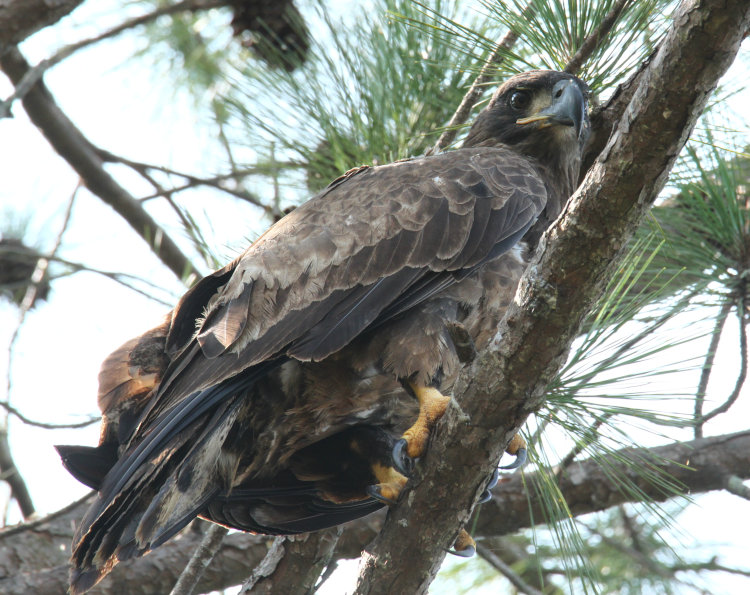
second-year bald eagle Haliaeetus leucocephalus perched high in pine tree
That’s the juvenile plumage of a second-year bald eagle, and it was roughly ten meters above our heads in the pine tree. We fired off tons of frames as we crept closer, knowing that at any time it would decide we were too close and fly away – which it did not do. The potential explanation for this was forthcoming.
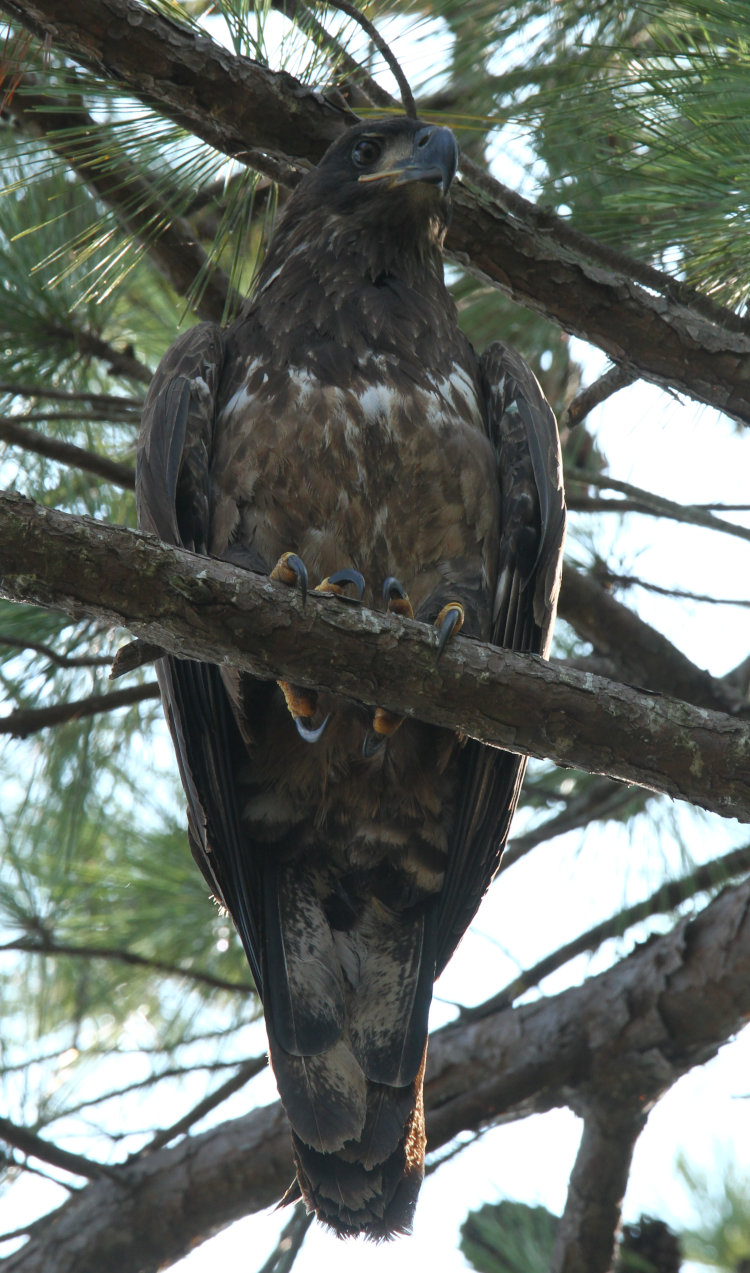
second-year bald eagle Haliaeetus leucocephalus giving regal pose in pine tree
While I was in a bad position – not this one – the eagle vomited something up, and then again a minute or so later, which I missed because the pine needles that were intervening at that point grabbed the autofocus away from the eagle itself. It was likely this that I’d heard crashing down through the pine needles, though a subsequent examination under the tree only turned up half of a minnow and a medium-sized patch of fish skin. There was what appeared to be a fresh-ish persimmon nearby, which eagles don’t eat – had it consumed this by accident and was trying to get rid of it? I can’t say. Meanwhile, the eagle regarded us without alarm.
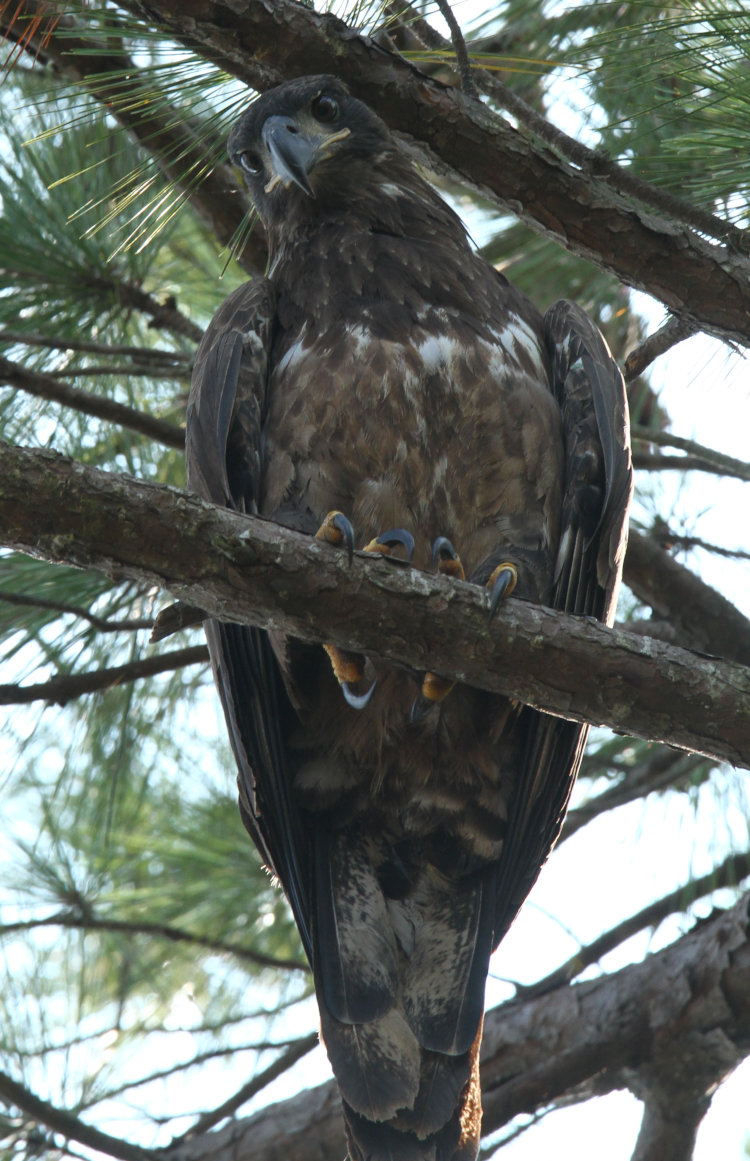
second-year bald eagle Haliaeetus leucocephalus wondering just what the photographer below is up to
What a great pose, and to our credit, we were remaining silent and casual, not alerting the bird with predatory fixation behavior, though as high up as it was, it likely wasn’t very concerned. But we’d gotten right underneath the eagle and it simply watched us curiously so, great opportunity.

Off in the distance, another was wheeling out over the lake, and we fired off some frames of that one too.
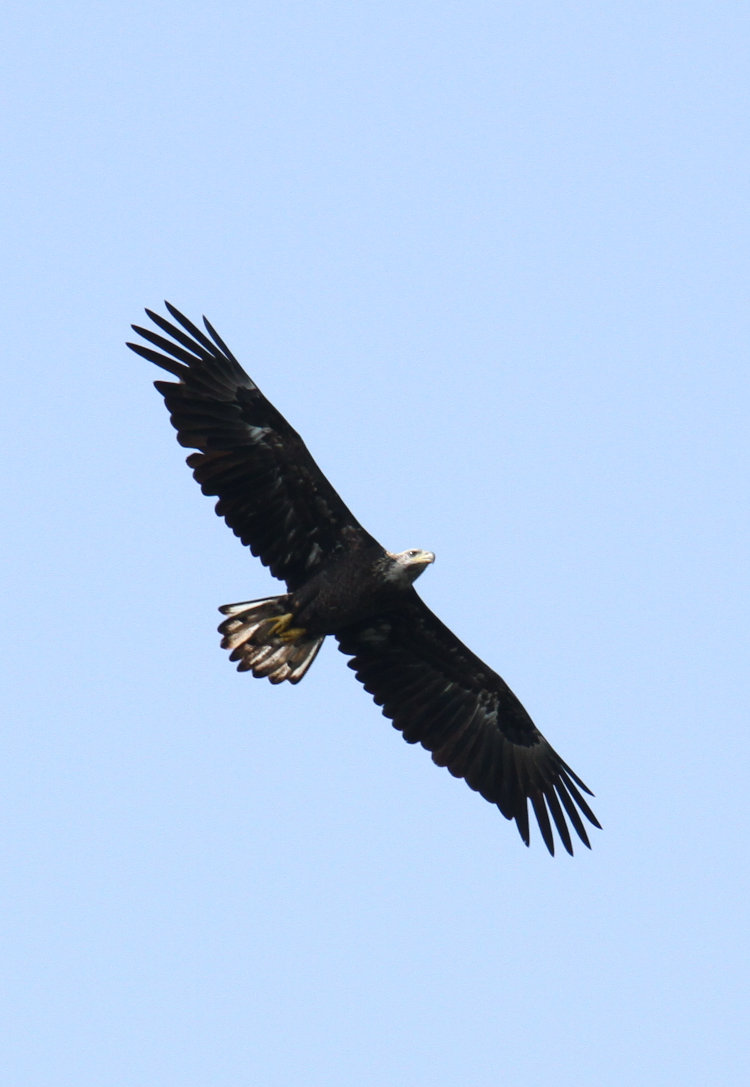
third-year bald eagle Haliaeetus leucocephalus circling in distance
This is a third-year juvenile instead, so not a sibling – or at least, not an immediate sibling. Nonetheless, while we were watching this one and further away than we had been, the second-year one overhead took flight and headed in this direction. They never drew close together or exhibited any kind of territorial behavior, so the reasoning behind this was lost to us, but at the same time the apparently ill specimen was showing no signs of distress.
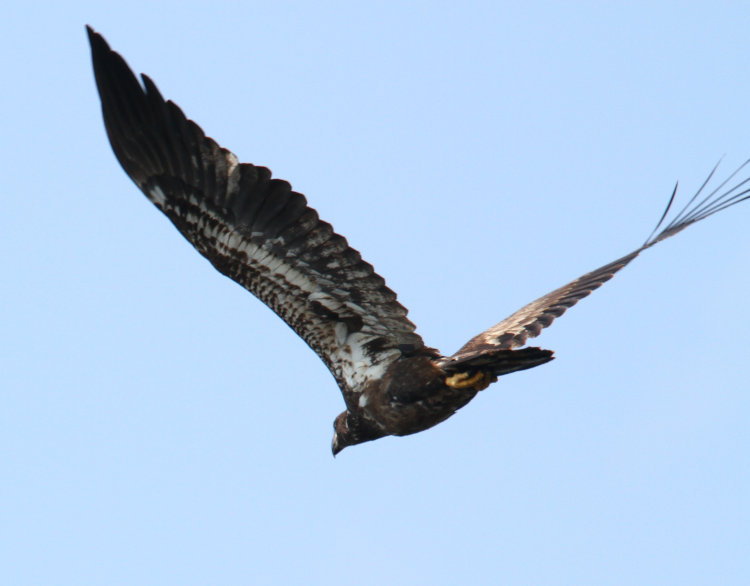
second-year bald eagle Haliaeetus leucocephalus flying off without apparent concern
Getting even more frames as it flew off allowed me to compare the markings, especially under the wings, with photos from previous outings to the same location in an attempt to see if we’d photographed this one before. Answer: not to any appearances – the markings all have distinctive differences. So how many eagles are actually hanging out in the area? It might take a lot of long-distance photography and cataloging plumage variations to determine, and this can only be done between molts, since that act alone can change the appearance.

Anyway, you can see why I left these for the end, even though they were close to the beginning of the outing. Far more luck than we’ve had on many days out there, but that’s why you keep returning.
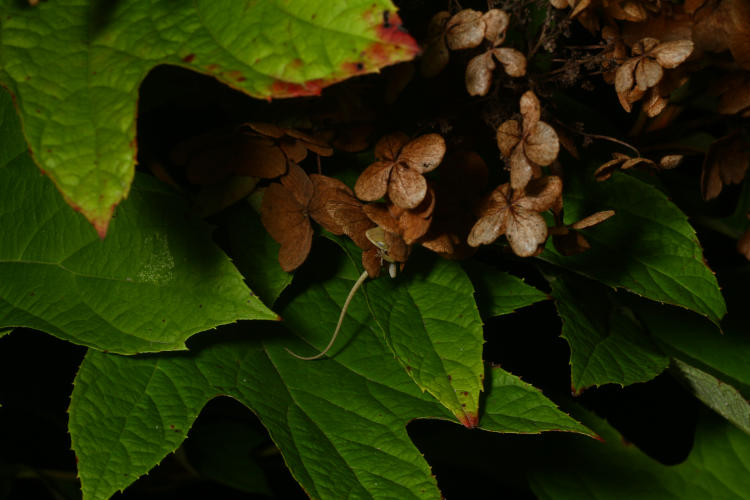
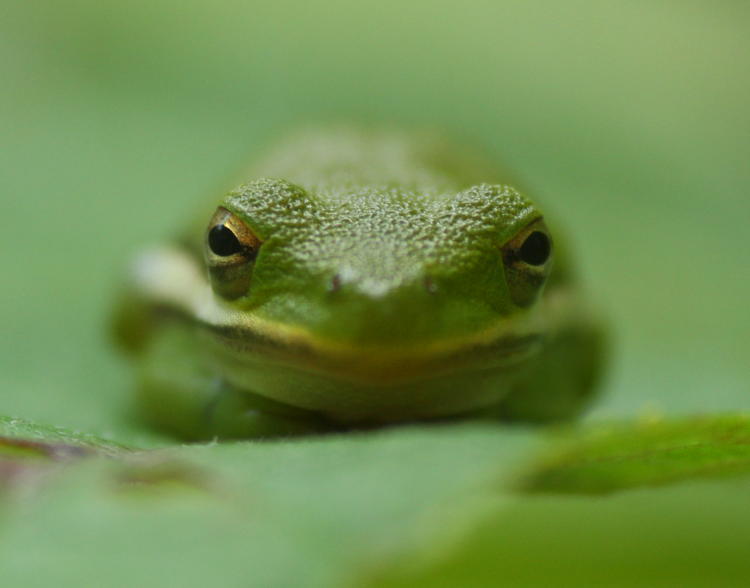
But they’re cute

Yeah, back in a rut – or I never left, whatever you like. But these finds from last night couldn’t be passed up.

I semi-routinely check out the property, day and night, to see what can be found, mark progress, and so on. I’d like to think that I’m getting even better at spotting extremely subtle things, but there’s no real way to determine this, no ‘master list’ of what there is to be spotted. I just know what I do find, which might only be 2% of what could be seen if I didn’t suck. Man, empiricism isn’t good for the ego…

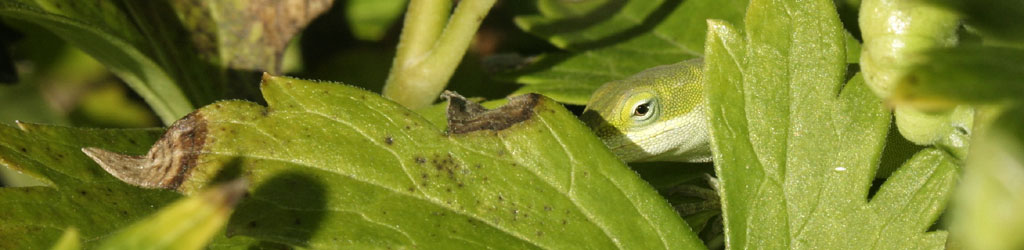
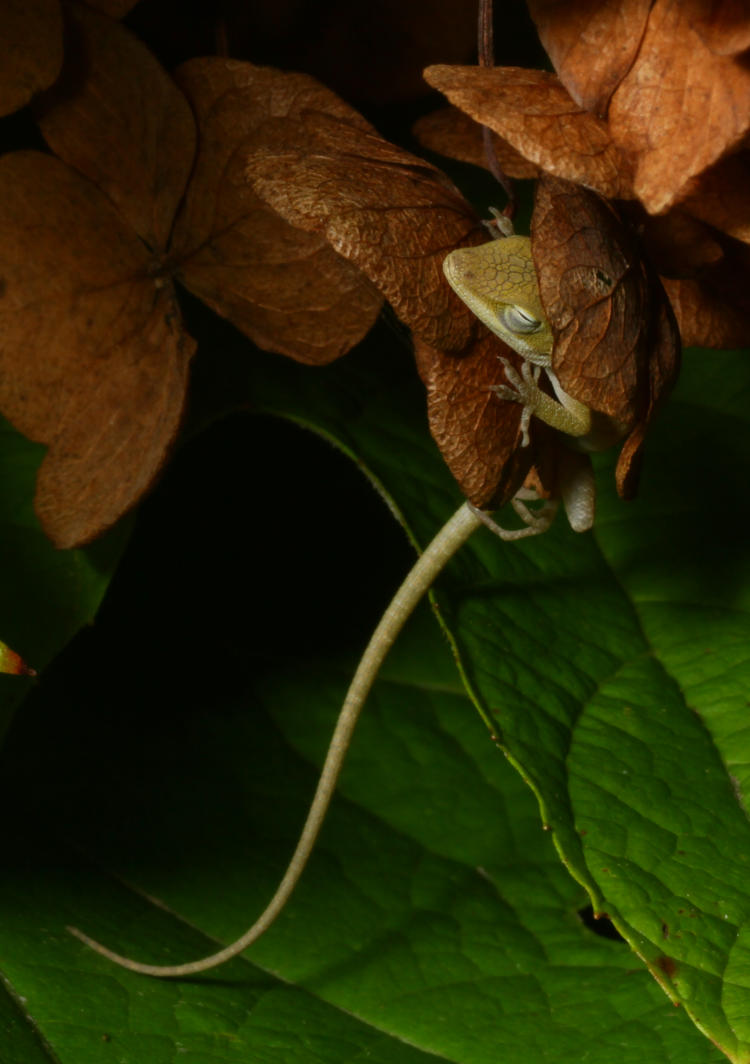
tail of Carolina anole Anolis carolinensis hanging down from dried flowers of oak-leaf hydrangea Hydrangea quercifolia
The oak-leaf hydrangea (Hydrangea quercifolia) in The Jungle has been a good place to spot things this year, though not every time I’ve checked (see above.) The flowers from this past spring are still there, dried and brown now, and may hang on through the winter, providing a nice accent to the overall appearance as well as hiding places for various small critters – that tail hanging down is the clue, though it’s only 3cm long. And there’s more to see, if you look very closely, but I’ll make it easier in a moment. Don’t keep scrolling if you want to challenge yourself first.

.

.

sleeping juvenile Carolina anole Anolis carolinensis within dried flowers of oak-leaf hydrangea Hydrangea quercifolia
Yep, our old friend the Carolina anole (Anolis carolinensis) is once again sleeping within those flowers. So you know, the individual petals might be fractionally larger than your thumbnail – this is one of the juveniles, almost certainly this year’s brood. They appear to grow much slower than the frogs do, and a few days back I believe I spotted one of last year’s brood, only half of adult size. There’s no way to tell for sure, and all I can go on to differentiate them is their locale, which may change at any time when they decide to move on. I suppose I could sneak up some night and attempt to give them a tiny tattoo…

By the way, you can tell this is a juvenile by the awkward sleeping position – adults of every species know if they try to sleep like this they’ll be worthless the next day.

About two meters away on the rose of Sharon (Hibiscus syriacus,) was another find.

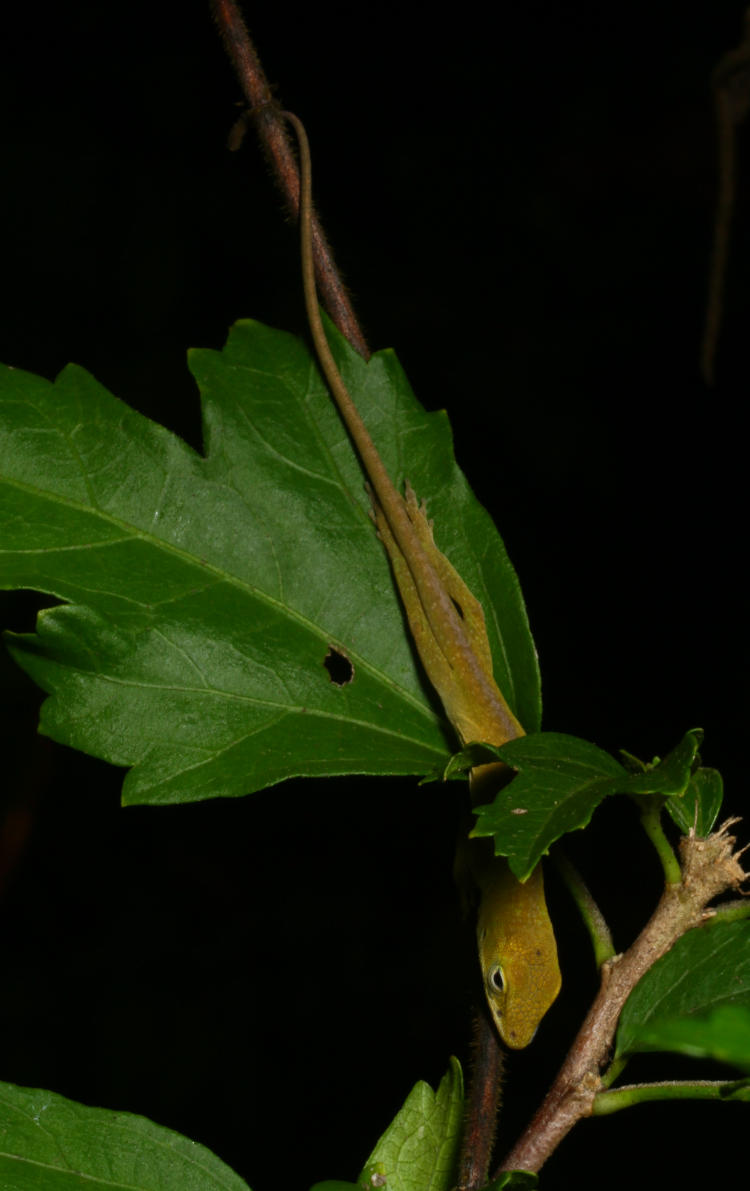
juvenile Carolina anole Anolis carolinensis hanging awkwardly from rose of Sharon Hibiscus syriacus
This one probably heard my attempt to get closer up the overgrown slope of The Jungle, through the ivy and blackberry iris and various unwanted vines, thus the open eye. It didn’t budge from position, though – and it is this position, shot perfectly upright and level, so the anole really is hanging head down like that. I’m not at all sure how it’s remaining that way, since neither the hind legs nor the tail seem to be latched onto anything, so perhaps it just licked its own belly and stuck itself to the leaf? Maybe this is a very localized example of those gravity anomalies? Maybe… nah, let’s not be indelicate.

The other day when I didn’t have the camera in hand (the horror!) I viewed some behavior that I’m dying to get on video, and it was almost certainly displayed by one of these two, given that it was on the top of the same hydrangea roughly midway between these two photos. I’ve already done a few short video clips, nothing fascinating, but I intend to catch more behavior before the season ends and these spuds go into hibernation. The problem is, there’s no way to get a decent view without them being acutely aware of my presence, which likely affects their behavior – it could be a while. Still, it’s been a good year for video efforts, so we’ll see.

Per the ancient lore, part 27

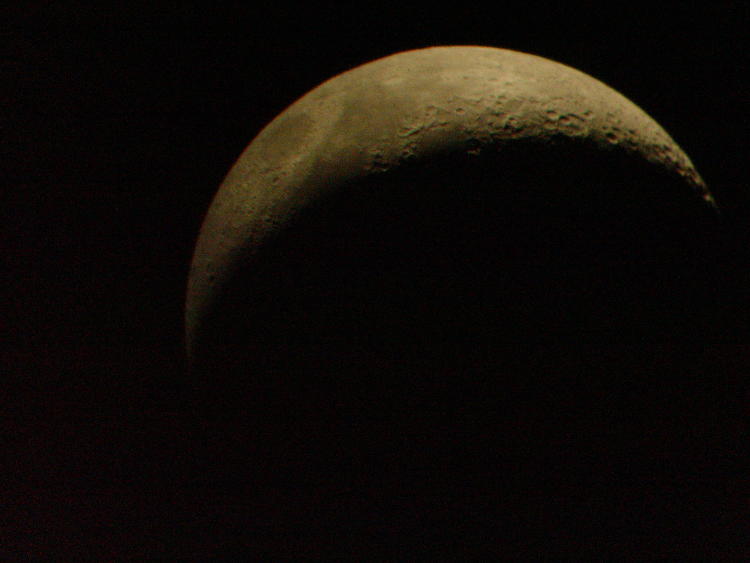
grainy and ratty moon image shot through homemade telescope adapter
We be in the Space folder now, looking through squinted eyes (or at least I am) at a not-very-good photo of the moon taken through a telescope, but I include it because it’s one of the first that I took. A friend loaned me her 800mm Galilean telescope, a novice-level entry for reflector scopes, and I had endeavored to create a rig that would allow the camera to be mounted. This was the first result, which largely illustrates that it wasn’t worth the effort, but there are a lot of modifiers to be considered.

Let’s start with, the exposure time for a crescent moon is considerably longer than for a full moon, because it’s much dimmer. Seems kind of obvious, but then, you might pause and say, “Hold on there – the moon is still lit by full sunlight, so even though there’s less of it showing, it’s the same brightness, right?” Except it’s not, because the light is now hitting it obliquely and there’s far less of it reflected down towards us, while a full moon is much more of a direct reflection. And as the exposure time lengthens, so does the blur from the motion, because the Earth continues to rotate and so the moon continues to track across the sky – more or less, its own width in 180 seconds. Unless one is using a tracking motor (which this scope did not provide,) the shutter speed has to be fast enough to prevent much motion during the exposure and keep the details sharp. In this case, that meant ISO 800, which the Sony F717 did not handle well.

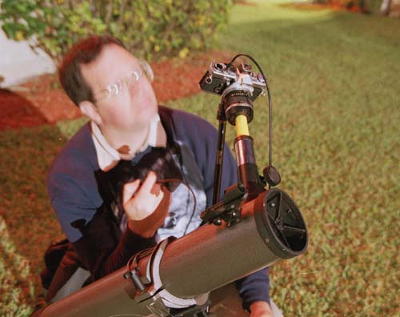
The author not holding still during a long exposureThen there’s light attenuation because of not just the scope itself, but whatever adapter is necessary to affix a camera. Consumer telescopes of nearly all types only have to provide an image through our tiny little eyes and are optimized for such, both in focal length and in ‘exit pupil,’ the actual size of the projected image at focus. Naturally, a 35mm film frame (which is what I originally adapted for) is a lot larger than our pupils or retinas, but it’s the same amount of light coming through the eyepiece of the scope, so it has to be spread out more to cover that frame, thus the whole image gets a lot darker. To that we add focal distance, because telescopes are optimized for the lenses of our eyes and the ‘effective’ focus of them to a couple of meters away for comfort (meaning when we focus on an image in a telescope or binoculars, we’re focusing the same as we would for an object a few meters away,) while the camera is going to be different. All of this usually means extra tubes from the eyepiece and often additional lenses too, see here in my homemade rig: the yellow tube is an old metal broomhandle the right size to lock into the eyepiece extension of the scope, glued to a rear lens cap with a hole precisely drilled into it, which it itself attached to a reversed 35mm lens, attached to the camera with a reversing ring. All of that reduces the light getting to the image.

Hold on, we’re not done yet! The Sony F-717 used in the image at top had a fixed lens that had to be accommodated, so it needed a different lens attachment – a reversed 50mm if I remember right, and a certain focal length on the camera itself. Very involved. This ended up vignetting the frame, projecting an image circle smaller than the digital sensor itself, so the edges were always dark. You don’t notice it in the top image, but can see it in the one below – which had better light and came out much nicer.

gibbous moon through telescope on morning of Venus transit
By the way, this shot was taken the morning of the first Venus transit in the past century – two occur eight years apart, followed by a gap of over a hundred years. The one in 2004 was going to be visible from Florida right at sunrise, and the dim light at sunrise (due to atmospheric scatter) could potentially allow a direct sun shot without filtration, and I was ready with the scope. Unsurprisingly, the sun was obscured by a cloud on the horizon during the transit, so I shot the moon while I was out there. Eight years later, soured by this experience and knowing the transit would occur in mid-afternoon, I wasn’t intending to get any shots at all and got extremely lucky with the conditions. You never know…

[The rig shot in the middle of the post is a self-portrait – yes, there’s too many pics of me recently, I do apologize – mostly lit by the nearly-full moon but with supplemental light from the apartment complex. I couldn’t hold completely still during the exposure time necessary, but don’t ask me what that was because it was on negative film and I never recorded the details. The camera on the scope was an Olympus OM-1, handy for this because of a manually-locking mirror, while this was taken with my trusty Canon Elan IIe. Both cameras required remote releases: the long cable release of the Olympus is visible, while the infra-red RC-1 for the Canon is out of the frame in my other hand.]

Podcast: Out at sunrise

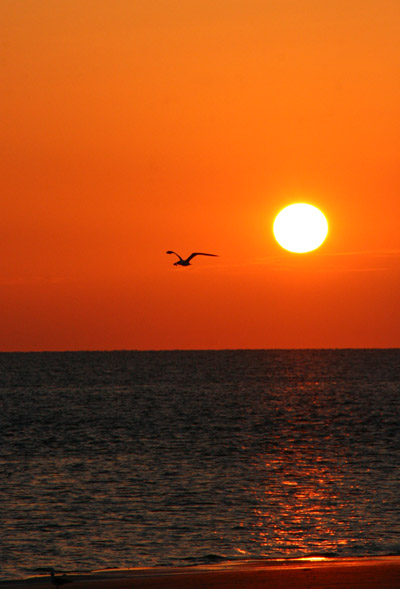
daybreak colors on Driftwood Beach, Jekyll Island, Georgia
And so we come to part two of the Georgia trip, waking up early on Jekyll Island. I’ve been planning this one since the last trip, three years ago. So sit back and get comfy while I take you directly out there.

Walkabout podcast – Out at sunrise

This Google Earth placemark will take you right to the shooting locale of my images here (provided you have Google Earth installed on your system.) While this one will take you all the way down to Negritos, Ecuador, and a lighthouse at the westernmost point of South America which is, nevertheless, still east of Jekyll Island.

driftwood and sun composition right at daybreak, Driftwood Beach, Jekyll Island, GeorgiaI’ve mentioned this before but will say it again: for sunrise and sunset shots, bracketing the exposure heavily is highly recommended, and by this I mean, taking several frames both over and under exposed from what the camera’s exposure meter is reading; this page may help you to understand it better. The sky colors may appear significantly different depending on the exposure, and you will likely find that the best results come from a setting other than what the exposure meter would produce by itself. And, as I stress in the podcast, your white balance should be set only to Daylight.

Most of the trunks on this beach sit just within the high tide line, so being there after the tide receded, and before anyone had any chance to introduce their own footprints, meant the beach was smooth and clean, much more pleasing to the eye for compositions like this. And this means that it’s fairly important to plan out your images before you put your own footprints into the shot (this is, unsurprisingly, much more important with things like snow.) This day, the sand was still slightly damp, not having been dried by the sun yet, and going barefoot meant that I was even less likely to leave behind noticeable footprints; what I did leave, when they were noticeable at all, looked a lot more appropriate to such scenes than the sandal prints. Just a little forethought.

Locations and conditions like this provide a lot of options for compositions, and it’s easy to frame dozens of different approaches in the space of a few minutes. Be warned, though, that the colors change faster than you might imagine, so you may still have to be on your toes when the sky produces something really dramatic. If you’ve waited until you see the conditions in the opening photo before finding a good foreground, for instance, you’re probably going to miss the shot. Be ready ahead of time, have all the camera settings where you want them (including contrast and saturation,) and know how to change them quickly if you decide that the shots will benefit from higher saturation or a lower ISO. And a tripod isn’t a bad idea.

newly risen sun behind driftwood stand, Driftwood Beach, Jekyll Island, Georgia
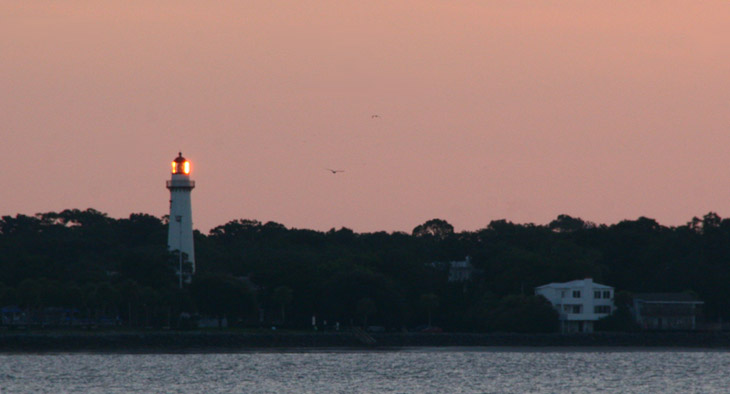
As I looked out across the sound, the light at St Simon’s lighthouse had been extinguished, but the glass panels surrounding it were still positioned right to produce sharp reflections from the low sun.

sunrise reflections off of St Simon's lighthouse, St. Simon's Island, Georgia
I would have liked the birds in the shot to be a little more prominent, but ya take whatcha get, and the background sky was a nicely moody hue. I was a little too west of the lighthouse to catch any of the sunlight colors on the tower itself but, you know, there’s always next time.

I mention how good this time of day is for portraiture, and I present to you an example, a self-portrait taken without the use of a smutphone or selfie-stick, just a timer. I was the only one around, so that’s who I had to work with, but even that wasn’t quite enough to ruin the shot. Note the color cast visible on everything that the sun was shining upon. And yes, I detoured well to the side to keep footprints out of the foreground, approaching from behind my sitting position. Forethought.

Photographer's self-portrait at sunrise, Driftwood Beach, Jekyll Island, Georgia

tern carrying crab against sunrise sky, Jekyll Island, GeorgiaI did manage to get a little more cooperation from the birds as the morning progressed, but not as many frames as I would have liked. When a bird is flapping, only certain wing positions (like this one) look good in the air, but timing the shot to catch the wings right there is next to impossible. Or at the very least, beyond my present abilities. So while I was firing off a lot of frames in the hopes of capturing more than a few with a photogenic angle, a lot fewer of them actually showed this than I thought they might. Most especially, don’t just hold the shutter down and let the frame-per-second rate of the camera do the work, since it’s entirely possible that it runs at the same rate as the flapping (or any other repetitive action) and you just get a sequence of the exact same pose. Be sure to pause, and if you have something flapping slower, try to time the shot precisely.
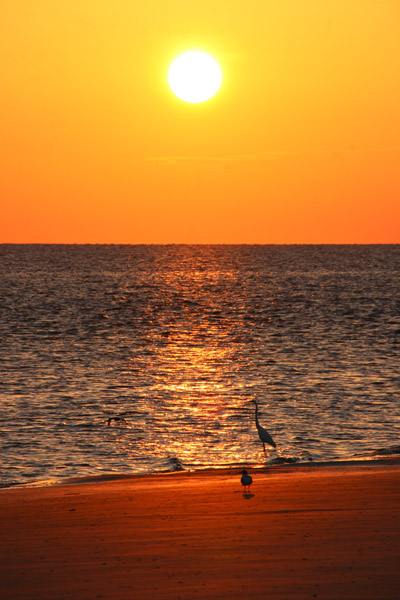
By the way, subjects like this often benefit from shooting a little wider, a shorter focal length than ‘good composition’ might dictate. The reason for this is, as the bird tracks sideways, the elements in the frame are changing, and being able to nail the bird with some leading space ahead of it, and the sun and the water and the glitter trail, even the beachline, all precisely where you want them in the frame in the fraction of a second is, to say the least, demanding. So shoot a little wider, leaving more space around everything, then crop it down to your desired effect.

great egret and tern on tide line against rising sun, Jekyll Island, GeorgiaThis image was taken only three minutes after the previous, so the conditions were not significantly lighter, but the framing was slightly different, producing a different exposure and rendition of the colors. The unfortunate part of this was the high contrast nature of the water texture, disguising the egret’s beak and almost completely hiding the one tern in the air in front of the egret (did you see it?) Naturally, I wasn’t aware of how this would look until I had unloaded the memory card at home, and by then I was a couple of days and five hundred kilometers too late to do anything about it. Notice, though, the illustration of a trait I’d mentioned in the previous podcast, the lack of any waves or breakers. This might have been the timing of the tides – you can see some faint waves from the visit three years ago – but for the most part the surf off of Jekyll appears to be pretty calm. Good for some things, but not as dramatic for photos.

small crab, possibly a marsh crab Sesarma reticulatum, feasting on chum trapped in driftwood
I’m going a bit out of order with this one, since it was shot earlier than all but the predawn image that opened the post. Shining my flashlight on a whim into a crevice within a large trunk, I found this crab feasting merrily on a fish head that had been brought in and left by the tides. Fishing boats drop a lot of chum into the water as bait just off the coast here, and lots of species take advantage of it. I’m not sure, but I suspect this is a purple marsh crab (Sesarma reticulatum.) The direct flash angle didn’t help at all, letting the complicated details all blend together too much, but there was no other way I was going to light the scene within the crevice.

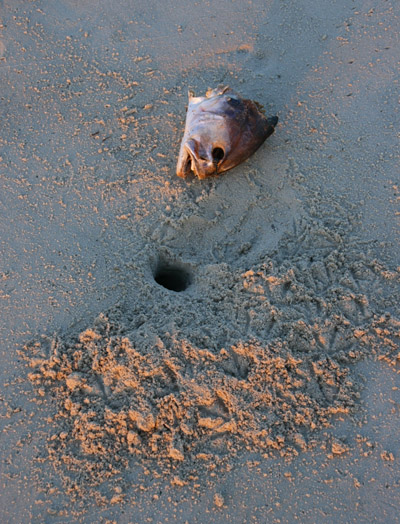
fish head on sand next to new crab burrowThis is a little bit different story. I’d initially shot this with a flash too, before the sun was up, but returned to it afterwards to take advantage of natural light, which did a vastly better job of rendering the scene. I have little doubt that the large crab who made that burrow did not just happen to find a fish head on its doorstep, but chose to make a new burrow where a lasting meal would be handy. At least until the seabirds made off with it – you can see the footprints of the first marauder in the fresh sand. Again, note the low light angle and the color cast, something that also worked well for the month-end abstract for August. If you want texture details, sidelighting is the key, and a low sun is excellent for providing that. But if you can’t use the sun, then an off-camera flash unit can do the trick too, and will usually provide a lot more angle options.

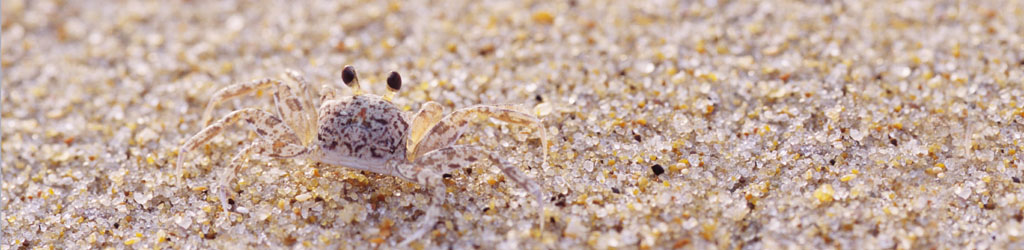
minuscule maybe marsh crab Sesarma reticulatum sporting a crown of sand grains
This is another view of the same crab seen earlier as a teaser, with a different scale aspect – those are sand grains sitting atop the carapace. I should have fired off the flash to fill in for those shadow areas left by the sunlight, but I honestly didn’t think to – I suspect I thought that the reflection from the sand would have been sufficient. Either way, I failed, and it could have been better, but for a quick shot snagged before the crab could scamper off, I’m not going to complain too much. Without the ability to corral it within a certain area, I had only a slim opportunity to even get this close before I would lose the subject. Next time, I’ll bring a shallow tray to set up a natural-looking surface and do some nice detail shots of the crabs I can capture.

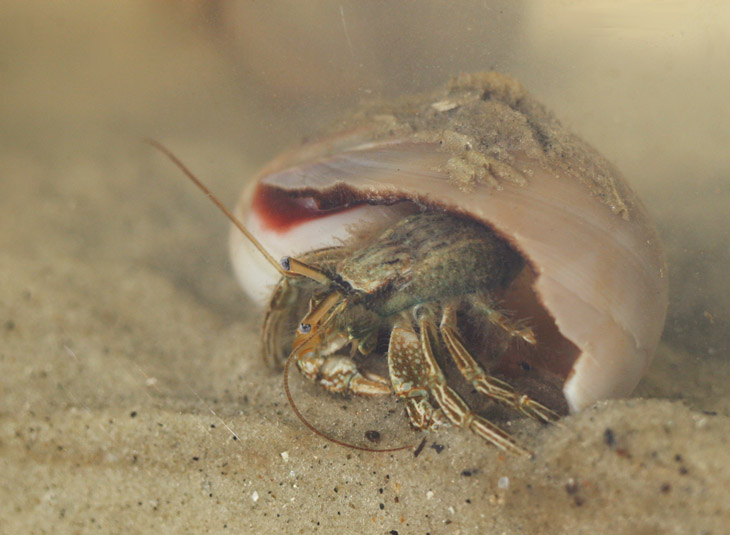
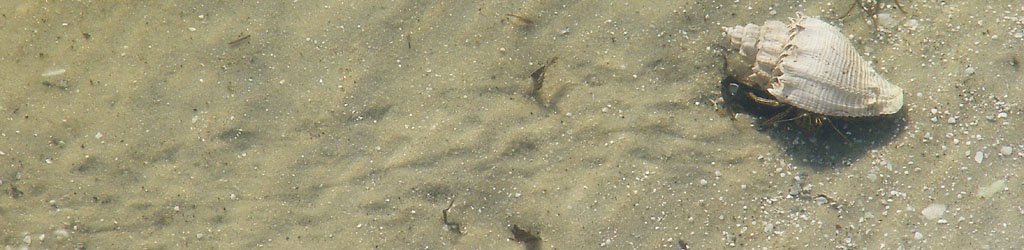
maybe thinstripe hermit crab Clibanarius vittatus ambling on seafloor, more or less
I’m going to tentatively identify this one as a thinstripe hermit crab (Clibanarius vittatus,) since it looks a lot like the ones I used to find in Florida, even though one source doesn’t peg them as appearing by the barrier islands of Georgia – feel free to correct me, anyone with good info. This is one of the ones that inadvertently rode back to the motel room in my pocket, and so got to be photographed in the macro aquarium later that morning.

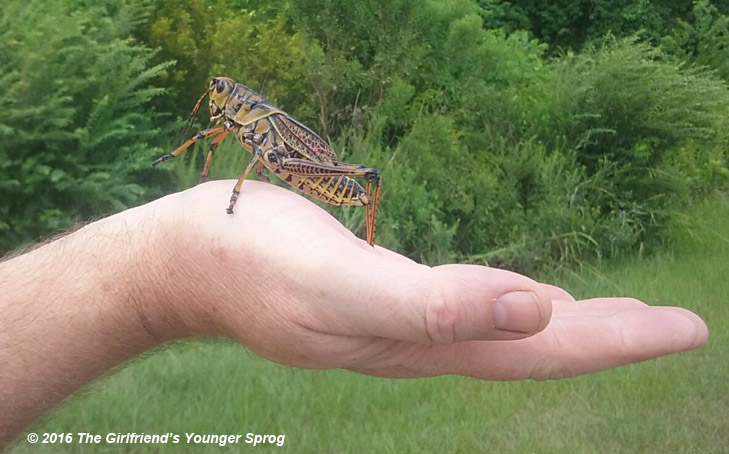
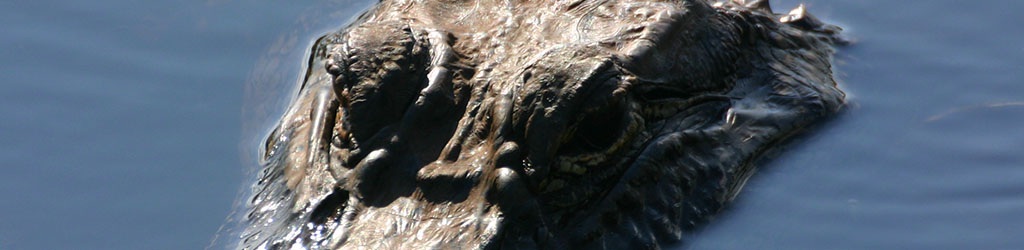
As the day wore on, we’d traveled back to the Savannah area and visited the Savannah National Wildlife Refuge (I keep calling it the Savannah River refuge, but that’s not the correct title,) the place where I’d gotten several pleasing alligator shots, one of which is visible in the rotating header images if you wait long enough or are lucky. This time around, there was almost nothing to be seen, but I did capture an eastern lubber grasshopper (Romalea microptera,) which The Girlfriend’s Younger Sprog shot on my hand with her phone – I, obviously, was unable to wield a camera to do my own photos.

eastern lubber grasshopper Romalea microptera on hand for scale
Curiously, while perched initially on my hand without being restrained, it chose to start biting me, but why this might be I haven’t the faintest. I flinched reflexively, just from the size of the thing, but there really wasn’t the slightest danger from those mouthparts.

Later that evening, I went exploring around Our Hosts’ property again to see what could be found. The first was this green anole (Anolis carolinensis) snoozing on a tree branch, which was good because it took about 15 minutes before the camera lens was warm enough not to fog up in the rainforest conditions, after sitting in the air conditioning for too long.

green anole Anolis carolinsensis snoozing on tree branch
possible bird-voiced treefrog Hyla avivocaI think the little guy at right is a bird-voiced treefrog (Hyla avivoca,) but the variety of photos and markings that I’ve seen for that species make this tentative at best – it’s the closest I can come to pinning down an ID, anyway. It wasn’t calling when I spotted it, so that avenue of confirmation wasn’t open to me.
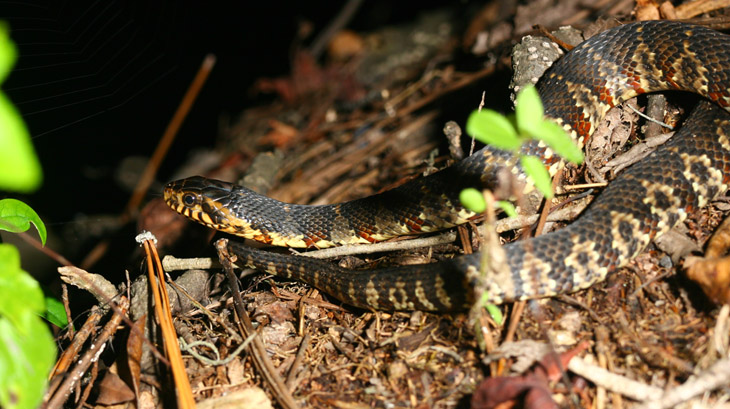
However, what I was really after, besides my continuing quest for scorpions, was a cottonmouth, sometimes called a water moccasin, but the number of species that are called ‘moccasins’ is wide and varied, so we’ll go with the scientific name of Agkistrodon piscivorus, and you’re on your own regarding that pronunciation. I failed to see one, but I did see three other snakes of two different species, so I can’t consider the night a failure.

southern banded water snake Nerodia fasciata looking suspiciousThe specimen above had me suspect that I’d finally found one, until I carefully leaned in a little closer and could see the markings better; instead, this is a southern banded water snake (Nerodia fasciata,) and completely harmless, despite having the same habitat and behavior as a cottonmouth, save for the open-mouth threat display that the latter has at times (which is where it gets its name.) This is a small one, less than 40 cm long and perhaps slightly larger in diameter than my thumb, and while the headlamp confused it, it was starting to get suspicious after a minute or two and slowly slipped off into the undergrowth.
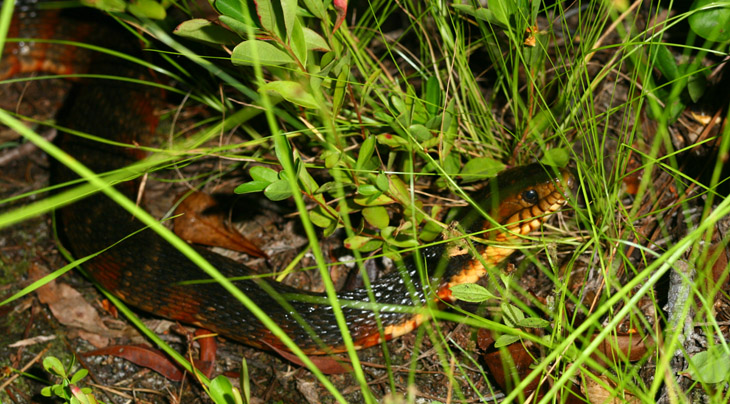
Not far away I found another, the second specimen of this species seen that evening – the first had slipped into the water before I brought the camera to bear, and the resulting photo of it was sufficient only for a positive ID and not for blog use. Below is a northern water snake (Nerodia sipedon,) seen a few times elsewhere on this blog.

Northern waternsake Nerodia sipedon newly emerged from water
This one was a massive specimen, about as thick as my wrist in the midsection, and had just emerged from the water and so was still glistening – snakes look so much more vibrant in color when wet. You can tell from the raised head that this one was also suspicious, though the bright headlamp kept it from knowing exactly how close I was to it. This species usually does not hesitate to bite when they feel threatened, but the provocation mostly requires actual contact or at least being within a handspan distance, and I was slightly more than that (probably about a meter, to be honest.) It was funny, because I was distinctly searching for a venomous snake, and each time I spotted one there was a quick thrill, dismissed when I found out I was facing a harmless species (granted, someone else’s definition of ‘harmless’ might be different from mine, but I’ve been bitten more times than I can count.) I also need to note that a handful of frog and snake pics would normally be considered a decent night’s work, but there are over 530 frames between the first image in this post and this one, so that’s a damn good haul for a day. How many of them are true keepers? Well, a lot less, but still…

And I close with a photo from Our Female Host, for reasons unknown shooting the same sunrise on the beach by the motel room (a few kilometers away from where I was) with her goddamn smutphone. Given that, it’s a pretty good shot anyway – it just could have been better

sunrise off east shore of Jekyll Island, Georgia

Monday color 32

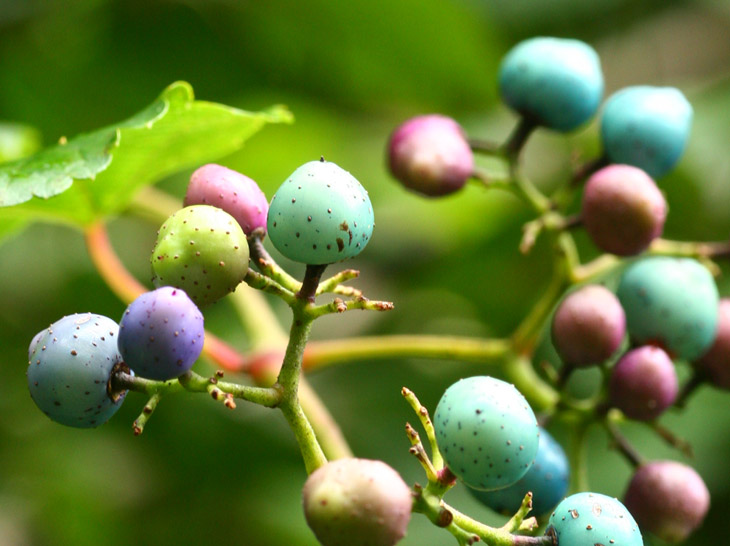
ripening porcelain berries Ampelopsis brevipedunculata
So, Monday color was originally intended to be only for the winter months because they lacked color and/or subjects to chase. It had come from the overflow of images that I had pre-selected for an end-of-year color post. Since I ended up carrying it through the summer, I figure I’ll just close out the year with it – it has assisted in boosting my post count for the year, as well as providing some updates when I had too few things to write about. However, I may discontinue them come next spring when ‘current’ color pics should be available (especially if I follow through as planned and have a lot more flower species coming up then.)

What we see here are ripening porcelain berries (Ampelopsis brevipedunculata,) a type of grape that has apparently been introduced into the area, possibly by birds. They are often considered “invasive,” a label I pay little attention to since it’s rather arbitrary; apparently, if it was not found in North America before the Europeans landed, and competes better than the species that horticulturists plant on purpose, then it’s invasive. Fully half of the plants you might encounter anyplace in North America are not “native,” and of course food crops have been bred far apart from the way we found them. Meanwhile, loblolly pines spread just as fast and crowd out other species quite readily, not to mention being ugly, but they’re “native” and thus okay, in fact encouraged. People are weird.

Odd memories, part six

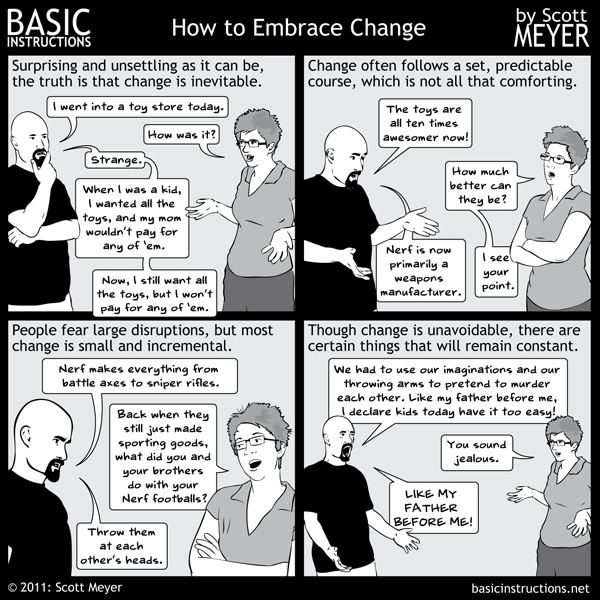
Scott Meyer of Basic Instructions fame speaks with the insight of the classic philosophers:


The Nerf designers may actually be missing the point – part of the skills of childhood is repurposing toys to your own ends. Things that are too specific cripple kids’ creative (and destructive) powers.

In my youth, GI Joe was a nine-inch (metric wasn’t invented then) fully-articulated dude with fuzzy beard and blue Speedos, perhaps a step up from my older brothers’ Joes, who were clean-shaven, plastic-haired, and conspicuously neutral in the nether regions (the action-figures, not my brothers.) I had a six-wheeled ATV “Banana Buggy” and a Schweizer 300 helicopter, though I did not know this at the time, for him to chase semi-military adventures within. Both of these were cool, but they didn’t provide half of the amusement of hurling Joe out of the third-story attic window with his homemade parachute. Joe, it must be said, was more accident-prone than YouTube stars, and curiously, his chute failed more often than it worked, especially when my friends and I figured out how to tie the knots for only momentary security. Joe would often regain consciousness on the front walk, limbs splayed at traumatic angles that the animators of Family Guy are quite familiar with; they know. But Joe never grimaced, never hesitated, never shirked his duty of running his ATV at full speed under the couch, which the ATV cleared but Joe did not…

Stairs are an important part of a child’s development, I am sure – we had four flights of stairs in the house that I grew up in and look how I turned out. The flight of sixteen steps in the main foyer was an excellent acceleration ramp for the Hot Wheels tracks that I inherited from my brothers. The orange plastic sectional tracks, able to be bent vertically but not horizontally, retained a bit too much warpage from being curled into loops, so it was hard to keep the cars on the track in the bottom third, often flying clear before reaching the jump we had placed at the end. Ah, but when they stayed true, we could send a Deora (without surfboards) or Whip Creamer sailing out the front door without touching the floor. Those that collect Hot Wheels in vintage condition nowadays, still in the original packaging even, are total dweebs – a Hot Wheels has not been christened until the paint is chipped or a wire axle bent down a bit. Ones with heavily-damaged front ends are true classics, bearing the history of numerous childhood experiments.

In my very early childhood, kids still actually stuck playing cards in their bicycle spokes, something I’d better explain because I suspect a lot of readers no longer know what the hell this is: the rattling made a sound reminiscent of motorcycles. Bikes are anything but bikes at that age, becoming motorcycles, aircraft, and even spacecraft. The physics that we learned from Hot Wheels we carried over into bicycles, or at least tried to, making ramps of various sizes when we couldn’t find our own in natural conditions. Bear in mind that this was the Golden Era of growing up, when playground equipment was metal and concrete and there was no such thing as helmets and pads – I still have a scar on my knee from wiping out in gravel, a scar that carries the fond memory of having banged the scab a week later and reproducing the tears, only to find a stone still embedded in my skin and now adhering to the scab. Fun times! I did a lot of bicycle jumps, learning that steep ramps often cause the bike to want to pitch forward on landing. You get over the pain quickly because your friends will only laugh that much harder if you moan or cry. Had we continued to use playing cards in this manner, some of our bikes would have sounded like Harleys at idle from the missing spokes (budda budda budda – blap – budda – blap blap…)

As I got older, model kits took over, and as most boys know, there’s a period of time that they don’t turn out how they were intended; this is coupled with those that get knocked down and obtain too much damage. At such times, their appearance is improved with the time-honored application of gasoline, usually anointed well out of the presence of stodgy uncreative adults. Several of my kits became masses of blobby plastic out Behind The Barn, which is another important developmental area. This achieved new heights of awesomeness when my brother-in-law brought over his 12-gauge shotguns and we attempted to extinguish the flames with birdshot. One gains valuable scientific knowledge of atomization and vapor ignition from watching the USS Constitution with full rigging, after having been damaged by pirates (tumbling it from the top shelf,) take one in the powder magazine and vanish in a classic fireball. Much is said about the joys of children’s laughter, but past a certain age, it means you better check to see what they’re doing.

Actually, just a little older than that, it then means you probably shouldn’t…

It is worth noting that this is a period in time when reality, and what your friends tell you with utter confidence, are two entirely different things, often polar opposites. My sister convinced me that the air freshener in the bathroom with strawberries all over the can actually tasted like strawberries, from her personal experience. I can save you that experiment: it does not (c’mon, I was four.) One of my model rockets was destroyed because a friend told me that a two-stage engine and a single-stage were pretty much the same, and a two-stage would successfully pop the chute. I watched my carefully built model return earthward at a high velocity with its chute aflame, never to fly again.

Oh, yeah, I should probably say that model rocket engines are a source of very useful chemicals. Split open the compressed cardboard casing with an X-Acto knife and you get a cylinder of varied packed powders that ignite easily. They smell terrible, of course, which makes them very useful for twisting small amounts into buds of toilet paper and sneaking into cigarettes. When you do this, you dump out several cigarettes and place the loaded one well into the pack, so it’s not found until sometime later – helps cover your tracks. The bottom charge flares brilliantly, because that’s the propellent, but the middle charge (we’re talking single-stage here) is the bit that produces the smoke trail to spot the rocket, and it works quite well. Being careless at one point, I ignited an entire cylinder of this stuff in our living room (on the fireplace hearth – I had a little sense back then)… right before my dad came home. The living room was filled with smoke about halfway down to the floor, but I suspect my dad got too much of a kick out of my sheepish and terrified admission of guilt and merely told me to air it out before my mom got home. Or maybe I’d given him ideas of his own; come to think of it now, some of my rocket engines went missing soon after. I’d always blamed my brother…

So, yeah, with all that, especially for the women reading, you can begin to understand where Mythbusters really came from. Even Homer Hickam, one of the pioneers of rocketry and author of the book Rocket Boys (later to become the movie October Sky,) engaged in shenanigans of this sort – if you’re lucky, you never grow out of it.

One free internets to everyone that knew what a “Banana Buggy” was. It’s the least I can do now that that song is going through your head… ;-)

Cause or symptom?

Over at the blog Bad Astronomy, Phil Plait has a post on September 11th, and on examining the circumstances surrounding the attacks with a critical eye. He makes some great points about distinguishing fanatics from the bulk of a religion’s followers, but says something that I feel misses the mark. I’m addressing it here (instead of in the comments section of his blog) partially because I want to go into greater detail than I should in a comment, and largely because Discover Blog’s spam filters rarely let me through, and I’ve given up trying.

Phil says,

After all, it was science that created the airplanes, science that built those buildings, science that developed the technology to bring the two together at high velocity. You might then say yes, but religion was the pilot; it was the fundamentalist jihadic brand of Islam that guided those men to do what they did.

No. What drove them is undoubtedly something much more complex, and in researching this post I was reminded just how complex this could be.