



It’s time

When did we last feature wood ducks? A couple of weeks ago? That’s enough of a gap.

Yesterday I looked out the office window and found a pair of the wood ducks (Aix sponsa) hanging out on the little log that serves as a turtle basking spot for the smaller species. They had a good view directly into my office window themselves, and so I shut off the lights therein to hopefully not disturb them, since this was the upper portion of the main pond, near the nesting box, where they don’t visit that often. So far, there’s been no further interest in the nest box, but this pair seems to be more mellow and hanging around a lot while all of the others only visit twice a day during their own specified feeding times.

Only a minute or three later, I noticed that the male had switched ends of the log while the female snoozed, and realized that he’d probably shifted to make way for a turtle, so I had to try for the shot.

male and female wood duck Aix sponsa sharing log with unidentified small turtle
The way the place is laid out, my office door leads out back from slightly below grade, so I have a few steps up to ground level, and this stairwell is shielded by latticework. I’ve tried before and the ducks easily notice me moving behind the lattice before I can shift the long lens around the end, so this time I got just clear enough to shoot through the lattice openings. This is far from ideal, since the openings are smaller than the front element of the lens; what happens is, a certain percentage of the light coming in is the white latticework itself, well out of focus but still contributing its pale coloration to the frame, reducing contrast and washing it out a bit. I’m considering how to change this so I can get clear shots from my door, but this is what we have for now.

male and female wood duck Aix sponsa sharing log with unidentified small turtle
I got a couple of frames as they preened, then stopped taking any further chances of them noticing me, but at least these two seem much better about human presence than the rest: even when they notice us outside, often all they’ll do is scoot over a bit to be obscured by branches or trunks, rather than fleeing with alarm calls as most of the others do. They’re nowhere near coming up for food when we appear like the geese and mallards will, but at least they stick around.

A little after this, as The Girlfriend and I watched from an upstairs window with binoculars, the female found something disagreeable with the turtle, leaning down and shoving it back into the water. Would have made a cute video clip, had I been ready.

That evening, I went out exploring by headlamp, mostly in search of snakes but also to see if the beaver(s) might make an appearance. Now, the property layout is, all of the east side is ponds, with a narrow spit of land that separates them from the nearly-still creek that forms the property boundary. Most of the beaver activity is on this creek, though there’s evidence that they come into the ponds on occasion, just not too often. The foliage, primarily bamboo, is quite dense on this spit of land along the creek and there are just a couple of places where clear views of the water can be had, which are the only places I’ll be able to see any beavers in the water. Last night I heard a splash, but not quite the sound of a beaver tail, then a flutter that told me that some waterfowl had launched itself from the water and landed again some ways downstream. I did eventually see the reflections of a beaver’s eye in the headlamp, out in the creek, but it quickly moved further off and was obscured by branches before I could begin to focus (using my trusty Beav Team Six rig.) I stood and waited, and realized I was hearing some soft peeping from right on the other side of the creek. I peered around, watching carefully, and eventually determined that a male wood duck was hanging around immediately opposite me.

male wood duck Aix sponsa shot at night
This was the closest I’ve ever been to one, and I credit it to the bright headlamp and rig focusing light that was preventing the duck from seeing me clearly – this is full-frame at 600mm, by they way, while the duck was perhaps seven or eight meters off. The light is provided by a Vivitar 285 HV, the most powerful strobe I own. Mr Bugg would have been delighted to see me chimping, but it was the quickest way to calculate the proper exposures. Meanwhile, the male wood duck seemed disinclined to vacate the area and continued its calling; I surmised this was to attract the female that had left, so they could stay together, but that’s only a guess.

I worked further on to not disturb him, still looking for other subjects, still hearing beaver activity but not seeing it. On my way back, I returned to the same spot and had a seat to just try and wait one out. I’d looked around quite carefully and had seen nothing as I settled in.

After a few minutes, there was a splash nearby, and as I homed in on it, expecting to see the ripples of a beaver, I found the male wood duck again, who had not been visible there only moments before.

male wood duck Aix sponsa shot at night
Now, I don’t know how good the night vision of a wood duck is. For most birds, it falls somewhere between terrible and nonexistent, and they take pains to have safe perches before full darkness descends. The exceptions that I know of are the owls of course, as well as nightjars and great blue herons, which seem to have no trouble flying at night. Wood ducks? I have no idea, but this one was not only hanging around the area, it might have purposefully landed right near me. And again, it was swimming back and forth, not ostentatiously, but still peeping very softly. It also gave me a brief flapping display, which I was barely fast enough to capture.

male wood duck Aix sponsa flapping briefly at night
I have a sneaking suspicion that there’s a nest nearby, perhaps in one of the trees I was sitting under, and the male was keeping an eye on things, if not actively trying to draw me away. I knew, should the nest exist, I had little chance of spotting it by the headlamp, so I elected to return in daylight to test this theory, because that’s exactly the kind of thing that I want to monitor, if I can find a way to do so without disturbing them – a tall order, that, especially since I’ve found no way to get to the other side of the creek where I could be farther off and less threatening; with luck, should the nest exist, it will be on the far side and I can try to find a safe observation spot on our own property.

By the way, I cannot stress enough how useful a good headlamp is. I’ve had this one for years, having replaced the elastic bands twice and the rechargeable batteries at least that many times, and it’s seen heavy use in not just photography, but household tasks like entering the crawlspace or working in tight quarters where light doesn’t penetrate, and even working on cars at night on the side of the road. It has multiple lighting modes and the batteries last for hours of constant use, which is damn good because I wouldn’t be able to do excursions of this nature without it. I highly recommend that everyone have one.

I close with one little detail that I discovered while reviewing the photos last night, seen here close up:

closeup detail of sides of male wood duck Aix sponsa showing stippled feathers on sides
Every photo I have seemed to show that the sides of the males were simply tan, but now I see that they’re actually stippled very finely, making me feel bad because I don’t have that detail on my wood duck figure (I really am bothered by inaccuracies like that, even though only a small percentage of people would spot it themselves.) Now, do I have the patience and steady hands to correct this oversight? Yeah, not sure about that…

Estate Find XIV

This one was a semi-targeted find – I figured some representative of the order would be visible around here soon, but this one showed up when I wasn’t specifically looking for it.

very young banded water snake Nerodia fasciata held in author's hand
Instead of being anyplace along the water’s edge or among roots of trees nearby, this one was found in the middle of the driveway when we took the trash out last night. This is a very young banded water snake (Nerodia fasciata,) but being unfamiliar with exactly what snakes might be in the area (as well as examining it by pocket flashlight,) I did not immediately grab it, instead gettimg down on the ground to examine it closely first. The pattern certainly looked familiar, but the round pupils and stripes along upper and lower jaws pinned it down as a water snake, and the unbroken bands in the hindbody indicated that this was a banded rather than the northern water snakes that I’ve been finding for years. This is much smaller than average adult size, which runs close to a meter in length with quite a thick body.

very young banded water snake Nerodia fasciata held in author's palm
Familiar with the ‘spirited’ defensive traits of the northerns, I grasped my subject here carefully behind the head, but needn’t have bothered – I have rarely handled a more docile snake, who didn’t even struggle feebly but settled into my hand with complete aplomb. I housed it temporarily in a terrarium before I was ready to shoot some images, and it reacted the same way when I took it out again – ain’t no thang.

very young banded water snake Nerodia fasciata held in author's palm, clearly showing pupils and jaw stripes
This image shows the two traits I was looking for when I bent down close before picking it up: the round pupils and the stripes along both jaws, neither of which are possessed by the cottonmouth (the only venomous snake in the area that this even remotely resembled.) There are other definitive traits, such as the more triangular, pit-viper head and the prominent brow ridge, but I wasn’t sure how well these were developed in the immature specimens. Looking at images from others afterwards, it would seem they’re present from the start.

This is where I made the mistake, though. Wanting some more natural-looking portraits, I went outside and chose a spot in the yard with very little grass or weeds, instead a blanket of old dry cypress needles. On setting it down in a likely spot, the snake recognized this as the opportunity that it had been waiting for and quickly nosed into the cypress needles, which were much thicker and yet less packed than I thought, and before I could even put the camera down, the snake was vanishing under this carpet. Completely. I tore up a good swath of needles hoping to unearth it again and found not the faintest hint. See, this is why I make studio settings for this kind of stuff.

Anyway, it was the first water snake found on the property, so that counts nicely. And I have a few other images from the past 24 hours to feature here, probably right after this.

Multitasking

Nearly all of the images herein were obtained while I was out last night after the month-end abstract – it was a nice night after an even nicer day and so the critters were making the most of it.

This one, however, is not from yesterday, but we have kind of a theme going so we’re running with it.

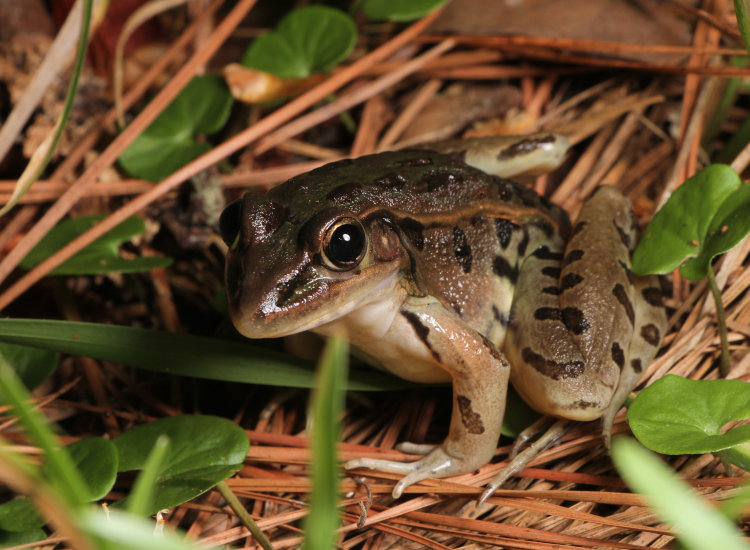
possible southern cricket frog Acris gryllus at edge of small pool
I’ve dealt with this too much before, but amphibians can be a real pain to identify – their markings can have far too many variations, and some identifying characteristics would involve handling and the examination of subtle facets that don’t usually show up in images like, well, like this. So I am tentatively identifying this as a southern cricket frog (Acris gryllus,) based on one very subtle marking and the bare fact that it appears to match nothing else better. All cricket frogs tend to have a distinct Y-shaped marking extending from their eyes down their back, which this one does not have; they also occasionally have a triangle in the same coloration extending forward to their snout – ditto. But there’s the barest hint of the triangle that would lie between those, extending between the eyes and pointing down the back. Given that and the warty skin that is not duplicated in most other species common to the area, I’m going with southern cricket frog. The base coloration is no help at all, because like many amphibian species, their base color is all over the map, as looking up any illustrating photos online will demonstrate. This guy was found by a small pool off of the main ponds, and is smaller than the top joint of your thumb (unless you’re like eight-years-old or younger.)

Yesterday afternoon I spotted another amphibian in the yard at the mouth of a small opening, but it dodged inside before I could get my hands on it. I suspected it was a spadefoot toad like this one found last year, and so got the long lens out and slowly went around to the burrow later on to snag identifying traits before it ducked away again.

American toad Anaxyrus americanus peeking from burrow
However, that is not a spadefoot, but the exceedingly common American toad (Anaxyrus americanus) instead, or probably eastern American toad. Quite small for the species, but at least three times larger than the cricket frog, between 20 and 30mm and much more rotund than the svelte cricket. You can also see that we have very distinctly entered into pollen season, or at least for the loblolly pines that infest North Carolina (of which, thankfully, we only have three in the yard, though this doesn’t seem to have reduced the pollen load.)

Then that evening, I did indeed find a spadefoot.

small eastern spadefoot Scaphiopus holbrookii foraging in yard overnight
More specifically, an eastern spadefoot (Scaphiopus holbrookii,) but certainly not the same as last year, since this was half the size. Since it was night the pupils were quite dilated and so we don’t see the wonderful nature of their vertical pupils, but oh well.

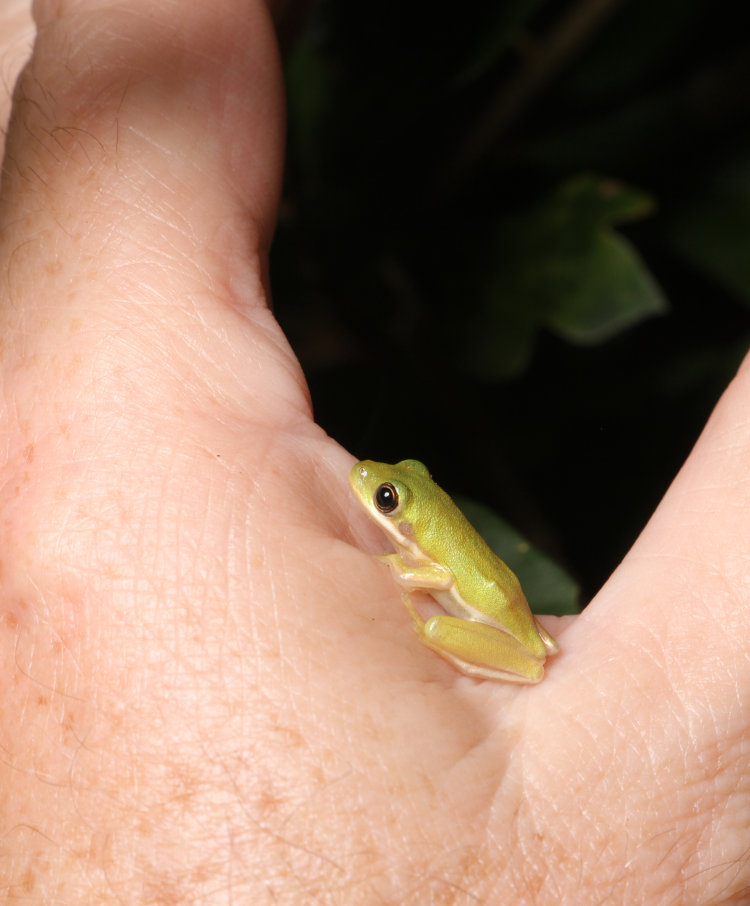
And then, on a camellia bush not far away, a little break in the shape and pattern presented itself:

very small Copes grey treefrog Dryophytes chrysoscelis perched on branch of camellia Theaceae bush
This is a very small specimen of Cope’s grey treefrog (Dryophytes chrysoscelis,) no bigger than the cricket frog, so I’m going to hazard a guess that it was a brood from late last year. Those pupils are absolutely huge, so I’m guessing it got into something that it shouldn’t have, but likely a private stash because we don’t have anything like that growing wild (or cultivated) here. I don’t think.

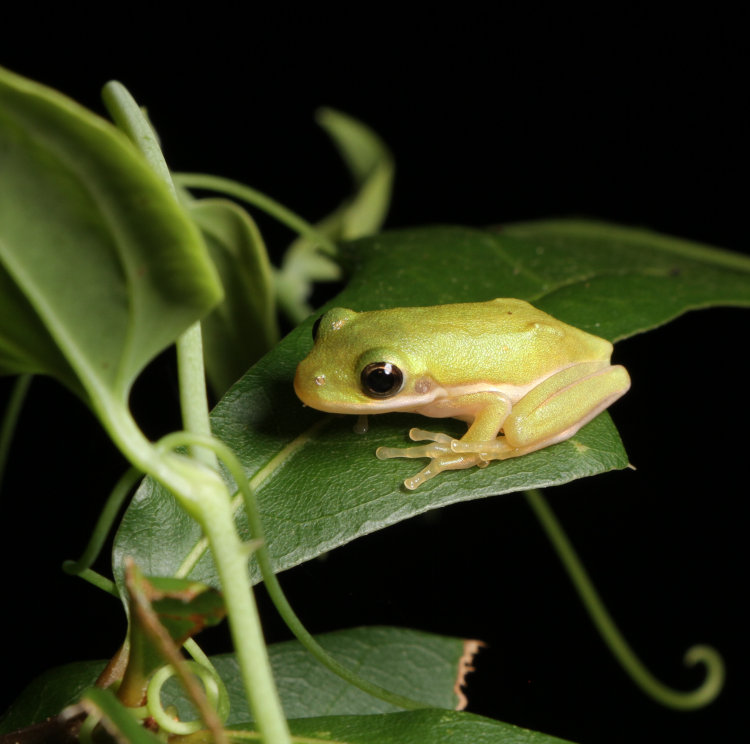
Then, on a downspout some distance off,

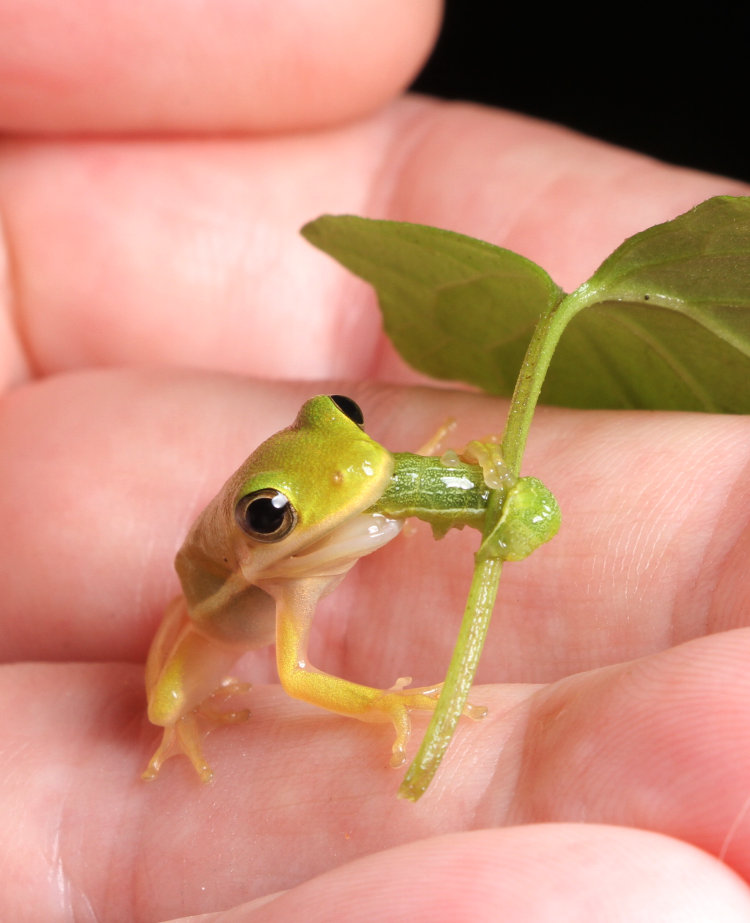
green treefrog Dryophytes cinereus settled on downspout
Another Dryophytes, this is a green treefrog (Dryophytes cinereus) instead. This is not the first I’ve found for the season, however – I found one on a vine alongside the pond last week I believe, when I was distributing corn for the ducks and did not have the camera in hand. I know, I know, why wasn’t I prepared? Because distributing corn means my hands get covered in cornstarch, which then gets on everything else quickly, so I don’t tote the camera along. I am obligated to inform you that this one was shot blind, holding the camera down near my ankles and aiming in the direction that I thought was correct. It was, and autofocus nailed it first try. Notice how different the pupil size is from the others shown.

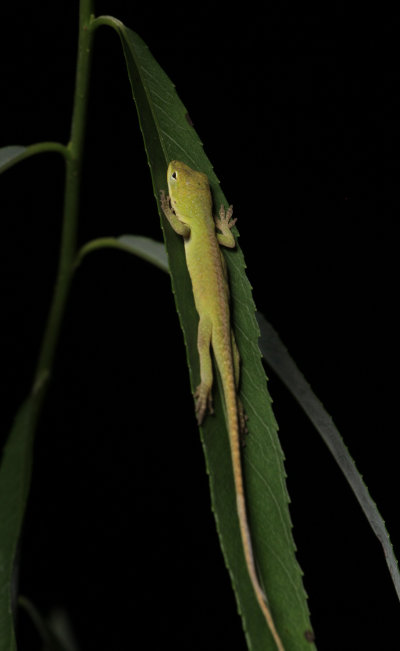
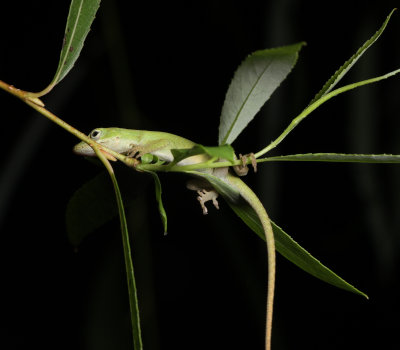
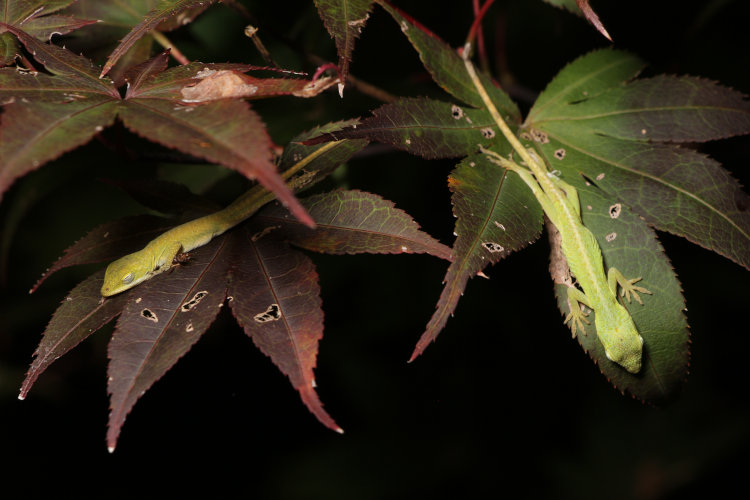
And now, the lizards – actually all Carolina anoles (Anolis carolinensis.)

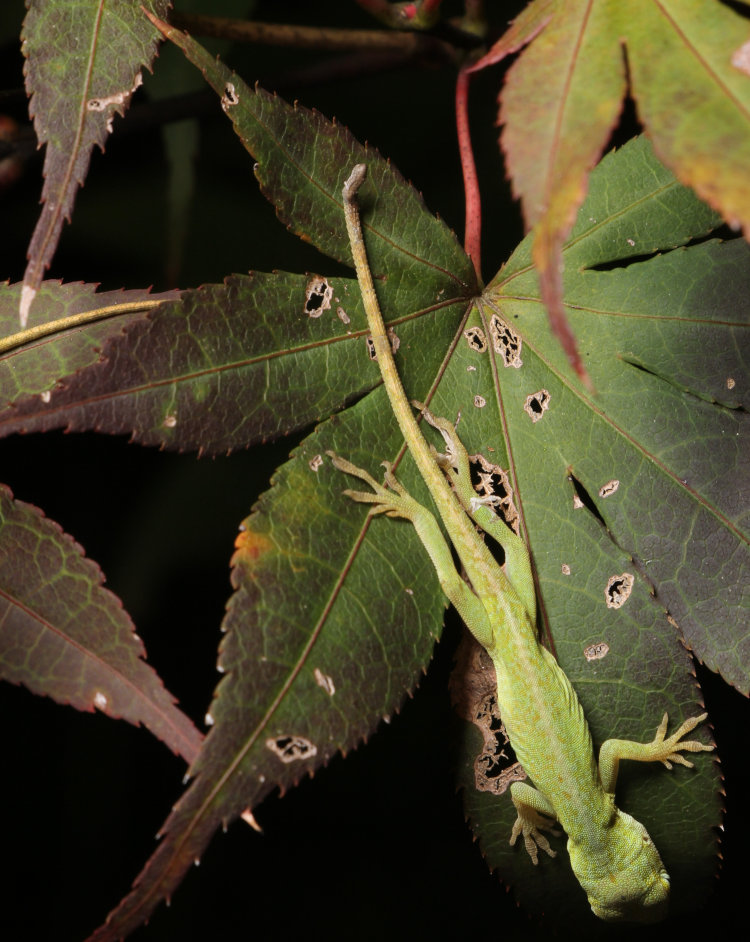
young Carolina anole Anolis carolinensis snoozing on trunk of Japanese maple
One of the Japanese maples that we pulled up from the yard and transplanted into a pot before the move got flooded last fall, because I didn’t realize the damn pot had no drainage holes and we underwent some horrendous rains. That still got transplanted and we’re waiting to see if it recovers, but in the meantime, I found the first of the anoles snoozing in the branches this year, though it opened its eyes as I maneuvered around with the headlamp. Not full adult size, more like half that.

young Carolina anole Anolis carolinensis snoozing on trunk of Japanese maple, from another angle
From another angle, we can see that it might have fed quite well during the day. We can also see that, like a high percentage of the anoles on the property, it lost the tip of its tail during some altercation of the past, but it’ll grow back. I’m hoping that I can pin down some specific individuals that suffered such injuries so I can monitor how fast this occurs (and of course, find another that grew back forked.)

even young Carolina anole Anolis carolinensis splayed out on leaf of tea olive Osmanthus fragrans
The Girlfriend got a small tea olive (Osmanthus fragrans) tree a couple weeks back, and since transplanting, this little anole has taken up sole residence. It’s quite small, perhaps last year’s brood though I have yet to pin down their true growth rate, so I won’t commit to that. But the pollen gives a bit of scale at least, or you can use the branch behind it to judge, since that’s about 4-6mm in diameter.

So, halfway decent haul for the night, when all I was after was an abstract. It’s still a little light on photos for the month, compared to most other years, but that should be remedied soon.

What’s happening? Not March!

Do you think that, if I had readers, they’d be writing in to request that I hire someone else to write my titles? Let me know…

But March is on its way out the door, and you know what that means? No, not that you can finally let out that fart you’ve been holding in for hours – it’s the end of the month abstract! And we’re definitely pushing the deadline here, because this was shot less than two hours ago, when I realized that nothing that I had was even remotely interesting. The nonexistent readers are remarking that this hasn’t ever stopped me before, but we can ignore them. So what do we have?

dew or exuded moisture on the tips of new hosta Agavoideae leaves overnight
Going out to try and find something, I did, in this case the dew appearing on the tips of the new hosta (Agavoideae) leaves as night wore on. I did a few initial shots, then returned with the reversed 28-105 to do higher magnification. But, I’m not sure this is actually dew, as in, moisture that condenses out of the air as the temperatures fall. Considering that little else had even a hint of it and that I’ve seen the same kind of thing on similar plants, I think this is actually moisture that the plants extrude from the leaf tips overnight, bolstered by the fact that as I was out there, I saw a droplet fall away without being disturbed, apparently gaining enough mass to overcome its tenuous hold on the leaf.

The hostas were slightly surprising, because their pots remained out unprotected over this harsh winter, and we had feared that the cold temperatures had penetrated into the pots and killed the roots. This is what happened to the tall avocado tree in the garage, the only place high enough to hold its 280+cm height. But about a week ago the new hosta sprouts appeared, and these are now several centimeters tall, so they appear to be doing fine.

A little trivia: last summer, while attempting to show the scale of one of the anoles that was perched on a hosta leaf, I eased one of my little paper millimeter rulers in alongside the lizard, but it dislodged and slid down the slope of the leaf right along the stem, the same way that rain does. It disappeared entirely from view deep within the cluster of stems, and I wrote it off – I get more every few print jobs anyway. Late this past fall, as the hosta leaves all withered, I could see a little strip of white down at the soil level and retrieved my scale with some amusement. You’ll probably see it again sometime.

Move forward, even just a little

Another holiday rears its ugly head today, serving as a reminder for those things that you’ve been putting off: Make Noticeable Progress on a Project Day. That’s right, pull that thing out of the box and try to make it work again, go out to the garage/yard and bang on the car some more, actually stir up the paint before the masking tape become a permanent part of the walls, and so on. We all have projects of this nature that sit, neglected, and should be cuddled again and assured that they matter.

I am deep in the throes of this myself, since Dan Palmer and I are currently at Unpub 25, a festival coordinated by the Unpublished Games Network to feature and playtest new, unpublished games (ah, that’s where the name came from!) among many other game enthusiasts. We had a table on Friday and are manning another today to demonstrate the Gnonom Deck and various games designed for it; in fact, I spent the past week or so getting things together for this endeavor, including a play-through video. Dan, meanwhile, has been working on this off and on for the past few months, rewriting rules for clarity and consistency and making his own play-through video. The Gnomon Deck website has been updated for a few months now and we add things periodically, so it’s actually starting to flesh out a bit.

Dan Palmer and Al Denelsbeck at the family day of the Bridges 2024 Conference, Richmond, Virginia
This is not Unpub 25, but the previous demo opportunity at the family day of Bridges 2024 last year

It should be fun and informative, but I haven’t attended before so beyond that, I don’t know what to expect (can you tell I wrote this three days ahead of time?) Dan’s been to one other, but doesn’t know the behind-the-scenes stuff like how beneficial it was overall and how many people got their games noticed and into production. So, we’ll see/we’re seeing.

Feel free to check out the GnomonDeck.com site – it describes the deck, has several initial games with a couple of videos, and has a mailing list to sign up for further news. I may be back later on and let you know how it all went.

Estate Find XIII (XIIV?)

I was talking to The Girlfriend while looking out the back windows over the pond, and realized that the bird I’d seen wheeling in the thermals fairly high up didn’t quite look right; I’d been seeing plenty of turkey vultures the past few weeks, but this struck me as wrong. Luckily, the camera and long lens were right there (because of the ducks, and geese, and herons, and so on,) and so I snagged it as I went out the door and focused on the bird, who was trying pretty hard to disappear among the still-bare branches of the cypress trees. The bird got much further away, but then swooped lower and cut back across, eventually passing fairly low right over the rooftop, and I confirmed my suspicions:

second-year juvenile bald eagle Haliaeetus leucocephalus cruising directly overhead
Yep, that’s a bald eagle (Haliaeetus leucocephalus,) second-year juvenile, so last year’s hatchling. Considering that we’ve only seen one in the region so far, an adult circling over downtown in late November, we were quite pleased to see this here. It even gave a couple of soft calls as it passed over, in case there was any doubt.

second-year juvenile bald eagle Haliaeetus leucocephalus cruising low overhead
Now, do we expect this to be a regular occurrence? Not in the slightest; there’s no body of water in the immediate vicinity that would prove to be a decent fishing ground (well, fishing water, I guess – you know what I mean) for eagles, and the pond certainly doesn’t qualify, being perhaps a half-meter deep and unlikely to be housing any kind of fish much beyond minnow size. Still, seeing a juvie this close means breeding grounds can’t be too awful far off – we just have to find them.

[I will note that we went down to Goose Creek State Park last week, the most likely place in my mind to find them, and saw nothing but a couple of cormorants and seagulls. We were only there an hour at midday, though, so it was hardly a thorough investigation.]

second-year juvenile bald eagle Haliaeetus leucocephalus emerging from behind chimney
Curiously, not one frame of the dozens that I shot as it wheeled shows the head with any clarity; when it was more distant behind the trees, nothing snagged good focus, and when it was closer like seen here, even when I had a nice profile angle, the eagle seemed to have its head cocked watching either above or below it – usually, when their head is turned this way, it’s looking up, but I saw nothing at all in that direction. Still, we were standing on the back deck watching this right overhead (this frame was as it re-emerged from being hidden by the chimney,) so no complaints at all.

Nobody dresses up these days

Knowing that I’d be tied up for the latter part of the week, I went out today to find a subject for the Estate Find, and/or see if any other snakes had emerged. I wasn’t successful on either count, finding only the typical subjects of the property so far, but a little later on I almost casually got the Find for this week, so no issues there. This guy had to be featured, though.

Carolina anole Anolis carolinensis in late stages of shedding
Naturally, one of the hundreds to thousands of Carolina anoles (Anolis carolinensis) that litter the property – seriously, the numbers are huge – but this one looking quite decrepit. This is only because it’s in the middle of molting, the large patches of its old skin sloughing away. I saw this from a short distance and, while it was right where I expected to see anoles (atop the concrete bunny alongside the lamppost on the front walk, where they are routinely found,) I couldn’t identify it until I got the long lens on it, when it all became clear.

Carolina anole Anolis carolinensis in mid-molt displaying dewlap through tatters
Amusingly, this guy gave a couple of flashes of his dewlap as I stood there, though no other anoles were in the immediate vicinity – I suspect it was actually trying to dislodge more of the dead skin; right after this, it turned and shook a couple of legs, breaking free more of the flakes. This one was fairly large but not the largest that I’ve seen right around there, and I believe that dewlap pins it down as a male.

Down by the pond where I wasn’t finding snakes, I did at least spot this guy, doing a pretty good camouflaging job as a cypress knee:

small yellow-bellied slider Trachemys scripta scripta basking on pond shore
A yellow-bellied slider (Trachemys scripta scripta) of course, only a little bigger around than my palm, and complacent enough to stay put while its brethren had all abandoned their perches on logs and snags at my approach. I hadn’t gotten too close, though, so we’re not talking totally complacent. But quite a collection of vegetation on the carapace, there.

And a few dozen meters away,

pair of yellow-bellied sliders Trachemys scripta scripta face-to-face atop a barely adequate snag for basking
For the population of turtles within this pond, there are too few basking locations, which we intend to remedy fairly soon, but it means the competition for spots is fierce. Well, it’s hard to use that word with turtles, but there remains a very slow race to see who gets to the best spots first when the sun comes out. This pair was also fairly mellow with my approach, and in fact didn’t budge as I circled around them on the end of the pond, though I was still ten meters off – they get credit since most of the others bail long before that distance has closed. The Girlfriend, by the way, loves that little, “Look, Ma! No feet!” pose that they adopt, presumably to get more sun on their actual skin, but maybe it’s a sexual thing – who knows?

So, nothing new (that will come Friday,) but at least more spring-like. We’re getting there.

Estate Find XII

As I said almost a week ago, there was no question that this one was going to make the Estate Find this week – unless something really kickass popped up later on. But as I was taking care of a few yard details on Sunday, ol’ Eagle Eyes here spotted something stretched across the grass:

eastern rat snake Pantherophis quadrivittatus or Pantherophis obsoletus quadrivittatus in yellow-gray coastal morph extending across yard
I’m being facetious of course, because this was really hard to miss. I consider this way too early to be seeing snakes, and we really just got past another cold snap, though it didn’t drop below freezing. This is an eastern rat snake (Pantherophis quadrivittatus,) almost identical to one found four years ago except for being half the size. This one was quite complacent when I went over and picked it up, but then realized that this probably wasn’t ideal and began struggling gently, mostly trying to move out of my grasp. At no time did it make anything resembling an aggressive move, which is fairly typical for the species, and because it probably just came out of its winter torpor, it didn’t even defecate on me. I never tried to get a measurement (running a piece of string along the length of a coiling snake trying to get away is never easy,) but I’m estimating it as a meter in length.

Now the faintly amusing bit. I had submitted one of the images from that linked post above to the annual photo contest at Panda’s Thumb last year, not because of its striking artistic merit, but because they request images of scientific interest, and I felt that the color pattern might be something special. It used to be that there were black rat snakes and yellow rat snakes, and while this one certainly wasn’t black, it could hardly be called yellow, nor did it appear even remotely like the yellow rat snake that I’d photographed a year previously. One source that I’d found had said that it seemed the yellow and black subspecies of rat snakes could interbreed, and I was wondering if I had an example of that.

I mention Panda’s Thumb because, the day after I caught this one (so, Monday,) Panda’s Thumb featured my image – not because I’d won, but because webmaster Matt Young often features all of the entries to the contest on subsequent weeks. However, Matt had found a much better publication that I ever had, which updated things quite significantly – and yet, still a little hazily. The scientific names have gone through multiple changes even as I’ve been featuring the species on the blog, and they’re not exactly pinned down yet, but it seems that both the yellow rat snakes and the black rat snakes may be the same species, differing in coloration depending on location. Where I used to live in central North Carolina, the blacks were predominant, but out on the coastal plains where I am now, the coloration pictured here is common, while towards the mountains it becomes more of a blotchy brown color. None of these match what I’d found in the coastal plains of Georgia, and it’s hard to say which of these morphs extends where, when we’re talking that much farther south. Genetically, however, they are virtually identical, and so the actual species remains up for further debate. This is either a Pantherophis quadrivittatus or a Pantherophis obsoletus quadrivittatus, and unfortunately, I had released the snake before I had a chance to ask it what it preferred.

eastern rat snake Pantherophis quadrivittatus or Pantherophis obsoletus quadrivittatus in yellow-gray coastal morph held by the author, photograph by The Girlfriend
Once again, this highlights something that gets missed a little too often, which is that species distinctions are purely a human creation and conceit; the animals themselves know who to breed with, but when we try to pin such things down, there are often large grey areas. Genetic sequencing can help to a degree, but recognize that every individual is genetically different from every other, including its parents, plus there are always a hell of a lot of gene pairs in the first place, so even just directly comparing two individuals can take months of sequencing. In some cases there are large portions with significant diversity, usually due to the length of time that any species diverged from another, so telling human DNA from chimp isn’t too hard. But then, telling any domestic dog species apart from a wolf, genetically, is next to impossible. And we can visually tell lions and tigers apart easily, plus they’re geographically isolated – but they can interbreed, which fudges one of the definitions of ‘species.’ It’s tricky, and no surprise that the rat snakes will continue to be debated for a while yet.

Now, obviously my specimen here wasn’t blending in with anything and was remarkably easy to spot, but see that colorful thing behind my shoulder in the pic above? Yeah, that’s one of the favored perches of the red-shouldered hawk that was hunting in the yard; this was a damn dangerous place for the snake to be. We haven’t seen Red in the yard for a few weeks, and it looks like the pair might have abandoned the nest that was here too, though they have remained in the vicinity because we hear and see them several times a week. This snake’s days might be numbered. But that day, after I released it back where I found it, it disappeared under a bush, only to re-emerge perhaps two hours later and set off determinedly across the lawn, while we followed it out of curiosity until it went off into the neighbor’s yard. We’ll see if it appears again.

closeup portrait of eastern rat snake Pantherophis quadrivittatus or Pantherophis obsoletus quadrivittatus in yellow-gray coastal morph

There’s something behind me!

The other night as I worked on the computer in Deep 13 (my basement office/workshop/studio/makerspace/junk room,) I heard a soft, repeated sound, kind of a cross between a tap and a thump, coming from someplace off behind me. Once the repetition had established itself, I got up and went looking for it. It didn’t take very long.

spring peeper Pseudacris crucifer in homemade studio
This is a spring peeper (Pseudacris crucifer,) one of the most common chorus frogs, and no, my office is not this flooded – this is a small homemade studio setting that I created just to get detail images. The frog had two potential means of ingress: I had a ground-level window cracked in the attached utility closet for ventilation, the most likely access, but I’d also had the outside door open for a few hours in the afternoon because it was that nice out. Given that these guys get active at night, I’m leaning towards the former, even though the space it would have had to slip through past the ventilation unit was quite small – so are these, this specimen being perhaps 12mm in length.

spring peeper Pseudacris crucifer in homemade studio showing namesake 'X' on back
This image shows where it gets part of its scientific name, the ‘crucifer’ bit – it’s that ‘X’ or cross on the back, and I like how the pattern continues onto the hind legs when they’re tucked in typical fashion, like the coloration was applied afterwards. Such patterns serve to break up the froggy outline and make them harder to spot, but why an ‘X’? I don’t know, and can’t right offhand think of anything in their preferred boggy environments that looks like that. It’s likely just a happenstance thing, a semi-random pattern to blend in with the water-borne debris, repeated through bilateral symmetry. This is an exceedingly common trait: details on the left side of the vast majority of organisms are repeated on the right, with very few examples of true randomness. It’s just how the genes develop.

spring peeper Pseudacris crucifer in homemade studio
Meanwhile, we see here a small artifact of the peepers’ (and many frogs’) behavioral traits. They often leap quite blindly, mostly determining that the way ahead is open and little else, and this one was banging its snout on both the office steps (the noise that attracted my attention) and immediately after capture, the small terrarium that I held it in while I created this elaborate setting. It’s just a little inflammation/bruising – remember that this guy is the size of the top joint of my thumb.

I’ve already featured their calls, but we’ll hear them again:

Several amphibian species

All of the high-pitched ‘cheeps’ or squeaks in there are spring peepers – they’re very common. What I find curious is that, back where we used to live, the frogs and toads seemed to give up on calling after a few hours, certainly by midnight, but here they appear to keep sounding off all night long, when the weather’s right at least.

But while I’m here, I feature a frame from yesterday:

small eastern painted turtle Chrysemys picta picta perched high on back of large yellow-bellied slider Trachemys scripta scripta basking on small log
Resist the urge to think this is a mother and offspring, if you’re still so inclined: these are two different species, and most amphibians don’t care for their young in any manner. The one on top is an eastern painted turtle (Chrysemys picta picta,) albeit probably only a few years old, while the other is a yellow-bellied slider (Trachemys scripta scripta,) certainly much older, though I have no idea how long it takes them to get to this size. The carapace of the painted turtle would probably have spanned slightly larger than my palm, while the slider likely weighed a few kilograms. I spotted this from a notable distance, confirming that they really were stacked only through the use of the long lens, and slowly crept closer to get a better view. Soon after this shot, they considered me to be too close and slid off into the water. But yeah, I doubt the slider was ever in a better position for the painted to access, so the little one likely had a significant climb up that domed shell. All in the name of getting some solar radiation.

Old Estate Find

This one was already being slotted in for the weekly topic the moment that I saw it, but before I even got the necessary photos, another topic that I liked much better happened along, so we’re going to go ahead and use this one now, rather than save it for another week. Spring is on its way, and I expect to have plenty more subjects to feature.

We still have to sell the old house, and The Girlfriend took a weekend trip back there to prep it to go on the market. While there, she gathered a handful more plants that had been in the yard, mostly daffodils, but she also collected what I believe is a coastal witch alder (Fothergilla gardenii) that came with a bonus:

ootheca egg case of Chinese mantis Tenodera sinensis on coastal witch alder Fothergilla gardenii stem
Yep, that’s the egg case/ootheca of a Chinese mantis (Tenodera sinensis,) and definitely this past season’s, because it hadn’t been there before. About the time that the mantids would have been laying egg cases, we were deep in the throes of the move and I wasn’t paying much attention to the front garden, plus the fact that this shrub was wrapped in honeysuckle vines, so much so that the vine was incorporated into the ootheca and had to be cut away. But this does mean that I didn’t leave all of my old mantis subjects behind, even when none of them actually survived the winter because they don’t live that long anyway. So, cool!

Meanwhile, this morning The Girlfriend spotted something that I’d walked right past (but that’s okay because I’d already found something cooler anyway – that’s waiting until Friday.)

likely eastern mud turtle Kinosternon subrubrum burrowing into the lawn
We could make out even fewer identifying marks than before, but this is likely an eastern mud turtle (Kinosternon subrubrum,) perhaps the very same one spotted before. I had thought that it was departing its burrow because the temperatures are better now, but on returning to the spot a little later on, there was no hollow, just an expanse of very loose soil, and now I suspect it was actually re-burying itself. I didn’t try digging gently down to see, though I might try this later on, since they apparently go less than 2cm under and I would contact the shell pretty quickly if it’s there.

[Actually, now that I think about it, The Girlfriend was the first to see both instances of mud turtles, so she’s challenging my wildlife-spotting abilities. Next thing you know she’ll be writing obsessive posts about free will and eighties music…]

1 29 30 31 32 33 334