Just gonna duck right between ya here

It has been a week without posts, which I don’t even do when I’m traveling, always having a couple of even token posts appear to keep from announcing that the house is empty. Yet I’ve been here in Walkabout Studios and the environs the entire time, just wrapped up in projects, to say nothing of it being ridiculously hot out there and not only is it uncomfortable to be out, any photo subjects largely feel the same way. So before another Tripod Holes appears, we’ll have this one.

There have been the occasional subjects, and here’s one of them from a few days back:
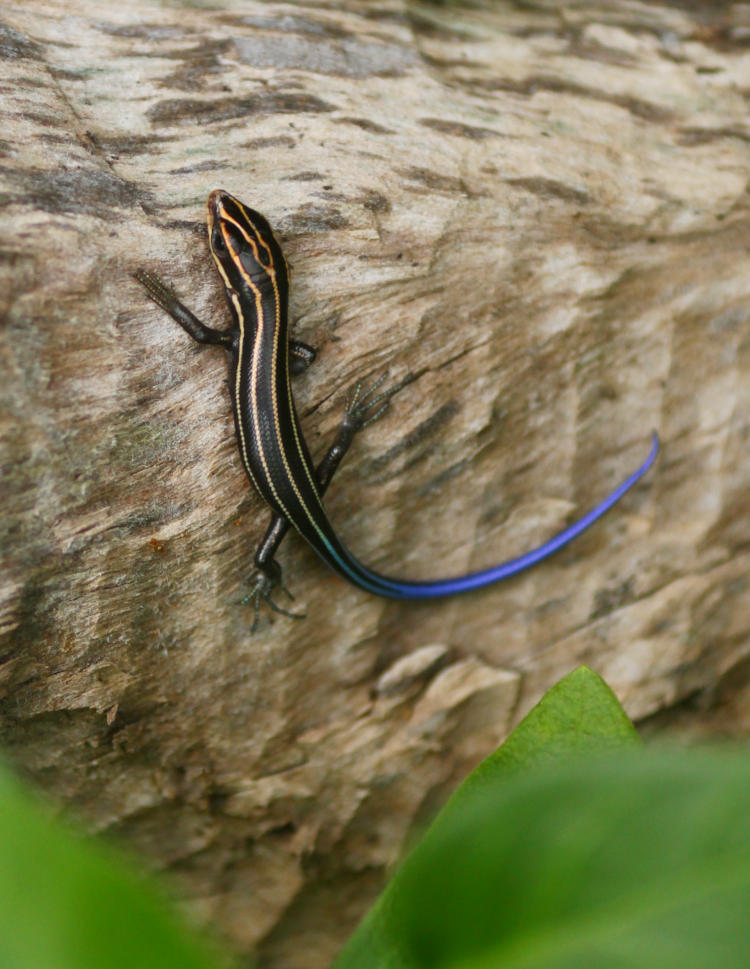
newborn American five-lined skink Plestiodon fasciatus basking on beaver log
That’s a newborn American five-lined skink (Plestiodon fasciatus) perched on a section of beaver-gnawed trunk out front of Walkabout Estates, and it’s no larger than the newborn anoles (so, maybe a hair over 50mm in total length.) I was a little surprised to see it, because while the adult skinks were in evidence out front in the early spring, I have seen no sign of them for well over a month now. And this is literally half-a-meter from the first appearance of the newborn anoles too, both right underneath the big Japanese maple near the front door, so it doesn’t appear either species is so territorial that the other is disallowed, which is fine by me. There’s a little overlap in their habits too, in that skinks tend to be ground dwellers but climb walls readily enough, while anoles prefer the branches of lower plants but scamper across the ground without issues, which means both can be found venturing across the front steps at times, though so far not at the same time. Regardless, welcome anyway. We’ll see how many more photos I get.

Meanwhile, one of the bigger projects was working on a new macro softbox. The flash unit that I was using was discontinued some time ago, perhaps as late as the early nineties, which means its days are numbered, and my main unit conked out a couple weeks back without luck in replacing or repairing it yet (I have not given up my efforts.) So I have considered what is going to replace it in this eventuality, and well as needing something to shoot with right now. Not going into specific details as to the whys and wherefores at the moment, but I need a smaller, lighter flash unit with specific light characteristics, and have been using a custom softbox/diffuser unit of my own construction. Switching flashes meant this wouldn’t work, having been specifically fitted to the older Sunpak model, so a new one was needed. And while contemplating this, I thought, Hey, I have this 3D printer here…
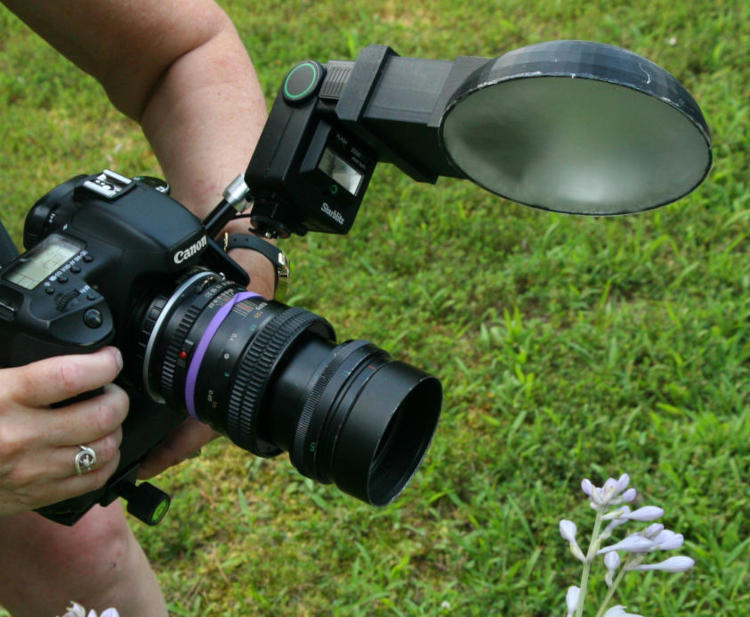
custom-made 3D printed softbox/diffuser for macro work
The initial design and test prints came out far better than expected, and that’s what you see here mounted on one of the two little flashes in consideration, some cheapass K-Mart unit known (or not) as a Starblitz 2500 BTZ that I don’t even know how I obtained. It has a broken shoe foot and a missing battery door, both of which I replaced with the help of the printer and Blender design software, the idea being that this was quite small and quite light, and the limited light output wouldn’t matter much for macro work. I also have a Canon 300EZ unit in consideration as well, and mounts for both were designed and printed, fitting far better than expected, almost as if I know what I’m doing.

The real question, of course, is how well it all works. The acid tests were last night.
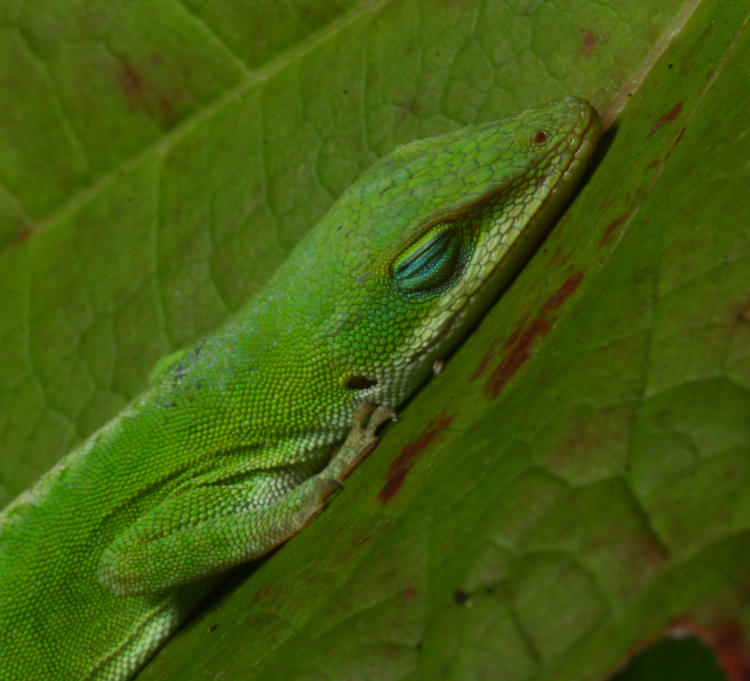
snoozing Carolina anole Anolis carolinensis in closeup with new softbox
That looks fine, perhaps a little dim, though I was to determine that this was due to the aim of the softbox. It’s an adult Carolina anole (Anolis carolinensis,) by the way, not one of the newborns. It’s not a demanding subject, so I continued to prowl around.
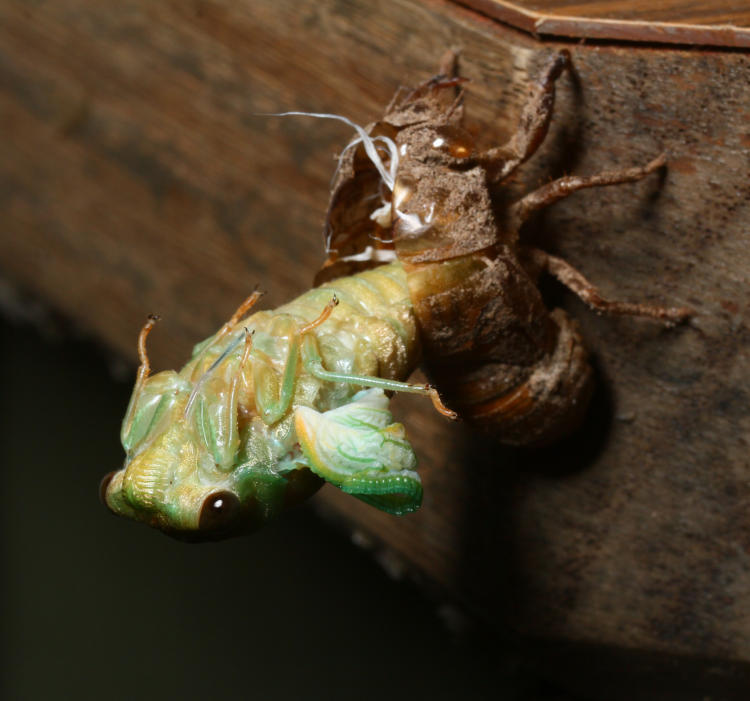
cicada possibly  Neotibicen molting into final instar adult phase
Ah, that’s better! I was too late to capture the initial stages of this cicada molting, but it was within easy view and allowed me to get on several sides, so a nice test subject. As such, we note that the light is carrying acceptably well to the background beneath/behind the cicada, better than a half-meter beyond, and pretty evenly illuminating the upper surfaces without harsh shadows. The shadows on the underside of the body are a little deeper than ideal, but this is how it’s going to be with a single light source – still contemplating that. But yes, this is as good as the old one at least.

For the record, this is possibly a Neotibicen, one of the annual cicadas – I’m not sure I could tell from the coloration at this stage and aren’t even bothering to try, because we’re doing lighting tests here and you shouldn’t be getting distracted. Still, while here we will note the white threads visible from the gap in the molted exoskeleton, which are actually the lining of its lungs, or what passes for such among most of the arthropods. Seriously, go to that link, it’s weird but fascinating.
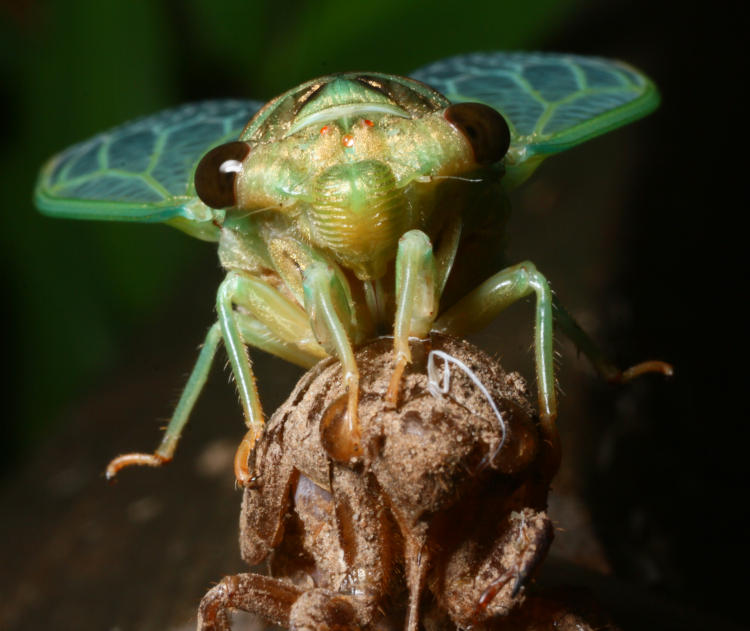
cicada possibly Neotibicen recently emerged as final instar
Just a little later – I’d gone back into Walkabout Studios to get further lenses for more tests in the interim, and now the cicada has fully molted and the wings are extending. It has lived almost its entire life underground up until this point, having now dug itself out of the ground to molt into its final instar, reproducing adult phase, to then go high into trees and produce the unmistakable whine of summer days. But again, lighting. Let’s have a closer look:
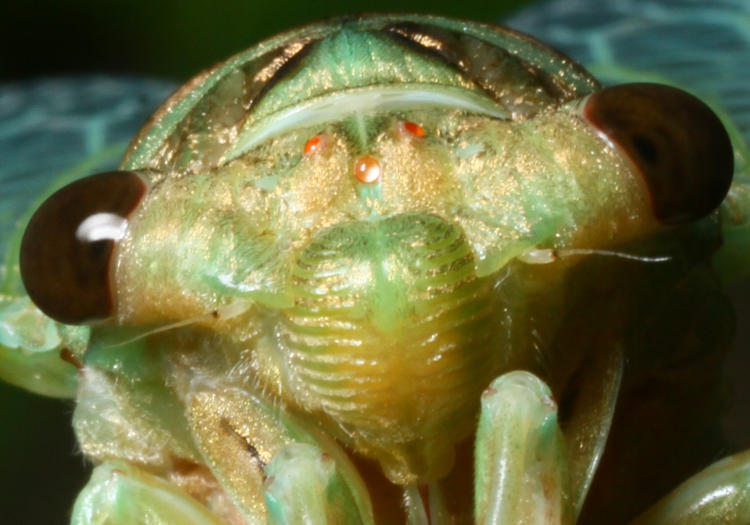
close crop of previous frame showing tight portrait of cicada possibly Neotibicen
The colors and the faint translucence of the exoskeleton at this point are great and all, but the point here is why I even use the flash on an arm in the first place, and that’s modeling. The shape of the head is defined by the faint shadows, which doesn’t work very well with on-camera flash (when it can even be aimed this close to the lens) and not at all with ring flashes which surround the lens and produce virtually no shadows at all. Having the flash on an adjustable arm means I can aim it at will, tailored to the subject.

I’ll point out here the reflection of the flash itself in the eye of the cicada, which isn’t a nice clear circle, but has ‘hotspots’ of uneven light – this shows better with my final subject of the evening.
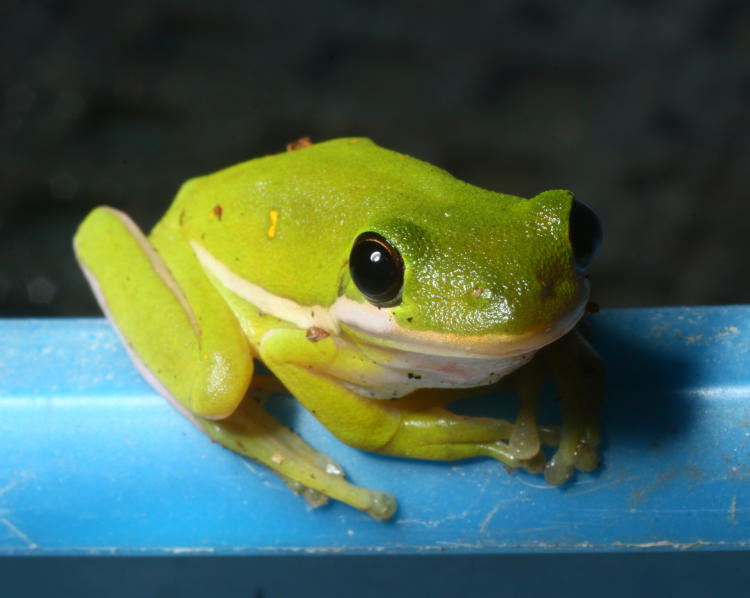
green treefrog Dryophytes cinereus posing for posterity
Highly reflective subjects, which I tackle more than occasionally, show the reason why I opted for a circular diffuser in the first place, because a circular reflection is the most natural-looking and easiest to ignore. Am I the only one that sees the uneven nature of it? Probably not, to be honest, though the numbers of us may be so small as to be beneath notice. Still, I printed two diffusing panels, one in white and one in clear (which doesn’t come off perfectly clear from a 3D printer anyway,) and this was using the clear one. I will probably switch to the white one, which will cut down the light a little more, and run another full set of tests. Right now, however, this is working more than well enough.

The design will probably be uploaded to share among the 3D printing community, though it may well be for a fee (despite the deplorable wealth my photography already produces.) The stumbling block is, virtually no one will be using the flash units that I am, so the custom-fitted adapters will be useless to them, and I’ll either have to include instructions on how to fit the softbox to their own flash heads (not too hard at all, really,) or actually design adapters to anyone’s request, which definitely will be a paid service. Still hashing out the details.
Tripod holes 29

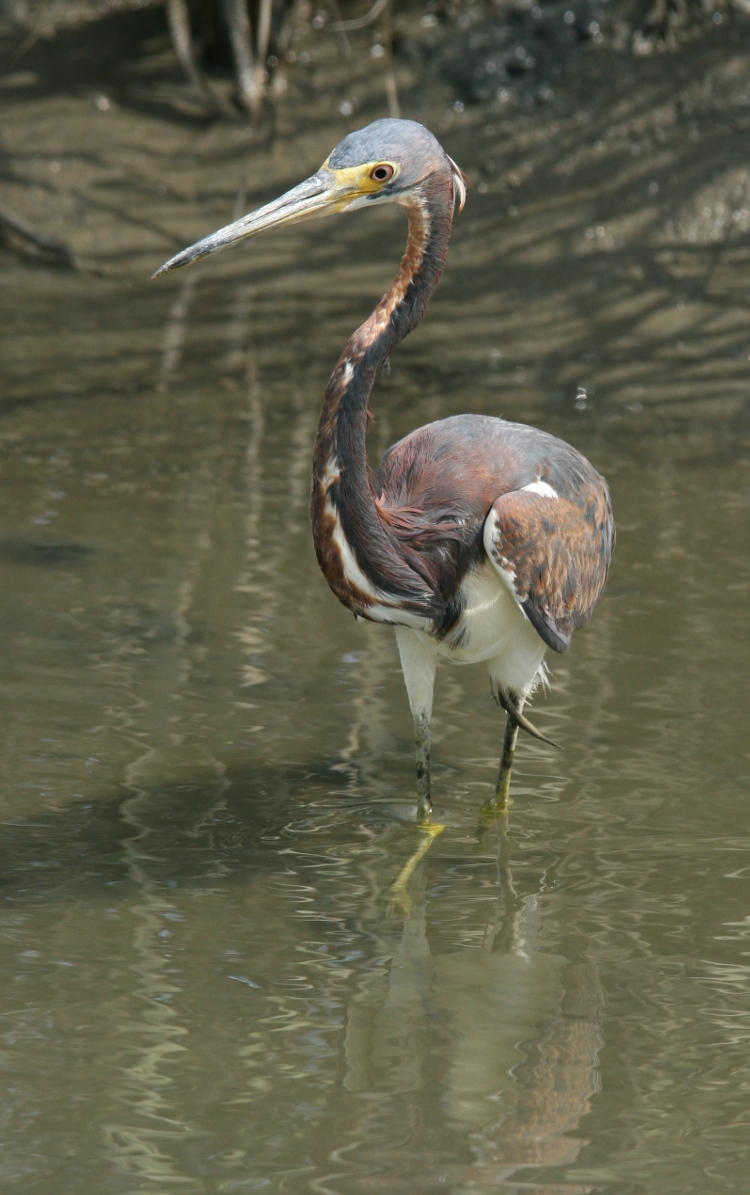
tri-colored heron Egretta tricolor looking curious
N 33°30’40.28″ W 79° 3’54.10″ Google Earth location

This wonderful close approach of a tricolored heron (Egretta tricolor) comes courtesy of Huntington Beach State Park, between Murrell’s Inlet and Pawley’s Island, South Carolina – specifically, out on the boardwalk extending into the swamp, as the plots show. When we visited a few years ago, we passed a plaque along the boardwalk that spoke of the species that may be seen there, and The Girlfriend asked what a tricolored heron looked like. That’s always a challenging thing to provide, and I did my best, but only a few minutes later I was able to just point and say, “Like that.”

Definitely a cool and perhaps underrated area to visit, the state park is home to countless species that are acclimated to visitors and thus allow much closer approaches that in most circumstances, as well as the best tree that I’ve ever been in contact with. Nearby is also Brookgreen Gardens, a huge park largely dedicated to sculpture but also featuring picnic areas, a small zoo and aviary, and boat tours. The beach is kinda boring, but the birds make up for it. We threw the kayaks in for a little excursion around the inland islands just a little northeast of here too. Check it out.

Out of proportion

Boy howdy, peanut-brittle and sausages, do some of these posts take way more time than they really should! But I’ll go into that later. Right now, we have a simple (!) follow-up on the anole front.

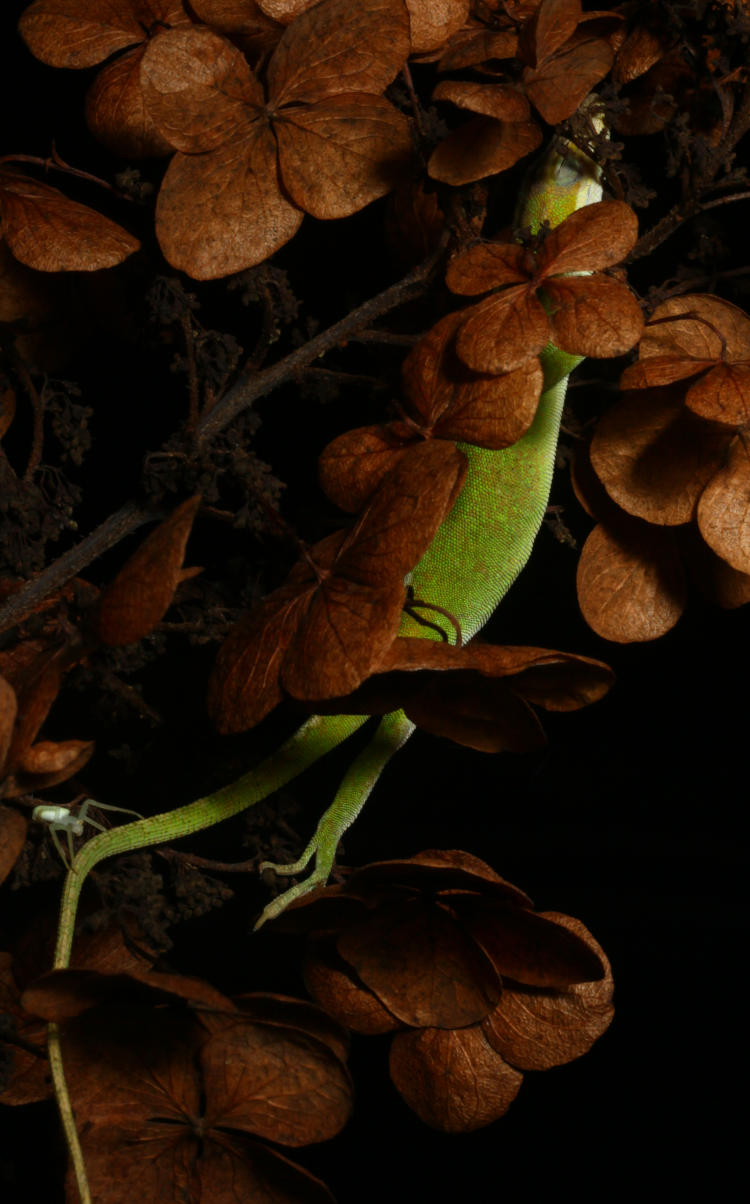
After finding the adult Carolina anole (Anolis carolinensis) snoozing in the oak-leaf hydrangea in the previous post, I’ve been keeping an eye on that particular lizard, because it’s been making it easy – it returns to the same spot every night, and can on occasion be found foraging on the bush during the day.

adult Carolina anole Anolis carolinensis sleeping upright in oak-leaf hydrangea Hydrangea quercifolia
While I have yet to witness this in action, I’ve found that the anole takes its perch near sundown, while there is still plenty of light in the sky, but at that point is deep brown, blending in with the dried flowers remarkably well – it is only after night falls that they turn quite pale. I’m only guessing, but I suspect this is because, after the birds bed down themselves, there’s no reason to be camouflaged and they can adapt a color that optimizes their temperature for the night, and/or collects dew faster. But as I’ve said before, lizardology ain’t my degree, I just takes da piccies…

adult Carolina anole Anolis carolinensis sleeping upright in oak-leaf hydrangea Hydrangea quercifolia
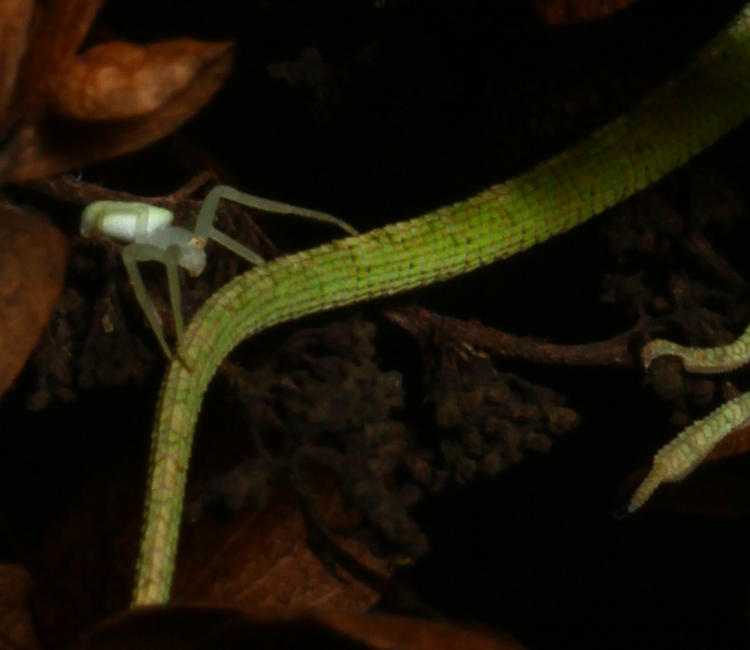
We needed another angle on that same one, showing the one foot just splayed against the dried flowers; the anole appears to be supported solely by its two left feet hooked onto the branches. But what’s that down there?

likely white-banded crab spider Misumenoides formosipes investigating tail of sleeping Carolina anole Anolis carolinensis
We have what appears to be an opportunistic white-banded crab spider (Misumenoides formosipes) literally sizing up the anole, or perhaps just posing for a novelty photo like the typical idiots with wildlife in national parks; there’s no doubt that the anole would scarf the spider up immediately if it were awake. Have your fun, little spider, your days are numbered.

More interesting, however, was Saturday’s find on the butterfly bush (Buddleia davidii.) It was basking on a leaf when I spotted it with my hands full, and when I returned with the camera it was spooking into the Japanese maple.

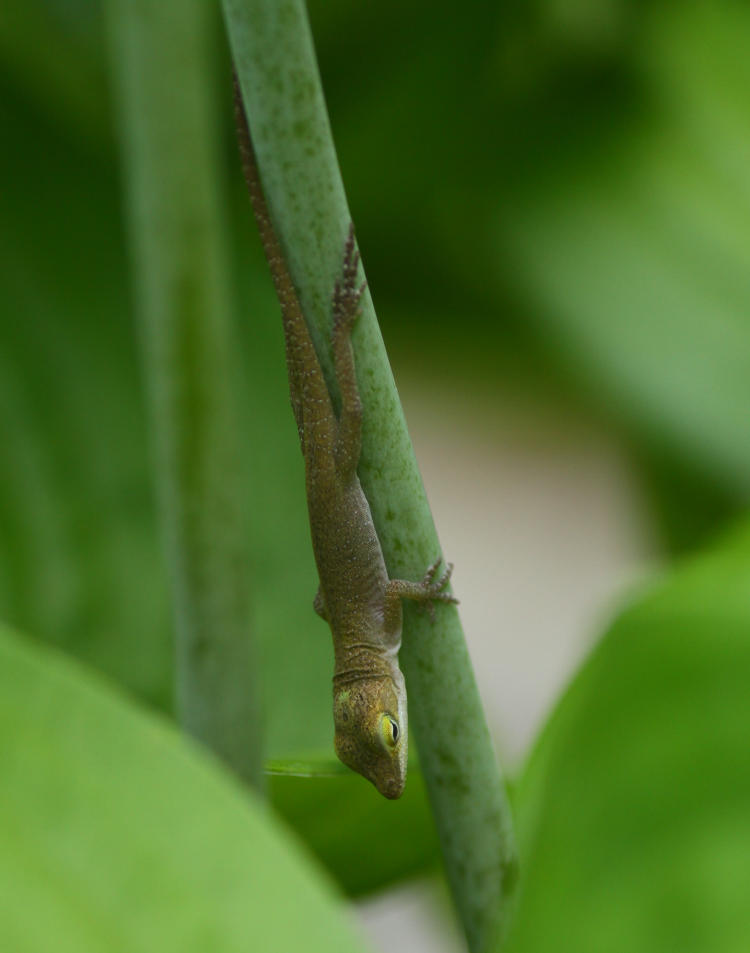
newborn Carolina anole Anolis carolinensis seeking refuge in Japanese maple
That’s pretty much a newborn anole, the first appearance of any this year, and this is perhaps the best sense of scale that I obtained (so far, anyway) – the pale curve in the background is a standard-sized planter, maybe 30cm across, but a video clip from last year shows a better comparison. I have no idea how long after birth they might remain deep in concealment before venturing out like this, but I’ve been keeping my eyes open for just such appearances so this is certainly among the first few days of being in public, as it were. Given this one disappearing into the maple, I figured I’d lost my chance for a decent shot for a while, and I wandered off seeking other photo opportunities. Yet just a few minutes later, as I came back around the butterfly bush, it was basking in almost the exact same location that I’d first spotted it.

newborn Carolina anole Anolis carolinensis basking on leaf of butterfly bush Buddleia davidii
If you know butterfly bushes, you know that leaf is perhaps 100mm in length and no more than 20 wide; this spud is tiny. But unlike its discretion only a few minutes previously (which might have been provoked by carpenter bees visiting the flower clusters,) this time it largely stayed put, and I could get a variety of angles as long as I moved cautiously.

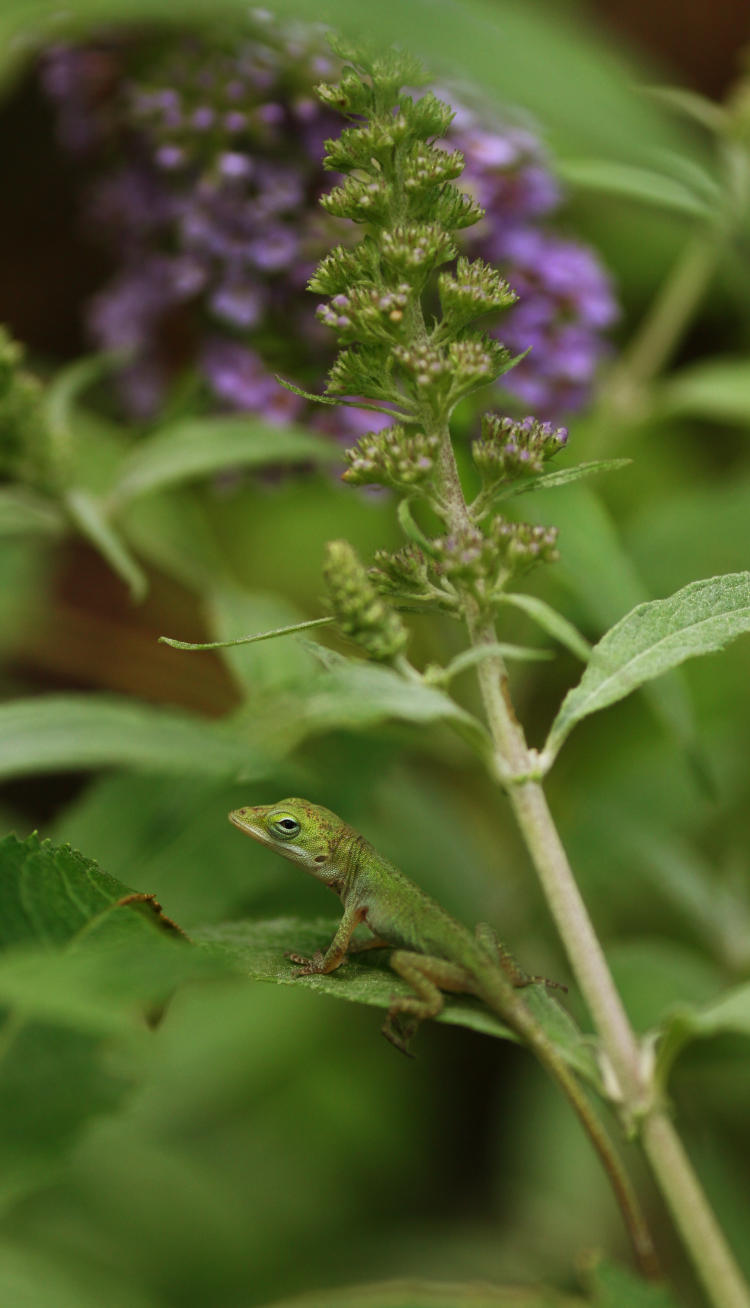
newborn Carolina anole Anolis carolinensis perched near new buds of butterfly bush Buddleia davidii
I would have liked it to have taken up a perch on the flower clusters themselves, but the anole probably knew instinctively that this wasn’t good camouflage or shelter, so for now we just have this pose near a smaller budding cluster. But we need to see the detail from this frame, at full resolution:

very close detail of newborn Carolina anole Anolis carolinensis
The length of this head is roughly the width of a standard pencil, and yet, seen this close, there’s virtually nothing that distinguishes it from an adult many times its size, except maybe the spindly legs; it still possesses the mosaic scale detail and even the proportions of the adult, and the mottling makes it seem way older than a few days or so. A typical housefly would be a hell of a mouthful for this fella – maybe someday I’ll get some pics along those lines. I tried, even with video:

It’s funny: I recognize the issues with doing handheld macro video, but I have yet to find decent ways to surmount them. No, there are no stabilizing rigs that can handle a heavy DSLR and still allow things like tilting forward on demand. I would say I’d design one and market it to other macro videographers, but that’s not a lucrative market – few of them have any more money than I do.

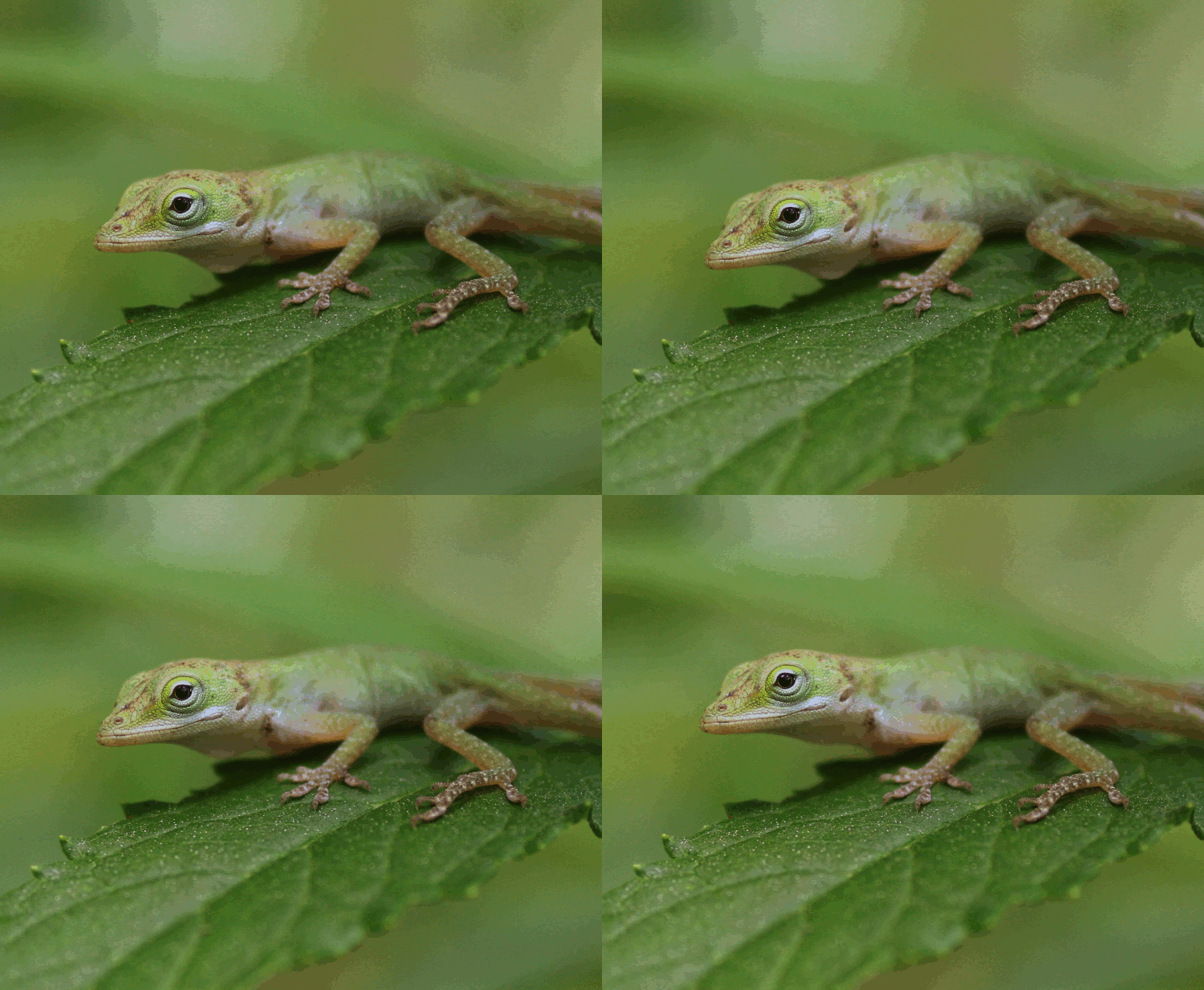
But I know you’re skeptical over the behavior that I mentioned and illustrated in that video, not exactly sure that I’d actually seen what I claimed, so I present another example, an animated gif (pronounced, “grrrr-ATE”) of four frames from just a bit earlier.

animated gif of newborn Carolina anole Anolis carolinensis  doing territorial display
I realized what I was seeing just as I was snapping the first frame and so kept going, unable to switch to video fast enough, but this is adequate. That dewlap, while not exactly displaying like an adult, is undoubtedly extending a little. And no, this is not a ‘swallow’ or anything, because I saw it more than once – in fact, I’d first seen it, almost disbelievingly, last year and vowed to capture video of it but never got another opportunity. It’s so cute when they act tough.

I had brought The Girlfriend out to see my subject here, and she suddenly told me to turn around and check the center stem of the hosta plants about a meter away. She’s getting to be pretty good at this herself.

newborn Carolina anole Anolis carolinensis  on stem of Hosta flowers
Yep, another newborn, and perhaps slightly bigger in size than the first, but not by more than 10%, and I would have to see them side-by-side to confirm it anyway. You know I’m pleased; I love the idea that Walkabout Estates is home to a colony of this species. Now if I can just get some meerkats established…

Even while it knew I was right there, this one scampered up in plain sight atop one of the big hosta leaves and posed, and I went a bit wider for a slightly more scenic shot:

newborn Carolina anole Anolis carolinensis  in middle of large Hosta leaf
Will I be able to tell these two apart in any way? Not likely, though I perceived this one to be a little more active than the other, and will endeavor to observe them closely enough that I can distinguish them by behavior – not holding my breath, but it’s not out of the realm of possibility.

We’ll close with one last shot of the second one, deciding for whatever reason to scamper up the flower stems again and shelter in among the seeds, though whether this was due to my presence or not I can’t say; it certainly danced around quite a bit before it chose to climb up there.

newborn Carolina anole Anolis carolinensis  nestled in among seed pods of Hosta plant
Even if you have no idea what the seeds are, they seem to communicate their size better and give more of a sense of scale, but maybe it’s just me. I missed my video opportunity here, though I hadn’t known it was going to happen, since as the anole gained the seeds its coloration deepened into brown; I do have a goal of illustrating how quickly they can change color, but it often takes some provocation that I’m not likely to induce myself. Many years ago in Florida I witnessed a territorial dispute between a Carolina and Cuban anole, and the Carolina changed into deep brown within about two seconds, which immediately caused the Cuban to rush it. Still not sure what this said, but I definitely vowed to capture something similar one day. Maybe this’ll be the year.

Sleep is the meridian

Mr Bugg and I had a sunset outing to Jordan Lake yesterday, which was unsuccessful in capturing a sunset – it occurred, but not in the slightest bit photogenically. Before that, we were checking out what kind of other activity was available, which also wasn’t much, and mostly too distant for the efforts. But I’ll include a couple of frames for the sake of it.

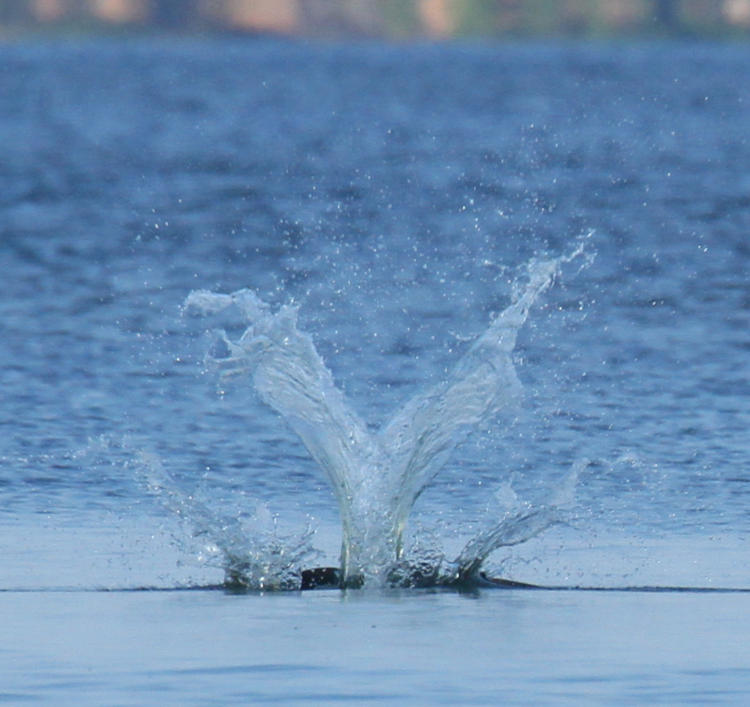
symmetrical splash of osprey Pandion haliaetus entering the water, with no sign of the osprey
This is the splash of an osprey (Pandion haliaetus) entering the water, perhaps the sharpest that I’ve captured (so far,) and with only the barest hint of the osprey showing at all. It was a nicely symmetrical splash though. The bird gave little warning of beginning the dive and autofocus didn’t lock on until it hit the water.

The same bird, successful in its fishing efforts here, climbed out and circled around to pass nearly overhead, and so I was firing off frames of its approach.

osprey Pandion haliaetus passing overhead with fish capture
I thought that I had exposure compensation dialed in for shooting against the sky, but apparently not for this sequence, and thus it’s a bit dark and moody, not at all helped by the sun angle. Clicking on this image, however, will bring up a larger one at full resolution, just to see the detail – the autofocus wasn’t behaving perfectly yesterday, but well enough for some nice frames.

And now we switch subject matter and go to ‘today,’ even though, according to my personal timeline, these were still yesterday, taken in the wee hours of the morning – I am available to answer further questions as needed. Mostly, what I needed to post was the first appearance this year, or the first that I’ve caught anyway (but we all know that I miss nothing) of a behavior I was seeing a lot of last year:

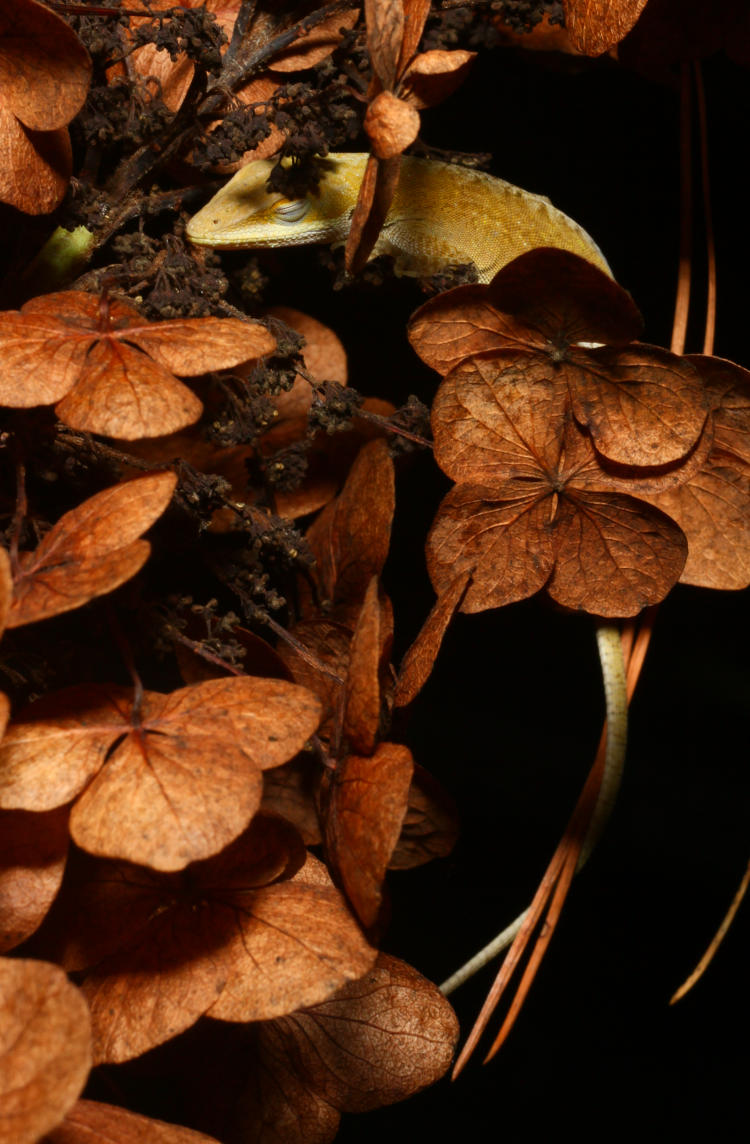
Carolina anole Anolis carolinensis snoozing on dried flowers of oak-leaf hydrangea Hydrangea quercifolia
I played around a bit getting an adequate flash angle without disturbing things too much, to which this Carolina anole (Anolis carolinensis) lazily opened an eye, repeatedly, before closing it again, rendering me inconsequential – I’m quite used to that. It’s draped on the dried flowers of the oak-leaf hydrangea (Hydrangea quercifolia,) which seems to be a preferred perch for night basking at least. To the best of my knowledge, this habit of sleeping suspended up in branches or flowers occurs during hotter days and is a method of gathering dew overnight, though it has to be said that this is about a meter from a full birdbath below, so it’s not like water is hard for them to find, meaning I could be wrong about this. Maybe it’s just akin to how cool we suddenly find hammocks in the summertime.

While out with the headlamp, I took a look around back to see what was happening back there, which wasn’t much, but I did find one of the frogs hanging out by the pond.

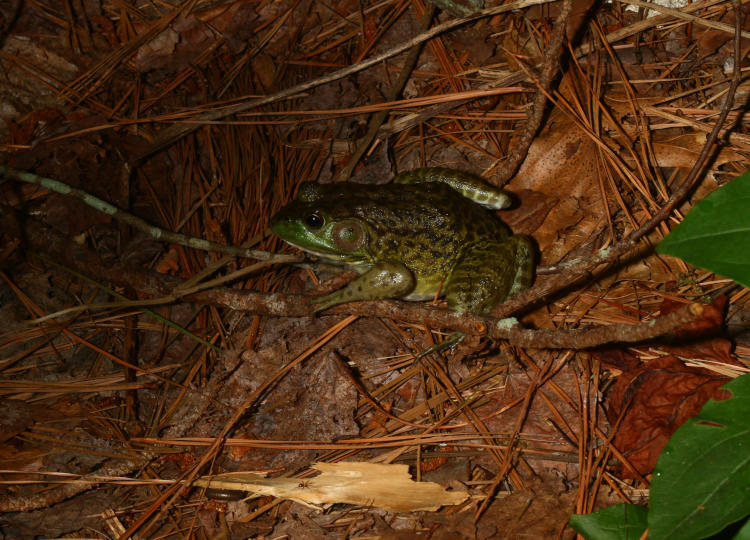
American bullfrog Lithobates catesbeianus just chillin'
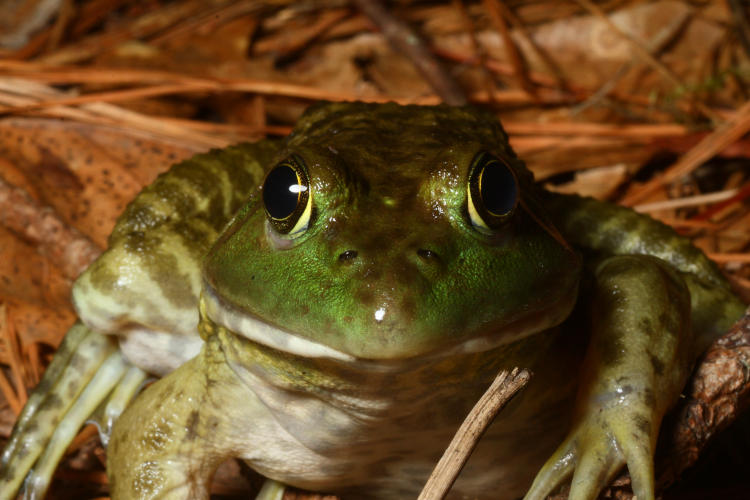
Finding a frog just chillin’ near the water isn’t even slightly uncommon, but the species is a new one for here: this is an American bullfrog (Lithobates catesbeianus,) the first I’ve seen in the backyard, and not a small specimen at that – perhaps a little smaller than my fist. I would have thought the pond was a bit too small for their tastes, and have not confirmed yet that it is a resident and not just on vacation here. I mean, it does kind of resemble me on the beach.

Since it never even twitched as I leaned in, even closer than this, I carefully detoured around (there was a small tree in the way) to the front for the dramatic portrait, being careful not to let the camera or my arms into the beam of the headlamp, which is what normally alerts them to a ‘dangerous’ presence and sends them vaulting back into the pond. I was more successful than expected at this.

American bullfrog Lithobates catesbeianus in direct portrait
This is full frame using the Mamiya 80mm macro, so you know I was close – roughly half a meter away from its nose, and even got the chance to adjust the flash for better lighting than the original frame. You’d think it was a lawn ornament – until I was a little incautious while getting back up and it sailed into the pond in one great leap over its own shoulder. But now I’m curious to see if its actively sharing the little water source with the resident green frogs, and how many of those remain. Plus I’ll have to sit out in the evening with the audio recorder and see if I can snag the calls of either species, but especially both, for the comparison.

Wrong hemisphere

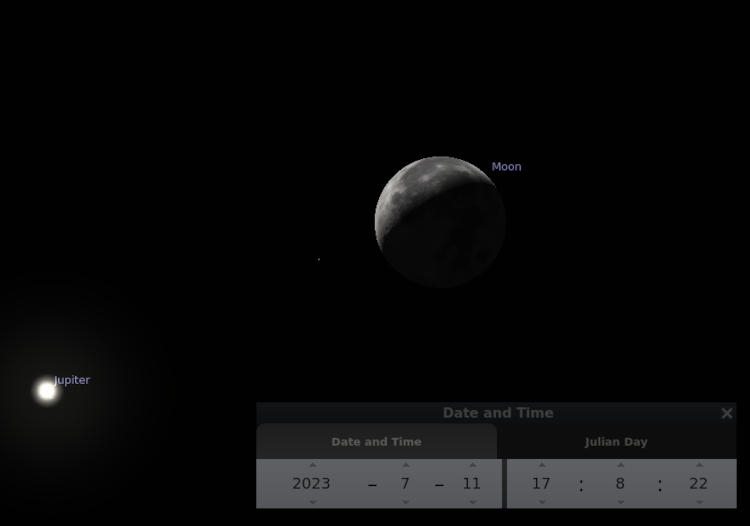
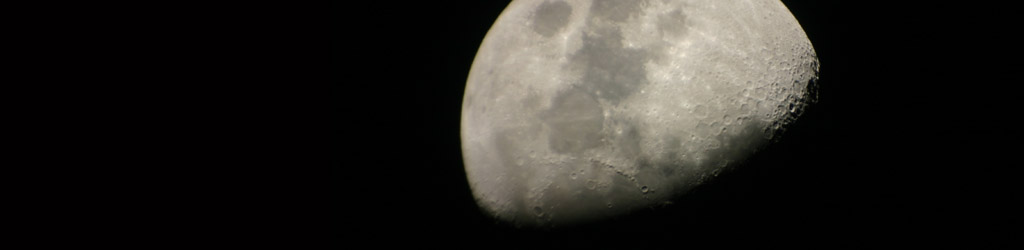
I went out briefly very early this morning (like 3 AM) and noticed the crescent moon had a reasonably close companion, but wasn’t inclined to set up for a photo session at that hour. I forgot about it until reminded this afternoon, and took a look at Stellarium to see what the companion was, and what it would look like tonight/early tomorrow morning. Turns out to be Jupiter, which will have switched positions with the moon in regards to the plane of the ecliptic. That means they would pass in the intervening time, so I switched off both the Ground and the Atmosphere options in Stellarium, eliminating both the view of the Earth and any dayglow from the sun scattering from the atmosphere, creating what one would see if floating free in space far from the planet. Then I played around with the Date/Time menu until the moon and Jupiter passed the closest.

screen capture from Stellairum software showing Jupiter/Moon conjunction
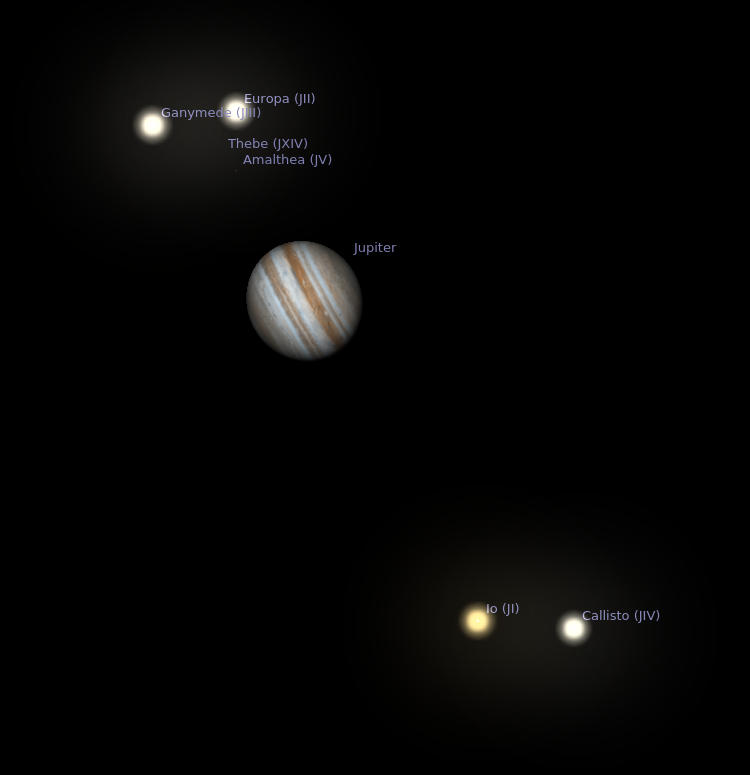
That’s 5:08 PM local time, which of course is still broad daylight, but worse, the moon sets at 3:17 PM, about an hour hence as I type this; at present, it’s too close to the horizon for me to see it with all of the trees in my area. Knowing exactly where to look, I might have been able to spot Jupiter against the blue sky. But then I zoomed in on Jupiter’s appearance during this conjunction, and saw this:

screen capture from Stellarium software showing trapezoidal pattern to the Jovian moons
That would certainly have been a great thing to capture, but there’s no way in hell to see the moons during the day, except for maybe a total solar eclipse. For years, all I ever saw were the Jovian moons in a straight line with Jupiter, because the orbital patterns of Earth and Jupiter put us mostly along the plane of Jupiter’s ecliptic. But now we’ve moved more and the plane is tilted to our view, so the moons can now shift higher and lower, allowing for something like this. If I were in, like, India at least. Ah well, so much for that.

[At some point I’m sure I can capture a similar pattern from the moons, just not with a conjunction, but I doubt I could get our moon, and Jupiter, and the Jovian moons in the same frame anyway, given the huge difference in light levels, so it could only be a candidate for the Photoshop Picture of the Day, er, Astronomy Picture of the Day. Same thing.]

[ADDENDUM: I just checked, and Jupiter, Venus, Mars, and Saturn will all be in the sky during the total solar eclipse of April 8th, 2024, though the latter two will be fairly close to the horizon. I plan to be within the viewing corridor for that event, so I may be a busy little photographer during the few minutes of totality, with as many cameras in use as I can manage. This could be interesting….]

Tripod holes 28

fartistic high-contrast monochrome image of pool in sand
N 35°14’12.95″ W 75°31’41.43″ Google Earth location

A few weeks back, I presented my favorite true B&W image; this is my second-favorite, though the rankings may swap depending on my mood, so be warned. And this is largely as-shot, with perhaps a slight tweak to brightness and contrast, but nothing that I couldn’t easily accomplish in the darkroom. A friend and I were out at the Outer Banks, specifically a beach access south of Hatteras Lighthouse in Buxton, NC, and I was carrying a film camera loaded with Ilford HP5+ because I was in that phase (and likely will be again.) I realized that the sun reflecting from the still water might make a nice focal point and fired off a frame or two; the bright light coming into the lens shifted it from a ‘normal’ exposure to quite a bit darker, which improved the moodiness of the image magnificently.

While I purposefully avoided extraneous elements, the unintended result was that scale becomes almost impossible to determine, potentially even being an aerial photo of a coastline, at least until you find the seagull tracks entering and exiting the pool at the bottom. Curiously, while I usually call this, “Tidal Pool,” it’s not, and appears and disappears in the same location from time to time. From looking at the aerial photos and bolstered by my own hazardous experience (yes, that’s the same pool,) I’m inclined to say it’s a drainage swale from further inland, perhaps only brackish despite its proximity to the ocean. So if you go to this location hoping to duplicate (or, dog forbid, improve upon) my image here, be warned that you may never even see this fleeting puddle.

Limited success

About seven weeks ago, I was at the neighborhood pond without my camera (hush – it was a spur-of-the-moment thing) and spotted a green heron, not too unusual, except that this one seemed to be half to two-thirds normal size. Even the young tend to be just shy of adult size and weight when they leave the nest, and this one was displaying adult plumage. An example of dwarfism in avians? I honestly didn’t know, but I wanted a photo of it. Thus started my quest to find it again, returning semi-regularly armed with the camera and long lens, which naturally meant that I saw no signs of it again.

Until today.

small adult green heron Butorides virescens perched on semi-submerged branch
Only thing was, this time I wasn’t trying for wildlife, and while I had the camera (duryea!), I wasn’t carrying the heavy, bulky long lens with me, because I also had an infra-red camera along – long story, but I’m kinda on assignment for some particular images, and it isn’t even a dedicated IR camera, but the ancient (in digital camera terms anyway) Canon Pro90 IS, which will do infra-red in a pinch. So this image was taken with the Canon 7D and 18-135 STM instead, and limited by 135mm, I was forced to creep closer while not appearing to creep closer. The heron accepted this for a while, and then decided discretion was wiser and all that, and flew off, but I could see that it just cruised around the point of the island in the pond. So I hiked back, ditched the IR for the long lens, and returned.

I did eventually track it down, but significantly father away now so the edge of the long lens was diminished, and the choice of backgrounds and positions almost nil.

very small adult green heron Butorides virescens perched on snag
The main issue with both of these, which I knew I’d be facing the moment I first saw the bird weeks ago, is that there is no way to determine size or scale. What I really need is another green heron of normal proportions immediately alongside, close enough to be in the same frame, or really, any other bird of recognizable size. The chances of achieving this are small, given that I’ve only seen two or three green herons at the pond this entire season, and no evidence of nesting activity so not even any young to be venturing out soon.

During all this I sweated out roughly a liter of fluids, though not from the enormous exertion of getting these photos, rather from the stifling heat; that’s the heron panting in the first photo, and it was svelte and holding still, so you can imagine the effect on my fat ass (well, if you’ve met me in person anyway, since I don’t publish the photos that show reality.) This is part of the reason you haven’t been seeing much here (the heat I mean,) but only part. We’ll see if that can be corrected soon.

Just because, part 52

Carolina anole Anolis carolinensis peering down from upper branch of Yoshino cherry tree
Just a quick one from today, finding a Carolina anole (Anolis carolinensis) stretched out on an upper branch of the Yoshino cherry tree, the same one that I’ve been trying to protect from the Japanese beetles – it would be nice if this guy was eating those, but I’m not sure anything does. After finding the lizard there, a bit higher than I stand myself, I misted the leaves nearby because it’s been hot as shit here recently and I thought it might like a drink; my reward was this expressive pose, though at the same time the reptile’s skin darkened to a medium greenish-brown from the pale green that it was when discovered. What this means, I do not know, but I suspect we might be married now…

Tripod holes 27

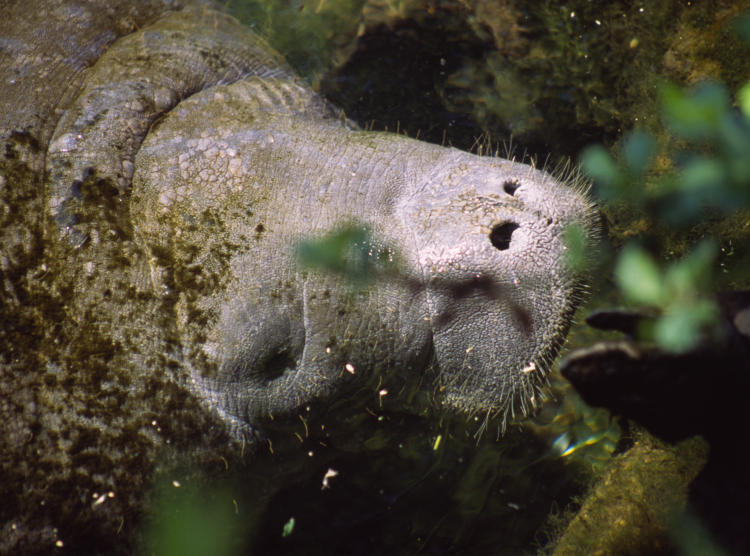
North American manatee Trichechus manatus surfacing for food in Ellie Schiller Homosassa Springs Wildlife State Park, Florida
N 28°47’57.33″ W 82°35’16.94″ Google Earth location

This plot is as close as I can get it with the trees in the way, though if I was there again I could tell you within a half-meter. Not that it matters, because you might see something similar from many different spots, and anyway this particular model is likely not still waiting there.This is a North American manatee (Trichechus manatus,) or at least the head of one, found (easily) in Ellie Schiller Homosassa Springs Wildlife State Park, far too long of a proper name, in Homosassa Springs, Florida – the “Ellie Schiller” part has been added since The Girlfriend and I were there in 2009. We had been making our way south along the West/Gulf coast of Florida and had stopped in two locations previously to try and spot manatees; we’d actually been successful at the first, though it was from a distance without the best lighting and we saw what is typically seen, a snout peeking briefly above the water. This is so unprepossessing that it could easily be mistaken for a turtle, and if you look closely at the image here you can see the waterline around the nostrils that denotes what’s above and what’s below the surface.

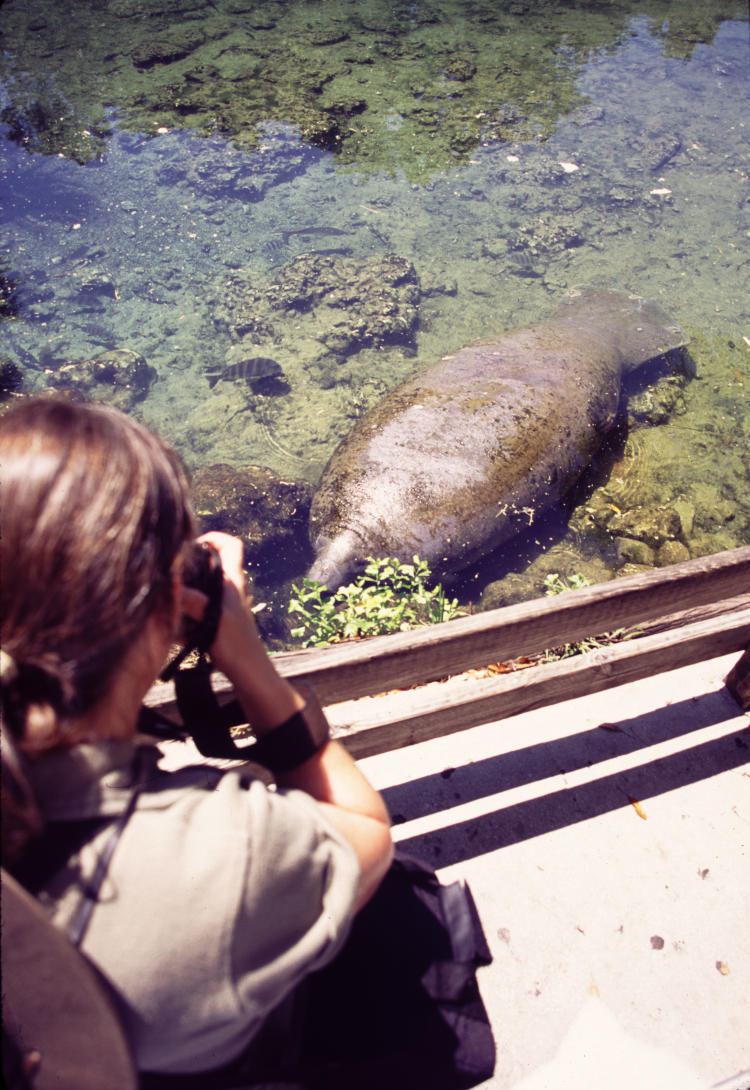
But we hadn’t seen this yet, and were continuing on our path south when we suddenly passed the state park and decided to turn around and check it out. This was quite fortuitous since it is, among other things, a manatee rehabilitation center and one of Florida’s many warm springs, so the manatees were there in abundance, this one in particular coming right up along the shore under a viewing stand to await the scheduled feeding. Thus, captive, but about as close as you could possibly get, so if you want to see what a manatee really looks like, this is one of the better places, short of the tours at nearby locations where you’re allowed to snorkel with them. The Girlfriend doesn’t consider herself a nature photographer (I know, right?) but is more than happy to do so when the subjects are nearby and photogenic, while the definition of that word is stretched a bit when talking about manatees, just slightly above a formless blob and what I tend to call, “the beginnings of evolution.” Which isn’t true at all, and they used to be land mammals, but I can be cruel like that. I include, however, a shot of The Girlfriend getting her own shots, taken from the viewing bleachers in the same spot.

The Girlfriend aiming down at a captive North American manatee Trichetus manatus in Ellie Schiller Homosassa Springs Wildlife State Park in Homosassa Springs, Florida
This is the visual of a story that I still tell, by the way, because The Girlfriend stood there motionless without snapping any frames for a while, and eventually I asked her what she was waiting for.

“I’m waiting for it to open its eyes,” she told me.

“They are open,” I replied, and they’re wide open in the top pic as well; manatees have quite small eyes for their bulk, and that’s as big as they’re gonna appear.

Now, some comments about the locale. The northern to central parts of Florida are riddled with warm springs; the geology is ‘porous,’ largely subterranean caves, that take the drainage from the swamps of southern Georgia and carry it underground until it pops up in various openings throughout Florida. Because they’re deep enough to be sheltered from surface temperatures, the water stays roughly the same temperature year-round, about 23°c – this is pleasantly cool in summer but nicely warm in winter, and thus the manatees love it, and will follow the channels up from the ocean to the spring sources in winter; despite their bulk, manatees can not handle colder temperatures. I say all this because the park sits directly over the mouth of one of these springs, and I mean directly: an underwater viewing area is suspended smack in the mouth of the spring. That’s the octagonal building with the pale green roof immediately west of the plot that I provided, and in those photos you can see the water darkening as the bottom (only a handful of meters deep until that spot) begins to drop off into the cavern system. As I type this, the aerial photos used in online Google Earth and the default in the program actually show manatees in the water. It’s easy enough to zoom out and follow the path of the springwater out to the nearby Gulf, and you’ll see the gate that keeps the injured or ill manatees within until they’re healthy enough to be released.

Ellie Schiller Homosassa Springs Wildlife State Park is also home to an education center and a small zoo, so definitely worth a stop. There’s a boat tour that you can take from the visitors’ center off of Rt 41 (you can follow that narrow, winding channel east from the plot too,) but you can also just drive over to the zoo area.

Two small side notes: the slide film I was using did not come up with a good color register, either from age or (more likely, since I kept my film refrigerated) a bad batch, so the colors have been improved here yet still suck. And North American manatees are also known as West Indian manatees, a name that I’m surprised is still in use; the “West Indies” is a relic of Christopher Columbus’ stupidity and “Indian” isn’t even considered appropriate for the indigenous people of North America. While I find a lot of the ‘Woke’ actions recently to be overreactive nonsense, anything related to the region being considered the ‘Indies’ should have vanished long ago.

1 62 63 64 65 66 327