Estate Find XLVI

Another two part one this week – we’ll start off slow.

While I had been seeing some news alerts that the aurora borealis might be visible in several northern states, I paid little heed to them since North Carolina, despite its name, is far from being considered a ‘northern’ state. Then The Girlfriend’s Sprog told me that we might actually be seeing a display here, and I made it a point to get out to a dark sky location with a decent-ish view to the north – which is harder in this area than I imagined. I did numerous time exposures aimed north at various exposure settings, as well as some not aimed north, for the sake of it. And while chimping at the resulting exposures gave an indication that some light was there on the horizon, I wasn’t convinced that this was any evidence of the aurora itself.

time exposure of night sky to north with faint vestige of aurora borealis showing pink on the horizon
However, the following day I saw some photos from others at this same latitude that had a better view north and did indeed capture a nice pink glow, so it’s safe to say that this is what produced the light here. Certainly not a stunning (or even interesting) display, but evidence that it can be seen at extreme times all the way down here.

time exposure of night sky to the north showing faint vestige of aurora borealis as pink glow on horizon
I could easily have credited this to light pollution from nearby sources, though I’ve never seen it this hue and it was notably different from the glow in other directions. By naked eye, this color could not be made out at all, so not in any way a nice display.

But I did a 20-minute exposure for giggles, unfortunately with less-than-ideal settings that blew it out a bit, so I ended up tweaking the image in GIMP for a more fartistic version.

20-minute time exposure of night sky to north showing circular star trails and aurora colors on horizon
That was part one. Part two was captured last night down at the pond, when some uncommon noises attracted the attention of The Girlfriend and I.

The headlamp in tightly-focused spotlight mode is just barely adequate for video at short to moderate distances, provided I can keep it on the subject while also keeping the camera trained that way, which requires watching the LCD screen on the back which my personal focus range doesn’t want to permit easily – to be sure everything’s sharp, I usually end up using my inherent myopia and looking over top of my glasses at the screen, which naturally starts aiming the headlamp in the wrong direction. This is not a working solution.

The microphone, by the way, was the same Takstar SGC-598 used here, but damn it was picking up too much of the ambient noise – the cars weren’t half as close as they sound in the video. I should have gone with the Azden shotgun mic, but there wasn’t time to affix it to the video cage. The video light that I have (and did use for the latter clips when it decided to work again – don’t know why it balked initially) is an LED model with a broader view, ideal for macro work, but not focused for any distance. And yes, the video monitor seen at that link would help with focusing, but not with keeping the headlamp aimed correctly.

The beavers, meanwhile, were initially willing to ignore the bright lights and the occasional odd sounds coming from The Girlfriend and I, but eventually began to believe that this might not be kosher. It’s a shame that I wasn’t prepared for video right from the start, because on first finding one of them (which I believe might have been this year’s offspring,) I watched it stuff its head into a tangle of water reeds and plow around after something in there, venting a little grunt/whimper of frustration – this helped support the idea of it being young, since I’ve never heard the adults make any noise save for some teeth chattering as a warning if approached too close.

But, yeah, I have some improvements to make if I intend to pursue these kind of subjects with video. We’ll see how that goes…

You can always try

night time exposure view of Orion with plane passing through
This is just to give you adequate notice that the Leonids meteor shower is expected to peak the evening/morning of the 16th/17th, just a few nights away. While it is not forecast to be a significant one this time around, it has a tendency to be a decent display, so go for it.

Just to let you know, pictured is not Leo, but Orion, and not a meteor, but a plane of course. I have no worthwhile pics of a Leonid meteor, or indeed any, and not from being lazy. But we needed something here to capture your attention, and I just got this shot recently. Rest assured, if I get a decent image of a meteor, you will not only know about it, but I will be celebrating this long overdue event, a cake and a DJ and possibly a trained elephant. Don’t get me started…

You don’t say?

collection of over sixteen Canada geese Branta canadensis on edge of backyard pond
Last Friday, we featured a video of the return of the Canada geese (Branta canadensis) to the pond after their curious disappearance months previously; the count was always either six or eight geese at any given time. A few days after that, I was looking out the bedroom window just after waking up in the morning to see nothing out there, until a flash of movement through the trees drew my attention, and a small flock of four or five came in to land further up by Turtle Island, some on the water and some actually on shore.

By the time I got downstairs, however, the numbers had increased significantly. Being blocked by various cypress trunks made it hard to be precise, but I dependably got at least fourteen. After feeding the cats, I took a bucket of corn down to the water’s edge – we won’t do this while the ducks are present because they’ll scatter and we’d rather not scare them off too often, but the geese are relatively complacent, just giving us a little distance. At that time, I got a count of nineteen, twice, which is a big jump in the number, literally overnight.

Obviously, the word was getting out that this was a safe place with food – but that got me to thinking, since no words were getting out at all. How, exactly, was this idea being communicated? And forgive me, because from this point on it’s only going to be idle and unedumacated speculation.

We’re oriented towards sound/speech/vocalization, so the first direction we tend to turn is thinking that the honks that the geese use from time to time are a method, and to be sure, there are subtle variations that can be found in the pitch and spacing and volume. I am reminded of our (human) neighbors in central New York, when one of their sons was now old enough to obtain his hunting license. They grew corn to feed their dairy cows, and the geese often used these fields after the harvest because it was a safe stopover and always had some leftover cobs available to snack upon. I could see the neighbor out there on the edge of the treeline, waiting for the geese to arrive, and when a flock was cruising in low, he gave forth with his goose call – only, he was imitating an alarm cadence, and the geese veered off and never landed. It’s not simply the sounds they make that matter.

So perhaps the geese now visiting our ponds have honked out the charms of their destination, but from experience, I can tell you that honking isn’t used that often at all, more often in flight and in gathering the flock together as one for takeoff. Since we’ve had at least two different groups visiting, this doesn’t seem to be a collective flock circumstance (especially when a flight can be as few as four or five geese or as many as several dozen, which could not be entertained on our little pond.) Moreover, for three days or more we had no more than eight, and then suddenly that number better than doubled. And to add to that, quite a few of them don’t fly in at all, but simply swim through the channel from The Bayou (which is much larger and even better protected, at least from a gooseley standpoint, because no one has access to the shoreline at all.)

Nonverbal cues are often far more prevalent in the animal kingdom, and indeed, we use them a lot more than we give credit for ourselves. We (perhaps just ‘I’) might ask what kind of behavior clues the others in? Is it that the initial group tended to leave some common meeting ground together to come up to our pond, or maybe how long they stayed away? Did they show little interest in food when they returned, suggesting that they’d been eating well while they were gone?

There’s a possibility that it’s a time of day thing, too – maybe geese have certain times that they seek food, and leaving for another spot at these times was indicative? Morning, of course, is prime feeding time for just about any diurnal animal, so suddenly heading out to another locale at that time perhaps says all that it needs to.

I’ve watched several movements that are repeated, from both the geese and the wood ducks, and they certainly seem to mean certain things though I have yet to hash out a decent ‘vocabulary,’ and of course I’m not able to see them at all when they’re about to leave The Bayou (or anyplace else) to come up to the main pond here. There may be some subtle communications of that nature, head bobs or shakes, flapping just before heading out, things like that. I’ve seen one goose always on lookout when anyone is feeding, same with the mallards, and this might be carried to the wood ducks too but they’re in such a frenzy when they finally do come up on shore and I’ve never seen one that’s committed to being the lookout, though often there’s one seeming to temporarily fulfill that duty. With the geese it’s more obvious, as are their warnings once we got too close; this really applied to the previous collection visiting, who were semi-habituated to us, while these are far more wary and maintain a certain distance out on the water when we’re nearby.

I have no conclusion to offer, just trying to hash out something that’s outside of our normal perspective, and offering perhaps a little insight into what any animal observer should try to pay attention to. Decent and definitive answers likely only come from dozens to hundreds of hours observing, and I’m certainly not at that level yet with any individual species (I tend to treat it as a buffet of many species and not concentrate on any one, which stretches things out a hell of a lot longer.) Naturally, anyone that has greater info is welcome to jump in and tell me where I’m all wet.

six Canada geese Branta canadensis cruising past in backyard pond

Life in the wild

To say that the property is littered with lizards is understating things to a serious degree, since they can be seen nearly everywhere when the day is warm enough and the sun is out, and I’m used to seeing them scampering away around the edges of the house, shed, and greenhouse – in fact, I have to regularly check the shed to see who’s gotten locked inside because, if the door is open for longer than ten seconds, they’re compelled to go in there. We even leave the garage door cracked at the bottom now so they can escape from their forays into there.

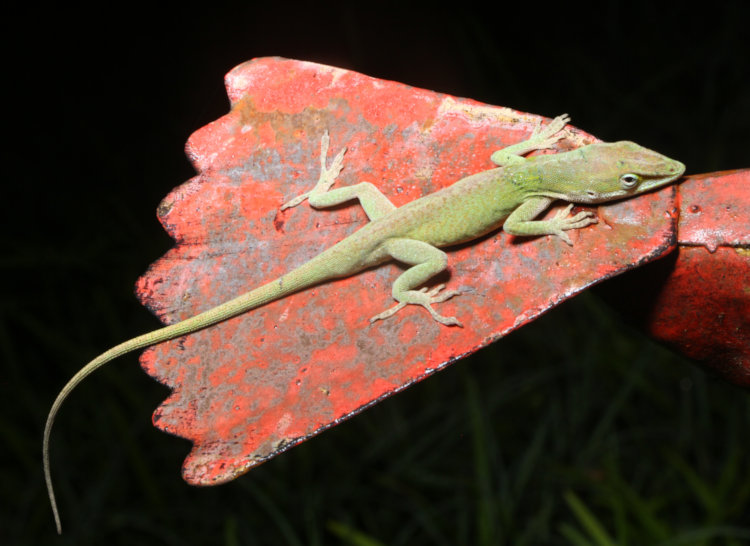
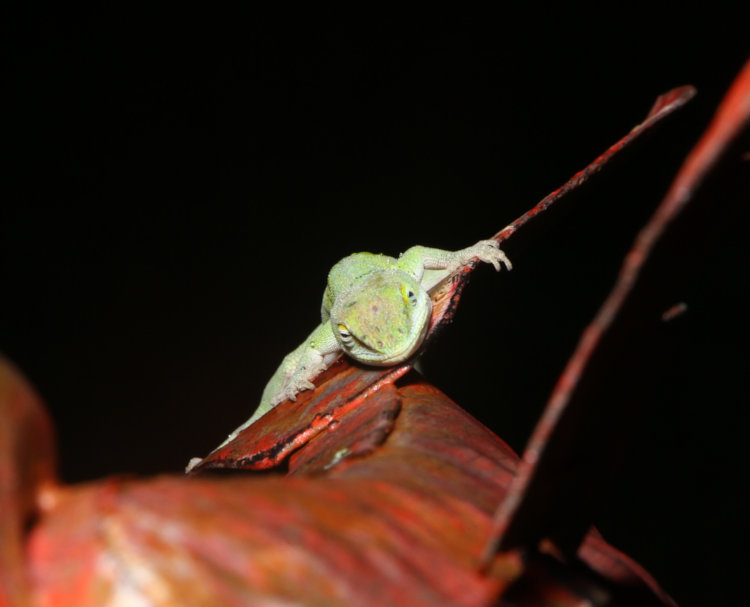
So why I specifically noticed this Carolina anole (Anolis carolinensis) as it sat on the ramp into the shed, I can’t say, but I thought something looked odd. I managed to capture it easily, too easily, and then had to find something to put it into since they’re sneaky little cusses and can easily slip between fingers. Eventually I got it into the bathroom ‘studio,’ but it resolutely refused to stay in the dish setting and flew out of it instantly, twice, and so I decided to take it outside to the coral bark Japanese maple and use that as a setting. Thankfully, the anole stayed put and I could get some detail shots.

Carolina anole Anolis carolinensis with drastic eye issues
This is about what I was first seeing, the lizard only half of adult size so the head a mere 10mm in length, and I couldn’t tell if that black ball was a seed or debris simply adhering to the head, or some serious issue; it turned out to be the latter.

Carolina anole Anolis carolinensis with left eye swollen out of socket and black
That’s either the eye itself, or some growth thereon, but either way I’d say there’s no going back from that. Checking the other side wasn’t a lot better.

Carolina anole Anolis carolinensis with infected ad misshapen left eye and right eye entirely missing
The right socket was entirely empty so the anole was completely blind, making its mad dashes out of the dish that I was using as a photographic setting rather surprising – at least it paused on the leaves of the tree and remained there as long as I didn’t disturb it.

I seem to recall reading about something infecting wild reptiles, but can’t remember exactly what and can’t find it now. I know I’ve come across both a green treefrog that was missing its eyes, as well as a yellow-bellied slider back in the pond near the old place:

yellow-bellied slider Trachemys scripta scripta missing both eyes
Now, I can’t vouch for how well a slider can cope with not being able to see, since they’re herbivorous and mainly feed on subsurface plants – can they do that by smell or feel? I honestly don’t know. But anoles are sight feeders, pouncing on insects in a lightning fast manner, and lacking sight, this one’s simply going to starve.

blind Carolina anole Anolis carolinensis dangling from Japanese maple by its hind legs, unsure of how to flee.
It started to move out of easy sight behind some leaves, but my gentle nudge caused it to start to flee, stopping only when it was finding no purchase for its front legs, and it remained there, unsure of what danger was present. This isn’t precarious for them – they can sleep like this, and climb vertical and quite smooth surfaces like the plastic sides of the greenhouse, so I left it alone, but then after confirming its condition by examining the photos that I’d gotten in detail, I gathered it up again. It had dropped to the grass beneath and was making its way along in short dashes, easy enough to capture again.

Knowing that it would only deteriorate from here, I started the car and flooded with container with car exhaust gases, then sealed it tight overnight so the carbon monoxide could do its work. It was that, or slice its head off with a sharp knife, so I opted for the cleaner and more peaceful method, not to mention that I couldn’t count on the lizard to hold still enough and I’d probably end up slicing off a fingertip instead.

A batch of autumnal monochroma

“Wait, monochrome?” you say, “As in, black and white? Al, you fucking moron, fall is the time to exploit the colors, not eliminate them entirely. What, are you trying to be avant-garde or poetically ironic or something equally spastic?”

Which hurts, I admit it, even when I wrote it myself. But I saw the possibilities of some of these, which worked better than most of what I’ve shot in the past several months for converting, so here we are. Now try to be nice.

time exposure of backyard by moonlight, reduced to only red channel monochrome
By converting this one, it almost says “moonlight” better than the original. This is channel clipping again, just the Red channel. If you haven’t tried this, you should – some pics just look blasé, while others pop up with something entirely new.

fraternal potter wasp Eumenes fraternus on chrysanthemum blossom, reduced to only Blue channel
This one wasn’t part of the original lineup, but as I was doing these, I went back through recent pics for some candidates. Most of them didn’t work that well, but this one converted nicely, using only the Blue channel this time; most times Blue is the least interesting, often grainy, but it brought out the mauve chrysanthemum blossom well. The fraternal potter wasp (Eumenes fraternus) was already monochrome anyway.

An insert here, two that have been sitting in my folder for nearly a year – I just never posted them. But this is a view of The Bayou in winter, taken from the best vantage that I could reach by foot (so far, anyway):

view of The Bayou in winter, reduced to only the Blue channel
Just the Blue channel again. I could have tweaked contrast to improve this one, but there was a reason that I didn’t, which is, this is the full color version:

view of The Bayou during winter, nearly monochrome by itself
The cypress had all shed their needles, and the Spanish moss never has much color anyway, and facing south (my only choice) made the sky more washed out. In fact, I think it had more color than it might have because that’s ice you’re seeing, reflecting the sky color even better. What I should do is convert the two images into an animated gif (pronounced, “JREY-skayl“) that slowly morphs between the two, and say nothing about it, just to make people think their vision is going wonky.

Carolina anole Anolis carolinensis overexposed, converted to greyscale
This one, from October’s month-end abstracts, is simply a conversion to greyscale – I tried channel clipping, but each of them left something to be desired. I like how the eye almost produces a pure black and thus suggests the exposure was close to proper anyway, while the rest is a light pencil sketch. Very avant-garde.

backlit bald cypress needles reduced to only the Green channel
The Green channel this time. Funny thing about this one: I had an original cropping for the color version all set to go, but then when I converted to greyscale, I realized it looked better with a slightly different crop – and so did the color version, so that’s what I ended up using. Hilarious, right?

scattered leaves on surface of water with high contrast by reflection, combined Green and Blue channel greyscale
I remarked on the high contrast of this one despite the low contrast lighting conditions, and this is what prompted the monochrome experiments in the first place. This is one of those minor refinements, in that it’s a combination of the Green and Blue channels, making the Green (which sits ‘above’ the Blue) transparent to a degree – either one by themselves wasn’t quite right. Now it’s even more surreal and seems far more like elaborate digital editing, which might work against it standing alone – we know what the color version looks like, so we know it’s just a trick of the light and surface tension, but without that it may seem too artificial. Still, I like the eye-bending aspect of it.

And finally,

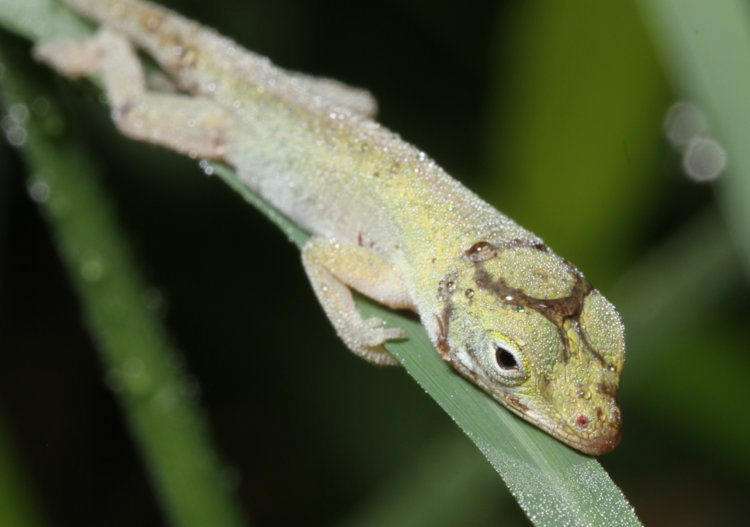
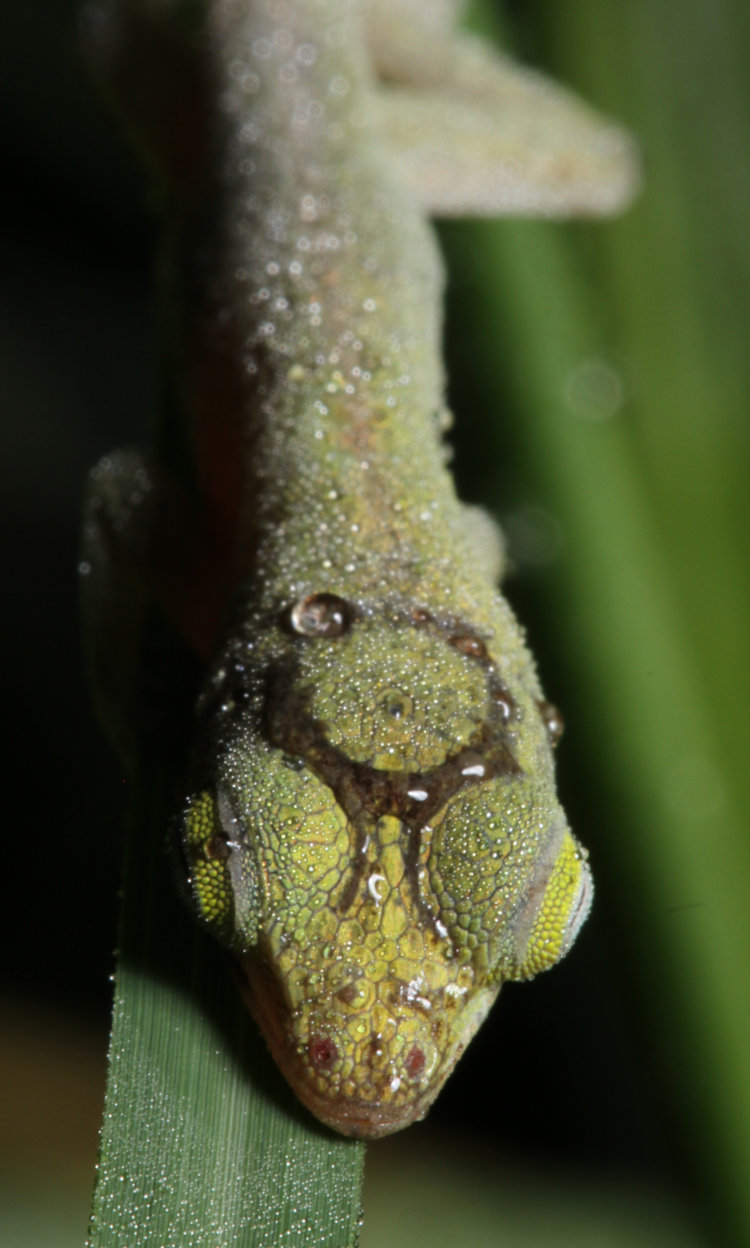
dew-covered Carolina anole closeup reduced to only Blue channel monochrome
I did this one some time back, soon after the original posted, but had nothing else to go with it, and just remembered it now. For saying that the Blue channel is often a poor choice, here it is again – we’ve actually had more of these in this batch than the other channels, so maybe don’t listen to me. I know, “Way ahead of you, Al,” shut up. But seriously, go do your own experiments, see what you produce – it’s healthy and appealing to the appropriate sex, and how many things can claim that nowadays?

Comparing the mics

Last night we had a thunderstorm roll through with some halfway decent thunder production, and I grabbed the two wildlife microphones to do some recording and comparisons. This turned out to be a great test subject, because it demonstrated just how different the methods captured sound.

The first microphone is the newest addition, though I’ve had the main part for a while: a Sony ECM-44B lavalier mic, but fitted to a 3D-printed parabolic dish to focus and magnify sound (I’ve reprinted it since that post, so it’s slightly improved now.) Initial tests with this showed that it was excellent at being able to pinpoint a sound source by the changes in volume as it reached the focal direction. But the smaller the parabolic dish is, the more low-frequency sounds it fails to capture; ideally, it should be in the realm of a meter across, but that’s unwieldy in just about any application, and commercial designs seem to fall a little less than a half-meter. Mine, however, is 26cm across the widest section, limited by the size of the printer bed.

The second microphone has been in use for a while now, an Azden SGM-2X unidirectional ‘shotgun’ mic intended for exactly these kind of uses, fitted with only a ‘dead cat’ wind guard. Shotgun mics are really slick in how they reduce off-axis sounds, and I don’t want to go into it here but encourage you to look it up if you’re unfamiliar with it, because it’s great.

Both mics have their own power source, a single AA battery, and both were feeding into an Olympus VN-8100PC digital audio recorder. Both were also pointed in the same general direction from the same location on the front step, about 30° upwards over the tops of the nearby trees where I could see the flashes and occasional lightning bolt, and by this time it was raining steadily, as can be heard. Unfortunately, I couldn’t do a direct side-by-side comparison since I only had the one recorder, so I could only pick thunder examples that seemed roughly the same, so precise it’s not. That said, the audio recordings showed a drastic difference in tone.

First, the parabolic dish mic:

Parabolic dish mic test

I had amplified this one slightly to get the ambient rain sound in the same general realm for both recordings, so the thunder could be more directly compared, and I let the recording run until I could no longer make out the echoes of the thunder.

Followed by the shotgun mic test:

Shotgun mic test

That’s a world of difference – the parabolic dish really doesn’t capture the lower registers well at all, though I think the shotgun mic is both optimized for them and has more of a built-in pre-amplifier. It also has a ‘low pass filter,’ which can reduce much of the very low frequencies/longer wavelengths, since a lot of ambient noise falls into this category. However, I was not using this setting since I wanted to see how low it captured.

Another example from the shotgun mic, this time of the loudest thunder that I heard while out there. Listen carefully, because you’ll hear the rain vanish for a few moments:
Thunder through shotgun mic

I actually heard the rain seem to stop through the monitoring headphones, amusing because I was standing right there and knew that it hadn’t, and I was a little concerned that the audio had issues. But what I suspect now is the Olympus recorder has an auto-levels setting and it quashed the volume as it began to creep too high, resulting in the quieter rain dropping off.

I also have to mention that I stepped out into the rain with the parabolic dish, and this is not recommended: the thin plastic of the dish picks up the raindrops hitting it all too well, producing a tinny but distinct tapping sound, close to the sound of rain on tight sheet plastic (which I guess it is.) Meanwhile, the dead cat on the shotgun mic prevents nearly all noise from rain hitting the mic, though you can still here faint taps when it hits the mic body outside of the wind guard. And both, of course, need to be handled gently with as few hand movements as possible, since these transmit through the bodies and come out quite distinctly in the recordings.

But I think the answer is clear, and I’ll be staying with the shotgun mic for audio and video recording, though I intend to do some tests with the wood ducks, notably much higher in pitch, to see if the parabolic mic amplifies those better. I think it’s likely that the parabolic will be used mostly to locate subjects with precision, because it is good at that, while the useful recording will be with the shotgun mic.

[I just have to add that I have a lightning tracking app on my smutphone, and I purposefully changed the alert tone to an actual recording of thunder that I’d made some years ago – which went off while I was listening to the audio of this very post in draft form. Nice little surround-sound effect…]

Next batch of autumnal chroma

“Autumnal” – that’s where Radar O’Reilly is from, isn’t it?

Now on to part two of the recent fall color pics, most of them from right here at Walkabout Estates Plus, but a few from a downtown park. Like this one:

unidentified tree producing backlit autumn colors against blue sky
We actually saw this same tree last time – this is just a different spot on it. Making sure to use the backlighting, of course.

Canada geese Branta canadensis in backyard pond under variety of autumn colors
The light wasn’t the best, the colors not exactly popping, but convincing the geese to come back at a better time wasn’t going to happen – and I didn’t tweak this one for more saturation this time, either. Perhaps I should’ve…

I remarked earlier that the bald cypress in the immediate vicinity all had different schedules for changing. We have this one, hanging on in places:
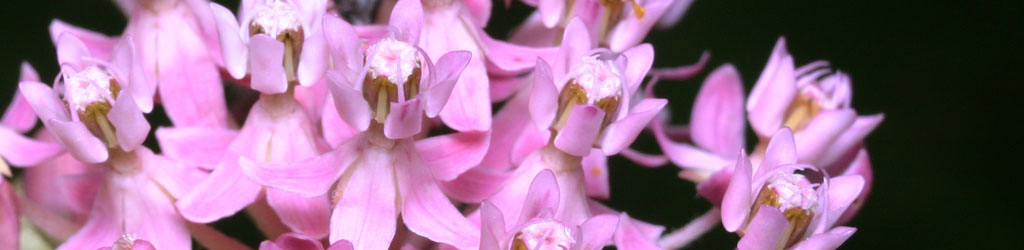
bald cypress Taxodium distichum with green patches among the fall foliage change
… and then this one, completely given over to the orange side:
bald cypress Taxodium distichum completely turned to red-orange in fall
… and why there’s such a difference, I couldn’t say (without a decent contract.) It’s not like there’s any significant change in the conditions, or their distance from the pond. The best I can say is that, due to the open area of lawn (I use that word loosely) alongside this one, it receives more direct sunlight than the others which are clustered together, so maybe that’s it.

We can’t neglect our leaves on the water, a perennial favorite of mine:

variety of fallen leaves and duckweed on small channel of backyard pond
I made it a point to choose an angle that caught the sky and neighboring tree trunks reflecting from the water, brightening the frame considerably more than the typical dark water background. And selected that red leaf of course, but there aren’t enough maple trees in the area to provide sufficient fallen red leaves. We are at least trying to remedy that with the Japanese maples that we planted, but they’re all pretty small right now so their contributions are minimal – give it a few years. Though this one is trying:

changing colors of coral bark Japanese maple Acer palmatum 'Sango kaku' on same branch
Yes, we saw this same coral bark Japanese maple (Acer palmatum ‘Sango kaku’) before, and we’ll see some of the leaves again as a setting in a post or two, but I just like the way the colors change so abruptly on the same branch, and this tree isn’t even as tall as I am, having maybe a half dozen branches – we just got it this summer, and transplanted it less than a month ago. I may also be back to feature another, whose autumn changes made me wish I’d set up to do a time lapse.

yellow fall color of probable grapevine backlit against blue sky
C’mon, clear blue skies and backlit yellow leaves? You always have to try and make those work, even when you have a bare quartet of leaves to work with (I think this is a grape vine.)

Now, the same night that I did the ‘supermoon’ pics, I also did some time exposures by the light of said moon, and we’re going to see four of them, spaced out a little. This is the first:

time exposure of upper end of backyard pond under light of full moon
81 seconds, f5.6, ISO 800 – you can see some streaks from the stars, and they’re only as short as this because this was facing north-northeast. But I also did a variation of this perspective in daytime, albeit when the sun vanished behind a cloud:

wood duck nest box over backyard pond under fall colors
Another look at the wood duck nest box, patiently awaiting its use in early spring. See that trunk just barely peeking in the frame to the right? That’s the same as in the image above it, the most distinct one a little right of center – the moon wasn’t reaching the nest box at that time, unfortunately.

time exposure under full moon of backyard pond, fall colors, and Turtle Island
That’s Turtle Island in the center there, which appears to be in the center of a well-trimmed lawn because of the duckweed, but that is indeed water. This is about a dozen meters to the right of the previous night exposure, on the bend on the pond.

cluster of backlit possible maple leaves in fall colors
Another from the park – maple? Not sure. I selected the leaf at bottom as the focal point because it’s relatively unobscured and unshadowed, and made sure the focus brought out the veins.

Back to Walkabout Estates at night:

time exposure of stretch of back yard of Walkabout Estates Plus under moonlight
A similar shot, also under moonlight, was featured a month ago – last full moon, of course – but without much of the autumn coloration then. Once again, a little assistance was provided by the streelight that sits at the head of the driveway, coming in from the right around the end of the house. Though it’s not terribly visible, the thicket to the right is actually the foliage within The Puddle, a damp hollow that’s sometimes a tiny pond, and sometimes just squishy – it’s closer to pond right now.

Back to daylight.

branch of bald cypress Taxodium distichum showing fall color variations among the needles
Another branch of the bald cypress right in mid-change, caught as a shaft of sunlight worked its way through the canopy, making it glow. We’ll see another variation of this later on.

Back to moonlight.

time exposure of pond in backyard of Walkabout Estates Plus under light of full moon
We saw this same perspective a month ago, too, even with the same strand of Spanish moss, but without the schmuck this time. That’s Duck Island left of center, four different species of tree sprouting from one little tussock that isn’t even above water right now. I like how the moonlight rendered this (84 seconds, f5.6, ISO 800.)

And finally, back to daylight, kinda,

collection of fallen leaves on water surface with reflected hazy sky
I’ve done a variation of this long ago, with the fallen leaves and the reflection of bare branches in the water surrounding them, but this time it’s more mocking with full foliage in the reflection. While the light is distinctly low-contrast and the colors all quite muted, the image nevertheless has high contrast from the water reflecting the sky and the leaf shadows, with the surface tension rimming much of the detail in stark outlines – I like how this came out, half-unintentionally, and you’ll see a variant of it soon.

That clears out the autumn colors that I’d had in the folder, which is not to say that some more won’t be along, but this is the best showing that I’ve had in years, I think. Without making any special trips, either. One of these days, we’ll get a mountain trip timed right, though we’re now at least five hours from the mountains. Too late for it this year, but there’s still time to find a few more selections of foliage in this area, so we’ll see what transpires.

I am not to blame

Listen – we haven’t seen a single bunny rabbit in the yard since we moved here. There have been a handful of fawns, and you’ve seen them all. No lambs, no kittens, certainly no red pandas or meerkats or bushbabies or quokkas. Assuredly, if there were, I’d be photographing them, but I can only snag what I see, and the cute ones are few and far between. It’s not my doing.

The other night when the supermoon was stunning the entire world, for some reason, the wolf spiders were heavily in evidence, emphasis on the ‘heavily.’ Spotting the eyes in the headlamp, I sidled up to the largest wolf spider I’ve ever seen – and then another, and another. Within four minutes I’d found four monsters, three of comparable size and one just a wee bit smaller. Between the moonlight and the nice temperature, I’m guessing they were taking advantage of prime hunting conditions, but that’s only a guess. We’ll start with one in its habitat.

massive unidentified wolf spider Lycosidae at mouth of its burrow in the reservoir of a planter pot
Since the eyes reflect extremely well, little blue-green stars within the grasses, I was able to spot them all from several meters off and stalk them, two of which were standing guard just outside their burrows. The ‘burrow’ of this one, however, was actually the reservoir of a planter pot, one that I’ve had for years and first appearing here. The spider (I’m presuming) had used leaves and grasses to fashion more of a restricted opening just its size. There’s too little for scale here; for that, we go to the first that I found, and caught for the studio shots.

massive adult female unidentified wolf spider Lycosidae with US quarter for scale
Capturing this one was remarkably easy, just scooting her into a small tub, and she also behaved well in the shallow dish I use for such sessions even though she could probably have stepped out without scraping her belly. That’s a quarter in the dish with her. I’m not even attempting to determine the species, since there are “Approx. 240 species in 21 genera in North America north of Mexico,” according to BugGuide.net, so we’re just going with Family Lycosidae. To her credit, this one moved very little in the dish and allowed me some closeups.

massive unidentified adult female wolf  spider Lycosidae in closeup
I cropped this one a little too tight to see, but the pedipalps are narrow and pointed, signifying a female, though the size is probably enough; for most spider species, the females are the bulkiest to have the nourishment to produce a few hundred eggs, while the males are leaner and often magnitudes smaller. What are the chances that these can still produce an egg sac before winter? I can’t say, but I’ve been surprised by how cold hardy spiders can be, popping out after a freeze that I would have thought would kill them.

The Sigma 180mm macro and the custom softbox brought out a curious detail that we’re going to go in even closer to see. You’ve made it this far, you’re good.

closeup of eyes of massive adult female unidentified wolf spider Lycosidae
Think she’s fearsome? Look at those eyes – she’s terrified, and only wants a hug! Though what we’re actually seeing here is the reflection of the walls of the small dish that she was resting within, combined with the angle of the softbox light source for those white spots. But it’s a good illustration of the Lycosidae eye pattern, one of the better ways to distinguish spiders: four low in front, two main eyes centered above, and two side-facing eyes higher up and almost on the sides of the cephalothorax (‘head/body’.) The fishing spiders, which can get bigger than this, have those last two eyes more in a horizontal line with the two main ones, even when they can appear almost identical to some of the wolf species.

I soon released this one without ever having to try and recapture it within my bathroom ‘studio,’ but made several attempts to snag another near her burrow, to no avail – she always ducked back down before I got close enough for a decent frame. Which was probably for the better, because just over a meter away, this little spud was lying in wait:

eastern spadefoot Scaphiopus holbrookii out hunting by moonlight
That’s an eastern spadefoot (Scaphiopus holbrookii,) a toad large enough to make a meal out of wolf spiders even this large, and whether it knew the spider was about or not, I can’t offer any opinion. I know that when we established a little pond liner in the back yard of the old place, the green frogs wasted little time in moving in, and soon afterward, not a single wolf spider could be found in the back yard, though the front yard still had plenty. Even a few fishing spiders set up residence in the pond, but never for very long.

By the way, this is still late at night, but shot with the custom softbox – I can’t complain about its lighting ability.

Two days later I was out around the upper pond edge and went to step between a couple of saplings, only to be pushed back by what I thought was a twig. It wasn’t – it was a web, which I discovered almost simultaneously with finding this one a little too close to my ear:

adult female golden silk orbweaver Trichonephila clavipes very late in the year
Nothing for scale here either, but the leg span of this golden silk orbweaver (Trichonephila clavipes) would have come close to covering my palm, and while I’m probably exaggerating in memory, the abdomen wasn’t far from the size of my thumb – I’ll get some specific measurements later. [EDIT: I did. Not quite the size of my thumb, but very close to the top two joints of my little finger, a body length of 35mm. The leg spread account was accurate, though.] This one was a surprise though; the property had been littered with them several weeks back, but they rapidly disappeared as soon as the temperature dropped just a bit overnight. While possibly from the cold, it’s more likely that they had passed the laying stage and thus fulfilled their life cycles, living only a year. I have yet to find any of the newborns, or even an egg sac (old or current,) so I can’t vouch for how successful any of them were in reproducing, but this one was still game, it seems.

I have to stress how much resistance the web gave as I tried to pass through it: it’s not exactly fishing line or thread but it feels like it, remarkably tough, and I didn’t actually break through it before I backed off to see what I was missing. I could possibly have ended up as another meal for the spider had I been a little less alert, but then again, had that happened we wouldn’t even have this post, would we? I’ll let you stew on that…

First batch of autumnal chroma

Boy, do we have a gout of photos to get through now! They’re going to be spaced out a bit, so perhaps they’ll last the week, but a few days at the least. And that still doesn’t count some (a lot of) video clips to edit together. So let’s get started.

This year we have a decent selection of fall colors, almost all of them local – and this was after I was concerned that we wouldn’t have many at all. The summer was hot and dry, which is rarely a good condition for the trees to turn brilliant, but right before the crucial point we got some heavy rains, and that might have done the trick. However, nearly everything that I have is a vertical composition – we’ll just have to cope.

autumn pin oak leaves blowing past nearly bare branches of American tulip
This was actually earlier today, and the weakest one that I have (“Strong start, strong finish, Al,” yeah. hush,) but the conditions sprung up as I was there and I snagged a couple of quick frames. While the leaves are from a pin oak, that’s out of the frame, and the branches are the American tulip tree that had dropped nearly all of its leaves during the drought anyway.

collection of fallen leaves in shallows of pond
The pond contributed to making a collection of fallen leaves three-dimensional, even when there wasn’t a lot of color to be had right there. But we have some photobombers…

inset of previous images showing minnows floating over leaf
Now that the duckweed is breaking up and not shielding the entire water surface, some of the pond denizens become visible, enhancing the depth aspect a hair.

This one was re-shot today, because the original didn’t quite have the lighting that I wanted:

view of pond with fall colors and basking turtles
Ehhh, okay, but not great, and the basking turtles that I wanted to be well-lit still don’t show up in the wider angle necessary to get the most color in there. We’ll see a variation of this in a later post, but right now, we’ll see another variation that I never intended but stumbled across while exploring, also today:

turtles basking on tiny island under brilliant yellow autumn leaves
Same island, almost directly opposite – these leaves were shielded from view by the trees on the island itself. Also, this approach helps disguise the bare fact that most fall leaves look pretty tattered, and finding clean, photogenic ones can be a chore. This is demonstrated by the next composition:

backlit autumn leaves, possibly maple, showing rough shape
This wasn’t on the property, or today, but the backlit colors popped up nicely while the leaves themselves looked like plague survivors from last century. That’s a nice mental image to provoke for the gallery, I’m sure…

But these are better:

cleaner fall leaves of unknown species backlit on tree
I can’t be bothered to find out what species of tree this is – you want this to take forever? – but they look healthy at least. Or as healthy as leaves that are rotting away on the tree before falling and decaying to dust can possibly look. Which is pretty good, really.
coral bark Japanese maple showing two distinct colors for fall
One of the new Japanese maples, recently transplanted, is a spindly little thing right now yet produced the best autumn colors of them all – these leaves on on the same branch, the ones on the end changing to red first, and not too gradually either. You’ll see this tree again later on.

color-enhanced view of entire tree in autumn against clear blue sky
I admit to cheating with this one, since the image came up much more lackluster than it looked in person – I probably should have been bracketing the exposure, and this has showed in several other compositions as well. So I took the best and boosted saturation a little, getting a bit closer to what I was actually seeing, though this might be a tad too far. Still, it’s not overwhelming, and it’s not AI, simply Al.

And to close out today’s batch:

branch of bald cypress tree showing mix of autumn colors
The bald cypress trees outnumber everything else (save for the bamboo) on the property, and show such a wide variation of colors for trees only a few meters apart. Are these leaves, or needles, or what? Regardless, you can see them turning from the tips inwards, and I liked this composition for the stark curving branches cutting through the colors – cypress branches are often curved, oddly.
That clears out a few, but not all of them and not the best – and who knows if I’ll snag some more in the interim? Don’t touch that dial!

[Go ask your grandfather what that means…]

Estate Find XLV

We hope you’ll join us in welcoming back our old friends – unless of course they’re not actually our old friends, in which case we welcome some new ones, even when they’re not as friendly.

As I said in the video, the Canada geese (Branta canadensis) have been missing from the environs since May – the last time they appeared was to bring by their new brood (or complain about it,) and then they simply stopped showing up. Parenthood, I guess.

Canada goose Branta canadensis returning to backyard pond
This was about the time last year that we first started seeing them, though, so perhaps it’s their normal schedule. They showed no recognition of us, so we’re thinking these are a different flock than the ones coming by earlier in the year.

[We’d semi-habituated the earlier ones by offering corn, and they took to this quickly, coming up close for handouts. The ones that appeared this week show no inclination, and made their way further off across the water as we approached the pond edge. A couple of them seemed to pause and pay attention when the corn started pattering on the ground, though, so maybe this might be only a matter of time.]

trio of Canada geese Branta canadensis remaining wary at approach of photographer
By the way, I mis-spoke in the video when I said the patch of sunlight was coming at late afternoon. It was actually early morning, and facing largely east, but the sunlight was a patch reflecting off of the storm door on the porch, I think. I knew this, but in handling umpteen different video clips I forgot which one I was using. More are coming, too. Meanwhile, go back and watch around the 3:42 mark in the video for one goose to ‘goose’ another right in the ass to get it to move on a little.

With the weather getting crisper, the wood ducks have changed their habits too, being out more into the sunlight a bit and hanging around longer, but they’re still largely morning and early evening visitors. The geese, however, come later in the morning most days and may be back and forth all day long, being seen the most in late morning and typically just hanging out on the pond as if bored.

five Canada geese Branta canadensis almost lined up as they drift off
Now, I’ve spoken before about doing most of the pond shots from the upstairs bathroom window, because it has a pretty good vantage and is fairly subtle, though at times I suspect the wood ducks have seen me up there. For a while, I couldn’t even do any photography if I hadn’t have opened the window before they arrived, because they heard and saw it opening and took flight. This is their rough perspective:

view of back of Stately Walkabout Manor from the perspective of anything on the pond
The bathroom window in question is the dormer to the right of the chimney so, you know, this is not exactly an obvious threat. I enlisted The Girlfriend’s help in getting some pics from down at the pond edge to see just what the ducks could see, and it’s far less than I thought.

view of bathroom window with author behind camera within
From having seen the ducks get spooked right as I was adjusting the zoom, twice, I thought they could see my arm moving. But what can you see here? Okay, let’s brighten it up a little (lot.)

view of bathroom window, lightened to show author within at camera, by The Girlfriend
This is the exact same image as above, just brightened considerably, and you can just make out my arm, the lens, and the microphone (and my mug of course.) I’m considerably less convinced that the ducks could see a damn thing. And no, there are almost no occasions when the light is coming directly into the window – most times the ducks are too early for the sun to break through the trees, and in the evening the sun is well behind this spot. There have been just two occasions when the sun was illuminating me in there, and I was careful not to move more than a hair. We’ve also seen the ducks spook over nothing apparent at all, and as I said, their average time scarfing corn is less than 100 seconds before they scatter, invariably, so it almost seems they have a ‘hazard limit’ to how long they’ll be onshore.

Now, the change to shooting position:

view of back side of Stately Walkabout Manor with lattice removed from under deck
See the difference? It’s the patch of missing latticework from underneath the deck, which permits roughly a 30% closer vantage than the bathroom window, and if you look closely, you can see the silvery leg of the tripod in there, at least in this light, though this was taken much earlier than I was attempting to shoot; this was taken aiming close to due west, the sun being almost directly to the left, and by the time I was doing the initial tests the sun had moved a few hours onward, more behind the house. Near as I could tell, the goose and the wood ducks could still see me in there; I wanted to be further back and deeper in shadow, but the narrow gap meant I would restrict the field of view more by doing so. Part of the reason I was doing this was to open up the view, most especially of Duck Island which is normally obscured by the trunk on the right here; the other reason was to get closer without spooking the critters. Anything else would require a complete blind to be set up, and then I’d have to be in place well before anything showed because I wouldn’t be ale to get to it unseen. This spot is bad enough: getting into it (from the right side, behind the chairs and camellia bush) is still tricky and fraught with the possibility of spooking the ducks, plus it’s hell on my back since the space is less than 150cm. Just bare earth down there, no room for even a stool, and I’d have to remain for an hour or so. I’ll probably just stick to the bathroom.

1 6 7 8 9 10 327