Almost forgot about this one

Looked out the kitchen window in early afternoon the other day and found this guy:

eastern rat snake Pantherophis quadrivittatus carefully scaling down a brick wall
Eastern rat snakes (Pantherophis quadrivittatus) are excellent climbers, not even hesitating to scale virtually any kind of tree in search of birds’ nests (for eggs, nestlings, or adults); a friend insists that one was regularly shinnying up a perfectly smooth, 6-inch square pole at least five meters to reach her marlin houses, which I would have liked to have seen, but that means that brick walls like ours, especially with deep mortar spaces, are a piece of cake. Note that this one wasn’t going fast, but it wasn’t struggling either.

medium closeup from below of eastern rat snake Pantherophis quadrivittatus carefully scaling down wall
The first two shots were with the (urk!) smutphone, simply because I wanted to ensure I had a few pics in case the snake wasn’t there when I returned with the real camera, so I ask you to please excuse the gaucheness. And from the size and coloration, this might indeed be the same one seen earlier this year (and who was again spotted in the yard a few days after this.) Roughly a meter in length, and this close approach didn’t spook it particularly, though it was watching warily and could easily have dropped to the ground if it felt too threatened – this was only at eye-level, and the snake appeared to be descending from the roof edge, a single story at that point.

eastern rat snake Pantherophis quadrivittatus making progress down brick wall
Now I’m back with the real camera, and we can see the progress that it’s made; I checked, and none of the bricks from the first frame seem to be found in this one, and I can tell you it was roughly a meter lower on the wall. It took me maybe two minutes to get the camera.

eastern rat snake Pantherophis quadrivittatus on brick wall seen from side
This view is useful in that you can see how much of the snake’s body is out over open air – their muscle control, maintaining leverage on the minimal surfaces of the bricks that they can get onto and in-between, is phenomenal. Moreover, they then ripple this leverage down along their body to slither down the wall. I should have done video, but that would have been best with the tripod and the snake probably wouldn’t have waited around for me to set up.

profile shot of eastern rat snake Pantherophis quadrivittatus on brick wall
I let this one be after this, because it’s welcome on the property and quite harmless (to humans, anyway.) Their principle diet is their namesake small rodents like rats and mice, as well as birds and eggs (which are indeed swallowed whole and crushed within their body,) and occasionally other snakes. I imagine it has no issues finding food around here. While roughly the same length as the red-bellied water snake found just over a week ago, it’s distinctly slimmer, less than half the girth, but this is simply a trait of their respective body shapes and not indicative of their eating habits or anything.

I leave it up to you

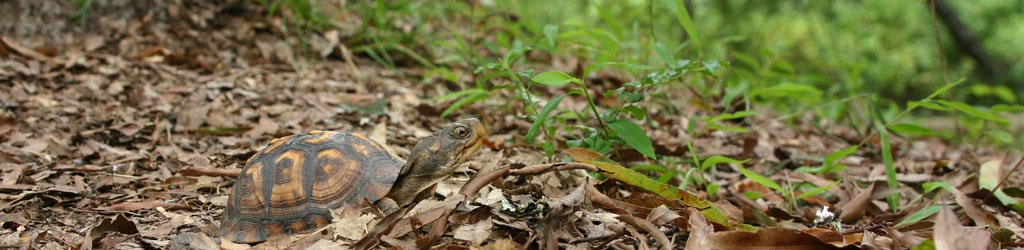
Thursday, May 23rd, is World Turtle Day – but I’m sure you already knew that, at the very least from reading it here several times before. This time around, however, I am unlikely to have any free time that day to pursue it in any form, and will have to catch up later, so I’m putting this in your capable hands – no, not those hands, and you really should wash them, but your capable ones. Go do something turtley, or educate someone about turtles, or even do a little research on them yourself. How many do you have in your own state? Okay, that’s an extremely tall order, so let’s shorten that down to how many different species? Can you dependably find one? At this time of year, you should, especially if you’re on this blog, so go ahead and prove it to me.

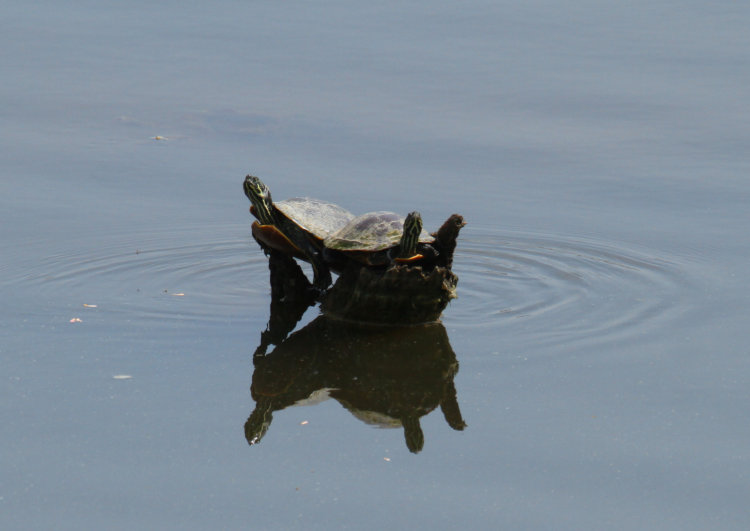
Yeah, I know, throwing down challenges in a somewhat condescending manner immediately after claiming to be too busy to do it myself, but you know, things do come up. Whatever – I’ll be back later on and make up for it to some extent. Right now we have a pic from a few weeks back, while checking on one of the osprey nests.

pair of likely pond sliders Trachemys scripta perched on barely adequate snag
Not close enough to be sure, but I believe these are pond sliders (Trachemys scripta,) and there are only two – the third head is only a bump on the stump. And for the record, the most recent turtle image that I’ve obtained, as well:

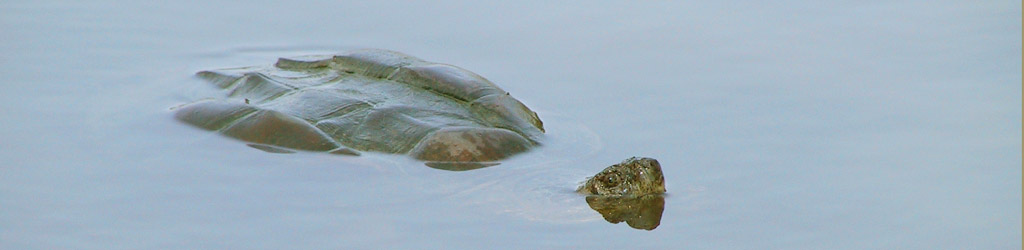
barest peek at turtle head protruding from lake
Yeah, I know it sucks, and it’s not even going to survive the sorting cull, but it’s the latest, a grab shot right before it disappeared. I provide it in good faith, or some shit like that, establishing that at least I’ve done something within the month without even trying. Yeah, “That’s obvious,” ha ha ha, go do something better…

Tripod holes 21

raindrops on leaves at base of Crabtree Falls, NC
N 35°51’25.89″ W 82° 8’14.55″ Google Earth location

This week we have raindrops, or perhaps leftover dew, though it looks more like raindrops – I just wasn’t there when it was falling. Big deal, right? You can get rain anywhere, often at a decent price too. But the background is Crabtree Falls off of the Blue Ridge Parkway in western North Carolina, not really close to any particular town. It was one of the places The Girlfriend and I visited while doing a tour of the Blue Ridge many years back.

Or at least, I think this is the location. Here’s the issue:

I was clearly remembering Crabtree Falls, and in fact the images in my stock folders were labeled as such. I knew, from the nature of the terrain, that I’d never be able to find them for this post just by looking at aerial views, so I searched on the falls themselves, which are as I’ve plotted. But this is well off of the Blue Ridge Parkway, and I can find no evidence of the parking area where we left the car and started the hike, definitely over a kilometer, down the steep trails to the base of the falls. I don’t recall a long drive off of the Parkway either, but at that point we were following signs, having come across the turnoff for the falls, so perhaps I’m not remembering that it was a few kilometers to the trailhead. The trail, however, I remember distinctly: The Girlfriend is not sure-footed on downslopes and wasn’t happy about that part of it, which is what I consider easy, while I was unhappy about the return trip upwards, carrying the stuffed camera bags and the tripod on a hot day over what was only a little less than a flight of stairs up many stories. Should I return, I’ll do more plotting with the GPS functions on the smutphone, but both of these were unavailable in, hmmmm, 2009 I think?

So if you’re using my info here to get to the same shooting locale, well, you might not – you’ll be near the base of some falls anyway, because you can see them to the right in the mapping plots, but I can’t vouch that they’ll look the same as the photo here.

On the other hand, I think I might have found two other former shooting locations on the Parkway while doing all this, which you may see later on…

Broken promise

So Wednesday’s morning out at the beach got off to a good start…


… and almost immediately devolved into rain that lasted all day. Worse, it got damn cold too. We spent the rest of the day indoors, muttering over the weather and idiotic gas situations, but at least played games in the evening. This video was about everything that I shot.

By the way, I apologize for pointing out in there the trace of magenta that appeared as the sun separated from the horizon; it was visible in the raw files and as I was editing, but apparently didn’t survive the rendering into MP4. This time around I tried out Kdenlive instead of OpenShot, mostly because the latest version of OpenShot has some serious audio stutter issues during editing. Kdenlive has video blipping instead, but overall, it seemed a bit better and certainly didn’t have as many issues with rendering as OpenShot (which suffers from a million indecipherable options, most of which produce bloated video files.) Still working out the kinks.

Meanwhile, I snapped a pic with my (blerk) smutphone while the video was shooting.

smutphone shot of video rig at sunrise on North Topsail Beach, NC
This shows naked eye conditions with reasonable accurately, save for the ‘too wide’ effect, but it suffices.

You can also see some wind vibration during the vid, but seriously, at 600mm with the stiff gusts off the ocean, this is actually pretty damn stable; I wouldn’t achieve better without at least an extra stabilizing arm for the camera body itself (the rig was supported near the balance point by the tripod collar on the lens.) Perhaps it would have been slightly better had I used the tripod at minimal leg extension – the center column wasn’t extended at all – but that would have required plopping my ass on the wet beach just to frame and focus, and may have even obscured things more from the wave height closer to the camera. I’ll cope with the vibration, and hopefully you will too, but there are therapists around if need be.

The idea of doing this came from capturing the green flash in still photos a couple years ago, and realizing that it’d look much cooler in video. Those fishing boats would have also looked better, but no such luck this day.

More video (and naturally lots of still photos) will be along later on – I’m kinda building up here.

Brookgreen Gardens

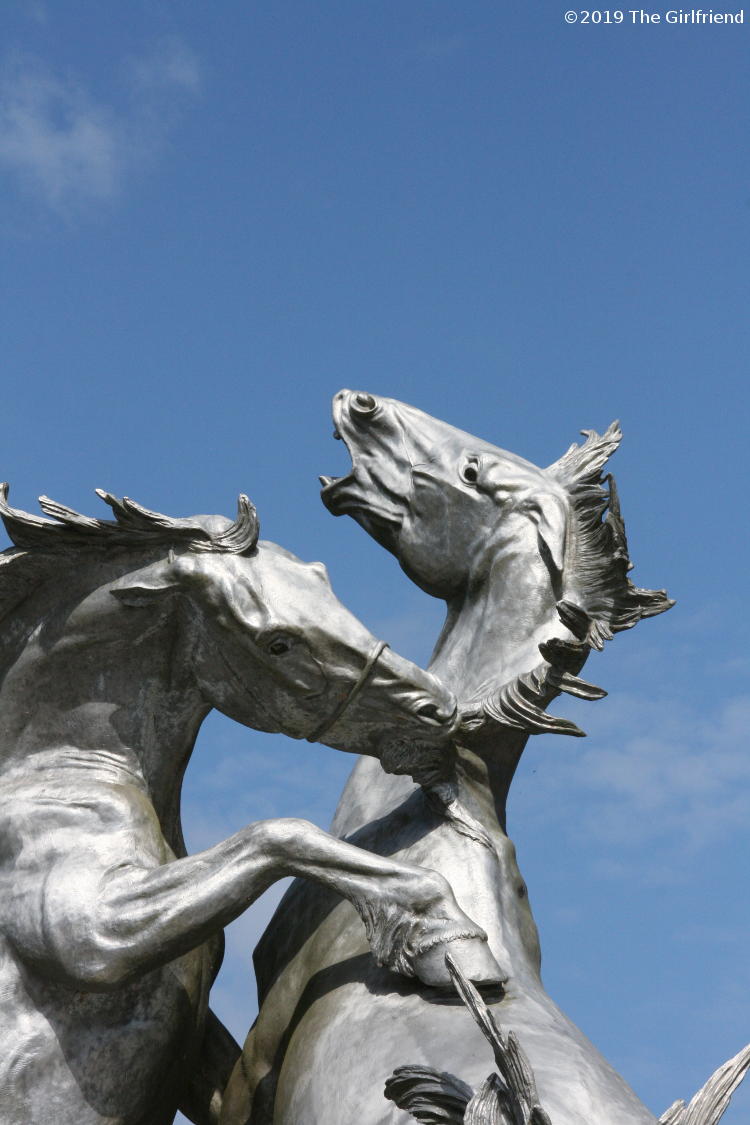
detail of Fighting Stallions by Anna Hyatt Huntington - photo by The Girlfriend
Instead of hitting Topsail Beach again for our early summer vacation trip this year, we opted for coastal South Carolina instead, mostly because The Girlfriend wanted to see Brookgreen Gardens, but there was enough other stuff in the area that I could find plenty to do myself. This is the first of… three maybe?… posts regarding the trip, so I’ll mostly concentrate on the gardens this time.

Brookgreen Gardens is a converted rice plantation – four of them, actually – which is not to say it is a plantation of converted rice, and I don’t even know how you’d convert rice; it’s always seemed pretty intransigent to me. But anyway, this area of former rice fields is now a huge expanse of gardens and lawns, with a small zoo and even a section of river, dedicated mostly to sculpture – some of those from the family of the founders, but plenty of other talented artists are included as well. Personally, I am kinda so-so on sculpture – couldn’t care less about the classical styles or most post-modernism, but there are a few things that I can get into. I greatly prefer realism, and especially expressive natural subjects (funny, that,) but occasionally other things might catch my interest. The gardens themselves are far less of a botanical garden than a huge park, with a lot of really old twisted trees decorated with Spanish moss because, hey, it’s the region and I doubt you could prevent it if you tried.

Spanish moss on trees along walkway, Brookgreen Gardens
One entrance fee will allow visitors access for a week, and it’s not a bad idea at that – one day probably isn’t going to be enough, and I know we walked too much the first day around, so we split it among two, and we didn’t even try any of the tours. ‘Crowded’ is definitely not a word that describes the park, insofar as the sculptures and exhibits are concerned, since things are spread out quite a bit, and while we were there it didn’t describe the number of visitors either, though it was a healthy showing. On our first visit, only minutes inside, we came out into the first big expanse of lawn and walks, and I noticed a bit of discarded plastic or something near the bank of a carefully-manicured pond, before recognizing it. “That’s a gator!” I told The Girlfriend.
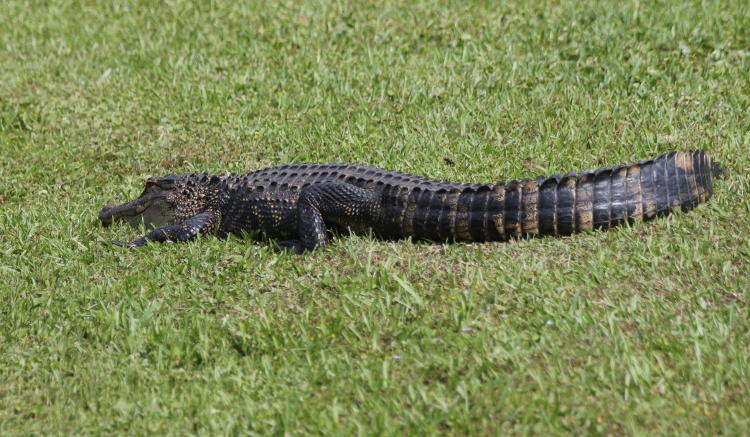
American alligator Alligator mississippiensis on bank of pond, Brookgreen Gardens
There’s something special about the subtropical southeast, I have to admit. We’re pretty litigious in this country, and warning signs are rampant, but American alligators (Alligator mississippiensis) are so prevalent in places that you’re simply expected to know to leave them alone, and so this one was basking unconcernedly in the middle of the gardens. Maybe about a meter-and-a-half in length, this was not an impressive specimen, except for the fact that it was a lizard that was a meter-and-a-half in length. And gnarly – marvelously gnarly. I like gators.

Amercian alligator Alligator mississippiensis in Brookgreen Gardens
We behaved ourselves, and only drew close enough for a couple of shots with longer focal lengths while the gator tried valiantly to ignore our presence, though after a minute it straightened its tail, perhaps to let us know it was aware, but more likely to have a good swing if it needed to whack a nosy tourist, and that was the extent of its movement.
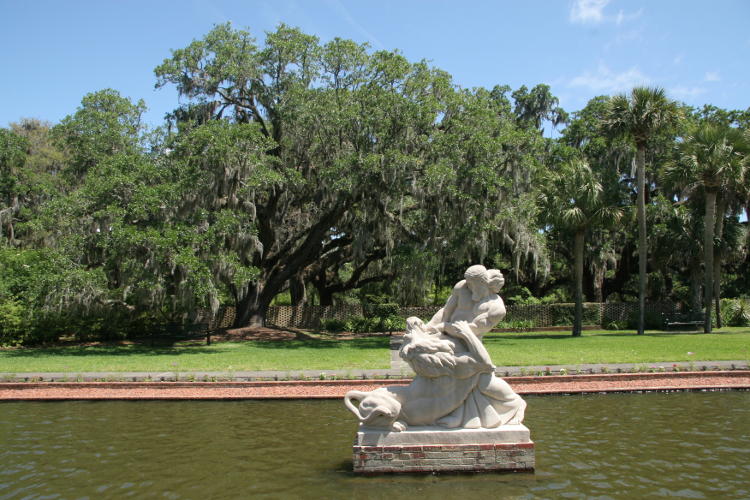
statue and pool in Brookgreen Gardens
The displays within the garden are much less that of a museum, and more how anyone might display statuary on their own property – a single element among the landscaping. There are a couple of areas where the statues get ‘dense,’ but overall, it’s spacious – room for about 1500 picnickers or so at once. Perhaps a few less if you wanted to leave the gators some space…

curious perspective on statue in Brookgreen Gardens
Now, just taking photos of statues is, for the most part, redundant to me – I’d rather do my own fartistic stuff than simply record others. So, where the opportunity arose, I experimented a bit. I’m hoping the one above is at least momentarily confusing, but probably not for very long. A more normal approach is below:
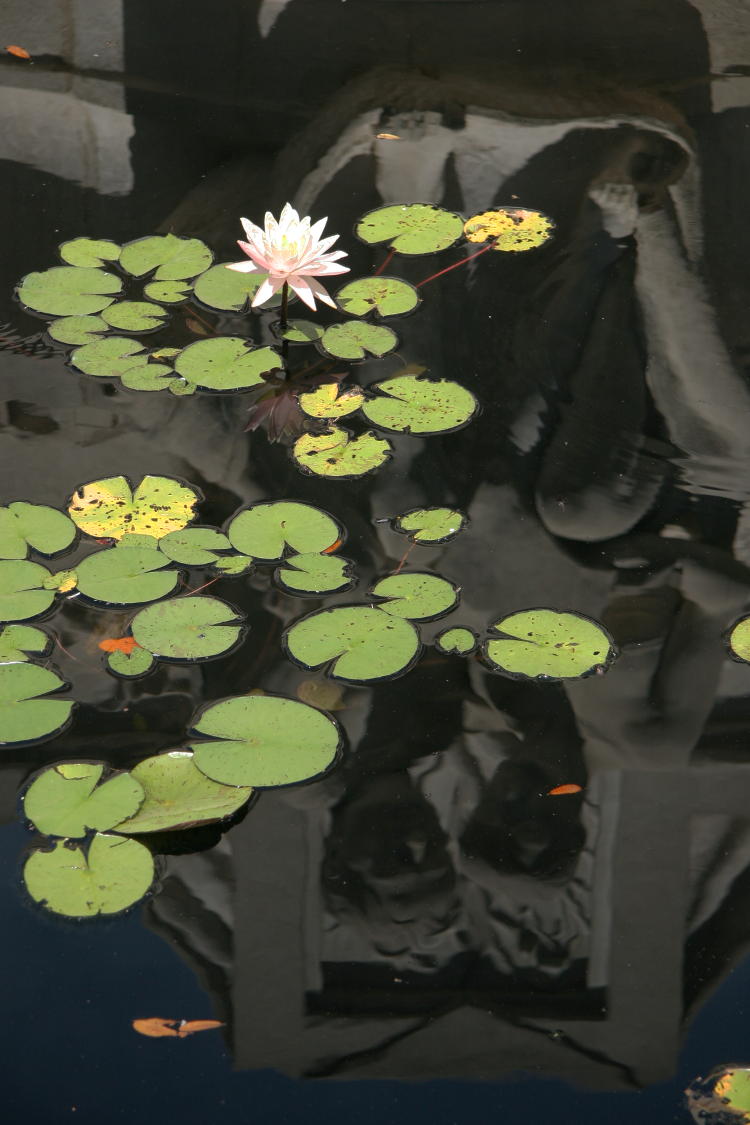
statue reflected in surrounding pool in Brookgreen Gardens
As should be clear now, I simply inverted and cropped the first to change the context. It likely didn’t work, but hey…

the author posing stupidly with Bernard Baruch by Maria J. Kirby-Smith in Brookgreen Gardens, photo by The Girlfriend
We couldn’t resist posing among a couple of the pieces. I’m not sure it’s clear what I was doing here, but if not, there’s no point in belaboring it…

Now, it doesn’t matter where I am, I’m likely to pursue my favorite subject matter every time I get the chance (something that a wedding photographer that I worked with once remarked upon, not positively.) So when the critters were showing themselves, I was taking advantage. The first occurred almost before we were in the park. Driving down the long entranceway, I glanced over and saw a curious squirrel that looked piebald. I wanted to stop and back the car up, but there were other cars behind me, so we continued down to the loop and came back around, finding no sign of the squirrel on our return about two minutes later. I was curious, knowing that I saw something, but tried to put it out of my head. This didn’t last long, as I began seeing more of them, and finally got the chance to start stalking them while on a broad expanse of lawn and trees. A couple provided a fetching pose and that was all the encouragement necessary.
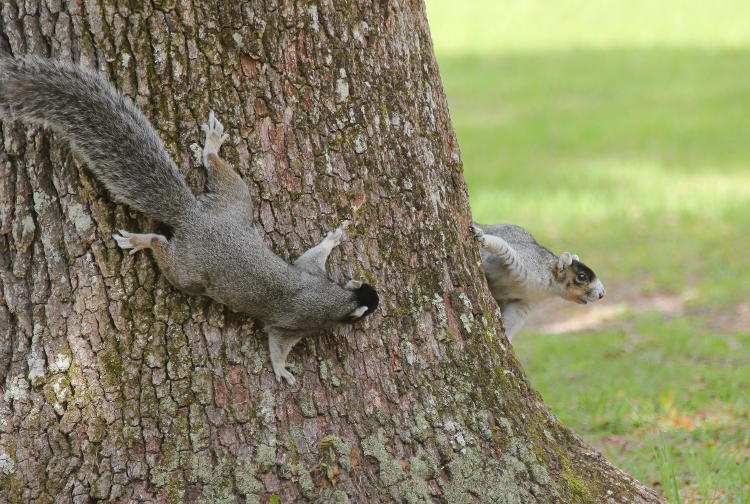
pair of southern fox squirrels Sciurus niger niger interacting on tree in Brookgreen Gardens
southern fox squirrel Sciurus niger niger in black phase in Brookgreen GardensIt turns out that these were actually southern fox squirrels (Sciurus niger niger,) a species that I never knew existed, and there’s a wide variety of coloration, two of which are seen here. They were all over the place in Brookgreen, but I never saw one anywhere else, even in the state park that was adjoining the gardens. I liked their colors, especially the fawn-faced ones, which helped me to overlook that they were squirrels and still, like around here, a bit of a pain. In and of themselves, they don’t bother me, but they tend to overpopulate an area and do too much damage to, for instance, the eaves of the house and any mantis egg cases I’m patiently waiting to see hatch. We got our photos of them, for novelty’s sake, but will probably reclassify them mentally as ‘just another squirrel’ soon enough.
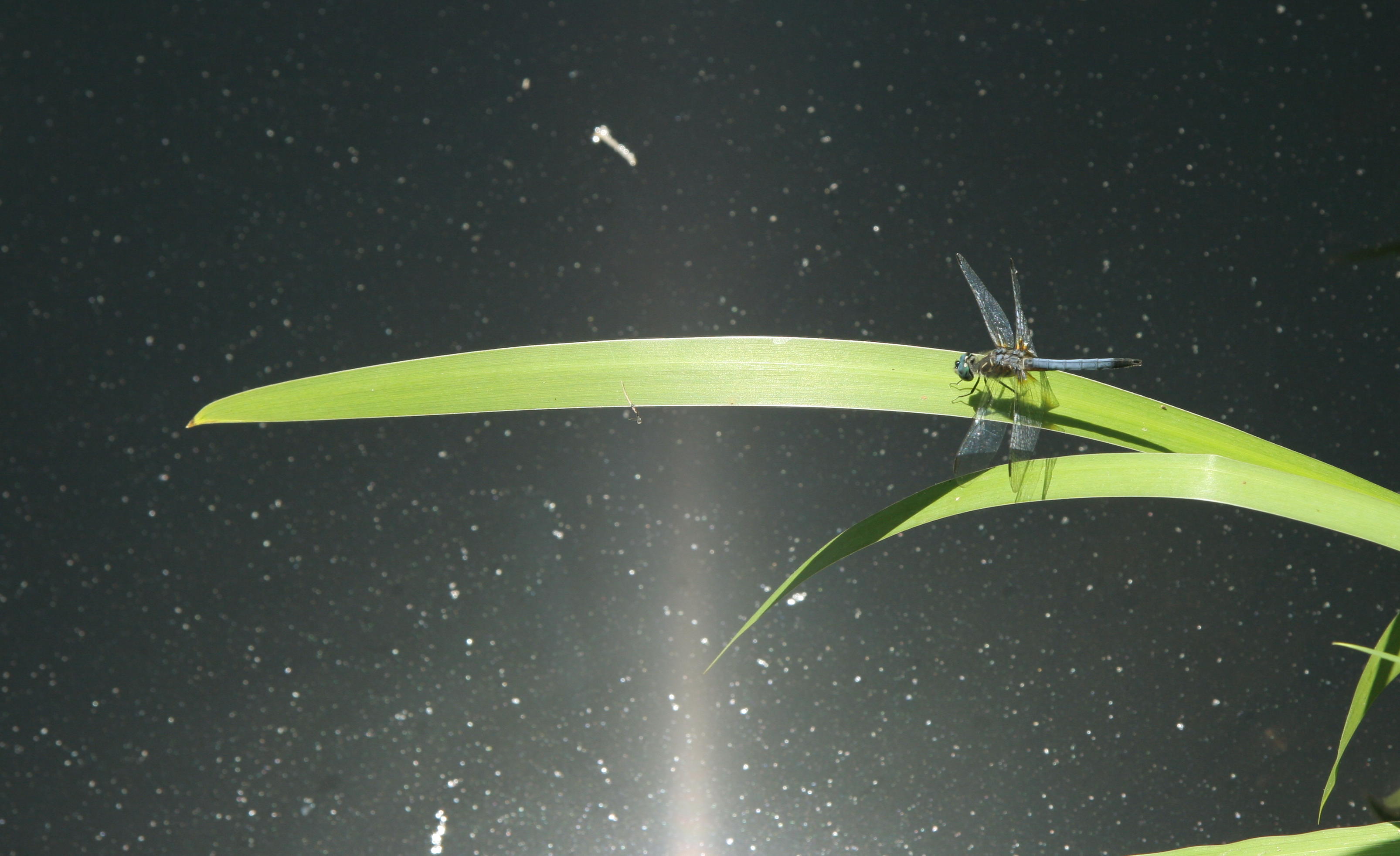
blue dasher dragonfly Pachydiplax longipennis on reed in Brookgreen Gardens
Sure, there’s a statue nearby, but look! It’s a dragonfly!

small frog in pond in front of statue, Brookgreen Gardens
I had actually been photographing this statue of a guy with his junk out, wrestling an alligator, because some subjects manage to draw my interest (the alligator,) when I spotted the little frog just hanging out in this ideal pond, and the real, uncultured me kicked in. Actually, I’d been hoping for some natural subject in the foreground, preferably on the pads or weeds in the middle of the pond, so into the breech leapt I. And of course, the distracting statue had to be excised for other frames.

green treefrog Hyla cinerea in pond near statue, Brookgreen Gardens
Hey, we have several resident green treefrogs (Hyla cinerea) on our own property, so there was no need to get another, but that didn’t stop me. And since one of these days, I’m going to do a post specific to this, I asked The Girlfriend to get a shot of me getting this shot.
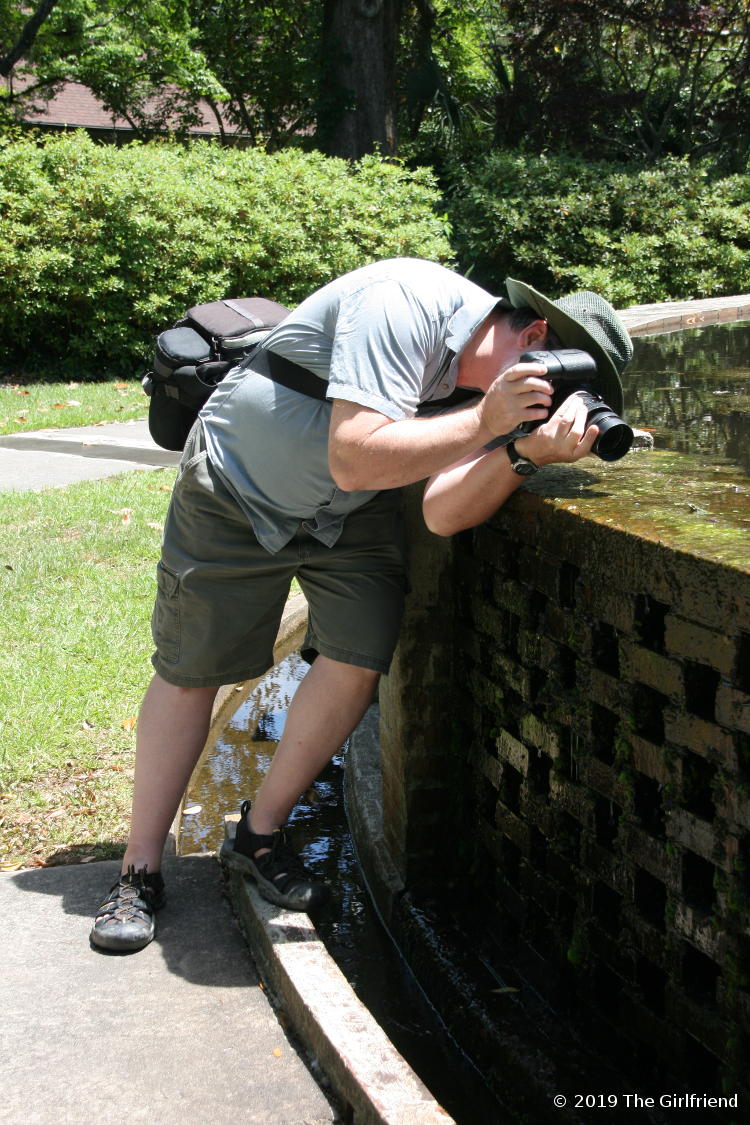
the author in Brookgreen Gardens ignoring statues for a frog, photo by The Girlfriend
Yes, my arm, and a portion of my shirt sleeve, got plenty wet and a little muddy doing this, but that’s part of the allure. If you’re not at least a little grubby, you’re not a true nature photographer, just a poseur. You know, one of the Great Washed.

tree and Spanish moss emeulating rays, Brookgreen Gardens
Still playing fartsy. Shot at 10mm, the wide angle made the moss spread like sunrays, and of course you can’t beat those limbs. Seriously – they’ll chuck you out of the park if you try.

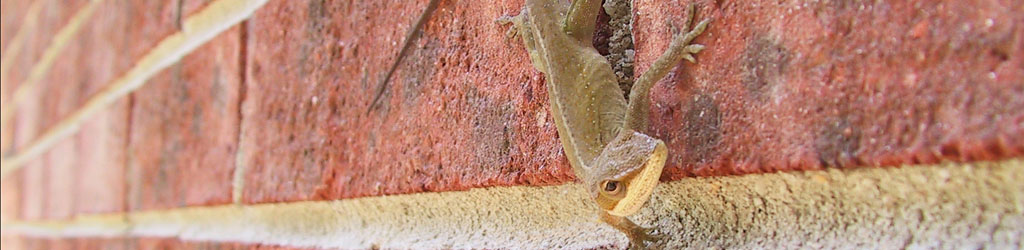
Carolina anole Anolis carolinensis immediately after displaying dewlap
On both days, we spotted Carolina anoles (Anolis carolinensis,) and I couldn’t ignore either. This one was displaying its pink dewlap (like the guy with the alligator) in the hopes of attracting a mate, though the only sharp image I got of his twitchy scaled behind was this one – but it’s sharp. You gotta love those scales. If I ever do any kind of mosaic tiles, it’ll be just like this.
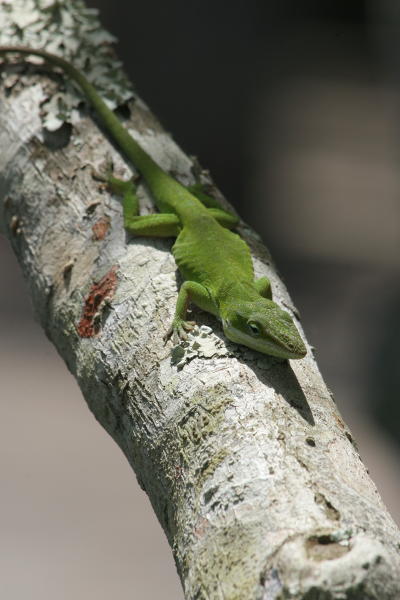
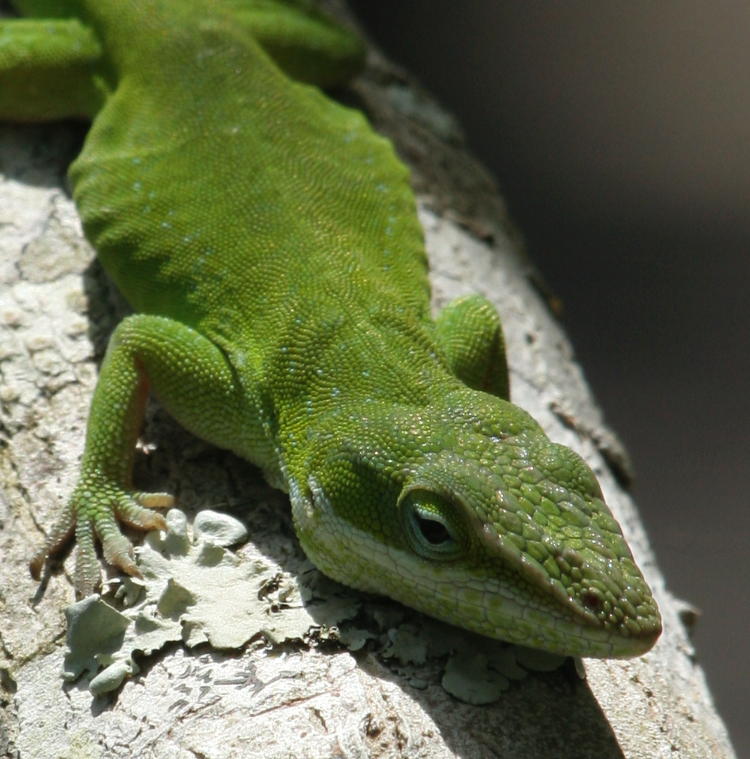
carolina anole Anolis carolinensis perched on treeThe other played hide-and-seek with me around a tree branch on two occasions spaced a few minutes apart, but this is the frame that won out over all the others. To the left is the entire frame, but below is a detail crop. Virtually all of the time, they appear matte and unreflective, yet the right sun angle will produce a hint of iridescence from the scales. That head is slightly smaller around than my little finger, just so you know.
Carolina anole Anolis carolinensis in detail
Okay, I hear you – we’ll get back to the real art now. Sheesh. Philistines.

Flying Brown Pelicans by Grainger McKoy
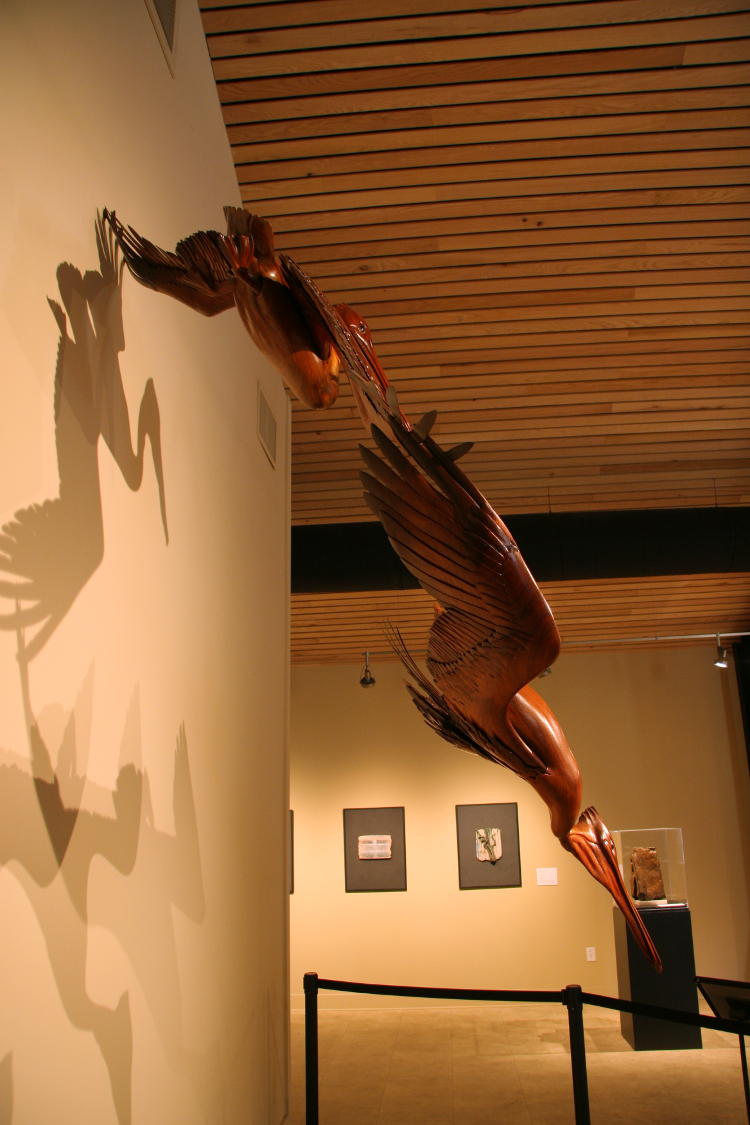
As I said, I prefer realism and natural subjects, and this one made me stop and marvel. Called Flying Brown Pelicans by Grainger McKoy, I want you to pause and look closely for a bit. Especially at the shadows.

Here’s another perspective:
Flying Brown Pelicans by Grainger McKoy
Notice anything odd yet?

Let’s go to the placard.

placard for Flying Brown Pelicans by Grainger McKoy
The entire sculpture is suspended from the wall by those four little wingtip feathers at top, and the two pelicans are joined by the same – there are no other posts, wires, or magnetic fields at work. I should tell you, too, that the entire thing is well over two meters in length, much larger than life size. And it’s a great rendition of pelicans all by itself. There’s not too much artwork that evokes awe in me, but this guy can do it. I would probably never be able to afford any piece of his, and wouldn’t know where to put it if I did, but damn, do I want to. There were several of his works in the gardens, including this next one.

Wood Duck Pair by Grainger McKoy
Now, I’ve seen too few painters that could bring out the colors this realistically, and he does it as a part of his sculpture. And, like the pelicans, it’s all cleverly mounted and balanced – the entire sculpture is supported by the sapling rising behind the ducks. Check out his website – I insist – to see these in much better conditions and detail. Note the ones, too, that show the birds against their own ‘reflections’ in the water. Fantastic.

That’s going to do it for now – this took long enough by itself. More will be coming along shortly.

Sunday slide 21

unidentified dragonfly in short depth against bright background
I don’t even remember where I was when this was taken, but from the timeframe I suspect the head of the Neuse River, an area I used to frequent. The bright nature of the background caused it to almost blend in to the colors of the dragonfly – the wings are mostly transparent of course, but it almost appears as if the body is too. This is helped in no small part by being shot wide open at f2.8 with the Sigma 105 macro.

“Now hold on there, Mr. Pants-On-Fire,” you say, “how am I supposed to believe you can remember the lens and settings but somehow forget the locale?” That’s pretty rude of you, but I’ll tell you anyway: I don’t remember the lens and setting. I do remember what lenses I had to do this kind of work then, and the very short depth-of-field makes it clear that I was shooting with a very wide aperture; that makes it either the Sigma 105 macro or the Sigma 28-104 f2.8-4, and I almost certainly would have used the macro. So there.

This rounds out the color week nicely, even though technically it’s the next week now, which brings up something that I’d hinted at “yesterday.” I had actually been away this past week, out at the beach, and will have just a couple of pics to show for it. But I tend not to announce everything I’m doing online, especially something like, “the house will be empty,” and wanted a few things to post automatically in that time – I had internet access and could have done it more directly, but it was easier and more dependable to set up some to post on a schedule, and I used the color thing again. All of them were written well in advance – you couldn’t tell at all, could you? That’s what being a professional blogger is like…

Why would they lie?

There’s a common argument that crops up in discussions of UFO sightings, always from UFO proponents (which, for my purposes here, denotes those who feel that the large number of reports are indicative of something significant – there isn’t a consensus on exactly what.) It can also crop up in regards to paranormal and even religious experiences. Made in regards to eyewitness accounts and their veracity, the argument is, “Why would anyone lie about such experiences? What would they stand to gain from that?” It often goes on to say that there is little money to be made from such, and/or that anyone doing so is setting themselves up for derision and social ostracism. We’ll set these related points aside for a moment to tackle the primary one: why would anyone lie? This question was even raised by a book reviewer in his own defense recently.
The question itself seems remarkably naïve, but it’s possible that it doesn’t stem from naïveté, but instead from rationalizing a tendency to take eyewitness reports at face value because it serves as support for the favored notion of UFO sightings as ‘significant.’ Ignoring the pop psychology angle, the question is essentially the same as, “Why would anyone perpetrate a hoax?” It’s a question worth examining, but hardly very supportive of the idea that no one actually perpetrates hoaxes; of course they do, all the time really. One might as well ask, “Why watch sports on TV?” or “Why buy a car that can go 200 kph when the speed limit is 100?” and so on. It smacks of believing that humans are always and dependably rational.
Hoaxes, however, are an interesting topic, most especially those where no apparent gain is possible, or where a lot of effort is required to maintain them. Yet, a hoax is simply a practical joke applied on a larger scale, aimed more publicly (and usually impersonally) than a practical joke. A practical joke is not only done for humor, but often as a means of humiliation, or as a challenge: the perpetrator attempts to establish a form of superiority, however benign, over the victim in a battle of wits. Often, it is a manipulation of emotional reaction – the victim responds as if events are random or undirected, entirely differently than they would if they were aware that someone is trying to manipulate them. In these cases the joke exists solely because the victim does not consider the correct alternative.

These traits apply especially well to hoaxes. A successful hoax draws in as many people as possible, which implies that the hoaxer is more clever than all of the victims/believers, in effect raising the hoaxer higher in status (within their own perspective, at least) than all who succumbed. In many cases the hoax is intended as a comment on society, targeting the fixation on a particular explanation without considering alternatives; it may highlight the reliance on social support (all of these people believe, so I should too) that humans utilize a bit too often, instead of individual examination and weighing of the factors alone. Most hoaxes are non-harmful, victimless exercises, breaking few if any laws and rarely even disadvantaging anyone. The level of anyone’s involvement is dictated solely by themselves – if they either fail to fall for it or simply treat it as lacking significance, they are free from any ill effects. This means, in all cases where such traits are applicable, that the victim has simply done it to themselves.

True, not every hoax falls into such categories, such as fake bombs being planted in public areas – here the hoaxer preys on substantial fears and, frankly, rational erring on the side of caution; such ruses are both malicious (whether intended to be or not) and criminal. But the large majority of hoaxes avoid such targets in favor of harmless applications.

In some cases, hoaxes start out small, but gain more notoriety than intended or imagined by the perpetrator, and quickly pass the point where revealing the hoax would still be greeted with rueful laughs and shaken fingers – the Cottingley Fairies are a great example. The hoaxer is then placed in a position where they must either face serious public reprisal and embarrassment to reveal their intent, or maintain the charade until such a time when the revelation is either foregone or considered irrelevant. But this serves to explain how a hoax can become extraordinarily elaborate without any intention or planning, like a child playing with matches. We need to recognize that hindsight cannot be reasonably applied; a simple hoax that grew just a little too big might engender some fear of scolding from, for instance, parents or local authorities, which may be enough to discourage the hoaxer from admitting their stunt. As it continues to grow, the potential blowback becomes commensurately greater, making the parental scolding seem ridiculously tame in comparison – but is it safe to believe that any hoaxer could accurately predict how far it could reach? To assume that a hoax would be admitted before it got too big, therefore any large-scale public attention is evidence against a hoax, demonstrates a lack of perspective.

In situations such as UFO reporting, the willingness to believe of the majority of proponents is already well-known, and little support other than earnest storytelling is needed to perpetrate a hoax; this makes the task far easier. In fact, this can even result in the hoaxer gaining accomplices from the victims themselves, as the victims become reluctant to admit that they fell for it or that a hoax even exists, and struggle to find ways to support the premise of the hoax rationally. And this doesn’t just happen in UFO circles, as anyone familiar with the name “Chris Mooney” knows.
Seen from the hoaxer’s standpoint, every credulous remark, every news story, every believer, all feeds into their ego, racking up points on an internal scorecard. It really is no different than anyone pursuing sports records or high test scores, since these are also methods of placing any individual above a large number of others. In fact, it can even be said that the hoaxer accomplishes far more than the athlete, since not only are their skills more likely to be applicable to career functions (marketing, politics, sitcom writing,) any emphasis on reducing gullibility and increasing critical examination within the general public is solely beneficial. On rare occasions this is even recognized (“Fool me once, shame on you; fool me twice, shame on me”), but overall, hoaxes are resented more often than appreciated, generally from embarrassment over being caught – this is unfortunate when compared against the utterly pointless and selfish pursuit of sports trophies, and the generally positive reaction to such.

Returning to the question of what someone might stand to gain from a hoax aimed specifically at the UFO (or paranormal, or religious) community, one has to be unfathomably ignorant to ignore the amount of money someone can sell a story or a photo for, much less speaker’s fees and book rights. And in some cases, it may be true that “the general public” might find someone less than reputable, but the UFO community isn’t too discriminating and is more than happy to shower praise and huzzahs on even the weakest and least substantiated stories – and continue to do so for decades, long after the general public has stopped paying attention. It’s strange that more people don’t take advantage of this, really.
Consider, too, that any hoaxer who is treated as a crackpot or mental defective by any portion of the public knows that their story is a charade, specifically intended to provoke a response. They are far less likely to be embarrassed by such attitudes because they have no reason to take them personally – it’s an act. Any stage actor who plays a villain and provokes negative responses over their “evil” is proud of this, since their goal is to be believable. Failure, to any hoaxer, is only provoking no reaction. But what this also brings up is that it is much more likely that anyone honestly relating an actual encounter, personally and emotionally involved, is the person who will feel embarrassed by public derision and the loss of their reputation – which probably makes it more likely that a prominently publicized account is a hoax rather than genuine, at least when considered from the emotional standpoint. Note that this is exactly opposite how the argument is usually forwarded.

Finally, there is the notoriety aspect to be considered. While any claim of an encounter may generate certain amounts of both good and bad public reactions – support from UFO proponents on one hand, and ridicule from cynics on the other – both of these are considerably more attention than any individual typically garners. People are arrested all of the time for such pointless acts as streaking and public nudity, destruction of property, disrupting social events, climbing monuments, and various other less-than-reputable actions. Numerous celebrities are especially well known for being assholes. For some, it’s not a matter of good or bad attention, merely attention, sometimes in whatever manner works best. Consider, too, the practices of the internet troll, whose sole motivation is to provoke a response and “push buttons” – it is a form of manipulation, the psychological equivalent of using an opponent’s strength against themselves, and hardly qualifies as being a respected practice in the least, yet there is no shortage of these.

Failing to recognize the possibility of hoaxes naturally makes someone a prime target for such, and within the realm of UFO proponents and enthusiasts (and again, other topics as well,) this failure is far too prevalent. When most of the evidence advanced in support of extra-terrestrial visitation et al consists of personal accounts and indistinct photos and video, hoaxing is remarkably easy. Denying this makes it even easier. Worse, it opens the door to dismiss UFO proponents (et al) as not just unworthy of being taken seriously, but gullible and fatuous, by anyone who notices the lack of rigor. And while this seems nasty, one must ask how else such terms are reasonably defined?

Macro photography, part two


Earlier I talked about some of the basics, so now I’m going to introduce you to a new form of cheating (but one that may make your life oh so easier and perhaps considerably longer because, you know, stress…): captive aquarium photography.

Aquatic subjects are something that takes considerable effort to capture in the wild, and much more so if you’re after small subjects that need high magnification. And if you’re approaching freshwater pond or bog denizens, you can practically write off such pursuits. Gear rated for underwater use is one thing (and a significant expense); macro lighting underwater is another; and trying to find things that live in shallow, murky, and above all mud-bottomed areas is a class all on its own. Just trying to get close will stir up obscuring sediment and likely send your subject scurrying under cover. The detritus on the bottom and the thickness of border plants will prevent you from ever achieving a camera angle that lets you get adequate lighting in there. I’ve even messed with reverse periscopes, finding that they simply don’t allow many opportunities. But you can do fantastic aquatic subject images with only the equipment you have now and a few additional inexpensive items. While it may take a bit of preparation, the results are well worth it.

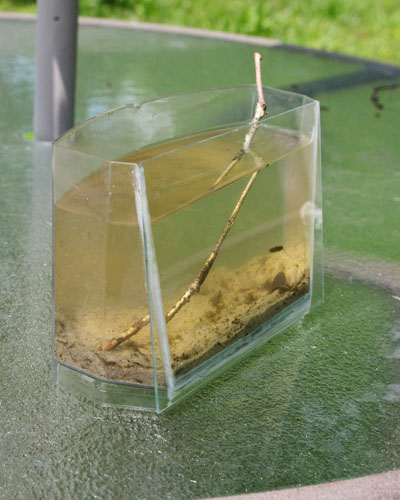
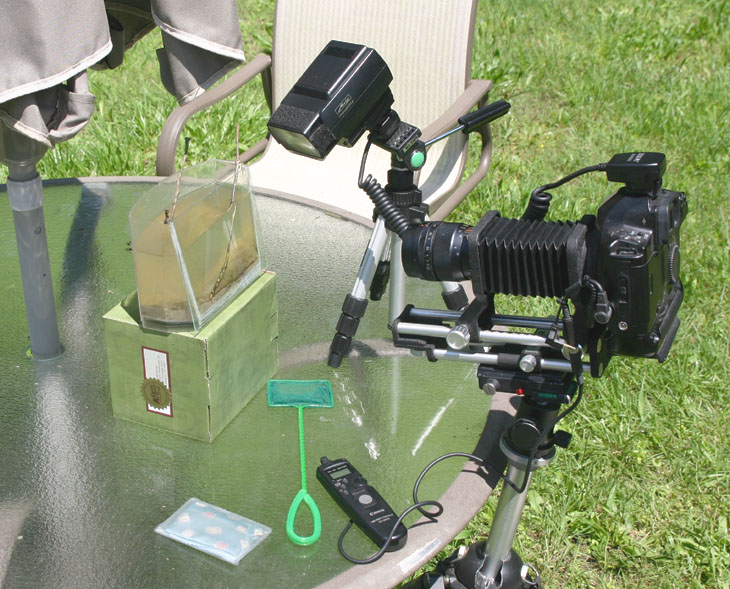
First off, you need a macro aquarium, a small watertight enclosure to keep your subjects hydrated and natural-looking while still allowing you the visibility you need. This one is a small Betta tank I obtained from WalMart for five dollars, that I sliced one of the plastic sides from and replaced it with glass (in this case a sheet measuring 5×7 inches from a photo frame.) I angled it back as far as the tank design would allow, for three reasons: first, you want to try and shoot dead-on through the glass, and not at an angle, because glass will easily distort a macro shot, and angling back lets you work without your chin resting on the tabletop; second, your additional lights may bounce off of both the front and the back of your tank, so this angle helps reduce the occurrences; and third, it lets you use more of the bottom substrate as your background, meaning you won’t have to cover the back of the tank with something appropriate as often (but still have stuff handy.) When you do this, remember that you’ll have to wrangle subjects and arrange your “setting” within the tank, so don’t make the top opening too small. At the same time, restricting your subject’s movement as much as is reasonable means you spend less time waiting for it to wander into range, or shooting through suspended sediment.
As for sediment, I’ve found the best substrate is beach sand, which settles out of the water quickly when stirred up, and looks natural for most subjects. A few clean sticks and some leaves can round out a setting nicely, but if you use some aquatic plants, all the better. Just keep it limited, since it can block lights and provide too many places for your subject to hide behind or under. Also, be aware that leaves have to be presoaked or they’ll float – leaving a few in a bucket in the rain for a few days will give you some nice “props.” Behind the tank, all you really need is something green or brown and not too reflective – you actually want it remaining very low key. You might also notice that I used the curved side of the tank as the back, which reduces unwanted reflections even more.

I’m showing this rig in bright sunlight, which can help with natural light photos and tends to be more ambient and throw less shadows, believe it or not – the water helps scatter the sunlight in all directions, so you can see subject details on the undersides as well. However, there are reasons this is bad, too. For decent depth-of-field you’re likely to be using a small aperture, and this will often mean slower shutter speeds, which your subject is not likely to hold still for. Also, the small volume of water in such a tank will heat up quickly, and the brighter light often drives subjects under cover, so being able to shade the tank frequently is paramount. A separate strobe unit is recommended, but you may spend a lot of time adjusting for appropriate angles, and the light will reflect from suspended sediment and even from the glass surfaces themselves. Also, a strobe tends to be very contrasty, leaving dark shadows on your subject, so a second light or some bounce material can help.

Seen in the top shot is another necessity, a microfiber cloth for cleaning the front surface of your tank (and another reason I used glass for my viewing surface.) Do not scratch the surface you want to shoot through, and clean said surface meticulously because every last bit of dust and gunk will show in your images. Even facial tissue leaves behind lots of lint fiber. And a small squeegee, or a soft food spatula, is recommended for cleaning the inside wet surfaces. If you use tapwater (which I don’t recommend because of the chlorine and ammonia additives you’re likely to have,) you may find tiny bubbles forming on your glass surfaces.

And finally, a way to wrangle your subjects is necessary. I use small sticks and a small fine-mesh aquarium net, and a lot of patience – disturbing subjects too much can make them anxious and overactive, and will prevent feeding behavior or anything interesting like that. I don’t house my subjects in the macro tank, but keep them in a larger aquarium or outdoor tub and collect them individually (or a few at a time) for photo sessions. Once done, I set them loose back where I found them.

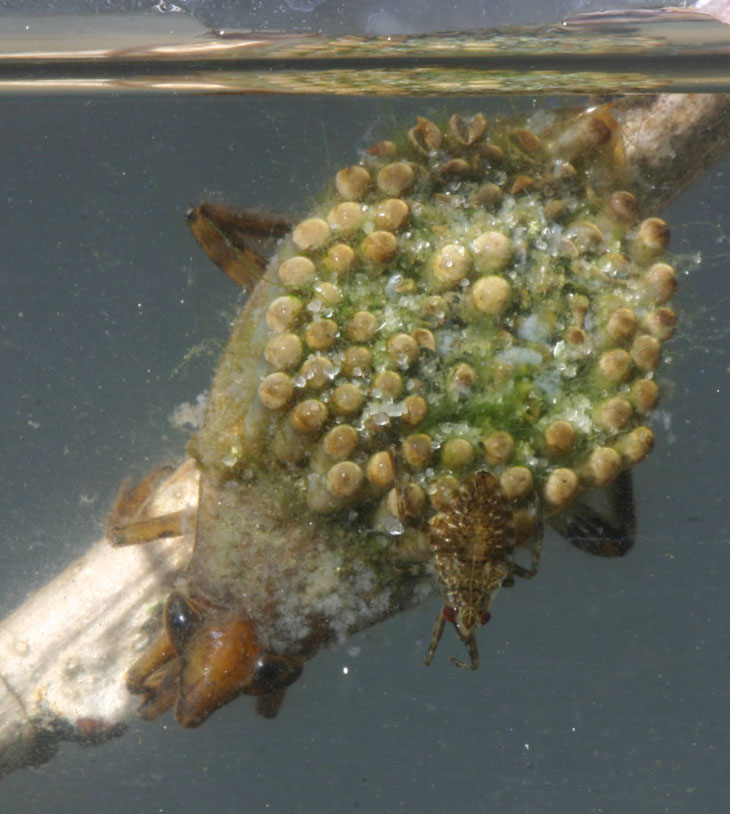
Does it work? You be the judge.

My model here is a giant water bug (genus Belostoma, possibly Belostoma flumineum) carrying eggs on his back. Yes, his – the female cements the eggs onto the male’s back for protection. He runs only about 20-23mm long (less than an inch,) which makes the newborn riding along about 4mm long, able to hide under a pea.

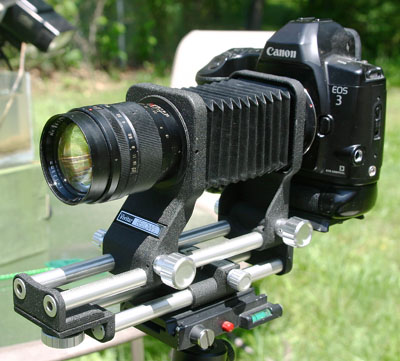
In my previous post on the subject, I didn’t talk about one method of macro photography because I didn’t have the equipment – now I do. Seen here is a macro bellows, which is much the same as an extension tube, but able to be extended much further, which means increased magnification. There are some distinct limitations to using them. They need to be rock-steady, because depth-of-field will drop down to levels where a tiny twitch will throw your subject well out of focus. They don’t usually work with automatic lenses, because the linkage or electronic contacts between the camera and lens aren’t maintained. And they’re bulky. But they make up for it in performance, if you’re after very small subjects. The variable extension provides lots of options in subject distance and focal length of lens used (here I’m using a Vivitar 135mm f2.8.) Magnification is a factor of lens focal length versus extension – the more extension you have over focal length, the greater the magnification. So while the 135mm provides some decent working distance, a shorter focal length will provide even higher magnification (stay tuned.) The extension also reduces light, not helped by the fact that you’ll typically be using f11 to f22, so you will needs lots of light, as shown by the very close Metz flash being used at full power at top. In most cases, you’ll have to close the aperture manually after you’ve focused and before you trip the shutter, and in some you may have to manually calculate exposure based on lighting and extension – luckily the Canon can do it without needing to communicate with the lens.

By the way, this model bellows (Vivitar’s t-mount version) features a second rail under the first, which allows the entire rig, with the camera mounted, to slide smoothly forward and back without moving the tripod – this is far more useful than I’d imagined. Without it, I’d recommend the separate macro rails that can be found. You don’t have to have either of these for aquatic work, as there are several macro options, but a bellows can add a lot to your repertoire.

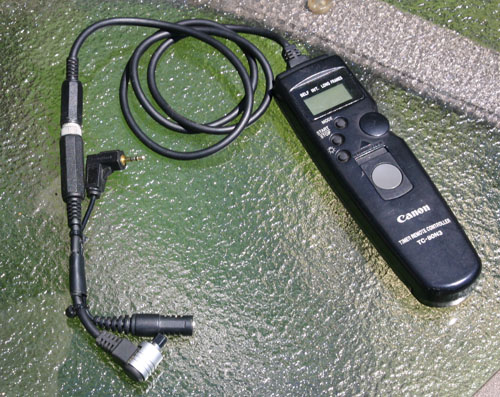
Since another detail is visible in the top image and I’ve been meaning to mention is, I’ll throw it in now. While I have a DIY project for a basic Canon remote release (Canon eliminated the compatibility with a standard cable release in the EOS line,) I eventually ended up purchasing the Intervalometer, which can be programmed. But it comes only with the N3 connector, while a couple of my camera bodies sport the E3 connection (which is exactly the same as a 2.5mm micro stereo connection.) Both connections do exactly the same thing, and the power is provided entirely by the camera body, so all that is necessary is closing the contacts in the right order (a small aside: the Intervalometer has its own battery to run the logic circuits.) So, I cut the cord between the remote and N3 connection, and wired two adapters; one using the N3, the other an E3/2.5mm, both ended with a 3.5mm mini stereo connection. There are two benefits to this. One is that I can effortlessly switch the remote between cameras; and the second is that I can use a standard headphone extension cable (3.5mm connections) to extend the remote for the length of whatever cable I find.

You may note that the adapters I made are bound together but in opposite directions – this makes it impossible to mistake what connection I’m using, and I can even select them in the dark by feel. I do get clever every once in a while ;-)