… since we first saw the new Walkabout Estates Plus in person.
Yep, we were perusing the real estate listings and considering this location, initially having rejected it for not having some specific criteria, then a closer look seemed to contradict that, indicating that it actually met those criteria. The Girlfriend had the day off for the Juneteenth holiday, and I said, “You know, we could be out there by noon – why don’t you give our agent a call?” She did, our agent and the house were available for a walk-through, and, well, here we are.
While not everything has been hunky-dory, this was not unexpected for any home purchase, but really, the house and land far exceeded anyplace that we figured we’d ever live. Personality-wise, I’m somewhere between a ‘bitter realist’ and a pessimist, and this whole thing seems almost unreal to me. But I’ll cope.
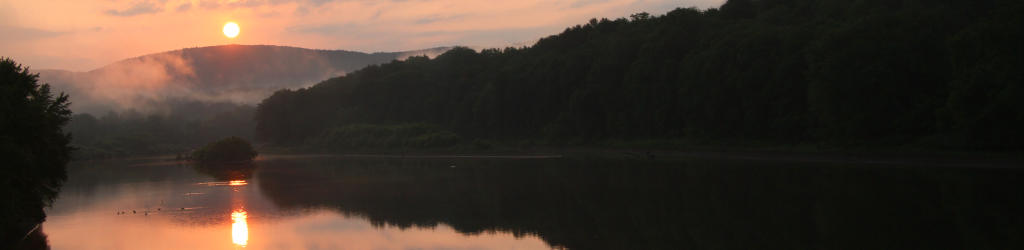
Naturally, we haven’t been here a year yet – you’ll see that when it occurs. And I’m not into putting too much personal information online, so pics of the house aren’t really forthcoming, but you can see a couple of the finds that we’ve made while here, just for the sake of it – there have been plenty, and that’s largely why I started the ‘Estate Find’ weekly topic.
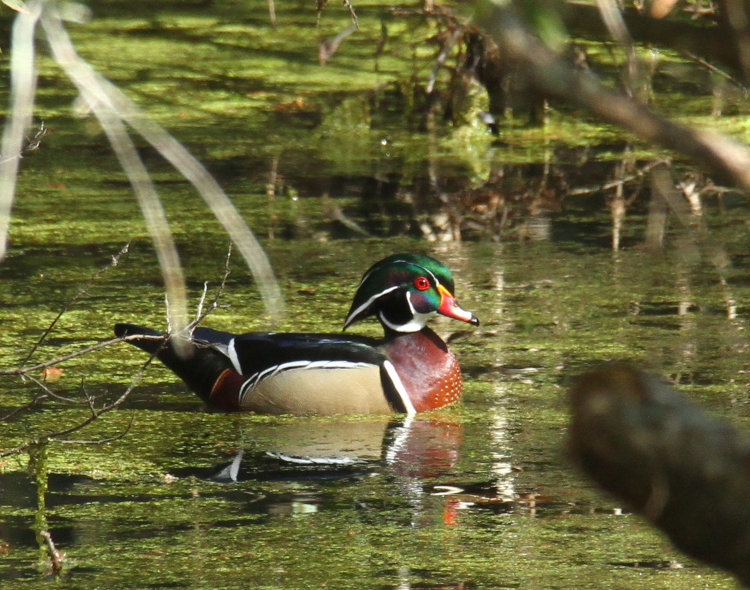
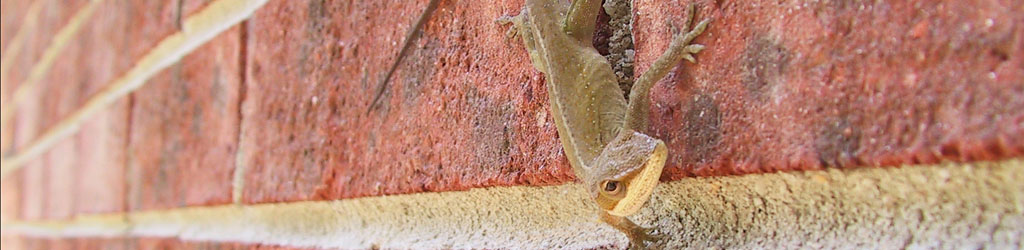
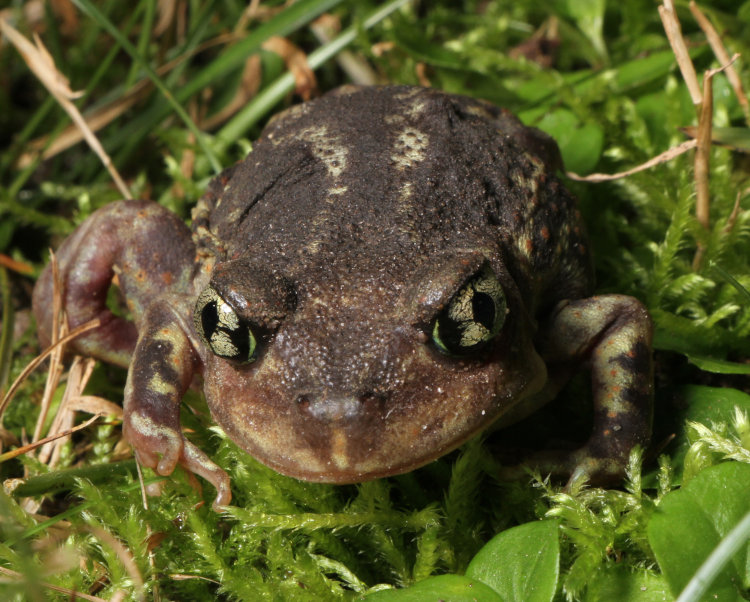
So we’ll go with a couple of my personal favorites: a hypnotic eastern spadefoot (Scaphiopus holbrookii) above, and of course, a pair of wood ducks (Aix sponsa) below.
I could post a hell of a lot more, but you can simply just skim backwards through the posts too.
But that’s as far as I’ll digress over it – we now return to our regular warped content…
Okay, this holiday actually occurred almost a week ago on May 25th, but I’m bringing it up now intentionally, and you’ll understand why in a moment – give or take.
Today (not today) is the birthday of Dumfroot Spaglokkit, known far and wide to photographers as the inventor of the shutter lag. Here’s his story:
In the early days of the field when photographers had to create their own film plates out of dried shellac and chickenshit, and portraiture was rearing its ugly head, Spaglokkit noticed that despite preparing his subjects for the inevitable clicking of the shutter, usually they weren’t actually ready – at least half of the time, the fear of what might occur caused them to blink (these were the days of flash powder, after all,) but there was also the factor that anyone trying to smile pleasantly invariably looks like they’ve discovered a snail in their undergarments. He did observe, however, that once they felt the ordeal was over, their look of relief, while not the targeted warm expression, was at least better than appearing to be holding back flatulence. Spaglokkit reasoned that, if the shutter actually tripped well after it was triggered, the number of keepers would probably double and much expensive chickenshit could be salvaged.
Dumfroot began with squeeze bulbs that tripped the shutter through air pressure, ensuring that flexible long hoses and compression delay introduced an uncertain and unpredictable pause before the shutter actually opened. He also experimented with wound springs, which were quickly adapted to the group portrait task where the photographer wanted to be in the frame. These worked a little too well, in that the variability was quite wide, producing either a shot of the photographers’ backs as they were running to get into position, or the strained confusion on everyone’s face as the timer ground to a near-halt well beyond when it was supposed to before actually triggering the shutter. Nonetheless, these remained in use for decades before being repurposed to calculate the time that a caller would spend on hold before a customer service rep would actually answer.
As films improved and photographers got bored with portraiture, the shutter lag was gradually phased out in favor of split-second timing to capture that precise moment after something cool happened, driving it home that it was all the photographer’s fault and could not be blamed on shutter lag; this is widely believed to be a German innovation. Electronic shutters and circuitry served to almost drive Spaglokkit’s efforts into obscurity – until the advent of digital photography.
This ‘advancement’ brought instant gratification into the hands of amateurs, but it also brought complications. Camera manufacturers realized that instantly producing a snapshot worth keeping, first try, meant their products might last far too long, and so they brought back shutter lag, as well as autofocus wandering and the deceptive pre-flash to fool people, ensuring that a) users would take many more photos trying to get the one that they wanted, wearing down the equipment faster, and b) the promise of ‘improvements’ with a new model a mere six months down the road would improve sales by several hundred percent. The shutter lag was carefully calculated to reduce by fractions with every new model, despite the fact that solid-state circuitry had no discernible delay like mechanical shutters and apertures did. There was a third factor as well, in that a certain number of users, frustrated at the missed shots through the shutter lag, would smash their camera and go purchase a ‘better’ one.
[There was a variable-delay software that was initially used in digital cameras before the ‘calculated reduction’ technique was settled upon; this software was later sold to Microsoft to run their “time remaining” displays for larger tasks, which bear no relation whatsoever to the actual passage of time. This is to produce an unbalanced and insecure state of mind in the user, which can cause them to buy more Microsoft products. Apple, it must be noted, went in the other direction, pricing their products exorbitantly to convince the less-discerning population that they must be more valuable, knowing how few people would actually perform a simple comparison…]
Nonetheless, this gradual reduction in lag time could only last so long, and manufacturers were quickly running out of new models to introduce (though the marketing ploys of both “X zooms” and “megapixels” helped stretch this out a bit.) Spaglokkit’s innovation was once again teetering on the verge of obsolescence when so-called ‘smartphone’ cameras burst on the scene.
The premise behind smartphones is, the more time they spent out of someone’s pocket, the more information they can scarf from their environment and send back to the manufacturer; thus, every task is created to take far longer than necessary, assisted by the introduction of a balky touch-screen interface. Once again, the shutter lag came into play, necessitating at least three photos be taken in order to obtain one keeper, leaving plenty of transmission time for data. Quite often, the phones are transmitting the audio as well, because the frustrated mutterings and curses of the users are hilarious – remember this the next time you take your phone into the bathroom. And the phone manufacturers took a cue from the camera makers, ensuring that their products were more delicate than necessary so that the frustration damage factor keeps replacement models on the market.
Dumfroot Spaglokkit unfortunately died quite young while pursuing his other hobby of skydiving; his idea to adapt his invention to that field wasn’t the brightest that he’d had. So he never comprehended the impact that shutter lag would have on the field of photography, and especially, never received any repayment from photographers themselves, which is probably for the best.
I’m quite fond of rotorcraft, and rarely get to indulge this in any way, though the local airport being used for refueling the regional medevacs helps to some degree, and occasionally we get buzzed. But as we found long before moving here when only visiting the town, said airport also gets used for practice by Bell Boeing V-22 Osprey tiltrotors, military aircraft likely based out of Cherry Point Marine Corps Air Station. To date, the only time I caught this since moving here was at night, and while I cruised over to the airport to see what I could, what I could wasn’t much – mostly, just navigation lights passing with a moderate amount of noise, though at one point I did realize that Osprey have tip-lights on their rotor blades, and faint green circles could be seen escorting the navigation lights through the darkness. These did not unfortunately show up on the videos that I took.
In the past few days, however, the Osprey have returned during the day. Their combination of turboprop engines and heavy rotors lends them a distinctive sound, but we’re semi-shrouded by trees here and I’ve missed a few closer passes because of this. And then the other day, I heard one approaching as I had the camera and long lens handy, and barely caught it as it passed almost directly over the property.
Aside from the fact that I had maybe just under two seconds to focus and frame as it zoomed overhead, this also told me that 600mm was too much magnification if they were going to be this low, though it shows the half-open cargo hatch clearly. And you have to admit, that’s some excellent detail on what is probably the fuel-dump pipe on the tail…
I figured they were probably doing the usual, which was approach and departure practice on our little not-busy airport, so I headed over there to see if I could snag some better views. And I did, to a degree anyway.
This is banking around for approach, catching the later afternoon sun at a decent angle. You can see that the engine nacelles are already rolled back though the landing gear hasn’t been deployed yet; this is roughly 60° off of the approach corridor, but likely less than half a kilometer from the runway threshold. Tiltrotors cruise with the rotors rolled all the way forward just like any standard propeller aircraft, but obviously the rotor disk is too big for them to be on the ground this way, so they’re always rolled back towards vertical for takeoff and landing, though not always all the way.
After sitting down out of my sight on the taxiway or end of the runway for some time (there are too many hangars blocking that view,) this is the aircraft now climbing out, mostly in hover mode but you can see the nacelles are forward slightly to give more efficient forward thrust. Osprey can maneuver in all directions with the nacelles fully vertical, like any helicopter, but not particularly quickly, and so when climbing out and accelerating, the nacelles roll forward a bit, trading a little lift for speed. Curiously, the flaps, the hinged portions of the trailing edge of the wings, are still deployed – these provide extra lift but also extra drag, and will be used for both landing (slowing the approach speed while still giving extra lift) and takeoff, but generally this is under full thrust; I would have thought that the extra drag at this low of a forward speed would be more of a hindrance, but I don’t fully understand the aerodynamics of a tiltrotor. You’ll also notice that the chain link fence around the active aircraft area also blocks the view, far too much.
A day later they were back at it, and I had enough forewarning to be ready with the long lens as they approached. I have a flight tracker app on my smutphone, but it only tracks military flights about half of the time; we see flights of F-15s cruise over routinely, at 5,000-10,000 feet, and those never appear on the tracker, though the Osprey do sometimes. Still, I caught it as it appeared over the trees.
The nacelles are now fully forward in cruise mode and the angle isn’t right to be approaching for the runway facing more-or-less towards the house, even though they were only a little over two kilometers from that threshold, so I’m guessing they were doing approaches on another runway. They’d have to be a lot further away for a decent head-on shot, but I’ll take this.
I waited them out, and sure enough, they did another pass about twelve minutes later.
The noise isn’t as great as you might think – it’s much worse in full hover. Here you can see the faint forward-sweep of the wings (and the flaps fully retracted in both passes) while the cargo hatch is open again; I’m not sure I’ve ever seen an Osprey in flight with the hatch closed, to be honest, and I could say the same for the CH-53 heavy lift helicopters (seen below, from North Topsail Beach in 2017.) Don’t ask me the purpose behind this, but it was a nice enough day that I don’t imagine it was chilly inside.
These, by the way, are noisier that the Osprey – and can haul better than half-again the payload, but they’re over 100 knots slower. Like everything, you pick your tradeoffs.
We go back to the previous day at the airport for the closing image, as the departing Osprey passed directly in front of the sun for a bit of a fartsy shot.
Okay, now back to our regular content (notice that I didn’t say, “normal.”)
It’s been a busy couple of days, and so I haven’t cleared any of the backlog while, yes of course, adding to it. So I’ll clear two add-ons and reduce the amount of deficit by a small degree. Seriously, I shouldn’t even be doing this, since I’ve got a shitload of photos to sort too, and will be returning to that once this is posted. Anyway, two from this morning.
It’s been raining for two days straight, with only pauses here and there, so activity among the critters is much reduced, but this Carolina anole (Anolis carolinensis) chose to peek out from the camellia leaves during a lull, only to find me standing there. Just can’t win…
Further off, and the find that made me get the camera out in the first place (this time around, anyway,) were these unidentified lilies with another occupant.
Sure, I could have worked around for a better angle, but we’ve seen green treefrogs (Dryophytes cinereus) dozens, if not hundreds, of times on the blog, so why do we need another full view? But a faint sense of mystery and foreboding, ah, that works better! Now if I could only accomplish that…
Hoo boy! Lose internet for four days (don’t ask,) and suddenly I have a shitload of things to post, on top of the things that I already had waiting. It’s gonna be a while to catch it all up, plus tomorrow is going to be busy so not only will I make no progress then, I might even add to the backlog. In the meantime, I present a blue flag iris (Iris versicolor,) one of many that popped up in the puddle, as we call it, the same one where the wood ducks explored that one time and is now almost dry, certainly not swimmable by even a minnow. You may recall the yellow flag irises that were near the old place, but I definitely like the blue better.
A few photos sitting largely by themselves, just gotta clear some of the folder out.
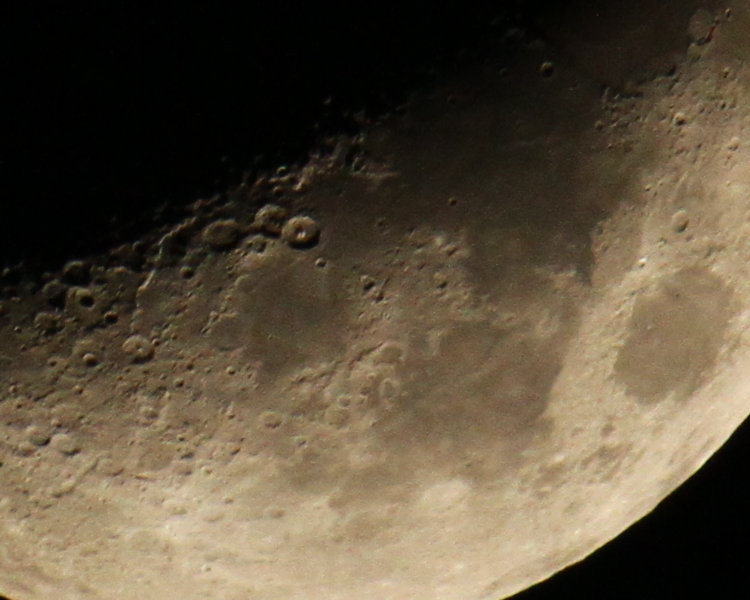
Out the other night with the long lens attached, I fired off a few frames handheld at the waxing crescent (nearly half, or first quarter) moon high in the sky, adjusting focus manually each time. This one came out the sharpest, and this is a full-resolution crop from the center – that’s Theophilus crater so prominent near the terminator, and yes, it has multiple peaks in the center. It’s 100km in diameter and about 4.2km deep.
Only now realized that the last ‘Just Because’ was also a moon shot, but it was a couple of months ago so it’s okay. Plus we have other subjects.
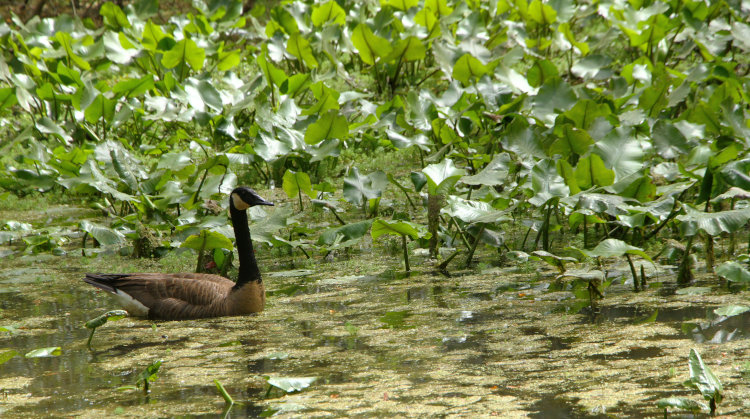
Canada geese have several different subspecies, and this appears to be a dusky Canada goose (Branta canadensis occidentalis,) easy to spot because their breast coloration is almost the same as their backs, plus they’re a little smaller. We have a pair that visits semi-regularly now, upsetting another male (probably the most-common Atlantic Canada goose) because he believes this should be his territory. This results in squabbles and lots of honking at times – I’ll have some recordings and video later on. Right now, we look at that pond and recognize that the pond lilies are taking over – no surprise, since the water is quite shallow, but soon it won’t look like water at all.
And finally,
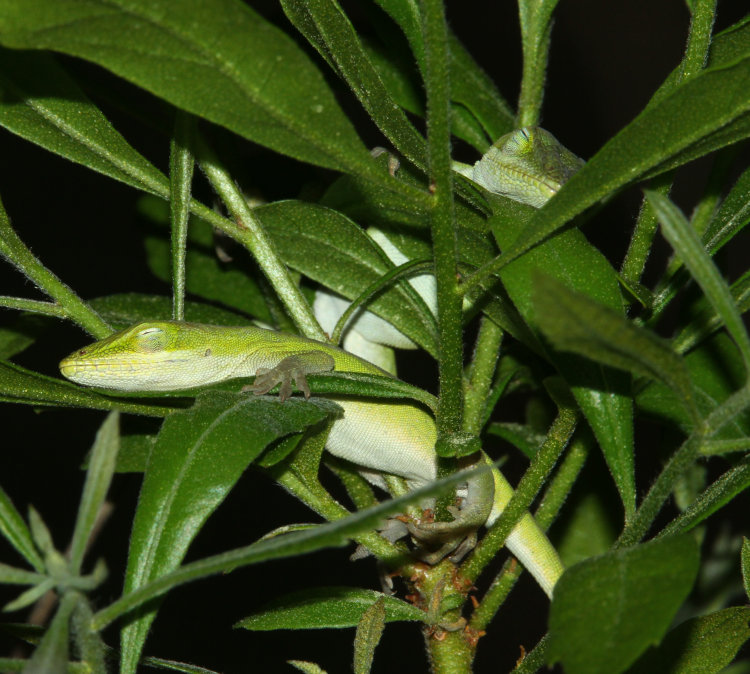
Out the other night looking for snakes and beavers – yes, I’m biphotographic – I was in one section of the property that had been crawling with green treefrogs just two nights previously, but now was hosting countless Carolina anoles (Anolis carolinensis) asleep in the weeds, grasses, and trees – I could stand in any given spot and find at least three in the light of the headlamp, in any direction, with little effort. But these two demanded that I get their picture, because who could pass this up? It’s actually taken from a moderate distance off with the 150-600mm and Vivitar 285HV, since that’s what I had mounted.
There’s more to come, but these required little exposition, so I could throw this post down easier. You’ll see more shortly.
“You started off last weekend telling us about the game convention, Al,” you say, “and then you go back to bug and snake pics. What happened with the convention, Nimrod?” Which is a little rude, I must admit, yet deserved nonetheless. So here’s what happened:
As I said, Dan Palmer (the driving force behind the Gnomon Deck) and I had two tables; Friday evening and Saturday midday, but we’d also spent a little time before that on Friday poking around and getting an impromptu playtest going. Friday’s table was a little slow, and we were speculating as to the cause: experienced gamers were looking for a more challenging or elaborate game, people were tired of card games, and so on. And there were some truly elaborate games there, looking somewhat daunting to me since I’m not into games that take a long time to learn. Actually, the games that other people had ran the gamut – some simple, some complex, some very professionally created and looking like they were already in production, some hand-drawn from household materials. One, called Lucky Starch, had the most homemade look yet demonstrated that a lot of thought had gone into the design and gameplay – you can’t judge on appearances.
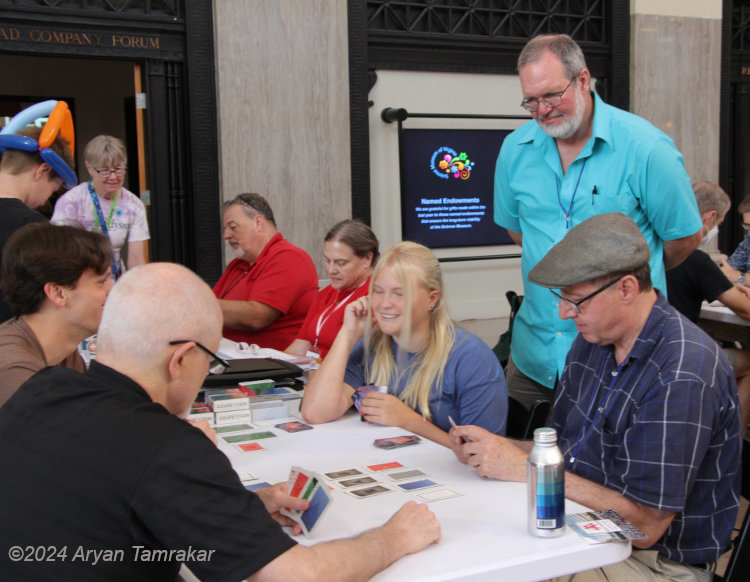
From left: Josh, Ethan, John, Liam, and Jen, with creator Dan Palmer (in hat) Saturday was much more encouraging, though – I don’t think there were ten minutes all told that someone wasn’t at the table trying out the game. And everyone had valuable input, even though Dan is uncanny at determining the stumbling blocks of games before he even gets them on paper. We developed some new rules and variations, with me contributing more than aesthetics for once, and got to see how some of the games worked with varying numbers of players and experience. Very few people had problems with the rules or gameplay, and the deck seemed to hold its own in regards to being clear and self-evident.
From left: Robin, Maria, Jessie, and Mariah My apologies to anyone I missed or whose name is misspelled – contact me and I’ll correct it immediately. And for anyone who’s developing their own games, I can’t stress enough how much value extensive playtesting has. You’ll find the little things that never occurred to you, or the odd situations that might prove frustrating to the players, or the unresolvable conditions, or new variations or gameplay options that improve things noticeably.
Also (and this applies to damn near everything that receives criticism, which I’ve addressed more than once before,) don’t give too much weight to single data points. In venues such as this, some players feel compelled to find every small detail that might detract from the game experience, which is a large part of the value of such gatherings – you just can’t put too much weight behind them, and instead focus more on the overall trends among player feedback. No game (photo, essay, motorcycle, garbage disposal) will be perfect and no one should feel compelled to seek that, and while potential problems should always be recognized, one should also recognize that in many cases these may affect very few players, or aren’t serious issues to begin with. Notably, the feedback forms provided by the Unpublished Games Network, the host of the convention, asked a specific question therein: “Did you win?” They know that winning or losing can easily color one’s overall opinion of the game.
From left: Ronald, creator Dan (in hat,) Steve, and Susan From a photography standpoint, I have to mention that trying to get everyone equally in a shot, while they all look enthusiastic, is challenging – getting them all in a flattering manner is damn near impossible, at least for me, but that’s also why I don’t shoot people. Flashbacks of wedding photography with round tables at receptions – what a pain in the ass those are! More backs than faces. But yeah, timing it just right to catch smiles and enthusiasm and above all faces takes a bit of effort and speed on the shutter.
The biggest negative that I have, and it comes up frequently with conventions and seminars of all types, is choice of venue: far, far too many organizers think that getting into a metropolitan hellscape is somehow better for the participants, and this was no exception, being held in Baltimore (well, Linthicum, which is indistinguishable from Baltimore in any way.) By itself, not too bad, but it required too many attendees like myself to pass through the DC region, which is easily the worst urban planning that I’ve ever seen. I purposefully scheduled the drive up for late Thursday night and still caught oppressive traffic, to say nothing of ridiculous spaghetti-junctions with confusing signage. On the return leg I extended my trip by an hour, with nearly $30 in tolls, to come down the Maryland/Virginia peninsula instead and cross the Chesapeake Bay bridge/tunnel, which dodged all of the ultimate stupidity that is DC. I’ll be avoiding all conventions in future where the organizers choose absolute shithole cities.
But back to the positive aspects, which was how valuable this was to the development of the deck and games, and once again we offer our sincere thanks to (in chronological order,) Cary, Natalia, Chris, and Trista on Friday, and Josh, Ethan, John, Liam, Jen, Robin, Maria, Jessie, Mariah, Ronald, Steve, Susan, Gavin, Dan, Sam, and Calvin on Saturday! All of you were both great and helpful, and we gained a lot of information from you all! And for the record, the site for the Gnomon Deck can be found at gnomondeck.com, with all current information therein and the ability to sign up for breaking news.
As for the player with the pink carnation and the suspiciously light pocket change, we’ll be holding you to your promise… ;-)
Another holiday rears its ugly head today, serving as a reminder for those things that you’ve been putting off: Make Noticeable Progress on a Project Day. That’s right, pull that thing out of the box and try to make it work again, go out to the garage/yard and bang on the car some more, actually stir up the paint before the masking tape become a permanent part of the walls, and so on. We all have projects of this nature that sit, neglected, and should be cuddled again and assured that they matter.
I am deep in the throes of this myself, since Dan Palmer and I are currently at Unpub 25, a festival coordinated by the Unpublished Games Network to feature and playtest new, unpublished games (ah, that’s where the name came from!) among many other game enthusiasts. We had a table on Friday and are manning another today to demonstrate the Gnonom Deck and various games designed for it; in fact, I spent the past week or so getting things together for this endeavor, including a play-through video. Dan, meanwhile, has been working on this off and on for the past few months, rewriting rules for clarity and consistency and making his own play-through video. The Gnomon Deck website has been updated for a few months now and we add things periodically, so it’s actually starting to flesh out a bit.
This is not Unpub 25, but the previous demo opportunity at the family day of Bridges 2024 last year It should be fun and informative, but I haven’t attended before so beyond that, I don’t know what to expect (can you tell I wrote this three days ahead of time?) Dan’s been to one other, but doesn’t know the behind-the-scenes stuff like how beneficial it was overall and how many people got their games noticed and into production. So, we’ll see/we’re seeing.
Feel free to check out the GnomonDeck.com site – it describes the deck, has several initial games with a couple of videos, and has a mailing list to sign up for further news. I may be back later on and let you know how it all went.
A couple weekends back, The Girlfriend and I were checking out thrift stores in another town and came across a nice little wood duck figurine, fully painted. It became clear that the proprietor wanted much more for it than we were willing to pay, but it got me mildly determined, and of course when you have a 3D printer you have to check out the options. Sure enough, someone named milletro had a wood duck decoy on Thingiverse, apparently a 3D scan of an actual decoy, and I downloaded and printed it.
But the proportions were off a bit, the head being too small and narrow, as well as too rounded on top – real wood ducks have rather oblong heads. So I reworked the model in Blender, a 3D modeling software – this was no small feat, because I don’t know how to do complex shapes very well, and so resizing and reshaping the head left behind some yucky artifacts. After I printed it, I had to do a little sanding, but at least the proportions seemed a lot closer to reality.
[Original model in front, my rework in back.]
Then, of course, I had to paint it. Interesting enough from the standpoint of mixing colors to try for the best match, and the details of the real ducks have a bit of variation – not in their coloration so much, but in how the details look depending on whether the neck is more extended or not, and how the wings sit across the back, and so on. This says nothing whatsoever of the iridescent feathers, which I had no decent way of emulating to any degree of accuracy – they do make iridescent paints, but they’re expensive and I’m not sure the effect is the same as wood duck feathers anyway. After several tries, I settled on a base coat of a metallic grey, overcoated with clear acrylic mixed with green or purple, which provided a colored sheen anyway. I mean, the actual bird feathers change color depending on the angle that you’re looking at them, as well as disappearing and simply appearing black in indirect light, but this was close enough to communicate the idea anyway. At least, I think so…
The original paints that I used were matte, so I top-coated with a clear gloss acrylic, because duck feathers are waterproof of course, but I think it has a little too much shine to it and may have to re-coat it in semi-gloss, except for the eyes and iridescent feathers. The model itself is roughly 150mm in length, or about half life-size of the real thing – good size for a shelf, you know? Plus it kept the print time down to about two and a half hours. I’m pleased with the results, even when I see the small printing and painting mistakes that I made. And, of course, the new version was uploaded to my Thingiverse account.
[A small note: Licenses and attributions are a variable thing, though most people uploading designs to such sites do so under a ‘Creative Commons – Attribution’ standard. This means editing their designs is allowed, as long as you credit the originator, but commercial usage and sales are not allowed without express permission. There are still assholes that violate this – I’ve seen them a few times myself – but for the most part, the agreement is honored as part of the 3D printing community, and that’s how I was able to use and edit this one. Without mmilletro’s original, I would have made no progress at all because I simply can’t model shapes of this nature.]
More photos of the real things will be along shortly, even though I’m still trying to get a really nice portrait. They’re now visiting the yard routinely because we’re feeding them, but they’re still insanely wary of our presence and usually at least swim off, if not flying away to the lower pond, the moment they see us, so nearly all observations have been taking place through windows. Working on it…
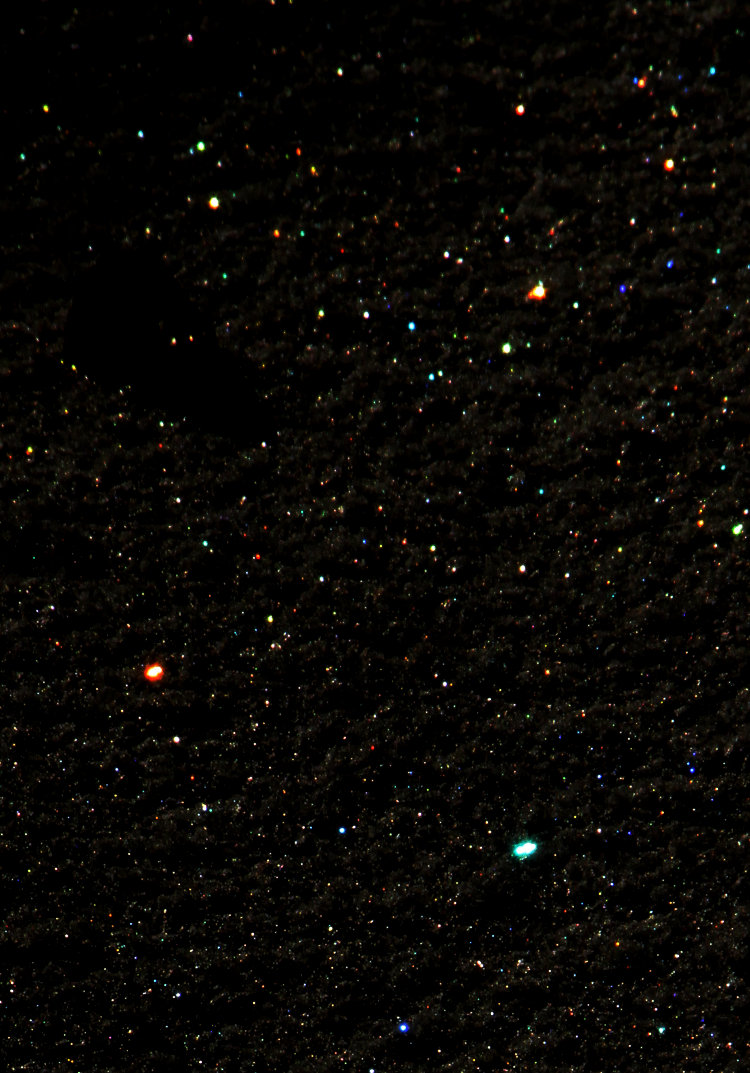
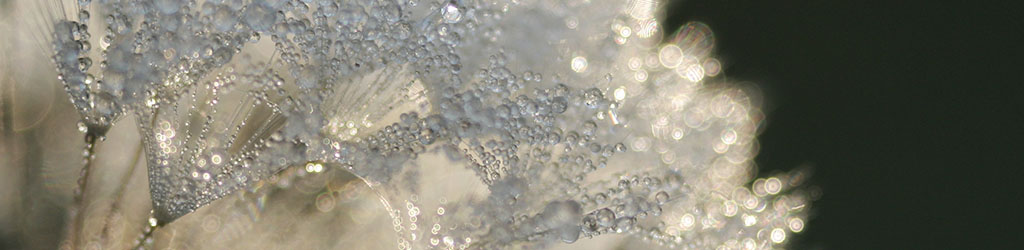
It’s the end of the month, natch (does anyone say “natch” anymore?) and so we are beholden, through the ancient rituals of this here blogareenie, to feature an abstract image of some kind, far too often a quite poor one. But we’re a little bit better off this month, because we have this:
I’m not going to tell you what this is – you have to figure it out for yourself. I will say that this is not as-shot, instead edited in GIMP, but a very simple edit. It came out far better than anticipated, with lots more sparkly bits, and who can resist those?
[Only tangentially related, but over two decades ago when working as a ‘stringer’ wedding photographer, I attended a wedding planner event put on by one of the photographers I worked with, a married couple. Right before the doors opened, the wife scattered glitter with abandon all around the studio. I was careful to remain out of the line of fire and didn’t even set my camera bag down on any such adorned surfaces, but that wasn’t sufficient, and I was finding glitter in my bag for years – just the occasional little sparkle from the depths when the light was right, but goddamn, that shit gets everywhere. I’m pretty sure I have that same bag stashed away upstairs, and I bet if I did a careful examination of the nooks and creases, I’d still find some. The sparkles seen above, however, are well and truly gone.]
I’ll be back later on and tell you what this is, if you really need me to.













 But the proportions were off a bit, the head being too small and narrow, as well as too rounded on top – real wood ducks have rather oblong heads. So I reworked the model in Blender, a 3D modeling software – this was no small feat, because I don’t know how to do complex shapes very well, and so resizing and reshaping the head left behind some yucky artifacts. After I printed it, I had to do a little sanding, but at least the proportions seemed a lot closer to reality.
 Then, of course, I had to paint it. Interesting enough from the standpoint of mixing colors to try for the best match, and the details of the real ducks have a bit of variation – not in their coloration so much, but in how the details look depending on whether the neck is more extended or not, and how the wings sit across the back, and so on. This says nothing whatsoever of the iridescent feathers, which I had no decent way of emulating to any degree of accuracy – they do make iridescent paints, but they’re expensive and I’m not sure the effect is the same as wood duck feathers anyway. After several tries, I settled on a base coat of a metallic grey, overcoated with clear acrylic mixed with green or purple, which provided a colored sheen anyway. I mean, the actual bird feathers change color depending on the angle that you’re looking at them, as well as disappearing and simply appearing black in indirect light, but this was close enough to communicate the idea anyway. At least, I think so…