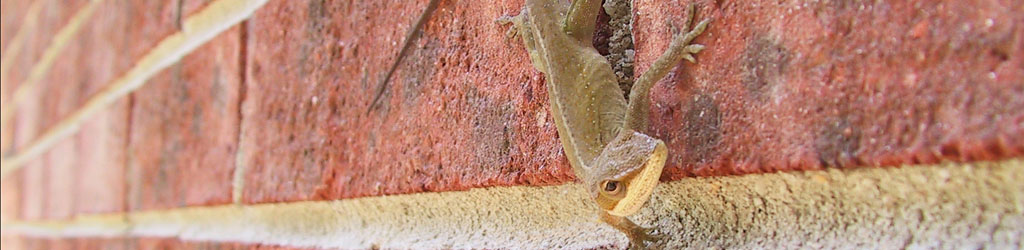
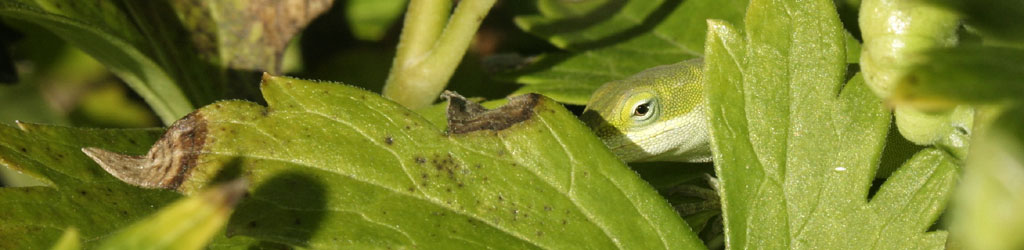

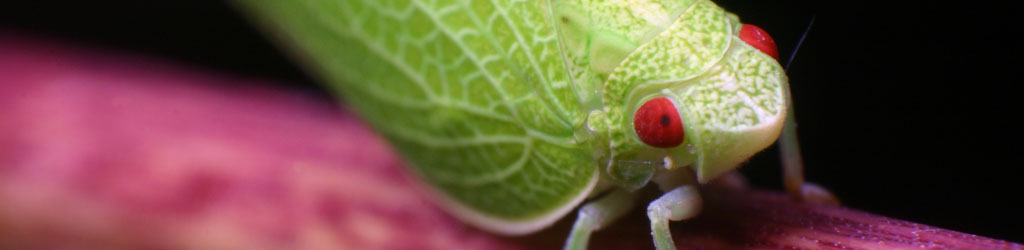

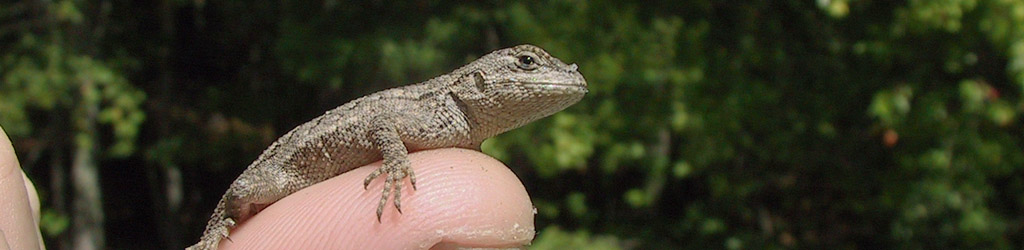
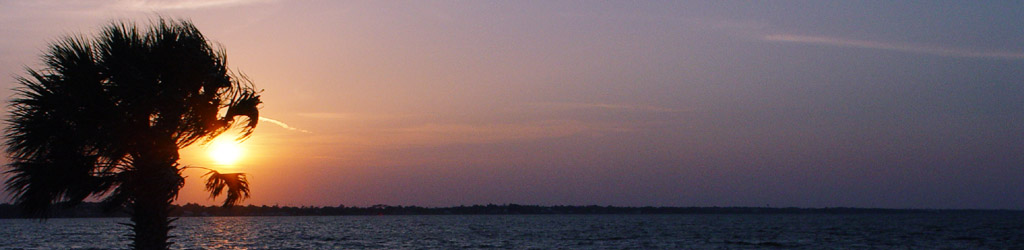
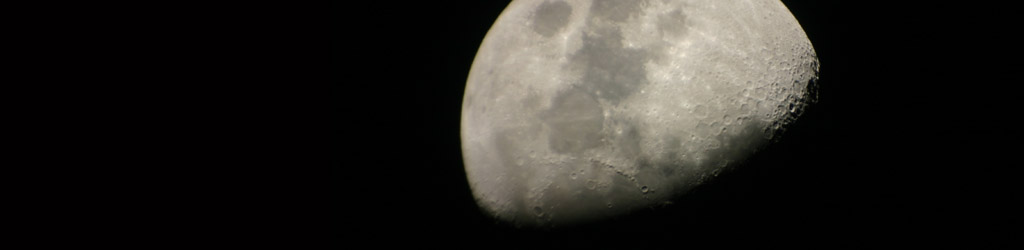

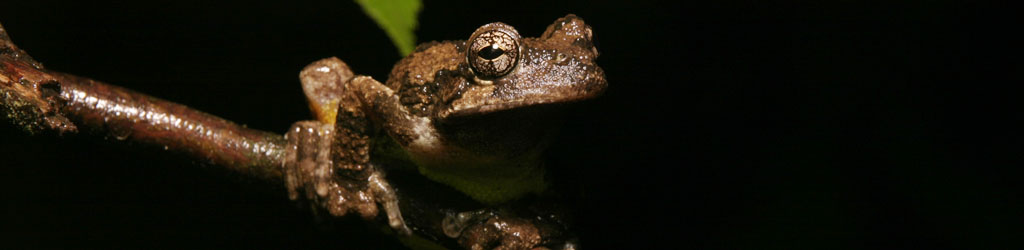

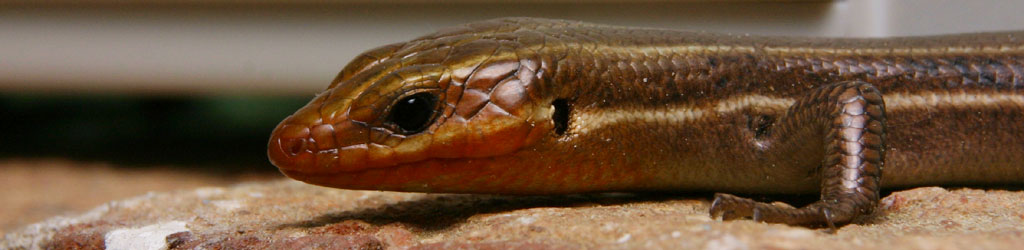

Hopefully, it’s clear why this is one of my favorite images. The curious pose with its chin on its ‘hand,’ the downward, thoughtful eyes, and the soft and pastel, dreamlike background all work together extremely well – and all a happy accident; hell, I was only shooting with a wide-open aperture because of the light, and working without a flash. Plus I love the mosaic skin of the anoles, which fell into the narrow zone of sharpness. That the image is not exactly an accurate representation of what was going on is just fine – who needs the truth?
More human than human
Our legal system, at least in the US but I imagine in many other countries as well, has gradually become so broken that it barely serves its original purpose anymore, and while by all rights it should be improving, it is instead collapsing into a wildly manipulative affair that falls a long way from, “justice.” There are multiple factors behind this, but I’ll stick to the larger ones because I’m not going to do a treatise, and there’s a point that I’m about to examine.
Let’s start with:
Over-reliance on human testimony. By far, our courts rely on witness statements, which is perhaps the weakest factor that they could. Humans are notoriously prone to subjectivity, emotional bias, suggestibility, false confidence, and even “gut feelings,” something that a recent experience with jury duty reinforced, suggesting that we the jury ask ourselves whether we thought the witness’ statements felt correct. This is patently ridiculous, since courts are there to present evidence, not solicit feelings, and objectivity is intended to abolish whether we like some aspect or not – this is likely never completely possible, but at the very least the attempts should be actively encouraged, rather than subverted in this manner.
More specifically, however, humans make terrible witnesses, and this has been established and clinically proven time and time again. What someone says that they saw or heard should be taken with a grain of salt, especially if there is nothing solid to corroborate their statements. We tend to forget how often people lie, to say nothing of how often they’re simply dead wrong, and/or wildly mistaken in what they’ve seen or heard. Attorneys actually know this, because they’ll coach their clients, again and again, on exactly what to say, trying to establish confidence through repetition. The further people are from an event, the more likely their recollection of it is damaged or altered, and this has been well-established too, and preyed on just as much by attorneys.
Humans are notoriously biased. You can instruct jurors on penalty of expulsion or mistrial not to let prejudice enter into their decisions, and it won’t stop the lifelong, ingrained biases that they possess. The idea is that this balances out with multiple jurors, but in reality? Not so much, especially in some cultures, or portions of a city, and especially not if the attorneys are tasked with helping select jurors. And this says nothing whatsoever about judges, public defenders, and so on. It’s even hard to determine to what extent this takes place, though long-term examination of data and decisions often reveals some nasty little trends.
Expert testimony is too often anything but. It’s fairly well known that police officers are usually considered impeccable witnesses – certainly their testimony will be considered much more reliable than any other participant unless strong countermanding evidence is presented, as if becoming an officer instills perfect objectivity while also eliminating bias – just saying that highlights how ludicrous this is, though most people never even raise the question. But at the same time, outside testimony, for instance by metallurgists or handwriting experts, is often selected carefully by the attorneys because such testimony hews closest to their desired outcome. No one is a certified “expert” that cannot be wrong, and such testimony thus comes down to how convincing they make their statements and how well, or poorly, the opposing attorney has sought their own expert witness. Moreover, precision in many of the sciences simply doesn’t exist, and despite the impression that DNA testing and such offers incontrovertible evidence, almost no one steps in and points out how often such things can and do go wrong.
Nearly everyone involved is more motivated by their own career, advancement, and ego. Judges, attorneys, police officers, expert witnesses – the idea of serving proper “justice” is not usually paramount to most of them. Instead, it’s their record, and their politics, how many ‘wins’ they garner, how high-profile the case is, what kind of settlement it’s likely to produce, and so on. Everyone is well aware of the “hanging judge,” or the public defender that doesn’t put much effort into drug cases, and so on; attorneys routinely juggle the court dates of their clients to aim for the desired bias.
It’s ridiculously, irrevocably, undeniably money-driven. With few exceptions, the client with the most money will win their case, and attorneys will even refuse cases based on who they’re up against rather than the merits of the case itself. While it may not be as distinct as implied here, a legal team receiving more money will devote more time to reviewing case histories for applicable precedents, seek out better testimony, and most especially, bend over backwards to ensure a larger settlement and thus a greater payoff from their percentage (which is often ruinous, and not in the slightest commensurate with effort involved or an ‘hourly rate.’)
It’s also disturbingly true that representing oneself is almost guaranteed to fail; the legal system is so byzantine and convoluted that trying to negotiate it without years of law school is impossible. Clients that cannot afford a decent attorney will therefore never get representation, in the vast majority of cases, meaning that many, many crimes simply never go to trial, something that large corporations prey upon ruthlessly.
There’s a lot more, but suffice to say, it’s fucked up.
Now here’s the curious, potential solution that’s been nagging at the back of my brain for a little while now: this is what artificial intelligence can actually provide for us.
Not in its current state, no – what we have now is not even remotely artificial intelligence, it’s just algorithms to find patterns. And it’s possible that we may never develop a system that mimics natural intelligence to any serious degree. But bear with me for a moment.
The biggest issue with artificial intelligence pursuits right now, that many don’t even realize is an issue, is that the biological imperative defines what we are and what’s important to us. Actually getting humans to think rationally requires effort – otherwise, we default to indulgences and reactions and feelings. It’s what worked best for us among the choices that arose, all during our evolutionary development, but it’s so intertwined with our thought processes that it defines us and guides us, and depending on what purpose we might want to develop AI for, it could be exceedingly difficult to ‘program in.’ It’s also what introduces a tremendous amount of the difficulty in producing a functional, objective, and fair trial of justice. Hell, we can even argue about what justice is and what our morals should encompass.
Very little of that would actually have to be present for a justice AI, and the lack thereof is what would produce the fairest and most focused system in the first place. No ulterior motives, no biases, no underlying self-aggrandizement, no past experiences that color perception, and especially, no corruption. As the saying goes, just the facts, ma’am.
It would take a lot of work, without question – but quite possibly a lot less than self-driving cars. Attorneys would still be necessary (that’s a hard sentence to type) to prepare the cases for presentation, at least for a while, though a system that can search a broad database for precedents and interpretations is well within our abilities now. it even has the advantage of being able to determine, through the same kind of data searching, what forms of ‘expert’ testimony are anything but, and where the flaws lie.
Right now the idea is only half-baked in my own head, and needs more consideration; witness statements, for instance, which should probably take place in the forms of immediate recordings and specific questions to eliminate the subjective and exaggerating aspects – though this should be the case regardless. Cross-examination? Is this possible for an AI to accomplish functionally?
But overall, it suggests that it could potentially produce the environment that we’ve striven for all along, the elimination of human pettiness and imperfect concepts of justice, as well as the aforementioned biases and unrelated motivations. I’m at least finding the idea rather intriguing…
Living in the past XVI

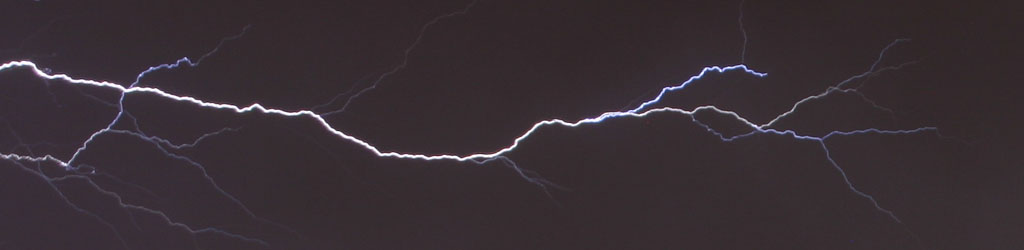
I probably shouldn’t even feature this, because it represents a stupid move on my part, a failure to register the imminent danger. I’d gone out to a nearby clearing to witness a distant thunderstorm, which petered out, but then I noticed that the clouds directly overhead were starting to get active. There were no ground strikes, not even any thunder, just cloud-to-cloud activity. Until this one. It was the only ground strike of the entire storm, but it struck within a couple hundred meters, which is way too fucking close – you’re looking up the bolt here. I knew it could happen, I just wasn’t thinking. It could easily have killed me.
If it had, this image would possibly have garnered worldwide attention for a few days, unlike what it’s doing now. I wouldn’t have made any money from that of course, but The Girlfriend could have built a nice nest egg. Kabang!
We might also conclude that there was an even worse atheist than me nearby, more deserving of the whole vengeful wrath thing. I never heard of anyone being struck, but you know, we typically don’t merit the media attention…
November is not
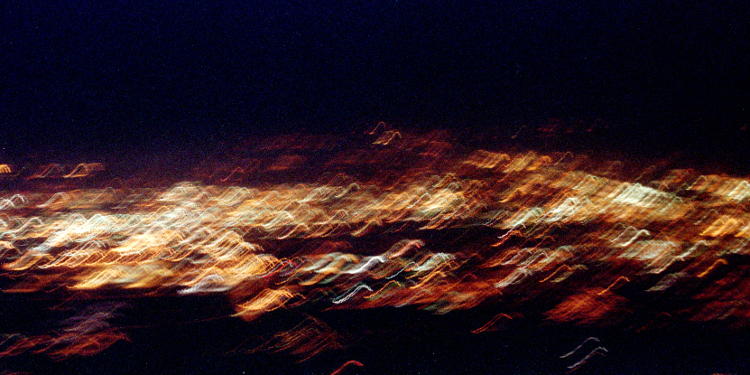
Not after today, anyway. And that means we have the end-of-the-month abstract to deal with, because it’s tradition now. Meaningless ritual. Completely idiotic superstition. You know the deal.

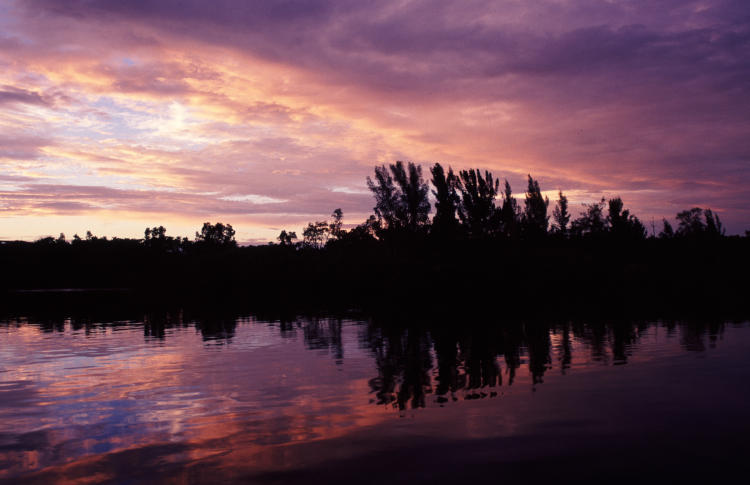
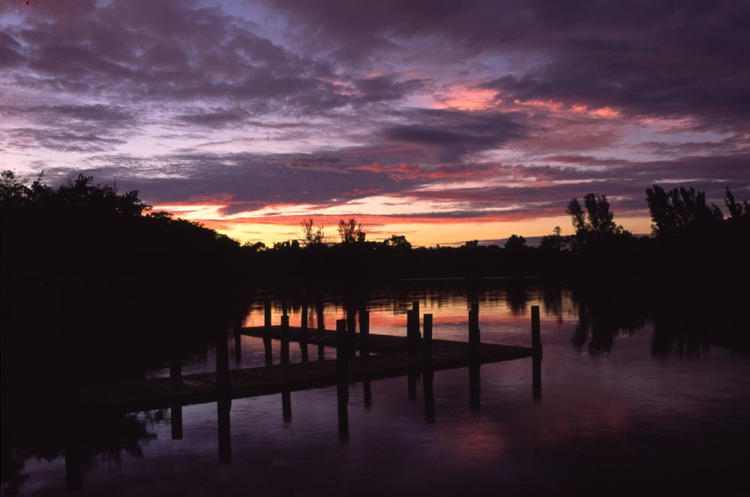
Definitely abstract this time, if not a bit hard to fathom, but this is the glitter trail of sunlight reflected from slightly choppy water, seen through the needles of a bald cypress (Taxodium distichum.) They were there, I had to do it, and I regret nothing! Nothing, I tell you!
Well, maybe it would have been a little better with a tilt to it. But beyond that, the regrets are nonexistent.
Okay, maybe a section of more geometric or even branches. But beyond those…
Though wait! We have another, only an hour and twenty-two minutes and five seconds later.

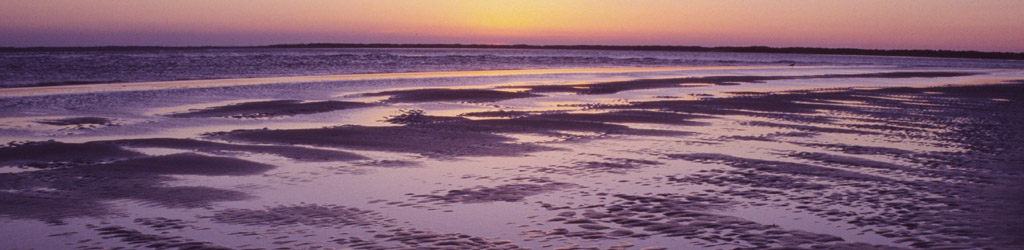
Easy to recognize this time, yet still abstracty enough, using what little color the sunset produced. Absolutely no regrets over this one.
Well…
Too cool, part 51: Enki Catena
I still routinely check out Astronomy Picture of the Day, even though I’ve come to personally call it the Photoshop of the Day because the number of edited images are now surpassing the unaltered ones – virtually all of those showing starfields over landscapes, certainly. But yesterday’s deserves a look at least. It’s a magnificent sharp image of Jupiter’s moon Ganymede, taken by the Juno spacecraft, and the detail is stunning – clicking on their image (linked within the one below) will take you to the full-resolution version, and it’s well worth it.

Just the textures and details revealed when viewed at full resolution are fascinating enough, but there’s a specific detail that jumps out when you find it, vaguely visible in the smaller version here. About one-third down from the top and just left of the center of the moon is a prominent white splash on the edge of a dark smear, and through the middle of that white region runs a connected string of smaller craters – thirteen, to be exact, in a remarkably straight line.
Turns out this is Enki Catena; ‘catena’ is the term for a line of craters, as if you didn’t know that. It is presumed that they were all formed either simultaneously or in quick succession from an object, likely a comet, that got close enough to Jupiter to be broken up by the gravitational forces. and later impacted on Ganymede. Recent investigations into the nature of comets has revealed that they are more loose collections of dust and boulders than they are a solid body, unsurprising to a degree because they’re too small to compact themselves tighter through their own gravity; more surprising is how the whole mass gets redirected into long-term orbits between the outer reaches of the solar system (the Kuiper Belt) and the sun or Jupiter. Yes, there are comets that orbit around Jupiter itself rather than the sun, because it’s big, you know. But it likely takes rather specific conditions to direct such a mass away from typical orbital profiles into the elongated ellipses that comets typically follow, without just tearing them apart. And Enki Catena, at least, indicates that this particular one didn’t begin with a much larger, solid body that gradually accumulated more dust and ice, because all of the craters are roughly the same size.
That dark smear that it crosses the boundary of, by the way, deserves a close look too, because it’s pretty specifically delineated, and the other image of Enki Catena, obtained in 1997 by the Galileo mission, clearly shows a boundary trench, which is also visible in other portions of this image away from Enki Catena. Is the whole region bounded by a trench, and moreover, what caused this? That’s something else to ponder. Makes me wonder if we’ll get a lander onto Ganymede within my lifetime.
Profiles of Nature 58
The combination of rituals, lucky talismen (talismans? Whatever, we don’t care,), cutting foods ending in “S” from your diet, and talking backwards on Tuesdays failed to work, because we’re here again with the Profiles! Right when you were thinking, Maybe. Just maybe…

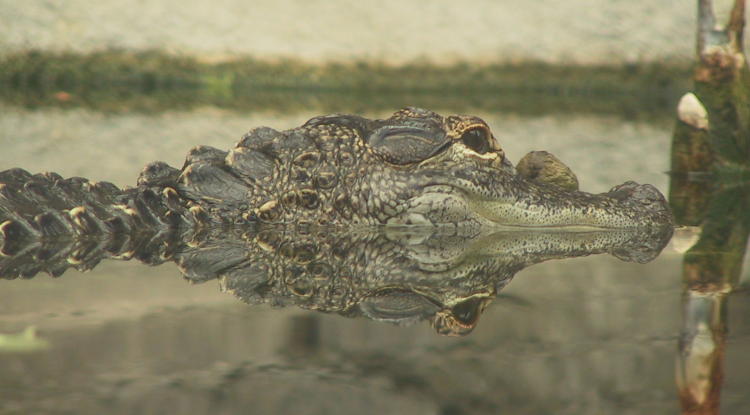
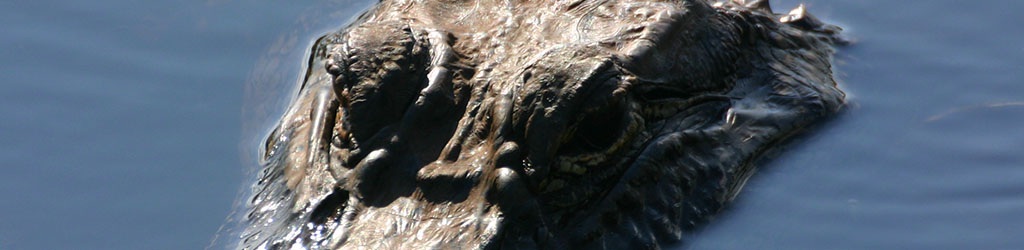
Today we have Caleb, up well before he ever wanted to be and quite sure the breeze is making too damn much noise. Caleb thought he had struck gator gold when he happened across a flock of egrets too unresponsive to escape last night, realizing now that they’d been partying hard (it was an Ardean holiday yesterday, the Feast of the Timely Tailwinds,) and he definitely exceeded his limit of schnockered seabirds on an empty stomach. The last thing he needed this morning was paparazzi, which might normally have been very bad for us, but the thought of doing a death roll makes him want to blow chunks, and even a fat floundering guinea pig could escape by making the water ripple a bit too much. Because of all this, Caleb wasn’t answering our questions with anything more than a weak groan, so we’re using his Herpepedia page for the remainder (no, that has nothing to do with STIs – geez, read a science book.) Caleb is in high demand among directors because he can tell the difference between a popular, A-list actor and the special effects mockup spurting fake blood, so he knows when he can chomp down; additionally, he knows the difference between a popular, A-list actor and an extra getting paid $25 a day so, you know, the catering costs are greatly reduced. Caleb was discovered while he was ‘performing’ (lying there) in a roadside attraction as the largest alligator in Florida – one of 758 of them, anyway – but has now been in every movie featuring Florida in the past eleven years. The popularity of such, however, has waned recently and Caleb isn’t in demand as much anymore, so he’s now hoping to meet a certain ex-President who is by no stretch of the imagination a popular, A-list actor; following that meeting, Florida may again start to be more acceptable in the media, but even if it doesn’t, Caleb considers this a valuable service to his country. He admits that he never picked up a hobby because he thought spare time had something to do with bowling and not about ribs, the fool, but he has campaigned against Pearls Before Swine and The Far Side for their bigoted stereotyping of crocodilians. Caleb reluctantly admits that his favorite song that no one knows the name to but was not actually used in that The Simpsons episode where the power plant is bought by a German corporation is, ‘Happy Go Lively.’
Will it be six months from now? Will it be next week? Will it even be later this week? No one knows, including us, but the Profiles will return. Book your therapy now.
Living in the past XV

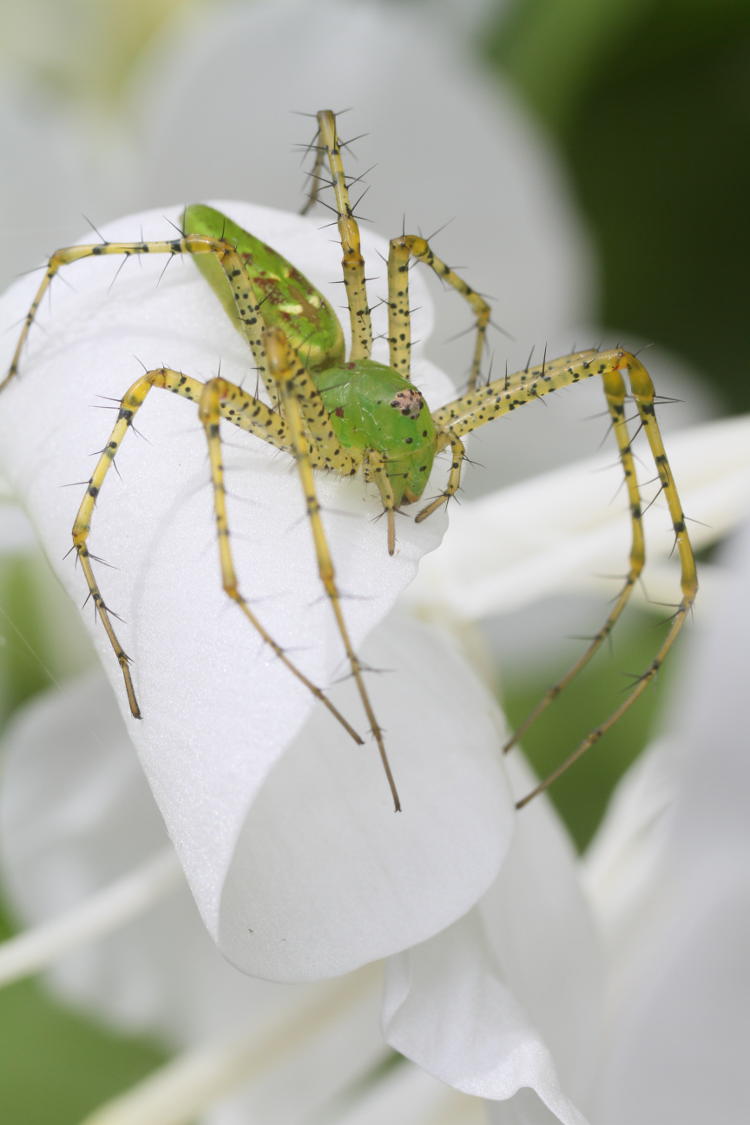
Another from 2014, I always liked this direct portrait of a minuscule crab spider (genus Mecaphesa) – I went back to the original post to find that she measured 6mm across the legs in this position, which doesn’t make her a whole lot bigger than a tick.
Then I looked at the date, which was familiar, and thought, Is this the last arthropod photo that I took at the old place? Because we moved to the new house the day following, or over the next few days anyway. So I went back and checked through my stock; the answer is no, but close. The last was this (previously unpublished):

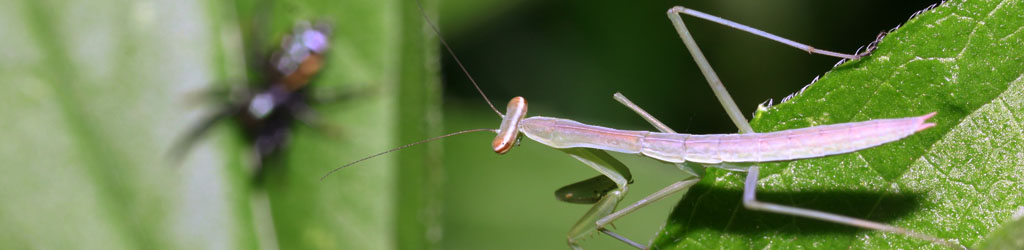
This batch of Chinese mantids (Tenodera sinensis) had hatched from an ootheca right on this very azalea bush and I had been following their life cycle, so I was determined to collect a few and bring them along with us to the new place and continue monitoring them. Except that the very next image in the Arthropods 4 folder was this one:

This was taken on the Japanese maple tree alongside the front door at the new place, about the same size as the previous mantis shown, so there had been a hatching there too, and I figured I’d leave the others at the old place and just work with these. Moreover, it’s the same Japanese maple that has appeared in dozens (if not hundreds) of images here over the past 9 years.
I mentioned the Arthropods 4 folder; I limit them to about 4,000 images to make them easier to skim through, and I’m up to 7 now. The Arthropods 3 folder, however, contains images solely from October 2012 to August 2013 – easily my most prolific bug period. Someday schoolkids will be required to know that…
Tripod holes 48
This one’s for Mr Bugg, who is likely to be pretty damn close to this spot in about a week or so.

N 26°27’10.73″ W 82° 7’33.94″ Google Earth location
Accuracy? I sincerely doubt it. But I was somewhere along Indigo Trail in JN “Ding” Darling National Wildlife Refuge on Sanibel Island, Florida when I took these frames, and that’s close enough, especially since this bird is unlikely to still be there 28 years later. I was on my first dedicated photography trip alone, though my second visit to Ding Darling – I’d visited the year before with friends – and was hiking the walking trail looking for critters. A then-unknown bird species was calling out across the marshes and, after spotting it in the treetop, I stalked it carefully, pausing every handful of meters to take another frame in the certainty that it would notice me soon and take flight. Yet it did not, and within a couple of minutes I was directly underneath it – there was zero chance that I had successfully maneuvered so close without it being aware of my presence, so apparently it just didn’t care. After securing some nice frames, I brashly imitated its call.

And this is what I got in return: the yellow-crowned night heron (Nyctanassa violacea) fixed me with an evil glare and held it, which I have to say is the only time I’ve been so honored. It’s easy to imagine what was going through the bird’s head and virtually guaranteed to be absolutely wrong; the best I can say is that I either did more than a passing imitation of its calls, which demanded close examination to determine that there was no actual interloper on its territory, or (more likely) I was only close enough that it was confused as to what was making this inept attempt. Regardless, I took advantage of this with delight.
And then after a moment or three, the bird looked away again, dismissing me as inconsequential. I have to note that this was taken at 260mm, since that’s the longest lens I had at the time, and while cropped, I was only a handful of meters from the bird’s position, quite close as far as wildlife photography goes – the first frame at top is uncropped and taken while I was still further off. But my proximity was no matter – the bird had more important things to tend to.

I want to point out that the species does not have an orange stripe along its jaw at all; that’s simply a leaf in the way, visible in the second image too. What’s funny about this is, I still consider Ding Darling to be a great place for photos, but when looking for examples as proof, I have nowhere near as many frames as I do of other locales. Truth be told, I’ve been there four times, I believe, and two of them were remarkably unproductive; the last visit with The Girlfriend (in 2009, damn) has so few frames I could easily argue that it’s a poor choice. Yet my first fartistic gator shot came from here, not half an hour before these, plus some raccoons, plus some fartistic lizards, so, hit-or-miss, but when it’s a hit, it’s a big one. That probably says enough.
Living in the past XIV
I threatened to do this, and it was not a mere bluff – I’m going through with it, and there’s nothing you can do to stop me.
[Well, there probably is, but let’s not go there…]

We’re back to revisiting some of the images from years past that I particularly liked, and this one certainly counts – dating from 2014, it’s been a part of a gallery show, and resides on the main site, and has even been converted to monochrome. Moreover, the effort in achieving it was minimal – I think I had to be in a slightly awkward position to get it, but it was right outside the door one cool and humid morning and the light was right. ‘Course, knowing that it might look great with extremely short depth-of-field was all skill, baby…
Actually, I recognized the potential, but the result exceeded my expectations – not exactly a happy accident, just a nice bonus. Of course it deserves to be seen again.
Here’s why, part 6: Psychic abilities
This is a rather broad topic with no real consensus on what it includes, so it’s likely that anyone could either fault me for not covering something, or accuse me of lumping disparate concepts together. Overall, however, the same factors will apply to most or all of them, so let’s dive into, “Why doesn’t science take psychic powers seriously?”
The short answer is, such things have been tested repeatedly and extensively, and have come up sadly lacking in any actual impact. There are two key factors in such tests, however, which are double-blind testing and functionally-defined results. We’ll do these one at a time.
Double-blind testing is a common method of determining results of tests that can be influenced too easily by human perception and/or desired results. It’s been used in testing medicines, in that even the doctors prescribing the medications don’t know whether they’re issuing the actual medicine or an inert substance, and the patients don’t know the same; only those tabulating the results have access to the guide that reveals the truth. In this way, the subjectivity of either patients or doctors in evaluating the results is reduced to a minimum. With psychic powers, this method is often used by refusing to reveal what, for instance, the actual cards have on them that the test subject is attempting to guess, or even that the proctor of the tests doesn’t even know what they’re trying to find. Without this, the possibility arises that someone who wants to believe in psychic powers can interpret the results with bias, or even influence this – which leads to the second bit.
Functionally-defined results refers to an unambiguous and distinct set of goals, with little room for creative interpretation or ‘close’ results. One example that comes to mind is a test subject, asked to determine the target held in the mind of another subject, naming a ‘parade’ when the target subject was, ‘July 4th.’ There are a lot of reasons for a parade, and July 4th doesn’t rank as one of the more prevalent examples of such, but more to the point, where’s the value in having a perhaps-close-but-not-very-specific answer when resorting to psychic abilities? If I can’t remember ‘July 4th’ in conversation and say instead, “You know, parade day,” how many guesses would anyone have to provide to get it correct? And if I fail to confirm any answer, what then?
[A small side note that came from some of my researching on the topic: useful scientific results aren’t demonstrated just by the publication of a paper – initial results can easily overturned, papers retracted, to say nothing of the ‘pay to publish’ journals that exist. Confidence comes from peer-review, and especially replication; can someone duplicate the results with the same conditions and standards? This reflects the bit above regarding bias in researchers. Always look for review and replication before putting any confidence in any scientific studies.]
Other factors come into play, such as leading the test subject, usually unconsciously, sometimes not so much. The classic case of Clever Hans, many decades ago, revealed that a horse that could supposedly do advanced arithmetic was actually only reading the subtle physical cues of the owner and those running the tests – a horse, mind you. Unable to see the person posing the math problems, or worse, presented with problems that the person did not know the answer to, produced a sudden case of typical horse intelligence. Anyone experienced at reading the body language, the “tells,” of someone running the test can produce results well above random chance, especially when such tests often have very narrow choices that are already known to both. Inexperienced testers often inadvertently help the testees along, by answering questions that they shouldn’t or prompting for more details only at key times.
This of course leads to cold-reading, an extremely well-known, and well-understood, tool of countless public psychics. The field is broad with a lot of aspects and I would encourage anyone to look into it deeper if they want a full treatment, but in essence it is a method of allowing those seeking answers to actually provide them to the psychic. For instance, the psychic may ask if someone in the room knows someone whose name begins with “J.” A moment’s thought reveals this doesn’t narrow things down very far – we all know someone, usually in our immediate family, whose name starts with “J.” With a positive answer from an eager audience member, already primed to believe, the psychic then begins to narrow things down by guessing at names: James, John, Jack, Jerry, and so on, with the audience member virtually always confirming it when the psychic finds a match among these ridiculously common names. Once the reader has a ‘match,’ they can then proceed with providing vague, feelgood assurances that the recipient and audience somehow never notice is nonetheless more specific than “a name that begins with ‘J’.”
But with the common tricks of the psychic out of the way, let’s talk about the issues from the scientific side:
Somehow, the psychic lacks knowledge of matters that could be truly informative, lucrative, or life-saving. Any true psychic could make millions with no effort simply on the stock market, no clients necessary. They also would be remarkably invaluable when it comes to warnings about natural disasters or violent attacks – it’s actually hard to imagine that such abilities wouldn’t be utilized in thousands of ways in thousands of different functions, military and law enforcement being the prime candidates. And while it’s true that some psychics do occasionally offer their services to local police to help locate a missing person, it’s also quite easy to see how infrequently this has the slightest effect – not to mention that their input before the person went missing would have been hundreds of times more useful.
Psychic predictions demonstrate causality. This is a big one, because at the barest minimum it suggests that events are, for want of a better word, ‘planned.’ Whether this is through the determinism of physics or the will of some god(s), it’s still a earth-shattering thing to know about our universe. And it also raises the biggest issue with causality: is this fixed or is this changeable? Science fiction writers have examined the ramifications of this ad nauseum, including the number of flaws, but somehow this is glossed over entirely by psychics. I mean, forget which goddamn card I’m holding up – which treatment is going to be effective for my cancer? Shit, when’s the best time to travel this holiday? Where and when are the criminals going to strike next? C’mon, Aunt Agnes, let us know something important.
Moreover, how, exactly, are these future events recorded, and thus able to be read/sensed/divined/whatever? Videotape? Clay tablets? Radio transmissions? The implication is that events that have not even come to pass somehow emanate something detectable and specific, able to be discerned among the literally infinite events that the future holds. That sounds like a damn noisy environment. And what about the past? Do these records fade when they happen or something, because I have yet to see a psychic clarifying all those sketchy details about past historic events.
Communicating with the dead proves an afterlife, but who cares about who’s at peace there? Religion is one of the biggest contentions on the globe, and has been for centuries. Let’s have some solid answers about all this. Which religion is correct, and what can we expect after we die? How are you sensing anything without physical sensory organs, and what are the parameters? How boring is it? Have you talked to the folks in charge, and if so, what do they say? Seriously.
[I’ve already tackled the idea of non-corporeal souls earlier, so go there for a more in-depth treatment.]
The physics isn’t kind. [I know, switching back and forth so often between ‘psychics’ and ‘physics’ is cruel, and I’m one of those that can miss the distinction from reading too fast.] Brains are simple fats and proteins and a lot of water, and the energy with which they operate is remarkably tiny; this is the source of the ‘green jello’ problem with electro-encephalograms. Yet somehow, they can both send and receive distinct patterns of ‘thought’ across vast distances including, apparently, from brains that are no longer operational – that’s how psychics are supposed to find dead bodies, right? I mean, even if they ‘see’ them they have to know where to look in the first place? Yeah. But if this were indeed the case, the entire environment would be absolutely jam-packed with the emanating thoughts of everyone else in the detectable radius, and we’re all familiar with how rapidly thoughts progress and vary – to call this ‘noise’ would be a vast understatement.
We have the senses that we do because they’re what won the evolutionary lottery. And certainly, being able to sense the intentions of any living being in the immediate vicinity could be extremely useful – but the vast majority of us don’t have that, do we? Even if psychics are a genetic mutation, it would imply that they could come to virtually no harm whatsoever. Weakly supportable, perhaps, for the living psychics, not so much for the dead ones, but note that this should also prevent simple accidents and injuries, ‘bad luck’ and crummy days, and of course, all of the negative press that’s ever received. Any time a psychic makes an incorrect prediction – more on this in a second – they should have already known it was incorrect and how bad the repercussions would be, and avoided all that entirely. Yeah.
There’s this thing called ‘confirmation bias.’ The internet has not been kind to psychics. Before, someone would have to root through newspaper archives and perhaps even tapes of morning talk shows to find the various predictions that psychics made that were dead wrong, but now finding such things is easy. And such mistakes are plentiful – it’s almost as if psychics ascribe to the idea that if you throw enough shit at the wall, some of it will stick. Those sticky bits are the ones that are referred to as evidence of the psychic’s prowess, somehow ignoring all of the stuff that they should have known was wrong in the first place. Anyone can be right 100% of the time with such methods, but the real world (and especially the scientific community) takes into account all of it – no cherry-picking. When these are counted, the amazing results fade very quickly.
Oh, the excuses. One could disprove psychic ability just by listing all of the excuses for incorrect predictions and failures to operate, and realizing that there is no pattern, rhyme, nor reason to them. Again, why didn’t you see that ‘negative energy’ coming? Even if you can’t play the market because ‘your powers can only be used to help people’ (and who told you that?), we’re still looking at a lot of disasters and terrible events that were missed entirely, when they should have had a remarkable impact on that pre-recording of events. Even if we consider that such powers or properties are sporadic and capricious, this means that they have exceptionally little use to anyone.
If you look, you’ll also notice that the caveat, “For entertainment purposes only,” appears an awful lot in regards to published psychics (and astrology, and so on.) It would appear that a lot of psychics attest to their remarkable abilities, but not to the point where they’ll legally stand behind them. No guarantees, no money back, let the buyer beware, you were the sucker that bought into it.
But what about the police using psychics? A legitimate question, but one with a lot of baggage. ‘The police’ is/are not a single entity, but a collection of law enforcement agencies for individual districts, guided by individual officials. The vast majority have nothing whatsoever to do with psychics, and I have yet to come across any that routinely utilizes such. Psychics often volunteer their services in high-profile cases, with often terrible results, and officers that don’t automatically dismiss them are considered to have some confidence in their abilities – you see the flaw in thinking here. On occasion, police departments let the psychics do their thing from a) there being no harm in it (they’re not being charged for the services,) and b) they may get accused of not using ‘all available resources’ when trying to find a missing person or something. And one more, that’s come up more than a couple of times: so-called ‘psychic information’ is occasionally from someone who actually knows something about the case, such as a witness or relative thereof, but wishes not to testify or be named. It’s more prudent to pay attention to such ‘readings’ on the chance that this may be the case, than to dismiss them regardless of how badly psychic powers have been proven.
[There was a prominent missing person case where I used to live in central NY, and a psychic popped up with information – the details were incredibly vague of course, mostly attesting that the body could be found “near water,” which it actually was. But not for many years, because depending on your definition of “near,” this applies to the entire state and indeed everywhere in the country that’s not actually a fucking desert. It should also be noted that the missing woman’s purse and driver’s license had already been found within a park bordering the major lake, which had been reported in the news so, yeah, wild shot in the dark there. The body was only discovered by accident, as I said, many years later.]
People believe what they want to believe. This is how psychics still abound, because far too many people want to believe in mystical powers and properties, and listen uncritically to the accounts. They go on the defensive the instant that anyone raises the slightest question, and never, ever raise any questions themselves. Any positive aspect is grasped lovingly, any negative aspect is ignored. The biggest issue with this is, naturally, that anyone who recognizes this kind of behavior and has no scruples can exploit it easily – and routinely do. It must be said here: it takes a special brand of shithead to twist the emotions of the grieving for personal gain.
Moreover, such beliefs contribute to the too-prevalent distrust of science – the old, “Science can’t explain this,” and, “We don’t know everything,” which is true, but doesn’t actually increase the probability of any given concept in any manner. Those who spout such weak little proverbs may be prone to dismissing intelligent evaluations regardless, for myriad reasons, but the number of people who profess to have some kind of extra-special mystical powers, as well as the number who want to believe them, contribute to the idea that ‘there must be something to it’ – while the solid results that we should reasonably expect if there were remain elusive still.
Note, too, that it hardly requires recognition or testing from the scientific community, however you might define that, to establish the usefulness of psychic powers – anyone with such should be quite capable of making their own amazing progress in the world, at a distinct advantage over everyone that lacks it. Doctors didn’t need the investigations or recognition of priests, shamans, or really anyone to actually start healing people.
Or, you know, we could simply ask ourselves where the phrase, “parlor tricks” originated…