
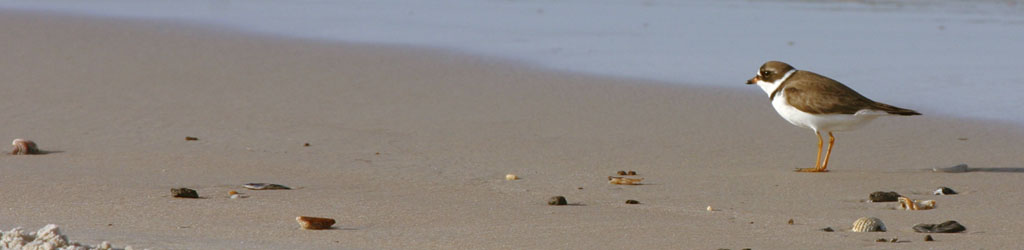
June’s last gasp

Just three four last photos before I close out the first half of the year, and start all of the associated maintenance.

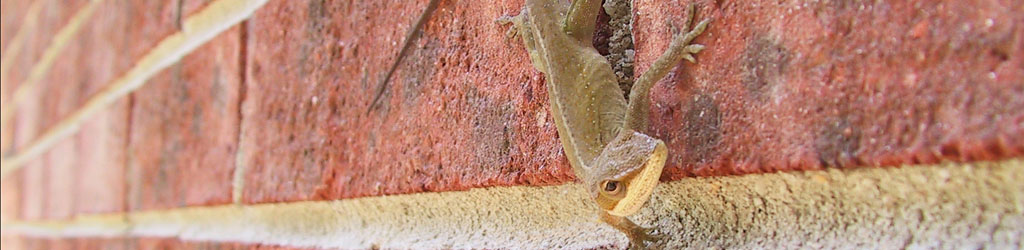
In doing my routine patrol of the front forty of Walkabout Estates today, I was musing to myself that I hadn’t seen any Carolina anoles (Anolis carolinenesis) up there for a while, like several days; there are at least two, in two different locales. Not troubling, but curious.

That was all it took, apparently.

Carolina anole Anolis carolinenesis posing on ornamental sweet potato leaves
This is the closest one, generally hanging out on or around the Japanese maple that sits close to the front door; in this case it’s on the sweet potato vines in the planter that’s immediately adjacent to the tree, flanking the front steps, which also holds (as you can see) some pansies. While cautious about my presence, the lizard nevertheless gave me a couple of poses as I endeavored to get the flower in there.

A little later on, while engaged in the ongoing Japanese beetle slaughter that marks summer around here, I found the other one, or at least an other one, on the front oak-leaf hydrangea. This one sat up high and retained its position as I scooped a handful of beetles off of lower branches into the soapy water.

Carolina anole Anolis carolinensis atop oak-leaf hydrangea Hydrangea quercifolia
Both were patient enough to allow me to go inside and grab the camera, since I did not have it in hand on either occasion – my hands were full with beetle patrol. [A little tip: Japanese beetles typically just drop off of their perch when danger threatens, counting on either taking flight as they fall or simply disappearing into the undergrowth. Fill a bowl with water and a little dish soap and hold it underneath, then tap the branches above or near the beetles, and they’ll usually fall right into the bowl. The soap breaks down the surface tension of water, preventing it from being repelled by the beetles’ chitin, and they’ll drown – without it, they may escape. And while you might question the efforts to slaughter insects by a nature photographer, this particular species is invasive, has few predators in this area, and can do a lot of damage.]

Back to the anoles. Suspicious of my switching vantage, this one started slipping down the layers of leaves, but in doing so came in my direction, so I got a few more frames.

Carolina anole Anolis carolinensis atop oak-leaf hydrangea Hydrangea quercifolia showing eyes aimed in two different directions
This is not just an expressive pose, but it is the first distinctive evidence that I’ve gotten that shows that anoles, like chameleons, can aim their eyes in two different directions as once; I’d often wondered, but the chances of seeing this are always slim, unless I somehow got one to pose in front of a mirror. There’s no reason why they couldn’t move their eyes independently, since binocular vision isn’t too necessary for them, but I’d never been sure until now. By the way, I cropped this image to include the entire tail, and so have to draw your attention to it.

One more, totally unrelated, but I’m not making an entire post over just this:

basilica orbweaver Mecynogea lemniscata in tentlike web structure
This little guy has had a web stretched between two potted plants on the back deck for a while, and I initially took it to be an orchard orbweaver because I couldn’t see the back of the abdomen clearly, but later determined that it’s a basilica orbweaver (Mecynogea lemniscata) – I’ve only seen them once before, but certainly recognize the pattern. And while they call it an orbweaver, which typically means a wheel-shaped web, this is more of a sheet web, and you can see that there are multiple layers to it with some curious strand patterns. On moving the plants earlier, I reduced the space between them to almost nothing, collapsing this web, and then returned them to position and the web sprung right back into its shape, the spider only twitching in preparation of fleeing. Good engineering.

Last night I had finished photo sorting over 1,500 images and run the internal backups, and then today I added another couple dozen photos so, do it again – it shouldn’t take too long this time. Though there’s also the post draft purge of the blog database, and e-mail purging, and some month-end maintenance, so I’ll be busy for a couple of hours – but at least I got one last post out for June.
Garden finds

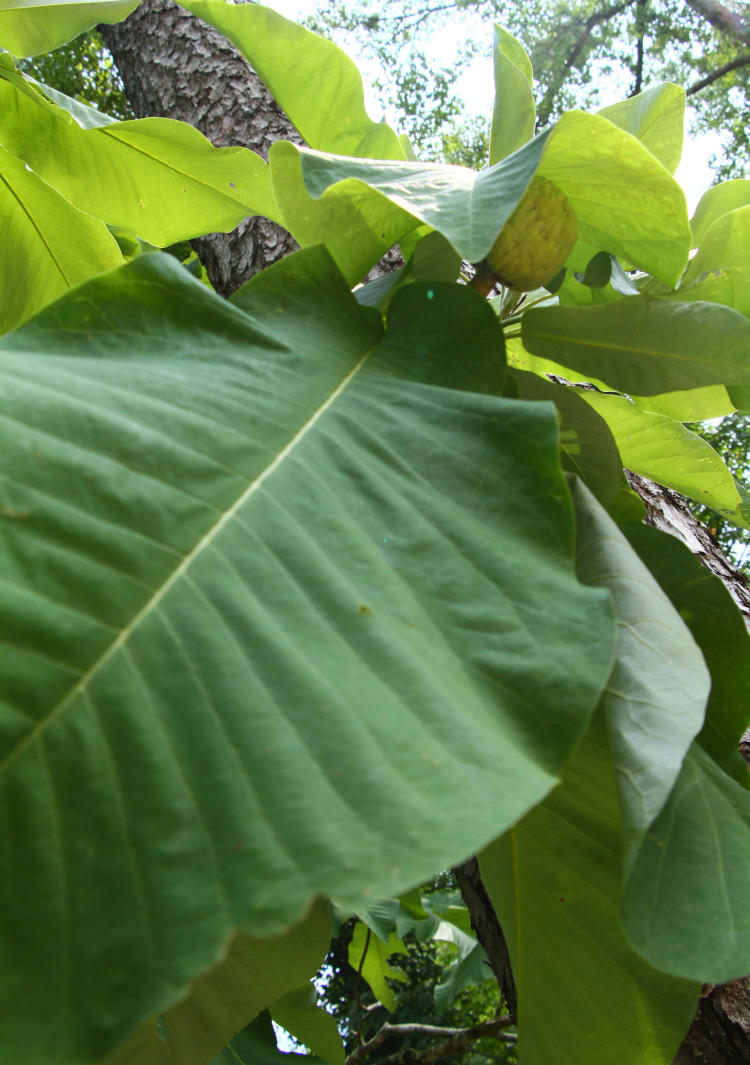
fartsy shot of possible bigleaf magnolia Magnolia macrophylla
The other day I went out to the NC Botanical Garden for the first time in ages, to see what could be found. Notably, this was the first time in several years, I think, that I found no Carolina anoles during my visit, though we’ll make up for that shortly. There were enough other things to photograph, but like normal, I wasn’t looking for the ID plaques of what I was photographing, so most of my identifications here are tentative and subject to blaming the garden just for the sake of it. For instance, I believe the above image is a bigleaf magnolia (Magnolia macrophylla) – it is certainly distinctly different from the common magnolias around here, but we’re not here for a botanical lecture, just for fartsiness. We may not get that, either.

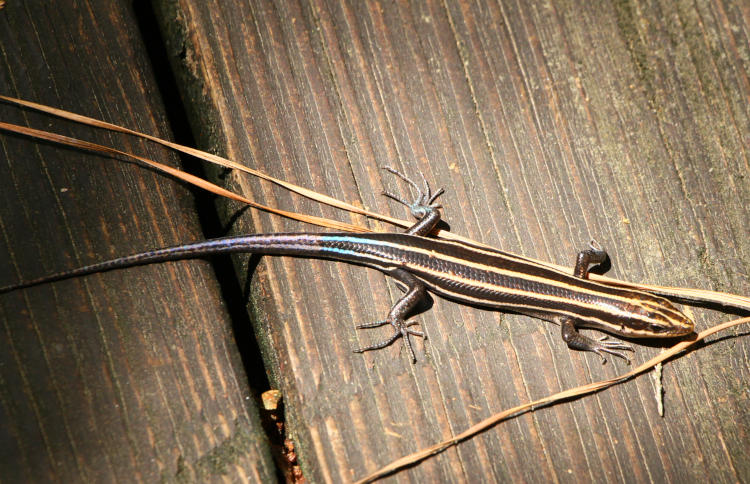
younger American five-lined skink Plestiodon fasciatus showing evidence of regrown tail
Not even minimal effort of fartsiness here, just a close view of my first find, an American five-lined skink (Plestiodon fasciatus.) The electric blue tail is a trait of juveniles, though this one was large enough I would have thought this would have faded by now, but we have clear evidence that it had dropped its tail sometime in the past and it was now fully regrown. Skinks can actually release their tails on their own, when it isn’t actually pulled off by a predator, and the detached tail will writhe exuberantly for some minutes, hopefully keeping the attention of the predator while the skink, now lacking some of the bright coloring, makes its escape. The tails will grow back, fairly quickly though I have yet to observe one dependably to see just how long it takes. It’s not overnight, but it’s within a season at least.

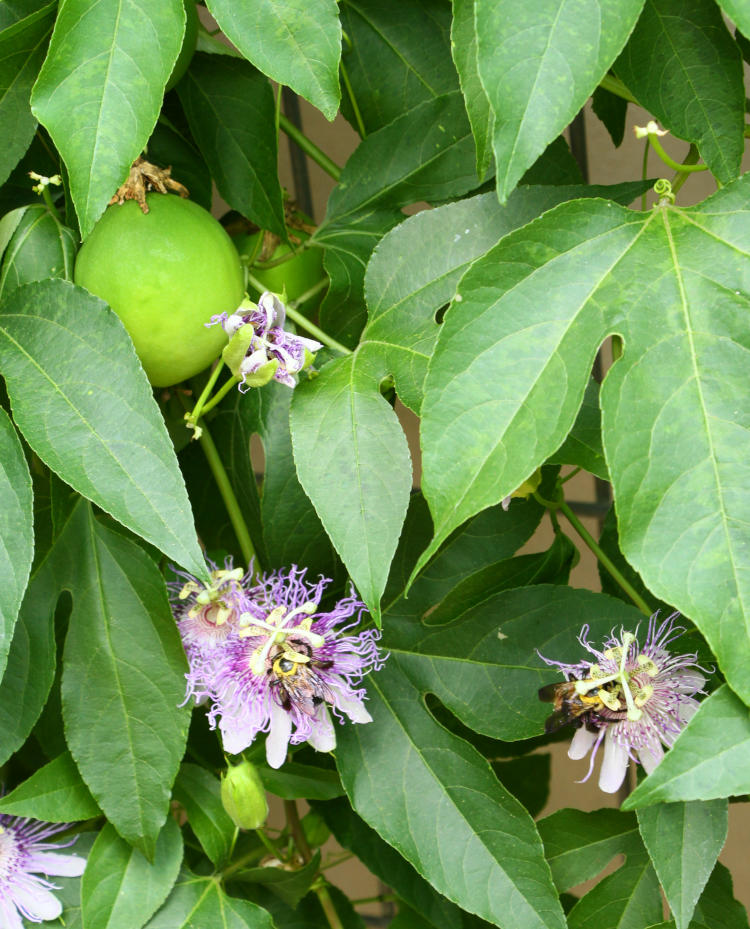
unidentified carpenter bees visiting blooms of fruiting purple passionflower Passiflora incarnata
Against one particular building is a trellis that hosts some abundant purple passionflowers (Passiflora incarnata,) including several ripening fruit. The carpenter bees, however, were still visiting the past-peak blossoms, and I really have to do some detailed macro work of these when they’re at peak, because they’re one of the more peculiar flowers in the area, ideally adapted to have carpenter bees doing the pollinating. You can see it here a little, the umbrella-like stamens arching over and facing down to introduce the pollen to the bees’ backs.

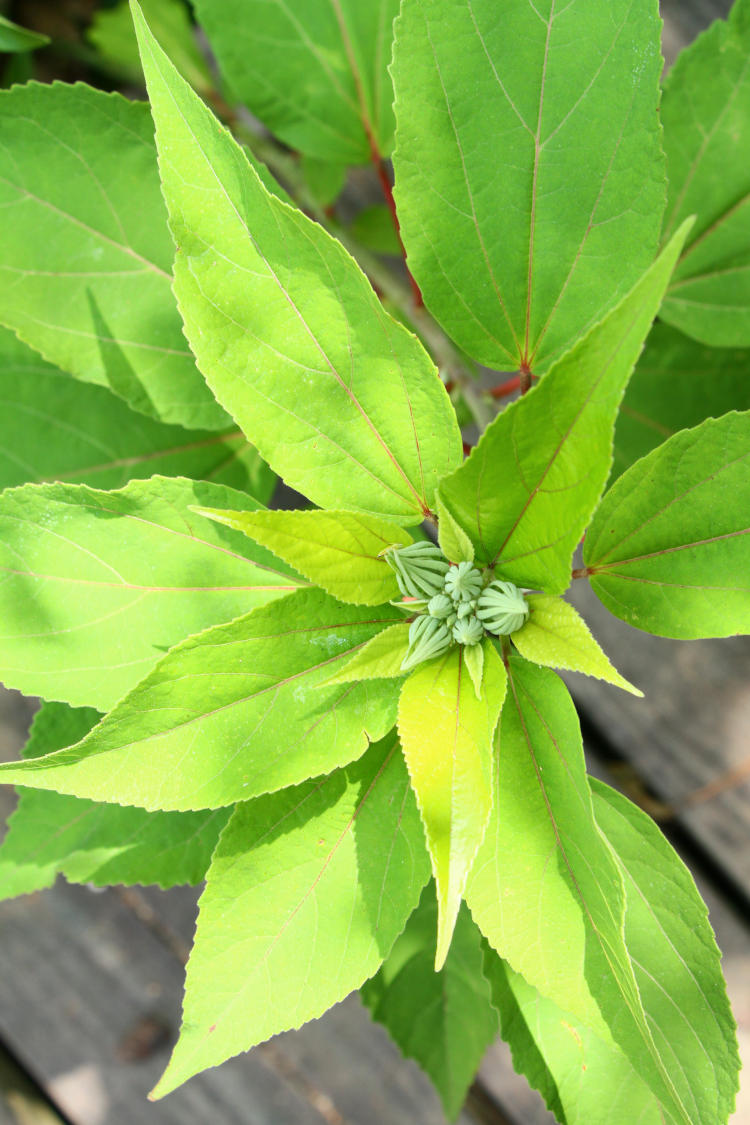
leaves and buds of a probable hibiscus plant
I think this is a hibiscus in the early stages of the flowers budding, but again, just the aesthetics. I tried to make sure the leaves filled the frame appropriately.

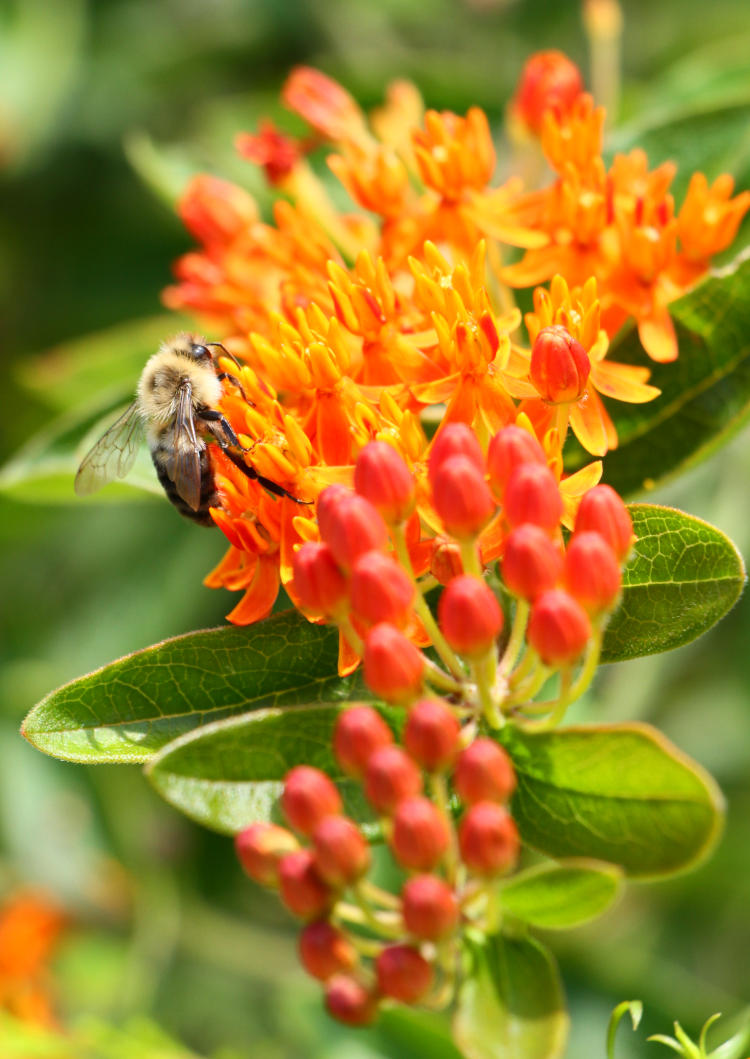
milkweed flowers with possible honeybee mimic pollinating
I’m quite comfortable saying these are a variety of milkweed flowers, but not too sure about that “honeybee” – the head and eyes don’t look quite right, and I think this may be a mimic, but it never gave me the opportunity for more detail than this. Still, aesthetics.

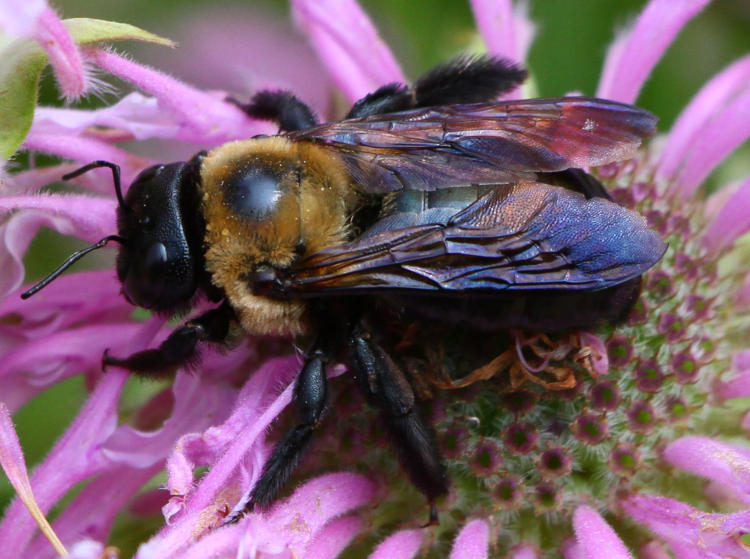
sluggish unidentified carpenter bee on wild bergamot Monarda fistulosa
The flower is a wild bergamot, of which I approve because it’s what makes Earl Grey tea (I mean, aside from certain kinds of black tea leaves.) The carpenter bee was almost motionless atop it as countless others serviced the flowers exuberantly, and why it was so still I can’t say, though I did see it feebly try to ward off interlopers. Rough night? Counting to 100? Got me, but we’re here for the detail of the wings, which caught the light just right.

And finally,

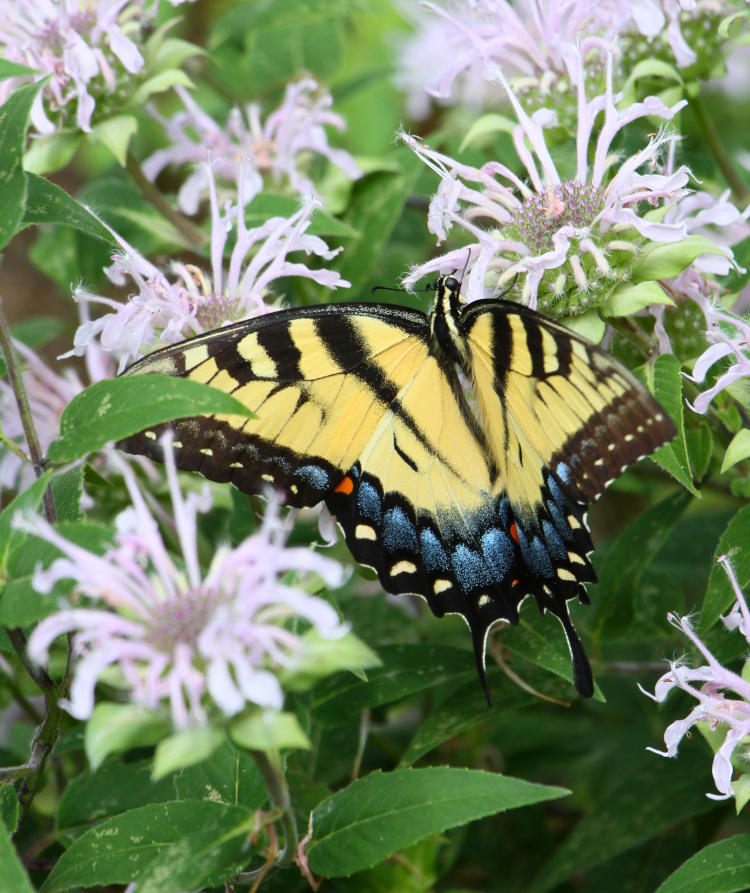
eastern tiger swallowtail Papilio glaucus on wild bergamot Monarda fistulosa blossoms
The bergamot appears again, this time being visited by an eastern tiger swallowtail (Papilio glaucus) – I believe, anyway, because they seem abundant around here and I see the black morphs from time to time, while the common yellow swallowtail does not have those. But let’s not forget about them aesthetics, the complementary colors all working together here. Who needs sciencey stuff when you have all that? Okay then.

Lazy swapping

I know people keep going on about this and it’s a bit tiresome, but it really is lazy to just swap out “ne” for “ly” and consider it a whole new month. “August” and “September” I can get behind, two entirely different words with almost nothing in common; you know you’re making changes when September comes around. With these two, you can only abbreviate them by dropping the last letter, a mere 25%, otherwise it can still be confusing. I propose we rename July to “Maxuary,” after a gerbil I once had…

Which means it’s time for the end of the month abstract, of course. “What could it be?” you ask breathlessly, to which I reply, Oh, for dog’s sake, calm down…

close up of blooms of wild carrot Queen Anne's lace Daucus carota
I’ve known these flower clusters since childhood as Queen Anne’s lace, which is somewhat curious in that it’s only known by this name in North America where we’re proud that we told the British royal family to get lorried, immediately afterward hanging on their every antic; elsewhere it’s known as wild carrot mostly, but Daucus carota for the pompous and pedantic. The deep purple flowers in the center are what the band took their name from, and exist mostly to make birds think there’s a bug there and waste time flying down to it, because the plant is easily amused.

But that’s not all that we have for the day! June yielded yet another that qualified, in the vague and formless structure of the term “abstract” in my head.

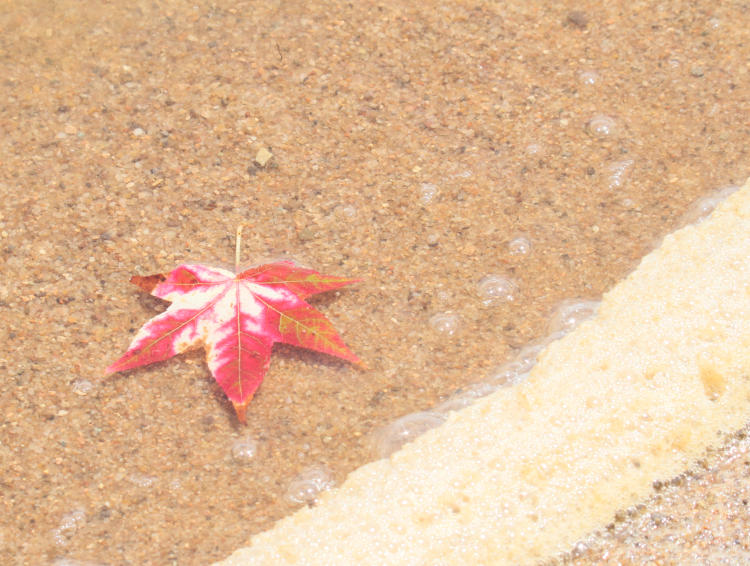
leaf of American sweetgum Liquidambar styraciflua floating near surfline on Jordan Lake
Despite it being high summer, this leaf from an American sweetgum (Liquidambar styraciflua) got convinced that autumn was nigh and dropped vividly into the water, likely to the sniggers of its brethren still greenly partying up in the parent tree. Wankers. But this meant that it stood out distinctly when I was out there chasing birds, and thus gets featured here today, with the foam at the water’s edge included as an extra element. But we need a closer look.

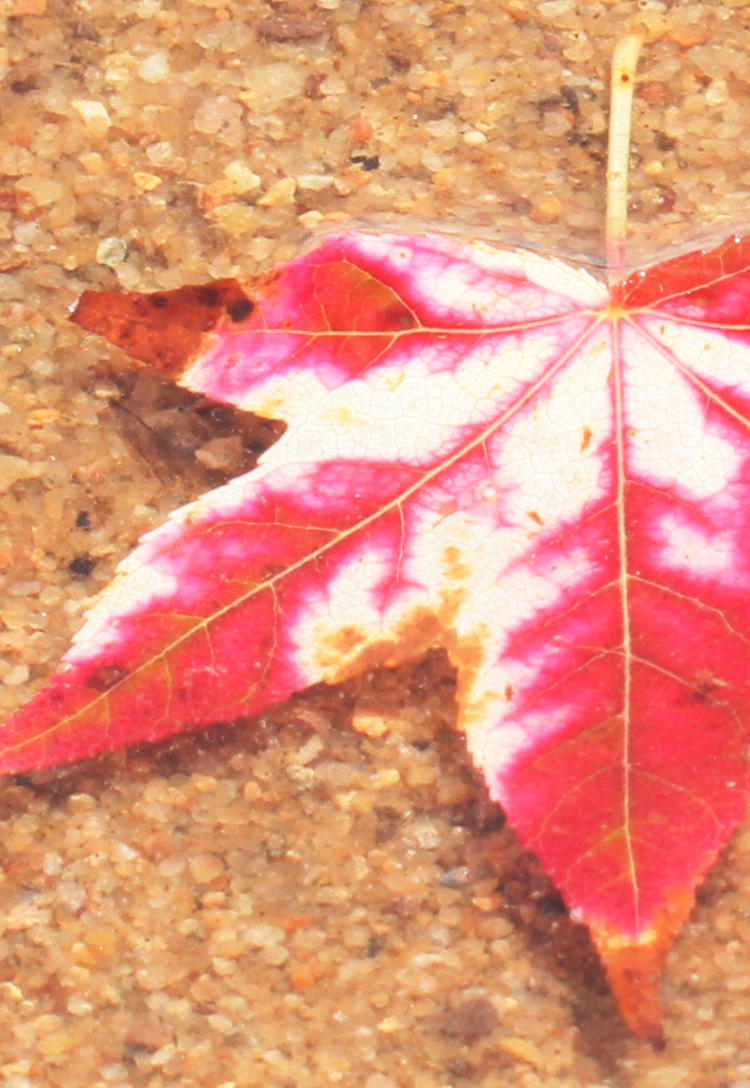
detail of dead leaf of American sweetgum Liquidambar styraciflua
Not too shabby for being shot at 150mm with the Tamron 150-600, eh? I know you’re jealous, but if you’re nice to me, I’ll sell you a large print of the overall frame where you can see both the exquisite composition and the amazing leaf detail all together, and for an extra fee I won’t sign it and you can claim that you took it yourself in a casual, devil-may-care manner that therefore hints of even greater hidden talents and will surely get you laid. I’m that kind of guy.

Heartbreaking

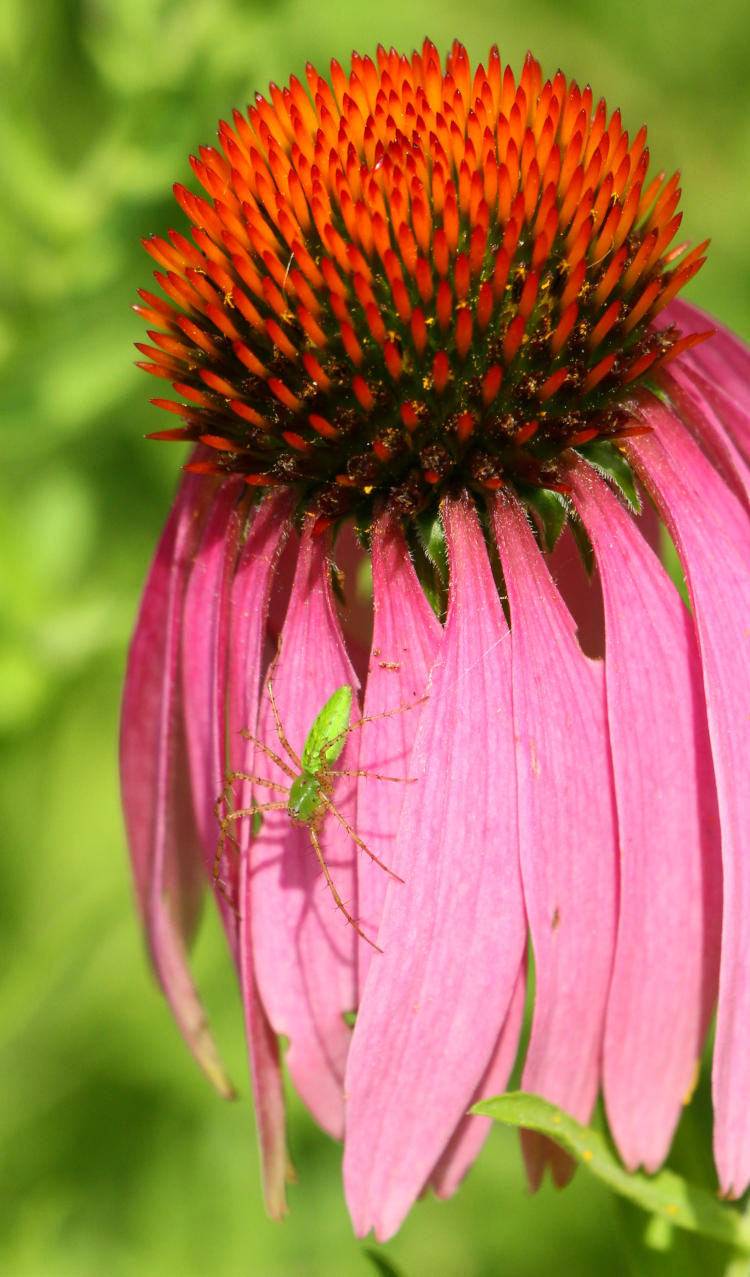
I realize we’re in a culture that has more causes, charities, campaigns, and fundraisers for various ills than we can ever tabulate, and that this one is likely to pass under the radar, but seeing it in person is simply devastating. I’m talking, naturally (as always,) about Help Arthropod Color-Blindness Day, which is tomorrow (June 30th, in the Northwestern hemisphere at least.) Many people don’t realize how dependent insects are on interpreting the correct colors of their environment, and mean ol’ natural selection is doing its best to eradicate the sufferers. It’s not right that, as in this case, spiders should go hungry, or worse, fall prey to parasitic wasps, more than the average that they already do.

green lynx spider Peucetia viridans starkly obvious on purple coneflower Echinacea purpurea petals
Sure, I know, it’s bugs – why should we worry about them? But think where we’d be without insects? Okay, fine, we can do without bedbugs, and I’m slaughtering dozens of Japanese beetles every day to keep them off of the hydrangeas and Yoshino cherry tree, and fuck those goddamn fire ants. Yet without things like caterpillars, we’d have to do without ubiquitous children’s books.

And I hear you; evolution weeds out the poor fits, balance of nature, and all that. But if you’d met me in person and realized that I’m still alive and might actually have bred, you’d recognize that evolution isn’t the most efficient of functions, thank god. Listen, I know this doesn’t compare to the importance of Alien Abduction Day and National Bubble Wrap Appreciation Day, but look deep into your heart and ask yourself, Can I watch this spiky little bastard die just because it was Vivid Lime Green/Lavender Pink colorblind?

Well, can you?

Toldja

Remember when I said that a frog could be nestled within the canopy of the little potted Japanese maple on our deck and I might never see it? I mean, it was just a couple of days ago, a mere two posts back.

The next day (I’m a little slow on pasting right now,) I was watering that very tree and a green treefrog (Dryophytes cinereus) erupted from within and landed on the deck, obviously a bit taken aback by the deluge while it was trying to sleep. I finished watering and then returned the frog to the tree, not trying to convince it to be anywhere, just releasing it within the leaves. This is what it looked like:

green treefrog Dryophytes cinereus hidden within foliage of small potted Japanese maple
Oh, it’s in there all right, and I took pains to position myself so it was visible, but at this resolution, you’re not likely to see it regardless. Here’s a tighter, full-resolution crop:

green treefrog Dryophytes cinereus nestled in foliage of potted Japanese maple, with bonus juvenile katydid
The immature katydid is just a bonus (and not spotted at the time,) but this gives you an adequate idea, I suspect. I took a moment to examine the other angles that I could exploit, but believe me, they were very narrow indeed.

green treefrog Dryophytes cinereus nestled among foliage of potted Japanese maple
This angle shows a couple of scars on the upper lip, which makes me curious as to what produces them – I’ve seen much more distinct ones before, on a green (aquatic) frog, same approximate location. Is this from a predator, or burrowing into something unyielding?

green treefrog Dryophytes cinereus nestled among foliage of potted Japanese maple
This is my favorite of the session, but it does give me the impression that I’m somewhere in the Amazon about to get blowdarted.

Yet as I took my leave, the frog, shifting position among the thin branches, gave me a friendly wave. Or am I reading too much into it again?

green treefrog Dryophytes cinereus nestled among foliage of potted Japanese maple

My kind of summer weather

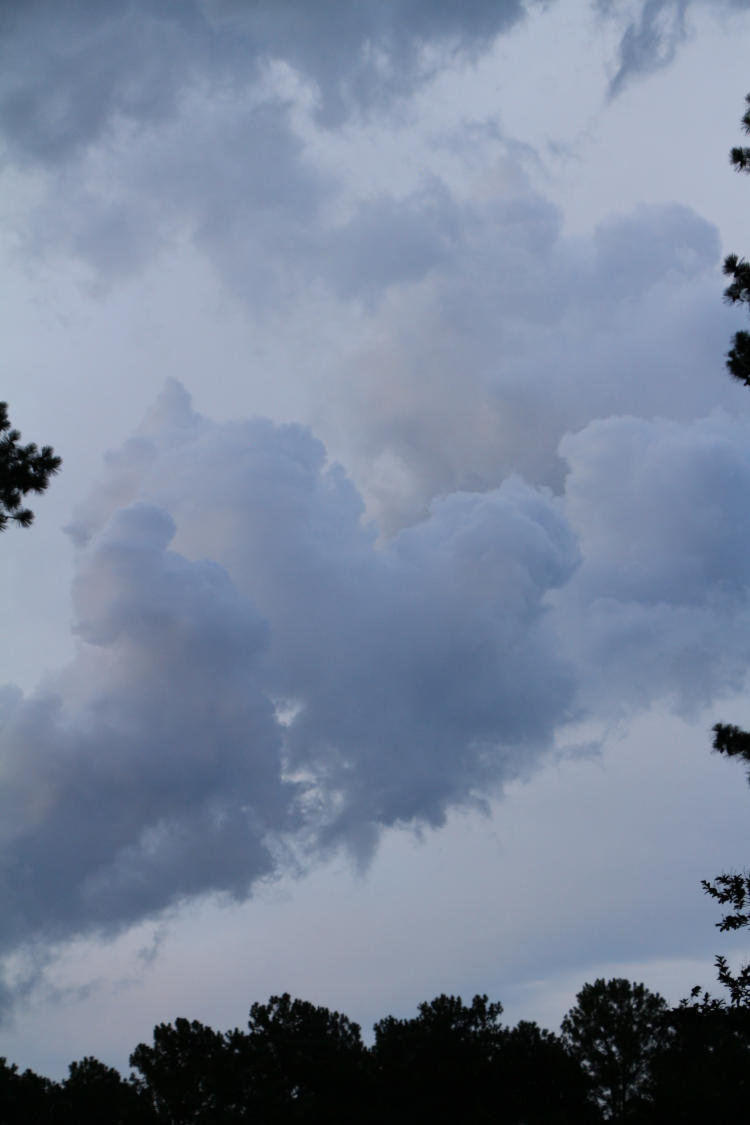
So, really last night now, we were receiving warnings of dire storms to pass through the area, with conflicting time frames, but I was ready for them regardless. I’m fine with sunny clear weather, and even lightly overcast days, because each has their own light quality for different subjects, but when the weather itself is a subject, good bracing storms are a lot more fun. Not too long before sunset, the sky was uniformly overcast but throwing out multi-level clouds with some nice shapes.

low-level cumulus clouds below overcast deck
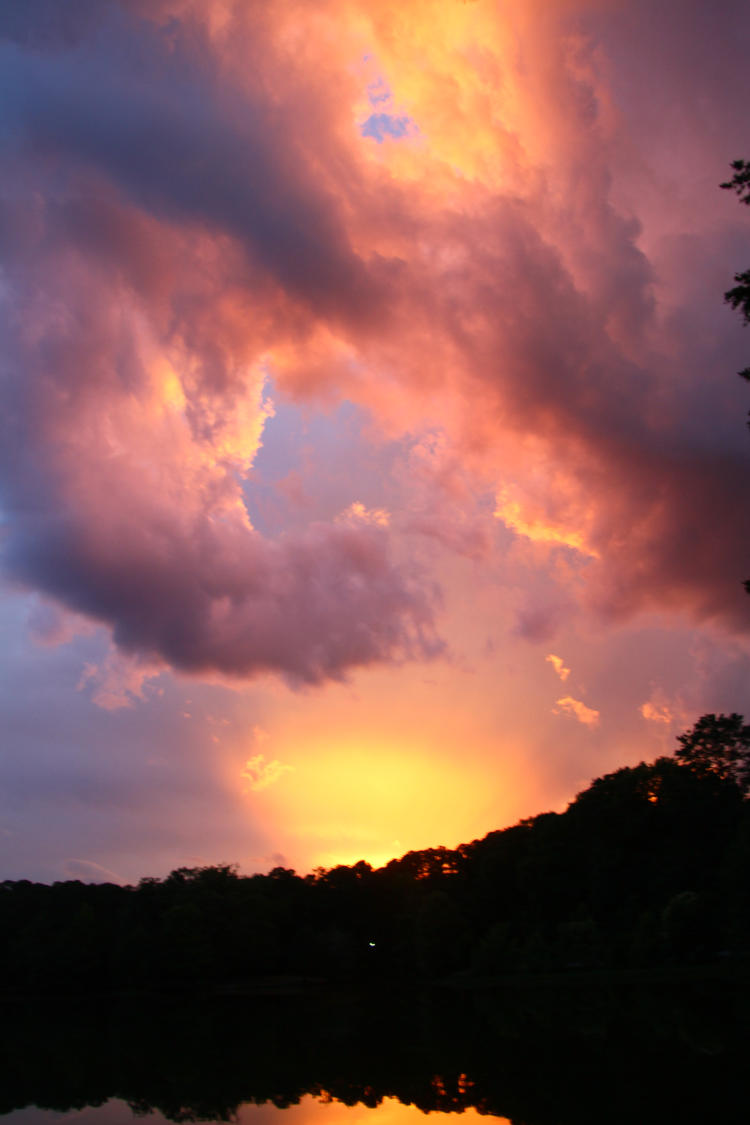
This is facing east-northeast, the sun largely behind me, and you can see that the sun isn’t having much of an effect. I went inside for a short while, and we have only one window that faces west with any kind of view; as I passed it just a little later on, I saw the sky in that direction was suddenly brilliant orange. The neighborhood pond is a few minutes away, so even though I scampered right out with the camera, I could see the color fading even as I tried to get clear of all the trees in the neighborhood to have a nice view. It was fading as I got there, but not so much that all hope was lost.

stormy sunset colors over pond
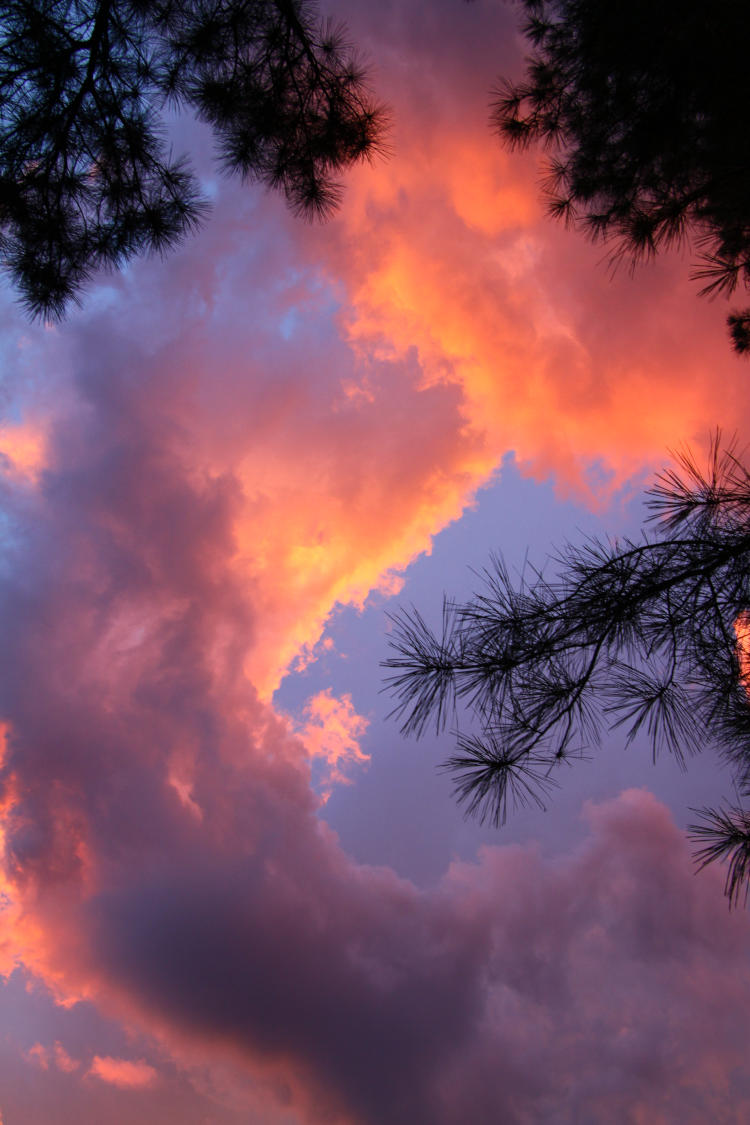
Somewhere over the horizon, the sun had found a break in the clouds even as it was setting, and the North Carolina skies in this area (who I’m convinced are at least semi-sentient) had done their damnedest to try and clear completely before sunset, as is their wont, but the approaching storm was stronger. As the light changed, the clouds were also twisting and shifting at a pretty good clip, betraying that the high-altitude winds were much more active than the dead air down where I was. I played with some frames of opportunity.

twisted colorful sunset clouds surrounding pine branches
The fit was pretty good, really – how could I pass this up? Yet while the sky was so dramatic, it wasn’t really evidence of an active front yet, and the lightning tracker app indicated that electrical activity was still a ways off. I did a few photos of opportunity, but it was incredibly muggy out and I decided not to wait for the storm, which might still be another hour.

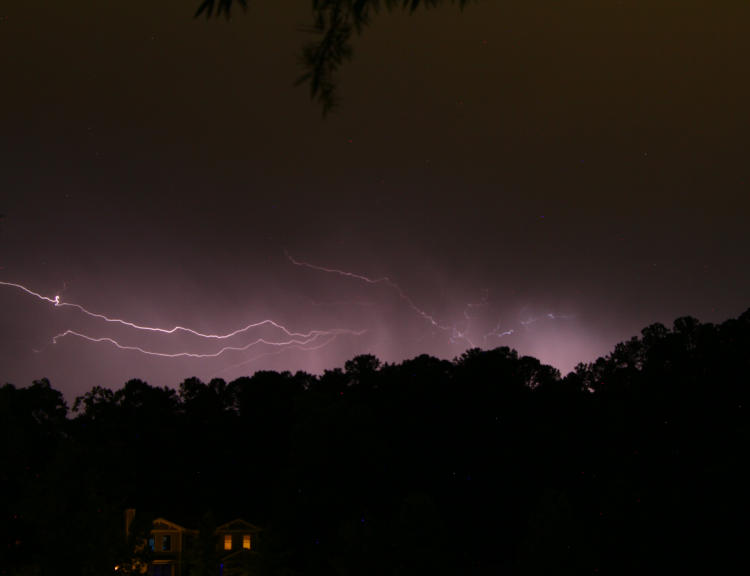
I kept an eye on the online tracker, and was back out just shy of an hour later, when the sky had gotten properly dark. It was certainly active then.

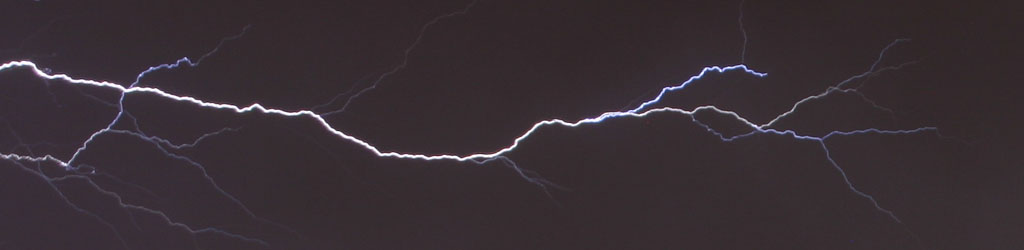
lightning stretching across sky
This is just faintly out of focus, and I think it’s because of the peculiarities of the Canon 18-135 STM lens, but I’m not going to go into technical stuff right now – suffice to say that I’d switched to manual focus because there was no light for autofocus, but manual focus is not entirely manual for that lens. Later images are fine, though.

There were three active cells within a 90° arc from my position, and it was tough trying to determine where I should be aiming, much like trying to decide which lane is fastest at the supermarket (and entirely unlike trying to decide which lane is fastest in a traffic jam because they are all averaging the same speed you morons.) I certainly missed a couple of good electrical discharges, but I got enough to make the effort more than worthwhile regardless. Even if they looked a little weird.

star pattern lightning display over house on pond
This is fairly wide angle and cropped only slightly, evidence of a multiple-bolt discharge centered on that one point. Also evidence that I can’t level the camera after all these years, but c’mon, it was dark (we’re going to conveniently ignore the fact that the 7D has a simple built-in leveling function that takes two button presses to activate.)

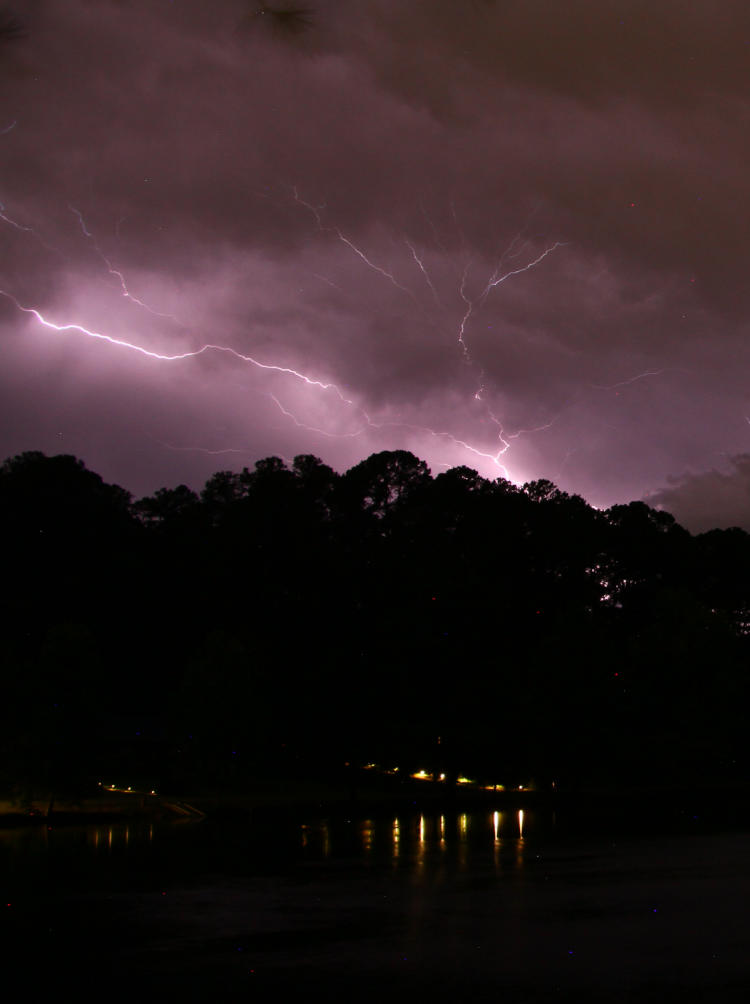
fanlike lightning pattern over trees
This was the second cell, and has been cropped to vertical to enhance that fan pattern from the lightning arms. It would have looked good on video, perhaps, because they spread across the sky like roots, but I knew that video would be largely grainy without any of the sky definition that time exposures provide. Most of these are about 20 second exposures, by the way.

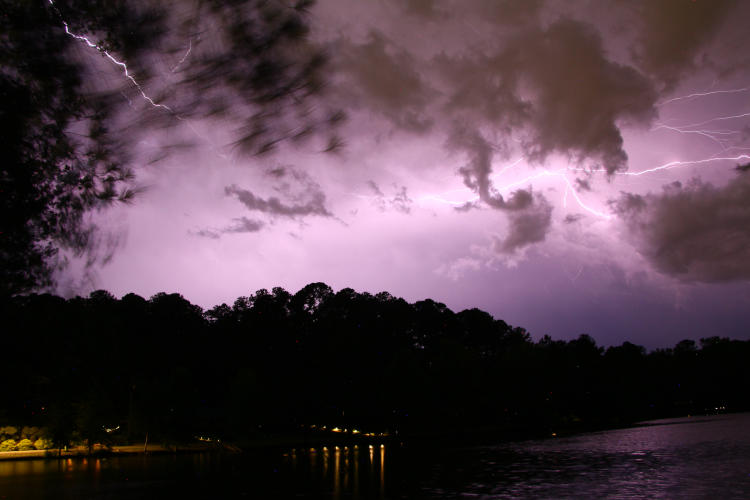
convoluted clouds illuminated by lightning
This was the third cell, and you could almost stitch these above three images together into one complete panoramic, with this one being the rightmost. It produced a lot of bright flashes, but they were mostly hidden by trees from my vantage; had I moved to see this one better, the others would have been obscured. As it was, this lightning in this cell seemed mostly hidden within clouds anyway, though it did define those well for this frame at least.

The storms were getting closer, and while few ground strikes were in evidence, the activity was stretching more overhead, and I’ve had experience with that before; it was getting time to pack it up. I waited out one last decent strike, as long as it happened within two minutes, and I wasn’t disappointed.

lightning stretching across entire wide-0angle frame
This was the very last frame, which is a lot more cooperative than many storms that I’ve pursued. I’ve said it before, but I’ve missed a lot more lightning photos than I’ve gotten, because electrical storms are tricky and unpredictable, and even getting to a scenic locale when one threatens is very hit-or-miss – I’m lucky to have the pond so close by. Ideally, however, I want a very tall tower with a view to all sides, preferably where the mountains reach the sea at the edge of a tropical rainforest – with, of course, convenient shopping nearby that I could get to in my Lotus Esprit. All of this comes from people paying an appropriate amount of money for my images, of course…

Need better curtains

I was out on the back deck firing up the grill tonight and checked out the various plants that share that space. One of the hydrangeas showed something grumpy (or at least, I’m wildly interpreting it that way.)

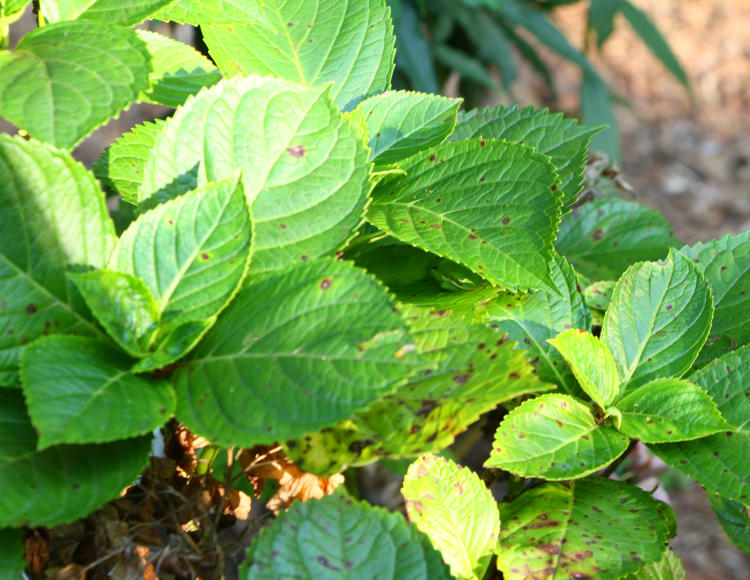
hydrangea bush with hidden occupant
No, I’m not really expecting you to spot it easily at this distance, I just did this one for context, though it’s there if you look close. But even I was ‘closer’ than this when I spotted it, not to mention knowing to look closely because I’d seen it on the same bush a few days previously. That’s a clue, if you know your species, because a) it’s daylight, and b) this says the species tends to return to the same general location.

I’m going to take up more space so you don’t jump to the next image too fast. You can see two other plants in the frame: a peach tree above and slightly right, though technically that’s not on the deck itself but the ground below it, and a small but wonderfully dense Japanese maple above to the left. That one in particular is less than a meter across, perhaps slightly shorter, and has the thickest canopy of any tree that I’ve seen. Itself, it may have harbored countless occupants that I could never spot, except that the leaves are too small to be comfortable for the species in question for this post.

Okay, we’ll go in closer now.

hydrangea bush with hidden occupant
Shouldn’t be too hard now, though you can easily imagine that, were you not specifically looking for things of this nature, you could be standing right next to it and miss it entirely. Which is the goal, really – it’s why they have such coloration, and know to hold very still, though in many cases I suspect it’s simply because they can’t be bothered.

Closer yet.

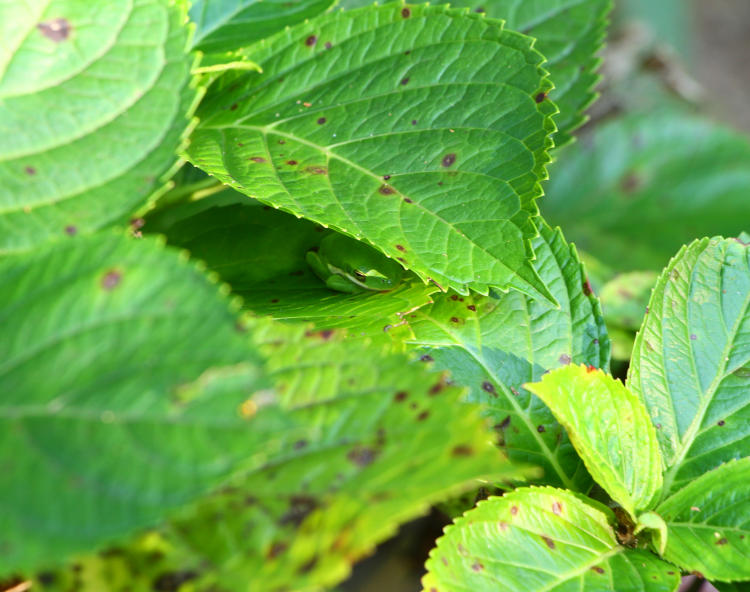
hydrangea bush with hidden green treefrog Dryophytes cinereus
Okay, now you’ve surely seen the little green treefrog (Dryophytes cinereus) that was mostly sheltered from the sun during its daytime snooze. It was the early evening sunlight peeking through at just the right angle that made me get my camera, that kind of ‘slip through the cracks in the blinds’ form of sunlight that makes you realize how thin your eyelids really are. Too early to be awake, but unable to sleep in the glare, the treefrog was likely just sitting there stewing irritably. Or am I letting my imagination and anthropocentrism color things?

green treefrog Dryophytes cinereus under hydrangea leaves
Aw, dammit, it’s going to tomorrow – gotta not do these so late at night. But I was also out getting some other images just a short while back, ones that belong in another post, so that will be along shortly too. Anyway, change ‘tonight’ to ‘last night’ because this posts after midnight… or will it?

Tripod holes 26

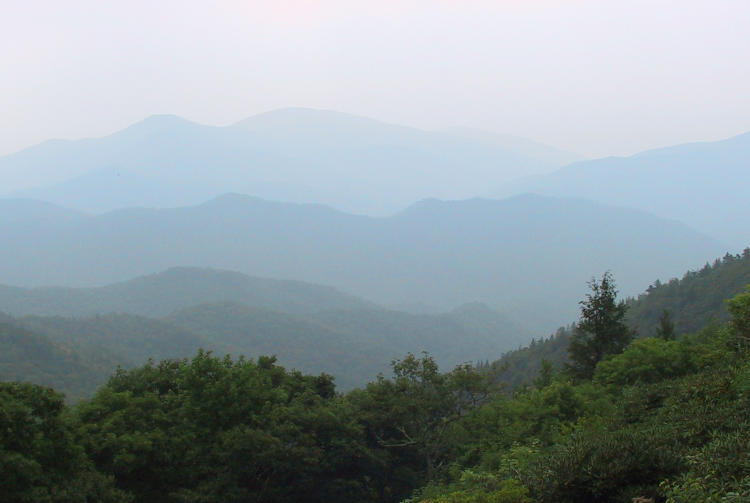
Blue Ridge Mountains at Green Knob Overlook on Blue Ridge Parkway
N 35°43’3.71″ W 82°13’21.89″ Google Earth location

Back when I was trying to locate Crabtree Falls, I stumbled across this location on the map (Green Knob Overlook) and instantly recognized it; comparing Street View with my photo produces an exact match. Many years back I was doing my second trip along the Blue Ridge Parkway north of Asheville, NC, and stopped at an overlook to do a few frames. Not the best of conditions, since the day was pretty close to overcast, and as I stood there I watched the fog come boiling up through the valleys immediately below me. It was quite memorable, because you typically don’t see fog move like this, if at all. The Parkway was cut along the side of the mountain and immediately behind me, opposite this view, rose a steep mountainside. The wind suddenly started to pick up, blowing a bank of fog up over where I stood, and then I watched it also come boiling down the mountain face behind me in a quite dramatic and foreboding manner. In moments I was completely enveloped and visibility dropped down to a dozen meters or so. Abruptly I realized this was not fog but an actual raincloud – not like there’s a lot of difference, but I was high enough up in the mountains that ‘cloud’ was actually more appropriate. I could feel the humidity in the air and the dropping temperature and took the hint: within a minute, I had the cameras and tripod in the car just as the first raindrops fell, and by the time I was leaving the parking area it was rapidly becoming a deluge. This did, in fact, continue for the next hour and I cut my trip short, knowing I would get no more decent opportunities within the mountains.

The Blue Ridge Parkway meanders all over the place, constrained by the terrain, and I didn’t even consider trying to locate the spot where I got the photos – and then happened across it by accident, and confirmed it for this post. You really should go to Street View, turn to face the rising mountain opposite the parking area, and imagine a billowing cloud of grey rolling directly down that face towards you. While I had done some video of the cloud coming up from the valley below, I had put that camera away before the bank came down the mountain face – no great loss, because what I had for video at that time was the Canon Pro 90 and the quality was execrable, which is why I’m not uploading those clips for this.

But if you’re after mountain photos, the exact location really doesn’t matter a whole lot; if you’re anywhere near this spot, as long as conditions are good you should be able to find plenty of scenic views. Curiously, I’ve done too few trips out there and my ‘Mountain’ stock folder is disturbingly spare – I really should work on this.

A break

sunset breaking through trees at Jordan lake
After three days of near-solid rain, including a horrendous downpour while we were getting dinner last night, the sky suddenly cleared, mostly, and I went down to Jordan Lake out of curiosity, mainly to see how much higher the water level was. Surprisingly, it barely appeared higher at all, so either they kicked out the stops down at the dam end, or most of the water in the area hadn’t yet drained to the lake – perhaps both. But while there, I shot a few frames of opportunity. Above, I played with the angles to get the sun peeking past the tree, and for one frame, I slowly leaned out until the sun just made it past the trunk – it was weird because the shadow line was so distinct, my left eye was catching the light before it was appearing to my right eye through the viewfinder.

Below, a great blue heron (Ardea herodias herodias) took a prominent perch.

great blue heron Ardea herodias herodias perched atop broken dead trunk
These trunks, by the way, are the same ones that opened this post exactly a year ago, but this is the first time that I’ve ever seen a heron chose to perch there. I’m glad I caught this when I did, because it didn’t last long.

Sunset actually turned out halfway decent – not fabulous, but better than normal.

multi-layered clouds catching post-sunset light
The post-storm clouds, the patches of humid fog rising from the trees in places, and the low light angle made a complicated mix of colors while there really wasn’t much red at all, but hey, it’s the best I’ve seen in a while. A little later on as the details started to fade, i did a small experiment with the foreground and flash.

buttonbush Cephalanthus occidentalis in foreground of sunset colors over Jordan Lake
Despite dropping the flash exposure down a bit, the buttonbush (Cephalanthus occidentalis) was still a little too bright, so I burned it a bit darker in GIMP. This was shot blind, by the way, roughly aiming the camera held out at arm’s length without framing through the viewfinder. As you might imagine, this is hit-or-miss, but I’m getting better at it.

And finally, a very weird-looking curiosity.

post-sunset clouds over Jordan Lake with specific lighting
I had the camera set for increased contrast and saturation, which unfortunately was too much for this frame, so I adjusted it back down in post. This was exactly how the cloud looked, only a portion of it catching the sun behind me (well below the horizon now) while the rest remained in shade. I get the irresistible impression of a long exposure with lightning illuminating the cloud from within, because I have plenty of images like that, but no, this is just what you could see from the lakeshore.

I know I’ve been to Jordan Lake too much, and have been trying to expand to other places, but scheduling and weather have not been supportive of that. It’ll change shortly.

Any falconers out there?

It’s occurring to me that it would be a lot easier to run experiments on photographic and camera options if I had subjects that performed consistently and when I needed them to. I can’t even get the cats to do this (no duh,) so it certainly isn’t going to occur with the raptors. Were there a bigger market among nature photographers (or, you know, if we actually got paid a decent amount,) I’d suggest someone start a business of trained hawks to perform on command, or perhaps even start it myself.

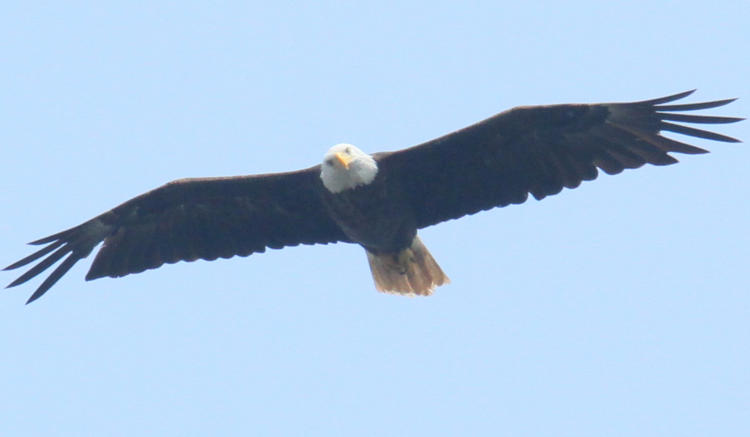
On Monday, before all the rains came, I went back down to the lake to see what I could see, and potentially try out some new ideas. Naturally, the osprey and eagles weren’t being as cooperative as they could be, though I still managed a few acceptable frames. Like this distant bald eagle (Haliaeetus leucocephalus) circling lazily overhead that nevertheless appeared to question my presence.

adult bald eagle Haliaeetus leucocephalus circling overhead with head cocked at photographer
The eagle only got marginally closer, yet never displayed any indication of actively hunting, but then again, the osprey (Pandion haliaetus) weren’t doing all that much either. Someplace not too far off, someone was burning off a significant amount of wood, judging from the pall of smoke that occasionally drifted over the lake surface, and I believe this particular frame suffered a little because of it.

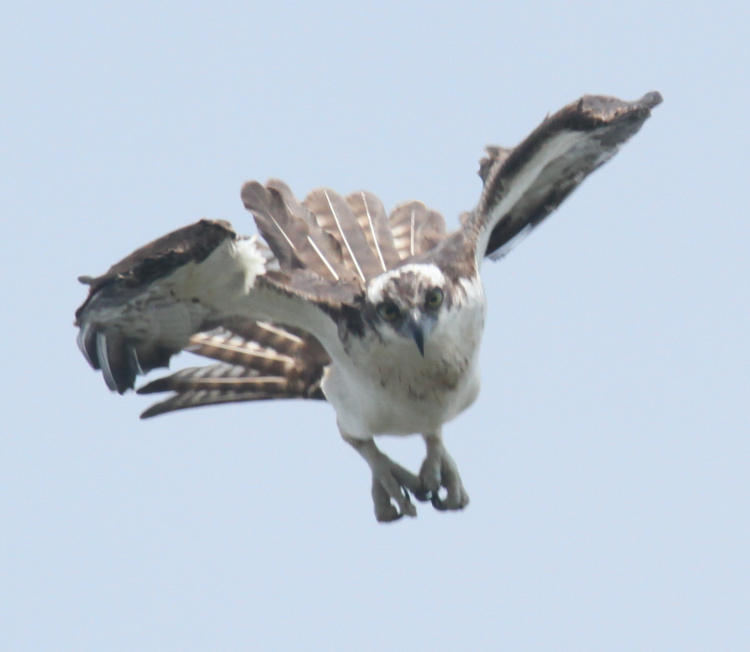
What I was hoping to get were a few good dives from the osprey, or really anything else that wanted to pretend it was an osprey, so I could see if some changes that I’d made actually improved things. It wasn’t a good time for this, apparently, and I saw just a few in the space of a couple hours, with only a handful of dives in there. One, I almost missed. The sky had cleared of all bird life and the camera was resting on my knees when abruptly, fairly close by, I found an osprey had swept in without any circling whatsoever and was already showing signs of having seen a fish, these being the dropping talons and the sharper banking.

osprey Pandion haliaetus banking in preparation to a stoop
With luck that I don’t think I’ve ever had before, the osprey was not too far off and facing almost directly towards me as it spotted the fish. Come to think of it, maybe if I could find just a fish trainer? That could work, though it might be a lot of effort for trainees that keep disappearing.

osprey Pandion haliaetus in head-on position entering stoop
There was very little hesitation as the osprey entered the stoop (the dive after prey,) and I endeavored to track it down. The lighting was a bit hazy so the colors weren’t as bright as I would have liked, but see all that above.

osprey Pandion haliaetus  with wings tucked in stoop
Definitely accelerating now – look at how cupped the wings are.

osprey Pandion haliaetus extending glide slightly in stoop
I can only assume the fish began moving off, perhaps having spotted the bird bearing down, because in a split-second the osprey stretched out slightly to extend its glide. I say this more from viewing the photos afterward, because I was only trying to keep the bird in the frame as the camera cranked out three frames a second.

I still blew it, both in tracking and in running an experiment. One of the changes that I made was to assign a function to a button under my thumb, one that shut off autofocus as it was held – this is intended to prevent the AF from suddenly grabbing the background as the diving birds cross the horizon line. However, not only was the osprey too close for this to have a lot of affect, it was coming towards me, so shutting off autofocus would only guarantee that focus was off – better to take my chances. Still, I failed to keep the bird centered as it entered the water, and the splashdown was 90% out of the frame, but what I got was motion-blurred a little anyway. However, I was back on as the osprey emerged back up from its brief total submergence.
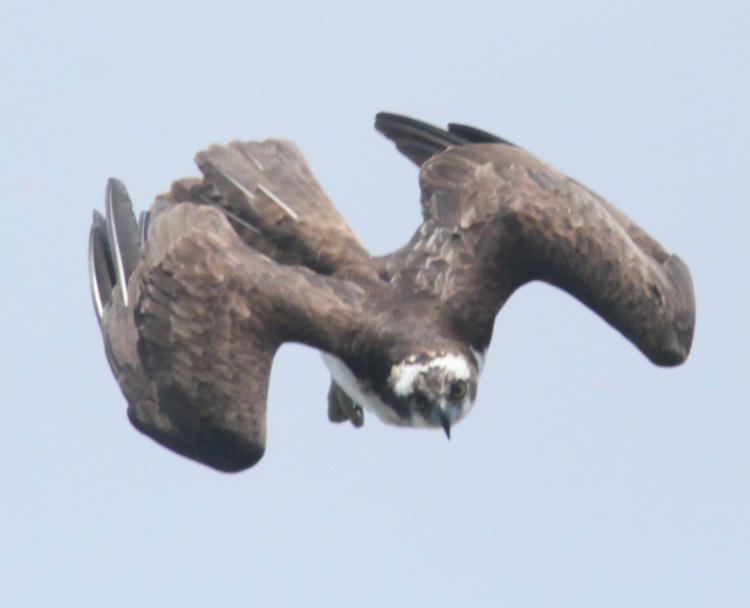
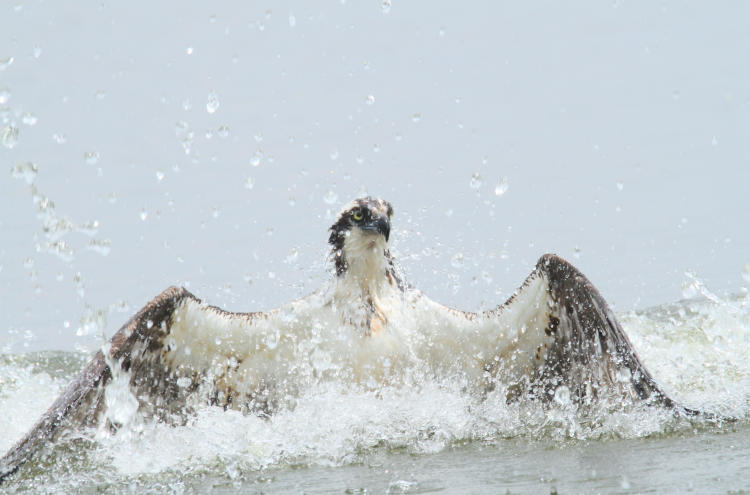
osprey Pandion haliaetus emerging from water after unsuccessful dive for a fish
This is only slightly cropped from the full frame, to give you an idea of the proximity, and looked perfectly sharp in the viewfinder, but I’ve been burned on that before – it’s hard to tell as the action is going on and everything’s changing, plus the resolution of the little image in the viewfinder isn’t anywhere close to the actual image. Neither is the LCD on the camera back, so checking it onsite remains meaningless. I was prepared to find that focus wasn’t quite on for this frame, and very pleased to be wrong this time. That’s the secret to a happy life: maintain low expectations.
But we need to go in closer on this frame.

closer crop of soaking wet osprey Pandion haliaetus emerging from water
Can you tell from this that the osprey missed the fish? No, of course you can’t, because birds don’t really change expression, but it would be easy to believe this anyway, and the osprey did emerge empty-taloned, which was more the average for the day while I was out there. So from an experimental standpoint, I didn’t have a lot of luck, but if you count the results instead, well, okay then.

1 63 64 65 66 67 327