


Viva Variety

I’m wondering how many people actually remember that show

Anyway, we’re counting down (no we’re not) the backlog of photos that I’ve got prepped in my blog folder, that I’m skipping around non-chronologically among in an effort to not have back-to-back posts of insects, and so on. Today, we’re doing a follow-up with the tadpoles… kinda. Because these photos were taken four days ago and the development has progressed much further in the interim, but back when I obtained them, some flamboyantly-dressed psychopath was threatening our fair city, and I had to take care of that first. I’m sure you read about it.
In the last post featuring our resident amphibians, I remarked that all of those that I saw were in the same stage of development, but such was not the case this time. I captured three, and they were all quite different.

unidentified tadpole showing newly-developed hind legs
One was noticeably less developed than previously, sporting a pair of limbs that were frankly embarrassing, so of course I’m going to show them off for all to see here (“all” being the three people who might actually be reading.) And despite my efforts to show scale, those limbs just about disappeared in the broader shot, so we’ll have to go in closer.

closeup of newly-developed legs of unidentified tadpole
For all the motion that they displayed, these might as well have been tattooed onto the tail – only on rare occasions did they appear to flop freely away from the body, without any muscular control whatsoever. But I do like that they still possess their own collection of pigment spots, which are interesting in their own right. The tadpoles appear, in all normal circumstances, to be a uniform dark brown, though if you obtain the right viewing angle, the transparency of the belly skin can be apparent. Up close and under the light of the flash, the skin is revealed to be spotted randomly with patches of pigment that will shine gold at just the right light angles. This means something, but I’ll be dipped if I know what it is.

Then we have what I was expecting to find.

unidentified tadpole with further developed hind legs
This one was demonstrating not just more defined limbs, but actual muscle control, occasionally giving little push kicks with those limbs to assist with the typical fish-like tail motion that propelled it through the water. Adding the the effect was some visible development of the webbing on those hind feet.

visible webbing on developing hind limbs of unidentified tadpole
The substrate at the bottom of the tank, by the way, is typical beach sand, just to give you the impression of their diminutive size and my remarkable abilities at macro photography…

You’ll also notice that the leg is being held in a useful manner, tucked up as if it could support weight (not yet) rather than flapping around behind. Though even when settling to the bottom, the tadpole was resting its weight entirely on its rotund belly.

And then we have Mk III, the sport model.

unidentified tadpole with well-developed fore and hind limbs
Now featuring all four limbs in good development, this one was getting ready for its emergence. Not only were the limbs being held in typical supportive positions while resting (ever so briefly) on the bottom, the tadpole was now swimming in froglike fashion, almost as if it was attempting to jump through the water rather than swimming, with the tail now hanging limply and without effect. And curiously, even though I’m almost positive that they’re all from the same brood, the size difference was visible and the reverse of what I expected.

two unidentified tadpoles, likely of the same brood, showing size difference at different stages of development
I do not know whether to credit this to feeding prowess and/or genetic predisposition, or (what I consider more likely) that the body reserves were now dedicated towards muscle development. I don’t presently have an aquarium large enough to hold developing tadpoles for several days, where I could observe a few individuals to get a more complete timeline of their progress, and by now (four days later, as I said,) these specimens are all drastically different. Like the mantids, I have no way of telling individuals apart – the tiny branding irons that I ordered never arrived.

In that previous post, I figured the tadpoles were too big to be treefrogs and speculated that they were green frogs instead (the adults would just fit within your palm,) but seeing how small the one is as the limbs are well-developed, I am likely wrong about that; these could be treefrogs, though I won’t guess whether these are greens or Copes greys.

And just to give you an idea of how well developed that last one was, I left the macro aquarium alone on my desk for a short while, considering that I might examine the moss that I’d also collected for evidence of tardigrades (a photo goal for a long time now,) and the four-legged specimen released himself of his own recognizance; I found him outside of the tank, sitting nearby on my desk and trying to hide within a face mask. Upon his somewhat-tricky recapture, he showed a loathing of the water, wanting nothing to do with it, and I had to ferry him back out to the pond in another container. Even when I deposited him into the pond with its good protective cover, he headed straight for the sides and climbed out, though he waited impatiently right at the edge for me to get my vast ugly bulk out of the way. I am sure that at this point, he (and numerous siblings) are traipsing their tiny little bodies about our lawn, just to make me tiptoe through the backyard for a while.

On this date 36

So we’re gonna talk briefly about coincidences today, because they must mean something! Or not. Almost certainly not. But remember last week when I featured the golden tortoise beetle (Charidotella sexpunctata,) and said that it was only the second time I’d ever seen one? This is the first:

golden tortoise beetle Charidotella sexpunctata in orange defensive mode
Taken on this date in 2013 – funny how I photographed them a week shy of four years apart.

Or likely not, because most arthropods have active seasons for certain behaviors, so it may be that there are only a few weeks out of the year (or even less) when I’m most likely to see this species as adults anyway. But that’s not half as dramatic, so we’ll go back to isn’t that weird!?

Another one, out of chronological order, for which I apologize not at all. Get over it.

pink rose blossom with raindrops
This is from 2011, The Girlfriend’s favored rose bush which I inadvertently uprooted a few years later when I pulled away a section of fence that it had grown through. She liked it because of the lemony scent, and we spent no small amount of time trying to find another like it, with The Girlfriend’s Sprog eventually succeeding a few years ago.

Now we go to 2014:

orange rose blossom with raindrop
Definitely in a rut here – I should start doing whiskers on kittens or some damn thing. This is not a lemony one, but another we’d purchased as a gift for someone who didn’t really deserve it, and now I’m slightly irritated. Still, I could do yet another wet rose pic today I suppose, if the weather cooperates, but I can’t get motivated over that as a yearly routine somehow.

Okay, that’s it for the coincidence bit. Moving on.

great egret Ardea alba in distance framed by tree branches
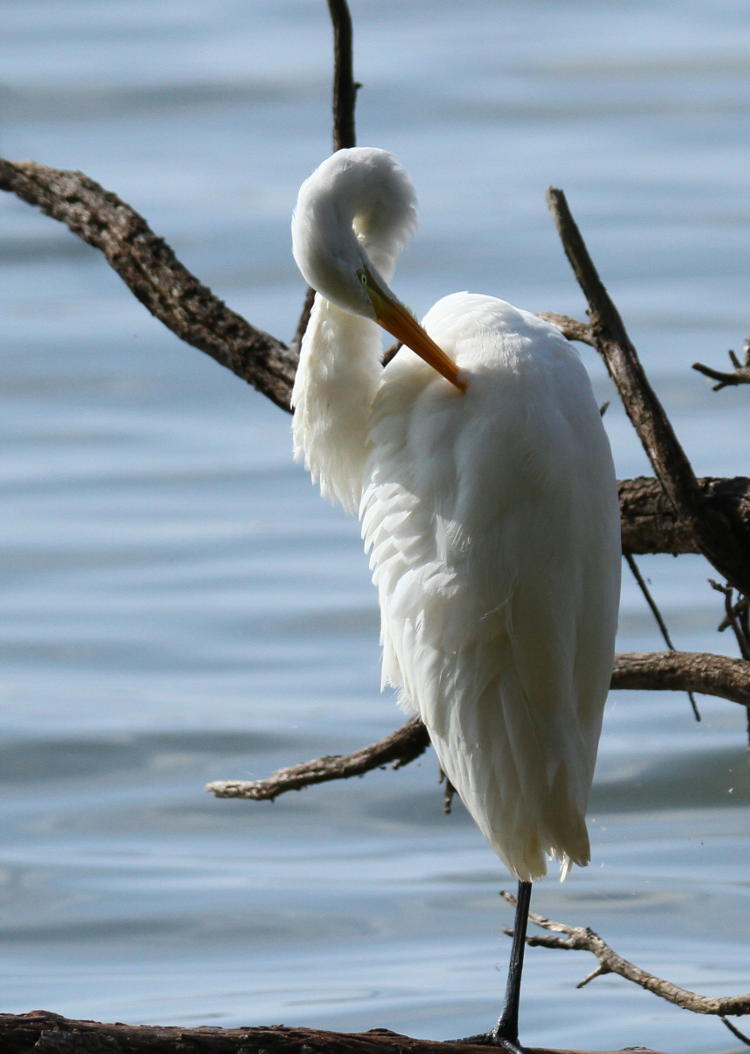
Definitely a fartsy kind of day, it seems – don’t know what that’s about. But I kind of like the framing of this one, just playing around with the egret who visited the nearby pond for a few days – it seems to be almost an annual thing, and never lasts very long.

And finally, an entry from last year, still being fartsy. I’ll stop soon, I promise – there’s nothing worse than someone pretending to have vision or style.

pair of dragonflies silhouetted against pond on thorn bushes
Wait! This is the same pond as the previous entry! What are the chances? Well, considering how many thousands of frames I’ve taken there, pretty damn good, is the official tally. I’m pretty sure this was from one of the many evenings I went over near sunset to see what the sky would bring, having no luck thereof, so I grabbed what I could. And you get to suffer for it. I wouldn’t stand for that, if I were you…

He’s a grower

I know, I’m attributing gender to an amphibian, long before adulthood even, but it made the title work better.

I’ve got more arthropods to feature, but we’re taking a short break to show off another find. It should have been a few days ago, because it would have been more distinct then, but no, I was being lazy…

tadpole possibly green frog Lithobates clamitans showing newly-formed hing legs
The backyard pond went very dormant for a while, nearly all evidence of life vanishing from it, and I wondered what the cause was; there was nothing specific that I could bring to mind, but it might have been contamination from the neighborhood pond nearby, since it seemed to occur right after I deposited a juvenile painted turtle and the water from its holding tank therein (the homeowners, or at least one of them, have taken it upon themselves to treat the pond for weeds, without any indication that they know what they’re doing, but with a noticeable appearance of a lot of dead turtles, so I’m fairly comfortable saying their dosages are incorrect.)

But recently, I noticed that we now had a batch of largish tadpoles within the pond – large enough that I doubt they’re either of the treefrog species, but suspect the green frogs (Lithobates clamitans) instead; there were at least three that resided in that pond for the past few years, and though I have seen no evidence of them recently, now we have tadpoles, so…

And as shown here, they’re starting to develop their hind legs, ‘starting’ being the key word. Not something to be proud of, yet.

tadpole possibly green frog Lithobates clamitans with newly-formed legs
These were taken in my macro aquarium, with some degree of difficulty. Capturing a few was easy-peasy, but for unknown reasons they all eschewed the nice, clear, unmarked (largely) glass at the front of the tank to go snuggle up the the cloudy, scratched, curved plastic of the rear, so getting them to pause up close to the glass for maximum clarity was actually taxing. I thought it might be my presence, or the lighting, or the green photo I was using as a backdrop, but when I turned the tank around, they stayed with the plastic side, so it seemed to be a dislike of the glass. Got me.

newly-formed hind limb of tadpole, possibly green frog Lithobates clamitans
Like I said, a few days previously when I first examined them, the legs were still more pathetic, if you can imagine that, but even now they flap along in the wake of the swimming motions like tinsel dangling from a cat’s ass. Muppets have more muscular-looking appendages. It’ll still be a few days yet before the front limbs appear, rather suddenly if past experience is any indication, and not too long after that, they’ll venture forth onto dry land, and I’ll try to follow up then.

But while I was doing macro work with the tank, I had to do a closeup of the mouth.

mouth detail of tadpole, possibly green frog Lithobates clamitans
I’m not bothering to look up details of tadpole anatomy (see above re: laziness,) but I do know that tadpoles don’t have gills and gulp their air with frequent visits to the water’s surface, so perhaps we’re looking at some degree of gill-equivalence here. Or maybe they’re just scrapers that help them scour food from plant surfaces and rocks. I don’t know; jump in if you like, I’m just doing the visuals.

With the water sample came along way too many mosquito nymphs, so I did a couple of detail shots of those, too.

two stages of mosquito nymph
There are actually two different stages of the same species’ development shown here – I believe, anyway. The upper one is in profile and is very close to emerging from the water as a feeding, annoying adult, showing the developed compound eyes, the pale developing legs and wings curved around, and the breathing ‘snorkels’ at upper left. While the bottom one is much younger, with little recognizable because this stage is dedicated to entirely different habits. I went in close for one of these, too.

mosquito nymph detail
There! Everything becomes more adorable as a baby, doesn’t it?

Maybe at some point I’ll do some video (probably about the same time I do some real research,) but for now I can tell you that those little gold things bottom center were in constant agitation, and are likely filter-feeders. Seen head on, or kinda from the top down, the eyes are the dark spots to either side, likely quite rudimentary because they’re only used to avoid danger by thrashing away without any real swimming skill.

Yes, we should not be breeding any mosquito larva in the pond, and after this, I did a bunch of net skimming to pull out as many as possible, followed by a treatment with the biological mosquito bombs, which are not supposed to harm the tadpoles, or indeed anything else, and to the best of my observations they fulfill this claim. I’d love to get more natural mosquito predators in the pond (like dragonfly nymphs,) but so far they have not been convinced to breed there often enough. I still may do some more detail shots of their emergence as adults, as well as egg-laying and hatching, but keeping the mosquitoes down in the yard takes a higher precedence, really.

Do svidaniya, August!

Really, the month’s pickings for abstract images is slim, even for my liberal and imprecise definition of the word (‘abstract,’ not ‘month,’) so we have this little number. But I may get some shooting done today, so perhaps I’ll have an addendum post show up later on, because this is embarrassing.

possibly smooth sumac Rhus glabra seen from directly above
I’m identifying this as a smooth sumac tree (Rhus glabra,) but under duress and with lots of subtle tics and twitches to indicate such. I just happened to see the layout as I passed over it on a footbridge and could shoot straight down into the crown.

By the way, if you think I’ve misspelled the title, that’s because Cyrillic spelling doesn’t translate to English precisely and there are several variations, but it’d be far more confusing to say, “до свидания, August!” – even I can’t read that. You know, linguist that I am.

Callback

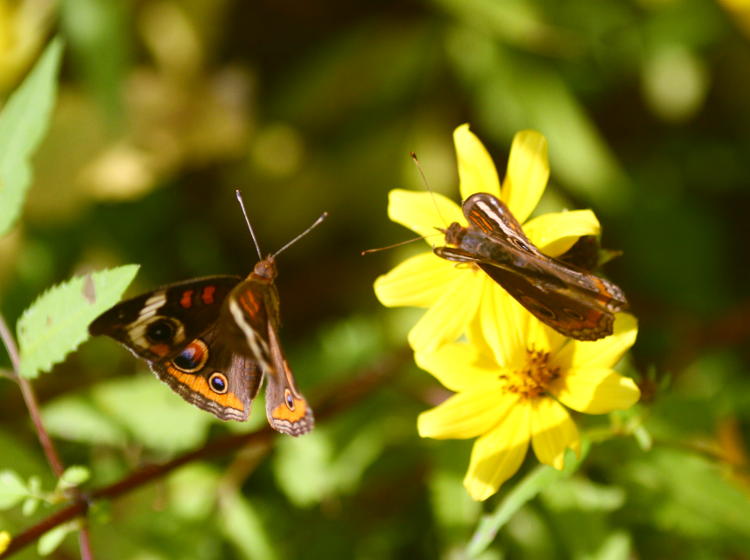
pearl crescent butterfly Phyciodes tharos perched on leaf
I’ve had this one sitting in the blog folder for a few weeks, waiting for me to feature it, and now seems as good a time as any, since I missed the really cool date to do so. If by ‘really cool’ we mean, ‘might have been a neat coincidence if it weren’t for the fact that we could never know, but were far too late regardless.’ You know, that meaning.

Y’see, way back in the early days of building my stock images, I snagged a shot that I particularly liked, featured here; nothing fancy, but seemed (to me at least) to have a simple charm and nice contrast. So when I saw the same species again in a similar position, I grabbed it. I knew it didn’t have the strength (or whatever) of the first, but it was a nice reference back. And then, when about to do this post, I decided to check the original, which was done on slide film back when I lived in Raleigh, and I knew it was shot at the head of the Neuse River. The labs often included a date on the slide mount, but that would only tell me when it was developed, not when it was taken – EXIF info in the jpeg files is one of the nicer advantages of digital. I was curious to see if it was anywhere near the same date, which is not as farfetched as it might seem, since the species is only going to be active for a few months of the year anyway.

Alas, the date on the mount is 6/29/00, so it was taken sometime before then – probably within two weeks, given that I developed my slides pretty quickly and I was doing as much shooting as I could in that time. But that’s still a ways away from August 8th, the date of this one, so we missed the 20 year anniversary by several weeks. Damn.

But then, because the contrast was nice and I was experimenting, I decided to play with the color channels again and convert it to monochrome.

pearl crescent butterfly Phyciodes tharos in monochrome red channel only
This was done by converting the image into the Channels and using just the red one – the method to do this with Photoshop and some of its derivatives can be found here, while the GIMP method can be found here (I should update that web page with this I suppose.) Did a great job of making the butterfly (which is a pearl crescent, Phyciodes tharos) stand out more, but without the color comparison the contrast is high enough to make one believe it was a white butterfly instead.

But the first was still better.

Why don’t we check out the lake?

Later in the morning yesterday – much later than I should’ve – I decided to take a quick trip down to Jordan Lake, see if there was anything happening down there. I had no intentions of spending a lot of time, and in fact was planning to meet someone for lunch, so, whatever I could find in 90 minutes or less (or it’s free!)

Not too shabby, for all that.

pair of osprey Pandion haliaetus wheeling overhead
I feel like I need to keep reminding people (dunno why,) but nature photography is very unpredictable; even if you know the habits and habitats of any given target species, even if you plan meticulously, you can see nothing worthwhile for your efforts. Or you may just snag a few good frames with only trivial preparation. A flight of turkey vultures was wheeling overhead, taking advantage of a small thermal (rising warm air mass) on the edge of the lake, but among them, slightly higher in altitude, were a pair of osprey (Pandion haliaetus.) As I watched, they converged in banks briefly, and I was already backing off the focal length to get them both in the frame.

But that’s too small to see detail, so we’ll go in tighter on that one on the right.

osprey Pandion haliaetus banking
The day was a bit hazy, with a largely boring, colorless sky, but I got lucky with the timing on this one and had a bit of blue to work with, while the sun remained low enough to get some acceptable lighting on them as they banked. Early and late sunlight hours are almost always better for the birds, since the birds are most active then, as well as providing light angles that work for our vantage underneath.

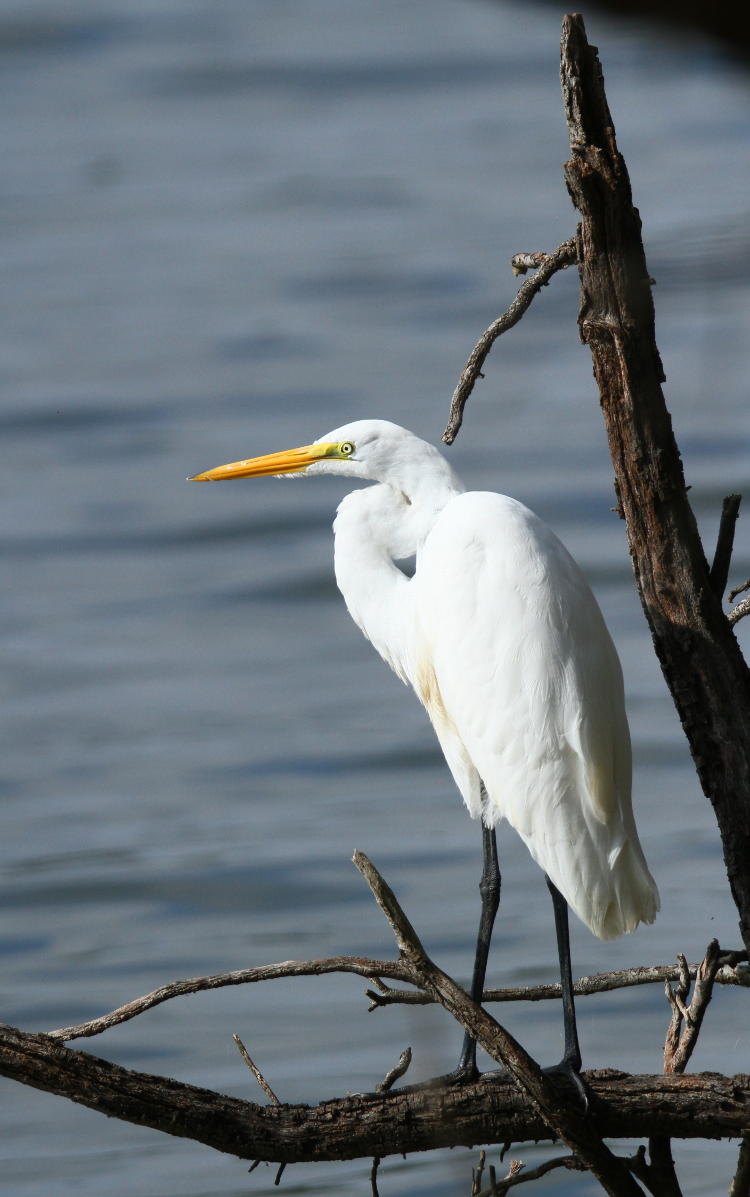
A great egret (Ardea alba) cruised in and landed nearby, but stayed in a cluttered region that sucked for photos, then flew a little ways away when I tried to creep over to a better vantage. But, this allowed me to get better angles.

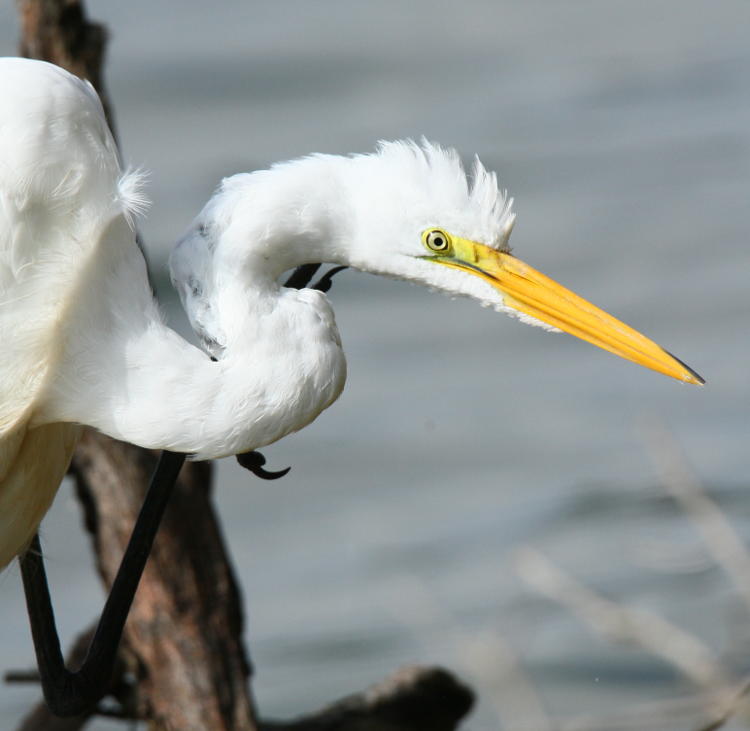
great egret Ardea alba peering over snag on lake
This is a fairly tight crop, because the suspicious expression comes through better this way. It would be easy to believe that I was the target of this look, but I was quite a distance away, farther than when it had first landed, plus it wasn’t staring, but examining the area. Impressions can be misleading, even if fun.

Soon afterward, a great blue heron (Ardea herodias) revealed itself in the immediate vicinity, and since I didn’t see it fly in, I am presuming that it was very close by but hidden. That’s it over on the left, trying to look like a stick (and you can see how well their coloration works now.)

great blue heron Ardea herodias and great egret Ardea alba sharing hunting ground by snag on lake
Now you know why the previous tighter crop worked better, because there was nothing I could do about that boat ramp in the background. It might have been better had it not been painted bright yellow, but I guess someone thinks boaters should be able to find it in foggy conditions or something. Very typical: no consideration of the nature photographers at all.

For a few minutes, it appeared that the two species were quite fine sharing the spot, but this was, again, the wrong impression.

great blue heron Ardea herodias chasing off great egret Ardea alba
By the way, a word about photography habits. While I might give the impression here that I was closely observing their behavior the entire time, in truth I’d watched for any initial drama, fishing behavior, or good poses, then turned my attention elsewhere. The big lens is too heavy to maintain ‘on target’ for long, plus the narrow field of view means you might miss something happening just outside the frame. Not to mention that I was still looking for more interesting shots, perhaps overhead, perhaps out over the open lake more. So I had to hastily re-aim when I heard the warning croak of the great blue – but I still had exposure compensation on for the brighter sky shots that I was taking in the interim. Thus this frame was mildly overexposed, and has been darkened in post. I’m not happy about all the clutter around the great blue, and if I’d been quicker might have had a better composition a moment earlier, but whatcha gonna do?

Because, keeping my eyes open and watching the entire area for activity netted me the frames that I was happiest to get for the day.

juvenile bald eagle Haliaeetus leucocephalus passing overhead
This is what a juvenile bald eagle (Haliaeetus leucocephalus) looks like – kinda. I mean, it’s one phase; their appearance differs from year to year until their fourth, when they take on the classic adult coloration that we all recognize. Except, this looks like a mix between second and third year plumage, with some indications that it’s in the process of molting. So, someone else can fill in the pertinent details.

By the way, this one has been lightened in post, since I spotted the eagle as it was passing close to the sun (because I’m alert as hell, boyo,) and even though I had exposure compensation dialed in for shooting into the sky, it wasn’t set for shooting the sun, so the eagle was more silhouetted than seen here – I just brightened the darker areas and left the sky alone. And I was glad I listened to that inner voice that told me something was different, because the eagle appeared not far from the vultures. There are some subtle differences in silhouette/body shape, but more distinctly, they have different flapping patterns; vultures tend to flap to gain altitude, but otherwise glide as much as possible, while eagles are more constant flappers, gliding in patches.

Another pic in closing, for the detail.

juvenile bald eagle Haliaeetus leucocephalus overhead showing talon detail
Actually, I just liked seeing those talons tucked up in there, and the fact that it never seemed to close its mouth. Allergies, man – I can relate.

At the forefront

August 28th is (don’t you hate when someone comes out and announces something that even a pre-schooler already knows, as if you are the sole idiot in the world who doesn’t, or maybe it’s simply laziness in finding an opening sentence?) Get Up In Phymata’s Phace Day, and yes it’s spelled that way. I won’t insult you by trying to tell you what a Phymata is, but the alliteration worked much better than the alternative, common name, which I’m not telling you. Anyway, there are no days of the week that start with the same letter; perhaps they could have made it an entire month, but Phymata aren’t as active in June or July.

Ignoring all that, I’m on the case.

jagged ambush bug genus Phymata on butterfly bush Buddleia davidii
As luck would have it, there was a jagged ambush bug Phymata hanging out on one of the butterfly bushes, so I could celebrate the holiday as necessary. But that’s not close enough – we’ll go in tighter on the same frame.

jagged ambush bug genus Phymata in close detail
This close, it’s easy to see where they get their name which I’m not telling you. But there’s some other details which bear noticing (aside from that captivating, hypnotic compound eye,) because. Notice the whiskers under the eye? Yeah, Phymata don’t have whiskers; they’re from something else, and if you look closely you can see evidence of them elsewhere too. This revealed what the Phymata’s last meal was, indicating that the perch was effective, at least.

Another shot, hinting that I might not have been the only nature photographer taking advantage of the holiday here at Walkabout Studios, and the Phymata was getting quite tired of the attention.

jagged ambush bug genus Phymata lifting foreleg near face
While it certainly looks as if it’s shying away and shielding its face, that seems unlikely, because Phymata are attention whores. No, I keed, that would work against them, but I’ve never seen one posing like this, anyway, and this was as I had backed off a little for a more full-bodied grape juice view. Bearing in mind that my subject here is roughly 8mm in body length, able to perch comfortably on your pinky fingernail without overlapping the edges, I was thus using the high-magnification lens, and focus range is eentsy. So, yeah, the occasional frame didn’t quite nail intended focus, but in one case, it showed other details.

closeup detail of jagged ambush bug Phymata foreleg, with clasping surfaces and moth remains
Here we get to see some of the detail on those forelegs, with the serrated grasping surfaces, and once again the remains of the Phymata’s last meal, or at least the attempt at such: the scales and body hairs of some kind of moth. Probably not a big one, considering, but Phymata are fairly capable predators, so the meal might easily have outmassed the jagged ambush bug – strike that name from the record. I actually went looking for the corpse underneath its perch but found nothing – not surprising, considering how little it might have been, the amount of leaf litter underneath the butterfly bush, and the bare fact that ants may have made off with the remains.

In closing, a photo from last night, but this was before the holiday so I was not allowed to get as close as I did today. I had gone through the region with the mist sprayer, so this was one beneficiary; others will be along soon enough.

jagged ambush bug genus Phymata nestled in among blossoms of butterfly bush Buddleia davidii

On this date 35

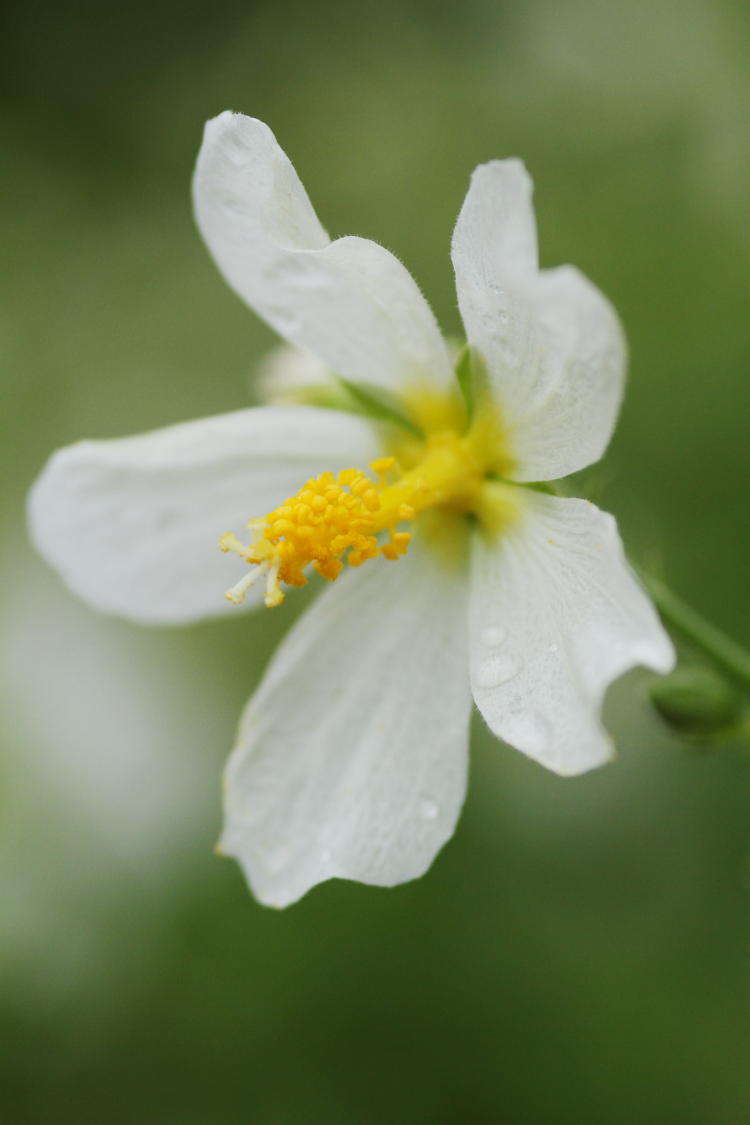
unidentified white flowers in unidentified locale
On this date in 2012, I was… I don’t remember where I was, to be honest, but I was taking photos of… I don’t know what these are. I just happened to like this little patch of white wildflowers, and I think it was off the back of the property at the old place – other photos from that date indicate that I was home that day, anyway.

But you know? This date in my personal history wasn’t a particularly productive one, so we don’t have much to show for it – it had to happen sometime. Just for the sake of it, I’m doubling up on the next year to be featured, which is 2017, because I got bupkiss to show otherwise.

unidentified crab spider on blossoms of butterfly bush Buddleia davidii
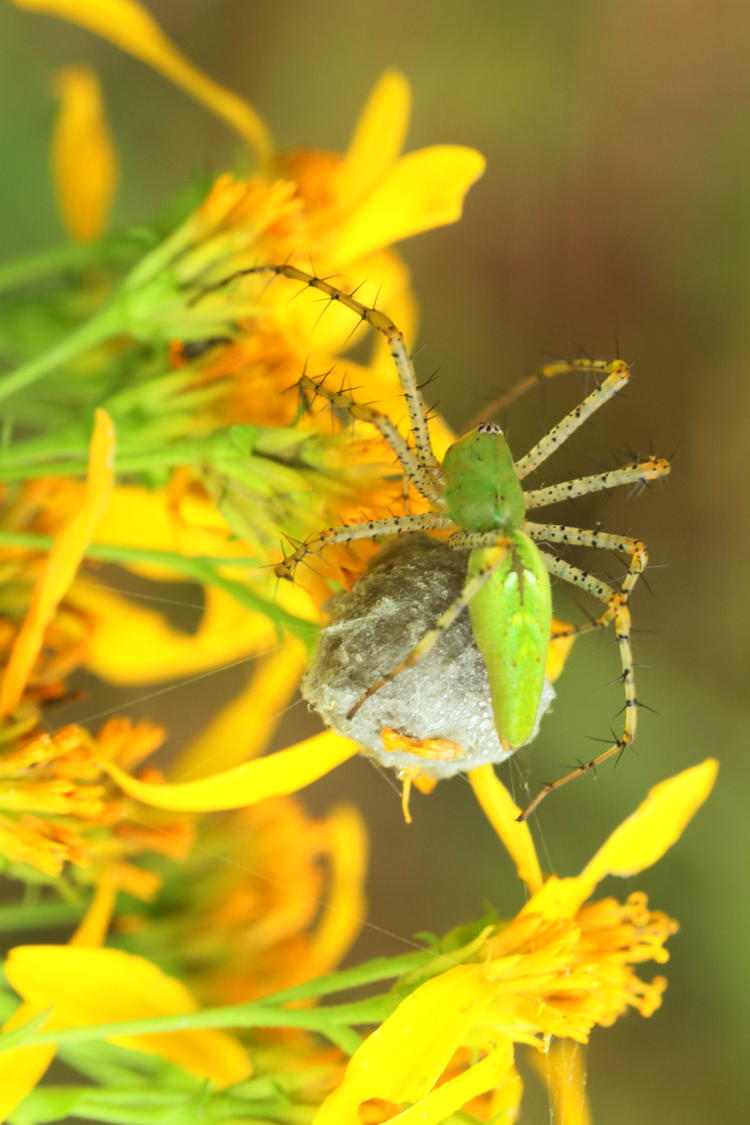
Three years ago, I was encouraging another butterfly bush to grow in the yard, another Black Knight variety, because of just subjects like this: an unidentified crab spider that would lie in wait for whatever pollinator of the right size to come along. In that respect, it’s distinctly similar to this year, because I have several photos of a crab spider about this same size to feature a little later on, even though it’s on an entirely different butterfly bush; the one from 2017 didn’t winter well, and I made a mistake in the spring that pretty much spelled its death (a tragic mowing accident.)

That day, I also spotted, only for the second (and so far the last) time, a curious type of beetle.

golden tortoise beetle Charidotella sexpunctata on sweet potato leaf
I should be keeping a close eye out for another of these, because they seem to like sweet potato plants and we have them again flanking the front door. This is a golden tortoise beetle (Charidotella sexpunctata,) which show a distinctive brilliant gold color and sheen – at least when unthreatened. When danger is detected, they immediately switch to a bright orange color, reminiscent of lady beetles, and they consider nature photographers leaning in close with macro lenses to be ‘danger’ – I know, right? It is in transition here, just starting to turn orange, so my goal is to get some photos of the nice gold hue, which may be challenging, especially given how rarely I see them.

And yes, they really are completely transparent around the edges, because they’re wanton little things. But without it, they wouldn’t see much, certainly not looming nature photographers, so I suppose it serves a non-lewd purpose too, or at least that’s what they try to tell their mothers. I don’t judge, myself, but you’d think beetles could find more respectable ways to behave…

It was a year ago this very night…

… on a dark and stormy road – no, that’s not right at all. It was a clear and warm evening, but it was when we first saw The Monster.

Well, not exactly monstrous in appearance, anyway…

Taz as an adolescent looking out the doorStopping into work for a trivial task, I found a note on one of the vehicles that said someone had seen a kitten sheltering underneath – the initial story is here. The follow-up to that, which I’ve been meaning to get to for some time now, is that we did indeed keep her, once it became clear that the other two cats, while not exactly delighted at this new boarder, could at least tolerate her. Most times.

She’s been named Taz now, though in reality we usually just call her Monster, based on an irrepressible and impish demeanor that is not at all visible in her photos, as well as far too much energy most of the time. It took Kaylee some months to figure out the best way to manage the attacks (some well-timed dodges and otherwise ignoring them,) while Little Girl just bears an underlying resentment; they get into slap fights from time to time, Little Girl seriously trying to get Monster to leave off, while Monster thinks it’s a game. She remains a friendly, inquisitive, and charming cat, with a curiously plush tail for a domestic short-haired, and unlike the other two cats, she plays no favorites among the humans in the house. She was initially completely silent, making the motions of meowing while not uttering a sound, but occasionally she would squeak and, prompted by our imitations, she will now issue a more elaborate version in response, often when I tell her, “Say ‘meek.'” So just as often, I call her Meekers.

And she sleeps with such utter abandon.

Taz/Monster sprawled asleep in the office of Walkabout Studios
I had intended to have some video of her energetic battles with toys, or attempting to tackle Kaylee, or wooing the bird and lizards on the porch, but it simply wasn’t coming together this week, and as it is this is posting late, plus who was waiting for this update anyway? But this is just as much a marker for us, a little chronicle of what’s happening.

Taz/Monster peering down from upstairs balconyFor instance, when a little younger, she was very fond of leaning through the railing of the upstairs balcony, as well as occasionally walking on the thin edge outside of the rails, with a 3-meter-plus drop to the living room; I have no photos of this because whenever we saw it, we tried to convince her to desist, especially since she’s demonstrated that she isn’t the most sure-footed of felines. I know she actually fell at least once, having heard it from the office, with no ill effects other than Monster being a bit startled, and it’s likely she’s done it again, since she’s far less inclined to be outside the rails now. Watching her learn the hard way about wasps was also amusing, again, with no lasting adverse effect.

And just this evening, The Girlfriend’s Sprog was playing with the cats with a fishing style cat toy, a stuffed whatsit on a string and long handle, when Monster somehow got it entangled around a hind leg, freaked, and did a very high speed multiple circuit of the entire house, dragging the toy along in full panic mode, before going to ground upstairs under a bed. She wasn’t hurt in the slightest, just confused by the pursuing creature that wouldn’t release her leg. Yet she recovered her aplomb faster than Kaylee recovers from electrical storms.

Maybe at some point I’ll get to editing some illustrative video clips, but for now, we simply have a shot from today, showing how Monster has claimed The Girlfriend’s sea turtle bowl – she’s also fond of sleeping in my bathroom sink. She seems very happy with the overall turn of events in the past year, and while we weren’t looking for another cat, we’re not complaining either.

Taz/Monster lounging in The Girlfriend's sea turtle bowl

1 137 138 139 140 141 323