




The rains finally came, and did so with vigor I must say, and while I was out last night doing some basic yard maintenance, they started up again while I was finding a couple of subjects to photograph. Thus, I went back out with a poncho on both myself and the camera to do a handful of shots (this was when it had slacked off to a half-hearted drizzle, and not the sideways walls of water that we’d had earlier.)
First off was noting that the molted exoskeleton from a few days before was still snagged in some webbing on a Japanese maple.
There wasn’t a reason to photograph this initially and I noted it in passing, but immediately afterward found another exoskeleton in the same tree, and so had to do the establishing shot. The new exoskeleton was of a spider, however – then I realized it wasn’t.
Well, it was, but not an empty one like I initially thought. This was instead a live spider hanging out waiting for the rains to cease, and I’m not going to try to identify it here because I didn’t capture enough detail – I feel comfortable saying it’s some kind of orbweaver, because I take comfort in such things. The raindrops were a necessary detail of course, even suspended in the web. By the way, there was no sign of this guy any time I looked today – don’t know where it got to.
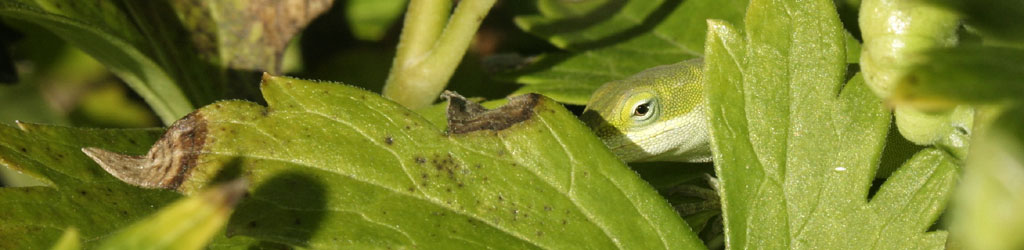
I decided to check on someone in the front yard as I was already out with the rain gear. One of the smaller Carolina anoles (Anolis carolinensis) has been found now and then on the front oak-leaf hydrangea (Hydrangea quercifolia,) and so it’s part of my routine patrol when I’m out. I’ll provide a photo snagged nine days back, that I didn’t post then, but when the anole was being its most obvious:
Like I said earlier, from the size I suspect this is last year’s brood, sprawled across the empty
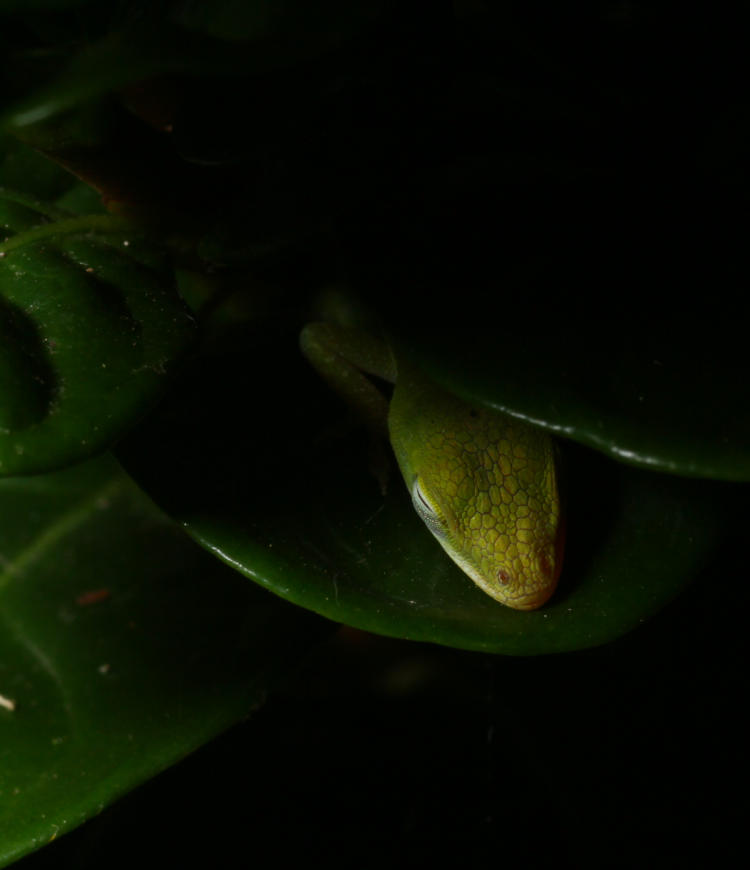
twigs that supported the former flower cluster, hanging way out in space with total unconcern. However, every time I’ve spotted it since, its done a much better job of concealing itself, usually to the point that I either never see it, or it’s hidden enough that photos aren’t really worth the effort – yet, it greatly favors the end of this one main branch of the hydrangea. The previous night, it had the tip of its nose, with one eye visible, peeking out from under a leaf, still fast asleep, but when I returned some time later with the camera it had withdrawn its head and just the tail was visible. This was the same circumstance last night, in the exact same location, right before the monsoon struck, and I figured the fierce storm would have driven the tiny reptile into deeper cover, but a couple hours later during the light drizzle, it could still be seen in the same position.
Unfortunately at this resolution the finer raindrops still adhering to its haunches aren’t very visible, but this was enough to indicate that it had probably weathered the storm that way. I tried, from multiple angles, to get a peek at the face, with no luck.
You can just see one front foot peeking out from under a flower petal, but the petal edges were down tight to the leaf, forming an adequate shelter I guess, and nothing of its body or head showed anywhere. It knows what its doing.
It had been nearly three weeks without a drop of rain, all while the sun was beating down (well, during the day at least) and temperatures peaked in the 30s while not dropping too low at night, and the various plants were all suffering from it. This also meant that wildlife activity was at a minimum, as was mine – I was taking care of routine yard tasks but unwilling to spend much time stalking subjects, even at night. Not sure this has changed much right now, but at least the ground is saturated and the plants will be happier.
This is Nancy Wilson with the band Heart performing at the Rochester War Memorial, the first concert that I ever attended, and because of an open audience area, no seating whatsoever, I was able to get fairly close to the stage so that my pathetic little Wittnauer Challenger and its 50mm lens could actually achieve a halfway-decent concert photo. This took some effort, because of course everyone was crowding the stage, and the press of bodies was damn near the same as if we’d been stacked horizontally instead of standing (mostly) upright. They largely don’t do that now, because it’s ripe conditions for accidents, not to mention groping and all that (though somehow I remained free of molestation myself, probably because no one then knew how famous a nature photographer I’d become.)
It was almost entirely luck that this image came out as well as it did, though I made the effort to frame it as well as conditions allowed and certainly sweated out a couple liters in the exertion necessary, but having enough light and no noticeable motion blur was pure chance. Cameras were even disallowed in the arena, but we didn’t know that until we arrived (there being no internet and no word about this when we purchased the tickets,) but the bouncers at the gate took a look in the backpack we had and let us pass through, more likely watching for ‘professional’ rigs with longer lenses, or perhaps not giving a damn anyway.
This one bumped slightly ahead in the lineup while I was doing a little research. It could have been posted very close to exactly 36 years after it was taken, since I know the date: October 17, 1987, during the Bad Animals Tour. However, Ann Wilson, Nancy’s sister and thus co-founder of Heart, is presently touring with her band Tripsitter and will be playing in Syracuse at the NY State Fairgrounds just three days from now – that’s as close as they’ll come to this tripod holes location. The two had actually planned to reunite Heart for a 50th anniversary (!!) tour this year, but apparently couldn’t agree on the lineup, and so Ann is touring with her own band and Nancy may yet appear with Heart sometime next year. If you’re as old as I am, you may want to keep checking the music news.
So, at ten PM I realized that I had that last post to put up, and ten older posts to correct in the database (mostly page break stuff,) with commensurate corrections to the text files of each post that I maintain, and the database to download as a backup and archive, and check all six e-mail accounts through the webmail interface for things going into spam that shouldn’t have, all before my deadline of midnight. On top of that, I found that, for the first time ever, a scheduled post (preceding this one by two,) had somehow not posted, showing as “Missed Schedule” in WordPress. Dunno how that happened, but I had to correct the scheduled posting time for that too.
All done now, as well as downloading a new 3D printer part and converting that into the .gcode file for printing, and starting that on the printer. I began this post at 12:04 with all that under my belt. Is the guy slick or what?
Found a couple of subjects while poking around tonight, but only had very short periods of time to capture them, which I’ll explain in a moment. So this is what you get.
First off, I found that the spiny assassin (genus Sinea,) still occupying the basil plant, was polishing off a meal which looked a little odd, so I quickly went inside and got the reversed Sigma 28-105 and the flash unit. Oh, and the camera. We’ll start with a wider shot.
Reasonable detail from the body this time, and even the developing wings are visible, but this is still a nymph. It got its big ugly ogre-club foreleg in the way, but I was able to shift vantage a bit for a better look (largely accomplished by turning the pot and tipping it up onto a rock so I could sit on the ground for stability.) Before we go any further, we’ll go in closer on that head.
This is not quite full resolution, and required a bit of luck because I could not resolve this detail in the viewfinder to know when I had sharpest focus – this is one of several frames. Also, the batteries of the headlamp that I was using to focus were running down. I did some specific measurements this time: the overall length (proboscis to end of abdomen) of the assassin was just 9mm, and the visible portion of the head seen here is 2mm. Give or take ten percent – I couldn’t actually clamp a micrometer on it. You can see we’re at the limits of what the lens can do, some distortion already creeping in, but I snagged the facets of the eye, so I’m pleased enough with that.
Now we get a better look at its capture:
I’ll be honest, I thought on first look that it had captured a tiny snail, mostly because of how shiny the prey was, but I also couldn’t see the tucked legs until I achieved this angle. I recognized that big ‘nose’ (I believe it’s called the frons) and initially thought it might be a cicada nymph, getting excited for a moment because I’ve never seen one in the stage after hatching, before they burrowed underground for development, but then I recalled another species which I’d photographed many moons ago, and the shininess is pretty indicative. This is likely a spittlebug nymph, especially since I’d already seen the drippy evidence of them on the same plant earlier – if you’ve ever found clusters of foam on plants and wondered what it was, it was the protective traits of these guys, and that link above will provide plenty more views. There are at least three separate species that I’ve found in the area, which all belong to the Superfamily Cercopoidea, so that’s as much as I can offer right now.
At full resolution:
All that KY Jelly is its own product, mostly the sap that it draws from the plants, which it then pumps full of air bubbles and surrounds itself with for protection – it didn’t work in this case. You can’t see it here, but this little spud has its own proboscis like the assassin, only it uses it instead to suck out plant juices. And check out the little horseshoe-shaped spurs on the legs to clamp onto the plants.
Moving to the back yard now, I spotted some newly-drying wings peeking out from under the leaves of one of the Japanese maples, and then spent a frustrating couple of minutes trying for a decent photo as the headlamp got dimmer and dimmer. This is the best I managed:
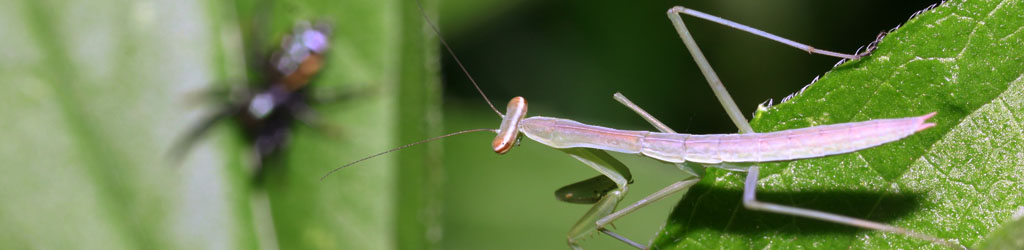
This is a Carolina mantis (Stagmomantis carolina,) about half the size of the much more prevalent Chinese mantids, and the first I’ve seen in weeks. I didn’t even spot the molted exoskeleton at first, but the faintly translucent blue tint to the wings told me to look for it, because that only shows right after molting. This specimen was well aware that I was around and likely concerned about its exoskeleton being not fully hardened, and repeatedly danced around out of a clear view while I vied for a good position. Add in that I just had the Sigma lens which is for extreme closeup work and doesn’t provide as wide a view as the Mamiya, plus it’s fixed at f16 which was no help at all with the dimming light. It was fun (meaning, it involved a bit of cursing, but that’s not even uncommon with me.)
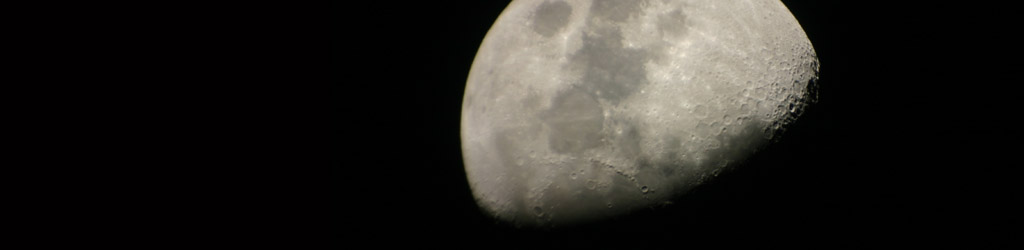
Coming back up the steps, I glanced up and saw the moon peeking through the clearing clouds. Mr Bugg is presently doing a long sequence of moon shots which you can only see if he’s friended you on FaceBlerck, since he’s abandoned his blog now – I don’t so social media. But he challenged me to get my own shots, which I’ve neglected up until it showed tonight through a small gap in the trees. Small gap – I knew it wouldn’t last long, what with the earth still spinning and all that, so I quickly got the long lens and tripod.
My position at the top of the steps was very limited, the moon moving rapidly (well, as moons go) behind the leaves. This was one of the initial frames without the teleconverter, and more than acceptably sharp, but I’d had to shift the tripod into a slightly unstable position to get it because the legs were already at the edge of the deck. After adding the teleconverter, I was already too late.
Without the preceding pic and a decent familiarity with the appearance of the moon, one might have missed how Maria Crisium, Fecunditatis, and Tranquilitatis got a bit darker, but it was just the leaves between the camera and the moon – my window was now closing. But hey, for a few minutes work (eighteen, to be exact, between the first and last images here,) I’m not complaining. Except about that uncooperative mantis…
Yep, four years ago today, at roughly this very time, we cleverly captured The Monster and brought her home.
Though, thinking about it, it might not have been so clever – it was far too easy, so she might have known exactly what she was doing. After all, there were absolutely no crinkle-ball toys to be found in the parking lot at work, while she has a fine selection of them here. And a sea-turtle bowl – let’s not forget that.
She has, admittedly, filled out a little:
She’s slightly more inclined to snuggle up rather than creating havoc now, but only slightly. At times, she’s quite insistent on biting because she really wants to play rough and the other Boogs won’t let her. Neither will The Girlfriend, so I’m the last remaining option:
Even I won’t let her get too excited/rough, but I think she needs an outlet too, and she usually knows not to bite too hard. But keeping her claws trimmed is paramount.
Little else going on here right now. Due to warning signs from the workhorse computer, I ended up swapping it out for an upgraded (but still used) one – I don’t need all the bells and whistles and nothing I do is demanding, but I do need a bunch of SATA ports for the multiple drives. That, however, presented a handful of problems during the switch, including one drive that got altered (for no reason that I can determine) and showed as empty – it took a recovery program to rebuild the partition table and reveal that yes, it did indeed possess files. This was a few hours of diddy-fucking around, but I will say that it was considerably less of that than any Windows system I’ve messed with, and while Linux isn’t any better than Windows in the error message department, once the root issue could be determined, there’s almost always a readily-available tool to repair it.
[The system is a dual-boot with Linux Mint and Windows 7, because the film scanner only runs on Windows, and upon booting, Windows wanted to download new drivers for every damn thing – despite the fact that it already had them all save for the ethernet card. Go figure.]
Other than that, play-testing a few games for The Manatee, and tricking out several 3D models for printing and eventual uploading. Been staying busy, just not with stuff that shows here, is what I’m saying.
Man, I’ve hardly picked up the camera in days, and haven’t done any high-magnification macro work in weeks at least. My macro muscles were protesting. But I did a handful of frames today, so we have a smattering of content – kinda like the sweater you get for your birthday from a distant aunt who has no idea what you like. Hide your disappointment and try to look grateful.
Anyway, we have a little find on one of the (many) basil plants, seen here at full frame for scale and context.
Looking like little more than a fragment of dead leaf, which is kinda the point, the nymph of a spiny assassin bug (genus Sinea) stands watch for other less-alert insects. Aside from not being able to see many details because of its size, it’s also a nymph, and distinguishing an exact species is next to impossible. There was enough detail in this frame, however, for a closer look.
Thorny little cuss, isn’t it? And those antennae look like they got caught in the folding doors, but that’s how they be. Overall length wasn’t above 10mm, so those thorns might have been a deterrent for something the size of the newborn anoles, or they might not even have been up to that task – I have no idea what might prey on something like this.
Because it was in a nice accessible location and not likely to be going anywhere, I dug out the reversed Sigma 28-105 for some tight closeup work. Those pics were just adequate for a broader frame – I should have had more light to focus by, since the indirect daylight wasn’t enough and focus was ever-so-slightly off, but my heart wasn’t in it.
You can see the peace sign of the left foreleg spikes, way out of focus in the center of the frame, and recognize that these were roughly 3mm closer to the camera than the head, giving you an idea that depth-of-field is not impressive at this magnification, even at f16. But the proboscis is prominent, and used to drill through the exoskeleton of its prey. Maybe someday if I’m hardcore I’ll try to stake out something like this to photograph (or video) a capture, but I imagine that could take hours, and it’ll occur on a day much cooler than anything we’ve had in the past several weeks.
In other news, while I haven’t been shooting, I did update the ‘Favorites’ page, and added an entirely new one, ‘Shameless,’ because it was probably long overdue. It is nowhere near complete, I’m sure, but you can always find both in the top menu. And I’ve got a few other things in the works, though the Tripod Holes posts are now complete through September, with several more images in the lineup waiting for the accompanying text. I’m not that lazy, in other words. Smile and say, “Thank you, Uncle Al.”
Despite the fact that it remains the summer months, I have not been as active, photographerically, as I should be, because of the heat – time outdoors is kept to a necessary minimum. This means nothing but local subjects, and you’ve seen enough of them (unless you haven’t? Let me know.) Instead, I’ve been engaged in other projects, some of which you may see shortly.
So I will crassly recycle content from other sites, partially to have something, partially because this is worth it, at least if you’ve managed to stomach some of the other content that I’ve had here. I tend to think that featuring other people’s work is not a real post, myself, but then again, there are plenty of sites where that’s nearly all that they do, so I suppose I can chill out.
Anyway, Ze Frank is back, and by now you should know what that means:
I just spent a fruitless half-hour looking for old images of a fish skull that I know I have, because I ran across them a few months back, but they’re negative scans dating from 2003 and I don’t recall in the multi-harddrive hierarchy of my computer where they reside. They were posted on a page back then requesting identification, because as Ze Frank indicates, fish skulls are not like mammalian, avian, or reptilian skulls, and I wasn’t even sure that it was a skull – a few people well-versed in biology were unsure as well, because if you don’t specialize in piscine fields you may not get any exposure. I eventually received a response from someone in South Africa who assured me, paraphrased here because two decades ago, “It’s definitely a fishy – I’m not sure what kind, but for sure it’s a fishy.” You gotta love the internet sometimes.
Okay, sure, this is the sun and the moon, together again, and can be seen from any location on Earth, more or less. Only not simultaneously in this way, which normally takes place in a narrow path, and so the location plotted is within this narrow path for the total solar eclipse that was visible from North America on August 21st, 2017 – six years ago tomorrow. I chose this spot because I was familiar with it, thought that perhaps some foreground elements might be able to be used (I was wrong, it occurred way too high in the sky,) and there were other things to see in the immediate area if the conditions failed to pan out. Lake Rabun in northern Georgia (the state) is not only scenic in itself, but hosts a handful of waterfalls feeding it, including Minnehaha Falls, one of the easier cascades to reach and quite photogenic. Along the drive here, taken traveling south from Asheville, NC, we stopped at Looking Glass Falls, allowing me to get a shot that presently sits over my desk (seen opening the first link above) in Walkabout Studios, and passed a lot of places on the twisty mountainous route that offered eclipse parking for ridiculous fees, as well as a church that advertised an eclipse sermon – I’ll leave you to ponder what that might have entailed, since we didn’t check it out. Crass opportunism? Of course! But it was so prevalent that we were resigning ourselves to getting robbed just to have a place to park, and then after skirting the lake on the local roads cut into the steep valley sides (an experience The Girlfriend does not want to repeat,) arrived at Nacoochee Park on the tip of the lake and found not only free parking, but surprisingly few people. Alright then.
This image has been enhanced slightly in that I brought the lower registers up a little higher, making more of the corona visible, but other than that it’s as captured in the camera. The experience, which I was willing to forego if it appeared it was going to be a major hassle, was actually quite cool, and I plan to do it again next April 8th when another passes over the US. I was prepared for this one but realized I could have caught more, and so will be more prepared for the next, possibly including having a camera mounted on a tracking motor for longer exposures. This will allow capture of more of the corona, and since the sun will be nearing maximum solar activity then, potentially some significant solar prominences as well – I caught a couple faintly in this attempt, visible as the pinkish blobs on the edges. As I often say, we’ll see what happens.
From xkcd by Randall MunroeWhile I did not announce it like I often do here, we’ve just passed the peak of the Perseids meteor shower, tied in with some halfway decent viewing conditions and, unlike many other showers in the past, acceptable temperatures to be standing out in a dark location for hours at a time. I actually went out to try and capture images three times, and you know how they say the third time’s the charm? Yeah, not so much.
First attempt was the early morning of the 11th down at Jordan Lake, which was both the most successful and the most curious, from a strictly viewing standpoint anyway: I saw several meteors, including one long, slow orange one that was in sight for literally three seconds (I was counting,) as it etched its way across the sky – out of the field of view of the camera, naturally. Now, there is always a guide for meteor showers, which is how they’re named the way they are, because tracing their path back to an apparent origin often reveals a common point, a radiant, which in this case is within the constellation of Perseus. I’ve seen plenty of composite (Photoshopped) images showing a plethora of meteors all emanating from the radiant – except that, in years of being out during showers and storms, I’ve barely seen the evidence of this myself. Even during the spectacular Leonids of 2001, meteors appeared all over the sky, in all directions, and it was only during the peak hour that more seemed to be coming from the radiant, but the most amazing ones were well away and traveling in the opposite direction, so concentrating on only the radiant is potentially a huge waste of time, and I always suggest finding the clearest, darkest portion of sky for best visibility of what does appear. For this particular three-second meteor, it was traveling past and underneath the radiant and in the opposite direction, but the sky was quite bright in that direction (looking towards the border between Durham and Raleigh,) and so I wasn’t aimed there because time exposures had to be very brief to prevent overexposing the image.
There was one that should, by all rights, have been in the frame, but it was brief and boring and subsequent examinations showed nothing at all; it was either just outside the frame, or too dim to register at my settings. On subsequent sessions, I switched over to using the Tamron 10-24 at 10mm, quite a wide field of view, and f3.5 to 5.6 at ISO 1600 to counteract this. While this increases the chances of capturing one (and appears to have worked – we’re getting to that,) it also makes everything in the frame smaller and requires shorter exposure times to prevent overexposure, especially if there’s any scattered light.
But I did get a nice skyscape that morning, at least:
This is at 18mm, 28 seconds at f3.5, ISO 3200 – a quite dark portion of the sky, but the Milky Way came out nice. It’s been color-corrected from the original Sunlight white-balance, which left the image yellowish-green from the residual city lights off of the humidity in the sky. Don’t bother looking for meteors, though for one of these frames I’d just finished aiming the camera, looked up at the sky right before opening the shutter, and watched one pass through the field of view. Typical.
Another from that night, which was pretty clear:
The exposure brought out even faint stars and crowded a lot of things together, reducing the apparent brightness of the brighter stars, but the Milky Way is cutting diagonally across the frame, with Cassiopeia getting cut off at lower center. Cassiopeia is an ‘M’ or ‘W’ shaped constellation that’s fairly easy to spot, but really kind of lost in this frame, and in a line off of the taller of the peaks, as if it was an arrow, sits the Andromeda galaxy – that’s the fuzzy blob to center right. This screen capture from Stellarium labels things a bit better:
This is largely the same field of view, though showing more on the left than my frame, but most of the ‘M’ of Cassiopeia shows at bottom, and the Andromeda galaxy is the blob that sits off of the arm of the Andromeda constellation.
That same night, I saw, twice, a singular flare of light, not moving – I don’t know for sure what this was. While it could have been a meteor that came ‘straight in’ to my position, those are rare, and seeing one twice is exceptionally so. But what else was it? It’s easy to believe there was movement that I just couldn’t register, but it seems that, if it was so slight, how then could the atmosphere heat up enough for it to glow? [That’s actually what you’re seeing for most meteors: the superheated air from its passage, not the rock itself glowing, though occasionally ablated material creates a color-cast.] There’s a slim chance it might have been something else, and so we have another curiosity, from the following night. First, the full frame:
There were scattered, high-altitude clouds that evening, which is the band that you see here, likely a long-lived jet contrail. The curious thing doesn’t even show in this image, but right at the tail-end of the exposure, I caught a glimpse of something as I looked back into the field of view (I don’t spend my entire time staring at the same patch of sky,) and so I chimped at the resulting image, zoomed in tight, and found evidence – and then had a hard time finding it again back home when unloaded. But here it is at full resolution, from off near the left side of the frame:
Okay, that’s not any kind of meteor that I’ve ever seen – I’ve seen plenty of variations in brightness, but not repeated and as periodic as this. So I want to say ‘firefly,’ but it’s not only perfectly straight, it has a faint glow between the bright flashes and extending far to either end, which I’ve never seen from a firefly, and there doesn’t seem to be the yellowish-green color cast that they typically have. Not an airplane, because no marker lights – I have plenty of those, and even at a great distance they’re distinct, plus nothing at all in subsequent frames. Not likely a satellite, because it was 11 PM and the sun would have been almost completely on the other side of the planet and unlikely to reflect from something, not to mention this was nearly due north, and again, nothing in subsequent frames. So it remains a mystery at this point.
The activity during that second session was minimal and the clouds were starting to thicken, so I wrapped it up, but not before doing a few wider, scenic shots like this one:
This is uncorrected, Sunlight white balance, which means no alteration from what was out there, but of course it’s a long exposure of conditions that appeared much darker, and the color cast wasn’t as apparent to me when there. I did a shifted version of it:
This seems more natural, if you ignore the distortion at the edges from the wide angle lens. The Milky Way is showing through at lower center – this is looking pretty much due south. From this point, the clouds were getting worse and I’d seen very little, so I wrapped it up for the night.
On stepping outside the next night, the conditions looked promising and I decided to try a different location at Falls Lake instead, about 25 kilometers away (I was guessing half that, but oh well.) This was a mistake, as I discovered when I arrived and was greeted with a thick haze obscuring all but the brightest stars, which had not been present at all when I’d left.
My images gave the impression that we’d entered a nebula, and things weren’t looking too promising. The bright ‘star’ here is actually Jupiter, with the second brightest being Capella. Cassiopeia shows relatively distinctly just left of top center, this time showing the ‘M’ shape better with the peaks pointing right, though in these conditions forget about Andromeda. Which places the Perseus constellation, specifically the radiant of this shower, not too far from the middle of this frame – I was guesstimating the location from memory. But here, I’ve marked it for you.
Still, I’d driven out there, so I was willing to give it a shot, even just to see if there was activity. And indeed, there was. Not too long into the session, I clearly saw a meteor where it should have been inside the frame, and on checking the preview after the exposure ended, could even see it in the minuscule LCD on the back of the camera.
It helps, of course, if you know where to look, which is within the darker band that extends from the middle of the tree. And so you know, this one overlaps the view of the previous, being to the left; the two bright patches from ‘civilization,’ on the horizon at the right (yes, i did not level the camera well, hush,) match the same on the left horizon in the previous images.
But the amazing meteor capture! Let’s zoom in:
Yeah, that’s… a little scratch on the film, except I wasn’t using film. It was one of the basic meteors, a 1/4 second don’t-blink “shooting star” that meets the bare minimum requirements and nothing more. Not the kind of thing that I was after.
BUT, I got two that evening!
That’s even harder to find, isn’t it? I probably wouldn’t even have found it on reviewing the photos later, except that I’d seen this one when it happened, too. Very close to the previous, it sits at the bottom edge of the dark band, extreme right edge. Or, you know, this:
This is again full-resolution, and we’re concentrating on the streak on the right, and not the streak on the left, which is a high-altitude, very distant aircraft. This particular location is reasonably dark and has much better views to the north and east, and very minimal air traffic, quite opposed to Jordan Lake which sits way too close to the airport – if you’re familiar with air traffic lanes, they often pass over airports to use their radionav beacons, even when the traffic isn’t landing anywhere close by.
Now, I pointed out the overlap so you’d know roughly where the radiant is, and that neither of these two were really emanating from it, though with the 10mm lens centered on it I might have gotten them into the frame anyway – not with the 18mm though. In fact, in all three nights I think I saw perhaps two that might have charitably been said to emanate, though neither would been caught if you were concentrating solely on that region.
But with three different sessions, from four to six hours of viewing, I was at least putting some effort into getting something and still netted just these two crummy blecchs while seeing maybe eight, nine? Not at all what I’m trying to accomplish, and believe me, I keep telling myself that the really good image will be snagged, one of these days – it certainly won’t if I don’t try. But results like these aren’t encouraging in the slightest.
Anyway, a last for giggles, as some of the clouds had finally dissipated; yes, it’s me, and color-corrected, but I couldn’t correct the aspherical wide-angle lens distortion – I’m not actually that pin-headed…
You can go to this precise location, but you’ll never get this photo there, ha ha! That’s because this is the Cape Hatteras Lighthouse, the one that was moved further inland back in 1999 because the shoreline was encroaching on its location – Wikipedia says that the water was only 15′ (5m) from the base, but I consider that horseshit since I’ve been there before and after the move and the water might have gotten within about 40 meters at the worst of times. That’s still too close, especially given what a storm surge might do, but don’t let Wikipedia overstate the case. When built of course, the lighthouse was much further from the water, but that’s the nature of barrier islands: they reshape over time, sometimes drastically, so building anything near the water is too often a bet against time. Anyway, this was taken at the old location, so if you go where I’ve plotted you’re not going to find the lighthouse, though if you look around you can probably spot it (if you look around anywhere within 8 kilometers of that location you can probably spot it.)
It’s easy enough to find videos regarding the move everywhere on the webbernets, so if you’re thirsting to know a short search will slake that, but basically, they left the lighthouse standing and built a rail system underneath the foundations, then slid it very slowly and carefully about 900 meters to the southwest – the path is easy to spot. Why not further inland? You’ll have to ask them (whoever they are,) but I’m surmising it was a matter both of solid footing and what land was obtainable or already in possession of the Parks Department, plus perhaps a solid footing for the tracks themselves.
Hatteras remains one of the lighthouses (unlike Bodie Island) that you can go to the top of, but best to pick a quieter day because the quarters are a little tight, and the slog to the top is a 60 meter vertical climb. Unfortunately, it is also one that can be difficult to photograph from a distance without getting a plethora of radio towers in the photo, so the historic effect is difficult to produce – I’ve hidden them behind trees with careful positioning. You can see it, day or night, from the road in either direction, many kilometers off, and if you do this at night pay close attention. The rotating light will be alternating brighter and darker, then roughly the same brightness as you get closer, then alternating darker and brighter. This is due to the aiming of the lenses on opposite sides of the light source, and provide a clue as to how close you’re getting – basically, if the lights appear the same brightness (and you’re in a ship at least,) it’s time to turn away. The pattern of the lights, and the paint job itself, also reveal which lighthouse you’re seeing and thus where you are – Bodie Island, the next lighthouse north, has simple bands and a two-flash then 27 seconds of darkness pattern.