Spring is being a little tease this year, flirting with us for a few days before mock-coyly disappearing, leaving us with her ugly sister Near-Freezing Temperature, who doesn’t even have a good personality. From time to time the conditions seem like the good shooting season has finally arrived, but I’ve been stung often enough that I don’t really believe it anymore; it’s like being back in high school.
Nonetheless, on a few different nights recently, more interesting things could be found than during the days, so I managed to get a little shooting in. The first on the list is a goal of mine, but I haven’t actually achieved it yet – this is only evidence that I missed, yet again.
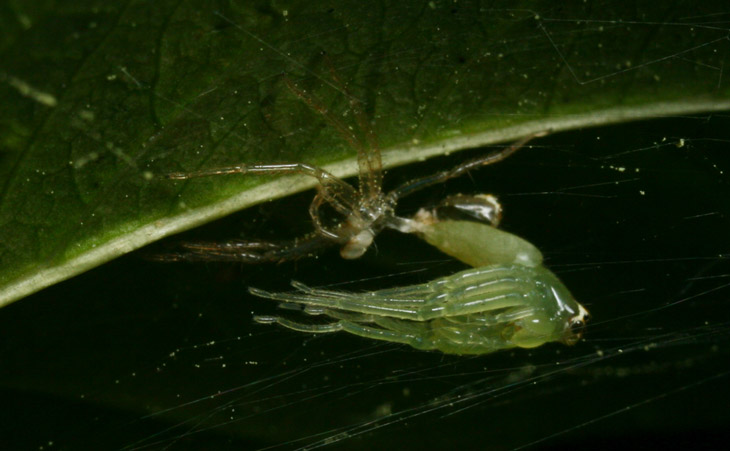
Aiming a flashlight up from underneath the leaves of the low gardenia bushes, I was presented with an odd silhouette against the backlit leaf, and was obligated to contort myself below for a detail shot, as much as I could get given the nearby leaves that would be disturbed by getting any closer. Still, I was able to photograph our old friend, the magnolia green jumping spider (Lyssomanes viridis) during a molt – the legs have recently been drawn free of the old exoskeleton while the tip of the abdomen is still attached; its head is to the right. My goal, of course, is to catch this as a sequence from the very beginning, with the chitin splitting along the back and the first emergence, something that has yet eluded me. But this might be very difficult, since any arthropod that feels it is imminent may be alarmed by my presence and avoid putting itself into such a vulnerable position. Every time that I thought it might be about to happen with other subjects and waited around patiently, nothing came of it.
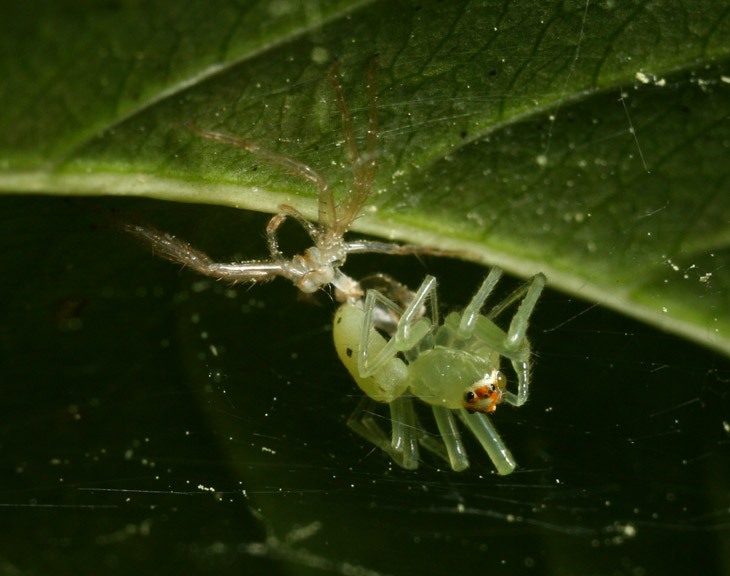
When I had returned a little later, the spider was in a slightly more natural position, but still not done with the process and obviously waiting for its chitin to harden. Between the two pics you might be able to make out the hints of the protective shelter of web strands that encloses it; magnolia greens are wandering ambush spiders, not using a web for capturing prey, but they still construct shelters for molting and egg clusters.
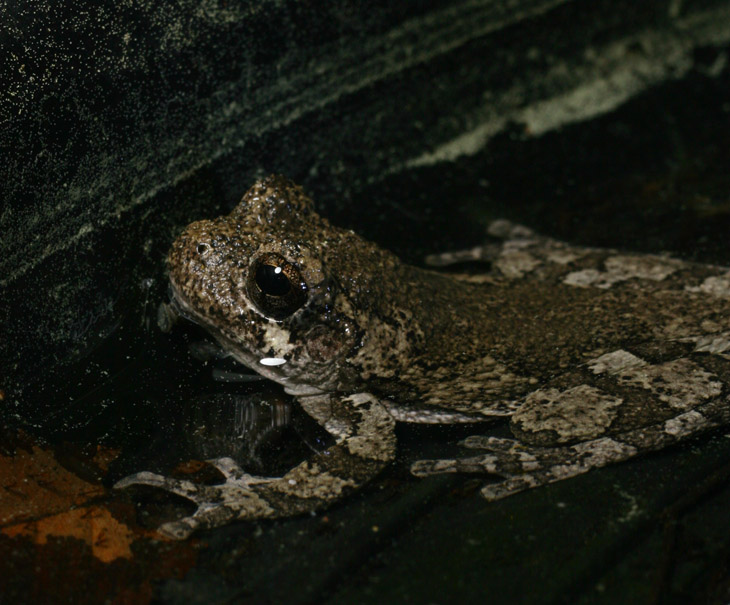
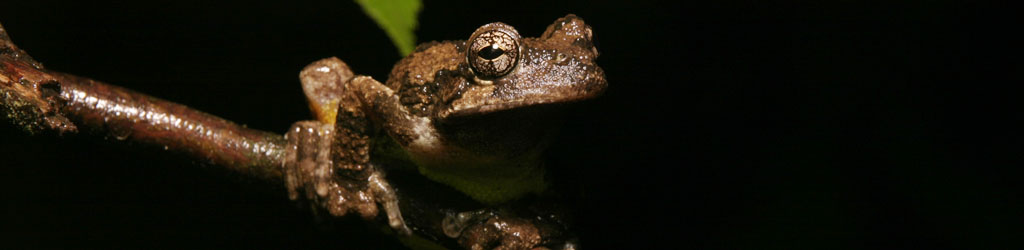
On another, much wetter evening less than two meters away, a different nocturnal rover was found, this one a juvenile Copes grey treefrog (Hyla chrysoscelis.) It occurred to me this year that the fence around the backyard might actually confuse the treefrogs, which leave their winter shelters down close to the ground and make their way further up trees come spring, but the fence doesn’t really go that high, and they find themselves having to locate another “tree” that actually climbs a proper distance.
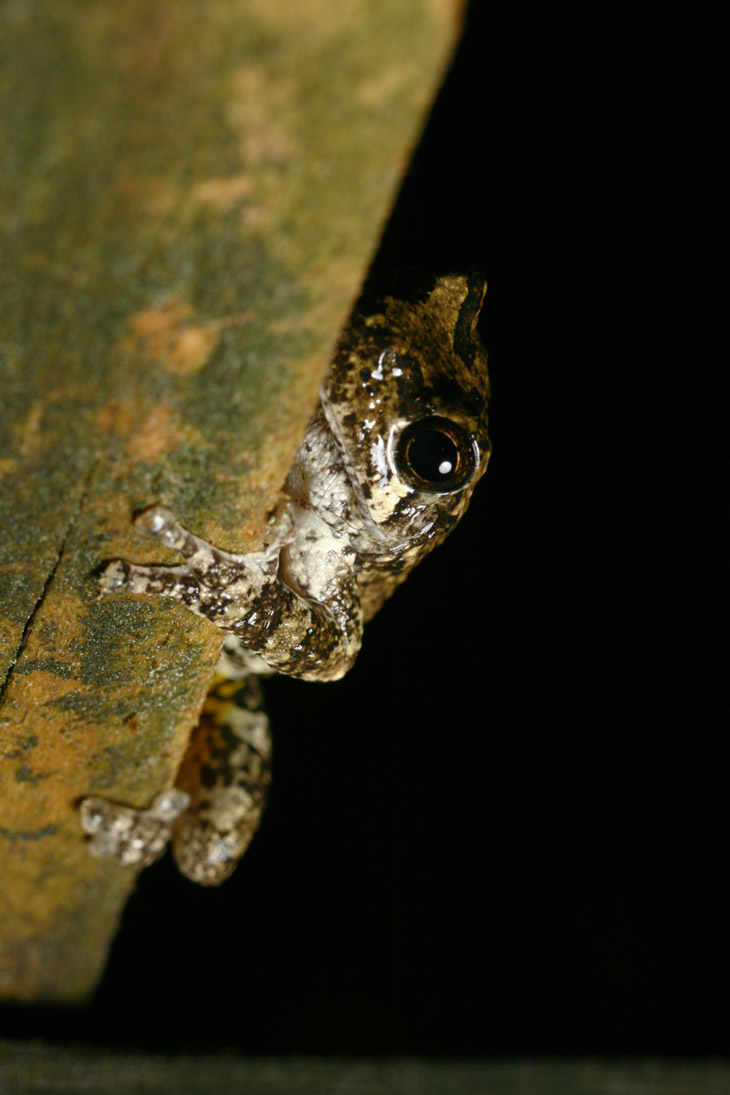
While I can often draw close to the treefrogs, night or day, to do detail shots, this one seemed very aware of my presence and was shifting to avoid me. But it also seemed to figure out the fence puzzle, since shortly after being spotted it jumped across to a nearby oak, where the camouflage coloration had the best effect. It took me a bit to spot it even when I knew it had to be close. Bear in mind that its body length is less than 3cm (he says defensively.)
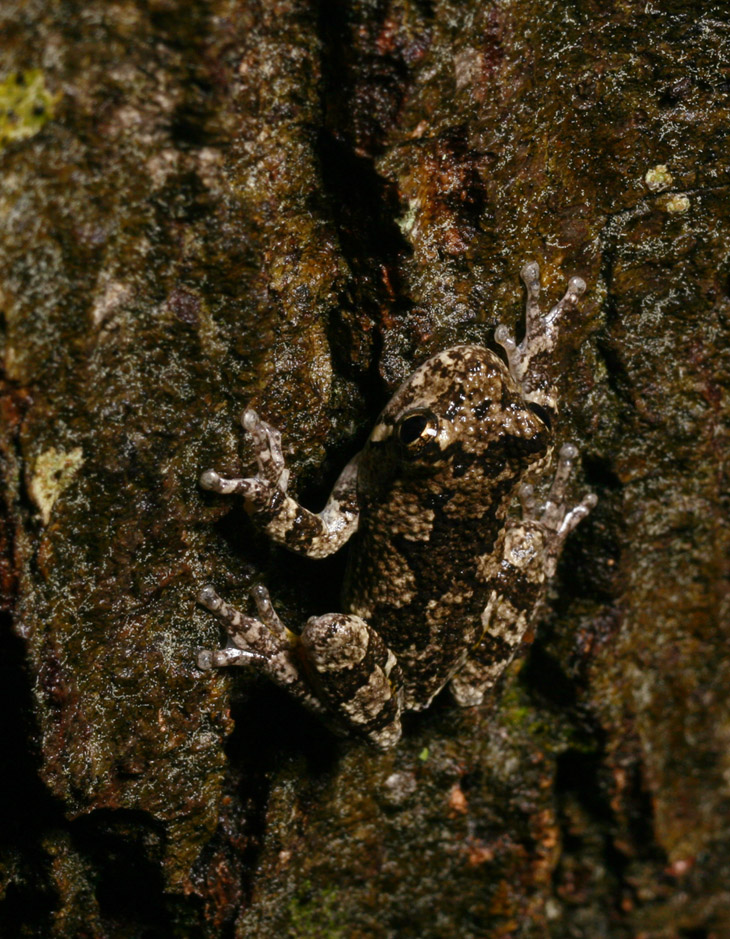
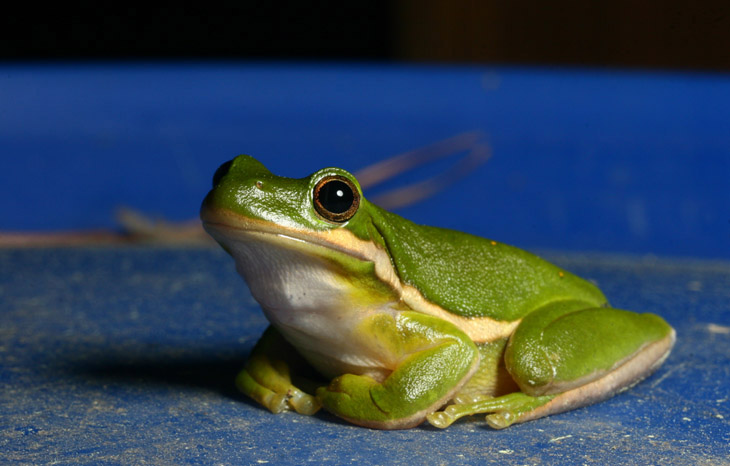
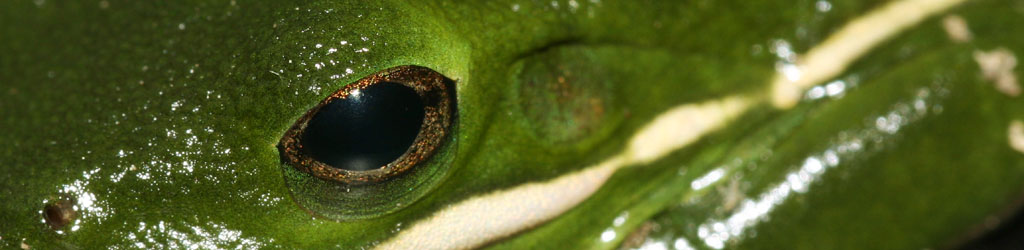
Later on, when I found a green treefrog (Hyla cinerea) on the crossbar of the fence, I moved it to the trunk of the nearby sycamore tree – after the brief portrait session, naturally. Priorities.

On the same wet night, a short distance away by the pond, I spotted something I don’t see too often, a salamander. Given the condition of my hands as soon as I’d managed to capture it, I have to say this is a slimy salamander (Plethodon glutinosus,) an appropriate name no matter which you use, though since there are apparently 13 subspecies another modifier is warranted; I’m just not going to tell you what it is, and let you figure it out on your own…
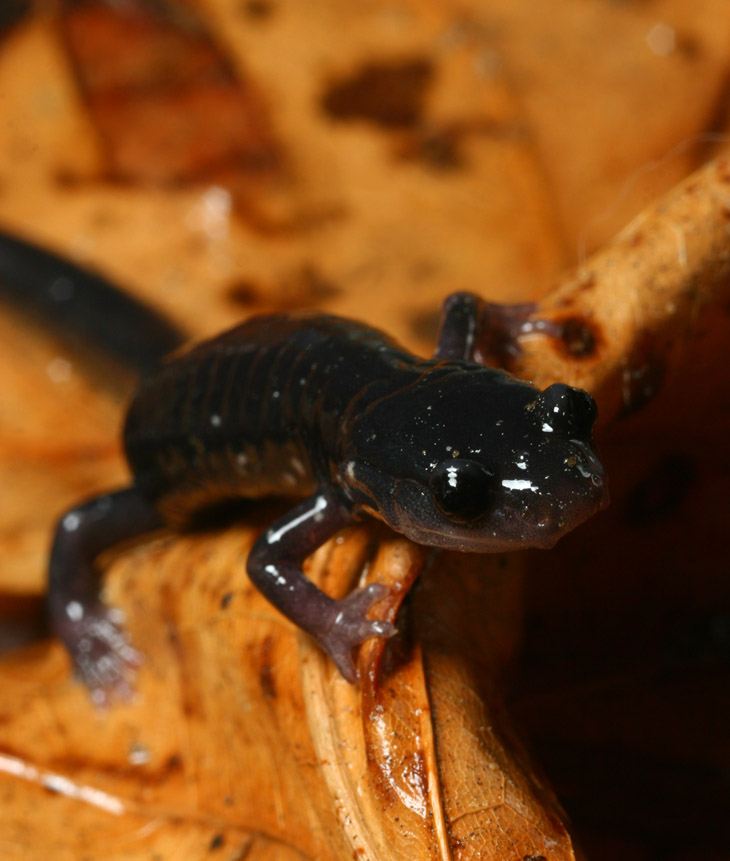
[If you do, let me know, because telling them apart is tricky.] So, here’s the challenge, one that I encounter frequently enough that I’m trying to improve my technique: subjects such as this are too spooky to photograph easily, and generally go for cover the moment they feel threatened – that usually means under immediately available leaves, which is why I captured it in the first place rather than photographing it where found like the frogs and spider. Any ‘studio’ shot needs to look plausible and realistic, while still preventing the subject from scampering off or simply hiding within the plausible realistic setting. For these shots, it meant a deep plastic bowl intended to place potted plants within for water retention, and a single layers of leaves carefully arranged to cover all of the plastic. The salamander still had to be coaxed out into the open from time to time, as well as towards the center of the bowl so the sides wouldn’t show in the frames. This one was somewhat more cooperative than some subjects that I’ve tackled in the same conditions, but the session still took a while.
What I didn’t alter was the lighting, which was a mistake. Such shiny dark subjects work best with a large diffuse light source, such as bounce flash from a white ceiling (or overcast skies,) while I was still using the latest macro rig, which wasn’t large enough to spread out over the subject as much as needed. The sharp bright spots really don’t work, and I’ll have to try a different lighting system, which I’ll illustrate if it works as intended.

Some of the shots had to be discarded because the bowl was showing, in one way or another, and technically it shows in these frames too, underneath the leaf at lower right, but it’s subtle enough that I’m not worried about it. The hair just above that point was unacceptable though, a hazard with home studios, especially if you have cats – the salamander was kind enough to hold still as I carefully snaked my hand up close and plucked away the hair. Considering that it was about the size of my finger (the salamander, not the hair you doofus,) this was notable patience indeed.
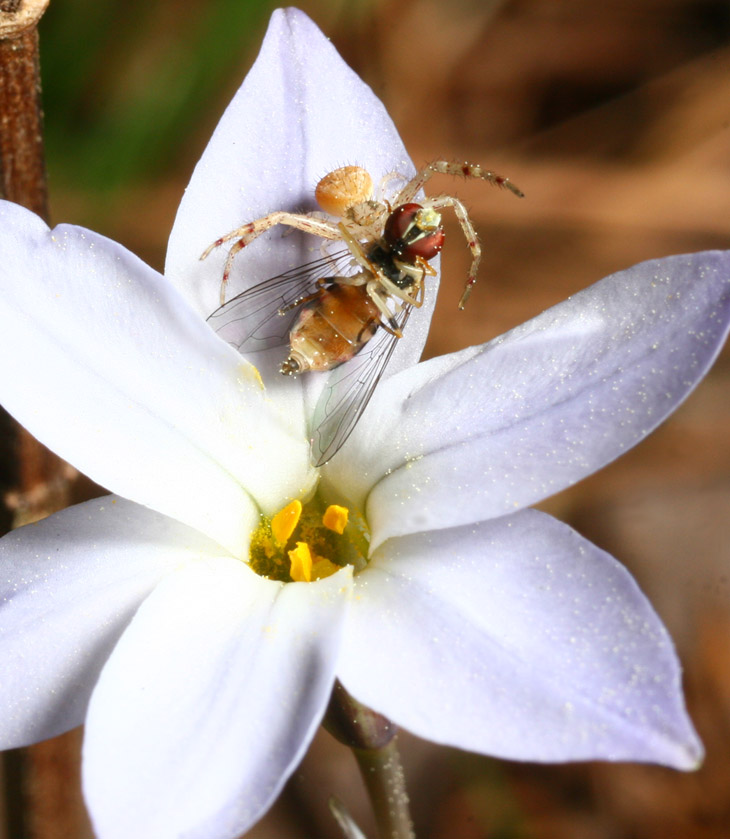
 A few nights earlier when the white azaleas had first come into bloom, I scouted around a few of the blossoms looking to see if any spiders could be found – because I know what I’m doing. One of the blooms did indeed sport a very small specimen, what is quite possibly a long-legged sac spider, often called yellow sac spider (genus Cheiracanthium.) Yellow sacs have a reputation as being a dangerous spider, as in, with a strong enough venom to make humans sick – not as big a reputation as black widows and brown recluses, but the folklore is there. And folklore is all that it might be; with all the work that’s been done in entomology and biology, there remains doubt that the bite has the effects attributed to it, especially the necrosis so often reported. Regardless, I’m not at all bothered by the presence of such minuscule spiders; it would take a very specific set of circumstances to be in a position to be bitten without actually crushing the spider in the first place, and given the large number of this genus within the US, we’d be much more certain of the properties if this could occur easily.
A few nights later, the same post-rain evening when I was pursing the frogs and salamander, I found an azalea bloom artfully dripping with water, and did a quick fartsy shot. I didn’t realize at the time that it was the same blossom, or at least, another that the spider had moved to.
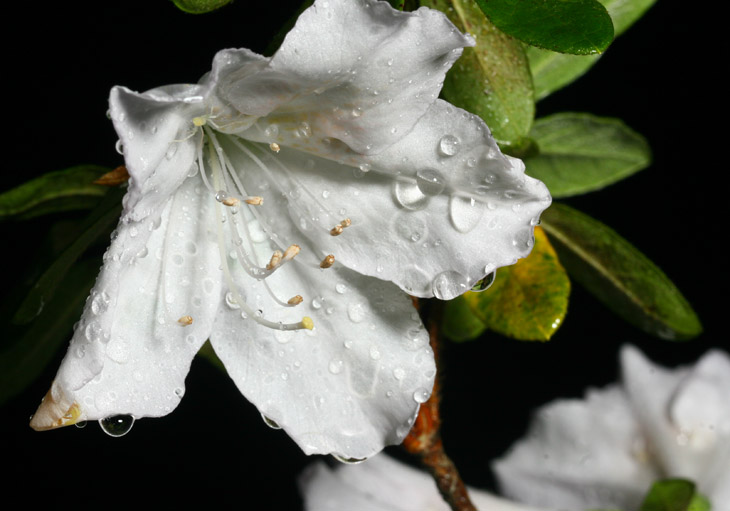
What do you mean, “Where’s the spider?” Right up there at the base of the stamens, upper left. Geeezzz…
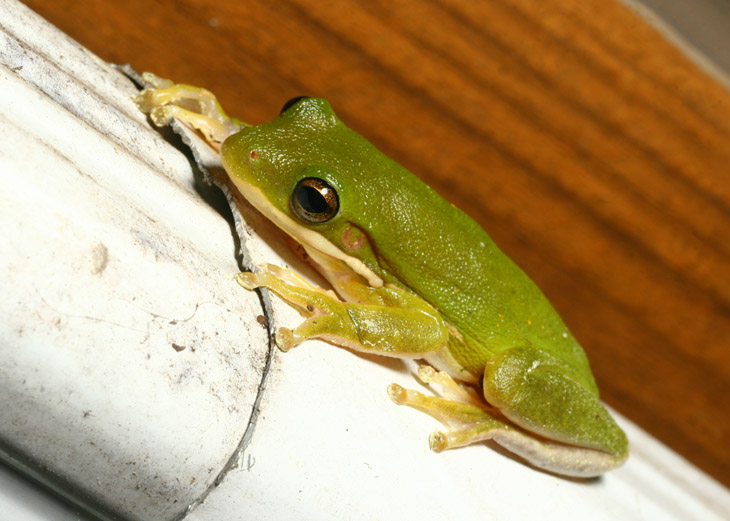
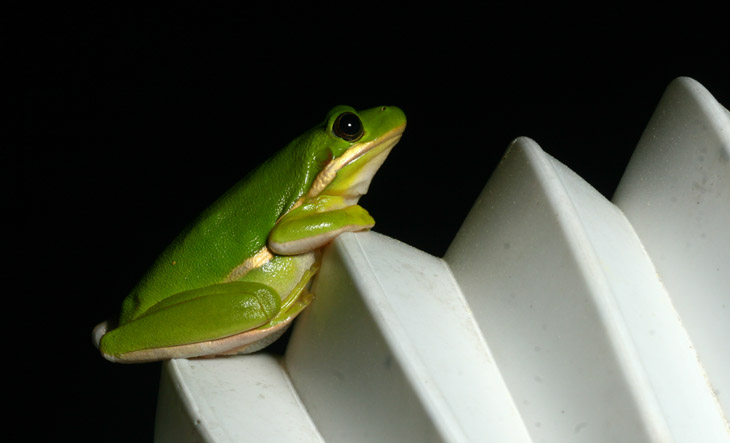
I close with another green treefrog, quite likely the same one seen in this post (the one in blue,) this time perched on the flexible downspout that connects the gutters to that same rainbarrel. The frog seems to have a noticeable gut on it, but it might simply be trying to maintain good contact with the uneven surface. Or maybe it had an especially lucrative night bugwise. I’m not judging.
Potentially Related Posts:




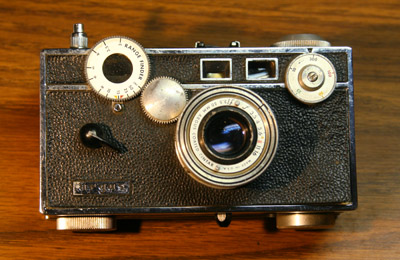 At one time, this was actually the case. Before SLRs, we had rangefinder cameras, and you didn’t focus through the lens that took the photo, but through a viewfinder lens above the film box. Seen here is an Argus C3, and to focus, you had to look through a peephole on the back of the camera that came out through those little rectangles near the top of the camera (also, through a round window that forms the center of the ‘rangefinder’ dial at upper left.) With the magic of a semi-silvered mirror and a couple of lenses, you could see a dual image of the subject that would resolve into a single image when the focus was proper. I would explain how this works but it’s not immediately germane to the topic. What is germane is that, since you were not focusing through the lens that captured the shot, it was possible to take photos while the lens cap was still on and never realize it – this was, in fact, a standing joke in the fifties and sixties. My first 35mm camera was a rangefinder (not this one,) and I only forgot the lens cap once…
 Now we come to the early eighties – 1981, to be precise. What was then the Soviet Union had launched a series of probes to orbit and eventually land on the surface of Venus – with varying success. Some crashed, some failed. The primary difficulty was, Venus is wickedly hot – like, 460°c (860°f) at the surface. Aluminum melts at those temperatures, and while you can construct a probe of better materials than aluminum, it still has to have delicate electronics within, and eventually the heat penetrates to the interior and shit stops working. And during the journey through space and the descent through the upper atmosphere, the cameras have to be protected – you can’t just have the lens poking out there.


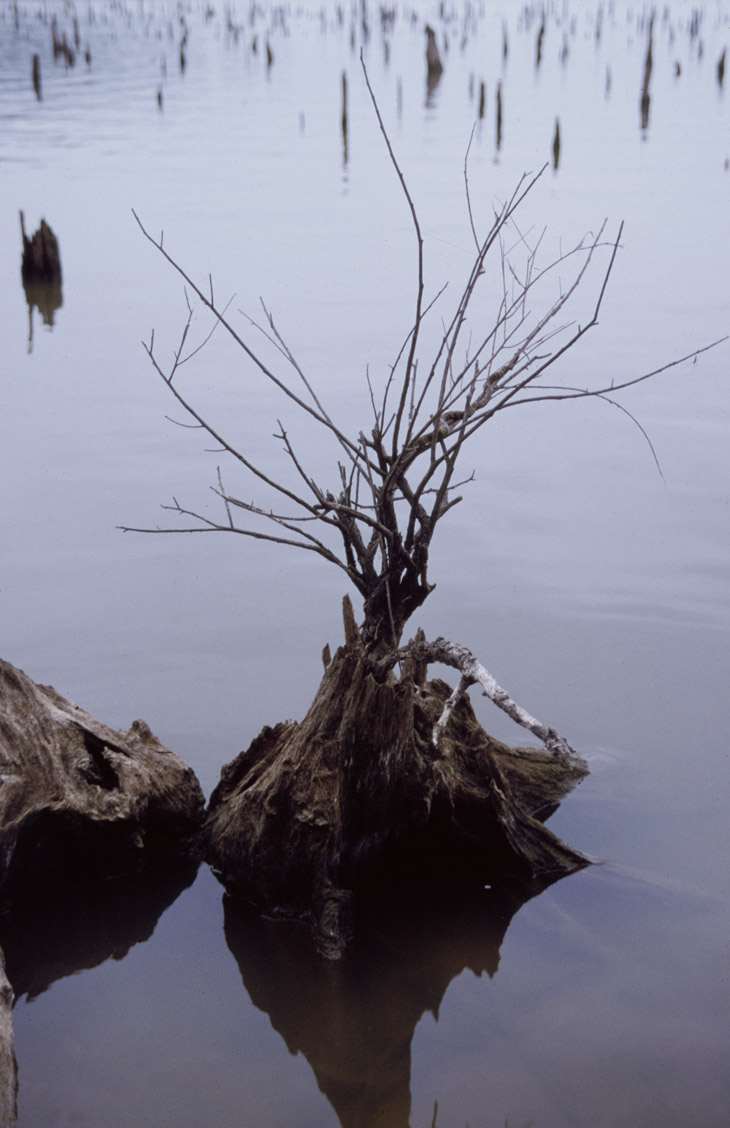
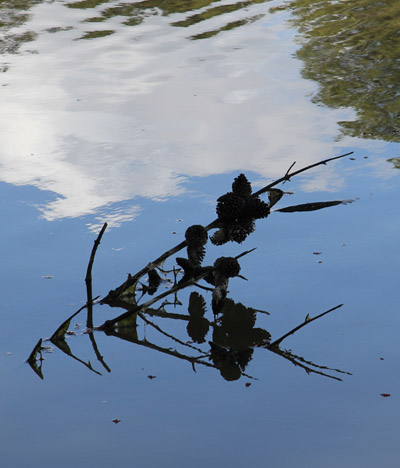 As I was preparing this post, I was trying to remember what I’d posted for February, and eventually came to the conclusion that I had never done a month-end abstract for February – don’t know how that one got past. Though I have some idea, because I shot almost nothing in February, and so as I was attempting to rectify my oversight, I was finding very little to use that was taken within the month. I found a couple that weren’t bad in my folders, but they were taken in either January or March, and I was determined, for no particular reason, to stay within February. So here we are, continuing a theme of sorts, since this is a pine branch replete with cones, partially submerged in the pond. It’s not a pretty picture, it’s just a little stark and confusing, but the sky color came out well.
 You should read that title in Bender’s voice, and if I have to explain that, well… let’s just say I’m disappointed in you.