





Oh, hey, welcome…

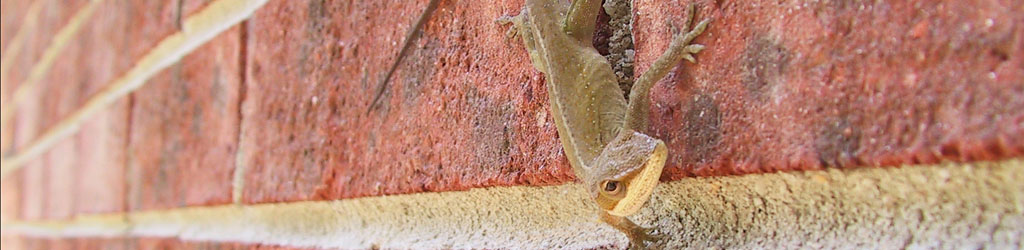
I’ve got a lot of photos to edit for a major post coming up, but I happened across this a few minutes ago and had to feature it. Remember when I said that I’d like to get some Carolina anoles (Anolis carolinensis) established in our yard here? Tsch!, of course you do – I apologize for insulting your recall, or insinuating that you haven’t read everything here. Anyway, this is what I found on a plant hanger, right alongside the front door just now.

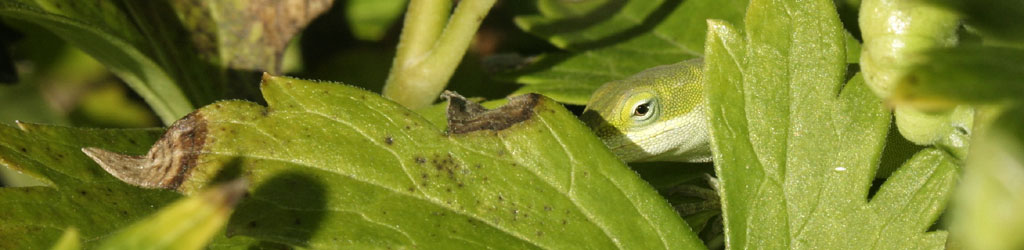
Carolina anole Anolis carolinensis on upright plant pole in front yard
It’s a good-sized specimen, and even has a complete (and very long) tail, which is semi-rare. Normally they’re bright green, but change color to suit their mood and occasionally to blend in better with their surroundings.

The thing is, we’ve done nothing to encourage them here, nor even introduced one (at least knowingly, though we’ve added a lot of plants.) I actually reduced the appeal of this particular spot, because it used to hold a hummingbird feeder than the hummers seem to be ignoring, so I removed it recently. Not that anoles like hummingbirds, or even sugar water, but they do like ants, and ants like sugar water. Yet there are more than enough ants in that precise location, so the encouragement is already present.

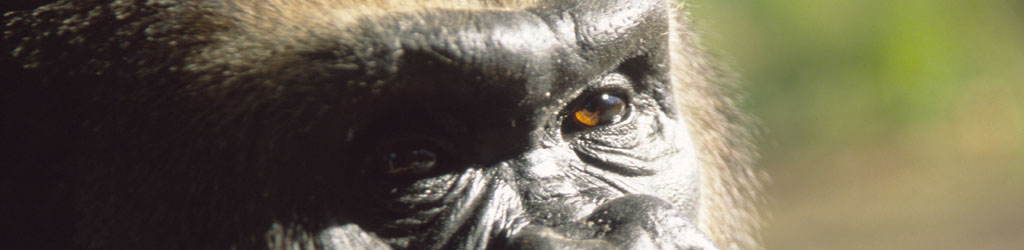
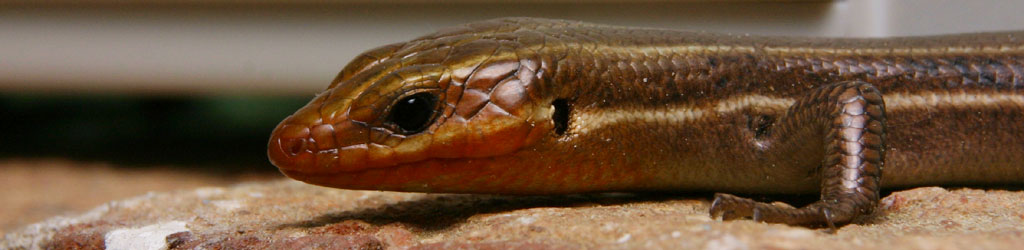
Unfortunately, so are a few five-lined skinks, right within the bricks of the front step to be exact, which means two meters from this spot. Is either species going to get territorial? Hard to say, but I’ll keep my eye out. For now, I made sure that I got several frames of my buddy here hanging out, for which it was remarkably patient even though it showed it was well aware of my presence. Here’s a variation, shot against a shadowed background so the exposure went a little high, but going in tight still showed some nice eye detail.

extreme closeup of Carolina anole Anolis carolinensis eye detail
For some idea of the size, the entire head here is maybe the length of the top joint of your little finger, though in overall length the anole might reach as long as my entire hand, half of which is tail alone.

So, now we’ll just have to see if we see more of it.

Verboten!

decrepit tree stump in Jordan Lake
See this stump? This is the Infrequently Posting Mr Bugg’s stump. It is forbidden for anyone else to photograph it. I took this photo just to show everyone else what it was that they could not photograph – you know, so accidents won’t happen, and no one can say they didn’t know it was this stump they were supposed to avoid. If any readers really need to know exactly where to avoid doing forbidden stump photos, they should contact me to learn the precise location.

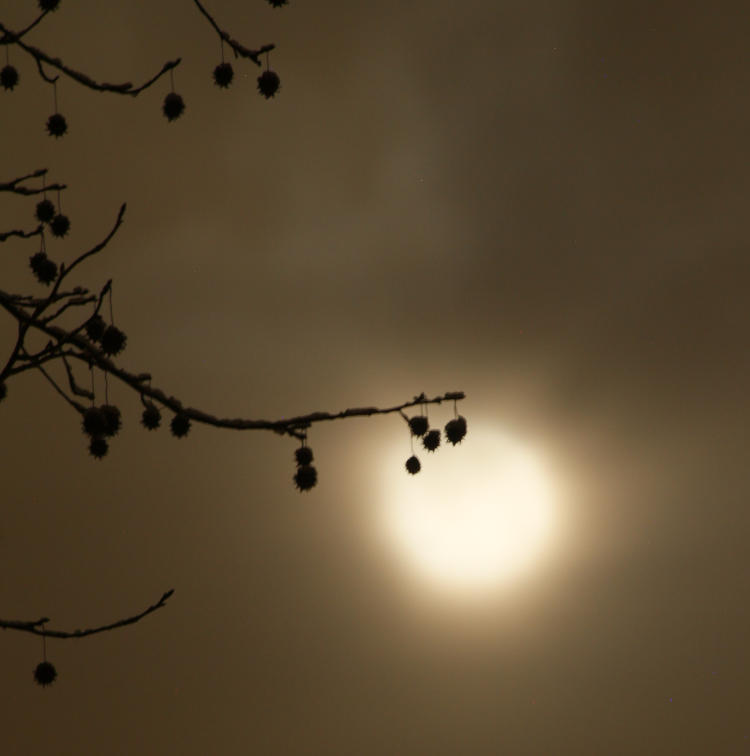
Mr Bugg, of course, has photos of it, and presumably, you will see them at some point, because he assured me that he will be doing better at posting than he has for the past two months, and he is a man of his word. Any of those photographs will be the certified, official images, even if they’re not as dramatic as this one, or fail to show the moon like this one (it’s up there just to the right off the top of the stump.) Mr Bugg has not so far claimed the moon, but perhaps you should move quickly.

While recording this to protect others, I couldn’t resist playing with perspective a bit and held the camera down at water level to frame it against the sky – so that anyone else doing the same would not fail to recognize it. This meant I was shooting blind, aiming the camera without using the viewfinder, so I had to fire off a few frames and check the results in the LCD afterward, something rather derisively known as “chimping” – it is very unprofessional-looking and really tells you nothing that you wouldn’t already have seen in the viewfinder, save for the effect of any camera flash, which wasn’t used for this. But since I hadn’t used the viewfinder, it told me how well I’d framed it.

All that said, the lack of scale and comparison might be misleading (not at all my intent,) so I’ll tell you that this stump stood no more than 70cm from the water’s surface – really, not an impressive stump to claim as one’s own, but who am I to judge?

On this date 24

distant thunderhead and storm seen beyond Lake Washington, Florida
This week, we’re back in Florida, in 2004, looking at a distant thunderhead dumping some heavy rains onto a region far to the west. Such displays were and are extremely common in Florida, as the prevailing winds carried moisture-laden air off of the Gulf of Mexico and across the state, where it encountered the overheated and rapidly rising air from the land mass, driving the moisture kilometers high, dropping its temperature and producing ice pellets. Eventually, the ice became too heavy for the rapid updrafts and fell again, melting on the way down to contact the earth as rain. Most times; serious updraft activity could keep the ice aloft for much longer, getting heavier with accumulation, and when it finally fell it wouldn’t have time to melt, and that’s hail. This method of exchanging heat with the upper atmosphere is also why the ambient air temperature drops with thunderstorms – except, not too often in Florida, because these cells tend to be sporadic and singular, as seen here.

You learn quickly to pay attention to rapidly growing, tall white fluffy clouds out to the west, because they’re often heading your way, and they can dump a lot of rain rapidly, what I call the Afternoon Monsoons. I remember one snorkeling trip on a brilliantly sunny day, but seeing that cotton off in the middle distance. I was on a bicycle, so I ended my snorkeling and headed home. Only a little ways back, the sky had become very dark, and at the halfway mark I could actually see the rain advancing on me down the road in a wall. Barely got the camera into the ziplock bag (that I carried expressly for that purpose) in time.

By the way, I’ve had this image sitting in the blog folder for a while, just to talk about Florida thunderstorms, and a few weeks back realized it would fit with the On This Date posts, and so saved it for today. There’s another too, but you won’t see that until December ;-).

Now we jump forward to 2010.

unidentified brilliant orange mushrooms sprouting from leaf litter
There are a large number of images from this date, all of mushrooms and fungi, and I seem to recall having a particularly wet week not long before. This soon became a long, tortuously-hot spell where the prime moisture for the local plants was my own sweat. Don’t ask me to identify these; I don’t have a handy guide and, to be honest, really don’t care. Yes, I’m dissing the mycologically-inclined readers out there.

unidentified pupa
In 2012, I had found this unidentified pupa, and took a lot of photos of it, from all angles, trying to determine what it might be – but I neglected a measurement (partially because, I hadn’t yet created the handy little paper rulers that I now carry routinely.) There is a cluster of four eyes like caterpillars have, but the legs and antennae seem to be developing well, so I’m guessing it’s a butterfly or moth on the way, though I suppose those details could be applicable to a lot of different species of insect, so, hmm. I can say that it was nowhere near the size of the hornworms in that linked post – more like 15mm, give or take. I would have expected this stage to be safely encapsulated in a cocoon or something, but no longer recall where or how I found it. So much for trivia.

old Cone Fabrics smokestack in Saxapahaw, NC
This was from 2014 (still is, really,) and I include it mostly as a curiosity – I remember the trip The Girlfriend and I took, exploring the quaintly-named town of Saxapahaw and the Haw River a bit. This was built in the 1940s and represents a fairly common practice then, of using different colored bricks to spell out the company name, a no-maintenance billboard – I remember seeing such things all around New Jersey as I was growing up, but the practice faded. I can’t imagine this today, since companies cannot seem to keep the same name for a whole seven years and redoing all the brickwork would probably get a bit expensive.

(This is in the process of being restored, by the way.)

carolina anole Anolis carolinensis perched on identifying plaque in NC Botanical garden
Our last is from 2016, and I liked the image but never found a use for it then (not that I have now) – just didn’t fit into any posts at that time. This is a Carolina anole (Anolis carolinensis) pausing on an identifying plaque in the NC Botanical Garden, and from the girth I’m suspecting a pregnant female. Another curiosity: while they were not in bloom at any point that I ever recall in the garden, the plaque is identifying balloon flowers (Platycodon grandiflorus,) which the following year we began hosting routinely in our porchside planters, and which I thought I had a photo of somewhere on the blog and just spent way too damn long trying to find. Exciting, I know. It’ll get better someday – it’s been a long week and it’s not even half over.

Your patriotic duty

I just realized, on typing that title rather awkwardly, that I don’t use the word “patriotic” much at all. Which is good, because I find patriotism on a par with tribalism, and that’s just arbitrary “us-vs-them”ism, which we don’t need. Personal rants aside, Saturday, June 13th is National Get Outdoors Day, and I know, you’re a bit skeptical considering some past holidays here, but this is for true; I’d provide links, but nearly everything that I found that was the most useful was also for, like, years past.

green treefrog Hyla cinerea on hosta leaf in late afternoon sunlight
But seriously, why would you need any guidance for this? Get outside, go explore, run around in the rain, play stickball against the stoop (or something) – go nuts. You want an assignment? Fine: sit in just one spot for ten minutes, without moving, and count how many different species you see in that time frame. Birds, bugs, neighborhood dogs, you name it. Even if you don’t know the species, just tally it. You might be surprised at how many there really are in a small area.

mist on hosta flower in afternoon sunlight
Of course, if you want to wield a camera at that time, I wouldn’t dream of stopping you. Or a sketchpad, paints, audio recorder, writing pad, whatever. Commune, I think is the word. Don’t let the country down.

Naturally, both images here are of the same (potted, for now) plant, taken at the same time from different angles. I don’t think the treefrog was counting on the late afternoon sunlight from finding a break in the surrounding trees and shining right into its eyes…

Bug fix

Normally, when you see those words, it means some techie details about software issues that are being corrected, but here, it’s nowhere near that exciting. Instead, we’re going to talk about breaking news on the arthropod front – cue triumphant newsreel music.

unidentified hoverfly being stalked
Just after sunrise the other morning, I was examining several of the plants in the yard and noticed that a trio of hoverflies seemed rather infatuated with one of the delphiniums, two of them flitting around while one usually perched on one of the leaves unless they got too close. What this meant, I don’t know – I try not to be too obtrusive with the lives of flies – but it attracted the attention of someone else, who actually appears in the photo above if you look close. Not fully prepared for a video session but unwilling to go get the proper equipment, I decided to wing it and simply shoot handheld.

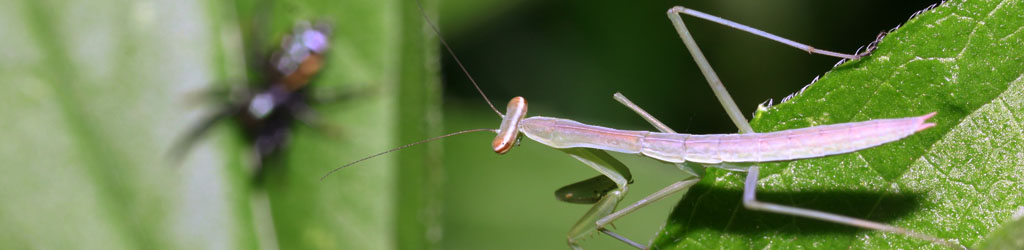
juvenile Chinese mantis Tenodera sinensis stalking unidentified hoverfly on delphinium plant
A juvenile Chinese mantis (Tenodera sinensis) had also noticed the presence of the hoverfly, and began stalking it with glacial slowness. I stayed put and watched as it drew closer, endeavoring not to spook anybody and hoping to snag video of a capture. It didn’t quite pan out, so numerous video clips of the stalking and several stiff joints from the awkward position never led anywhere, so I consoled myself with still photos instead.

juvenile Chinese mantis Tenodera sinensis on delphinium plant
It was actually more than a little disappointing, because this was behavior that I’d really love to capture on video, and it tends to be very sporadic and hard to even witness, much less get decent clips of, and here it was promising to happen right smack in front of me without ever coming to fruition. If and when I’m ever successful, maybe a couple of these recent clips will be used to help illustrate the process, but I can’t see the point in doing a bunch of editing for no visible payoff in the video right now.

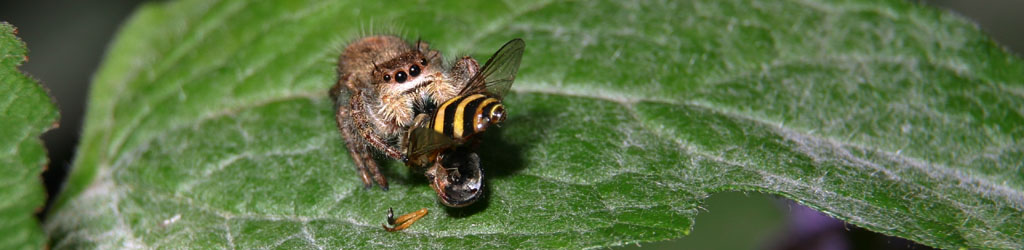
On the same plant, a jumping spider was appearing and disappearing as it hunted for available prey. My first good view, however, had the macro flash blocked by the very leaf the spider was perched upon.

jumping spider Hentzia mitrata hidden by overhanging leaf
Even though I’ve only featured them here once or twice before (and thus had to have it handy,) I remember the Latin name easily: Hentzia mitrata, with no apparent common name. They’re distinctively colored, and not uncommon around here. Eventually, my subject ventured further out where the flash could have the proper effect.

jumping spider Hentzia mitrata on delphinium plant
I suspect it’s simply the white coloration, though the large eyes might have something to do with it, but I consider these guys almost cute in a fuzzy-terrier sort of way. Would it be the same if they were black, or maroon? Is it just my own weirdness? The answers to these questions… will probably not come anytime soon.

Meanwhile, examining the flowers on the oak-leaf hydrangea (Hydrangea quercifolia) confirmed my suspicion that it’s a favorite haunt of crab spiders.

unidentified crab spider on oak-leaf hydrangea Hydrangea quercifolia blossom
I don’t know the species, but I see them semi-regularly on the hydrangeas – though as yet, I have neither seen them with prey or any actual insects pollinating the flowers to begin with, so maybe they’re not too bright. Move to the butterfly bushes, guys.

(That’s what we regular writers call a segue…)

We have two new butterfly bushes (Buddleia davidii) in the yard, which I’ve always found to be very attractive to arthropods of all kinds, and so far they’re proving this even in the brief time that they’ve been here. The paler one (though the flowers are coming in darker now that it’s been transplanted) is shown here, playing host to an unidentified species of bumble bee.

unidentified bumble bee feeding from butterfly bush Buddleia davidii blossom
hidden subject on butterfly bush Buddleia davidiiThere’s something that I want to point out about that image above, and it’s the forelegs. Because that’s them up alongside the eyes, pulled close to the head and clasping the top of the flower to hold it still while the bee plunges its proboscis within – the uppermost joints sit almost completely hidden behind the bee’s head. Like all arthropods, the legs all originate from the same region underneath the thorax, right next to each other, so the foreleg position here just looks bizarre.

Meanwhile on the ‘black knight’ variety nearby, an occupant that I knew was there showed its prowess at remaining hidden, and I purposefully used a smaller image to illustrate what it looked like from a typical viewing distance, instead of the invaded-personal-space closeups that I normally display, and to which we will return in a moment.

Found it yet? It’s pretty small, but the legs are the clue. Or I can simply say that I’m now paranoid about cutting off the clusters of dead blossoms, part of the routine maintenance of butterfly bushes. If that’s not enough, the next photo will help.

juvenile Chinese mantis Tenodera sinensis on stem of butterfly bush Buddleia davidii blossoms
It’s pretty clear that the bumble bees, and most of the other visitors to the bush that I’ve seen, have nothing to fear from this mantis. At least not yet. Give it time.

I’ve also seen some minuscule, bright green crab spiders, small enough to actually take shelter within one of the blossoms, but not while I had a camera in hand (hard as that may be to imagine.) I’ll show one off someday.

Nearby on one of several Japanese maples that we now own, another mantis snacked on… something.

juvenile Chinese mantis Tenodera sinensis cosuming unidentified insect
This mantis was slightly larger than the one on the butterfly bush, but still fell around 20-25mm in length, so the meal is something quite small. It doesn’t look like it in this pic, but they camouflage wonderfully within the maples – the ones that have green leaves, at least.

That’s all the front yard. In the back yard, I happened across a little farm going on.

unidentified red ants meeting atop curled leaves housing aphid colony
Ants are notoriously hard to differentiate and identify, especially if you’ve left them be and don’t have one to manipulate and examine, so I’m just saying these are large red ants, common and harmless to people (I say this as someone who routinely attracts the attention of fire ants when in the vicinity, little fuckers.) Their presence on the curled up leaves of some unidentified shrub drew my attention within the leaves, which are fairly visible here but I went in for better detail.

aphid colony within curled up leaves of unidentified shrub tree
That’s a cluster of aphids in there, most likely causing the leaves to curl up to begin with, but this is a small tree that I’m going to remove anyway so I don’t mind. And neither do the ants, because they ‘milk’ the aphids for their ‘nectar,’ to cross metaphors confusingly.

Here’s the scenario. Aphids suck plant saps and cycle it through pretty quickly, only getting a little bit of nutrients from their simple digestive systems, and thus excreting slightly-weakened sap. The ants know that the aphids will excrete in a defensive manner when irritated, which the ants do by tapping the aphids with their antennae, and then the ants collect the sap from the aphids, in effect farming the aphid colonies.

unidentified red ant milking aphid colony within dying leaf
I was having enough trouble, both trying to get the flash to illuminate the sheltered aphids, and just nailing focus on these leaves on the tips of thin branches swaying easily in the slightest breeze, so getting video of the farming wasn’t going to happen without a lot of prep work, tripod and light stand and stabilizing arm for the branch and so on. Maybe later.

And finally, we have a story. Simply checking out the nearby pond the other night by headlamp, I was casually examining the reflections I was getting from the water surfaces and within the grassy areas, which always turn out to be spiders, just different varieties (their eyes reflect light amazingly well, but only if the source light is held close to your own eyes.) I happened to find a medium-sized wolf spider (genus Lycosidae) sporting her young on her back, something that I haven’t seen for a few years now – and my camera was back at the house. Noting her position and that she wasn’t moving much, I went back and fetched it, knowing it would be a few minutes to do so and the chances of her being in the same vicinity was minimal. Sure enough, once I returned I couldn’t find her.

I amused myself with chasing the frogs again, and trying yet again to see if I could spot the cricket frogs that I was hearing, and on giving up for the night I had to pass through the same spot and gave it one last try. Which paid off nicely.

female wolf spider Lycosidae carrying offspring on her back
Body length for the mama was perhaps 15-18mm – like I said, medium-sized – so your guess as to how small the bebbies are. But I had the extension tube in hand, at least, and could go in a bit closer, though I started blocking the headlamp and had to remove it to lay it on the ground for a focusing light.

closeup of female wolf spider Lycosidae with offspring on her abdomen
I realize I’m in a rut again, what with the last On This Date post immediately preceding this one, but hey, that was years ago – this is current. Plus you got a lot of other subjects too, so hush.

On this date 23

time exposure of driving down city street
Back from 2005, we have an experimental image that showed proof of concept (which wasn’t really necessary – I knew the concept was solid,) but needed work on the execution. This is a mere one-second exposure while driving down a city street, intentionally streaking the various lights. One second seems to be a pretty good amount of time for this – I wouldn’t go longer than two – but from the wiggly lines it’s clear that either a smoother road (good luck with that in NC) or a stabilizing float mount is required to get a decent picture. And of course, mounting the camera with a clearer view, or at least using a more exotic car than an old Mazda pickup. I’d stood the tripod in the center of the cab within easy reach, but I recall that this is easier to imagine than it is to set up; cars aren’t typically made with lots of places for the tripod feet to go. Another way that photographers are discriminated against…

In the back of my mind, I was always going to retry this, but here it’s been fifteen years now…

Then, for reasons best left unvoiced, I went for five years without once taking a (keepable) photo on June 3rd, so we pick up again in 2010.

female wolf spider genus Lycosidae with offpsring on back
On my doorstep, a wolf spider of undetermined species, but genus Lycosidae anyway, was parading around with her voluminous offspring on her back, as they do. It might be easy to believe that this is an especially high-magnification shot, but no – wolf spiders can get pretty damn big. I know the size of the beetle she’s chowing on so she’s an estimated 25-30mm in body length. The deep shadows of this photo finally convinced me to finish a project I’d been intending to tackle, which was a dedicated macro softbox for the flash unit. It actually worked pretty well (note that the photo there was posted just a few weeks later,) but I also recognized the value of indirect, off-axis lighting and have been refining the designs ever since.

[It’s funny – while this post topic was just intended to provide regular content even if the week was slow, the posts have become a lot more about trivia, conditions, and progress, and they’re often served by showing earlier entries for comparison.]

The image above came from the Arthropods 1 folder, by the way. Our next entry from 2013 came from the Arthropods 3 folder. I’ve said before but you probably weren’t paying attention, I split the stock images up to make them easier to go through and get to about 4000 images before I jump to another folder, so I was fairly busy with the bugs those years. I’m about halfway through Arthropods 6 right now…

juvenile green lynx spider Peucetia viridans with morning dew attached
This green lynx spider (Peucetia viridans) wasn’t very big at all, but I can’t remember exactly how big, so you’ll just have to guess by the droplets of dew adhering to its body, and the translucence of the exoskeleton; I’m pretty sure it’s on budding hydrangea leaves, so I’m guessing within the 15mm range. If you look closely at the drop on the head (right behind that Lurch hairpiece that cradles the eyes,) you can tell that I used the second softbox design for this, because the highlighted reflections there are rectangular. And then, position is still a factor; notice how deep the shadows get on the left side of the photo? That tells us the flash was positioned on the right. Eventually, I found a way to move the flash rig easily from one side to the other, depending on my subject. I don’t do it as often as I should, but it’s a lot easier now than completely dismantling the flash bracket to reverse it.

And now we have 2015.

cherry tomato blossoms and emerging tomatoes
This was from the second attempt to create a garden at the new place, which we eventually gave up on because of both the soil not being optimal, and the only place that gets enough light is the front yard. But as we were learning this lesson, we have this cherry tomato plant that was transitioning between flowers and fruit, showing the various stages in one photo. In comparison, we have some (potted) tomato plants right now that are just starting to bud out, but we’re admittedly running late in planting this year. The old place was pretty ratty overall, but damn did it have good soil – stuff was effortless to grow there. Ah well.

Just because, part 36

Given the topic of the previous post, I feel obligated to get a start on this month with an image that embodies incredible depth, poignancy, and insight.

Don’t believe me? Check out the nails on girlfriend here.

basking yellow-bellied slider Trachemys scripta scripta showing inordinately long toenails on foreleg
You just know she’s going to start complaining loudly that the price that came up at the register was way higher than it said on the shelf…

Blog trivia is the worst kind

So I noticed something the other day as I was checking my records. A year ago, I set a significant personal record (the ‘who-cares?’ kind of record) in May with the number of photos uploaded during the month, that number being 173; this was due to the trip we took to South Carolina, and I can’t even give the town usefully because we were between two and not even the residents seemed to know whether it counted more as Pawley’s Island or Murrell’s Inlet. Regardless, that was a notable jump, since the previous record had been 103 images in a single month. This also helped set the stage for the year being a record-holder as well.

May of this year is not even in contention – I uploaded 89 images for the month. However… the total for this year, so far, is well in advance of the same time last year, even with those 173 images from one month alone: 312 uploads by the end of May last year, versus 355 this year. The previous months held their own quite well, which says a lot considering those are the slow months of the year.

Will this trend continue? Will 2020 be a banner year for photos uploaded? Does anyone actually give a flying fuck? We’ll find out… well, it’ll be a few months yet. Except for maybe that last question.

Yeah, whatever

You might have known, had you bothered to look at your calendar or the side of your frozen pizza, that today is another holiday, being Lack of Ambition Day, which pretty much explains why I didn’t tell you sooner. I’d go into the history of it, and the ways that it’s celebrated across the globe, but that would require way more research than I feel like putting into it right now. If you want to spit in the face of its founders and look it up yourself, feel free – I’m not that disrespectful, myself.

Hopefully the batteries in your remote are in good shape, because you aren’t likely to go changing them now. The clothes can stay in the dryer overnight. The flat tire is not gonna get any flatter, so forget about it. If you have any adult undergarments handy, have at it – they’re not as bad as they seem.

That’s enough typing.

There’s something about May

What was it now? Oh, yeah: it’s over. And in recognition of this, we have the month-end abstract.

six-spotted fishing spider Dolomedes triton showing surface tension from middle of pond
Up early one morning exploring Our Hosts’ pond during our trip earlier this month, I took advantage of the morning twilight showing the water bowing under the trivial weight of the spider. And that’s all I’m gonna say because I apparently can’t type seven words in a row without a typo…

1 146 147 148 149 150 327